13th Floor, Key International Unveil Nobu-Branded 74-Story Waterfront Tower at 619 Brickell Ave
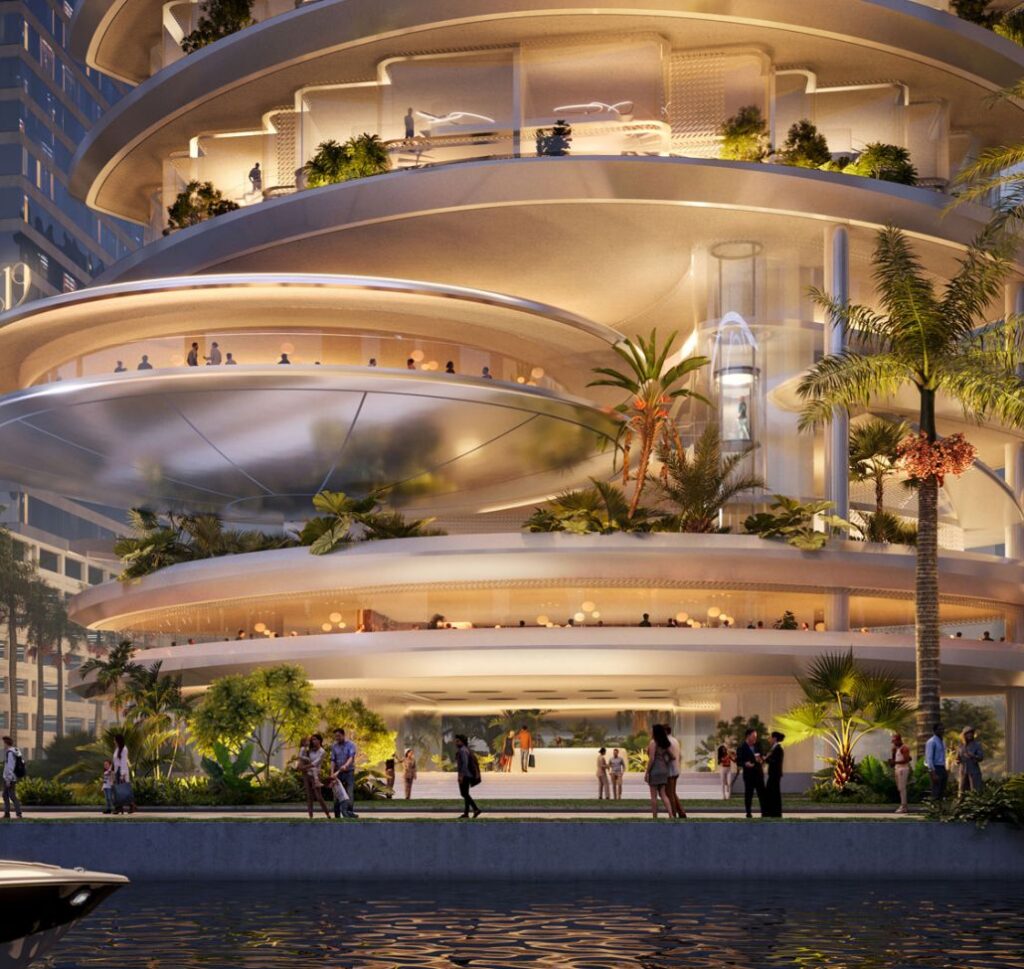
Nobu Hospitality is expanding its South Florida presence with its first branded residential project in Miami, a 74-story tower planned along Biscayne Bay in the city’s Brickell district. Developed in partnership with Miami-based firms 13th Floor Investments and Key International, 619 Brickell will bring 300 luxury condos, a full collection of high-end amenities, and a new Nobu restaurant to the heart of Miami’s core. Designed by Foster + Partners in collaboration with Sieger-Suarez Architects, the development will rise beside the historic First Presbyterian Church of Miami at 609-619 Brickell Avenue, one of the few remaining religious buildings on Brickell Avenue. In 2024, city officials removed the historic designation from the east side of the property, allowing for the future demolition of the building’s addition and surface parking lot. Plans call for 300 residences, which, according to Miami Residential, will range from one- to four-bedroom layouts. Each unit is designed by Foster + Partners to capture panoramic views of Biscayne Bay, with interiors reflecting Nobu Hospitality’s signature Japanese aesthetic. According to Nobu Hospitality, residents will also have access to 90,000 SF of private amenities, including a full-scale spa and wellness retreat, a state-of-the-art fitness center, and a poolside cafe. However, it’s important to note that unit sizes or configurations aren’t set in stone and may change at any time during the planning process. At the lower levels, Miami’s second Nobu restaurant will open within the tower, joining the brand’s existing Nobu Hotel and restaurant in Miami Beach. The new Brickell restaurant will feature a unique circular design and expansive waterfront views, envisioned as one of Miami’s most futuristic and modern dining locations. In a joint statement, Arnaud Karsenti, Managing Principal of 13th Floor Investments, and Inigo Ardid, Co-President of Key International, said: “We are honored to partner with Nobu Hospitality and Foster + Partners on this extraordinary project in the heart of Brickell. 619 Brickell represents the perfect convergence of design, service, and lifestyle — a residential experience elevated by Nobu’s world-class hospitality and commitment to exceptional service. Together, we are creating a landmark destination that reflects Miami’s sophistication and energy, and we look forward to unveiling it in the near future.” The 74-story tower will become one of the tallest buildings in Brickell. While full-scale renderings and official height counts have not been released, the building is expected to reach ‘supertall’ levels, internationally considered as structures rising above 300M. Only a handful of buildings in Brickell are planned to reach this scale, and none of them have broken ground yet.
Alta Development Advances Plans for 16-Story SOMI Walk Student Housing Near University of Miami

A new student housing tower is on the horizon for South Miami, as Alta Development prepares to move forward with SOMI Walk, a 16-story project planned near the University of Miami. The Miami-based developer has spent the past year refining the proposal through multiple planning stages and design iterations, with the latest version now submitted to the City of South Miami’s Design Review Board for review. Located at 5959 SW 71st Street and 7090 SW 59th Place, the 1.01-acre site currently houses a mix of hotel and office space that will be replaced by student housing to meet surging demand in the area. Designed by FormGroup Architects, SOMI Walk would mark one of the tallest additions to South Miami’s core, following the completion of Vox Miami nearby. According to plans submitted to the city, the development will include 173 residential units, with the potential for possible EB-5 investment funding. Units will be offered in a range of configurations, from one-, two-, three-, four- and five-bedroom layouts. Planned amenities include a rooftop deck, pools, a fitness center, wellness lounge, business center, terrace space, and more. The ground floor will include a spacious lobby, a bike shop, and a dog salon, along with a 3,168 SF public plaza for the public. Parking will occupy the first three levels, providing 173 spaces that include standard, accessible, and double-stacked lift options for residents. According to elevations prepared by FormGroup Architects, the 16-story tower will rise 192 FT at its tallest point. The facade incorporates stucco, brick, aluminum railings, and other modern finishes. Achieving this height, however, required navigating South Miami’s strict zoning regulations, which initially limited development. Because the site’s existing zoning only permits 8 stories, the developer had to make several adjustments to qualify for an additional height bonus, bringing the total to 16 floors. To achieve this, the project must contribute to open space, affordable and workforce housing, and sustainability initiatives by developing LEED Gold or LEED Platinum-certified buildings. If those standards are not met, the developer is required to make a payment in lieu of the city. Additional bonus floor area is also granted under these regulations. Prior to submitting plans to the Design Review Board, Alta Development secured approval on March 31st, 2025, for key land use and zoning changes affecting the SOMI Walk property. The updates changed the site on the Future Land Use Map (FLUM) to Transit-Supportive Development (TSD) and assigned it a TSDD zoning district, paving the way for the project’s current 16-story proposal. According to Alta Development, the team behind the development is planning to begin demolition soon, with groundbreaking in January. Once completed, it will be Alta Developments first project in South Miami.
The Avery Inches Towards Groundbreaking at 2517 West Kennedy Boulevard, Tampa
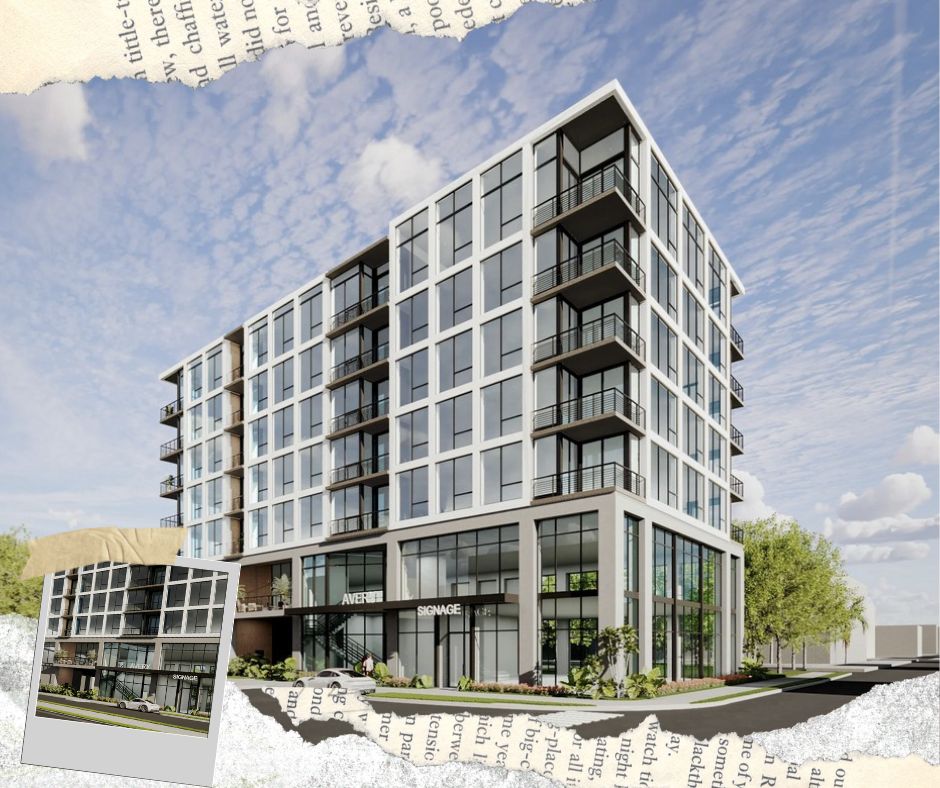
The Avery, a six-story multifamily development planned along Tampa’s West Kennedy Boulevard, is edging closer to a groundbreaking as the developer has recently filed for multiple construction permits. Located at 2517 West Kennedy Boulevard, the project will introduce new residential density to a corridor that has seen growing development interest in recent years. Led by The Avid Group and designed by ODP Architecture, the project has been in planning since 2022, when the developer purchased the site for roughly $2 million. The proposal has since gone through several design revisions over the past two years, with the latest plans reflecting the most refined vision for the property. Set to feature 36 residential units across six floors, the project will include a mix of studio, one-bedroom, and two-bedroom layouts. Unit sizes will range from 562 SF for the smallest studio to 1,333 SF for the largest two-bedroom residence, with one-bedroom units making up the majority of the offerings. Units are designed with an emphasis on natural light, efficient flow, and tall ceilings. In addition to residential space, the development will include approximately 6,130 SF of office space and 3,000 SF of ground-floor commercial space, activating the Kennedy Boulevard frontage and encouraging pedestrian activity. The building’s design also incorporates an expanded sidewalk and on-street parking. A total of 43 parking spaces will be provided in the development, with most spaces being in a surface parking lot next door. According to elevations provided by ODP Architecture, the building is set to rise 81 FT, one of the tallest buildings in the area. The modern facade will be composed of smooth stucco, exposed concrete, aluminum railings, and other design choices. According to ODP’s website, ‘the building’s clean, rectilinear volumes create a grounded podium that supports five levels of residences, articulated through recessed balconies and detailed facades. This disciplined use of concrete allows for large-format windows that animate the street rhythm and frame views above.’ The site was cleared roughly two years ago in preparation for construction. Recent permit activity includes threshold building permits, utility permits, and right-of-way applications, signaling that construction is imminent. While there is no official construction timeline, construction is estimated to begin next year.
The Gallery at Wagner Creek: First Tower of Related’s Health District Redevelopment Secures Financing
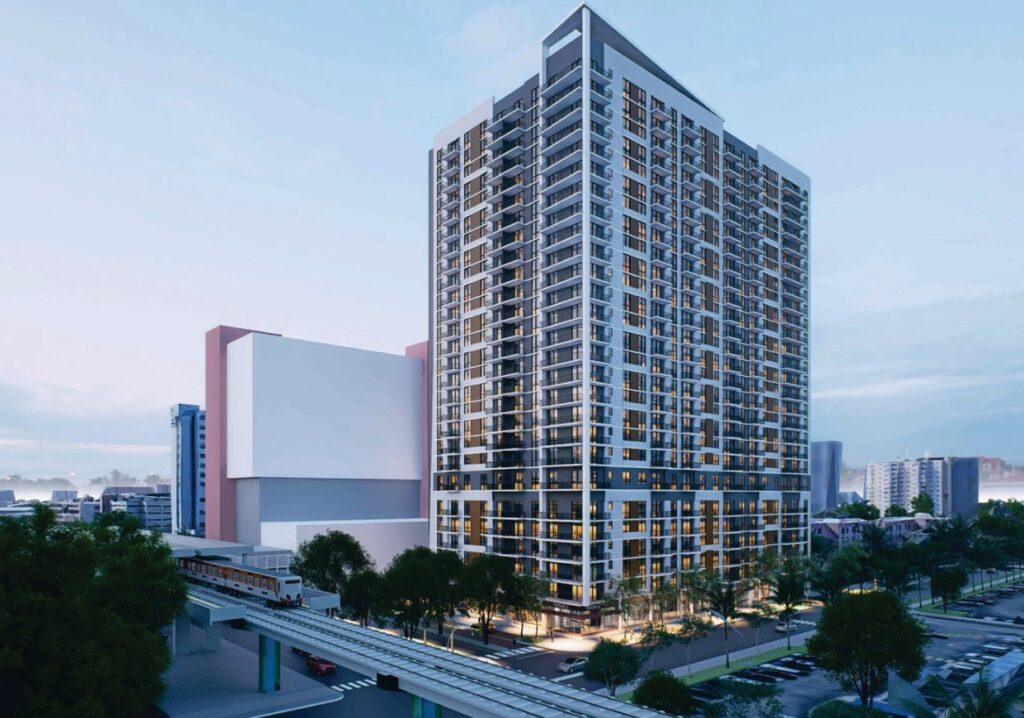
The Related Group has secured key financing for The Gallery at Wagner Creek, a mixed-income high-rise planned for Miami’s Health District that will include affordable housing. The project marks the first phase of a larger multi-tower development that will eventually involve the demolition and redevelopment of the nearby Jackson Medical Towers. Envisioned as a transit-oriented, mixed-income community, the development is located at 1165 NW 11th Street: just steps from the UHealth-Jackson Metrorail Station. On October 29th, Miami’s Housing and Commercial Loan Committee approved the allocation of $4,848,080 in Miami Forever Bonds to The Related Group. Miami Forever Bonds are part of a measure approved by voters to fund essential infrastructure, resiliency, and affordable housing projects. The $4,848,080 loan for the Gallery at Wagner Creek development is a key part of the project’s more than $190 million cost. Other sources of financing, including from the state, have also been awarded. The Gallery at Wagner Creek required financing from multiple institutions due to its large scale of affordable housing; the project will include 460 residential units, with 184 designated as either workforce or affordable housing for at least 30 years. These units will be priced for households earning between 30% and 120% of the area’s median income (AMI). Of the deeply affordable units, 70 will receive city assistance, including 35 specifically reserved for special-needs households in need of stable housing. This 40% workforce and affordable housing requirement stems entirely from the developer submitting the project under Florida’s Live Local Act. To avoid lengthy public hearings, the developer filed an administrative application, allowing the proposal to be reviewed solely by county officials. The Live Local designation also grants the developer greater flexibility, including increased height, density, and reduced procedural hurdles. A representative of the developer writes, ‘Pursuant to the Live Local Act, a maximum density of 250 units per acre is permitted. According to the revised survey, the gross acreage of the North Site is 1.98 acres permitting a maximum density of 495 dwelling units. For this first phase, the Applicant is proposing 460 units on the North Site, providing much needed affordable housing stock to the area’. According to floor plans provided by the architect, Cohen Freedman Encinosa & Associates, units will range from studios, 1-bedroom, and 2-bedroom units. Residents will have access to a range of amenities, including a pool, lounging space, a health club, co-working space, and much more. The development is also set to feature 346 parking spaces and 3,200 SF of ground floor commercial space. When the development was first submitted, parking counts were slightly higher. Elevations show a 27-story tower rising 305 FT, featuring materials such as smooth stucco, picketed railings, and louvered cladding. The building’s height is limited by nearby flight paths, with a maximum allowable elevation of 310 FT in this zone. To comply with aviation safety regulations, the roof will also include aircraft warning lights. While the project is still moving through approvals, it has already cleared several key steps. The site, currently used as a surface parking lot, has been granted site control through a ground lease, giving the developer long-term rights to design, finance, and operate the building without full ownership of the land. Construction is expected to begin in late 2026, with completion targeted for 2028.
Alta Developers Breaks Ground on Princeton Gateways Phase I, Set to Feature 308 Apartments
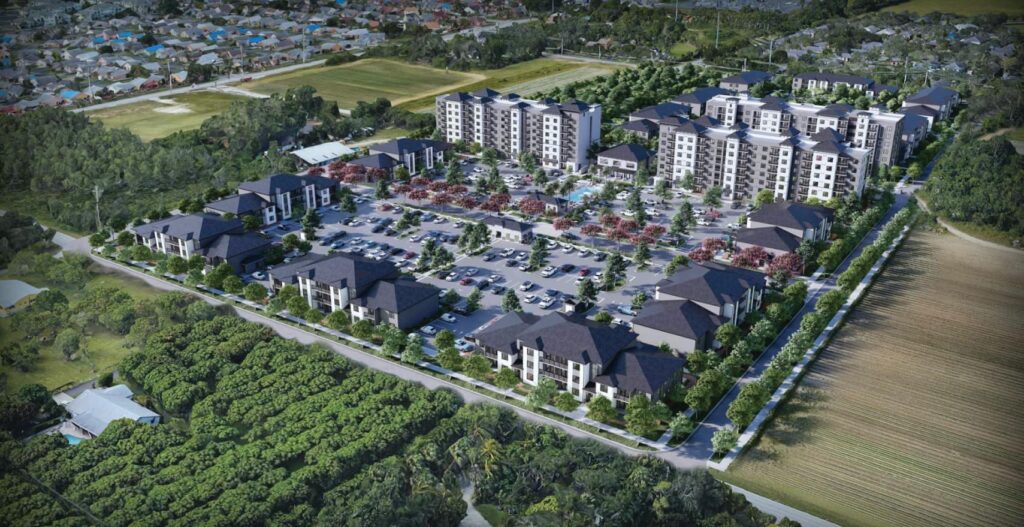
Alta Developers has just broken ground on the first phase of Princeton Gateways, also known as Princeton Commons. The project, which has been in planning since 2022, is now moving forward following a $60 million construction loan from Miami-based City National Bank of Florida. The first phase will replace three parcels located at 24450, 24500, and 24550 SW 127th Avenue with modern apartment buildings. The MSA Architects-designed complex isn’t alone. Despite being located in a relatively low-density area in Princeton, development across South Miami-Dade has surged in recent years. Limited available land has pushed traditional suburban projects to grow upward rather than outward; this groundbreaking is another example of such developments. After recently receiving ASPR approval for the first phase, the latest 2024 plans outline 308 residential units, although 384 are permitted. The mix will include one-, two-, and three-bedroom layouts, with two-bedroom units making up the majority at 61% of Phase 1. The development will feature nine buildings arranged around a central parking lot, with additional on-street parking for residents. In total, 417 parking spaces will be provided. With interiors designed by local firm Raymond Nicholas, the development will offer modern residences featuring large windows and private balconies. Ceiling heights will reach up to 9 feet 6 inches, creating bright and spacious living areas. Buildings in Phase I will range from three to seven stories, rising between 36 and 66 FT The first phase will include two seven-story buildings and seven three-story structures. The complex will also feature a white and gray color palette, accented by greenery along the facades and surrounding sidewalks. While the second phase hasn’t broken ground, it received approval earlier this year and follows a similar design and layout to the first phase. Smaller in scale, it will include 226 units spread across seven buildings, offering 1-, 2-, and 3-bedroom layouts. Residents will have access to 350 parking spaces. The construction start date is currently unknown, and unlike the first phase, the second phase’s site is not yet cleared for development. When both phases are complete, the complex will feature 534 units and 767 parking spaces. South Florida’s unique geological constraints, unlike regions such as Houston or Los Angeles, make projects like this feasible. Just months ago, a developer proposed a 25-story tower slightly further north under Florida’s Live Local Act, a landmark housing bill.
Sunny Isles Beach Set to Overtake Philadelphia in Number of Skyscrapers by 2029

Skyscraper enthusiasts across South Florida are about to witness a remarkable milestone for the region. While Sunny Isles Beach may not rival Philadelphia in population, economic scale, or national prominence, this slender barrier island city is on track to surpass the Pennsylvanian powerhouse in the number of skyscrapers. According to the Council on Tall Buildings and Urban Habitat (CTBUH), skyscrapers are defined as structures exceeding 492 FT (150 meters) in height. Over the past decade, these towering structures have increasingly reshaped South Florida’s skyline, and few places exemplify this transformation better than Sunny Isles Beach. The city’s appeal to developers lies in its prime location, relatively relaxed zoning laws, and the continued demand for oceanfront living in the region both domestically and internationally. With the upcoming completion of Bentley Residences and the two-tower St. Regis Residences complex, the city will add three new skyscrapers, increasing its total from 17 to 20 by 2029 when the final St. Regis tower is finished. Those buildings are currently working on their foundation and will quickly rise. For those familiar with the city, the real count of 17 towers in Sunny Isles Beach should be raising eyebrows. After all, it’s far above the long-accepted norm of 14. However, Floridian Development recently obtained city records and found that Trump Towers I, II, and III each reach 500 FT, not the 461 FT previously reported. That correction pushes the verified total to 17, bringing the city’s real count to light following years of misinterpreted data. According to elevations prepared by Sieger Suarez Architects, the towers each rise 500 FT starting from the lobby to the top architectural feature that conceals their mechanical components. These documents represent the most recent and final elevations for the buildings and do not reflect earlier versions. Dated late 2005, they were submitted as part of the foundation permits and reviewed prior to construction, which occurred between 2005 and 2009. This means Sunny Isles Beach is currently tied with Atlanta, Las Vegas, and Austin in terms of skyscraper count. By 2029, however, the city is set to surge ahead; it will reach 20 towers and tie with Dallas, which currently has no buildings over 492 FT under construction. Atlanta will fall just behind with 18 towers after the completion of 1072 West Peachtree Street, while Austin and Las Vegas are projected to have 19 and 18 skyscrapers respectively. The only U.S. city expected to surpass Dallas in this timeframe is Jersey City, which is also experiencing a major skyscraper boom. Even more impressive, Sunny Isles Beach is expected to exceed 20 skyscrapers in the near future, as developers continue to grab up low-rise parcels along the beachfront. Months ago, reports surfaced of a joint venture between Related Group, Dezer Development, and the BH Group acquiring the Miami Beach Club at 19051 Collins Avenue for over $100 million. The FAA recently approved an 820-foot tower on the site, which would make it the tallest building along the strip.
Azul At Blue Lagoon Proposed Through the Live Local Act, Set to Feature 250 Units
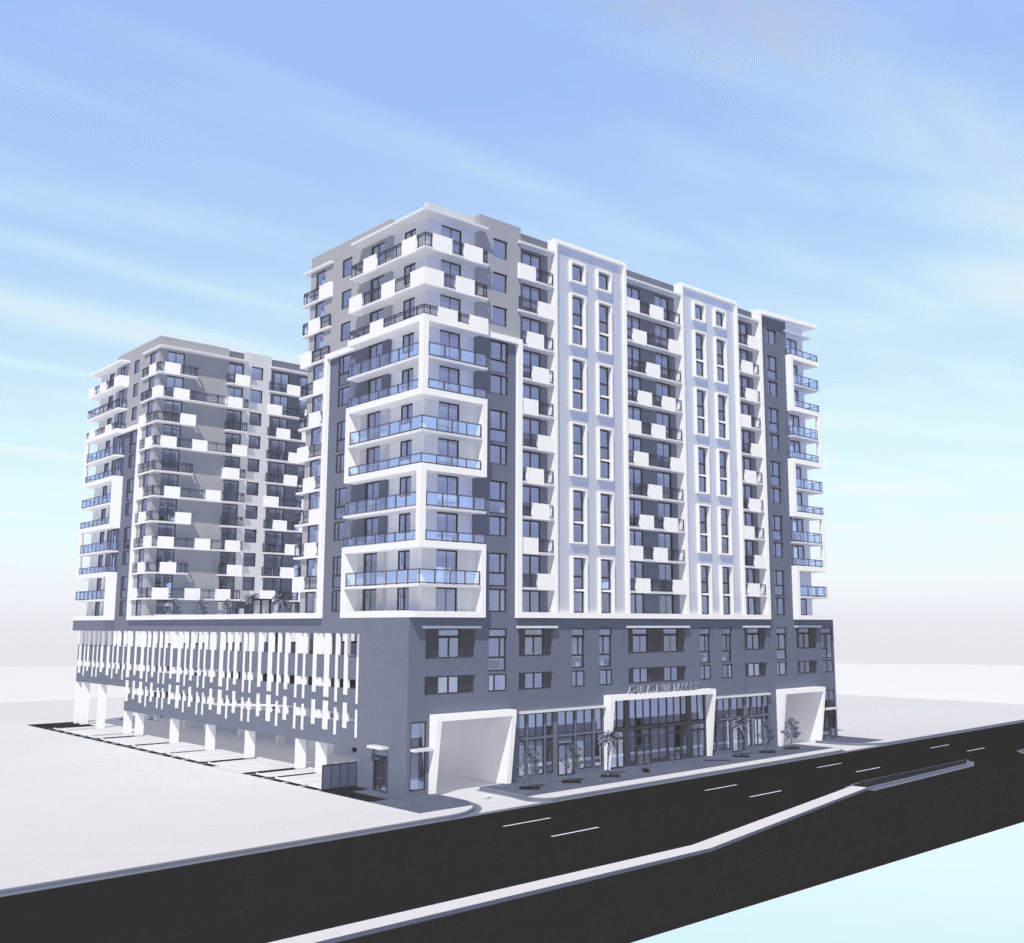
Miami’s Blue Lagoon neighborhood, an area defined by its mid-rise, office-oriented development, is seeing its first proposal under Florida’s Live Local Act. The project is known as Azul at Blue Lagoon, with plans currently awaiting Miami-Dade County approval for a 15-story residential tower made possible through the Act’s development incentives. Led by Keystone 1200, LLC, an affiliate of local firm Keystone Holdings, the proposal would rise on 1.2-acre site currently occupied by two industrial warehouses and a surface parking lot. The venture will also mark Keystone’s second Live Local project in the county, following its earlier Keystone Midway proposal, which Floridian Development previously reported on. According to plans submitted in early October, Azul at Blue Lagoon will feature 250 residential units. Under existing zoning, only 72 units would be permitted on the site, but the Live Local Act allows for a significant increase of up to 300 units in this case. By leveraging the act’s incentives, which include higher density and height limits, reduced parking requirements, and an expedited approval process, the developer must allocate at least 40% of the units as workforce housing. Most importantly, this proposal generously exceeds that threshold: approximately 54% of the building, or 136 units, will be reserved for workforce housing, priced at or below 120% of the Area Median Income (AMI). Residences at Azul at Blue Lagoon will range from townhome-style units and studios to one-, two-, and three-bedroom layouts, including optional two-bedroom units with dens. One-bedroom units will make up the majority of the development, accounting for 46% of all residences. All workforce-designated units will consist of either one- or two-bedroom layouts, ranging from around 600 SF to 900 SF. While the amenity package may continue to evolve, current plans showcase features such as a fitness center, resident storage areas, a pool deck, and multiple lounge spaces. At street level, the project will include 2,501 SF of retail space, a lobby, and vehicular access to the podium garage. The garage will accommodate 372 parking spaces, a significant portion of which will be configured in tandem layouts to maximize efficiency. Designed by FormGroup, a well-known architectural firm in the South Florida region, the building will feature a contemporary design with a concealed podium at street level, maintaining a pedestrian-friendly appearance. Balconies will incorporate a mix of metal and glass, while the facade will showcase stucco finishes in shades of blue, white, and brown. The building’s 15-story height is based on the maximum allowable height within a one-mile radius, with the precedent set by a nearby 15-story residential building at 725 NE 57th Street, located approximately 0.29 miles away. According to elevations, the building will rise 148 FT to its tallest point. Because the project is being filed administratively, there will not be a public hearing for this project. Once all is given the go-ahead, the existing site at 1200 NW 57th Street will require limited demolition.
Calle 8 Tower Undergoes Significant Changes Ahead of Groundbreaking in Brickell
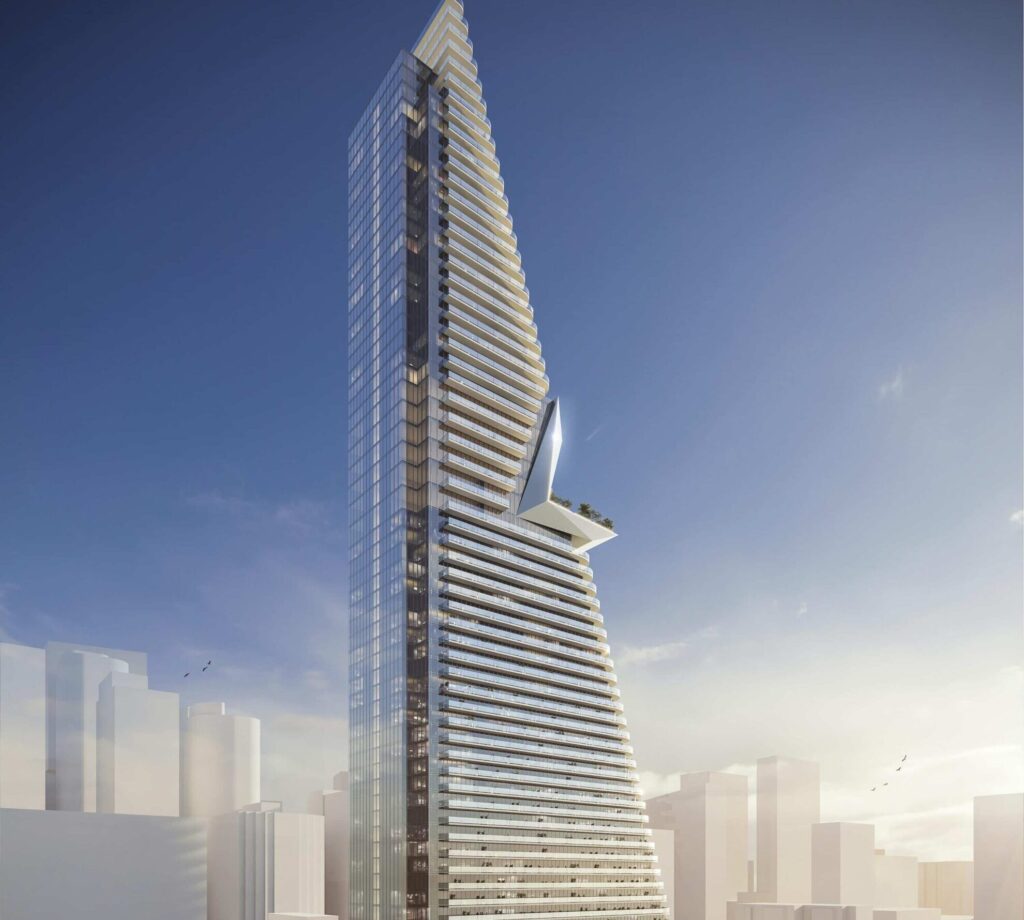
Calle 8, one of Brickell’s most distinctive proposals in both form and function, has just undergone a major change in its design. The update is being led by Millennium Developments of Brickell, an affiliate of G&G Business Developments: the same firm behind the Aston Martin Residences in Downtown Miami. G&G first proposed the project in 2023 and has since overseen several design revisions, the latest of which was submitted on October 17th. The newest plans remove the previously proposed music venue from the tower’s podium, replacing it with residential units to create an almost entirely residential tower. Despite the changes, the BMA Architects–designed building will retain its signature triangular design. Located at 190 SW 8th St, the development will now feature 500 residential units, an increase from the last iteration which called for 464. This increase comes entirely due to the aforementioned removal of the proposed music venue, which would’ve spanned over 70,000 SF. Residences will range from 1-bedroom units all the way to 3-bedroom penthouses on the top floors of the building. The building’s amenity package will remain similar in size but will feature several changes in offerings. Among the amenity package is a striking overhanging pool on the 41st floor, spanning 1,625 SF and surrounded by lounge areas. Other planned amenities include multiple bar spaces, a sauna and steam room, a spa, a beauty salon, and a dedicated wellness room. It’s important to note these amenities aren’t set in stone until construction commences. From the ground floor to the podium, the development will furthermore include 556 parking spaces, down from 653 in the original plan, along with basement parking to help minimize the podium’s visual impact at street level. The project also introduces new ground-floor spaces, including a car wash, 10,247 SF of retail space, and 3,669 SF of office space: none of which were part of the previous iteration. Beyond these functional changes, the tower’s design has also evolved. The facade now features a uniform composition of curtain glass and balconies, replacing the earlier visual disconnect between the podium, formerly containing parking and a performing arts venue, and the residential tower above. Despite these updates, the building’s overall height remains largely the same, rising 737 FT or 68 floors to its top architectural element, just seven FT shorter than the prior version. Submitted under an Administrative Site Plan Review (ASPR), the project falls within the Rapid Transit Zone (RTZ) Metromover Subzone, placing it under Miami-Dade County’s zoning jurisdiction rather than the City of Miami’s. This means the developer only needs to secure final administrative approval before moving forward with permitting and construction. The site, assembled by Millennium Developments between 2014 and 2015, was added to the RTZ Metromover Subzone through a boundary expansion approved in 2022. This zoning designation provides major incentives for developers, including increased building height and density, reduced parking requirements, and faster approvals for projects located near transit. Before qualifying for Administrative Site Plan Review, which is often much quicker than moving through a public hearing, developers must first obtain a general development plan approval. Millennium received that approval in early 2025, allowing the current ASPR submission to act as the final step before construction can move forward. While the tower moves through the final hoops before groundbreaking, it has captured the attention of international organizations including the Council on Tall Buildings and Urban Habitat. CTBUH’s Florida chapter will hold a presentation exploring the tower’s unique design, challenges, and solutions. The event will be held on October 30th. Summary of changes:
Miami-Dade Advances North Corridor TOD Master Plan with Its First Public Workshop

Miami-Dade’s North Corridor Transit-Oriented Development (TOD) Master Plan is officially moving forward, with its first community workshop scheduled for Wednesday, October 22 at the Sherbondy Village Community Center. The event, which will spam between 6:30 PM to 8 PM, will mark the first of two public workshops aiming to shape future development along Miami’s long-awaited North Corridor. Outlined in 2016 as part of the Strategic Miami Area Rapid Transit (SMART) Program, the North Corridor will extend approximately 10 miles along NW 27th Avenue, from the Dr. Martin Luther King Jr. Metrorail Station to the Broward County line. The goal of the line is to connect residents of unincorporated Miami-Dade, Opa-locka, and Miami Gardens to key destinations such as Miami Dade College, Opa-locka Executive Airport, and Hard Rock Stadium. The development will be one of the First Metrorail extensions in years, following the orange line to Miami International Airport. Among studies for the North Corridor, the county currently lacks a unified plan to guide development around its proposed transit stations. The upcoming workshop, and the planning process that follows, aims to change that. According to Miami-Dade officials, the Master Plan is being drafted to align land use, economic development, and mobility goals alongside the metro extension, ensuring that the region’s growth is sustainable and accessible to surrounding residents. Using a “5D Framework” (Density, Diversity, Design, Destination Accessibility, and Distance to Transit), the plan encourages compact, walkable, mixed-use communities around high-capacity transit. During the drafting process of the TOD Master Plan, planners hope to have a plan that will reduce car dependency and foster safer, healthier neighborhoods that connect people effectively to opportunities. The TOD Master Plan will evaluate land use within a one-mile radius of nine proposed elevated stations, assessing redevelopment potential, infrastructure needs, and pedestrian accessibility. The plan will also define strategies for creating complete streets and transit-ready communities. Progress on the Master Plan will proceed in four phases, with the final plan’s release scheduled for 2026. A second workshop will occur around March of next year. Once completed, the plan will be an additional step for the long-awaited North Corridor, which has been riddled by false promises. Once touted as reaching Hardrock stadium by the World Cup, the transit line is still undergoing funding, studies, and other concerns that have pushed the expected completion date back to 2036. A new Transit-Oriented Development (TOD) Master Plan is viewed as a must for the county, where an increasingly active corridor now demands a guide for growth. Among the projects taking shape is HueHub, a multi-tower complex with buildings rising over 300 FT. Leasing is expected to begin in December, and a new transit station is proposed just 150 feet away.
Riviera Beach Weighs In on ‘The Waterway,’ an Ambitious Three-Tower Development
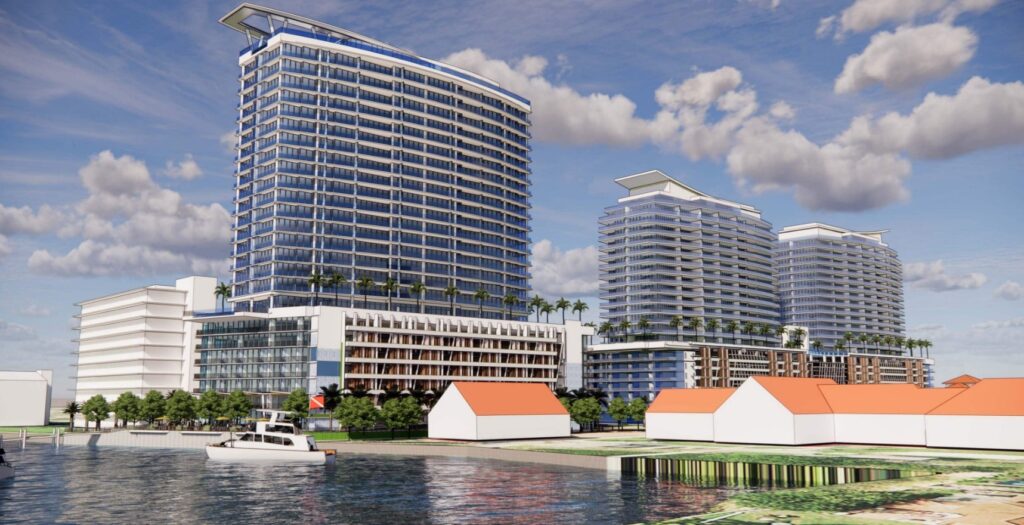
One of Riviera Beach’s most ambitious developments has arrived before the city’s Planning and Zoning Board. Called The Waterway, the project envisions a three-tower mixed-use complex spanning two parcels at 3200 Broadway Boulevard and 3140 Lake Shore Drive. Spearheaded by KMG Holdings, LLC and designed by REG Architecture, the 4.51-acre proposal will feature workforce and market rate units, along with retail, office, and other active uses. Set for review on October 23rd at 6 P.M., the Waterway development comes with a complex history. KMG Holdings, LLC acquired the waterfront parcel at 3140 Lakeshore Drive in 2018, followed by the adjacent west parcel at 3200 Broadway Boulevard in late 2020. Prior to KMG Holdings, an 18-story tower was proposed on the site in 2006. The most recent iteration would replace a 20-unit condominium built in 1967 along the waterfront, as well as a former BellSouth Communications office building. Originally envisioned as a single high-rise tower, the proposal has since expanded into a three-tower complex featuring 785 residential units. The Waterway’s three towers will offer a mix of one-, two-, and three-bedroom units. The two western towers will feature 239 and 233 units, respectively, while the waterfront-facing tower will contain 313 units. Of the total, 30 units are designated as MEAHOP workforce housing units under the Minority Employment and Affordable Housing Opportunity Plan (MEAHOP). These units are aimed at lower or moderate-income households. This requirement steams from a rule which permits height increases in exchange for workforce housing. While the two western towers comply with Riviera Beach’s 240 FT height limit, the waterfront-facing tower is proposed at 300 FT, taking advantage of the city height bonuses. This requires 60 MEAHOP units, equivalent to 30 workforce housing units, which will be concentrated in the west tower’s upper floors. Residents of the building will have access to amenities from a clubhouse, multiple infinity pools, a theater, lounge, gym, and other amenities. The development will also include access roads flanking both sides of the three-tower site, providing entry to 1,637 parking spaces for residents and retail patrons. One of the proposal’s highlights is the tower’s street-level activation and podium design, which includes 2,925 SF of restaurant space and 9,771 SF of retail and office uses. Along the waterfront, a public pedestrian promenade is planned, designed with seating, landscaping, and a proposed dock. Architectural elevations show the towers will feature a combination of curtain glass, smooth stucco, expansive glass balconies, and other design elements, including a garage wrapped in brown-toned metal louvers. The waterfront-facing tower is planned to rise 25 floors, measuring 300 FT to the roof or 305 FT at its tallest point. The two 21-story towers will then top out at 240 FT to the roof, or roughly 260 FT to their highest points. Riviera Beach’s Planning and Zoning Board is scheduled to review the proposed development on October 23rd. The board acts as an advisor to the City Council, meaning it does not grant final approvals. Instead, its recommendations, whether for approval or denial of the five items, will be forwarded to the City Council for the final decision. The development will proceed in one phase, with all three towers rising at once. If approved by the City Council, the project would represent another major investment in Riviera Beach’s evolving skyline. Traditionally a low-density city defined by smaller-scale infill, Riviera Beach has recently attracted growing interest from major developers. Firms such as Forest Development and the Related Group have introduced multiple high-rise proposals across the city, including the recently approved Oculina Development, which leverages the same MEAHOP incentives to achieve additional height.