Vertical Construction Begins on 306-Foot Shorecrest Condo Tower in West Palm Beach
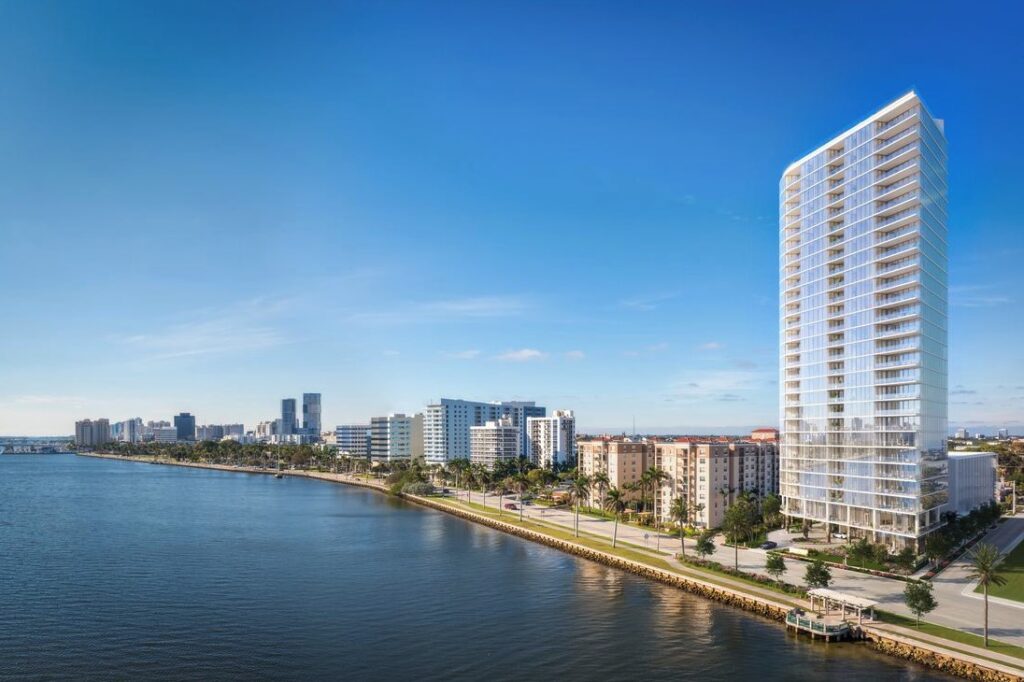
Vertical construction has officially begun at Shorecrest, a 27-story condominium development taking shape along North Flagler Drive in West Palm Beach. Led by Related Ross, which is advancing several other major development opportunities across the city, the project has now reached its first floor after breaking ground several months ago. Once completed, Shorecrest will bring 100 luxury residences to one of West Palm Beach’s fastest-growing areas, adding to the city’s increasingly active high-end condominium market. Located at 1901 N Flagler Drive, the tower will rise 306 feet across 27 floors when complete. The project sits on a nearly 1.5-acre parcel and has followed a lengthy path to construction since it was first proposed in 2024, undergoing multiple design and interior revisions along the way. The latest plans were recently approved by West Palm Beach’s Planning Board, clearing another major hurdle for the development as Related Ross also secured $157 million in construction financing from GoldenTree Asset Management. Photos taken by Floridian Development show crews now working on the first floor, with a red construction crane already erected above the site. Signage surrounding the property identifies Coastal Construction as the project’s general contractor. As vertical construction gets underway, crews are expected to focus initially on the lobby, amenity levels, select residential areas, and parking structure before the work shifts primarily toward the tower’s residential floors. Shorecrest is rising amid a broader wave of development along North Flagler Drive, with Olara also under construction next door and bringing additional multifamily residences to the surrounding area. Designed by Roger Ferris + Partners, Shorecrest will contain 100 residences ranging from one to four bedrooms, with larger floor plans expected to make up a significant portion of the project. Residents will have access to a wide range of amenities, including a swimming pool, fitness and yoga studio, golf simulator, coworking spaces, steam room, and a 24-hour attended lobby with concierge services. The development will also include a 204-space parking podium. At 306 feet, Shorecrest will rank among the tallest buildings in West Palm Beach once completed, with its height made possible through the city’s bonus-height program. The additional height is being achieved through contributions toward mobility infrastructure, infrastructure improvements, and other public benefits. Related Ross is currently targeting a 2027 completion for Shorecrest, which would bring the 100-unit condominium project to fruition after several years of planning and design changes.
Construction Begins on 754-Unit Ombelle Condo Towers in Fort Lauderdale
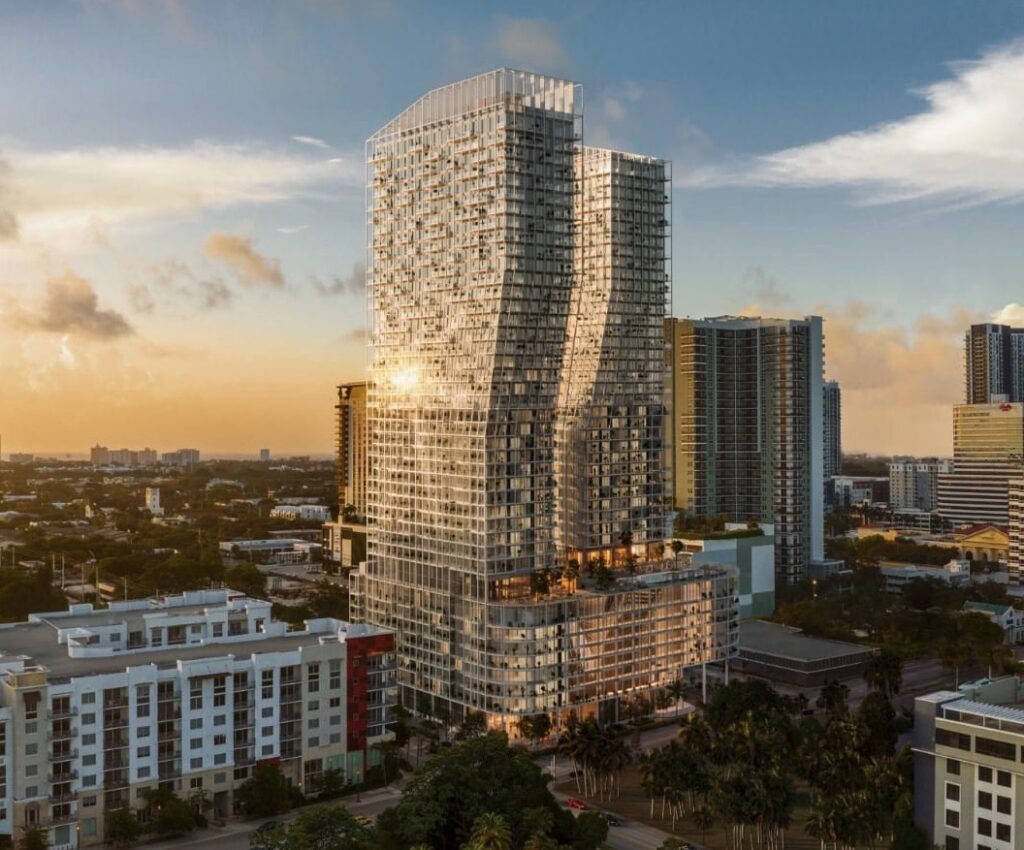
Crews have officially begun construction on Ombelle, a two-tower condominium development that is taking shape in the heart of Fort Lauderdale. Proposed by New York City-based Dependable Equities, the project has been in the works since its initial proposal in 2022, and after months of permitting and sales activity, construction has now reached the foundation piling phase. On-site documentation shows crews actively preparing the foundation, marking the first major step toward the project’s eventual rise above downtown Fort Lauderdale. Located at 316 NE 4th Street, Ombelle is being built on a nearly two-acre parcel that Dependable Equities acquired for $27 million in late 2021. The project has also recently secured $50 million in pre-construction financing from Dwight Mortgage Trust, with the developer expected to obtain additional financing as construction progresses. Current activity on the site indicates that foundation work is well underway. Photos from the property show a piling rig, multiple rebar cages, concrete mixer trucks, and other equipment needed for the early stages of construction. Crews have been drilling deep holes into the ground, filling them with concrete, and placing rebar into the concrete to form the structural foundation that will support the towers above. Dependable Equities is handling the construction through its own in-house contracting operation. Once complete, Ombelle will bring 754 condominium residences to the site, ranging from studios to three-bedroom units. Residences will feature 10-foot ceilings, floor-to-ceiling windows, custom finishes, and other high-end interior details, while residents will have access to approximately 100,000 square feet of amenities spread throughout the development. Those amenities will include a pool, two indoor pickleball courts, a business center with coworking space, fitness facilities, a game room, and additional recreational and social spaces. The development will also introduce new commercial space at street level, including more than 11,000 square feet reserved for retail and dining uses. In addition, approximately 35,000 square feet will be dedicated to a new Equinox gym, adding a major fitness component to the project. To accommodate residents, guests, and the anticipated demand generated by the development’s commercial uses, Ombelle will include 895 parking spaces. That figure represents a recent reduction from the 932 spaces previously planned, with the developer removing 37 spaces just two months ago. When completed, Ombelle’s two towers will rise approximately 525 feet across 43 floors, placing them among the tallest buildings in Fort Lauderdale. The towers are expected to reach their full height around the middle of next year, with completion currently anticipated in 2028. For the moment, however, Ombelle is still firmly in its earliest stage of construction. Once the foundation work is completed and vertical construction begins, the project will rapidly change the skyline around NE 4th Street. Both towers are currently positioned to become the tallest completed buildings in Fort Lauderdale, although they will not hold the distinction for long. Andare Residences, which is already under construction, is expected to top out before Ombelle at 542 feet, making it slightly taller than the 525-foot Ombelle towers.
Beitel Group Moves Closer to Breaking Ground on 3333 Biscayne After Key Permit Filings
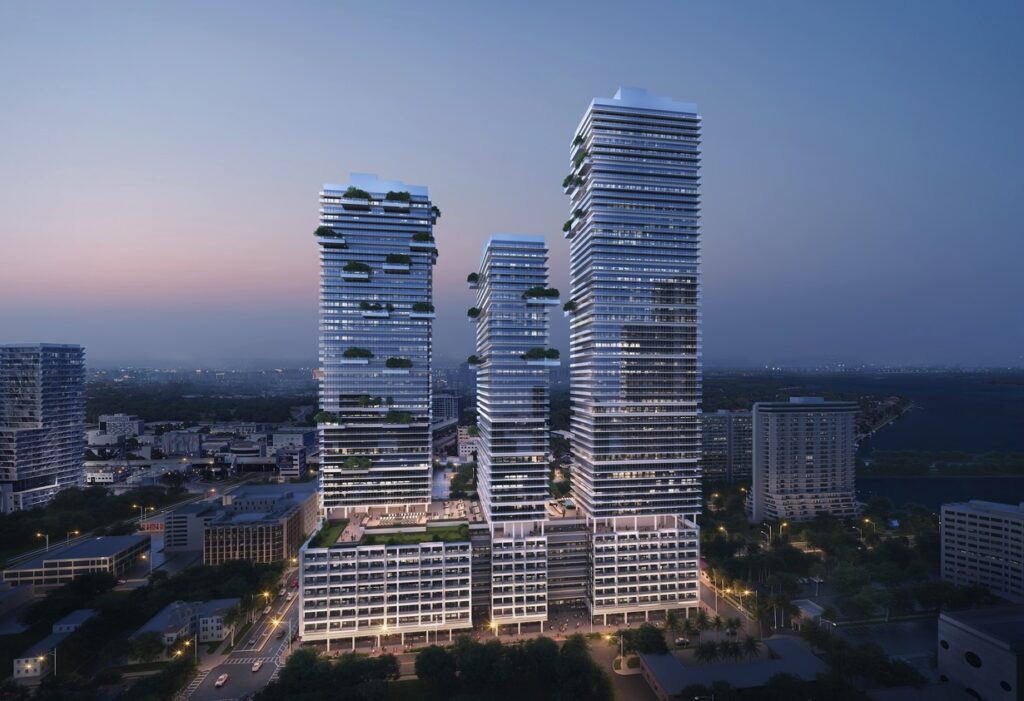
Beitel Group’s long-awaited plans for 3333 Biscayne appear to be gaining momentum, as the developer moves closer to construction on the three-tower mixed-use project after filing multiple crane permits with the FAA and advancing several key construction permits. The development, which will occupy an entire city block in Edgewater, has spent years in planning and redesign, but recent filings suggest the project may finally be approaching groundbreaking. Originally unveiled in 2022, the Stantec-designed proposal called for three towers rising 12, 40, and 41 stories, delivering 635 residential units, approximately 150,000 square feet of office space, and an active ground floor lined with retail. Beitel Group assembled the site for $45 million before advancing the original concept. Earlier this year, however, Floridian Development first reported that the project had shifted toward a new residential-focused vision, replacing the original proposal with three taller towers and likely eliminating the office component altogether. That shift is now becoming clearer through recently filed construction permits. Several permits have already advanced through the approval process. Tree removal and demolition permits have been approved, with demolition work already underway across portions of the site. Before vertical construction can begin, however, the developer must still receive approval for three critical applications: a master construction permit, a site preparation and foundation piling permit, and a phased vertical construction permit. Of those filings, the master construction permit provides the clearest look yet at the project’s revised plans. According to the application, the first tower will rise 45 stories and include 667 residential units, structured parking, and 7,408 square feet of ground-floor retail. While an official height is not listed, a building of that scale would likely rise to around or above 500 feet. Although the permit references only a single tower, the overall development is still planned to consist of three buildings, meaning the filing represents only the project’s first phase. Current renderings show the towers stepping up in height from west to east, with the shortest tower positioned in the center. Based on that arrangement, the 45-story building identified in the permit is likely the westernmost tower, which appears poised to become the project’s first phase. Permit activity also suggests construction could begin sooner rather than later. In addition to the primary construction applications, Beitel Group has filed four crane permits with the FAA, including two temporary crane permits requesting a maximum height of 603 feet and two traditional tower crane permits requesting a maximum height of 644 feet. According to those filings, the cranes are expected to operate between December 1, 2026, and July 31, 2028. While the developer has not announced a groundbreaking date, the crane applications indicate confidence that the remaining site preparation and foundation permits will move through the approval process in time to support that construction schedule. If those approvals are secured in the coming months, work can begin, spearheaded by the project’s general contractor: John Moriarty & Associates.
Stock Development Files Plans for Tampa’s Tallest Skyscraper at 601 N Ashley Drive
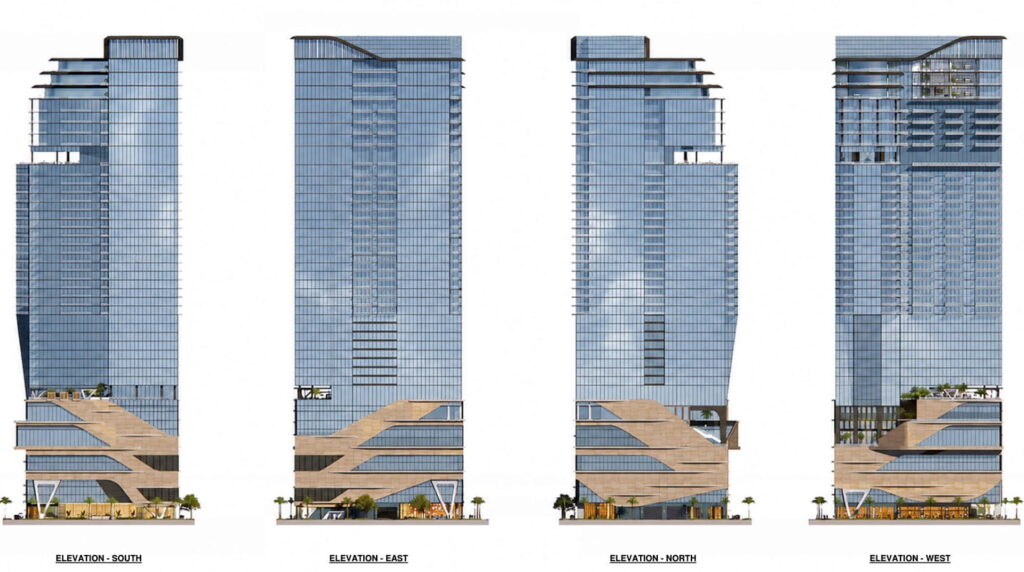
An ambitious proposal that would redefine Tampa’s skyline was unveiled today, as Florida-based Stock Development revealed plans for what would become the city’s tallest skyscraper. Rising 631 feet above downtown, the 48-story tower would eclipse Tampa’s current tallest building by a wide margin while transforming a site that has long been viewed as one of the city’s most significant redevelopment opportunities. The proposal comes just months after the demolition of the historic GTE Financial Building, a landmark completed in 1925 that occupied the property for a century. Located at 601 N Ashley Drive, the approximately one-acre site has undergone years of planning before reaching this stage. TLR Group assembled the property in 2021 and spent several years advancing its own vision for a high-rise development before Stock Development acquired the site in 2025 for $40 million, marking one of the largest property transactions in Tampa’s history. With demolition now complete, the developer has unveiled a project that would introduce more than 1 million square feet of residential and hospitality space to the downtown core. Plans submitted to Tampa’s Design District Review Board call for a mixed-use tower containing 220 condominium residences and 240 hotel rooms, alongside a variety of ground-floor hospitality uses. While the hotel operator has yet to be announced, the plans point toward a luxury brand, with accommodations ranging from king rooms and double-queen rooms to several suite configurations. The residential component would include two-bedroom, three-bedroom, four-bedroom, and penthouse residences, although both the hotel and condominium layouts are expected to evolve as the project advances through the approval process. The tower has been designed to function as two distinct uses within a single structure. Hotel guests would have access to a resort-style pool deck, spa, meeting rooms, ballrooms, restaurants, outdoor terraces, and a grand lobby, while residents would enjoy a separate array of amenities, including their own pool deck, a dog park, golf simulator, and additional recreational spaces. Rather than activating the ground floor with retail, Stock Development has instead prioritized expansive lobby spaces, amenity areas, and dedicated drop-off zones for both residents and hotel guests. Even without storefronts, the project proposes several improvements to the public realm. Plans include significantly wider sidewalks surrounding the property, along with a modernized bus stop on North Tampa Street. Beneath the tower, a 400-space parking podium would accommodate residents and hotel guests, exceeding the amount of parking currently required under city regulations. Architectural elevations prepared by Ziegler Cooper Architecture depict a modern 48-story tower organized into three distinct sections. Parking would occupy the lower levels, hotel rooms would fill the middle floors, and luxury residences would crown the upper portion of the building. At 631 feet tall, the structure would become Tampa’s tallest building by a considerable margin. The architectural elevations showcase floor-to-ceiling glass wrapping nearly the entire tower. The parking podium would be screened behind spandrel glass to minimize its visual presence, while stone accents and other contemporary materials would add depth and contrast to the facade. Although the proposal remains in the early stages of the city’s review process, several important milestones have already been reached. Earlier this year, the developer secured FAA approval for a structure reaching 635 feet, with the FAA determining that it would pose no hazard to navigable airspace. A separate application for a 687-foot tower crane remains under review, and construction timelines included in that filing indicate crane operations between July 1, 2030, and January 1, 2031, meaning groundbreaking may not occur until sometime in 2029. For now, activity on the site remains limited to demolition. Aside from the permit issued to remove the former GTE Financial Building, no vertical construction permits have yet been filed with the city, meaning the project must still navigate Tampa’s review process before work can begin.
Plans Submitted for 154-Unit Gwen Cherry Residences Redevelopment in Miami-Dade
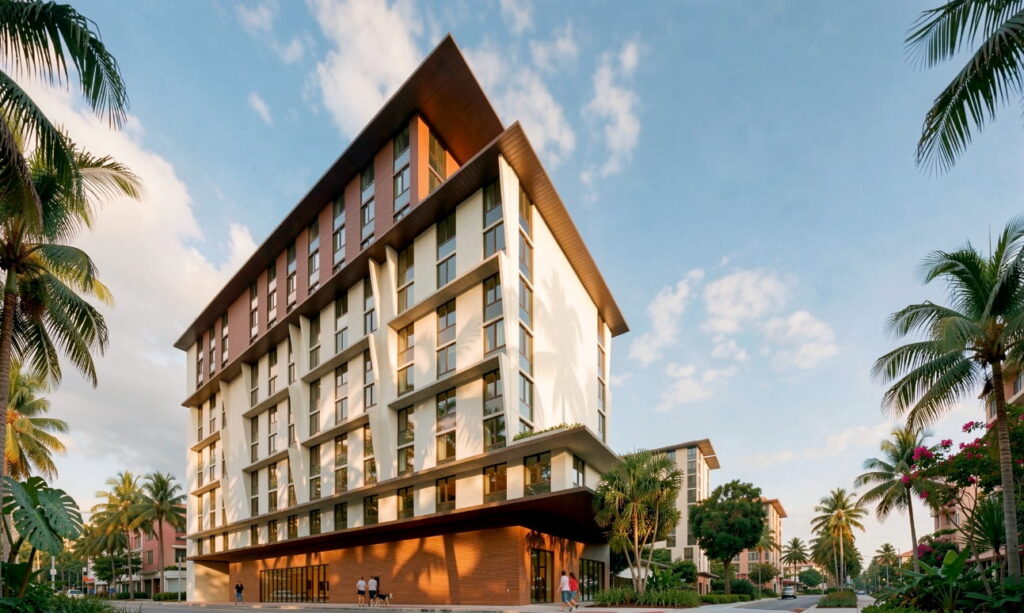
Miami-Dade County’s effort to modernize its aging public housing portfolio is continuing, with new plans submitted for the redevelopment of Gwen Cherry 7. The project, known as Gwen Cherry Residences, is being developed by Redwood Development Co. and Magasi in partnership with Miami-Dade County. Redwood has become an increasingly active participant in the metro area’s affordable housing development, with other major projects including the large-scale redevelopment of Claude Pepper in North Miami. Located at 170 NE 67th Street, Gwen Cherry 7 occupies a 1.6-acre site currently developed with several two-story apartment buildings constructed in 1970, totaling 24 public housing units. The property is one of several Miami-Dade housing communities named in honor of Gwen Cherry, the Miami-born educator, civil rights advocate, and the first African American woman elected to the Florida Legislature. The redevelopment effort dates back to 2023, when Miami-Dade County issued a solicitation seeking development partners for several aging public housing communities. Gwen Cherry 7 was paired with the nearby Lemon City property as a single redevelopment opportunity. Magasi Redwood Urban LC, LLC (a partnership between Redwood Development Co. and Magasi) submitted the sole proposal for the package. Following negotiations, the Miami-Dade County Commission authorized a 99-year Lease and Development Agreement, subject to approval by the U.S. Department of Housing and Urban Development (HUD), allowing the team to move forward with the redevelopment of both sites. Although the broader agreement includes both Gwen Cherry 7 and Lemon City, the latest filing pertains only to Gwen Cherry 7, marking the first detailed development plans submitted under the redevelopment agreement. Plans for Lemon City have not yet been filed and are expected to move through a separate review process at a later date. What’s Planned? According to plans submitted to Miami-Dade County earlier this month, Gwen Cherry Residences will deliver 154 homes, representing nearly a sevenfold increase over the site’s existing housing stock. The development will consist of two buildings connected by a shared two-story podium. The larger of the two buildings will rise 11 stories and contain 54 affordable family-oriented residences, with unit layouts ranging from one-bedroom to five-bedroom apartments. The second building will rise 10 stories and provide 100 units, consisting primarily of studio and one-bedroom apartments. The shared podium will incorporate approximately 7,700 square feet of ground-floor retail space, while a podium amenity deck will provide recreational and open space for residents. Parking will be accommodated through 214 garage spaces and an additional 19 surface spaces, providing capacity well above what is typically required for a development of this size. While final architectural elevations have not yet been released publicly, both buildings are expected to exceed 100 feet in height, making them among the taller structures in the surrounding neighborhood. Preliminary renderings depict a contemporary design featuring brown, gray, and white exterior finishes, expansive glazing, generous landscaping, and a mix of facade textures intended to add depth and visual variation. The filing represents another step in Miami-Dade County’s broader initiative to replace aging public housing communities with higher-density mixed-income developments through long-term public-private partnerships. As Gwen Cherry Residences advances through the approval process, its companion redevelopment at Lemon City is expected to follow with its own development application in the future.
Gallery at Little Havana Updated With More Affordable Housing Units, Refined Design
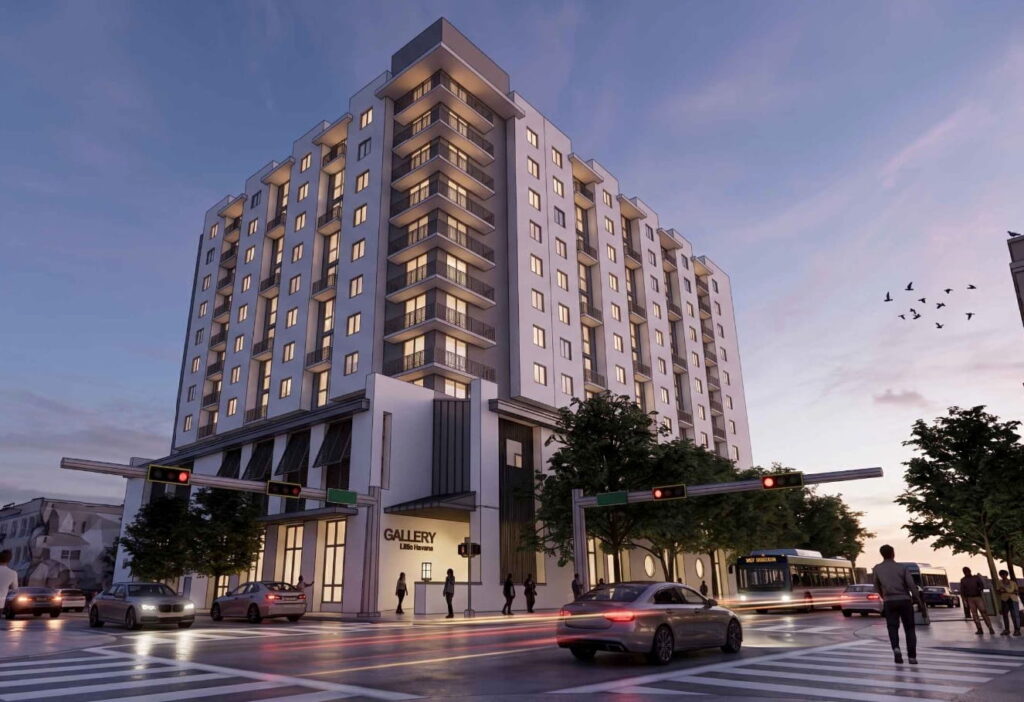
Related Urban’s next affordable housing development, Gallery at Little Havana, has been quietly advancing through the approval process, and newly submitted plans reveal several notable changes since the project was first unveiled. While the original proposal was explicitly preliminary, the latest plans refine both the building’s design and interior program as the development moves closer to construction. Located at 1275 SW 1st Street, the 12-story development will replace two three-story affordable housing buildings constructed in 1985, which together contain 21 existing units, according to property records. The redevelopment is part of a long-term partnership between Miami-Dade County and Related Urban Development Group, under which the developer has been selected to redevelop multiple county-owned affordable housing sites through long-term ground leases. The Gallery at Little Havana was first unveiled one year ago. Among the most significant revisions is an increase in residential density. The latest plans now call for 135 affordable housing units, up from 130 units in the original proposal. Apartments will consist of a mix of one- and two-bedroom floor plans in various layouts. Even with the additional units, the project remains below the site’s maximum allowable density of 170 units under the Live Local Act. The updated proposal, like the preliminary proposal, will continue to move forward under Florida’s Live Local Act, allowing the project to proceed through an administrative review process rather than the traditional public hearing process required for many large developments. The revised plans also introduce several architectural refinements. While the overall white-and-gray color palette remains, the facade has been simplified into a cleaner, more contemporary design. The most noticeable change is the treatment of the parking podium. Earlier plans relied primarily on flat perforated metal screening, while the updated proposal incorporates metal canopy elements that better conceal the garage and add greater depth to the building’s exterior. Additional facade materials include stucco finishes, floor-to-ceiling windows, metal balconies, and other contemporary architectural elements. Civica Architecture continues to serve as the project’s architect, with David O. Design leading the landscape architecture. Although the development will not include ground-floor retail space, residents will have access to amenities including a clubroom, fitness center, and leasing office. Parking will be provided through the ground floor and an integrated podium, totaling 109 spaces. While that is a reduction from the 118 spaces proposed previously, it remains well above the 70 spaces required by code despite the increase in residential units. The building will continue to rise 12 stories, reaching approximately 138 feet, representing little change from the original proposal. The additional height is made possible through the Live Local Act, which allows qualifying developments to utilize the maximum height permitted within a one-mile radius, subject to the law’s requirements. Because the project qualifies for administrative review, it is expected to move through the approval process without the lengthy public hearings commonly associated with comparable residential developments. A groundbreaking timeline has not yet been announced. Once construction begins, Gallery at Little Havana will join a growing pipeline of affordable housing projects by Related Urban across Miami-Dade County, including the recently updated Magnus Grove and Stirrup Plaza developments.
Biscayne 18 Nears Groundbreaking as Melo Group Files for Construction and FAA Permits
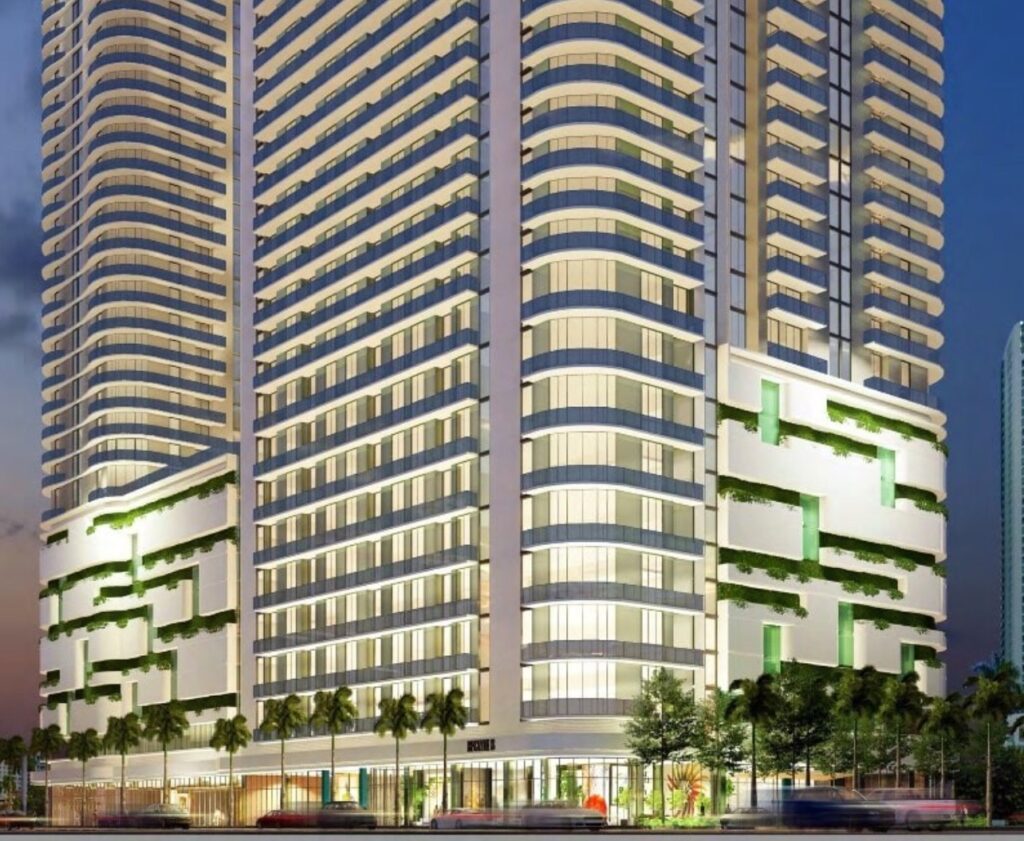
A long-vacant block along Biscayne Boulevard in Miami’s Edgewater neighborhood appears poised for redevelopment, as new permitting activity suggests construction could begin in the near future. Developer Melo Group has recently filed multiple construction permits with the City of Miami, along with Federal Aviation Administration (FAA) applications for the project’s two towers. The flurry of activity comes as the company nears completion of several major developments, including Aria Reserve and Downtown 6th, positioning Biscayne 18 as one of its next major projects. Plans submitted to Miami’s Urban Development Review Board more than a year ago call for two 45-story residential towers on a more than one-acre assemblage at 1825 Biscayne Boulevard. Melo Group acquired the property in 2019 for more than $30 million after assembling multiple parcels. According to the project’s master building permit, Biscayne 18 will deliver 1,178 residential units, split evenly between the two towers with 589 residences each. The development will also include 17,670 square feet of professional office space, 26,860 square feet of retail, and a 10,150-square-foot banquet and event hall, all located within the podium. Plans submitted to the Urban Development Review Board additionally call for 1,472 parking spaces. While construction has not officially begun, permitting activity indicates the project is moving steadily toward that milestone. The master building permit remains under review and is currently undergoing the city’s standard correction process. City records estimate construction costs at approximately $321 million, with Melo Contractors Corp. listed as the project’s general contractor. Several additional permits have also been submitted, including applications for site work and piling, tree removal, and phased vertical construction. Although each permit still requires final approval, work on-site appears to be ramping up, with construction equipment visible and initial ground disturbance already underway. The developer has also filed FAA applications for both towers. While the applications request authorization for structures reaching 490 feet, architectural drawings and city permitting documents consistently list the buildings at approximately 465 feet. It is common for developers to request slightly greater heights from the FAA than ultimately planned to provide additional flexibility during the design and construction process. The FAA is currently reviewing the applications, though approval is widely expected. Previous FAA determinations in the Edgewater area have permitted structures significantly taller than Biscayne 18, making the proposed heights unlikely to present an obstacle. Once complete, residences will range from one-, two-, and three-bedroom floor plans. Residents will also have access to an extensive amenity package, with additional details outlined in the project’s development plans.
700 North Miami Avenue Moves Into Construction After Securing $302.6 Million Loan
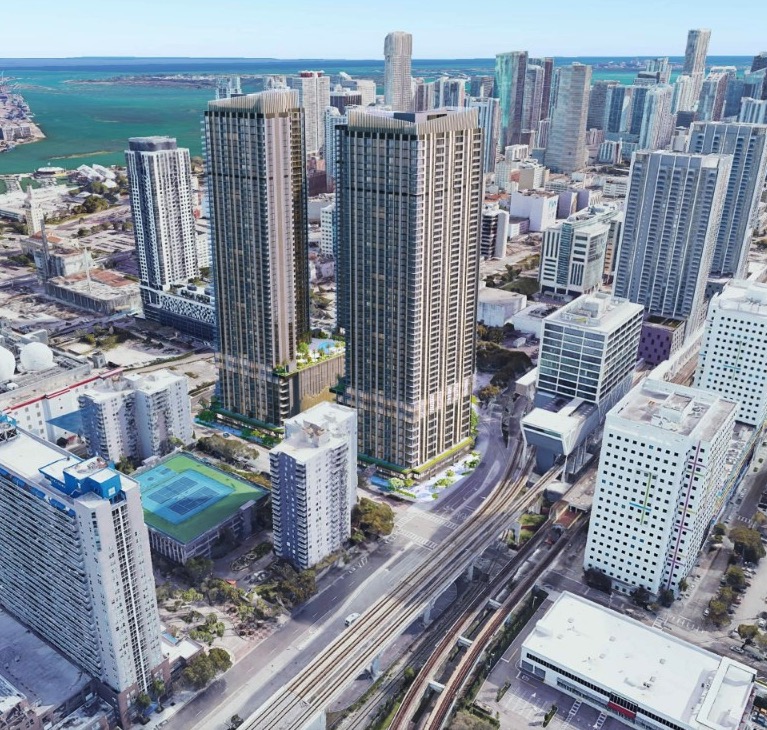
One of the final undeveloped parcels within Miami Worldcenter is officially entering the construction phase after its development team secured $302.6 million in construction financing last week. Known as 700 North Miami Avenue, the project is being developed through a joint venture between Witkoff and Monroe Capital. The financing will fund construction of the development’s first tower, the initial phase of what is ultimately planned as a three-tower residential complex. The project has been several years in the making, first appearing before Miami’s Urban Development Review Board in early 2023. According to Commercial Observer, the financing was provided by Apollo Global Management’s Athene Annuity and Life Company alongside J.P. Morgan Chase. The lenders refinanced approximately $57.3 million in existing debt while increasing the total loan to $302.6 million, representing an additional $245.3 million in financing. The first phase will deliver 894 residential units within a tower rising around 600 feet. Plans also call for 17,367 square feet of ground-floor retail and a nine-story parking garage containing 167,237 square feet of parking space with multiple vehicular entrances. While construction is beginning on only the first tower, the broader master plan is substantially larger. Documents submitted to the Urban Development Review Board a few years ago outline 2,346 residential units across three towers rising 50, 51, and 53 stories, along with 30,535 square feet of commercial space and 2,078 parking spaces. Whether construction on the remaining phases will begin shortly after the first tower remains unknown. Momentum on the project extends beyond financing. Multiple construction permits have already been filed with the City of Miami, including an approved site preparation permit. A master building permit and phased vertical construction permit have also been submitted and are currently undergoing the city’s correction process before issuance. The master permit estimates construction costs at nearly $270 million. Those approvals are already translating into visible activity on-site. Recent photographs by Ryan RC Rea and Carlos A. Lopez show work underway, with crawler cranes, excavation equipment, and other signs of active construction now present on the property. Construction will be led by Coastal Construction, which is listed as the project’s general contractor in the permitting documents. The firm is currently overseeing several other major Florida high-rise developments, including Pendry Tampa, 1775 Biscayne Boulevard, and CasaBella Residences Miami. The nearly five-acre site was acquired by the Witkoff-Monroe Capital partnership for $94 million in 2021. Located within Miami Worldcenter, the property sits just a short walk from Brightline’s MiamiCentral Station and other major transit connections, making it one of the district’s last major development sites to enter vertical construction.
Stetson University, Bromley Companies Plan Mixed-Use Redevelopment of Tampa Law Center
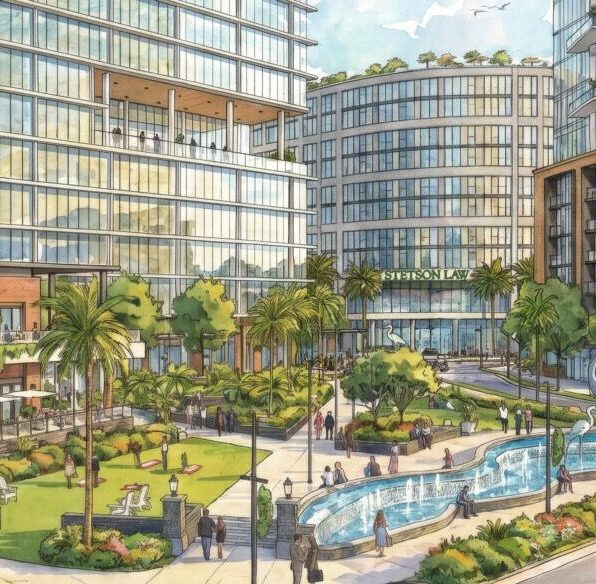
A 6.62-acre property in Tampa Heights could soon be transformed into a new mixed-use district centered around higher education, marking the latest redevelopment opportunity just north of Downtown Tampa. Stetson University, in partnership with Bromley Companies, has announced plans to redevelop its Tampa Law Center property into a mixed-use destination featuring a new academic facility, residential development, hotel accommodations, retail, and dining. Bromley Companies is no stranger to Tampa, having previously led the transformative Midtown Tampa development. Located at 1710 N. Tampa Street, the site is currently occupied by the Tampa Law Center, multiple surface parking lots, and related campus facilities. Since opening in 2004, the satellite campus has served law students, alumni, legal professionals, and the broader Tampa Bay community. At the heart of the redevelopment will be a newly constructed, multi-story Stetson Law Center featuring prominent university branding and modern academic space. According to Stetson University, the facility will support continued expansion of its Flex JD program, which provides greater flexibility for students pursuing a Juris Doctor degree outside the traditional full-time model. The new campus will also accommodate advocacy programs, professional development initiatives, micro-credentialing opportunities, and other legal education offerings. Beyond the academic component, the master plan envisions a walkable mixed-use district that would introduce new residential buildings, a hotel, retail, and dining uses within close proximity to Downtown Tampa and the Tampa Riverwalk. Stetson officials say the redevelopment is intended to modernize the university’s presence in Tampa while expanding opportunities for legal education and professional development. “This project will substantially increase our visibility while allowing us to reimagine our Tampa Law Center in a way that reflects the energy and growth of the city—and the ever-changing needs of the legal profession,” said Stetson Law Dean D. Benjamin Barros. “This is an investment in the future of legal education, professional development, and sustainable economic development in the Tampa Bay region.” Many details of the development have yet to be finalized, including building heights, hotel room counts, and the project’s architect. According to the development team, construction is expected to begin in late next year and will proceed in multiple phases. Stetson also says the new law center will be delivered in a manner that avoids disrupting current academic operations throughout construction.
Plans Revived? New FAA Filing Reveals 954-Foot Tower at Brickell’s Burger King Site
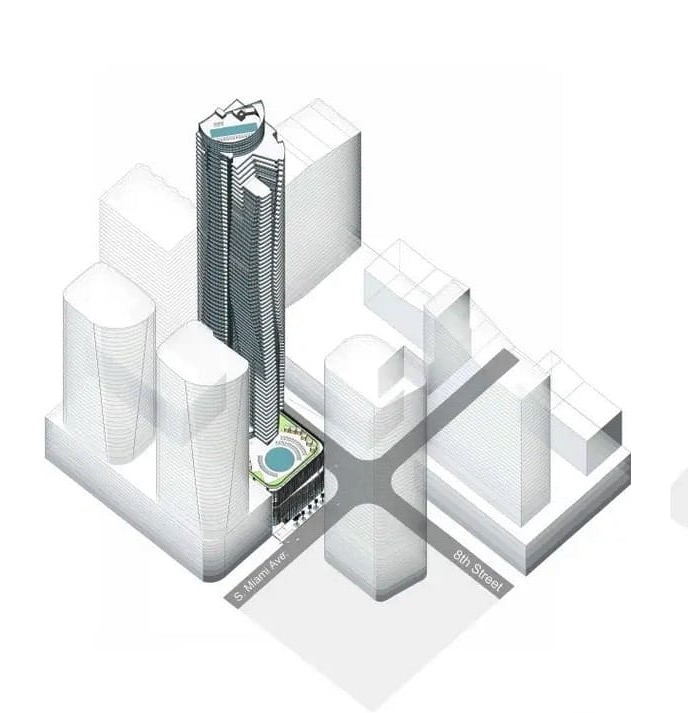
The last major undeveloped corner lot at South 8th Street and South Miami Avenue, just steps from Brickell City Centre and SLS Lux, may finally be moving toward redevelopment. While many know the property simply as the Burger King site, those familiar with Miami development know it has a long and complicated history, with multiple attempts to transform the parcel into one of Brickell’s tallest towers. That vision may once again be gaining momentum after a new FAA application was filed for a 954-foot tower. For longtime followers of Miami development, the filing may feel familiar. The application was submitted by City Center Properties, LLC, an entity associated with Simon Karam of The Karam Group, and closely mirrors an FAA filing first submitted in 2023 by The Karam Group and Claro Development. That earlier application generated excitement but ultimately led to little visible progress, with the project gradually disappearing from the development pipeline. The newly filed application now raises the possibility that the long-dormant proposal is once again gaining momentum. The 954-foot height corresponds with Tower 18, a high-rise proposal originally approved by Miami’s Urban Development Review Board in 2017. Plans at the time called for a striking curvilinear glass tower containing nearly 1 million square feet of development. According to the approved plans, the tower would include 392 residential units, 66,618 square feet of ground-floor retail, and 457 parking spaces. Residents would have access to an extensive amenity package, including a rooftop swimming pool offering some of the highest residential views in Miami, outdoor gathering spaces, and other luxury amenities. The project also proposed widening the narrow sidewalks surrounding the site, creating a more pedestrian-friendly streetscape. The FAA filing, submitted on July 10th, does not authorize construction. Rather, it evaluates whether a proposed structure would interfere with navigable airspace, making it a common early step for high-rise developments before additional permitting and approvals. Only one FAA filing has been submitted so far at the site’s coordinates (25°45’58.45″N, 80°11’38.60″W) at 10 Southwest 8th Street. However, the application notes that three additional filings will eventually be submitted to represent the remaining corners of the tower’s footprint, a typical process for large buildings. Whether the renewed FAA activity ultimately leads to construction remains uncertain. Still, after years of little to no movement, the refiling represents the most tangible sign in recent years that the long-discussed Brickell highrise may start after all.