9-Story Modern Apartment Building Proposed at 14501 W Dixie Highway in Miami-Dade
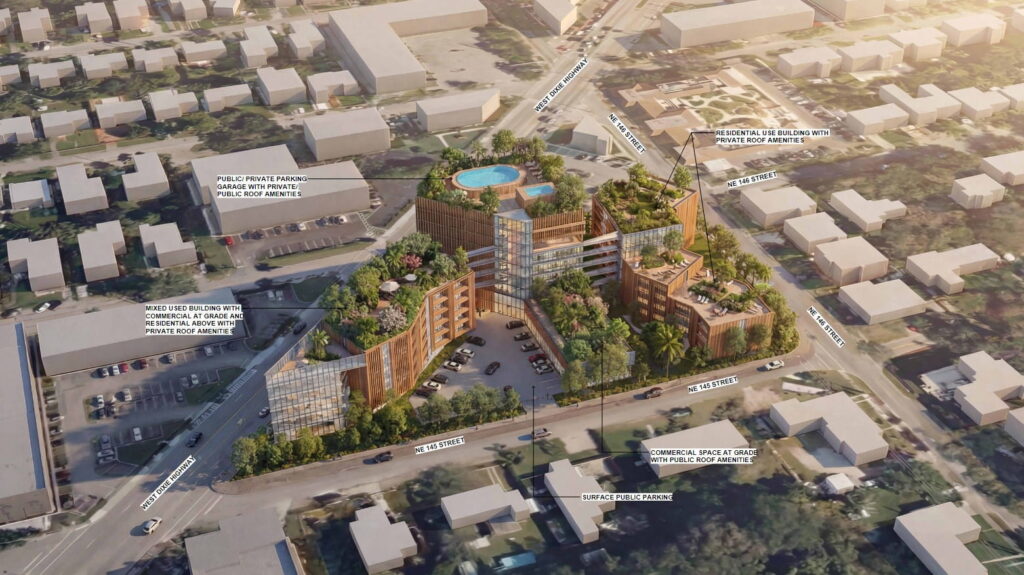
A largely vacant lot along Harriet Tubman Highway in Biscayne Gardens, an unincorporated area of Miami-Dade County just north of the City of Miami, may soon see redevelopment. On March 4th, a mixed-use proposal designed by the Gado Group and developed by RG Realty Investments was submitted to the county as a pre-application. The project envisions a modern residential building with dozens of units above ground-floor retail, introducing new housing density and activating the busy corridor with additional street-level activity. The project will rise on a 2.66-acre site spanning 14501 W Dixie Highway (Harriet Tubman Highway) and 1595 NE 145th Street, an assemblage acquired for more than $2 million. Much of the property has already been cleared following demolitions that occurred several years ago, though a small corner structure remains slated for removal. The pre-application marks the first formal step in the county’s review process, with additional filings and reviews expected before construction can begin. While plans remain in the early stages, the development is expected to include 110 apartments ranging from one- to three-bedroom layouts. One-bedroom units, measuring approximately 700 SF, will be the most common, followed by two-bedroom units at around 900 SF, and larger three-bedroom residences spanning roughly 1,400 SF. The proposed unit count slightly exceeds the site’s base density allowance of about 95 units under current zoning guidelines, meaning the developer would likely need to seek an exception as part of the approval process. Residents would have access to a variety of amenities, including rooftop lounge/seating areas, a rooftop pool and jacuzzi, and multiple rooftop garden and green space areas offering views of the surrounding cityscape. Residences are planned with 12-FT ceilings, featuring balconies and floor-to-ceiling windows. As part of the mixed-use development, the project would also include approximately 25,250 SF of retail space, primarily located along the ground floor frontage. A total of 282 parking spaces are planned to accommodate both residents and commercial visitors, both in a 9-story garage and surface parking on the south side of the site. Rising 9 stories, the development will consist of unique, interlocking structures connected by sky bridges to form a cohesive whole. The overall building height, including the parking garage, will reach 108 FT, while the residential portion itself will span up to 72 FT. The facade will showcase a palette of light blue, transparent glass, complemented by metal accents and brown vertical screenings, which will be applied to both the building exterior and the parking podium for a contemporary look. Unlike many recent South Florida projects using the Live Local Act, this development will follow the standard zoning process. A recent letter from Miami-Dade’s County Planning Division allows the property’s “Business and Office” land use category to apply across the entire site, clearing the way for the mixed-use project. Under county rules, the site could support up to 36 residential units per acre and a building intensity of up to 2.0 FAR. The developer plans to pursue a zoning change from its current business designations to formally allow retail along the corridor with housing integrated above, while including buffering to protect nearby homes (among other changes). According to Miami-Dade permitting records, no demolition permits have been issued for the remaining on-site parcel, and no permits for site work or tree removal have been filed. As this represents the first iteration of the project, the planned development, spanning over 230,000 SF, is expected to evolve over time.
Sweetwater Moves Forward With Flagler Center District Redevelopment at Former Li’l Abner Site
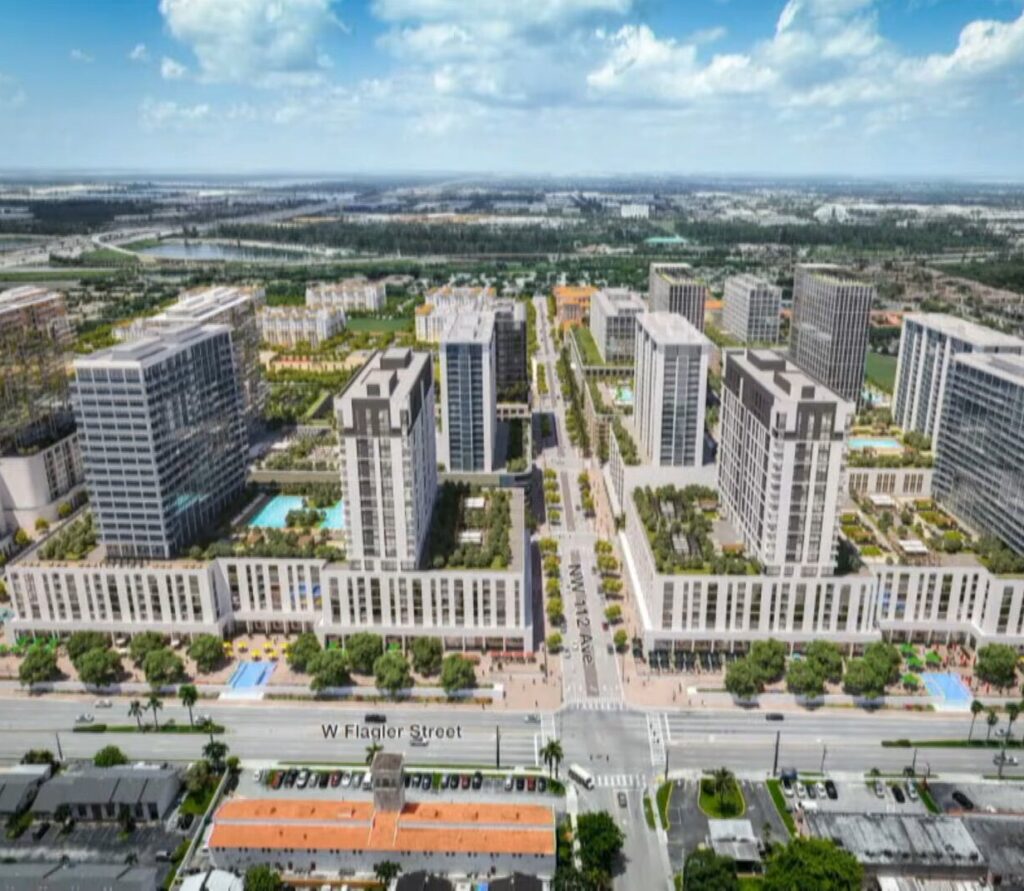
Plans to redevelop the former Li’l Abner Mobile Home Park are beginning to solidify, marking a key moment for one of the largest redevelopment sites in western Miami-Dade. The more than 90-acre property, once home to thousands of residents and now cleared, is set to transform into a dense mixed-use neighborhood known as the Flagler Center District. Plans call for residential towers, retail, medical space, community amenities, and more. Led by CREI Holdings, plans submitted to Sweetwater outline a walkable, mixed-income district poised to become the city’s largest development to date. The project has already cleared several early procedural milestones, including an initial commission reading and key land-use approvals, though additional reviews remain before the multi-phased development can begin with its first phase. With an estimated build-out cost of roughly $4.5 billion, early site plans illustrate the sheer scale and range envisioned for the community. Housing will dominate the site, with approximately 6,000 residential units proposed. Overall density is planned to be capped at about 105 units per gross acre, a figure that means potentially larger unit formats in portions of the project. The development team has also committed to delivering at least 1,000 units designated for affordable or workforce housing, with space for senior citizens. Beyond the residential component, the proposal calls for a minimum of 100,000 SF of non-residential space, though conceptual plans far exceed that limit. Potential uses include a hospital, with backup scenarios that could pivot to medical office space (or other uses) should a hospital operator not materialize. Additional program elements under consideration include hotel space, a new school, self-storage, and a significant retail presence expected to span hundreds of individual storefronts. Open space will also play a role in shaping the district’s public realm. According to the applicant, more than four acres are planned for parks and community gathering areas, fit with seating, shading, and more. As with any large master-planned project at this stage, architectural details remain in motion. Building heights have not been finalized, though preliminary plans suggest some towers could rise beyond 30 stories. Final heights will ultimately be influenced not only by local zoning but also by Federal Aviation Administration constraints tied to the site’s closeness to Miami International Airport, which could limit certain heights. On the first meeting, held on February 9th, Sweetwater commissioners approved several foundational steps that establish the framework for the project. The most significant was the creation of a new Comprehensive Plan land-use category called the Flagler Center District, which will guide how the site is planned, including how much density can be built and how the neighborhood will function overall. Officials also supported a request to update the city’s Future Land Use Map. The property, previously designated for mobile home and medium-density residential uses, would be re-designated under the new Flagler Center District category to allow the broader mixed-use vision. In tandem, the developer, CREI Holdings, is seeking zoning changes across roughly 104 acres to establish the specific development rules for the site, such as building heights, parking standards, and open-space requirements. While the former mobile home park itself spans about 95 acres, the larger boundary reflects additional land, including a nearby affordable housing property that will be incorporated into the master plan. Finally, commissioners advanced a rezoning that would replace the site’s existing designations, Trailer Park District, Interim Use, and High-Density Multifamily, with the new Flagler Center District zoning, aligning the property’s regulations with the long-term redevelopment plan. At a second meeting held on February 13, commissioners unanimously approved the first reading of an ordinance authorizing a master development agreement for the project. The agreement outlines plans for both on-site and off-site improvements, including infrastructure upgrades and roadway enhancements tied to the development. A master development agreement serves as a legally binding contract between the municipality and the developer, establishing timelines, performance standards, and other rules to ensure long-term consistency as the development proceeds. Controversy and Fears of Gentrification As redevelopment opportunities grow scarcer across South Florida, aging mobile home parks have increasingly become targets for large-scale communities. These properties almost always occupy large tracts of land at relatively low densities, making them attractive from a planning and financial standpoint. The former Li’l Abner Mobile Home Park was no exception. Spanning roughly 94.5 acres near Florida International University, the site was the target of redevelopment talks for some time. The path to redevelopment, however, has been marked by significant controversy. Residents were notified that they would need to vacate within six months, with relocation payments of about $14,000 offered to those who left early. A plethora of residents argued the compensation fell well below the value of their homes, especially for households that had invested heavily in renovations. Because mobile home residents often own their structures but lease the land, their power to influence redevelopment is limited, a problem that intensified tensions as plans moved forward. Reporting from WLRN South Florida detailed additional disputes during the site’s transition period, including allegations that demolition activity began shortly after notices were issued and before all necessary permits were secured. The property owner was also cited in connection with demolition practices involving trailers that contained asbestos, raising environmental and public health concerns at the time. Supporters of the project argue that the redevelopment represents a long-term investment in Sweetwater’s growth. The proposed district would dramatically increase density, replacing a community of roughly 900 households, estimated at 2,000 to 3,000 residents, with about 6,000 new housing units that could accommodate approximately 12,000 people. Proponents say the plan would enhance walkability, expand the local tax base, and introduce services not currently available in the area. City leaders have emphasized both the scale of the opportunity and the need for oversight as plans progress. Mayor Jose Pepe Diaz has described the redevelopment as one of the most consequential projects in the city’s history while stressing the importance of transparency and community engagement throughout the process.
After Weeks of Uncertainty, Fort Lauderdale’s City Hall Project Regains Momentum
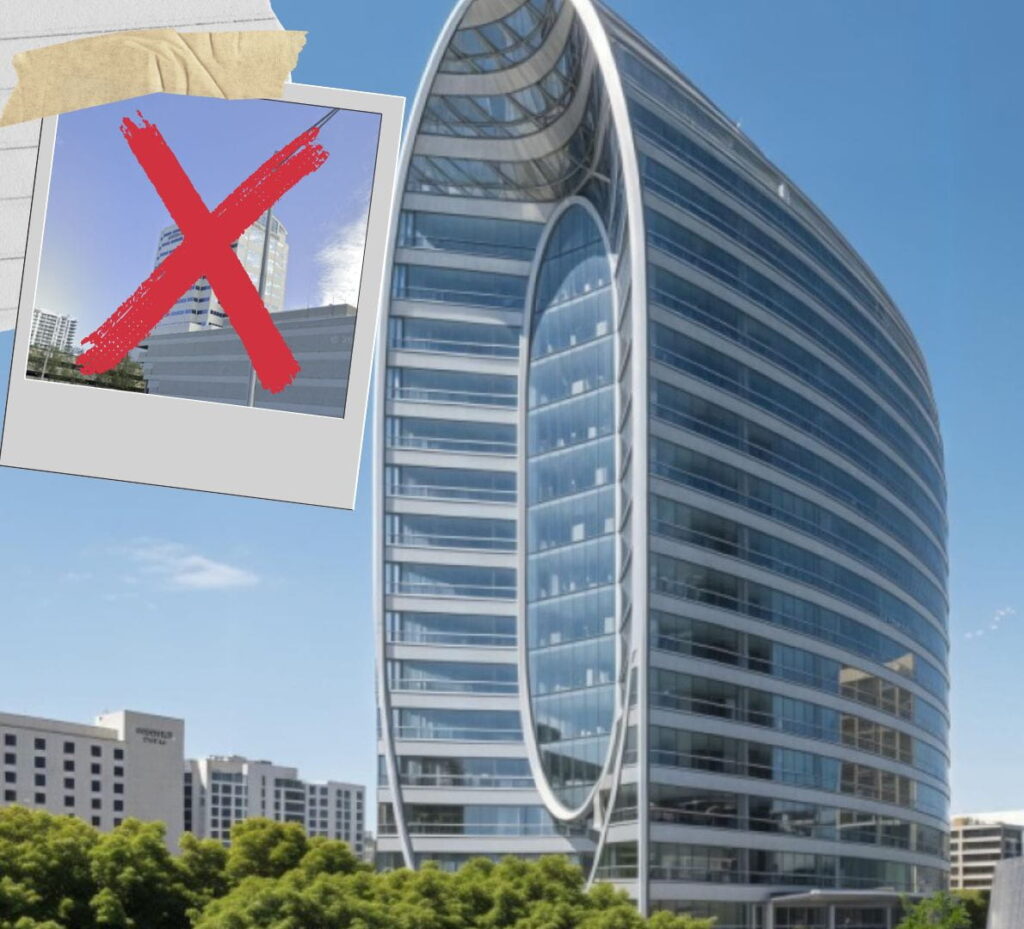
Plans to build a new state of the art City Hall in Fort Lauderdale appear to be back on course after a brief but dramatic detour that threatened to upend negotiations with a development team in favor of buying and retrofitting a nearby office tower. The shift began at the end of a January 20th commission meeting, when Commissioner Ben Sorensen raised an internal email regarding a potential sale of Tower 101, a downtown building where city operations are temporarily housed. The message, sent days earlier, relayed an unsolicited proposal from the property’s ownership. By the close of the late night meeting, Sorensen, Vice Mayor John Herbst, and Commissioner Pamela Beasley-Pittman all signaled interest in exploring the idea, placing the city’s ongoing development negotiations in question. The tower option introduced an immediate policy dilemma. Only weeks earlier, commissioners had ranked proposals and selected FTL City Hall Partners, a team led by CORE Construction, Stiles Corp., and PALMA, as the top candidate to deliver a new purpose built civic complex. Their vision called for a contemporary glass tower designed to consolidate municipal operations into a single facility. While Fort Lauderdale still has the right to revisit the process, alternatives would risk delaying negotiations and potentially undermine the competitive process. Moreover, walking away from the deal would not be inexpensive, as the city would need to cover the developer’s out-of-pocket costs in addition to a development fee, likely totaling more than $1 million. Through February, however, support for the tower began to soften. Beasley Pittman clarified that her initial interest was exploratory and later cited concerns about the cost of even analyzing the purchase. A formal evaluation of Tower 101 alone, including appraisals, surveys, and title work, was estimated at roughly $120,000 dollars. Beyond that, commissioners acknowledged the likely expense of bringing the building up to modern standards, from impact resistant glazing and mechanical upgrades to redesigned public meeting space. Mayor Dean Trantalis and Commissioner Steve Glassman opposed the pivot throughout, framing it as a distraction from a process already well underway. Trantalis warned publicly that entertaining purchase offers could open the door to additional unsolicited proposals, a prediction that quickly materialized when the owners of 1 East Broward floated their own potential sale at roughly $122.5 million dollars. As reported by the Sun Sentinel, which has tracked the issue throughout, Mayor Dean Trantalis said “Every building on the block is going to come to us now and say, ‘Buy me, buy me.’ I thought we made a commitment. I thought we had a vision. I thought we were looking to the future. Has that changed?” Despite the cooling enthusiasm, lobbyists for Tower 101 continued pressing their case. During a February meeting, a representative urged commissioners to keep the conversation alive, prompting a sharp rebuke from Glassman, who argued the city should remain committed to its chosen path rather than revisit alternatives. Underlying the debate was a fundamental disagreement over cost. Herbst and Sorensen maintained that acquiring an existing tower could ultimately save tens of millions compared to new construction. Skeptics countered that renovation costs would likely erode much of that advantage, particularly given the specialized needs of a civic building for a city the size of Fort Lauderdale. The urgency surrounding the decision originates from the city’s current circumstances. Fort Lauderdale has been without a permanent City Hall since April 2023, when a historic rain event flooded the basement of the former building, destroying critical infrastructure (servers, electricity, etc) and forcing its eventual demolition. The cleared site has since been earmarked for redevelopment. With the commission now refocusing on negotiations with FTL City Hall Partners, the project is expected to proceed in stages, including an interim agreement followed by a comprehensive development deal. Still, a degree of uncertainty remains. Officials continue to monitor a potential statewide ballot measure that could reduce property tax revenues for homestead properties, a change that might require further cost adjustments or value engineering before final approval. For now, after weeks of political talk and competing ideas, the city’s direction appears steadier. The emphasis has returned to delivering a new civic headquarters, even as financial and design details continue to evolve.
2900 Terrace Continues Vertical Ascent in Miami’s Edgewater Neighborhood
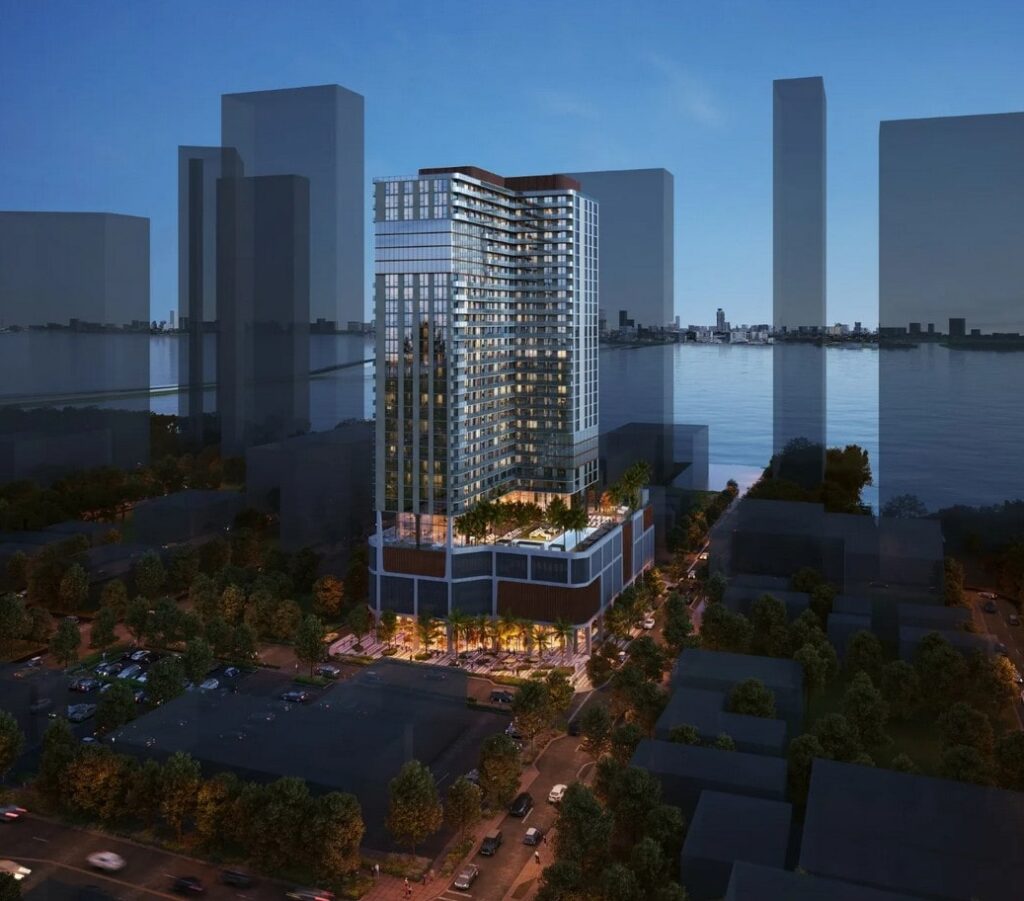
Construction at 2900 Terrace is advancing at a rapid pace in Miami’s Edgewater neighborhood, with the tower now rising through its fourth floor. Developers Oak Row Equities and LNDMRK Properties are targeting a fourth-quarter 2027 completion, as a seasoned project team, including Coastal Construction as general contractor, L&R Structural as shell contractor, and Arquitectonica as architect, maintains a vertical pace of roughly one floor every week and a half. The 32-story building will ultimately deliver 324 rental units and is expected to top out within the next few months. Vertical work accelerated following a $210.5 million construction financing package led by Bank OZK and Canyon Partners Real Estate. Although foundation activity and crane installation were already underway prior to the ceremonial groundbreaking, progress has notably intensified since financing closed. View this post on Instagram A post shared by L&R Structural Corp. (@lrstructural) At completion, residences will span one- to three-bedroom layouts, featuring 10-FT ceilings, floor-to-ceiling glazing, and expansive wrap-around balconies. Planned amenities include content creation studios, a yoga and fitness center, sauna, and a resort-style pool deck with outdoor lounge areas, among other uses: creating a diverse lifestyle package geared toward luxury renters. Permitting records with the City of Miami show the project has secured its master construction permit alongside several miscellaneous permits, including shoring and life-safety systems, clearing the path for vertical construction. The master permit also reflects 15,536 SF of ground-floor retail, a modest reduction from the more than 16,000 SF planned in earlier site plans. Retail will be complemented by a large residential lobby, an open-air plaza, and access to a 504-space structured garage. Rising to approximately 360 FT, the tower will not rank among the tallest in Edgewater, but will stand out for its almost full-block footprint, according to construction imagery released by L&R and site plans. In fact, the total site at 401 NE 29th St will span 1.5 acres. The project’s momentum comes as Oak Row expands its South Florida presence. The firm recently partnered with OKO Group and Mariposa Real Estate on the $520 million acquisition of a 4.25-acre waterfront assemblage in Brickell, emphasizing the developer’s growing pipeline across Miami.
1414 Brickell Moves Forward as Revised Plans Introduce Design Tweaks
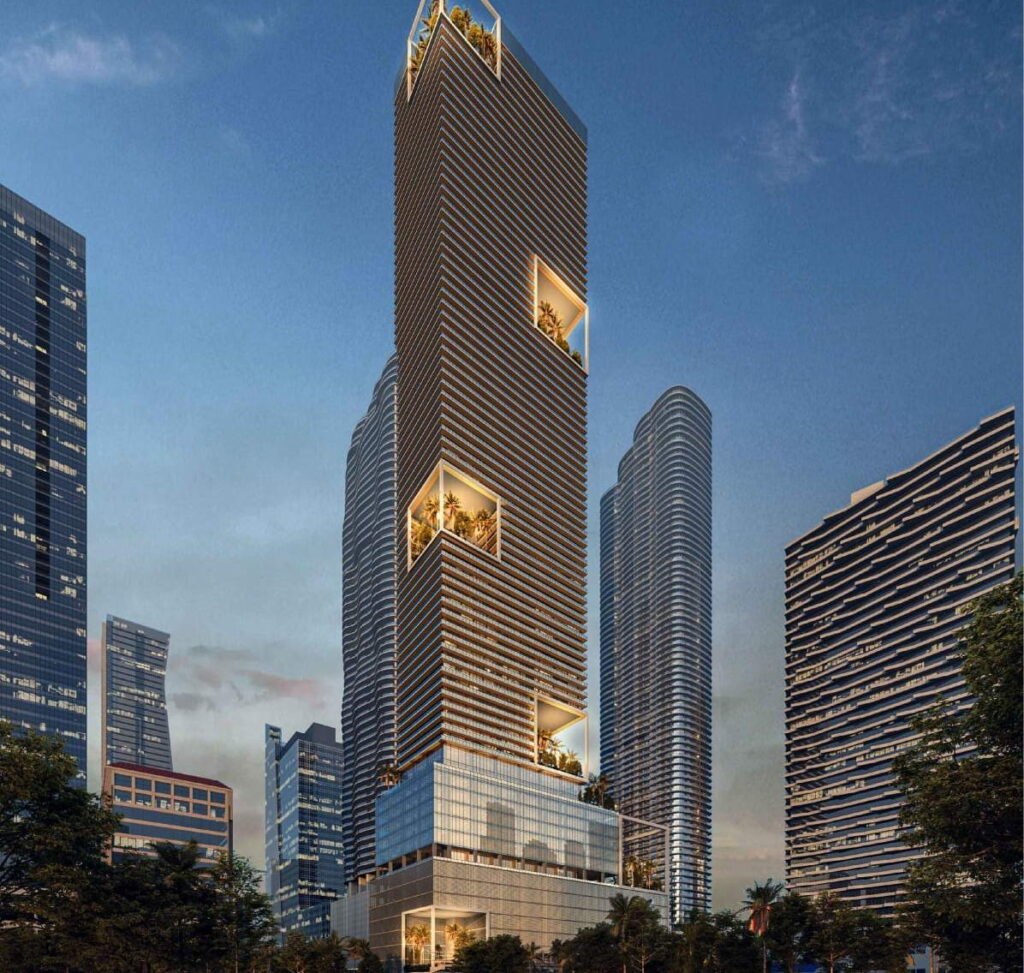
Plans for 1414 Brickell continue to take shape as revisions move through the review process with Miami-Dade County. The proposed supertall, designed by Arquitectonica and developed by Fortune International Group, would rise 81 floors and, if built, become the first supertall tower in Brickell. The newest plans, released within the past few days, represent the latest adjustment in a sequence of filings since the project first surfaced in late 2024, with updated renderings following in early 2025. The project spans an assemblage at 1421 S Miami Avenue and 1414 Brickell Avenue, combining three parcels that are now under Fortune’s control. Records show the primary parcels were assembled in the early 2000s, reflecting a lengthy hold period prior to the emergence of a development proposal. Development capacity at the site is enabled through a Rapid Transit Zone (RTZ) subzone designation approved on February 21st, 2024. RTZ zoning, a Miami-Dade framework applied along major transit corridors, permits increased height and density compared with existing zoning, and has become a commonly used entitlement path for large-scale projects in the Brickell area. The latest plans showcase 560 residential units alongside 84 hotel keys, unchanged from the last iteration. While unit mixes remain preliminary and subject to refinement, the residential component is expected to include studios as well as one-, two-, and three-bedroom layouts. Hotel accommodations would range from approximately 315 SF to 1,024 SF, depending on configuration. Amenity offerings are centered on a rooftop pool at the uppermost level and a dedicated 2-story sky amenity deck totaling 10,629 SF of indoor space. Additional residential features have not yet been fully detailed. The hotel component is planned to include a fitness center and spa, lobby bar, lap pool, poolside grill, and outdoor lounge seating. At street level, plans call for 6,141 SF of retail space, activating the frontage with neighborhood-serving uses along with a drop-off zone and gallery. The podium will accommodate 1,156 parking spaces, while the levels above feature 117,310 SF of office space (or 145,950 SF gross). These figures highlight several refinements from previous submissions. Office SF remains consistent, but retail SF has been modestly increased by roughly 100 SF. Parking, meanwhile, has been reduced from 1,226 to 1,156 spaces, representing a cut of nearly 100 stalls as the program continues to be optimized. One of the most notable revisions involves changes to the tower’s exterior. Earlier elevations depicted a more cohesive podium, with continuous glazing wrapping the office levels and concealing the garage below, creating the appearance of a seamless base rather than a distinct parking podium. Updated renderings, however, show the podium clad in a metal mesh screen, a clear value-engineering shift from the prior design. Despite the material changes, the tower’s height remains intact, with plans for it to rise 81 floors (or approximately 1,010 FT): placing it just above the internationally recognized supertall threshold of 984 FT (300 M). Although the project has been advancing through multiple iterations, the current submission is not expected to be final. According to a project representative, the ultimate development package will be processed under a separate Administrative Site Plan Review (ASPR) filing, which has not been submitted. As per both Miami-Dade permitting and the City of Miami, no demolition permits or foundation work permits have been applied yet.
32 Hundred Proposed in Downtown Coral Springs, Set to Feature 300 Units
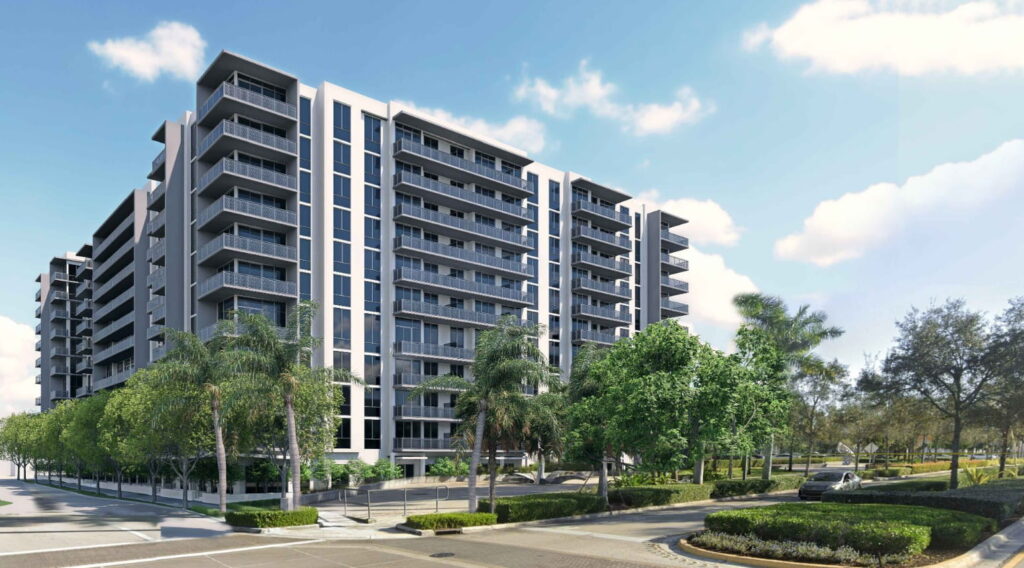
In Coral Springs, a quiet Broward County suburb nestled between Pompano Beach and Fort Lauderdale, a developer has submitted plans for the city’s tallest development. Called 32 Hundred, the project will rise 11 stories atop Downtown Coral Springs’ Bank of America Building. Developer Cade Capital Partners is planning 300 units on the west side of the property, alongside a replacement structure for Bank of America on the left. Facing University Drive, 32 Hundred will be among the many mixed-use developments planned for Downtown Coral Springs. Located at 3200 N University Drive, the 3.06-acre lot sits directly adjacent to Modera Coral Springs, part of the Cornerstone development in Downtown Coral Springs: a broader effort to revitalize the area. Cade Capital Partners currently owns the property, having initially purchased it for $2.125 million in late 2012. According to plans submitted to Coral Springs’ Architectural Review Committee, 32 Hundred’s 300 units will be divided into studio, one-bedroom, two-bedroom, and three-bedroom configurations, with one-bedroom units being the most common, ranging from 650 SF to 815 SF. Most units will feature 10-foot ceilings, large floor-to-ceiling windows, and wrap-around balconies. Other units will have even taller ceiling heights, some at 12 FT to 13 FT. As is typical with early-stage developments, the full amenity package remains subject to change. What is known is a large pool and deck with outdoor seating, alongside more than 8,000 SF of indoor amenity space encompassing co-working space, a mail room, and additional uses. The ground floor will dedicate 17,020 net SF to commercial uses, of which 5,350 SF will be solely reserved for a bank, likely the replacement Bank of America. The ground floor will also feature a four-lane bank drive-through, expanded sidewalks finished with pavers, and abundant greenery. The multifamily structure on the west side will be wrapped by units on all frontages, with lobby space and units extending to the ground floor as well. To accommodate the influx of retail, banking, and residents, the development will include a total of 439 parking spaces spread across the parking garage and ground floor. Designed by Behar Font Architects, 32 Hundred will rise 11 stories to 127 FT at its tallest point. According to TAPinto Coral Springs, which first reported on the project, the Architectural Review Committee raised several concerns during its initial review weeks ago, including parking podium visibility, balcony railing materials, and potential vertical breaks in the facade given the building’s height. Next up is Coral Springs’ City Commission, which will analyze the finalized project for denial or approval, though it was not on the most recent agenda.
PMG Proposes Delano Residences, Miami’s Second Supertall Skyscraper at Nearly 1,000 Feet
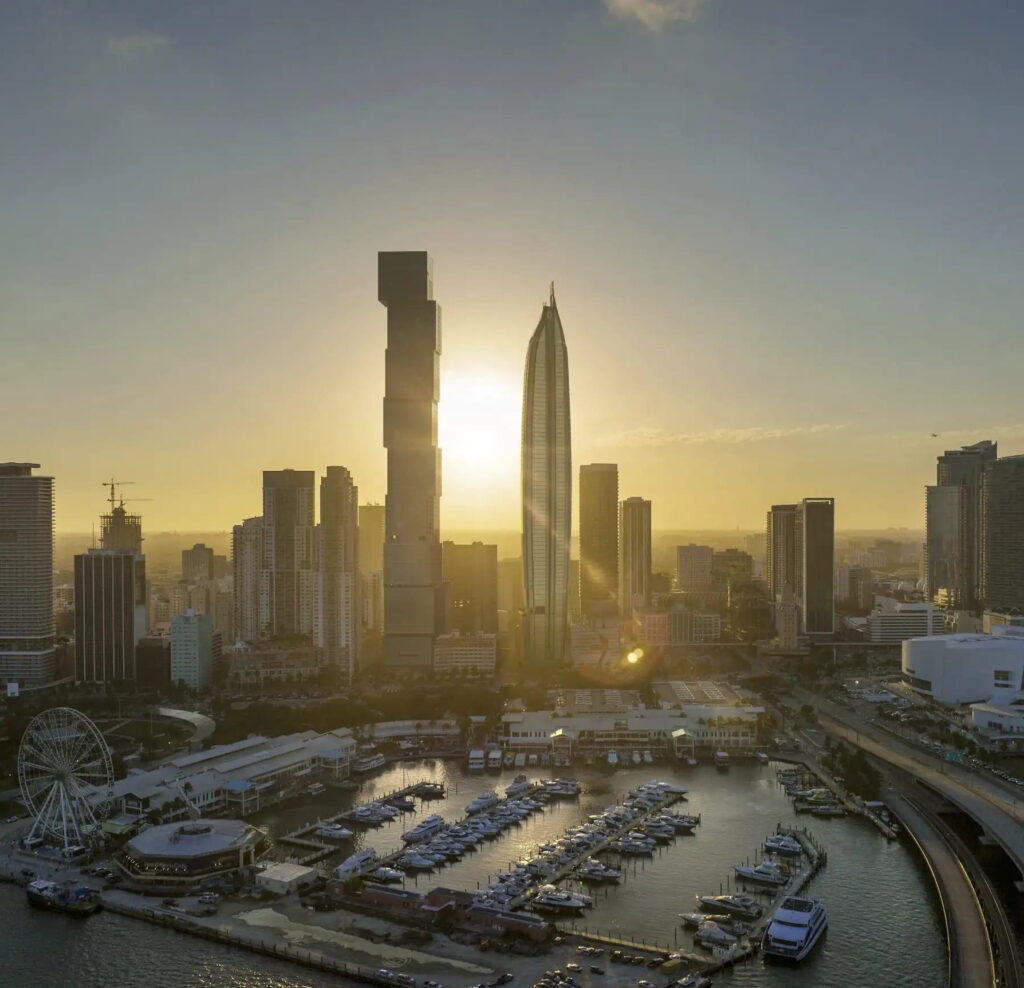
Miami has seen an influx of supertall proposals since the turn of the century, but few developers have advanced beyond renderings to actual construction. PMG stands alone as the developer behind Miami’s first supertall, Waldorf Astoria Residences, which is currently under construction. The company has now released plans for Delano Residences, a 90-story condominium tower rising 985 FT on Biscayne Boulevard. The project marks a partnership between PMG and Ennismore, owner of the internationally acclaimed Delano hotel brand, and will deliver 421 residential units. The new development will be located at 400 Biscayne Boulevard, directly adjacent to the Waldorf Astoria Residences. The 0.4-acre site was acquired by PMG in early 2018 for $55 million from the First United Methodist Church of Miami. Though the developer listed the property for sale in 2024, plans have since shifted toward developing the site themselves. With sales now launching, the developer anticipates achieving pre-sales milestones to support a groundbreaking in 2027. Residences will start at approximately $800,000, with interior design by Meyer Davis. The exterior design, characterized by a distinctive curved form, is being handled by Carlos Ott Architecture and Cube 3. The development will include studio, one-bedroom, two-bedroom, and three-bedroom residences. Units feature custom kitchen cabinetry, custom bathrooms, and modern finishes. Residents will have access to a comprehensive amenity package including a resort-style pool, lounge areas, a sky pool, fitness center, spa, and additional Delano-branded resort amenities. The tower does not include a traditional parking podium. While detailed site plans and elevations have not yet been released, the development is expected to utilize off-site parking through the adjacent Waldorf Astoria and X Miami (now named Alea) developments. Residents benefit from 24-hour doorman and reception services, valet parking, and concierge offerings. The tower’s upper levels will feature Miami’s tallest observation deck, complete with a cantilevered glass platform offering views of Edgewater, the Atlantic Ocean, and surrounding Miami landscapes. The development will also include food and beverage venues such as Cafe Delano, the Rose Bar, and a sky-level restaurant. The construction timeline for Delano Residences is expected to be substantially shorter than that of Waldorf Astoria. According to PMG, groundbreaking is anticipated in 2027, with construction projected to take approximately four years. The accelerated timeline reflects lessons learned during Waldorf Astoria’s development, particularly regarding foundation work and engineering solutions for Florida’s climate conditions. Ryan Shear, managing partner at PMG, told CoStar, “We feel incredibly equipped. We’ve done it before,” emphasizing the company’s confidence in executing the project successfully and on-time.
NOMI 7|90 Planned Near North Miami Through Florida’s Live Local Act
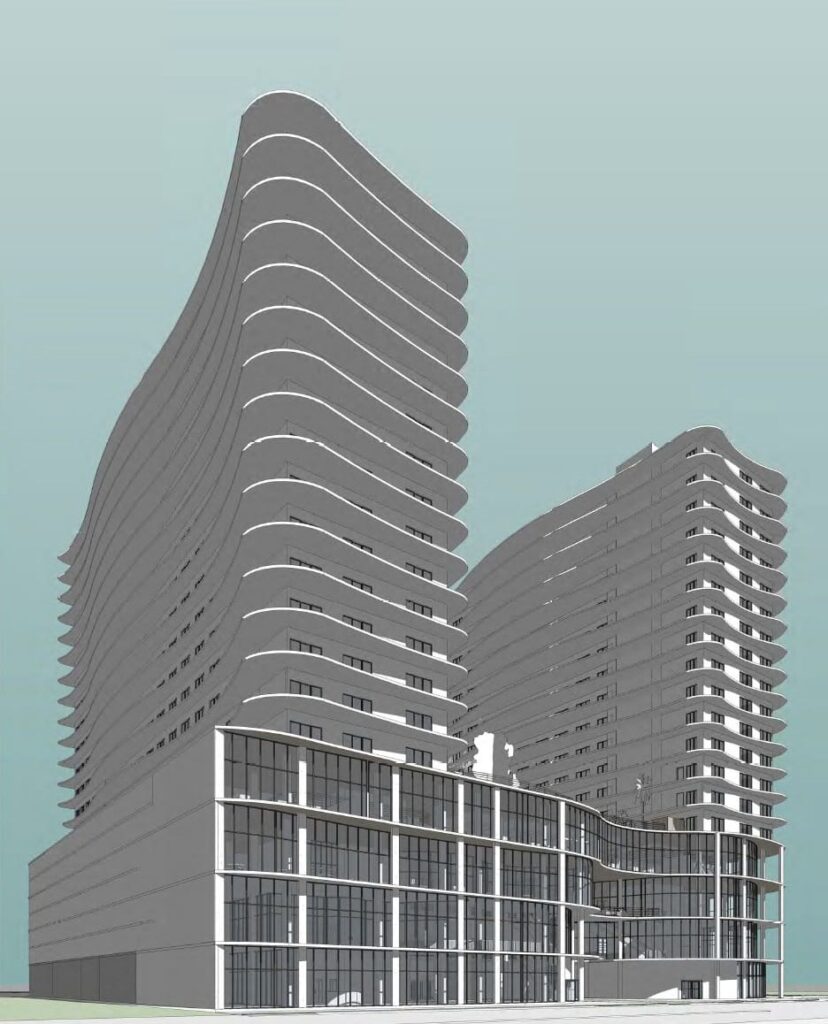
Florida’s Live Local Act continues to reshape South Florida’s development landscape, with yet another project emerging in a relatively underdeveloped corridor. 306 WW LLC and The Mimosa Group, operating under the Cobas Family, have filed plans for NOMI 7|90, a 19-story multifamily development along NW 7th Avenue in Miami-Dade. The project is pursuing height and density bonuses through the Live Local Act and Miami-Dade County’s Workforce Housing Development program, mechanisms that allow the development to substantially exceed what conventional zoning would permit on the site. The development site is located at 9001 NW 7th Avenue and 663 NW 90th Street, consisting of a 2.9-acre assemblage across two parcels. The Cobas Family acquired the first parcel in 2015 for $650,000 and the second in 2021 for $2.02 million. The site has remained largely undeveloped until now, with the land assembly representing a six-year accumulation strategy by the developers. The widespread adoption of Live Local projects across Florida demonstrates the program’s growing effectiveness as a tool for developers targeting corridors that have historically lacked high-density construction. Designed by Red Octopus Architecture, NOMI 7|90 will represent the first completed highrise in the area, despite The Emblem Tower’s earlier attempt at a similar 139-unit development that appears stalled for now. Plans submitted to the county outline a mixed-income 480-unit community. The project includes 192 units priced at 120% of the Area Median Income, 60 units through Miami-Dade’s Workforce Housing Development program priced at 140% AMI, and 228 market-rate units. The income-restricted allocations reflect requirements tied to two separate programs. The State’s Live Local Act mandates that at least 40% of units be priced at or below 120% AMI, while Miami-Dade’s Workforce Housing Development program offers incentives for developments that include units priced at 140% AMI or below. By satisfying both program thresholds, NOMI 7|90 can stack both the height and density bonuses each provides. While still preliminary, the unit mix includes studios, one-bedroom, and two-bedroom apartments. Amenity spaces are distributed throughout the building, with a fifth-floor deck featuring a pool, outdoor seating, landscaping, and terrace areas, while a lower level includes a business center, fitness center, playroom, and meditation room. The development will provide 553 parking spaces in the podium, equating to at least one space per unit. However, the project qualifies for substantial parking reductions under both the Live Local Act, which permits a 100% reduction, and Miami-Dade’s Workforce Housing program, which allows a 25% reduction. These incentives effectively reduce the parking requirement well below what would otherwise be mandated. In addition, retail space extends across three levels of the podium, with the ground floor encompassing 12,158 SF alone. The development also incorporates expanded landscaping throughout the site and widened sidewalks finished with pavers. The tower will rise 19 stories to approximately 223 FT at its highest point. Under conventional zoning, the site would be limited to 12 stories; however, the Live Local Act permits 13 stories within a one-mile radius, and Miami-Dade’s Workforce Housing program provides an additional six-story bonus, bringing the total to 19 stories. Designed by Red Octopus Architecture, the building features an active ground floor wrapped in glass with curved forms, while the upper volumes maintain a more rectangular profile complemented by curved balconies. According to recent site photography, the parcels remain undeveloped with existing structures still standing. Should the developer proceed with construction rather than pursue alternative strategies such as selling the development rights, both on-site buildings will require demolition. Given that neither structure exceeds one story, removal will be relatively straightforward.
House of Wellness Enters Pre-Construction Phase in Brickell; Renderings Released
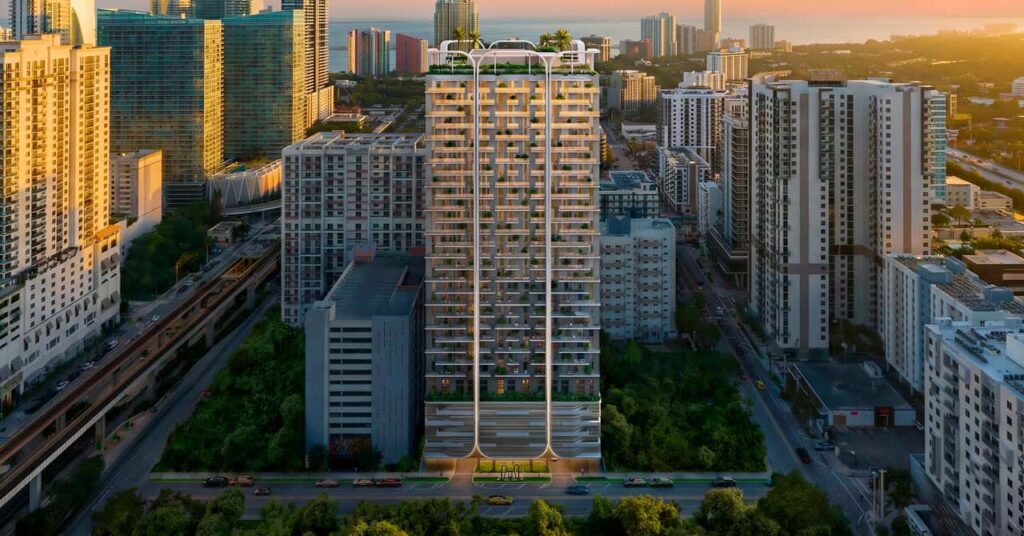
The House of Wellness project is entering its pre-construction stage, with newly released interior and exterior renderings coinciding with the start of sales. The 34-story tower, planned for three assembled parcels at 132, 142, and 152 SW 9th Street in West Brickell, is being developed by North at Brickell VI, LLC and designed by Studio MC + G Architecture. After several iterations over recent months, the proposal now appears largely finalized as the development team awaits final approvals from Miami-Dade County. The developer, a joint venture between Oak Capital and Edifica, brings an international portfolio spanning the United States and Latin America. In Brickell, the partnership is already active on multiple fronts, with Domus Brickell Center under construction and Domus Brickell Park approaching completion. Given the development activity from the duo, this likely won’t be their last project either. Plans filed with Miami-Dade County detail a program totaling 656 lodging units, designed to accommodate both short-term and extended-stay occupancy depending on owner preferences. The unit mix ranges from compact studios, to one-bedroom layouts, and larger two-bedroom residences. Amenities are centered around a wellness-oriented lifestyle, including a rooftop pool, spa facilities, a juice bar, dedicated wellness spaces, and multiple social lounges. Units will feature 9-FT-4-IN ceilings, expansive balconies in select layouts, “premium appliances”, and large windows designed to maximize natural light. Depending on orientation and floor level, residences will offer views toward Brickell, Little Havana, and surrounding areas. Pricing guidance circulated by several brokerage firms, including Miami Residential, indicates entry-level units are expected to start in the low-$400,000 range, with pricing rising to roughly $800,000 for larger layouts. For the 656 lodging units, the development will include 199 parking spaces in the podium, despite Miami code requiring zero parking spaces. This parking to units ratio is particularly due to the unit type being lodging units, but also due to proximity to the Metrorail nearby. While the development features no retail on the ground floor, the existing site’s landscaping and sidewalk width will be expanded. Current sidewalks expand 6 FT, with the new sidewalks expanding it beyond that. In addition, the ground floor includes bike parking and a dedicated drop-off zone for residences, handled by an in-house valet parking service. Because the project will rise 34 stories, it is expected to reach an overall height of approximately 366 FT. The facade will feature a predominantly gray palette with stucco finishes, glass balcony railings, and a more colorful treatment at the podium level. Earlier iterations of the project contemplated a taller structure rising 44 stories, or roughly 456 FT, indicating the developer has since reduced the height by a whopping 10 floors. Current site conditions show no visible construction activity, though permitting activity remains active, with early inklings of a demolition permit moving through the pipeline.
Insite Group Moves Forward on Two New Live Local Act Projects: 2620 and 910 Residences
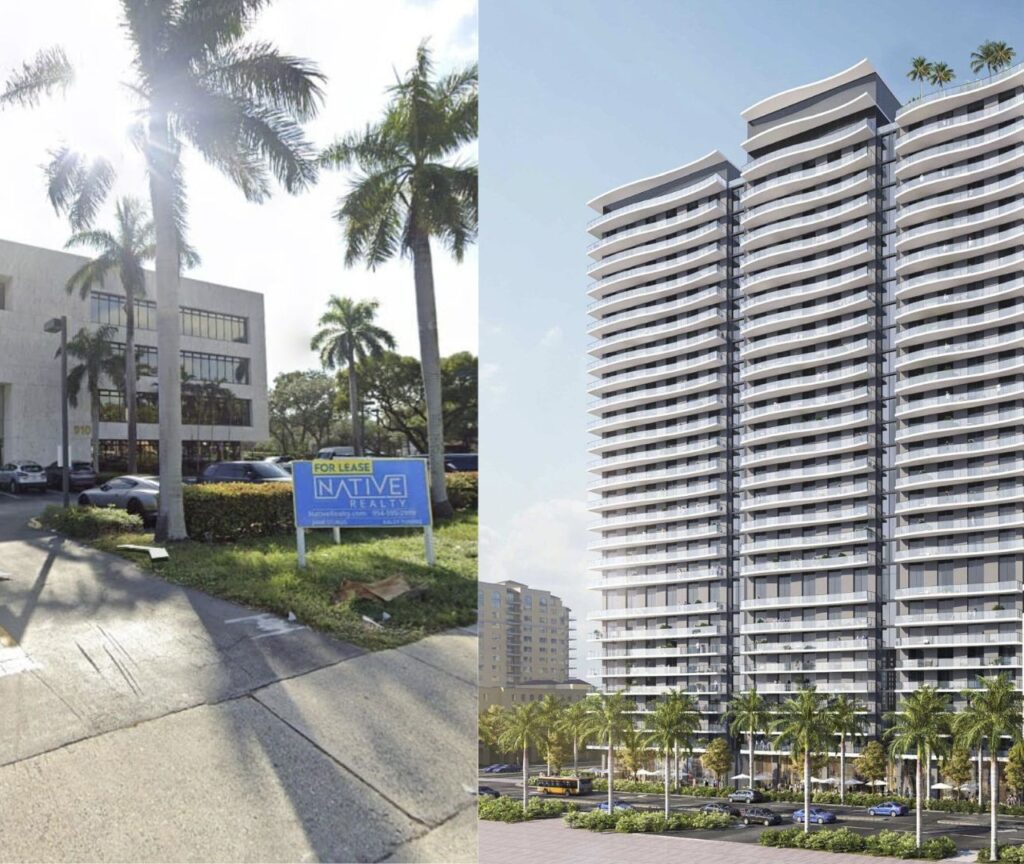
Fort Lauderdale-based Insite Group is advancing a growing slate of projects under Florida’s Live Local Act, continuing its push for high-rise development across the city. After submitting plans to redevelop The Galleria at Fort Lauderdale in partnership with GFO Investments, Atlas Real Estate, and Prime Finance, the firm now has two additional Live Local proposals moving through early review stages: one adjacent to the Galleria site and another in the Harbordale neighborhood. Near The Galleria, Insite has proposed 2620 Residences, a Live Local Act development that has been submitted to the City of Fort Lauderdale’s Planning Department for administrative review. While full plans and renderings have not yet been released publicly, the project is being processed under the state housing law, which allows qualifying developments to bypass certain local zoning restrictions. The second proposal, 910 Residences, would introduce a tower exceeding 300 FT in the Harbordale neighborhood. Insite has filed Federal Aviation Administration permits and submitted materials to city planners, signaling early-stage advancement. Because most parcels in Harbordale do not permit heights approaching 300 FT under current zoning, the project would move forward under the Live Local Act framework. If advanced, it would become the neighborhood’s second Live Local Act proposal, following the previously proposed The Quay nearby. 2620 Residences: Located just east of Insite Group’s proposed Galleria Mall redevelopment, the firm has submitted plans for a 27-story tower at 2620 E Sunrise Boulevard (on a 2.7-acre parcel). The site was acquired in mid-October for $13 million by an Insite affiliate, FLL Galleria PA LLC, around the same time the broader Galleria Mall property changed hands. It is not yet clear whether Insite is partnering with other developers on this specific tower, though the company has previously worked alongside GFO Investments, which maintains stakes in multiple Live Local Act projects statewide. According to plans submitted in December, 2620 Residences would contain 525 residential units, including 310 market-rate apartments and 215 workforce housing units priced at or below 120% of Area Median Income. The project also includes an amenity deck with a pool and lounge areas, as well as a structured, multi-level parking garage partially wrapped with residential units. Ground-floor plans show a main residential lobby and approximately 20,409 SF of commercial space. The proposal remains under administrative review, with the city’s planning record currently listed as open. 910 Residences: Plans for 910 Residences appear to be advancing ahead of 2620 Residences, with submissions predating its counterpart and FAA applications already filed. Located at 910 SE 17th St, this represents the Insite Group’s second proposed development on the site. Several months ago, the firm submitted plans for a 14-story mixed-use project, which would have included 393 hotel rooms and 103 residential units. The revised proposal shifts entirely to residential use. Current plans outline 520 units, including 312 market-rate apartments and 208 workforce housing units priced at or below 120% of Area Median Income. The development would also include 6,575 SF of ground-floor retail space, removing the previously proposed hotel component. According to FAA applications filed February 12, the tower would reach a maximum height of 393 FT above ground level. Three heights were submitted, 355 FT, 381 FT, and 393 FT, suggesting a stepped massing design. At 393 FT, the structure would substantially exceed the 156-FT height contemplated under prior zoning-compliant plans and would likely rise beyond 35 stories. Renderings have not yet been released publicly. While no renderings have been released publicly, Floridian Development will produce one once plans become available. The design is expected to be modern, featuring expansive windows and spacious balconies, consistent with other Insite Group developments.
Avalon Bay Communities Proposes Kanso Coral Way, Located at 2340 SW 32nd Avenue
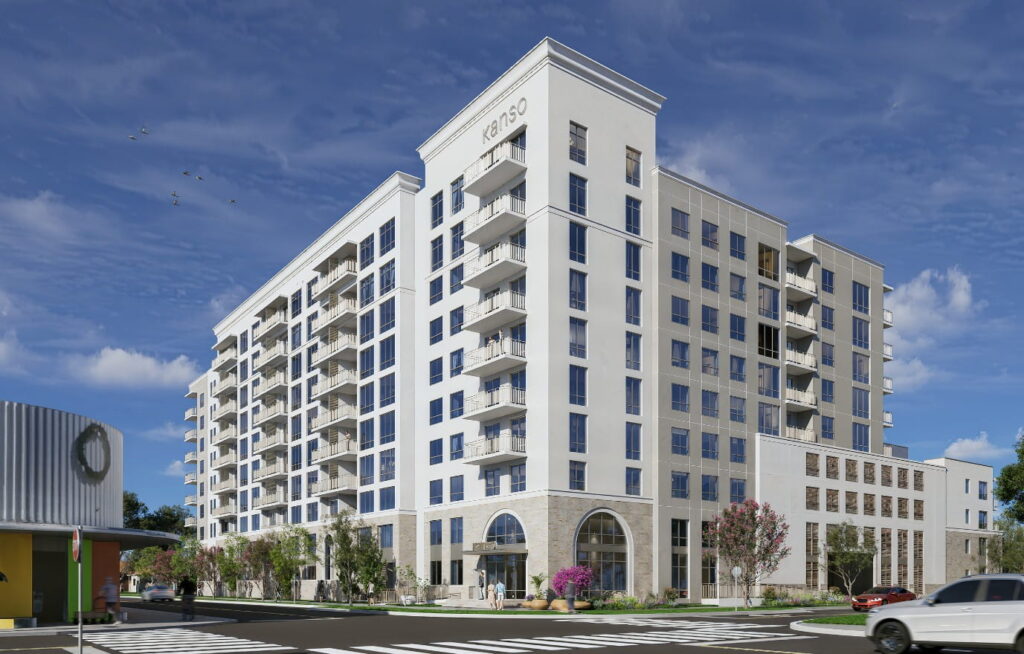
Development activity near Coral Gables continues to accelerate, as AvalonBay Communities has filed plans for a new multifamily project in the City of Miami. The proposal, scheduled for review by Miami’s Urban Development Review Board on February 18th, 2026, calls for a Mediterranean-inspired apartment building designed by Baker Barrios. Branded as Kanso Coral Way, the project would rise several stories and deliver 166 residential units within a 302,420 SF structure. The development site, located at 2340 SW 32nd Avenue, consists of a 1.6-acre assemblage spanning six parcels between Southwest 23rd Street and Southwest 23rd Terrace. One of the parcels is currently occupied by a former wedding hall. AvalonBay acquired the properties for more than $11 million late last year, positioning the national apartment developer for entry into this area of the Miami market. This marks the second major proposal for the assemblage, when the site was previously approved for a project known as Renaissance at the Gables, which secured UDRB approval several years ago for a 102-FT-tall building containing 269 units and 113 parking spaces. Despite receiving design approval, that iteration never advanced beyond the entitlement stage. The 166-unit development includes 21 studios, 75 one-bedroom units, 39 two-bedroom units, 18 one-bedroom lofts, 5 two-bedroom lofts, and 8 three-bedroom residences. Unit sizes will range from approximately 542 SF to 1,808 SF. Because the 1.6-acre assemblage carries two zoning designations, one permitting lower density (due to proximity to single family homes), the building massing responds accordingly: the western edge of the site steps down to a three-story portion, while the primary eastern volume rises to eight stories. Planned amenities include landscaped patio areas, a resort-style pool deck, BBQ grilling stations, and other shared outdoor spaces. The project provides 242 parking spaces within a podium and on-street. Under Miami’s parking code, the development would typically require 264 spaces (calculated at 1.5 spaces per dwelling unit plus 1 visitor space per 10 units). The developer is therefore seeking a 10% parking reduction to accommodate the proposed supply. Although no ground-floor retail is proposed, the plan meaningfully incorporates pedestrian-orientated improvements such as widened sidewalks and enhanced landscaping to strengthen safety and aesthetics on the main frontage. The parking podium is also largely wrapped with residential units, minimizing an imposing parking podium. According to elevations prepared by Baker Barrios Architecture, Kanso Coral Way will rise to approximately 111 FT at its highest point. The exterior materials include smooth stucco finishes, coral stone cladding, aluminum railings, and aluminum louvers, among other architectural elements. The facade is characterized by a predominantly earth-toned color scheme, incorporating shades of tan and dark brown. The building is designed as an eight-story structure; however, when including both mezzanine levels, it reaches a total of ten floors at its tallest point. Current zoning permits a maximum of eight stories on the site, which explains why the project is formally classified as eight stories from a regulatory standpoint. A groundbreaking date for Kanso Coral Way hasn’t been established. While this project is among the few proposals recently submitted by Avalon Bay in recent months, it certainly isn’t the last. Micah Conn (senior VP of development at AvalonBay Communities) noted, “We’re investing in South Florida for the long term and see this site as an important part of our continued growth in the region,” as per the SFBJ.
Inside Floridian Development’s 2026+ Update Roadmap
As 2026 comes into focus, Floridian Development is advancing a series of meaningful updates aimed at expanding the scope, accessibility, and functionality of the website. These changes have been in the works for some time, and are part of a broader focus to enhance the presentation of development news across the site. The goal is to make information easier to navigate, more visually engaging, and better connected across the platform, all the while maintaining the site’s focus on clear, accurate reporting. Among the changes underway is the introduction of a new interactive development map, updated integration between articles and Floridian Advanced development pages, and long-requested accessibility features such as dark mode. Floridian Development is also working on more ambitious tools, including 3D models that will allow users to explore Miami’s future skyline through various perspectives. Additional updates and features will be rolled out throughout the year, with deeper explanations to follow as each component comes online. Integration Improvements: Rolled out on January 5th, this update introduces tighter integration between standard articles and Floridian Advanced pages. A new button now appears at the top of each article, allowing readers to instantly switch to a corresponding Floridian Advanced page. These advanced pages provide a fact-checked, data-driven overview of each project, including parking counts, unit totals, building height, retail square footage, and other key information. The goal is to give readers a fast, digestible snapshot of a development without requiring them to sift through lengthy articles. Development Map: A free interactive development map has been in development for some time, focused on integrating Floridian Advanced project pages with a visual mapping interface. Once released, users will be able to filter projects using sliders for height and floor count, filter by city, development type (office, hotel, multifamily, etc.), and sort projects by phase. The map was originally targeted for release in February 2026, but has since been delayed due to technical issues and integration challenges. Floridian Development remains committed to releasing features only when they meet usability and performance standards. Progress updates will be shared periodically on Twitter (X). 3D Development Map: The development map currently under development is a 2D interface that displays projects as mapped points. While functional, some users have expressed interest in a more immersive 3D experience. Floridian Development has explored third-party 3D mapping providers, but due to cost and technical limitations, the platform is now evaluating the feasibility of creating 3D models. Under this approach, users would be able to browse and filter projects using rendered images of these models, with options such as day or night views and multiple camera angles. The models would be built using Google Earth-based tools (which are permitted under existing licensing so long as the feature remains freely accessible). Statistics Page: Floridian Advanced has grown into Florida’s largest free database of planned and active development projects. Utilizing this existing dataset, the platform is exploring the development of a statistics page filtered by city. This page would allow users to view metrics such as the number of residential units under construction, planned developments per municipality, and other development-related insights. All data would remain up-to-date, as Floridian Development closely tracks project updates statewide. Updates to Floridian Advanced: Floridian Advanced is approaching its one year anniversary and continues to evolve. One long-term initiative under consideration is the integration of official city documents directly into project pages, materials that would otherwise require immense searching through city portals. This feature is still in the early planning stages and, if created, would not be expected until 2027 at the earliest. Documents will include all the specifics, including renderings, surveys, zoning tables, elevations, and other important information for interested parties. Posting Schedule: Floridian Development does not currently utilize a fixed posting schedule, though the goal is to publish approximately five articles per week, often times in the afternoon. As many readers may know (or some may not), the platform is run by a single person managing reporting, social media, website maintenance, and ongoing coding/design work for future updates. Patience is appreciated, as the site continues to smooth out operations. While these updates may seem extensive, Floridian Development remains committed to keeping all necessary features free. Paywalls are not planned for the foreseeable future, reinforcing the site’s mission of open access to development information, not just for industry professionals, but for the public at large. If you have any suggestions for the website’s planned updates or suggest a new one, please let me know through the site’s email.
Marina Village Phase Two: An Inside Look at the Three Plans for Riviera Beach
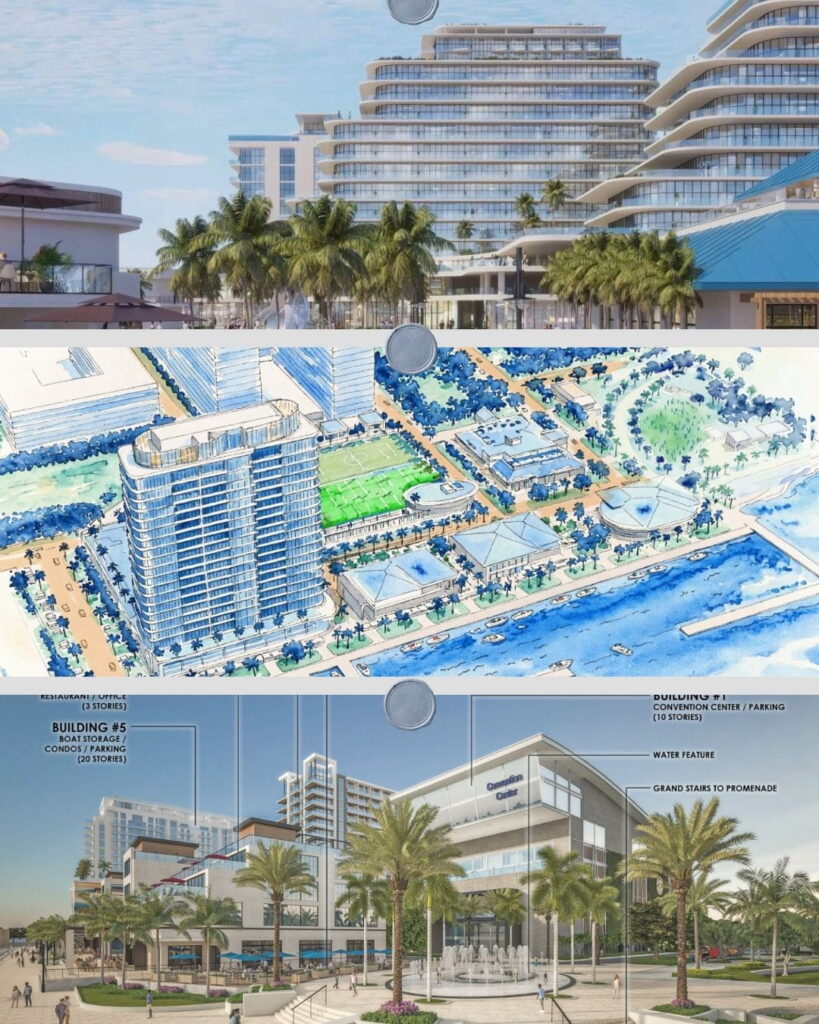
Riviera Beach is preparing to select a developer to lead the redevelopment of approximately 12-acres of waterfront land in the city’s Marina Village district. It will be the second phase of the full redevelopment of city-owned land along Broadway, which began in the early 2010s with the construction of Bicentennial Park and related public infrastructure. Plans for Marina Village’s second phase have been in development for several years and have faced multiple setbacks. However, the effort now appears to be back on track. On August 27, 2025, the city issued a request for proposals seeking a qualified developer to design, finance, construct, operate, and maintain a mixed-use waterfront development. The solicitation marked a restart of the process following a 2024 setback, when a previously submitted letter from a prospective developer was later determined to be fraudulent, halting progress at the time. Three development teams responded to the city’s request to enter into a public-private partnership (P3) by the November 17th deadline. The city is seeking a proposal that enhances public access to the waterfront while introducing employment opportunities, retail, and other investment-driven uses. The process is being led by the Riviera Beach Community Redevelopment Agency, with the proposals scheduled for discussion at a board meeting on February 11th, The three responding teams include Forest Development, which has led the planning and construction of several high-rise projects within the city, along with Related Urban Group and Sonnenblick Development. Related Urban is already advancing construction on the first phase of Marina Village, a project that includes public parking and three multifamily buildings, two of which are planned as high-rise structures. Sonnenblick’s Proposal (Margaritaville): Sonnenblick’s proposal envisions a mixed-use waterfront development featuring hotel, residential, retail, and entertainment components. The project is planned in multiple phases, with four high-rises sharing two podiums. Together, the buildings would deliver 270 residential units and a 300-room hotel anchored by the Margaritaville brand, complementing the area’s existing cruise ship activity. Retail and dining would total more than 100,000 SF, distributed across tower podiums, interior spaces, and outdoor stalls. A FlowRider surf complex is also planned, targeting families and local youth. The development would provide approximately 1,300 parking spaces and 200 bicycle racks to support both private users and the public marina. Additional amenities include a proposed 20,000 SF aquarium on the property’s north side, further enhancing Riviera Beach’s public and recreational offerings. Towers will range from 11 to 13 floors, with the tallest rising 25 stories. Because the site’s Downtown Mixed Use zoning does not allow buildings of that height by right, Sonneblick is acquiring air rights from the city to enable the 25-story tower. Sonnenblick brings more than 133 years of combined real estate and finance experience across multiple states, collaborating with Kaufman & Lynn Construction (general contractor), Leo A. Daly (architect), Island Hospitality (hotel management), and other firms. The development team plans to partner with non-profit organizations, utilize local hiring and training programs, and pursue additional community-focused initiatives to benefit the Riviera Beach area. Forest Development’s Proposal: Forest Development, which is currently leading projects such as Nautilus 220 and Oculina, is proposing a mixed-use destination that combines residential development with extensive retail offerings, a convention center, boat storage, and significant infrastructure and public realm improvements. The redevelopment is planned in four phases. Phase one would deliver 39,400 SF of restaurant space alongside 66,000 SF of office uses. Phase two would focus on public-facing components, including a convention center and improvements to Bicentennial Park, followed by phase three, which would introduce condominium residences (164 units) and dry boat storage. The final phase would add roughly 43,680 SF of retail space and a new hotel fit with 270 rooms to the waterfront district. While Forest Development has described the current proposal as its preferred vision for the site, the firm has indicated it remains open to refinements as the review process moves forward. The overall program is distributed across three primary buildings, with proposed heights of 10, 20, and 20 stories. To accommodate demand generated by the convention center, hotel, residential, office, and retail components, the plan calls for more than 2,000 parking spaces housed within multiple structured parking garages scattered throughout the site. In addition to Forest Development, the project team includes architectural firms such as Adache and Dwell Design Studio, with planning and landscape design led by Insite Studio and WGI. Moss is listed as the project’s general contractor, alongside a broader group of consultants. Forest Development has stated it’s prepared to invest up to $10 million to advance the project to a shovel-ready stage prior to securing full financing. The team reports having capital commitments in place across multiple projects and brings a portfolio reflecting decades of development experience. Related Urban Development Group’s Proposal: The third proposal was submitted by Related Urban Development Group, which is already leading phase one of Marina Village and is responsible for three buildings currently planned on the site. Related’s new submission proposes redeveloping its portion of Marina Village in two distinct phases, expanding both public amenities and revenue-generating uses along the waterfront. Phase one centers on the construction of a four-story parking garage with 578 spaces intended to serve Marina Village and surrounding businesses. The garage would include 9,800 SF ground-floor retail and a rooftop set with recreational amenities such as padel courts, soccer space, and additional active uses. Also included in the first phase are three waterfront retail bays totaling approximately 6,000 SF each, ten townhomes, and upgrades to the existing event center. Phase two would introduce a combined hospitality building containing a 120-key hotel and 224 residential units, supported by an additional 528 parking spaces. Approximately 6,000 SF of waterfront retail is planned at the ground level, alongside substantial improvements to Bicentennial Park, including a children’s playground, expanded event space, and other public-facing upgrades. Parking across the site will total 1,303 spaces, including on-street parking along several adjacent streets. On the south side of the property, 67 surface spaces are specifically designated for dock and marina-related
Redevelopment Vision Revealed for 25-Acre East Ybor Medical District by Darryl Shaw
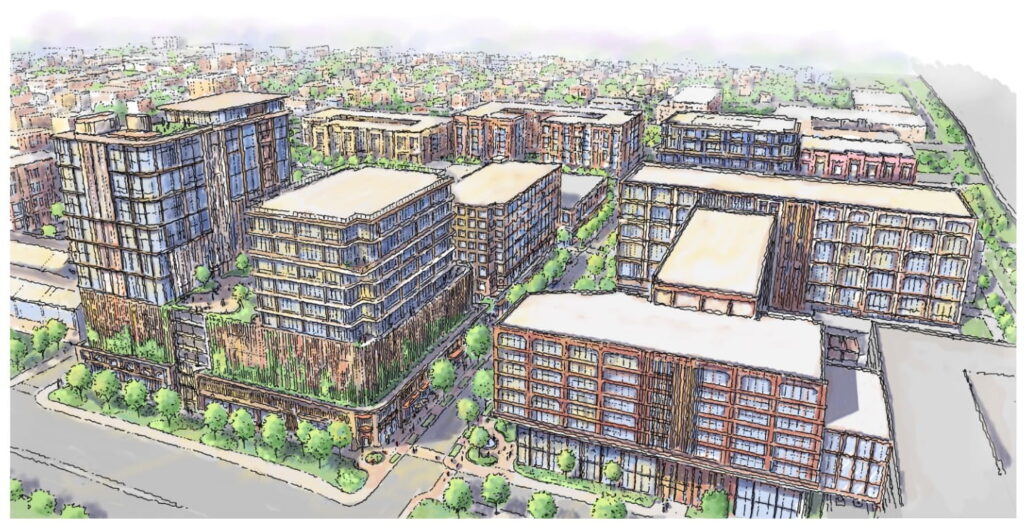
Darryl Shaw’s efforts to redevelop underutilized portions of East Ybor City took a formal step forward, with the submission of a rezoning request to the City of Tampa for the proposed ‘East Ybor Medical District’. Filed by Ybor Land LLC under the Casa Ybor umbrella, the request covers the complete makeover of a 25.23-acre assemblage bounded by N. 25th Street and N. 29th Street, and by E. 6th Avenue and E. Adamo Drive. The master-planned district is envisioned as a mixed-use, health-oriented development incorporating medical, hospital, research, office, residential, and retail within 11 city blocks. The site is currently occupied by light industrial uses and vacant land, zoned for Industrial Heavy (IH) and Industrial General (IG). A related Comprehensive Plan Amendment seeking to rezone the property as Urban Mixed Use-60 received it’s first approval from City Council on January 29th, with a second reading scheduled for February 19th. Initial design guidelines submitted to the city outline a district that restores East Ybor’s historic street grid while accommodating a range of building forms, including mid-rise, and high-rise structures distributed across multiple city blocks. The framework integrates landscaped streets, open spaces, and parks intended to introduce green space throughout the redevelopment. The guidelines were prepared in collaboration with Of Place, which has previously worked on redevelopment efforts in Ybor City and the nearby Gas Worx project. While detailed architectural plans have not yet been released, submitted entitlement materials outline a program exceeding 3 million SF. The proposal includes approximately 540,070 SF of residential space (Blocks G8 and H8), 49,000 SF of retail (Blocks H9, H10, H11, and I9), 1,332,105 SF of commercial uses (Blocks H9, H10, H11, I8, and I9), and 169,000 SF of hotel space (Block I8). A 932,425-SF hospital is also planned on the eastern portion of the site and is expected to be anchored by Tampa General, according to the South Florida Business Journal. Given the limited availability of public transit surrounding the site, the proposal relies heavily on structured parking to serve the district. Parking ratios vary by use, with studio apartments requiring as few as 0.25 spaces per unit, while one-bedroom, two-bedroom, and larger residential units would require 0.75 spaces per unit. Hospital parking is proposed at a minimum ratio of 0.1 spaces per patient bed. Building heights will ultimately be determined through FAA review, though early massing studies indicate structures ranging from as few as three stories to as many as sixteen. Consistent with Darryl Shaw’s work at Gas Worx, the district is designed with more traditional architectural themes, including expansive windows and brick facades, rather than the contemporary, glass-heavy designs common in newer developments. The street network is designed with a strong pedestrian emphasis. Plans call for wide sidewalks incorporating lighting, street trees, seating, and landscaped buffers, with select corridors accommodating on-street parking. Sidewalk widths are shown at up to 13 FT on each side of the street, providing well than enough space. With the rezoning request only recently submitted, the approval process is expected to extend over the coming weeks or months. During that time, Darryl Shaw and his partners are nearing completion on several buildings within the Gas Worx development. Shaw has also advanced plans for additional redevelopment efforts nearby, including proposals affecting multiple parcels along East 7th Avenue and the Hillsborough County Sheriff’s Office site.
Elevate 54 Planned in Brownsville, Miami-Dade Through the Live Local Act
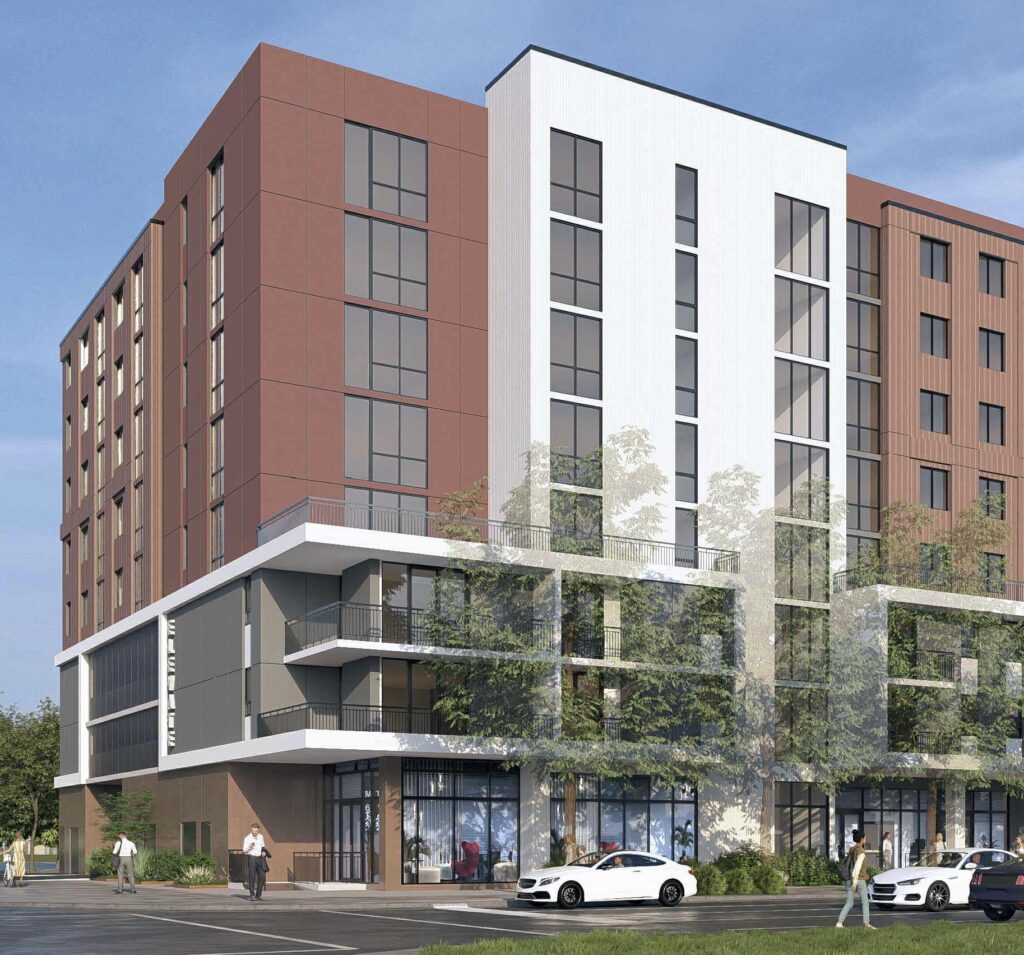
Another multifamily proposal is advancing near Brownsville’s Metrorail Station, as transit orientated development in Miami picks up. Known as Elevate 54, the project intends to serve as a 75-unit multifamily development, developed by 54 St Owner, LLC, an affiliate of Bay Heights Capital. It’s the latest project under the group, which has proposed multiple developments under the ‘Elevate’ branding in Miami-Dade. The development is planned for 2845 NW 54th Street, at the intersection of NW 29th Avenue and NW 54th Street. Plans indicate the project is intended to move forward under Florida’s Live Local Act, a state housing program that allows qualifying residential developments to bypass certain local zoning restrictions in exchange for the inclusion of workforce or affordable housing. Projects approved under the legislation may benefit from increased density, additional height allowances, and other incentives. The development site consists of four assembled parcels totaling 0.702 acres. The properties were acquired in late 2024 for a combined purchase price of roughly $1.225 million. The properties were acquired in late 2024 for a combined purchase price of $1.225 million. The site is currently cleared and operates as a car lot, conditions that are expected to limit the scope of site preparation required prior to ground breaking. Units in the 75-home development will range from studio, one-bedroom, and two-bedroom apartments. One-bedroom units account for the majority of the total, representing more than half of the project’s residential mix. While the project is being submitted under Florida’s Live Local Act, which allows for a maximum residential density of up to 250 units per acre, the proposed development utilizes a substantially lower density of approximately 100 units per acre. In exchange for these zoning changes, the project is required to allocate 40% of its units, or 30 apartments, as workforce housing priced at or below 120% of Area Median Income. At ground level and within the podium, the development will include 1,090 SF of retail space alongside parking for 75 vehicles. Additional ground-floor uses include a residential lobby, leasing office, and expanded sidewalks buffered by landscaped greenery. Under Miami-Dade County code, qualifying workforce housing projects are eligible for reduced parking requirements. Based on the project’s residential square footage, only 36 parking spaces would be required, down from an original requirement of 88. Designed by Caymares Martin Architecture, the development is planned to rise eight stories, reaching 90 FT at its tallest point. For context, the only taller structure in the immediate area is Brownsville Village, where the tallest building rises to roughly 150 FT. The building’s facade will feature a palette of red, white, and gray tones. Exterior materials will include smooth stucco finishes, aluminum railings, impact-resistant glass, and vertically articulated textures across select portions of the elevation. There are no permits submitted to Miami-Dade as of February 2026. It’s unknown if Elevate 54 is being planned for construction, or to be sold with entitlements. However, the application submitted to the county is still under review. Submitted through an Administrative Site Plan Review, the development will move through approvals faster, primarily because the Live Local Act expedites projects by limiting public review.
Construction Begins on Richman Group’s Capri Place II in Miami-Dade
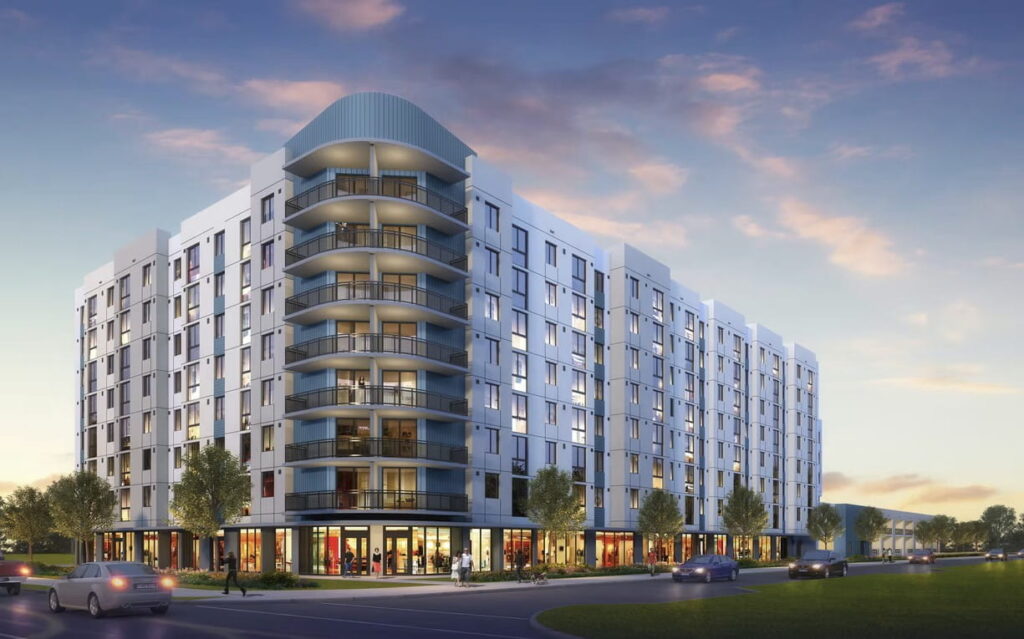
NW 27th Avenue, a major corridor home to multiple commercial hubs, Metrorail stations, and large-scale development proposals, has recently seen construction begin on a new affordable housing project. The development, known as Capri Place II, will deliver an 8-story multifamily building designed by Behar Font. Led by the Richman Group, a national developer with a portfolio spanning both affordable and market-rate housing, the project has been under consideration for several years and was initially envisioned as a 12-story structure. With construction now underway following a groundbreaking, the project will add new affordable and workforce housing to an area that has increasingly benefited from Miami-Dade County’s transit-oriented development framework. The project is located on a 2.6-acre parcel at 8001 NW 27th Avenue, located directly across from Northside Shopping Mall. The site was cleared in the early 2010s and was acquired by the Richman Group in late 2021 for approximately $6 million. Ortega Construction has been recently selected to serve as the project’s general contractor. Although the development was originally expected to break ground in the fourth quarter last year, site activity has now commenced. Recent updates from the contractor indicate that clearing work has been completed and that topsoil removal is complete via multiple excavators. County permitting records show that several approvals have already been granted, with additional permits still progressing through review. View this post on Instagram A post shared by Ortega Construction Company (@ortegaconstructioncompany) Issued permits to date include the site plan, while permits related to temporary construction facilities, a general construction permit, and other supporting work remain under review. The approved site plan permit reflects a construction valuation of $15 million, while the pending general construction permit lists a projected value of $33,572,527. Capri Place II is planned to include 180 residential units, despite zoning allowances that would permit as many as 374 units on the site. The residential mix will consist of one-bedroom and two-bedroom apartments. Along the eastern portion of the property, the parking garage will be partially concealed by a row of two-story townhome-style units. Future residents will have access to a broad amenity package, including a swimming pool, fitness center, yoga studio, clubroom, business center, mail facilities, literacy and library spaces, multipurpose rooms, and an outdoor pavilion with seating. Parking will be provided through a 254-space garage, resulting in a ratio that allows larger units to be allocated more than one parking space. At street level, the development will introduce 2,821 SF of retail space facing NW 27th Avenue. Based on the Richman Group’s previous projects, retail spaces are often leased to local organizations or small businesses rather than national tenants, though leasing plans for Capri Place II have not yet been disclosed. Additional ground-floor elements include landscaped buffers, widened sidewalks, and pedestrian-oriented improvements along the frontage. Architectural elevations prepared by Behar Font indicate the eight-story structure will rise approximately 81 FT, excluding a rooftop crown that brings the overall height to more than 90 FT. The exterior design incorporates smooth and scored stucco finishes, aluminum framing, and impact-resistant glazing. With early foundation activity now underway, Floridian Development anticipates the project reaching completion in late 2026 or early 2027.
546 Foot Tower Proposed West of Downtown Fort Lauderdale Following FAA Filing
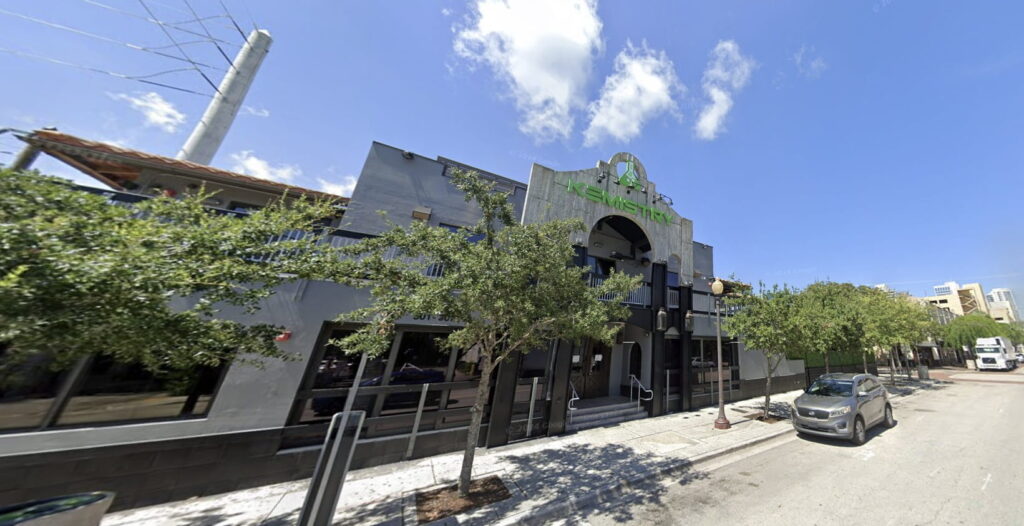
While new proposals and active construction have shown signs of slowing in Fort Lauderdale, the city remains far from dormant. Just a few days ago, an FAA height application was submitted for a 546 FT tower planned at 301 SW 2nd Street, signaling continued interest in high-density development near the downtown core. The site is located just west of the existing high-rise cluster in Downtown Fort Lauderdale, marking another project to extend the city’s skyline in a new direction. Although formal plans have not yet been submitted to the city’s Development Review Committee, the FAA filing identifies Integritas Capital as the developer (working in partnership with New York-based Heights Advisors), with FSMY listed as the project’s architect. The development team assembled the site through multiple acquisitions, beginning with the purchase of a surface parking lot at 111 SW 3rd Avenue for approximately $6.6 million in late 2021. This was followed by the acquisition of an adjacent low-rise property in late 2022 for roughly $4.6 million. Together, the purchases give the partnership control of three parcels along the block, while a fourth corner property at 329 SW 2nd Street is incorporated into the development concept but has not yet been acquired as part of the assemblage. The under-review FAA application, which lists a tower height of either 546 FT or 549 FT above sea level, represents a resubmission of an earlier filing from 2022. At that time, the partnership sought approval for a slightly taller 596 FT structure on the site. While the revised proposal reflects a notable reduction in height, the tower would still become the tallest building in Fort Lauderdale if constructed. More detailed plans for a tower at the site first surfaced publicly last year, when The Real Deal reported that the development team was pursuing a 57-story mixed-use project. Early concepts outlined a program consisting of approximately 550 residential units, including roughly 300 condominiums, alongside a 253-key branded hotel and structured parking. In prior statements to The Real Deal, Integritas Capital indicated that construction costs would be partially mitigated through the use of concrete sourced from a company-owned plant in Broward County, a move the firm says could deliver significant per-foot savings. According to Integritas principal, Stephen Palmese, condominium pricing was previously targeted in the $500,000 range, with units not expected to exceed $1 million. Projected apartment rents were cited at $5.50 per square foot. Given the updated FAA filing lists a maximum height of 546 FT, well below what is typically associated with a 57-story tower, it’s likely that the project’s size has been reduced or reconfigured since those early reports. No revised architectural plans have been made public, but that may soon change. If the project has been reconfigured, the development could also qualify for approval under Florida’s Live Local Act, a state-level program that allows eligible projects to bypass local zoning restrictions in exchange for the inclusion of workforce housing (priced at or below 120% of AMI). Developments approved under the legislation may benefit from reduced parking requirements, increased density allowances, and expedited review timelines. Floridian Development is currently in the process of working with the City of Fort Lauderdale to gather proposals submitted under the Live Local Act. Should this proposal appear in the records request, a follow-up report will be published.
UniDos Affordable Housing in Miami’s Omni Neighborhood Announces Groundbreaking Date
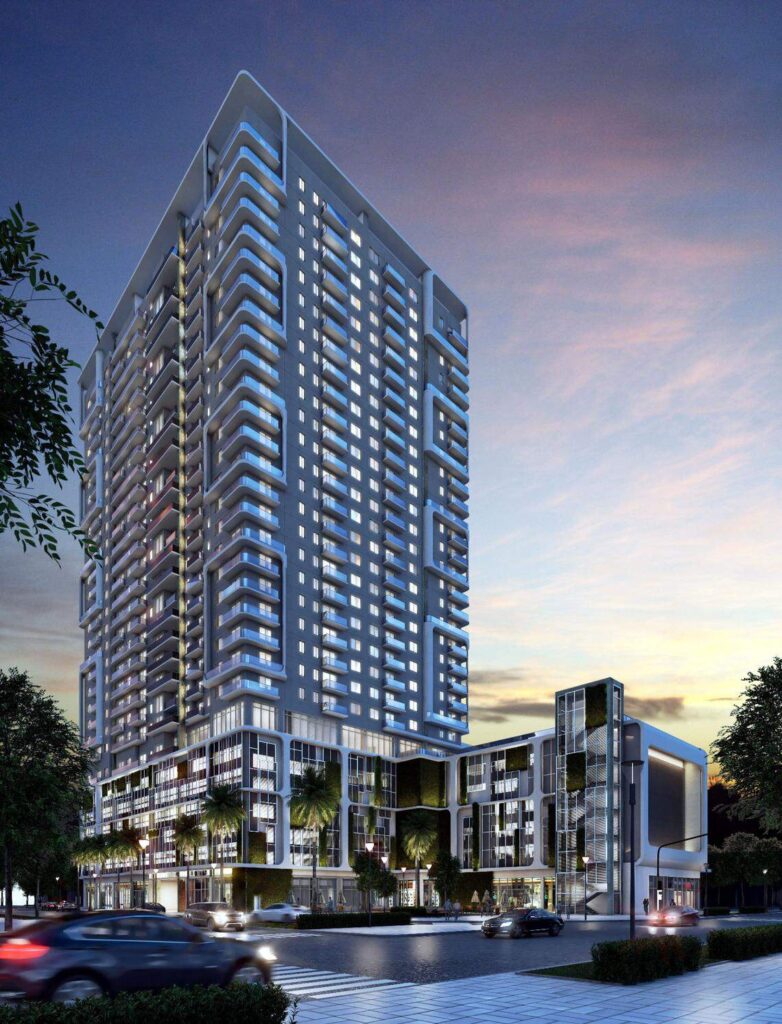
A long-anticipated affordable housing project in Miami’s Omni District is set to officially break ground, following a joint announcement by the developer and the City of Miami. Known as UniDos (also branded as Uni + Dos), the tower is planned for 1445 N Miami Avenue and represents the district’s latest addition to its growing affordable housing inventory. Spearheaded by NR Investments, UniDos follows the recent completion of Uni Tower, a 252-unit affordable housing project that marked the firm’s earlier investment in the neighborhood. A ceremonial groundbreaking is scheduled for February 24th at 10:00 a.m., marking one of several milestones required before the tower can begin vertical construction. Recently elected Mayor Eileen Higgins is expected to attend the event, following a campaign where she placed a strong emphasis on expanding affordable housing development across the city. The development site is the result of a multi-year assemblage of nine properties, acquired between 2014 and 2016 for a combined price of just under $9 million. Transactions involved both private property owners and the Omni Redevelopment District Community. Today, the parcel is largely cleared, with only limited landscaping and a surface parking area remaining. UniDos is planned to deliver 398 income- and rent-restricted affordable and workforce housing units. Earlier plans submitted to the city outlined a unit mix consisting of micro-units, one-bedroom, and two-bedroom residences. According to a construction permit filed last year and still under review, the residential portion of the project will add 406,694 SF of new construction, spanning from levels 8 through 31 of the tower. Residents will have access to a dedicated amenity level on the eighth floor, which will include a swimming pool, outdoor lounge areas, and roughly 14,000 SF of indoor amenity space. The project is also planned to accommodate 451 parking spaces, a supply intended to meet anticipated resident demand. At street level, the building adopts a distinctive footprint, forming an S-shaped profile in response to the presence of historic structures along the block. In addition to widened sidewalks and pedestrian improvements, the ground floor will incorporate 8,539 SF of retail space, contributing to street-level activation in the area. Designed by Corwil Architects, the tower will feature a contemporary facade defined by gray balconies and a palette of white and gray tones. The podium will incorporate ventilated mesh elements alongside patterned panels intended to mimic greenery. Once complete, the building is expected to rise approximately 321 FT. While vertical construction is not imminent, as site clearing and additional permitting remain outstanding, a general contractor has already been selected. First Florida is listed as the contractor for the project, and despite remaining pre-construction steps, vertical construction is still anticipated to begin by the end of the year. When it does, UniDos will become the second tower under construction in Miami’s Omni District, following the start of vertical work at Excel Miami.
Foundation Permits Filed for Channelside’s Largest Hotel at 111 N. Meridian Avenue
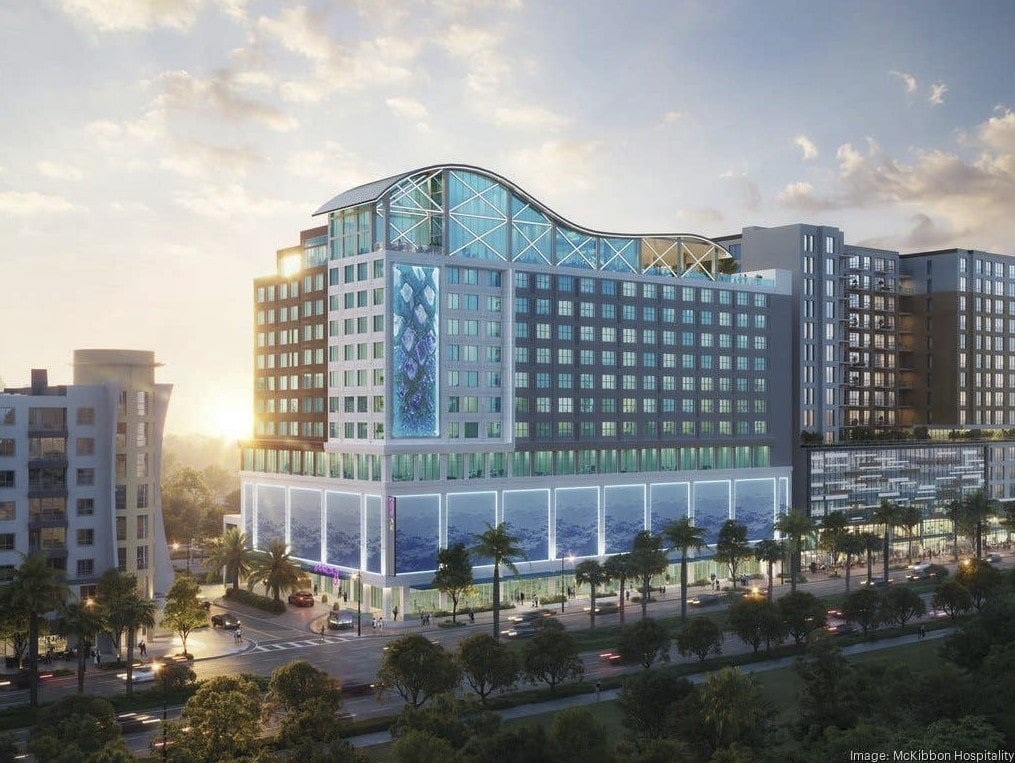
Channelside’s largest hotel project is moving closer to construction in Tampa, following the recent submission of foundation permits to the city. Led by McKibbon Hospitality, the development is planned as a dual-flag hotel featuring both AC Hotel and Moxy, brands operated under the Marriott International umbrella. Planned for 111 N. Meridian Avenue, the 13-story hotel would add a modern presence to the Channelside district. Designed by Atlanta-based LPB & Associates, the project has advanced quickly, with the recent permitting activity marking the latest step in a months-long process that included rezoning approval from Tampa City Council just a few months ago. McKibbon Hospitality acquired the 0.74-acre site for approximately $9.3 million in early 2025. The property was previously slated for a self-storage facility by UDR, though those plans were abandoned after only the residential component of the masterplan was completed. Once delivered, the hotel will become the second in the immediate area, following the opening of a nearby dual-flag hotel at N. Meridian Avenue and Kennedy Boulevard in 2019. The site is currently cleared following earlier site preparation and demolition work completed under the property’s previous developer, UDR. The newly submitted permit is limited in scope, covering drilled piers and concrete footings for the tower’s foundation, with designs helped by recent surveying and geotechnical work. Given the scale of the project, measuring roughly 280,000 Gross SF, the development is subject to additional structural and safety reviews to meet code requirements. A construction contractor has not yet been identified yet. However, multiple firms are listed on the application, including Bohler, which is serving as the project’s civil engineer. Plans filed with the city indicate the hotel will include 310 guest rooms, When first reported by the Tampa Bay Business Journal, the room count was broken down into 175 rooms under the AC Hotel brand and 135 rooms under Moxy, a configuration that appears unchanged in the latest filings. Parking plans have also evolved since early reporting. Initial concepts called for just 57 spaces, but updated civil plans now show a significantly increased parking program. The project is currently proposed to include 202 parking spaces, a figure more realistic considering the size of the parking podium and the number of hotel rooms listed previously. At street level, the hotel will include an AC Lounge, a retail space, and a main reception area. Overall, the project is planned to deliver approximately 25,000 SF of commercial space, consisting of roughly 14,000 SF of retail and 11,000 SF dedicated to restaurant uses, according to the latest plans. A designated drop-off area for valet and parking will be located along East Washington Street. The hotel will feature a facade composed of light and dark blue tones, accented by white and gray finishes across stucco surfaces and impact-resistant glass. A distinctive crown, defined by a sloped roofline, will cap the structure. According to the developer, the building is expected to rise approximately 179 FT to its tallest point. The foundation permit is still pending approval and represents the only construction permit applied for the site thus far. McKibbon Hospitality had previously targeted a February 1, 2026 groundbreaking; however, with the permit submitted on January 26, meeting that timeline appears unlikely unless the event is ceremonial. However, a 2026 start for vertical construction remains very much on the table and continues to look probable.
AHF Breaks Ground on Little River Plaza, a 250-Unit Affordable Housing Community
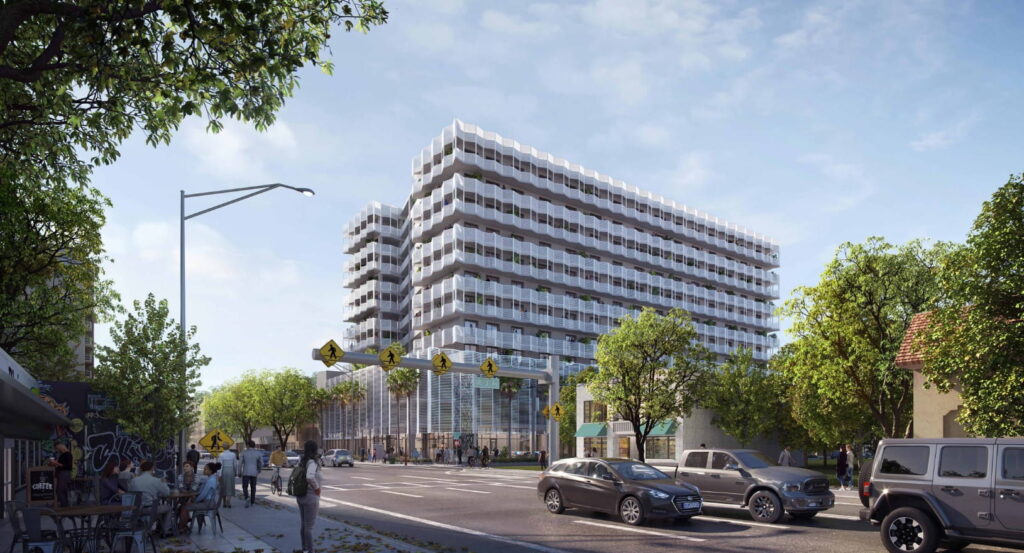
In Miami’s Little River neighborhood, where housing affordability remains a growing concern, a new development is moving forward with the goal of expanding access to supportive housing. The Healthy Housing Foundation, a subsidiary of the AIDS Healthcare Foundation (AHF), recently broke ground on a 12-story residential project aimed at serving individuals and families in need of housing assistance, including those experiencing homelessness. The project, designed by Glavovic Studio, was marked by a ceremonial groundbreaking held on January 23rd between 10:30 A.M. and noon. The event took place at 7952 NE 3rd Avenue, the site where the building will rise. The 0.9-acre property was acquired by the AIDS Healthcare Foundation for $6 million in 2022 and was previously occupied by a single-story strip mall and surface parking lot. Demolition of the existing structures was completed in 2023, and recent activity on-site, including site work, signals the start of vertical construction. View this post on Instagram A post shared by AIDS Healthcare Foundation™️ (@aidshealthcare) Coined as Little River Plaza, the project will deliver 250 affordable housing units targeted to households earning up to 50% of Miami-Dade County’s Area Median Income and below. The unit mix will consist of micro-studios and one-bedroom residences, with sizes ranging from approximately 380 to 540 SF. The groundbreaking event was attended by Mayor Eileen Higgins, who noted ‘you will not meet anyone in Miami that doesn’t know someone who is struggling to pay the rent’. At the heart of the building, residents will share a large common space, designed as a multi-story open-air atrium. The space functions similar to a hotel-style courtyard, providing lighting and fresh air to circulate throughout the structure. At ground level, the high-rise will include a designated drop-off zone and a total of 205 parking spaces, including five on-street spaces reserved for guest use. In addition to parking, the project will include 2,888 SF of ground-floor retail space designed for a single tenant. While no retailer has been announced to date, the space will be supported by widened sidewalks, on-site landscaping, and other pedestrian-oriented improvements intended to activate the street frontage. Glavovic Studio approached the design with cost efficiency as a core principle, allowing the project to pencil out while maintaining affordability. Architectural elements such as balcony railings are repeated across the podium to limit the need for custom materials and reduce construction costs. The zig-zagging aluminum balconies and parking screens serve a dual purpose, helping to reduce solar heat while adding visual movement and texture to the facade. According to architectural elevations, the building is expected to rise 134 FT at its tallest point. Permitting activity at the site has been active, with a master construction permit, electrical permits, and other required approvals now being issued. Gomez Construction Company is listed as the project’s general contractor. Once complete, Little River Plaza will join a growing pipeline of new development in Little River, much of it centered on affordable and workforce housing. The site was selected in part for its proximity to transit and daily amenities, including direct access to a bus stop along the property frontage.
The Mark, a Long-Debated Student Housing Project Near UM Moves Forward Under County Control
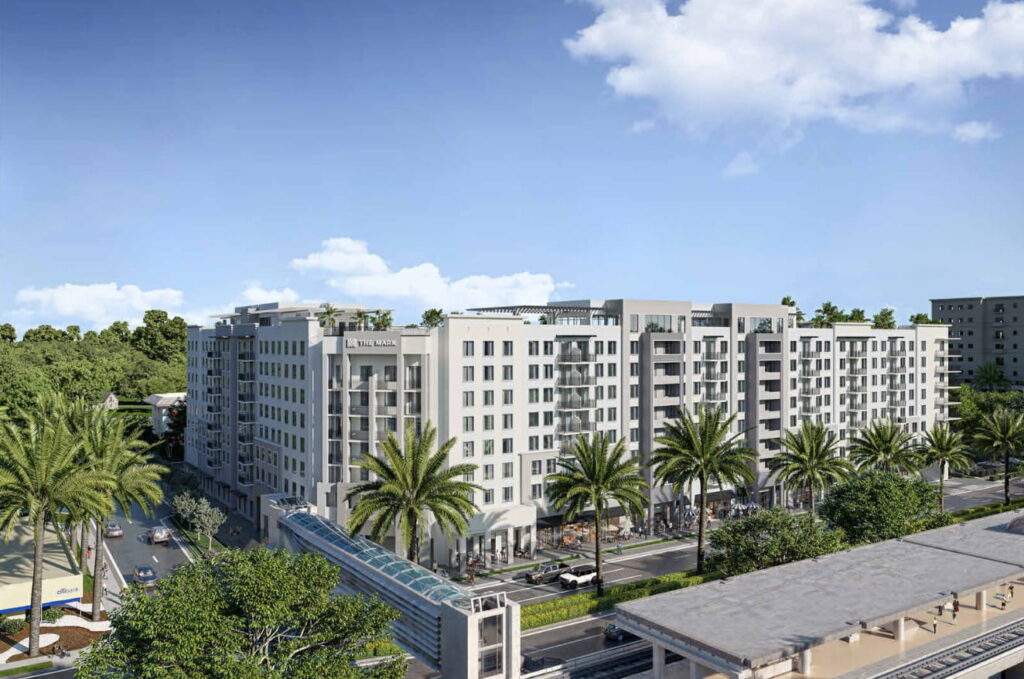
A student housing proposal near the University of Miami that has drawn years of debate is moving again through the approval process, following a recent filing by Landmark Properties with Miami-Dade County. Planned for 1250 S. Dixie Highway in Coral Gables, the project calls for an eight-story student housing project located just steps from the University Metrorail Station. Designed by Behar Font Architecture, the development would mark Landmark’s second student housing project in the city if constructed. The latest submission, filed in mid-January, reopens long-running discussions surrounding allowable height, density, and zoning authority in the area. The proposal was first introduced in 2023 as a two-building concept on a 3.17-acre site, currently occupied by a mid-century shopping center and surface parking. Early versions were reviewed locally by Coral Gables’ Development Review Committee, but stalled amid growing concerns over the project’s scale. As city-level approval became increasingly uncertain, the development team shifted its attention for approval under Miami-Dade County’s Rapid Transit Zone. The designation, which was granted last year, transferred planning and zoning authority to the county, opening the door to higher-density development adjacent to major transit infrastructure, effectively pushing the project beyond the hands of Coral Gables politicians. In response, Coral Gables later pursued its own University Station transit overlay in an effort to retain local design review and architectural control along the corridor. However, by that point, the project had already transitioned into the county approval process, significantly limiting the city’s ability to directly influence the proposal’s scope or configuration. While the proposal has now been formally submitted under Miami-Dade County jurisdiction, the project’s overall density remains unchanged: a silver lining for some concerned residents. Plans first outlined in 2024 called for a total of 393 residential units, a figure that has been carried forward into the current submission. The unit mix will range from studios to five-bedroom residences, with four-bedroom units representing the most common configuration. Residents would have access to a comprehensive amenity program, including a pool deck with outdoor seating and lounge areas, covered terraces, a wellness suite, study lounges, a fitness room, and a centrally located courtyard. The project also proposes 680 parking spaces, despite county code allowing zero required parking for transit-oriented developments. In addition to serving student residents, the parking supply is intended to support eight ground-floor retail spaces totaling 14,960 SF. At street level, the development would introduce widened sidewalks, updated landscaping, and a vehicular entrance to the parking garage accessed from Madruga Avenue, a nearby residential street where most site-related traffic would be directed. One of the more notable changes tied to the county submission involves both the building’s form and height. The project has shifted from a two-building layout to a single, more unified massing. At the same time, the height has increased modestly, rising from the previously proposed eight stories (or 97 FT) to nine stories (102 FT) at its tallest point. Architecturally, the updated design adopts a contemporary palette of whites and light grays, incorporating stucco finishes, score lines, metal balconies, impact-resistant glazing, and trellis elements. The revised approach is a byproduct of the county’s design playbook, which places fewer constraints on setbacks and architectural style than Coral Gables’ code, allowing the project to move away from Mediterranean design requirements and toward a more modern proposal. While the project may be controversial, especially over its visual impact, there is little the city can do. That concern was raised months ago during public discussions, when Vice Mayor Rhonda Anderson warned that prolonged delays would push developers to seek county oversight instead. At the time, she warned that doing so would likely result in larger projects with fewer setbacks, weaker design controls, and diminished opportunities for resident input. With the proposal now firmly under Miami-Dade County’s jurisdiction, that scenario has effectively played out. Plans were submitted only yesterday (January 21st), meaning the approval process is still in its early stages and further design revisions remain possible. According to sources, the property is currently under contract but has not yet changed hands. The most recent recorded sale of the site occurred in 2015, when it sold for approximately $4.2 million.
More Than 9,000 Units in the Pipeline: Data at West Palm Beach’s 2025 Developer Outreach Shows Development Surge
West Palm Beach’s Development Services Department recently held its 2025 Developer Outreach, providing an early look at how the city’s development pipeline is positioned heading into the year. The meeting convened developers, property and business owners, planners, architects, and other industry stakeholders as the city continues to oversee a growing number of projects moving through review, permitting, and construction. The presentation went beyond key figures, but also outlined how the department is responding to current development demand while offering updates on projects recently delivered, those under construction, and proposals advancing through the approval process. Several upcoming developments were also previewed publicly for the first time, offering insight into what may soon reshape the city’s skyline beyond Downtown. Floridian Development takes a look at the upcoming changes in West Palm Beach. Completed, Under Construction, or Planned Residential Projects: Several notable updates were shared regarding the evolution of downtown living and surrounding neighborhoods in 2025. The completion of 512 Clematis added 89 residential units to the downtown core, while Palm Beach Atlantic University’s new dormitory (long the subject of design-related controversy) has moved into the construction phase and is planned to accommodate 990 students. Under Construction: Completed: Planning: In total, 2,800 multifamily units are currently under construction, with an additional 130 recently completed and 6,125 more under review. Altogether, more than 9,000 units are in the pipeline for West Palm Beach in the coming years, an impressive figure for a city that has only recently begun to accelerate its development pace. (Certain projects may have been excluded due to inadequate data or lack of progress). Completed, Under Construction, or Planned Hotel Projects: Hotel development in West Palm Beach are also gaining momentum, fueled by an influx of talent and wealth that has increased both demand and expectations for higher-quality accommodations. Between 2020 and today, the city added 1,641 hotel rooms, including the 215-room property at 695 South Olive which opened in 2022. Looking ahead, the pipeline remains active, with projects such as the planned hotel in the Nora District expected to add 201 rooms and further projects that plan to increase West Palm Beach’s hotel inventory in the coming years. Under Construction: Completed: Planning: While smaller in scale than the multifamily pipeline, hotel development remains one of West Palm Beach’s most active sectors. Currently, 511 hotel rooms are under construction, with another 150 recently delivered and 1,305 more in various stages of planning. Among the more notable proposals are early plans for the PBAU Arkona–Olive Hotel, which would add a new hotel high-rise near the Palm Beach Atlantic University campus. (Certain projects may have been excluded due to inadequate data or lack of progress). Completed, Under Construction, or Planned Office Projects: In the last four years, developers, primarily Related Ross, has added 668,033 SF of new office according to the City of West Palm Beach, representing a large chunk of 1.6m currently of class A office today. The influx of new office construction and proposals in West Palm Beach reflects growing demand for high-quality, Class A space, with strong leasing activity concentrated in the downtown core and sustained interest from major tenants. Office utilization across the market has held above average, and developers such as Related Ross have committed significant capital to new projects. Under Construction: Completed: Planning: Perhaps the most closely watched segment of West Palm Beach’s development pipeline, new office construction now represents one of the largest concentrations of planned Class A space in the Southeast. Currently, approximately 1,834,009 SF of office space is under construction, with an additional 270,000 SF recently delivered and another whopping 1,150,636 SF in the planning stages. (Certain projects may have been excluded due to inadequate data or lack of progress). What Lies in the Future? As West Palm Beach works to manage an influx of new residents alongside rising construction activity, the city is also advancing several land-use initiatives aimed at making better use of existing urban space. In the Broadway Mixed-Use District, height allowances have been increased from three to seven stories, accompanied by an emphasis on enhanced landscaping and wider sidewalks to improve walkability. At the same time, the city is in the process of updating its Downtown Master Plan, introducing revisions to tower massing and, in select areas, higher height and density limits. While permitting activity has slowed across much of Florida, West Palm Beach has moved in the opposite direction, reaching its highest level of permit activity since 2022. Of the permits issued, approximately 52 percent are tied to residential construction, with the remaining 48 percent associated with commercial development.
Construction Permit Filed for Robles Park Lot D, Marking First Phase of Redevelopment
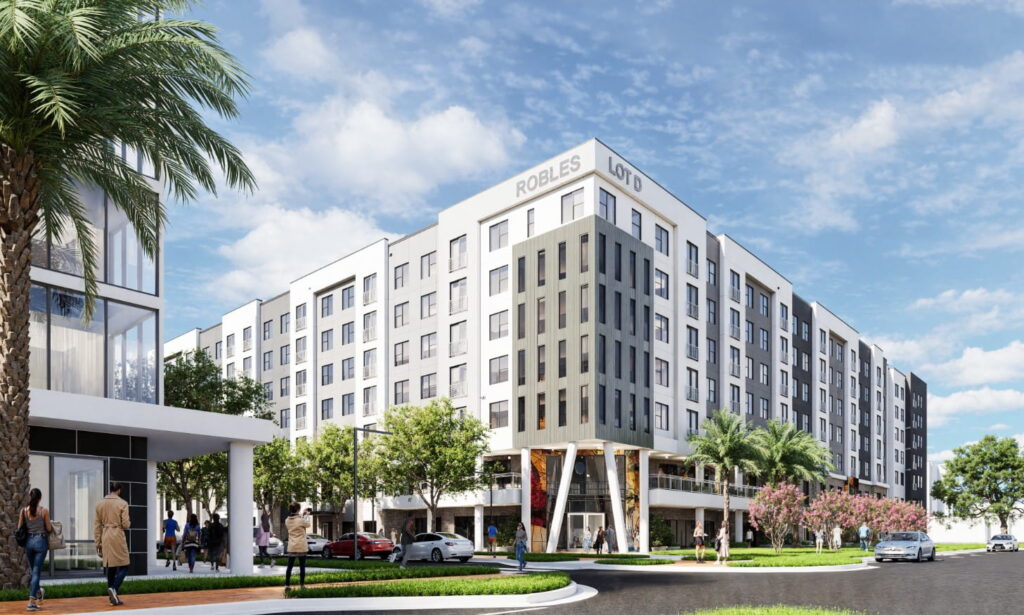
Plans for the long-anticipated Robles Park redevelopment in Tampa are moving closer to construction, as permits for the project’s first phase have now been submitted to the city. Known as Lot D, the parcel will deliver the first new residential building within the 35-acre redevelopment area, representing a major step forward following the demolition of the public housing complex. The effort is being led by PMG Affordable in collaboration with the Tampa Housing Authority, building on a master plan that received city approval in 2024 after an extensive planning and public review process. Demolition of the original Robles Park complex began in late 2025, clearing a site that once included 67 low-rise buildings constructed in the 1950s as part of a national urban renewal era. The redevelopment will replace one of Tampa’s oldest public housing communities with a modern, mixed-income neighborhood intended to increase residential density while preserving long-term affordability. The full Robles Park redevelopment is estimated to carry a price tag of approximately $800 million and will be delivered in multiple phases over several years. Construction is currently targeted to begin in April 2026, following the completion of demolition work. The recent submission of permits for Lot D aligns with that timeline, with permits likely being expedited prior to groundbreaking. Submitted on January 21st, 2026, the application represents a full building permit for new construction, covering structural work and core building systems such as plumbing and electrical. With this permit in place, the project can move forward without needing multiple smaller permits to begin construction. Construction will be led by Ducon, LLC as the general contractor, with Urban Atelier Group serving as construction manager. The proposed building will deliver 233 affordable housing units serving households earning between 30 percent and 80 percent of the area median income. Residents displaced by the original demolition of Robles Park will have a right of return and will not face rent increases should they choose to move back into the redevelopment. Unit layouts will include one-, two-, three-, and four-bedroom residences, with sizes ranging from 571 SF at the low end to about 1,439 SF for the largest units. Two-bedroom units will make up the largest share of the overall unit mix. According to a project description given by the developer, the building will include a plethora of residential amenities, including a pool deck on the second level. In addition to the pool, the development will feature approximately 10,000 SF of interior amenity space, along with a nearly 2,000 SF leasing office for residents. A 32,486 SF community center is also planned for the second floor, intended to serve the new community. To accommodate parking needs for both residents and the on-site community center, the development will provide 210 parking spaces. This total is made possible through an approved parking reduction waiver. All parking will be located at ground level as a surface lot. The building is designed by Orlando-based Baker Barrios Architects, the firm behind the broader Robles Park master plan. Architectural elevations show the structure rising seven stories, or approximately 83 FT to its highest point. The exterior employs a contemporary palette of gray and white tones, combining stucco and metal finishes in a style consistent with other recent Baker Barrios projects. Before demolition, the original Robles Park community consisted of 432 residential units and a 3,036 SF daycare facility. The approved redevelopment envisions a far larger and more comprehensive development, ultimately delivering 1,098 affordable housing units, 160 affordable senior residences, 550 multifamily units, and 42 single-family homes. In addition, the plan includes approximately 41,000 SF of retail space, a 32,486 SF community center, and a new 30,000 SF supermarket, significantly expanding both housing capacity and neighborhood-serving amenities.
Floridian Rundown: Alma at FIU Planned in Sweetwater; FAA Permits Filed for Tower 36
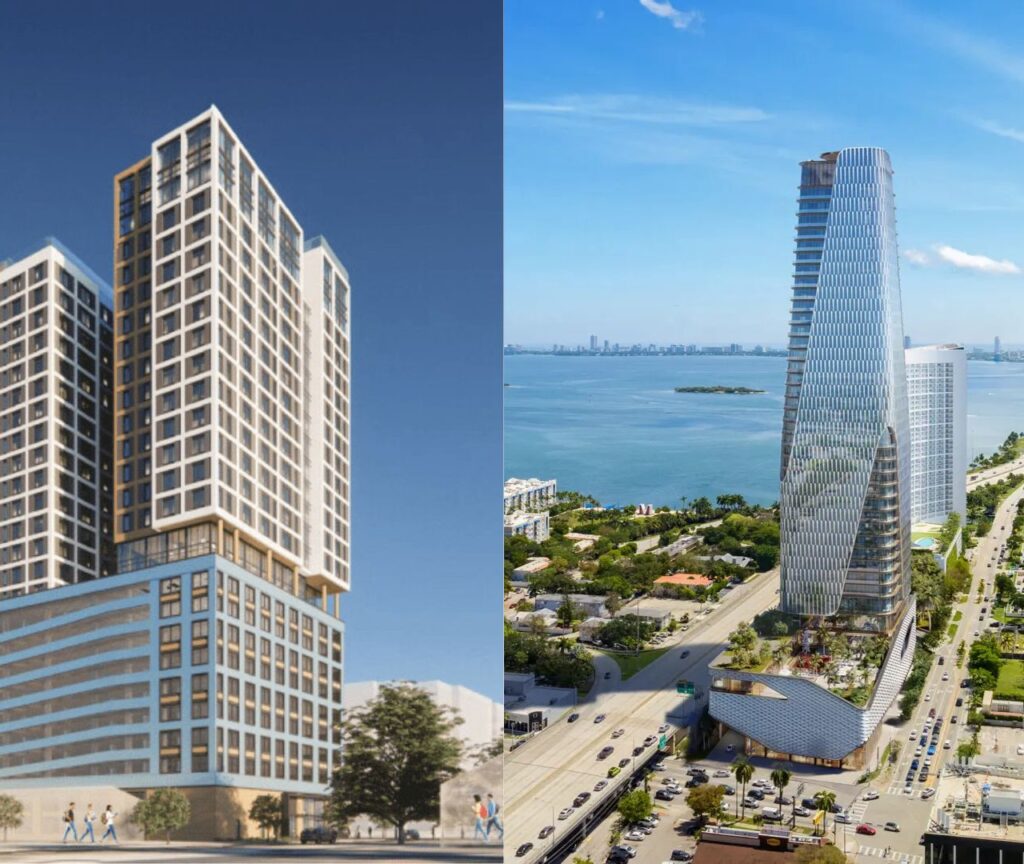
Today’s Floridian Rundown spotlights two high-rise projects, both in Miami-Dade. One centers on a largely under-reported development in Sweetwater, where Alma at FIU is moving forward as a major student-oriented tower serving Florida International University, with demolition complete and capital raising underway. The other turns to Miami’s Edgewater neighborhood, where Tower 36 is showing signs of renewed momentum following the filing of a new FAA height application, marking the first substantive update on the project in several months. Floridian Rundown is an experimental article format designed to surface development activity that may not always warrant standalone coverage. Published as a periodic roundup, the series focuses on early-stage proposals, design evolutions, and under-the-radar projects that are quietly moving through the pipeline, offering readers additional context beyond Floridian Development’s traditional weekday reporting. Please take the time to complete a poll at the end of the article to help the site better understand public perception of this publication type. Alma at FIU Sweetwater, already experiencing a surge in student-oriented high-rise development tied to Florida International University, is preparing to add another major project to its skyline. Dubbed Alma at FIU, the multifamily tower is planned for a roughly 0.8-acre site at 300 SW 109th Avenue. The project is being developed by BAI Capital and designed by BKV Group, with plans calling for approximately 561,000 gross SF of construction. Once built, the tower would stand among the tallest developments in Sweetwater. Construction is currently targeted to begin in January 2027, marking the project as the city’s third high-rise to enter construction since 2025, following two recent groundbreakings. As the project moves through Sweetwater’s design and approval process, the development team is also raising capital. Alma at FIU is offering multiple investment tiers, including an EB-5 Immigrant Investor Program. Because the project is located within a Targeted Employment Area (TEA), foreign investors are eligible to participate at the reduced EB-5 threshold of $800,000, while still qualifying for a green card. Alma at FIU is planned to deliver 565 residential units, totaling 644 beds. The development will include ground-floor retail, above which an eight-story parking podium will be constructed and wrapped with residential units to maintain architectural continuity. The podium will provide 644 parking spaces, effectively allocating one space per bed to accommodate student demand. Miami-Dade County permitting records show that a demolition permit for the former retail building on the site was issued months ago. Demolition activity quickly followed in early 2025 and has since advanced to the complete clearing of the property. Construction will be led by HITT Contracting as general contractor, with Kimley-Horn serving as the project’s civil engineer. FAA Application Filed for Tower 36 News surrounding Tower 36, a planned high-rise in Miami’s Edgewater neighborhood, has been relatively quiet in recent months as the project has undergone internal design revisions. That lull appears to be breaking, however, with a new FAA height application recently filed by One Thousand Group, the firm behind 1000 Museum by Zaha Hadid Architects. The project was first presented to Miami’s Urban Development Review Board in 2023 as an office-focused development, proposing 312,058 SF of office space, 28,922 SF of retail, and 691 parking spaces within a 32-story tower rising 635 FT. That concept was later abandoned in favor of a revised program centered on branded residences, a private members club, premium dining, and other hospitality-oriented uses. Detailed plans for the updated vision have not yet been publicly released, as the project is still in the planning phase. Designed by KPF in collaboration with ODP Architecture, the tower is envisioned as one of Miami’s more distinctive recent high-rise designs. The building is largely wrapped in glass, with balconies periodically carved out, giving the facade depth and a modern profile. The tower was filed with the Federal Aviation Administration at a height of 649 FT, or 662 FT above mean sea level. The filing suggests that the project’s height and massing may have changed over time, though it may also reflect a common decision to submit a more generous height for flexibility. In FAA filings, developers often list maximum possible heights rather than finalized numbers, allowing change for future design evolution without requiring a new aviation review. Located at 3601 Biscayne Boulevard, the One Thousand Group acquired the 1.6-acre lot for approximately $53 million in late 2024. The property, formerly occupied by a gas station, was quickly cleared following the acquisition and is now fully vacant. Would you like to see more?
Floridian Rundown: Plans Surface at 1501 NE 1st Ave in Miami; 315 NE 3rd St Returns to Review in Fort Lauderdale
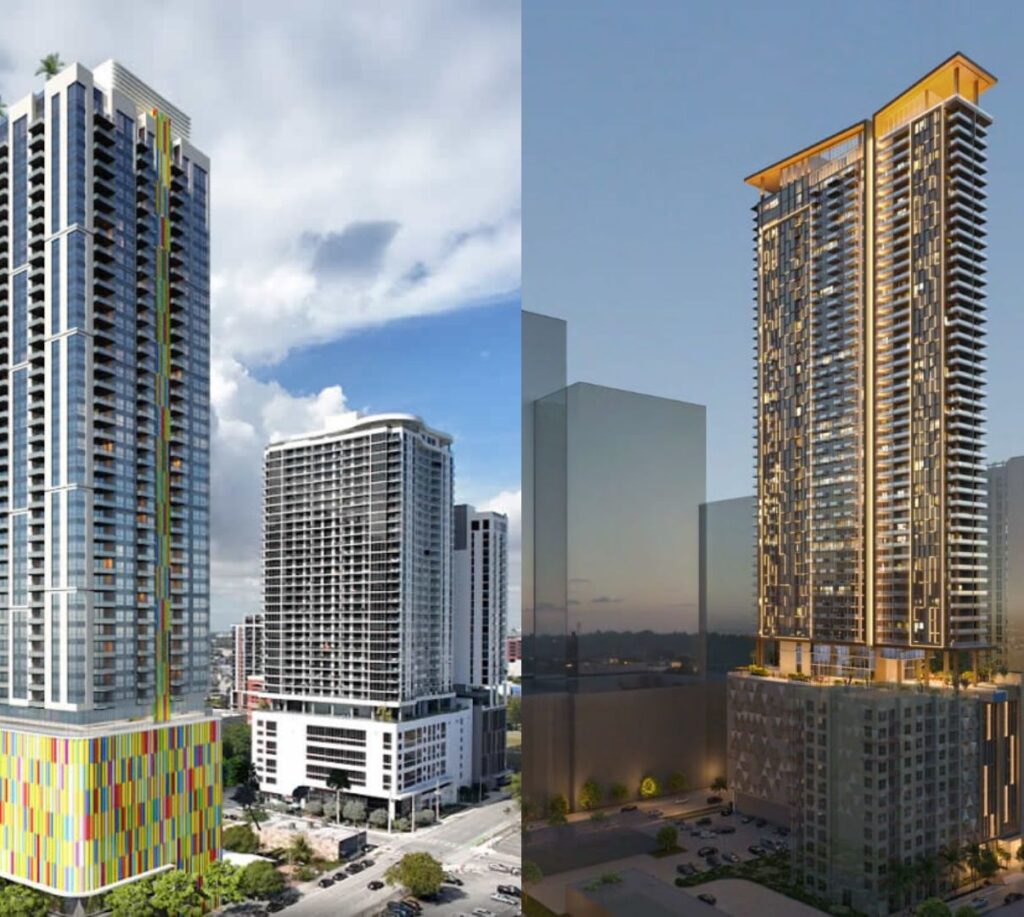
Today’s Floridian Rundown highlights two projects at different stages of the development process. The first focuses on the release of a new design for a long-anticipated redevelopment site in Miami’s Omni District. The second turns to Fort Lauderdale, where plans for the city’s proposed tallest building have returned to the agenda and are now awaiting review by the City Commission. The renewed activity signals renewed momentum for a project that has remained largely quiet since last year. Floridian Rundown is an experimental article format aimed at surfacing development activity that may not always warrant full-length coverage. Published as a periodic publication, the series highlights early-stage proposals, design updates, and lesser-reported projects that are quietly moving through the pipeline, offering readers more insight beyond traditional weekday coverage. If you would like to see more of this article type, which is in an experimental period between last week and tomorrow, please answer on a poll found at the end of the article. 1501 Northeast First Avenue View this post on Instagram A post shared by South Florida QOZ Fund (@sfqoz) A property in Miami’s Omni District, also known as the Arts & Entertainment District, is being pursued for redevelopment by SF QOZ Fund I, an investment group led by David Cohen and Liam Krahe. The fund specializes in projects located within federally designated Qualified Opportunity Zones, areas identified as economically distressed and eligible for certain tax advantages. Those incentives form a key part of the project’s capital strategy, which relies on outside investor participation. Promotional materials indicate that the offering is entering its final phase of fundraising limited to accredited investors. However, a review of city records shows that the proposal has not yet been formally submitted to the City of Miami. The development team is targeting a six-parcel assemblage at 1501 Northeast First Avenue, a roughly 0.8-acre site acquired from Genting for approximately $20.9 million in early 2025 by A&E District Holding Company, LLC ( an entity affiliated with SF QOZ Fund I). The project would become the neighborhood’s first true skyscraper, defined as a building rising above 492 FT, with the tower planned at 47 stories. The development will include around 10,000 SF of coworking space, 4,000 SF of retail, and 576 residential units. The project is designed by Kobi Karp, with artistic collaboration from Ron Agam. Architecturally, the tower features a colorful, multi-story podium paired with a modern facade characterized by floor-to-ceiling glazing and glass balconies. Permitting for the site, including demolition or site work permits, are not in the works right now. However, the development team has indicated that permitting is targeted for May 2026, with groundbreaking anticipated to follow in June 2026. 315 Northeast 3rd Street Plans for what is proposed to become Fort Lauderdale’s tallest tower at 315 NE 3rd Street are advancing to an upcoming City Commission meeting, following revisions to both the project’s height and density. After review by the city’s Development Review Committee and subsequent staff comments, the development team has updated several features of the design as well. Led by Arosa Developers and designed by FSMY, the project is scheduled to appear before the Fort Lauderdale City Commission on January 20th. The revised plans call for a total of 602 residential units, including 135 studios ranging from 400 to 404 SF, 207 one-bedroom units ranging from 462 to 737 SF, 201 two-bedroom units ranging from 637 to 949 SF, 43 three-bedroom units ranging from 953 to 1,032 SF, and 16 four-bedroom units measuring 1,422 SF. The updated unit count represents a slight reduction from the 607 units proposed in the first iteration. The project includes 3,653 SF of ground-floor commercial space and a total of 654 parking spaces, exceeding the 602 spaces otherwise required under the city’s one-space-per-unit code. The additional parking is intended to replace spaces currently serving the neighboring NOLA Lofts, which will forfeit its existing surface parking as part of the development. Due to the tower’s uniquely slender lot, the parking garage will also utilize an automated parking system, incorporating double and triple-stack mechanical lifts to maximize capacity within the garage. Changes to the building’s exterior design in response to Development Review Committee (DRC) comments have also resulted in alterations to the tower’s overall height. The DRC called for greater ‘skyline drama’ above the top habitable floor, resulting in the integration of the elevator overruns and mechanical spaces into the architectural form of the tower. As a result, the roof has been redesigned with a more sloped profile, bringing the final height to 608 FT rather than 603 FT. In addition, DRC comments called for a taller and more prominent ground-floor entrance, especially due to the podium’s massing. The development team responded by increasing floor-to-ceiling heights along the 3rd Street frontage, improving the street-level presence. Would you like to see more?
Design District Condo and Hotel Project at 3995 N Miami Avenue Advances to UDRB
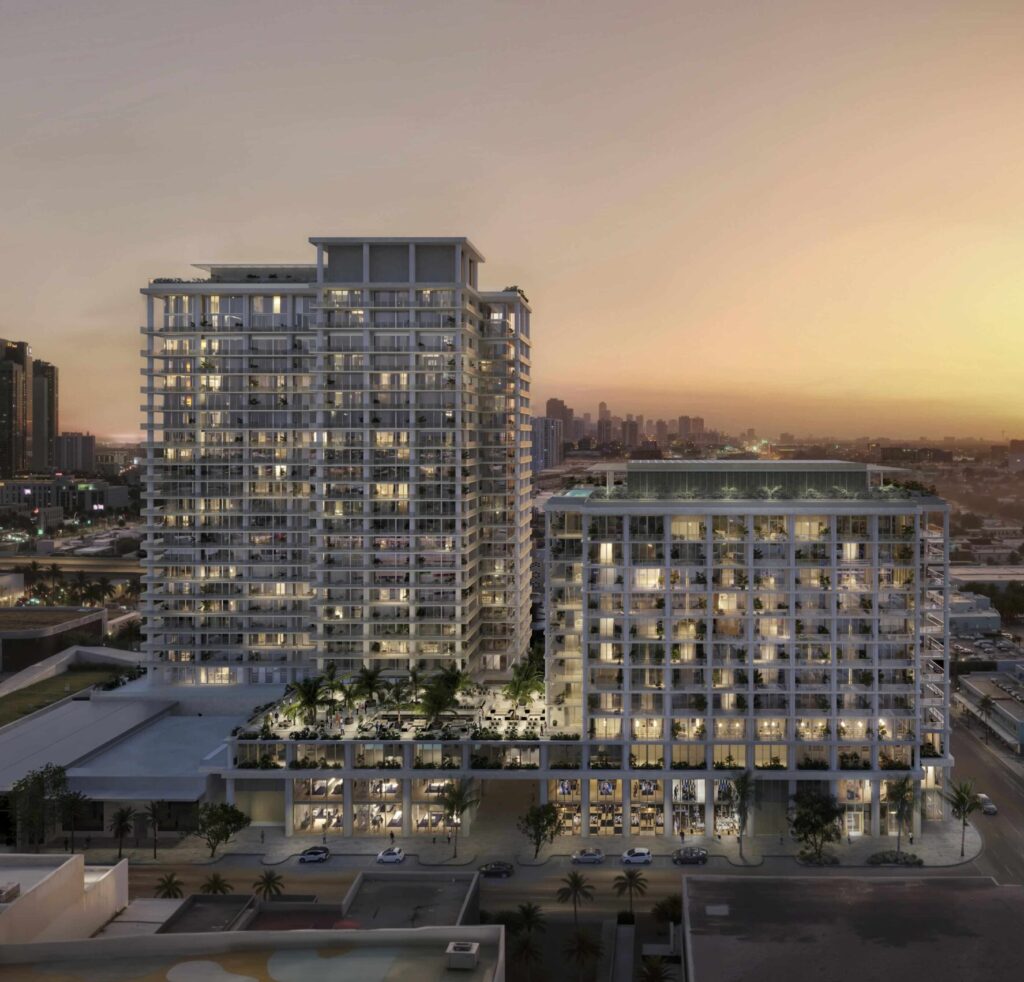
Miami’s Design District high-rise pipeline continues to build momentum as another development team advances plans for a mixed-use project in the neighborhood. The proposal calls for a luxury hotel and a high-end condominium tower positioned between two buildings, which (if built ahead of other proposals) would become the Design District’s first true high-rise, following decades of concepts that either stalled, evolved, or never advanced beyond planning. The development is scheduled for review by Miami’s Urban Development Review Board on January 21st. Planned for 3995 N Miami Avenue, the project spans an assemblage of 15 low-rise structures currently occupied by a mix of office, retail, and leisure uses. The properties were acquired for approximately $170 million in late 2022. The development is being led by a joint venture between Constellation Hotels Holding, Raycliff Capital, Miami Design District Associates, and Fort Partners, with Miami Design District Associates itself formed through a partnership involving Dacra, L Catterton Real Estate, and Brookfield Properties. According to development details submitted to the city, the project would include 143 condominium residences and 105 hotel units, comprising 85 traditional hotel rooms and 20 condo-hotel units that will likely allow short-term rental flexibility. All condominium residences would be located in the shorter building on the northern portion of the site, while the taller tower would house the hotel program, with the condo-hotel units positioned toward the upper floors. Hotel rooms are planned to range in size from 489 SF up to 1,226 SF, while the condo-hotel units would be significantly larger, spanning 1,613 SF to as much as 6,594 SF. Condominium residences in the shorter tower are also on the larger end, with unit sizes ranging from 902 SF to 2,975 SF. Amenities for the hotel and condominium components will be fully separated. Hotel guests will have access to amenities that include a large spa, dining areas, terraces, and a rooftop pool. Condominium residents, meanwhile, will have their own private and shared amenities, including a fitness center and a separate rooftop pool. According to Cube3, the project’s architect, residences in both buildings are ‘arranged to maximize views toward the ocean and sunset by looking past each other in plan’. At street level, the project will introduce 51,840 SF of commercial space spread across the first and second floors, configured as multiple retail slots. Given the site’s location within the Design District, the retail component is likely to feature a mix of designer brands and high-end local tenants. According to a letter of intent, Dacra (a partner in the project) ‘will ensure a curated group of retail tenants’ to fill out the retail units. To accommodate demand generated by the hotel, residential, and retail uses, the development also includes a single-level underground parking garage with 178 spaces, a rare feature given Miami’s groundwater conditions and terrain. Among other changes to the site includes significant upgrades to the pedestrian realm, featuring designated drop-off zones and a large civic space along the southern portion of the site. That public-facing area would be landscaped with substantial greenery, multiple pedestrian pathways, and integrated lighting to enhance walkability and street-level activity. According to the elevations, the shorter condominium tower will rise 12 floors, reaching approximately 185 FT to its tallest point, while the taller tower will rise 24 floors, reaching approximately 309 FT. The facade will feature a palette of glazed terracotta, terrazzo pavers, stone cladding, and complementary materials in beige, white, and light gray tones. These design choices are intentional, drawing inspiration from Miami’s modernist architectural heritage. The site is currently split between T5-O and T6-12 zoning, prompting the developer to require a unified site approach through a Special Area Plan that allows height and density to be distributed across the property. Approval of the SAP is required and falls outside the authority of the Urban Development Review Board; however, the UDRB will still review the project’s design and massing as part of its role. While no naming scheme is confirmed, recent documents call the project MDD-West, short for Miami Design District West.
Crescent Heights Proposes Legends, a 1,307-Unit Live Local Development in Edgewater

Crescent Height’s development footprint in Edgewater is set to grow even larger, following the submission of plans for a new two-tower complex called ‘Legends’ in the neighborhood. Proposed for 3180 Biscayne Boulevard, the project is being advanced under Florida’s Live Local Act, allowing the development to move forward without a rezoning or extended public hearing process. Designed by Minneapolis-based RSP Architects, Legends comes on the heels of an eventful 2025 for Crescent Heights, capped by the completion of Forma and the filing of Forma Phase II. With this submission, the firm appears to be carrying its Edgewater momentum straight into 2026. The 2.6-acre site, bounded by Biscayne Boulevard and NE 2nd Avenue, is the result of a multi-year assemblage completed by Crescent Heights. The property currently consists of a mix of low-rise structures, grass lots, and surface parking, all of which would have to be cleared to make way for the new development. According to the application filed with the city, Legends would deliver a total of 1,307 residential units across the site, split between condominium and rental residences. Unit sizes would range from the low 400 SF range up to 2,230 SF, resulting in an overall density of roughly 500 units per acre. That level of density would not be permitted under existing zoning, which caps development at approximately 150 units per acre. Instead, the proposal relies on Florida’s Live Local Act, which allows qualifying projects to utilize the maximum residential density allowed within city boundaries (up to 1,000 units per acre in Miami) provided certain standards are met. While the project remains well below the live local density limit, the project’s current density wouldn’t be possible without a rezoning. To qualify under the Live Local Act, the development must put forth at least 40% of its residential units as workforce housing priced at up to 120% of the Area Median Income and allocate a minimum of 65% of its usable square footage to residential uses. In this case, the proposal includes 527 workforce units, representing roughly 40% of total units, alongside 780 market-rate residences. The shorter tower on the western portion of the site will contain all of the workforce housing units, while the taller eastern tower will include 310 market-rate rental units as well as 470 condo residences. Regardless of unit type or tower placement, residents will share a common amenity deck featuring a fitness center, a large pool deck, lounges, and additional shared spaces. Consistent with many Crescent Heights projects, Legends includes a substantial commercial component. A total of 98,729 SF of commercial space is planned throughout the development, distributed between the ground floor and the 9th level. The size of these spaces would be suitable for a grocery store or large retailer, lining up with Crescent Heights’ recent delivery of a Whole Foods two blocks away at the newly completed Forma development. To accommodate both residents and retail patrons, the parking podium is planned to include 1,163 spaces: roughly half of the 2,326 spaces otherwise required under Miami code. The reduction is achieved through a combination of code allowances, including payment into a parking trust fund, the site’s proximity to a transit corridor, and provisions enabled under the Live Local Act. The two towers ,designed by RSP Architects, will feature a contemporary exterior design, including smooth stucco finishes, a metal mesh-wrapped podium, glass railings, and impact-resistant glazing. The shorter tower is planned to rise 27 stories, or approximately 327 FT, while the taller tower would reach 49 stories, or about 584 FT. Uniquely, these heights are not derived from the Live Local Act. Under existing zoning, 36 stories are permitted by right, with the additional height achieved through bonus programs rather than the Live Local Act. The project is scheduled to appear before Miami’s Urban Development Review Board on January 21st. While the UDRB does not issue binding approvals or denials, and instead provides recommendations, its suggestions often plays a meaningful role in the final design of many projects.
Sunny Isles Beach’s Tallest Skyscraper Ever Proposed at 19051 Collins Avenue
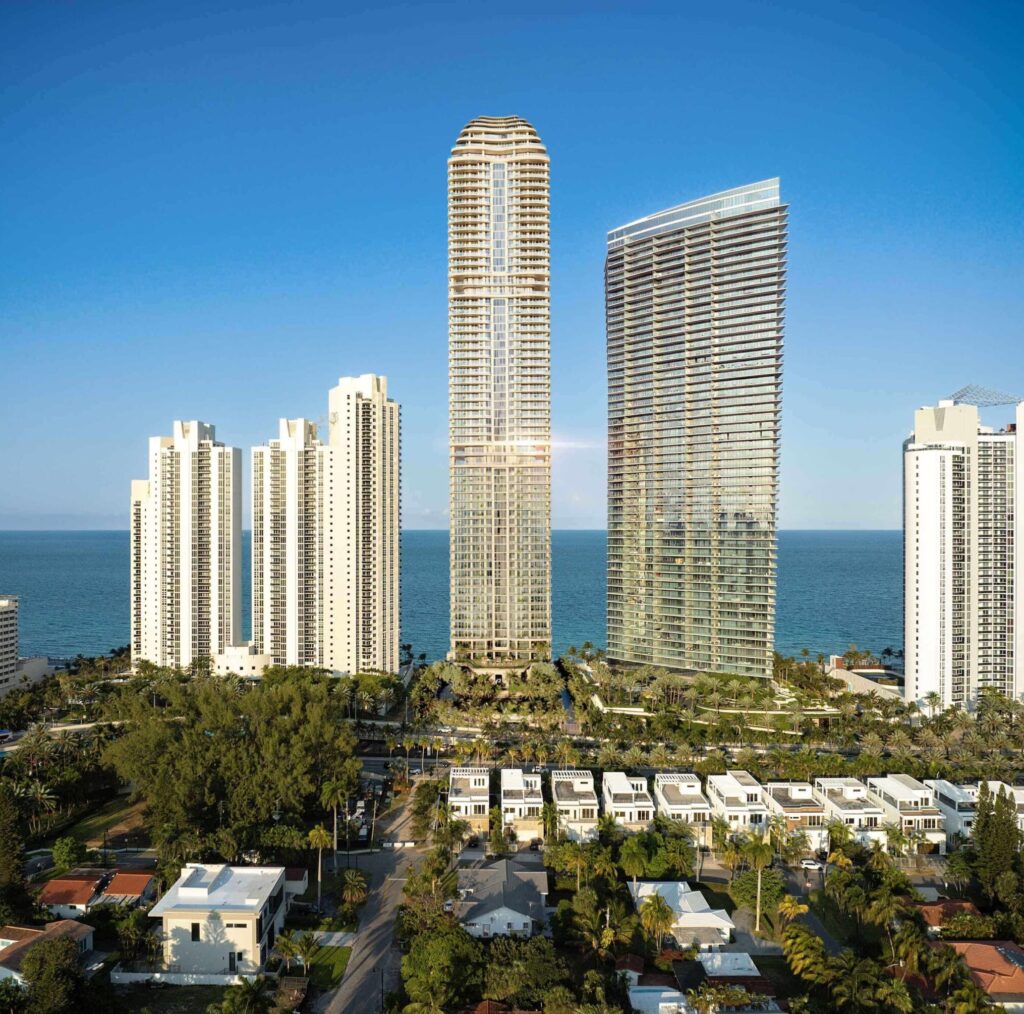
Sunny Isles Beach is set to receive its tallest skyscraper yet under a new proposal from a joint venture led by the Related Group, Dezer Development, and the BH Group. Planned for 19051 Collins Avenue, the development is scheduled to go before the Sunny Isles Beach City Commission on January 15th as the partnership seeks approval for a 62-story tower. Designed by Cohen Freedman Encinosa with landscape architecture by Enea, the long-anticipated project gained momentum after the FAA cleared the site for a structure of up to 820 FT: a height that would make it the tallest building outside of Miami. The roughly two-acre site is currently occupied by the Miami Beach Club condominium complex, which the partnership bought out for approximately $130 million under the entity MB RE Investments. Despite the buyout, recent photos from about two months ago show that the existing buildings remain intact, with demolition still pending. Plans submitted to the city call for 145 ultra-luxury condominium residences, with unit types ranging from three-bedroom layouts to four-, five-, and six-bedroom homes. Two full-floor penthouses of around 9,000 SF each are proposed near the top of the tower. While existing zoning permits only 50 units per acre, the development is seeking increased density through financial contributions and public benefits offered to the city in exchange for the additional units, bringing the final density to 73 units per acre. According to a representative of the project, the tower will have a large array of amenities for the residents. These include outdoor amenity space such as a padel ball court, water features, raised pool deck, and a sculpture garden. In addition, ‘The project also includes impressive “sunrise” amenities on the east side of the building facing the ocean such as a large lap pool, outdoor spa facilities, cabanas, outdoor seating, and a lawn area transitioning to beach access.’ The structure will rise from a three-story podium containing 298 parking spaces (featuring a mix of tandem and standard spaces), providing a ratio of more than one space per unit as well as parking for a proposed 2,390 SF private restaurant. An elevated driveway will carry vehicles up to the main lobby level at the top of the podium, a layout that is common for high-rise developments in Sunny Isles Beach. Architectural elevations show the tower rising 818 FT to its highest architectural point, or 820 FT including aircraft warning lights. The building is designed with an almost entirely glass facade, accented by limited areas of linen-painted stucco. All residences will feature glass railings and 12-FT ceilings, except for the penthouse units. In an accompanying letter of intent, the tower is described as a ‘slender’ structure with a ‘classical’ and elegant appearance, designed to maximize spacing from neighboring buildings. While the project has not yet gone before the Sunny Isles Beach City Commission, staff analysis has found the proposal to be ‘consistent with the City of Sunny Isles Beach Comprehensive Plan and all applicable provisions of the City’s Land Development Regulations.’ If approved, the development team would be required to satisfy 19 conditions prior to the start of construction. The project is estimated to have a construction cost of approximately $294 million, with completion targeted for December 2031.
Floridian Rundown: New Design Emerges for 3333 Biscayne; Milton Mirage Proposed in Princeton
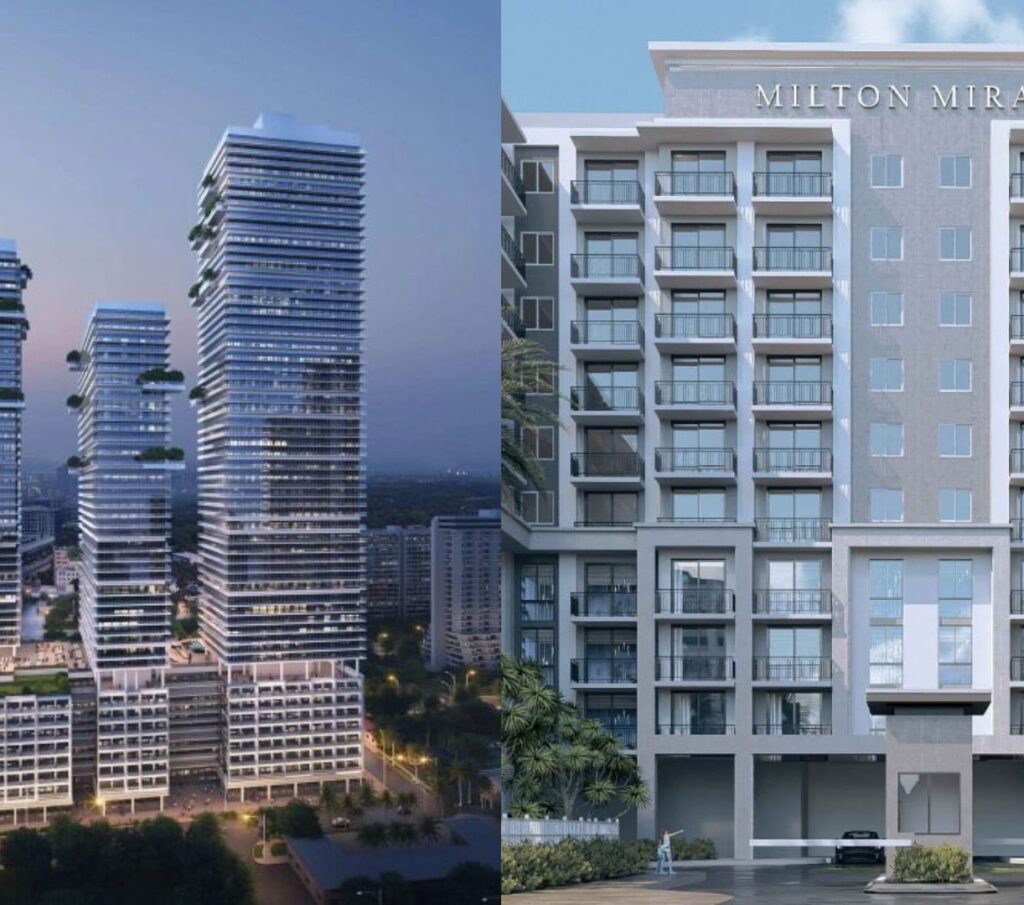
Weekends on Floridian Development are about to look a little different. In addition to regular reporting, Floridian Development is rolling out a new format to highlight development activity that often goes unnoticed: featuring early-stage proposals, smaller projects, and concepts still taking shape. These posts are designed to showcase what is quietly moving through Florida’s development pipeline, giving readers insight into the next wave of projects before they reach the broader press. Each post will spotlight two to three projects and take a more flexible, exploratory tone than weekday coverage. Called Floridian Rundown, this service will run from today, all the way to next week. Please take the time to answer a poll at the end of the article to determine if you’d like to see more of this. 3333 Biscayne A long-planned development at 3333 Biscayne Boulevard in Miami’s Edgewater neighborhood is now headed back to the drawing board. The three-tower project was first introduced to the city in 2022, when plans called for 635 residential units, nearly 160,000 SF of office space, and roughly 19,000 SF of retail at street level. The original design, led by Beitel Group with architecture by Stantec, envisioned three towers rising 12, 40, and 41 stories above a shared podium featuring more than 1,100 parking spaces. Since then, the project has been quietly reworked. About nine months ago, Beitel Group CEO Ben Beitel unveiled a new set of renderings showing a substantially taller and more vertical three-tower design, signaling a significant shift in how the site may ultimately be built. According to additional renderings from FTG Studio, which produced the project’s visualizations, the tallest tower is located on the eastern portion of the site, with the shortest in the center and the second-tallest to the west. An amenity deck is planned on the 8th floor, featuring a pool, lounge areas, and other shared spaces. While not much is known about the proposal as of now, the podium is entirely enclosed by units, improving the pedestrian experience and architectural coherence of the project. Milton Mirage South Miami-Dade’s historic densification continues with a new multifamily project proposed for a 7.2-acre site at 25101 Talbot Road in Princeton, within unincorporated Miami-Dade County. The project, led by Princeton Real Estate Investments, LLC, represents the latest version of a property that has undergone several changes in design and function. Plans submitted last month outline a development containing 819 residential units, including 24 studios, 330 one-bedroom units, 413 two-bedroom units, and 52 three-bedroom residences, reflecting a unit mix weighted toward small- and mid-sized apartments. The project would also include 1,265 parking spaces (more than one per unit) along with a suite of resident amenities such as two swimming pools, a business and home-office center, party rooms, and landscaped open spaces. Designed by Caymares Martin Architecture, the project is planned to rise 10 stories (or 104 FT), excluding rooftop architectural features that could bring the total height to approximately 115 FT. The exterior elevations showcase the development under the name Milton Mirage. Thoughts on Floridian Rundown? Answer Here!
After Years of Revisions, Partnership Returns With New Tower Plan at 11 N Andrews Ave
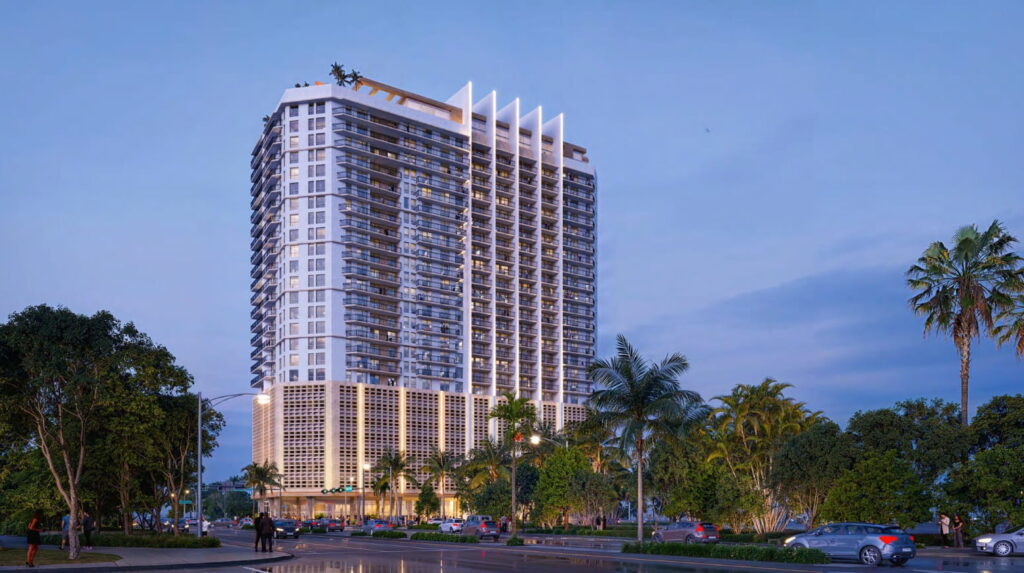
Plans have been unveiled for a new tower proposal at 11 N Andrews Ave, a site that has undergone multiple design iterations in recent years. Led by Bachow Ventures in partnership with Infinity Collective, the latest submission marks the fourth version of a project first introduced in early 2022. The development team is now returning to Fort Lauderdale’s Development Review Committee seeking approval to increase the unit count from previously approved site plans, with the updated proposal calling for a 378-unit residential tower. The assemblage, which currently includes a Goodyear auto service center and surface parking, is located in close proximity to the Fort Lauderdale Brightline station. The property was acquired in 2023 for approximately $8 million, at which time the Goodyear tenant had two years remaining on its lease. That lease has since expired, clearing the way for redevelopment of the site. According to plans submitted to the public today (January 9th, 2026), the proposed 378 units will include 36 studio apartments, 252 one-bedroom units, and 90 two-bedroom units. Studio residences would start at a minimum of 460 SF, while the largest units would be two-bedroom apartments measuring up to 1,396 SF. Residents will have access to an array of amenities located above the 26th floor, offering rooftop views of the surrounding area. Planned amenities include a demo kitchen, dedicated co-working space, a 2,342 SF fitness room, resident lounge, barbecue area, and a pool equipped with a spa and private cabanas. At ground level, the project will feature an expanded sidewalk with planters and landscaping integrated into the streetscape. There will be 5,605 SF of retail space, a slight reduction from the 5,822 SF approved under the original site plan (requiring an amendment to the site plan). In addition, the tower’s podium will feature 444 parking spaces. Designed by well-known architect Cube 3, the tower is proposed to rise 26 stories, measuring 310 FT. The building features a warm, tropical-inspired aesthetic, with a mix of board-look cladding, tan and white smooth stucco finishes, and metal balcony railings. At the base, the podium features tan-colored breeze blocks, adding texture while allowing for ventilation. As previously noted, the latest submission marks the fourth redesign of the project, reflecting a multi-year evolution in scale and form. Initial plans unveiled in 2022 called for a tall 47-story tower rising 499 FT, anchored by a large base. That vision was later dramatically reduced to a 23-story structure standing 241 FT tall. The project then rebounded in a later iteration with a 37-story, 397 FT tower. Under the current proposal, the building steps back once again in height, though the revised design widens the tower’s footprint, shifting the emphasis from height to a wider, more substantial massing. Set for review by the Development Review Committee on January 13th, 2026, the proposal has already several comments from staff ahead of the meeting calling for design alterations. Among the critiques, the tower’s podium was described as ‘not exceptional as required by the master plan,’ while the facade was characterized as ‘flat,’ lacking sufficient architectural variation. If revisions are made in response to these comments, Floridian Development will provide updates in a future article.
FAA Reissuance Clears Path for 540-Foot Tower at 601 N Ashley Drive in Downtown Tampa
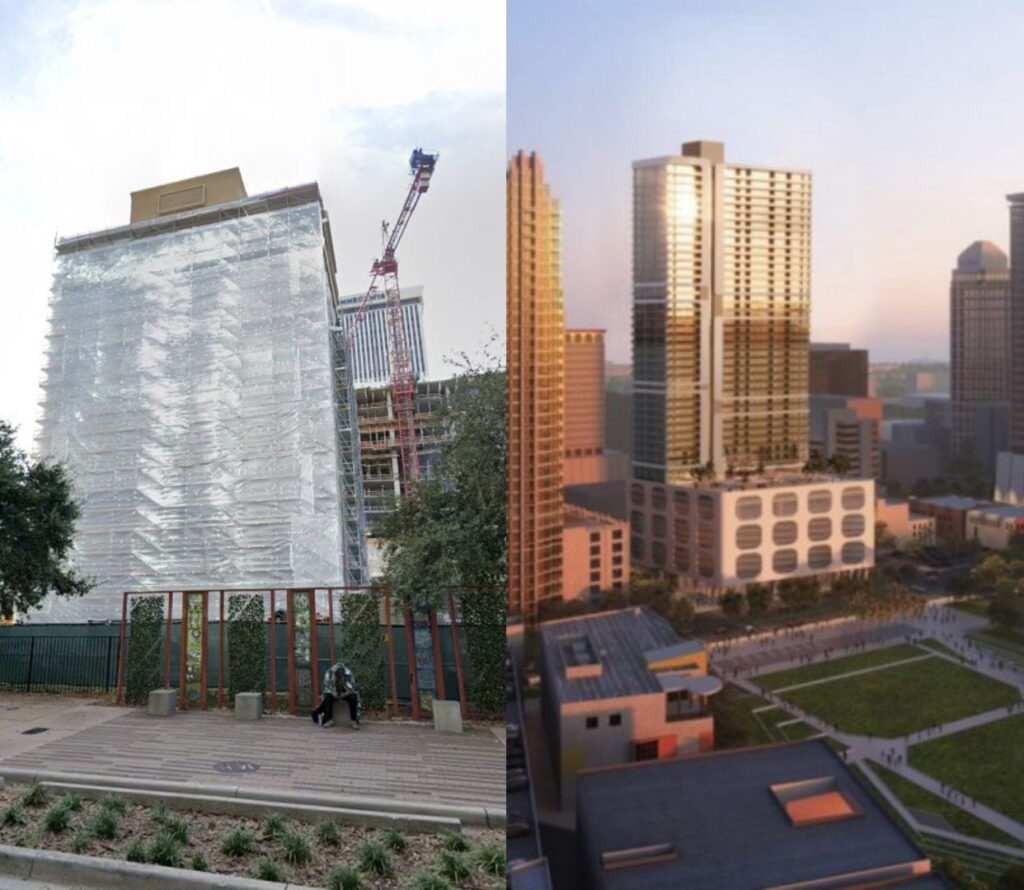
Tampa’s next major skyscraper is inching toward reality as permitting and regulatory groundwork begin to take shape at 601 N Ashley Drive, a prominent downtown parcel now under redevelopment. Naples-based Stock Development recently filed for the reissuance of a FAA height application amid ongoing demolition of the existing office building and surface parking lot, which will eventually clear the around 1-acre site. The property was acquired by Stock Development in 2025 for $40 million, marking one of the most significant property transactions in Tampa history. The sale ended a multi-year development effort initiated by TLR Group, which first assembled the site in 2021 and spent several years advancing plans for the high-rise project. Under TLR Group’s ownership, the site underwent multiple design iterations, including an FAA height application submitted in 2022 for a 540-foot tower. The final proposal, which advanced prior to the sale, envisioned a 48-story tower rising 540 FT, featuring 600 residential units, 68,000 SF of office space, and 12,000 SF of retail. A large podium was also planned, providing parking for up to 985 vehicles. On January 8th, 2026, Bill Fleck of Stock Development refiled FAA height approvals for a 540 FT tower, or 558 FT above mean sea level. The application received an immediate determination of no hazard to air navigation. The same-day approval is a result of the FAA’s prior completion of a full study for the project under its previous ownership. Because the refiling did not introduce any changes to the tower’s height, location, or aviation impacts (and was required solely due to the change in sponsor) the FAA treated the submission as a reaffirmation of its ‘No Hazard’ designation. While the FAA filing represents an important regulatory step, and signals Stock Development’s continued intent to advance the project, it also caps the tower’s maximum allowable height. With approval set at 540 FT, any proposal exceeding that limit would require a new FAA filing, suggesting that the tower is unlikely to surpass earlier iterations. Although it remains unknown whether Stock Development will follow a design similar to prior proposals, TLR Group previously noted that the site attracted higher purchase offers once development plans had received city approvals. Stock Development has indicated an interest in changing the project towards a condominium tower, potentially as a branded residential development, which could change both the interior and exterior design. Permitting records and recent on-site activity indicate that demolition is already underway, with a commercial demolition permit filed on December 1st of last year. D.H. Griffin Wrecking Company is handling the demolition, which includes the removal of the existing structure, basement, and foundation, with the site planned to be restored as a grass lot. This story is still developing, and Floridian Development will continue to provide new articles as the project advances through permitting and as further details on the design emerge.
550-Unit Biscayne Shores Proposal Moves Closer to Approval at 11400 Biscayne Blvd

A slender site in unincorporated Miami-Dade County, situated between Miami and North Miami, is quietly advancing through the approval process for a new multifamily high-rise development. Led by New York City-based Ben Josef Group Holdings, the proposal calls for two residential buildings rising from a shared podium, designed by Kobi Karp Architecture. The project is now on its latest iteration, following a review process that began when first designs were released in 2024. Planned for 11400 Biscayne Boulevard, the project will be the first development on the site in decades, following a long period in which the property remained vacant. Despite its narrow profile, the site will span a surprising four acres. Coined Biscayne Shores, the latest plans call for 550 residential units, including 206 workforce units (priced no more than 120% of the Area Median Income) and 344 market-rate units. This equates to a density of 135 units per acre, with a unit mix spanning studio, one-bedroom, two-bedroom, and three-bedroom apartments. Such density is not permitted under existing zoning and would be permitted through a proposed amendment to the County’s Comprehensive Development Master Plan (CDMP). The amendment would allow higher residential density for a limited number of qualifying sites within the SMART Plan corridor buffer area, while the applicant is also seeking changes to the site’s Future Land Use Map (FLUM) designation. In addition to the residential units, the development will include a shared amenity deck on the fifth level, featuring a swimming pool and lounge areas. Rooftop decks are also planned above the 15th and 11th floors. Residents will have access to 520 vehicle parking spaces, along with 292 bicycle parking spaces. The ground floor will introduce significant changes to the existing site, including approximately 20,000 SF of retail space, new pedestrian paseos, and a new private street linking Biscayne Boulevard with NE 14th Avenue. Landscaping and greenery will be incorporated along the streets/paseos. According to elevations submitted by Kobi Karp Architecture, the east tower is planned to rise 15 stories, reaching 179 FT to its highest point, while the west building will stand 11 stories at 127 FT. Earlier elevations showed the west structure topping out at 107 FT, indicating a height increase in the latest plans, while the maximum height of the east tower remains unchanged. Although the overall massing and design of the project has largely been the same, the updated design shifts toward a facade with more linear balconies and a heavier use of stucco relative to window area. According to the filing with Miami-Dade, corrections are still required before the applicant can receive approval.
FAA Filing Submitted for 282-Foot The Gaspar Condominium Tower in Downtown Tampa
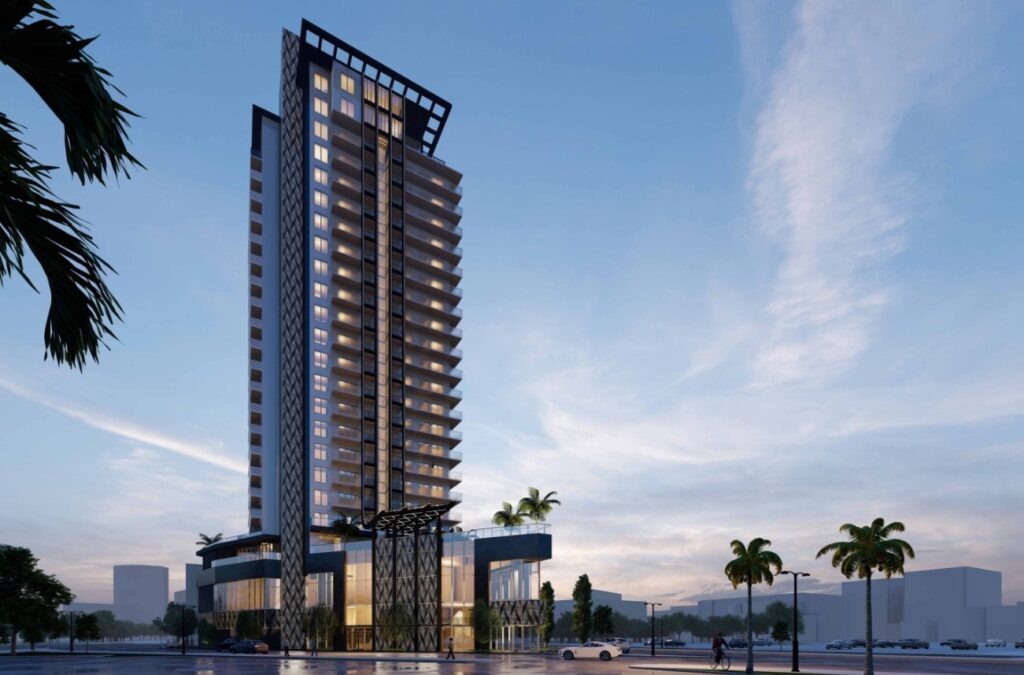
A recently-planned development proposed for a triangular parcel at the entrance of Downtown Tampa is moving closer to realization. Known as The Gaspar, the project has recently filed for an application with the Federal Aviation Administration seeking height approval for its proposed condominium tower, signaling progress toward construction. Planned for 1307 N Jefferson Street, the 0.33-acre site is being developed by Berts Real Estate in partnership with consultant Flamingo Homes. The property is currently owned by 1307 N Jefferson Tampa LLC, an entity affiliated with Berts Real Estate. Floridian Development previously reported on the proposal during its analysis by Tampa’s Design District Review board, a process which is still underway. According to the application filed by Bruce Strebinger, co-founder and CEO of Berts Real Estate, the proposed 23-story tower would rise 282 FT from ground level, or 302 FT above mean sea level. The application was submitted on January 5th and remains under review, though approval is widely expected given the project’s relatively modest height and limited impact on nearby airports. The proposed height aligns with earlier submissions, which called for the tower to rise 281 FT to its highest point. Designed by MGBA Architecture, the tower features a contemporary design composed of frosted glass, a gray-and-white color palette, and expansive balconies. The development is planned to include 188 residential units, comprising a mix of studio, one-, two-, three-, and four-bedroom residences. The podium and ground floor would incorporate 2,424 SF of commercial space, 5,327 SF of office space, along with 91 vehicular parking spaces and 72 bicycle parking spaces. While review by Tampa’s Design District Review Board remains ongoing, the developer has not yet filed for construction permits. An FAA application related to cranes on the site has also not been submitted, multiple steps still needed before the project can break ground. Development activity in Downtown Tampa has remained strong in recent years. Nearby, Hotel Ora + Private Residences has reported solid sales momentum and is preparing to move towards groundbreaking, while developments like The Pendry or One Tampa are already underway.
Partnership Proposes 6-Story Multifamily Building in South Miami at 6230 SW 69th Street
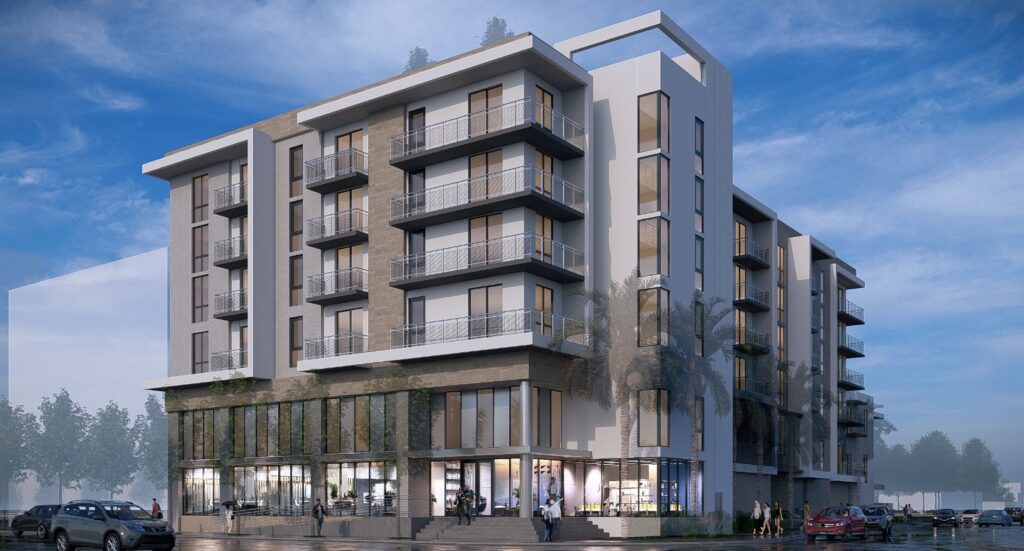
A South Florida–based development team has submitted plans to the City of South Miami for a new multifamily project. Led by The Estate Companies in partnership with MAS AJP, the proposal calls for a multi-story residential building designed by Caymares Martin Architecture. The project is scheduled for review by the South Miami’s Design Review Board on January 6th, and would deliver 75 residential units on an assemblage spanning nearly one acre. The site is located at 6230 SW 69th Street, in proximity to Downtown South Miami and nearby single-family neighborhoods. The assemblage is comprised of four parcels, with two owned by SOUTH MIAMI RE PARTNERS LLC and two by 6201 SREI 99 LLC: entities associated with The Estate Companies and MAS AJP respectively. All four properties were acquired for a combined $3.5 million in early 2023, with two of the parcels subsequently transferred to The Estate Companies as part of the development partnership. According to plans submitted to the city, the development will include 7 studio units of 500 SF, 14 one-bedroom units ranging from 600 to 650 SF, 28 one-bedroom plus den units between 700 and 750 SF, and 26 two-bedroom units spanning 800 to 850 SF. Residents will have access to a variety of amenities, including a swimming pool, a rooftop deck, an 890 SF amenity room on the third floor, and a spacious ground-floor lobby. Parking for the development will total 128 spaces, including 4 on-street spots. Unusual for a Florida project, one floor of the parking will be located underground. The parking podium, spanning from the ground floor to the second level, will be largely hidden by the building’s units. With 128 spaces, the development provides a parking ratio exceeding 1:1 for residents. Caymares Martin Architects, a frequent collaborator with The Estate Companies, is leading the design for this project. The building will showcase a modern aesthetic, featuring gray and white color tones accented by ceramic wall tiles that mimic the appearance of wood. According to submitted elevations, the development will rise 82 FT from the sidewalk to its tallest point, measuring six stories. While an official name hasn’t been announced, The Estate Companies often uses the “Soleste” brand for their multifamily projects, meaning this development will likely be coined ‘Soleste South Miami’. Developers have quickly turned their attention to South Miami, an area that has traditionally been overshadowed by higher-density development hubs like Coral Gables and Miami. Just a few days ago, AvalonBay Communities proposed Avalon South Miami II, a 16-story residential tower in the heart of the city. AvalonBay isn’t the only developer active in the area, plans were also submitted last year for a full redevelopment of Sunset Place, which would include towers set to become the tallest South Miami has ever seen.
Related Group Resubmits FAA Permits for 444 Brickell, The First Signs of Life in Years
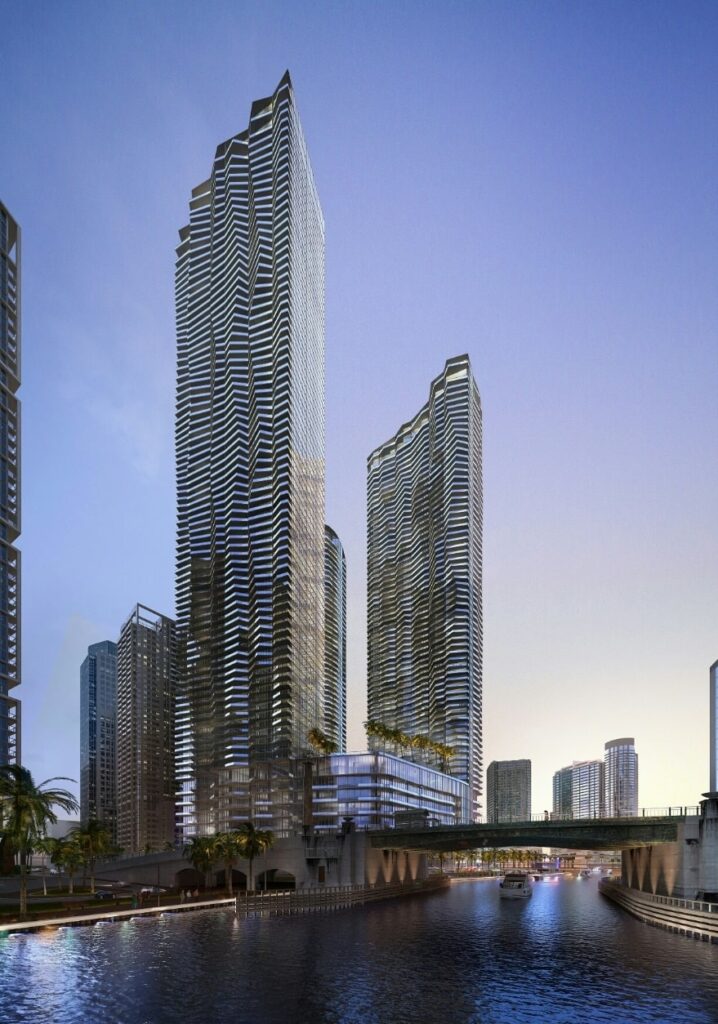
Signs of life have recently emerged for Related Group’s long-delayed third and final tower at One Brickell. New filings with the Federal Aviation Administration showcase refiled height permits for an 897 FT tower at 444 Brickell Avenue, the clearest indication in years that the developer is preparing itself to advance the final phase of the three-tower master plan along the Miami River, after years of uncertainty tied to archaeological discoveries. The 444 Brickell site has remained dormant amid prolonged archaeological review and preservation debates, following the discovery of expansive Tequesta artifacts and human remains during excavation of the adjacent parcels (where Baccarat Residences and Viceroy Brickell are now under construction). The FAA application was submitted after the permits filed in 2022 expired, which means the tower’s height remains unchanged at 897 FT above ground (901 FT above mean sea level). These updates are largely procedural, as the 444 Brickell site has been designated an Archaeologically Significant site to ensure the protection of historic artifacts and human remains uncovered during previous excavations. The designation does not prevent Related from moving forward with construction, since the developer holds vested development rights granted before the discovery of Tequesta artifacts and human remains. However, any major changes to the project beyond the current plans (such as changes in height/design) would require a resubmission, which could trigger additional review, public debate, and extra costs: outcomes Related would likely want to avoid. The designation does, however, require Related to carefully manage all archaeological materials, including their excavation, documentation, storage, and potential public display. Miami’s Historic & Environmental Preservation Board has the right to review and provide recommendations on how these artifacts are handled. In other news, Related told the Miami Herald in late 2024 that the existing office tower at 444 Brickell, which currently stores archaeological artifacts in certain rooms, is not expected to be demolished until at least 2028. The developer has indicated that portions of the artifacts will be incorporated into the project’s design, following the approach used in the Riverwalk for the towers already under construction. These spaces include planned homages to the Tequesta Tribe, such as exhibition areas. While updated plans have not been publicly released, a 2015 Miami River Commission submission (one of the last public files available) indicates that Tower 3 was planned to contain 420 units, designed by Arquitectonica, and intended to rise 80 floors.
Mill Creek Residential’s Modera Aventura South Development Enters Vertical Construction in Ojus
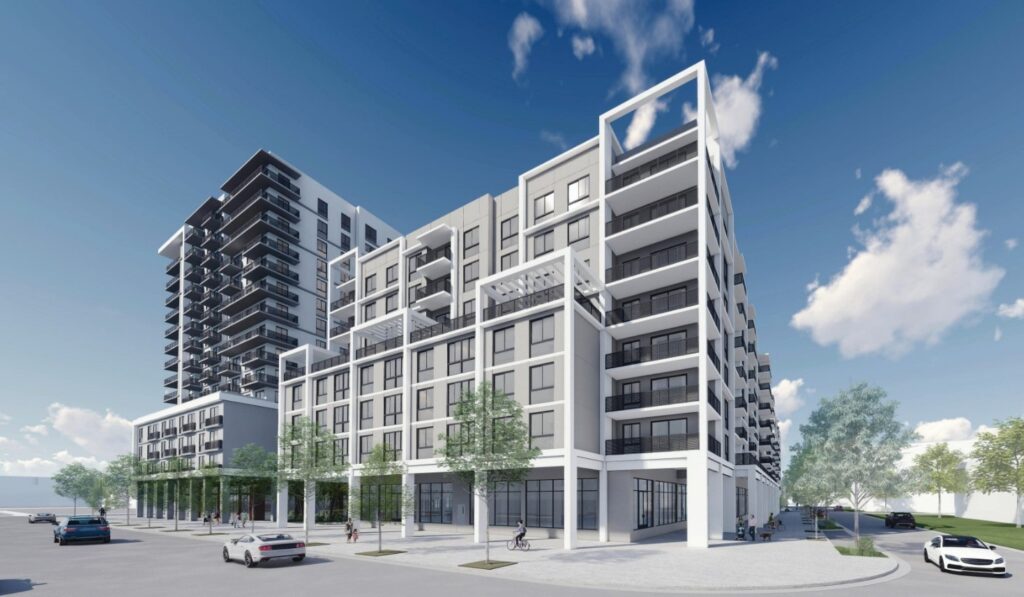
Mill Creek Residential has recently entered the vertical construction phase of Modera Aventura South, a nine-story high-rise planned in northern Miami-Dade. The project, which is the second phase of the Modera Aventura development, is rising at 2681 NE 191 Street in Ojus near Aventura. The milestone follows the recent completion and preleasing of Modera Aventura North, and marks the next step in a multi-phase residential buildout reshaping the corridor. Rising nearly half the height of its sister development, Modera Aventura South will top out at 9 stories compared with 15 for Modera Aventura North, and is expected to welcome its first residents in fall 2027. The project, which broke ground earlier this summer, will deliver 251 units, complementing the 420 homes completed in the first phase. According to a LinkedIn post by Mill Creek superintendent Louie Forte, Modera Aventura South poured its first foundation just three weeks ago, totaling more than 400 cubic yards of concrete. Construction has since advanced to the structure, with first-floor columns beginning to rise about a week ago. Mill Creek Residential is overseeing construction in-house, serving as both the developer and general contractor for the project. Modera Aventura South, once complete, will feature a range of units from one-bedroom to three-bedroom floorplans, with sizes spanning ranging from about 700 to nearly 1,400 SF. The development will provide residents with a large array of amenities, including a swimming pool with lounge areas, a sky terrace, a clubhouse, a spacious lobby, a fitness center, co-working spaces, and additional shared amenities. The development will also include 2,572 SF of retail space at the corner of Harriet Tubman Highway and NE 191st Street. Residents and retail patrons will have access to a total of 444 parking spaces, slightly fewer than the 600 spaces provided in Phase One. This total includes 438 garage spaces and 6 on-street spaces, ensuring at least one space per unit. When Floridian Development first touched on Modera Aventura South, the project had been reduced from the originally envisioned 15 stories to 8. Since that time, however, the developer has increased the building’s height to nine stories by introducing an additional floor toward the east side of the structure. Designed by Corwil Architects, the development will feature a contemporary architectural palette dominated by white and gray tones, assisted by abundant greenery, metal balconies, large windows, and a mix of stucco and concrete finishes. According to building elevations released earlier this year, which reflect the final plans submitted to Miami-Dade County, the structure will rise approximately 107 FT. Development activity in Ojus has reached an all-time high. Located just steps from a Brightline station and within close proximity to Aventura Mall, the area has seen a surge of new office, mixed-use, and residential proposals in recent years. Most recently, The Housing Trust Group (in partnership with AM Affordable Housing) completed construction on Oasis at Aventura, a 95-unit affordable apartment community located in Ojus.
Dulce Vida Advances Toward Groundbreaking Following Key $35 Million Financing Secured
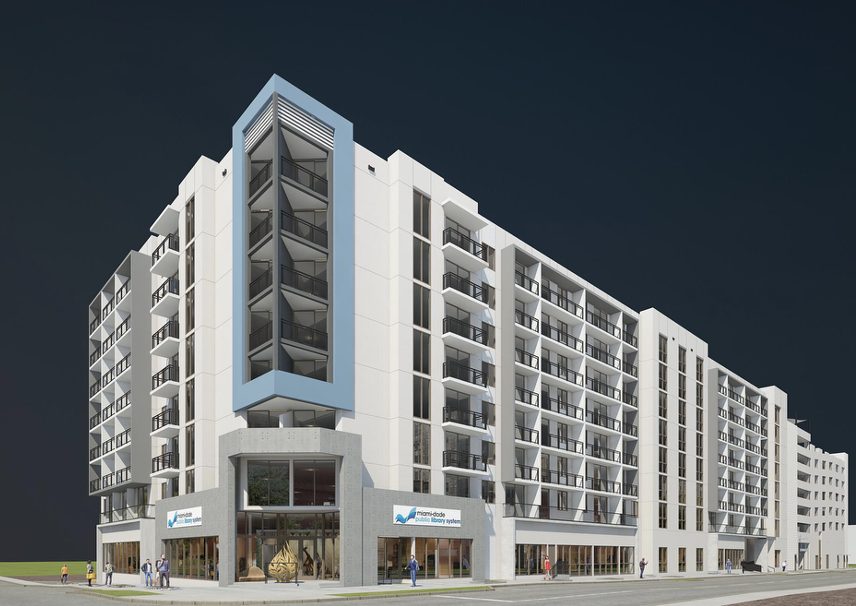
One of Allapattah’s first Live Local Act developments is preparing to move toward groundbreaking as Coral Rock Development advances plans for Dulce Vida, a mixed-income residential project enabled by the state’s sweeping pro-density legislation. The proposal, which received approval from Miami’s Urban Development Review Board in early 2024, is targeting a construction start in early 2026. Groundbreaking is supported by $35 million in financing just granted by Citibank, alongside an additional $15 million secured through the City of Miami’s Forever Affordable Housing Bond program, structured as a 30-year loan. Planned for 1785 NW 35th Street, Dulce Vida will rise on a Miami-Dade County-owned site currently occupied by a one-story public library and surface parking. The redevelopment will replace the existing facility with a new library integrated into the project, while significantly increasing density along a rapidly developing stretch of Allapattah. Set to deliver 227 residential units, Dulce Vida will feature a mix of studio, one-bedroom, and two-bedroom residences. The project is structured as a mixed-income development, serving both low-income households and those qualifying for workforce housing. Under the proposed income distribution, 40% of units will be reserved for households earning up to 60% of Area Median Income (AMI), 35% for households earning up to 100% of AMI, and the remaining 25% for households earning up to 120% of AMI. Residents in the building will have access to multiple amenities, including barbeque areas, a dog park, kids playground, and more, all on the ground floor. According to the project’s UDRB submission from last year, the replacement public library planned at the corner of NW 18th Avenue and NW 35th Street will span 8,494 SF. The development will also include 372 structured parking spaces, in addition to 15 on-street spaces for a total of 387 parking spaces, providing adequate capacity to serve both library patrons and residents. Dulce Vida will rise 8 stories, reaching 80 FT in height. The building’s facade, designed by Behar Font, will combine stucco, concrete parapets, metal balconies, and impact-resistant windows, with a color palette featuring shades of gray and blue. The project has also drawn public support from city leadership. Speaking to CityBiz, which reported on the project’s financing, District 1 Commissioner Miguel Angel Gabela described Dulce Vida as a positive step for the neighborhood. “Dulce Vida is a great addition to Allapattah and District 1 where the city teams up with the developer to continue the redevelopment of the area while providing needed affordable housing, public parking and a new public library,” Gabela said.
West Palm Beach’s Planning Board Unanimously Approves Related Ross’s Shorecrest Condominium Project
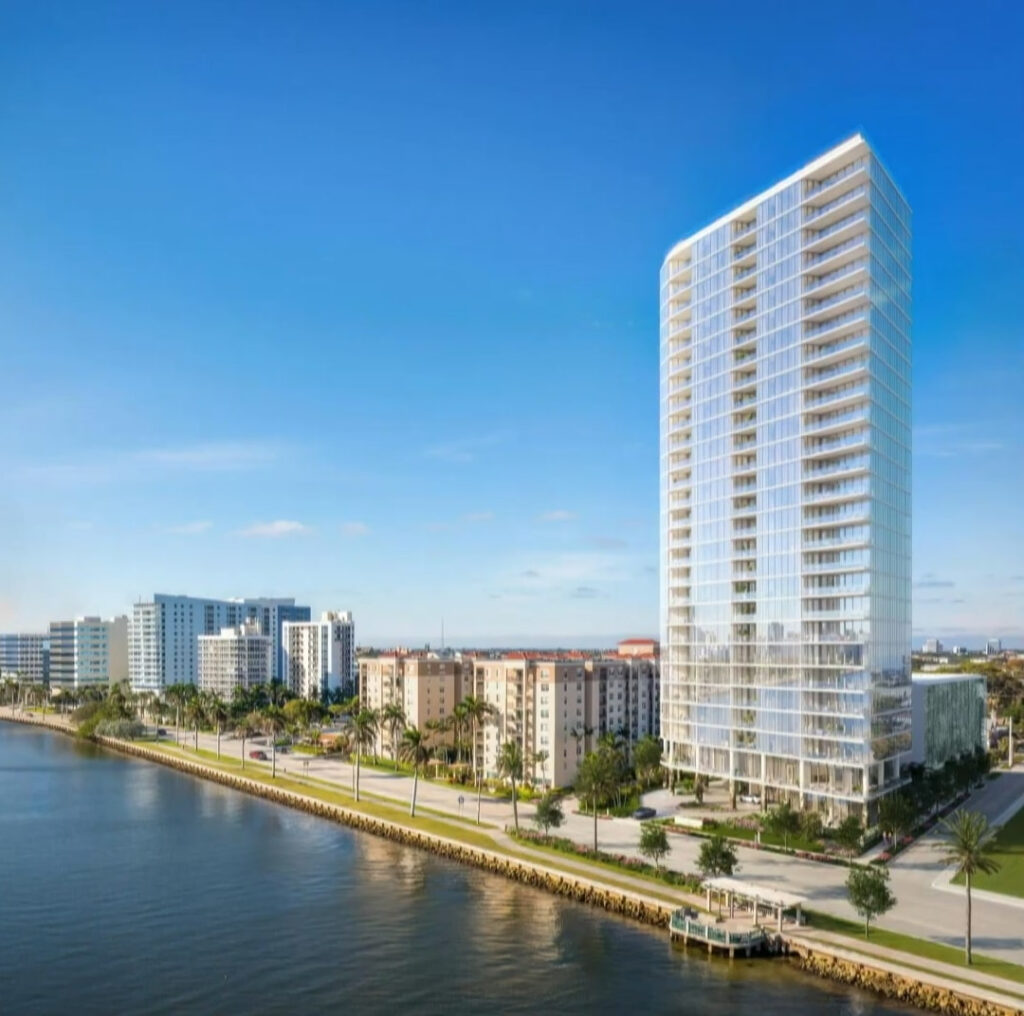
Related Ross’s multifamily pipeline in West Palm Beach is set to expand after the city’s Planning Board unanimously approved plans for Shorecrest, a 27-story residential tower along North Flagler Drive. Designed by Roger Ferris + Partners with interiors by Rottet Studio, the approval represents an early milestone for the project, which must still advance through additional regulatory reviews such as the City Commission. Planned for 1901 North Flagler Drive, the tower will replace the current site occupied by Temple Israel. Under the approved plans, the synagogue has chosen to relocate rather than occupy ground-floor space previously planned within the building. Slated for a transaction valued at around $30 million, the almost 2-acre site will soon be demolished to make way for 100 units. The current 100-unit configuration reflects the latest evolution of the Shorecrest project, which has previously ranged from 140 to 199 units. Units are planned as condominiums rather than apartments, with spacious layouts. While the developer has not provided a full breakdown of unit typologies, the project website currently showcases floorplans featuring two- and three-bedroom residences. Residents will have access to a multitude of amenities including a gym, golf simulator, bar and lounge, game lounge, a yoga room, pool, and much more. Despite only having 100 residents, the tower will feature a 5-story podium complete with 204 parking spaces, ensuring an adequate number of spaces per unit. The tower will not include ground-floor retail space, with the base of the building instead dedicated to a large residential drop-off area, large lobby, widened sidewalks, enhanced landscaping, and a publicly accessible park at the rear of the property. Landscape architecture will be handled by DS Boca, a renowned Boca Raton-based firm. The tower’s proposed height of 306 FT (27 stories) exceeds what is typically permitted under West Palm Beach zoning code. To reach that height, the project is utilizing 195 FT of bonus incentive height, secured through a combination of public benefits, including improvements to Currie Park, LEED Gold certification, payments toward mobility infrastructure, and the inclusion of the previously referenced public space (public park). The tower’s facade will be dominated by glass, offering residents expansive, panoramic views of the waterfront from wraparound balconies. The podium, set to be 5 stories and 71 FT tall, will be wrapped in a mesh facade featuring green and white graphic graphics, tying into the surrounding landscaping. The approved plans include requests for six variances, addressing landscape buffer width, maximum building length, building setback requirements, minimum greenery standards, maximum driveway width, and the separation of access points. Among the most important requests is a reduction in required landscaping, with the project proposing 27 trees compared to the 73 mandated under city code. Ahead of the project’s approval, city planning staff recommended approval with conditions tied to the requested variances. The development team also conducted public outreach with local communities, including the Palm Beach Chamber of Commerce, the Old Northwood District, and representatives of the neighboring Flagler Pointe building. As part of the vote, both the variances and the site plan was approved. These approvals are subject to staff conditions, with compliance among staff expected as the project moves forward.
Andare Residences by Pininfarina Continues Towards Targeted 2027 Completion Date
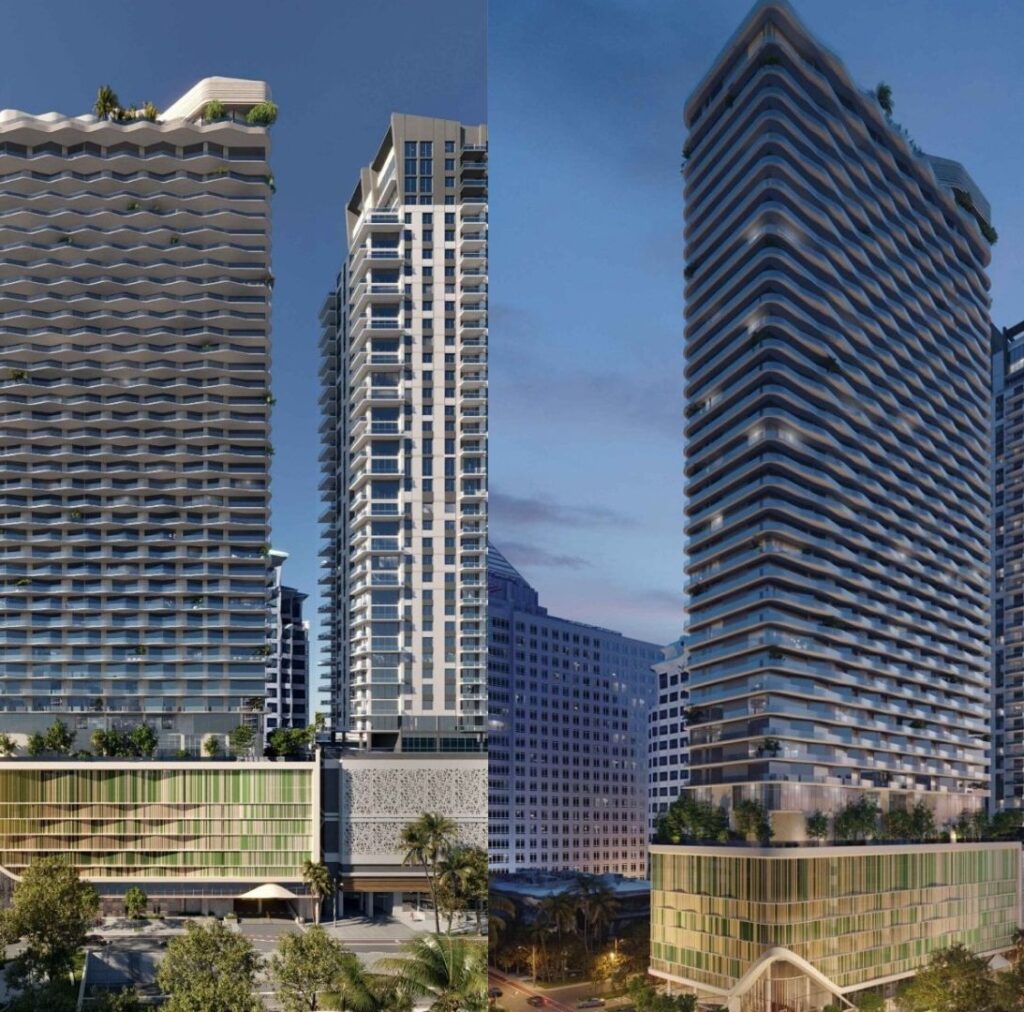
Fort Lauderdale’s newest high-rise, Andare Residences by Pininfarina, is seeing increased construction activity as the development targets a 2027 completion. After breaking ground in mid-May, developer Related Group has submitted new permit applications for tower cranes, alongside a wave of additional construction-related filings. The tower is planned for 521 East Las Olas Boulevard, and will become the third Related Group high-rise within a 1,000 FT radius across just three parcels, joining Veneto and Icon Las Olas. Recent construction documents obtained through a public records request by Floridian Development indicate the project will deliver 192 ultra-luxury residential units. The increased construction activity comes after Related Group secured a construction loan of about $231 million from Apollo Global Management. At the time of the groundbreaking, the developer stated that roughly half of the residences had already been pre-sold. According to tower crane filings dated December 3rd and December 10th, the project is planned to utilize two cranes on site. The filings note that the submissions are refilings made in response to an FAA Aeronautical Determination Decision letter. Each crane is expected to reach a maximum height of 688 FT, with work scheduled between October 28th, 2025, and January 15th, 2027. While timelines attached to FAA applications are subject to change and aren’t definitive, the October 28th start date suggests that crane installation may already have occurred on site. In addition to FAA approvals, the developer (together with general contractor Beauchamp Construction) has submitted a range of construction permits to the City of Fort Lauderdale. These include applications for structural work, utilities, right-of-way permits, foundation work, and other approvals. Importantly, the filings also cover the demolition of the on-site sales center previously built by Related Group, which must be removed to make way for the tower’s construction. While previous reports about the tower, set to become Fort Lauderdale’s tallest, relied on an outdated Design Review Committee submission from Related Group, Floridian Development has obtained updated documents showing the building will reach 542 FT across 45 floors. In addition to the 192 planned residential units, the project will include 280 parking spaces, 3,205 SF of restaurant space, and extensive amenity programs. The interior residences are being designed by Pininfarina, while the exterior design is managed by Cohen Freedman Encinosa, serving as the architect of record.
Camaco Development Submits Revised Plans for One on One Condo Project to Fort Lauderdale Planning Board
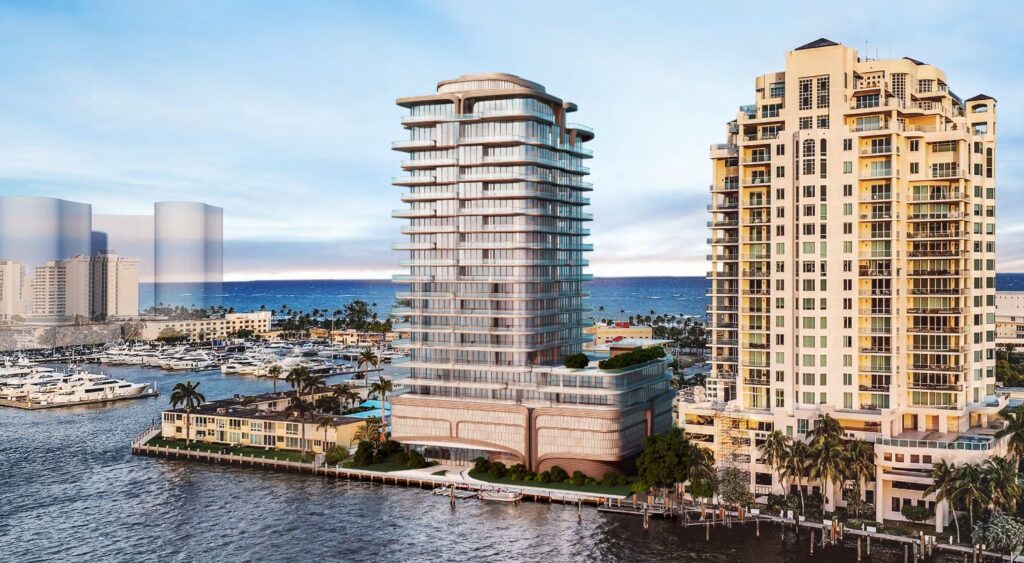
After multiple rounds of revisions with Fort Lauderdale’s regulatory boards, One on One Harbor Beach Inc., an affiliate of Camaco Development, has submitted a revised proposal for a condominium project on Fort Lauderdale Beach. Branded as One on One, also referred to as Harbor Drive Residences, the latest plan increases both the building’s scale and unit count compared to earlier versions. The proposal now calls for a 21-story tower containing 36 residential units. Planned for 3043 and 3049 Harbor Drive, the development is being designed by New York based Kora Architects in partnership with Adache Group Architects. Plans for the development first surfaced in early 2023, when Camaco Development proposed a slender, 17-unit residential building on a single parcel at 3034 Harbor Drive. Since that initial submission, the developer returned to Fort Lauderdale’s Development Review Committee with an expanded proposal that incorporates both 3043 and 3049 Harbor Drive. Property records show that 3043 Harbor Drive was purchased for approximately $2.6 million in 2021, while Camaco is currently under contract to acquire the adjacent property. Following review by the Development Review Committee, the project has progressed to the Fort Lauderdale Planning and Zoning Board, where updated exterior and interior designs are under consideration as part of the latest application. Although the project had been scheduled for review at the Planning and Zoning Board meeting on December 17th, 2025, at 6:00 p.m., the applicant requested a deferral. As a result, the proposal is now set to be reviewed at the Board’s January 21st, 2026, meeting. Plans submitted to Fort Lauderdale planners outline a residential tower comprised of two-, three-, four-, and five-bedroom units. The residences are designed with generous floor areas, with penthouse units approaching 9,000 SF and smaller units measuring around 1,800 SF. A full floor of resident amenities is proposed on level 7, featuring a fitness center, a pool and spa, a private pool bar, a social club, wellness facilities, a game room, and additional spaces. Because the earlier tower proposal was notably slender, floor plates were designed to accommodate a single full-floor residence. Under the revised plans, while unit sizes remain similarly large, each floor will contain at least two residences. The two highest levels of the tower are planned to include two penthouse units per floor. In addition, while the aforementioned submission to the Development Review Committee proposed 112 parking spaces, the latest revision reduces that total to 93. To optimize the smaller podium, 19 compact spaces are included. The architect has also designed the podium’s facade with a textured, modern screening featuring smooth stucco finishes and brown-painted aluminum cladding. At ground level, the proposal includes upgrades to both the pedestrian realm and on-site landscaping, with plans calling for a five-foot-wide sidewalk accompanied by landscaped areas (replacing the current condition of no sidewalks). The ground floor layout also incorporates a designated residential drop-off area, mechanical spaces, and a generously sized lobby. According to elevations, the building will reach a height of 259 FT to the top of the mechanical screen. Units will offer views of both Downtown Fort Lauderdale and Fort Lauderdale Beach, with expansive balconies and an all-glass facade enhancing views. While the South Florida Business Journal previously reported the tower at 22 floors based on earlier submissions, the updated elevations showcase a 21-story structure. According to the developer’s website, the project is set for completion in 2028. While it’s unclear whether that timeline has been revised, it would be somewhat consistent with plan approvals in 2026 followed by the permitting and the construction process.
One of West Brickell’s Densest Residential Towers Planned at 250 SW 7th Street
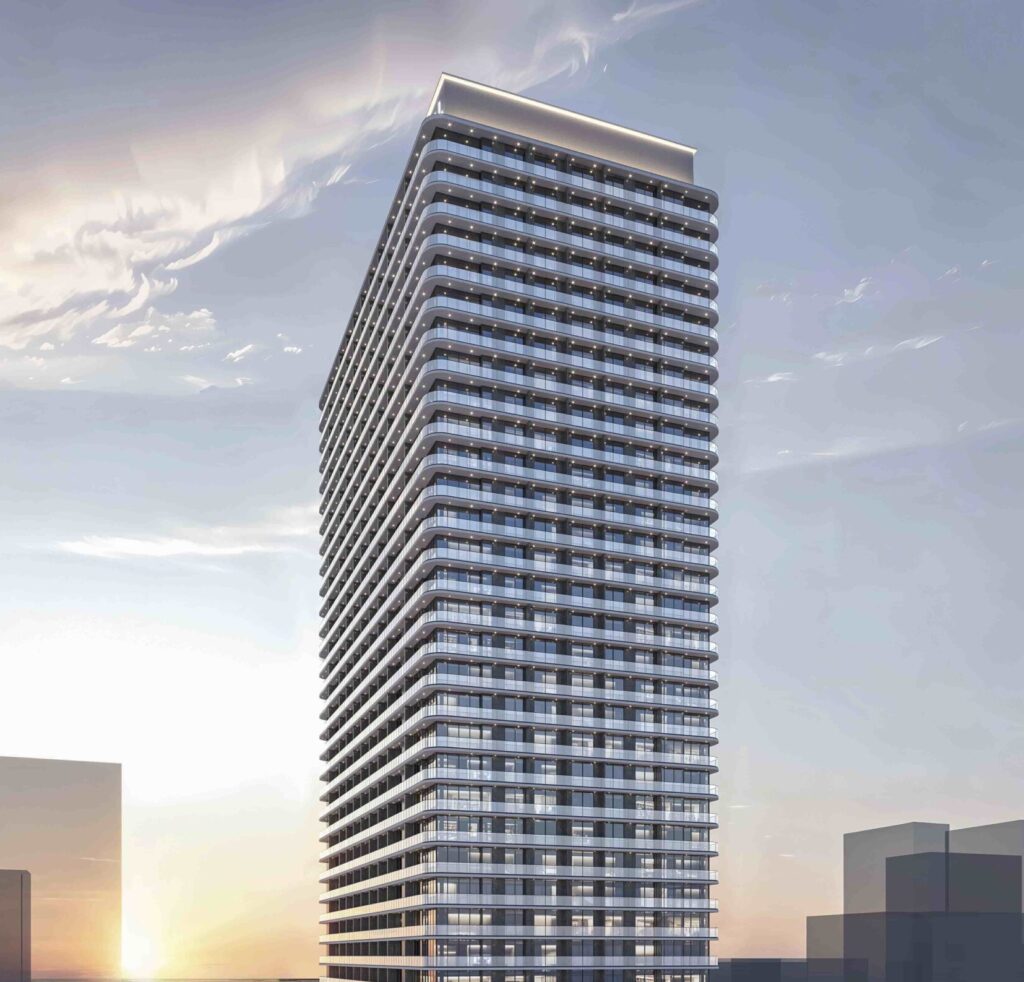
Plans have been submitted to Miami’s Urban Development Review Board for a high-rise on one of West Brickell’s last undeveloped parcels. Located at 250 SW 7th Street, the proposal would redevelop the one-acre site into one of the highest-density residential towers in the city. Led by Rockville Hospitality and designed by Miami-based Behar Font & Partners, the project would mark one of the first Live Local Act developments in West Brickell or Brickell for that matter. Rockville acquired the two parcels comprising the site for a combined $15.5 million in early 2015. The current 42-story proposal represents the latest phase of a multi-year development process that began with a 24-story concept, later to 29 stories, and has now advanced to its tallest iteration. Plans submitted earlier this week, and scheduled for review by the UDRB on December 17th, showcase a tower containing 1,030 residential units. A density of this scale is only feasible under the Live Local Act, which permits any project within the City of Miami boundaries to utilize the maximum allowable residential density. In Miami, that limit is a staggering 1,000 dwelling units per acre, enabling 1,030 units on this site and any site in the city. The developer plans to approach the maximum allowable density on the one acre site by utilizing compact floorplans, with units ranging from microunits (ranging between 275 and 400 SF) to studios, one-bedroom, and two-bedroom residences. Because microunits fall below the minimum unit-size requirements under the zoning code, the developer is seeking a warrant to permit 599 microunits. Microunits are only available within transit-oriented areas, where high-capacity transit can support smaller units. However, developments pushing the boundary on density are becoming increasingly prevalent under the Live Local Act, with Floridian Development recently reporting on a similar high-rise proposal in Overtown employing the same strategy. Because the Live Local Act requires qualifying developments to dedicate at least 40% of space to residential uses, the project is designed to be 78.8% residential. In addition, 40% of the units (or 405 residences) will be designated as affordable housing priced at 120% of the Area Median Income, on par with regulations set by the Live Local Act. On level 9, residents will have access to a full floor of amenities, including lounges, a gym, a yoga room, a movie room, a game room, a club room, a swimming pool, and more. The tower’s parking podium will provide 269 spaces, 260 of which are reserved for residents and 9 for retail patrons. Given the 1,030 units on-site, the development will also include 1,017 bike racks for residents in lieu of additional parking. This reduction in parking is permitted only because the project is located within a transit-oriented area, which allows projects to waive standard parking requirements. All parking will be screened from public view, with residential units masking the podium. The ground floor of the development will include widened sidewalks with greenery (significantly improving the current pedestrian realm) along with a residential lobby, a retail space fronting SW 7th Street, and a drop-off area. The retail component will total 2,980 SF. Rising 42 floors, or 436 FT, the development’s height is enabled under the Live Local Act, which permits increased building heights within one mile of qualifying commercial or industrial parcels. A nearby site zoned for 48 stories by right supports this height, though the developer has chosen to utilize only 42 floors. As the developer awaits a decision from the Urban Development Review Board, it’s important to note that UDRB approval is not final, ultimate approval rests with other regulatory bodies. If approved, the project is ready to proceed with permitting, as the site has already been fully cleared.
Near-Supertall 955-Foot Tower Proposed for 130 Biscayne Boulevard, Designed by Foster + Partners

Plans for a nearly 1,000-foot tower has just been revealed along Biscayne Boulevard, setting the stage for one of Miami’s tallest tower proposals in recent years. Located at 130 Biscayne Boulevard, 146 Biscayne Boulevard, and 141 NE 3rd Ave, the property is being redeveloped into a mixed-use destination by New York City-based RFR Realty, which owns all three properties. The developer intends to demolish all three mid-rises on-site for condos, retail, and hotel uses. Designed by world-renowned Foster + Partners in collaboration with Miami-based Revuelta Architecture, the tower marks another major entry by Foster + Partners into Miami’s skyline. Developments like 130 Biscayne have been made increasingly common by relaxed zoning and generous height limits, which have turned Downtown Miami and Brickell into Miami’s new hot spot for tall construction. Should it move forward, 130 Biscayne Boulevard would join the skyline near the Waldorf Astoria, now under construction. Spanning 1,667,604 SF and rising 87 stories, the tower is organized into multiple program areas across its height. Starting from the crown and extending down to level 31, the tower will contain 414 condominium residences, including one-, two-, and three-bedroom typologies as well as penthouse units. These units, fit with terraces, will have access to panoramic views of the Miami skyline and Biscayne Bay. Multiple amenity floors are also integrated throughout, with levels 31, 32, and 85 dedicated to resident amenities. The 85th floor will feature a sky-level pool, along with a spa, bar, meditation room, and other wellness spaces. Below the residential levels, the tower will house 144 hotel rooms. Levels 19 through 30 will offer a mix of suites, master suites, and traditional guest rooms. Like the condominium residents, hotel guests will enjoy access to abundant amenities, including a 140-seat fine-dining restaurant, a sky bar, a lounge, landscaped gardens, a pool, and more. The lower portion of the tower will accommodate 495 parking spaces, 1,895 SF of ground-floor commercial space, and two basement levels for retail, hotel, and residential storage. The ground floor will also feature a residential drop-off area and a spacious residential lobby. While Foster + Partners has not yet released word on the project’s design, the tower is envisioned with a clean rectangular form, a largely covered parking podium, and a uniform facade. Rising 955 FT, the structure will be topped with a glass crown. Although the height is just shy of the internationally recognized 300 M (984 FT) supertall threshold, it will surpass the soon-to-be second-tallest building in Miami, Cipriani Residences. Despite the property being located within the City of Miami, the developer is seeking approval through Miami-Dade County. The plans are pursuant to regulations under the Metromover Subzone, which grants properties near Metromover stations to access faster approvals, higher density, and other development incentives. Plans submitted to Miami-Dade last week are still under review. If the property is approved as part of the Metromover Subzone, the developer will proceed with an Administrative Site Plan Review (ASPR), a process in which county staff reviews the project rather than proceeding through lengthy public hearings. Floridian Development is breaking this story and will continue following the project closely, delivering updates on approvals, design, and construction as they happen.
Miami-Dade Set to Move Forward on 905-Unit Annie Coleman 15 Redevelopment in Brownsville
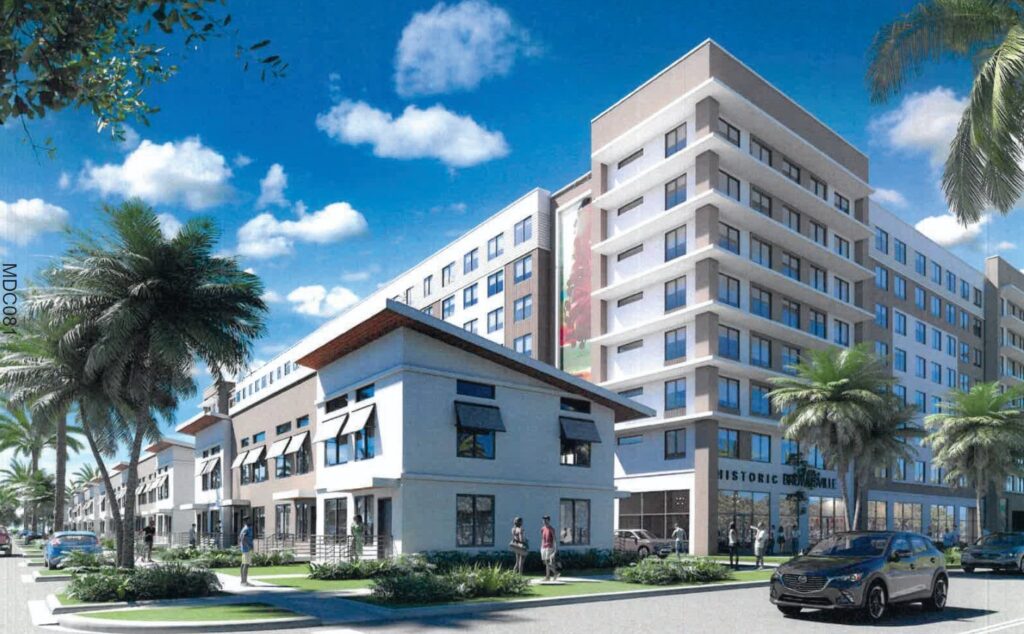
Miami-Dade is preparing to take a major step toward reshaping Brownsville’s affordable housing supply as plans advance for the redevelopment of Annie Coleman 15. The three-parcel site, which has slowly grown outdated, is slated for a full rebuild spearheaded by Miami-based Integra Solutions. The proposal calls for a 905-unit mixed-income community, including 144 public housing units to replace those previously demolished. The redevelopment effort, which began after the County issued a Work Order Proposal Request in July 2023, ultimately drew only one respondent, Integra, making the firm as the sole developer for the project. Now moving through the approval pipeline, the plan hinges on a vote scheduled for January 21, 2026, which would officially grant development rights and allow the project to move into the next phase. Located across three parcels at 5575 NW 27th Avenue, 2501 NW 58th Street, and 2200 NW 57th Street, the redevelopment will be built in multiple phases. Phase One focuses on 2501 NW 58th Street, which will be combined with an adjacent lot separately acquired by Integra Solutions. The merged site creates enough area to deliver 303 units, allowing all 144 displaced residents to return at the earliest date possible. The first phase includes 88 one-bedroom, 70 two-bedroom, 123 three-bedroom, and 22 four-bedroom townhome units, offering a range of typologies for families of different sizes and income levels. Ground-floor plans call for 4,750 SF of retail space, while parking will be accommodated in an off-street garage with 359 spaces. Phases two and three, situated at 5575 NW 27th Avenue and 2200 NW 57th Street, will deliver 332 and 270 units respectively. Layouts will span from one-bedroom, two-bedroom, three-bedroom, and townhome options. Integra Solutions has indicated that up to 20 townhomes may be offered for purchase on a fair-opportunity basis across the two phases. Combined, the developments will provide 548 parking spaces to accommodate residents, although a Metrorail station is close-by. Across all phases, the 905-unit community will include 182 units at 30% of area median income (AMI), 270 at 60% AMI, 272 at 80% AMI, and 181 at 120% AMI. The buildings will range in height, rising 10, 8, 6, 5, or 2 floors depending on the location. The redevelopment will offer a range of community amenities, including a study room with computer access, a fitness center, laundry facilities, an on-site police workstation, a playground, and a youth art center. Integra Solutions has also committed to hiring Section 3 residents for construction jobs, along with providing permanent employment opportunities for local residents. Miami-Dade County intends to enter into a 99-year ground lease with Integra Solutions as part of the redevelopment agreement. The lease calls for an upfront payment of $9,050,000, followed by recurring payments over the lease. Between the ground lease revenue, developer fees, annual rent, and the County’s share of cash flow, the agreement is projected to generate around $386 million for Miami-Dade over the life of Integra’s lease. As Miami-Dade amps the overhaul of aging affordable housing through the RAD program, Integra has emerged as a key player. Earlier this year, Floridian Development covered the firm’s plans for Annie Coleman 14 (not to be confused with Annie Coleman 15) where Integra Investments is preparing to transform nearly an entire block. The proposal introduces a mid-rise community that will also rehouse existing tenants while adding new mixed-income units.
Eco Landing Reaches Third Floor as Construction Progresses Toward Topping Out
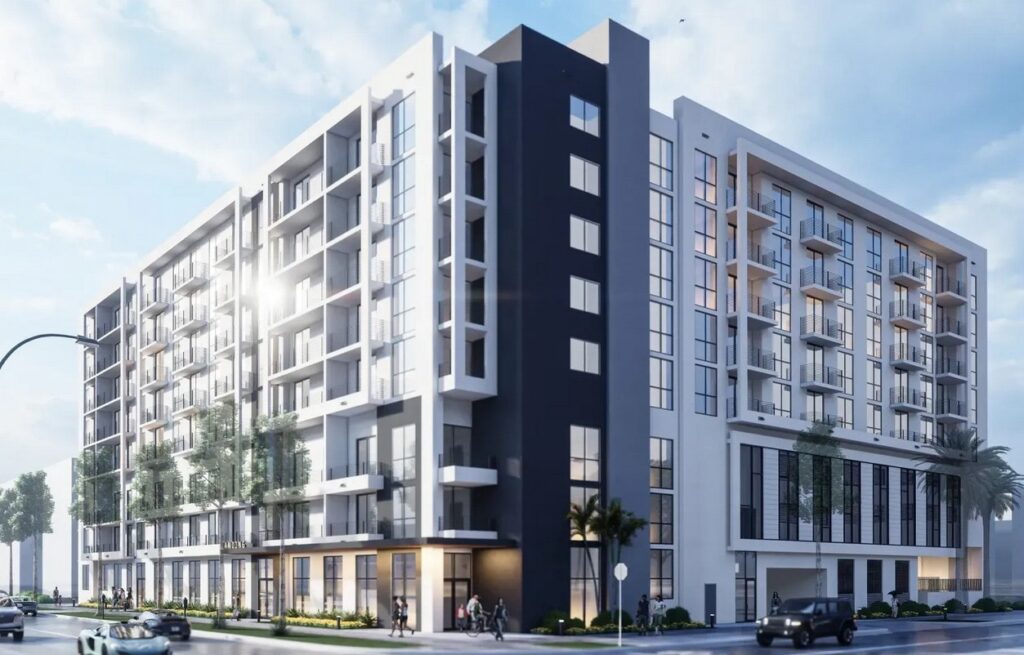
The EcoStone Group, a Miami-based real estate investment, development, and contracting firm, is moving forward on its first ground-up project. Rising in Allapattah at 1515 and 1601 NW 18th Street, the 8-story development has reached the third floor of vertical construction. The undertaking marks the company’s debut into multifamily development, with additional projects anticipated in the pipeline. With permitting and $23 million in financing secured from Banco Popular (also known as Popular Bank), EcoStone Group is now progressing towards completion on the 125-unit building. Work on the project began with the demolition of two on-site multifamily buildings in early 2023, both dating back to the 1970s and 1980s. Active construction ramped up this year, with groundbreaking taking place earlier in 2024, cranes erected in early August, and the first floor completed in early November. With construction progressing at an estimated pace of roughly two to three weeks per floor, the 8-story building is expected to top out at 75 FT in early 2026. The project’s permits include a master construction permit, currently awaiting applicant corrections, as well as fully approved vertical construction permits and an array of miscellaneous permits supporting site and structural work. View this post on Instagram A post shared by EcostoneGroup Ecostone (@ecostonegroup) According to City of Miami permitting records, EcoStone Group is listed as the general contractor, utilizing its long background in construction. C.G. Electrical & Consulting Services Inc. is shown as the electrical subcontractor, with Pacifica Engineering Services noted as the project engineer. Beyond its 125 apartments, Eco Landing will include a substantial parking podium fronting NW 15th Avenue, along with a pool, outdoor showers, lounge areas, spacious balconies, and other resident amenities. The project carries an estimated price tag of almost $35 million, similar in cost to other planned developments by the firm. Eco Landing is one of several projects in a submarket experiencing unprecedented growth, with developers like Neology Life, Alta Development, and EcoStone Group fueling a wave of mixed-use, multifamily development. Rising demand beyond Brickell is reshaping Allapattah, as projects like River District 14 and Eco Landing approach topping out, pushing hundreds of apartments in a market historically overlooked.
Brickell Starlite Moves Towards Groundbreaking at 128 Southwest 7th Street
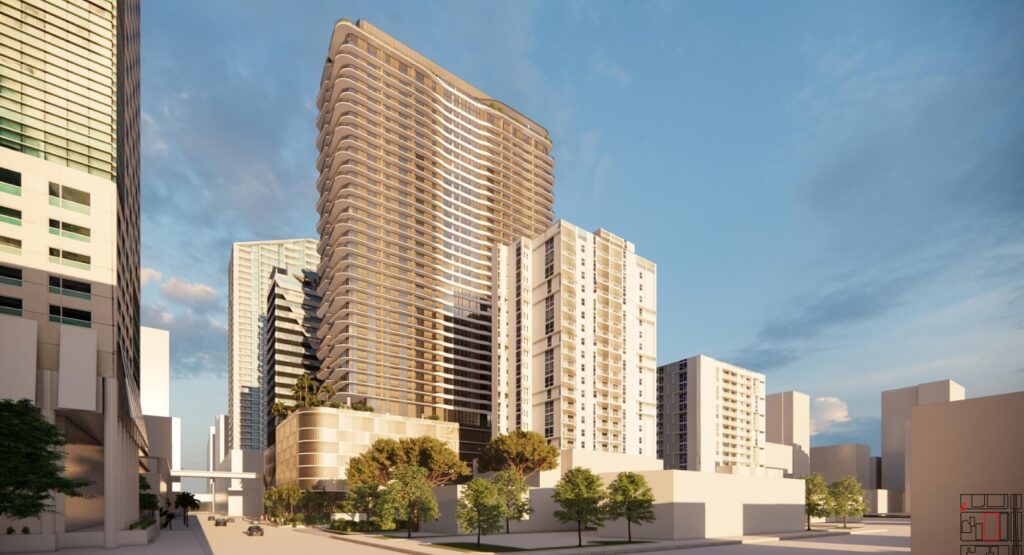
The densification of West Brickell continues as Chicago-based Focus Development prepares to break ground on its first Miami project. Located at 128 SW 7th Street, the development, called Miami Starlite, will bring new multifamily residences and retail to a narrow site in the heart of Miami. The parcel was purchased by Focus Development in late 2022 for $28 million and has been the subject of redevelopment proposals for years. Planned atop the former, now-demolished Starlite Motel, the project is moving through permitting after receiving building plan approval from Miami-Dade officials about a year ago. Targeted for completion in 2028, the Gensler-designed tower aims to meet strong demand amid limited supply in the Brickell submarket. The first signs of an upcoming groundbreaking emerged when the developer secured approval for a master construction permit from the City of Miami. The permit lists an estimated project cost of $157,000,000 and shows the tower rising 39 floors. Additional Miami-Dade County permits currently underway include tree removals, site plan reviews, and other preliminary work. The tree-removal permit, submitted in early November, is among those still awaiting approval: a vital step, as foundation work cannot begin until all on-site trees have been cleared. In addition, on December 2nd, Suffolk Construction filed an application for two construction cranes on-site, each planned to rise 583 FT. The filings show an expected operating period from June 2nd, 2026, through October 27th, 2027, showcasing that crane installation will likely occur in early 2026. Both cranes are currently under FAA review and remain in the studying stage. According to the final approved plans, the tower will reach 413 FT at the amenity level on the 39th floor, with its highest architectural point topping out at 423 FT. The development will include 517 residential units, 487 off-street parking spaces, 6 on-street spaces, and 130 bicycle parking spaces. The ground floor will feature a lobby along with nearly 8,000 SF of retail space. According to the developer, the project will feature a diverse mix of units supported by an extensive amenity package. “The tower, designed by world-renowned architecture firm Gensler, features a curved concrete and glass façade and offers sweeping views of the Miami river and skyline from the upper floors. The community will offer a mix of luxury apartments ranging from studio to three bedrooms, artfully appointed for Miami’s design minded members. Best in class amenities include first floor retail, co-working space, fitness studios, indoor and outdoor lounges, rooftop pools and more.”
740-Foot Elliott Towers Proposed for Downtown Tampa, FAA Filing Reveals Early Vision
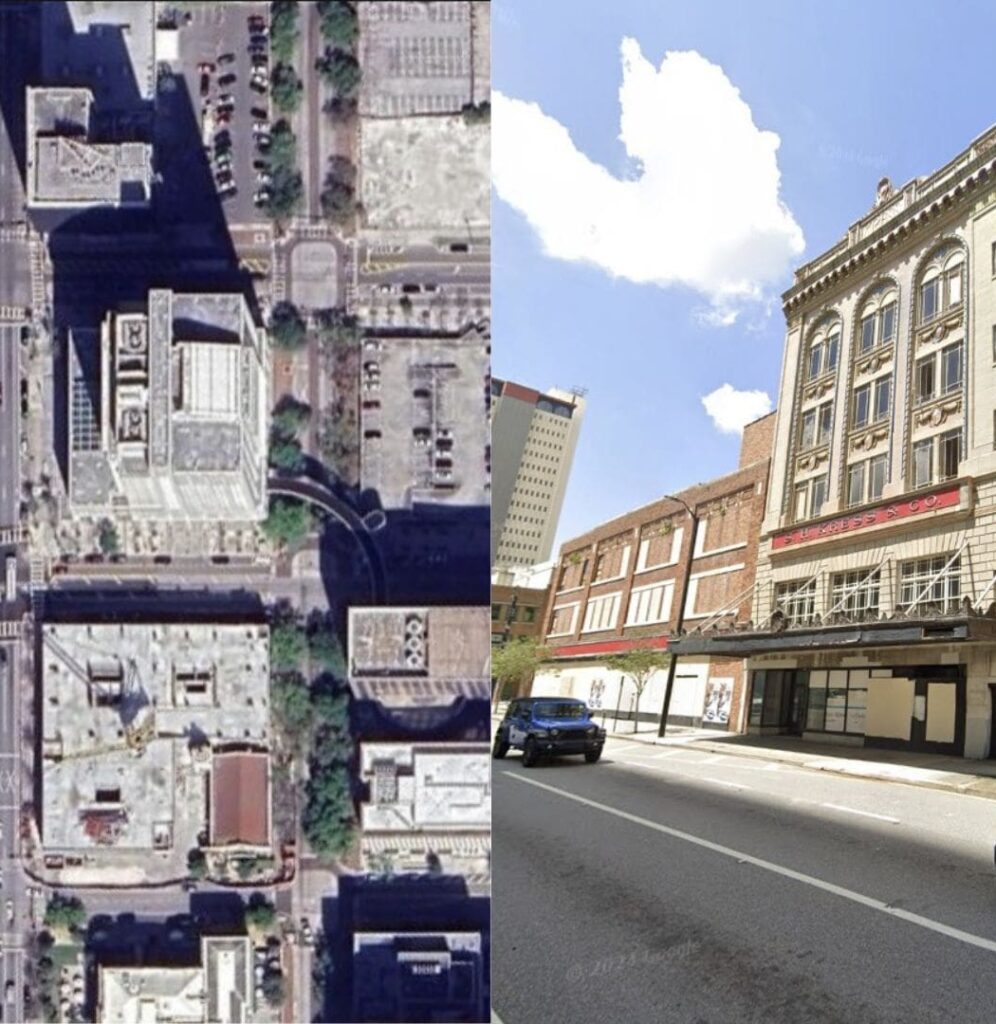
Tampa may be on track to welcome its tallest tower yet, according to a recent FAA filing. On November 25th, Colton Elliott, founder of Elliott International, submitted an application for a 740 FT structure planned for the former Kress Block in Downtown Tampa. The proposal would replace the entire block with a skyscraper rising more than 70 stories, set to include office, dining, and residential space. The project, spanning 801, 805, 807, 811, and 815 North Franklin Street, is slated to be known as Elliott Towers. While the firm has filed an FAA application, the tower remains in the early stages of land acquisition and entitlement approvals. The entire block is currently owned by CW Kress LLC, tied to Carolyn Wilson who acquired the properties in 2017. Early social media posts suggest the tower concept was launched only recently, with AI-generated imagery used to showcase potential designs for the site. Elliott International has emphasized that these rendering are conceptual and do not represent finalized plans. According to a description in the FAA filing, Elliott Towers will begin with two levels of retail and lobby space, followed by 8-10 floors of office uses and another 10-15 floors of condo-hotel units. Above that, the tower will transition into about 39 stories of private residences, capped by two mechanical levels. The project has an anticipated groundbreaking in early 2028, and all figures remain subject to refinement. According to the development’s website, the proposed tower is projected for completion in early 2032. The plan calls for 118 ultra‑luxury condominiums (starting at $1.05 M), two penthouses, condo‑hotel units, 500,000 SF of Class‑A office space, flagship retail brands, and a Michelin‑star restaurant on the ground floor. Residents would have access to 24/7 concierge and valet service, a wellness‑focused fitness center, private lounges, a large ballroom, a rooftop infinity pool, and much more. Parking is set to total 1,200 spaces for both residents and patrons. As per the developer’s recent Instagram post, there is claims of “$40 million in funding”, with new investment along the way. If the tower is set on moving forward, the development will likely apply for permits and building plan approvals very soon. Because plans are still flexible, it’s unknown if the development will incorporate the historic designs of the current site or do a demolition, although current city designations of the land restrict an all-out demolition. While the FAA filing is an important early step, it does not guarantee the project will move forward. The proposal still hinges on securing the land, gathering financing, and navigating a lengthy entitlement process. Elliott International, the firm behind the tower, has not delivered a high-rise or a project of this magnitude, adding uncertainty to the tower’s prospects. For now, the plan remains highly speculative. Still, if the development advances, the structure would become the tallest building in Tampa and a symbolic addition to a downtown that continues to grow at a record pace.
Plans Filed for a Mixed-Use Mid-Rise at 811 E Las Olas, Featuring Office and Retail Space
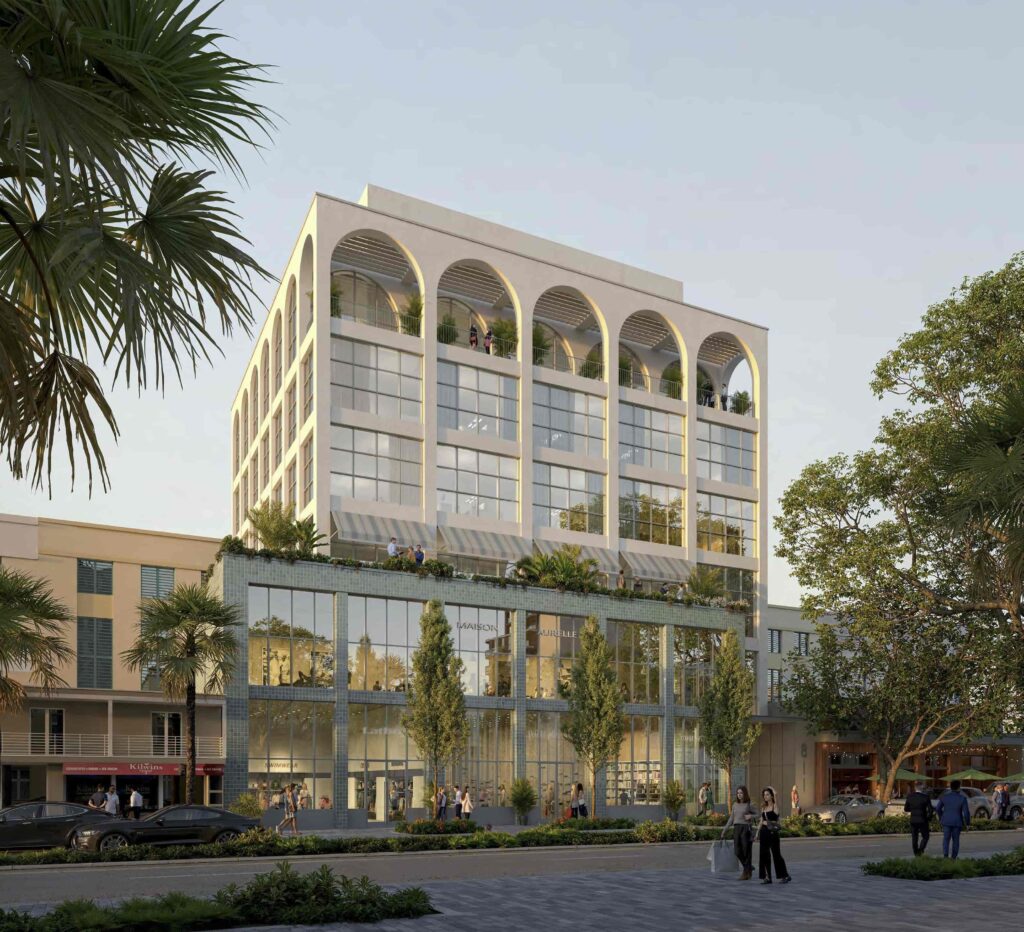
Fort Lauderdale’s iconic Las Olas Boulevard is poised for a major transformation, with new plans submitted to the city for a six-story mixed-use building. The project, led by Coombes Property Group, would replace two existing low-rise retail buildings with a contemporary structure planned with retail and office space. Designed by the acclaimed Morris Adjmi Architects in collaboration with Cube 3, the development is planned for 811 E Las Olas Boulevard on a 0.25-acre site at the heart of the corridor. Called 811 Las Olas and totaling almost 50,000 SF in size, the proposal represents one of the largest new developments currently planned along this strip of Las Olas. Just up the street, The Whitfield is poised to introduce luxury condominiums and multiple hotel rooms to the boulevard. Construction of the development began a while ago, but progress on its vertical ascent is unknown. Coombes Property Group acquired the site assemblage for $2,282,100 in late 2022. The firm maintains deep ties to Australia, where it has developed and owns multiple properties across major cities including Sydney and Brisbane. Plans submitted to the city’s Urban Development Review Board were taken up today. According to public documents, the building will feature a two-story podium with 16,167 SF of retail, divided into two equal storefronts at the ground level and a larger, continuous space on the second floor. Plans for the second floor originally included a terrace for a proposed restaurant, but that feature has since been removed in favor of a continuous glass facade. From floors 3 to 6, the new building will offer 27,256 SF of office space, enhanced by terraces on both the third and sixth floors. The office space will come online just as demand for high-quality workspace in Fort Lauderdale is rising, driven by recent construction in office such as FAT Village. As much of the region’s older office stock becomes less competitive, projects that provide accessible, high-quality space have become higher in demand. According to elevations, the building will measure 103 FT at its highest point. Its exterior finishes will include green glazed tile, a wood-look trellis, storefront glazing, warm white stucco, and aluminum grid-style windows. Uniquely, 811 E Las Olas will include no on-site parking, instead relying on 122 off-site spaces. Although zoning would normally require about 137 spaces, a recently prepared traffic study shows that only 122 are needed during peak operating hours. A construction timeline has not yet been announced. Before work can begin, the developer must demolish the low-rise buildings at 811, 813, and 815 East Las Olas Boulevard, all of which date back to the 1960s.
Canal Park West Tower Begins Construction in North Miami Beach, Set to Deliver New Office Space
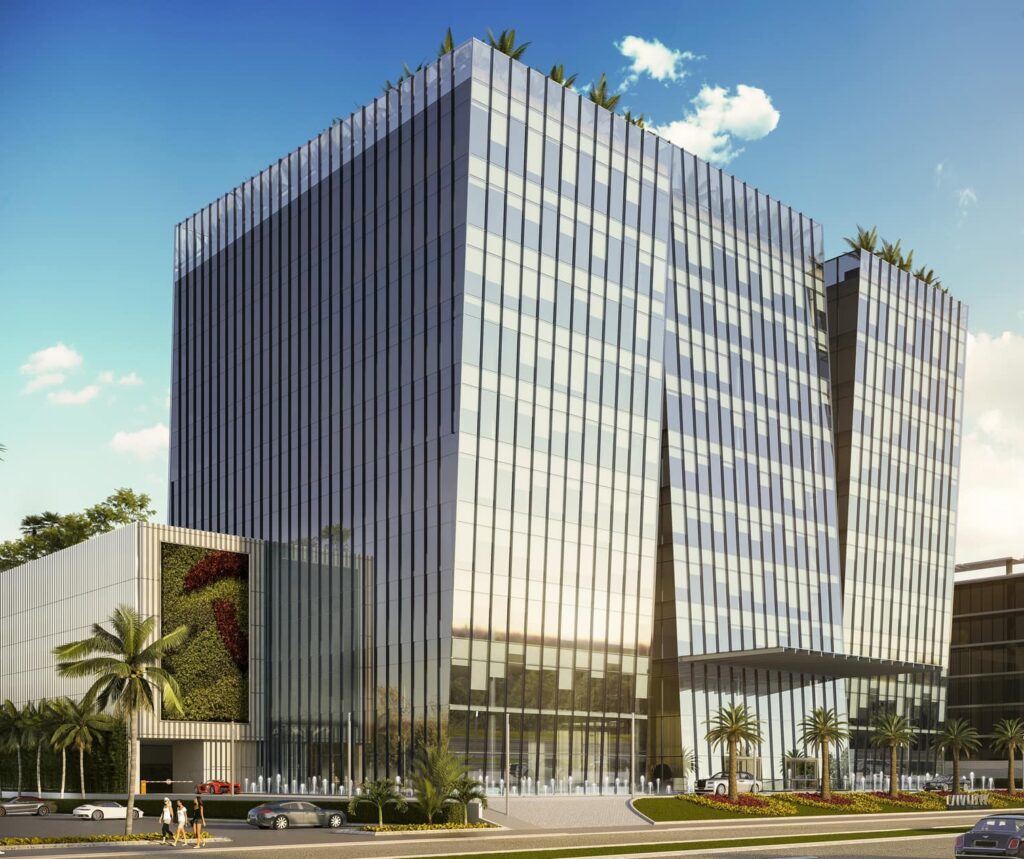
North Miami Beach is preparing to welcome its newest office development with the groundbreaking of Canal Park West, the second phase of a two-building complex along NE 163rd Street. Developed by Namnum Developers, LLC and designed by Idea Architect, the project follows the earlier completion of Canal Park East. With construction now in full swing, foundation work and site preparations are underway as the project begins rising vertically. Situated at 3227 NE 163rd St, Canal Park West will deliver modern office space to a growing commercial corridor. The building sits just steps from Uptown Harbor, Dezer Development’s upcoming mixed-use project featuring residential, office, retail, and hotel space, signaling continued investment in the area. First submitted in early 2021, Canal Park West has remained mainly consistent with the plans previously approved by the North Miami Beach Planning Board. The 10-story office tower will deliver 237,483 SF of modern office space, of which 158,509 SF is leasable area supported by a 714-space parking garage for tenants and visitors. Rising 167 FT, the building will be both taller and wider than its predecessor, Canal Park East, signaling the growing demand for premium office space in South Florida. Designed by Idea Architects with a sleek, modern facade, Canal Park West is set to offer tenants an abundance of amenities. The tower will provide 360-degree views of the surrounding skyline and waterfront from multiple viewpoints. On-site amenities include a fully equipped fitness center with personal training, a pool and tennis courts, a fully stocked juice bar, collaborative workspaces, and a restaurant offering ‘diverse cuisine’. The building is also centrally located, with easy access to nearby restaurants, commercial hubs, airports, and other key destinations. According to Miami-Dade permits, the Canal Park West site (formerly a surface parking lot) was cleared in late 2024 at a reported cost of $115,000. Beauchamp Construction, serving as the general contractor, has since secured multiple permits, including one for the tower’s shell. Beyond routine utility permits, the only remaining major approval is for the building’s site plan. Another viewpoint of the construction site can be found here.
University of Tampa’s New Science Building Moves Forward, With Permits Filed and Approvals Granted
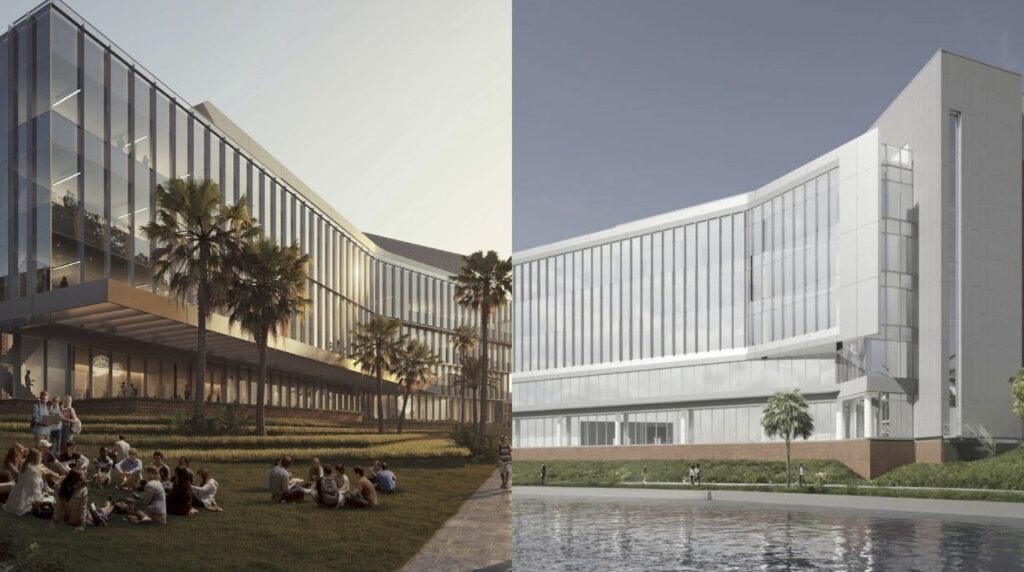
The University of Tampa’s campus is preparing for another major transformation as its next academic building moves steadily toward a groundbreaking. With key building plans approved and new construction permit filings underway, the university is laying the foundation for Project Beta, a six-story facility planned along the Hillsborough River. The project will replace a cluster of aging low-rise structures at 505 UT McNeel Ct with a modern, six-story building designed to support a range of science uses. The new academic building comes at a time when student enrollment at the University of Tampa is at an all-time high, prompting the need for revitalized and expanded academic space. Just last year, the university celebrated the opening of the Grand Center Residence Hall (Project Alpha), a mixed-use complex that introduced new academic areas, student housing, structured parking, and additional campus amenities. Plans for the new science building, known as Project Beta, call for roughly 200,000 gross SF of space, including research labs, collaborative areas, teaching facilities, faculty offices, and other academic functions. The building is being designed to achieve LEED Silver certification, incorporating strategies to promote waste reduction, improved indoor air quality, and enhanced energy efficiency. Because the campus already has sufficient parking, no additional parking is proposed as part of the project. According to elevations provided by Omaha-based HDR Architects, the building will feature a blend of the past and present, with red bricks on the west portion of the side in-line with campus material themes, and glass on the east side. The building will rise 120 FT. According to recently filed permits, Barr & Barr will serve as the project’s general contractor. Multiple permits have been submitted, including a general construction permit covering on-site demolition and new construction, as well as a separate permit for tree removal and pruning. As part of site preparation, several existing structures, including the Morsani Loading Dock, Cass Science Annex Building, McNeal Boathouse, and Communications Annex, will be demolished. Barr & Barr has extensive experience in STEM-related construction, having led numerous facilities nationwide. The new building’s research labs and specialized facilities fall well within the company’s proven expertise, making them qualified to manage the project. Construction of the new building is scheduled to take 18 months, according to Barr & Barr. There is no known groundbreaking date as of now. More images of the building can be found here.
Joint Venture Proposes Atrium Residential, Set to Feature 222 Units in Boca Raton
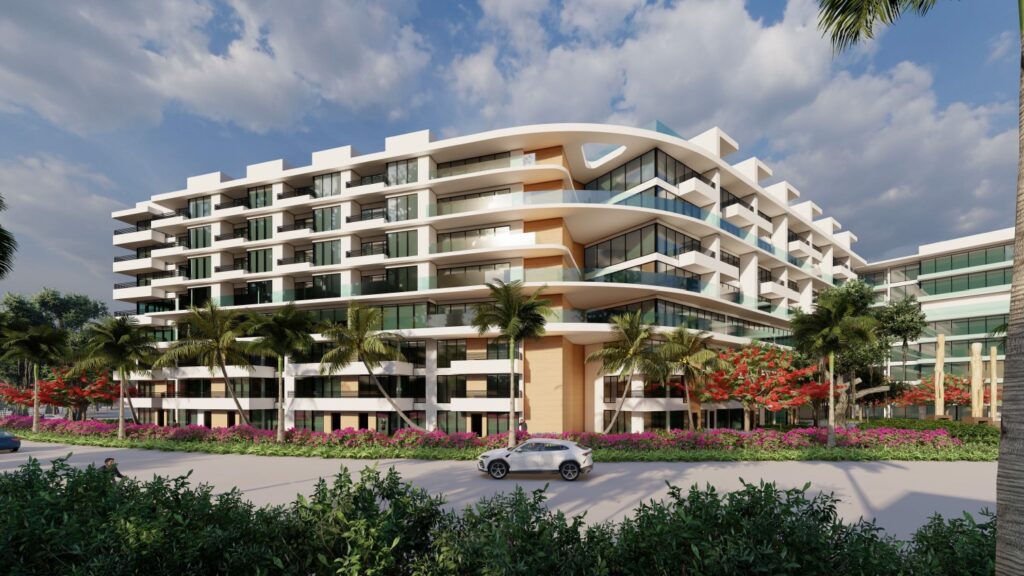
The Meyers Group and Accesso Partners, a South Florida-based joint venture with an extensive development track record in the region, are moving forward with plans to redevelop a site near the Broken Sound Golf Course. Officially titled ‘Atrium Residential,’ though also referred to as ‘The Residences at Broken Sound,’ the project is scheduled for review by the Boca Raton Planning Board tomorrow on November 20th. The proposal includes several requests related to zoning, land-use changes, site plan amendments, and more, which are all subject to different votes. Planned for a surface parking lot next to an existing office building, the project would introduce an eight-story apartment building at 6111 NW Broken Sound Parkway. It will be the first large-scale apartment development in Boca Raton for both Accesso Partners and The Meyers Group, following their $25 million acquisition of the property in 2024 under the entity BRI 1885 Atrium at Boca, LP. Designed by Garcia Stromberg Architecture, this modern residential building will include 222 units, with 12 designated as workforce housing and 23 as affordable units. This inclusion complies with Boca Raton code, which requires developers to provide a minimum number of affordable or workforce units to qualify for higher density in certain zoning districts. These units are subject to a 30-year affordability covenant, securing affordability long-term. The building’s 222 units will consist of 1 efficiency unit, 73 one-bedroom units, 109 two-bedroom units, and 39 three-bedroom units. Unit sizes will range from 528 SF for the smallest unit to 2,622 SF for the largest, with an average of 1,097 SF. All residents, regardless of income designation, will have access to amenities such as a clubhouse, resident lounge, gym/fitness center, lobby and mailroom, swimming pool, and other common areas. On the ground floor, the development will feature walk-up units, open space, 2,015 SF of retail space, amenity space, lobby space, and the beginning level of a four-story podium. This podium will include 325 parking spaces and 18 bicycle parking spaces. Parking will also be available in a surface parking lot and garage for the next-door office building, bringing the masterplan’s total to 622 parking spaces, well beyond the required 537 spaces. Elevations provided by the project’s architect, Garcia Stromberg, showcases Atrium Residences rising 80 FT, or 8 floors. The facade will be composed of glass balconies, white stucco finishes, impact resistant windows, and other modern finishes. The board is set to review five resolutions, including the rezoning of 0.90 acres from Recreation to Light Industrial Research Park, an amendment to the Future Land Use Map from Recreation/Open Space to Planned Mobility, a site plan amendment for the construction of an eight-story structure, and other items such as plat reconfigurations. Developments like Atrium Residences are becoming increasingly common in Boca Raton, where developers are eyeing office parks or industrial land for multifamily development, either through rezonings or the Live Local Act. Just a few months ago, Floridian Development reported on the proposed redevelopment of portions of the Amtec Center office park. Developers Beztak and Wexford are planning an eight-story multifamily building.
Miami-Dade to Review Citadel’s Supertall Global Headquarters, First Permit Filed
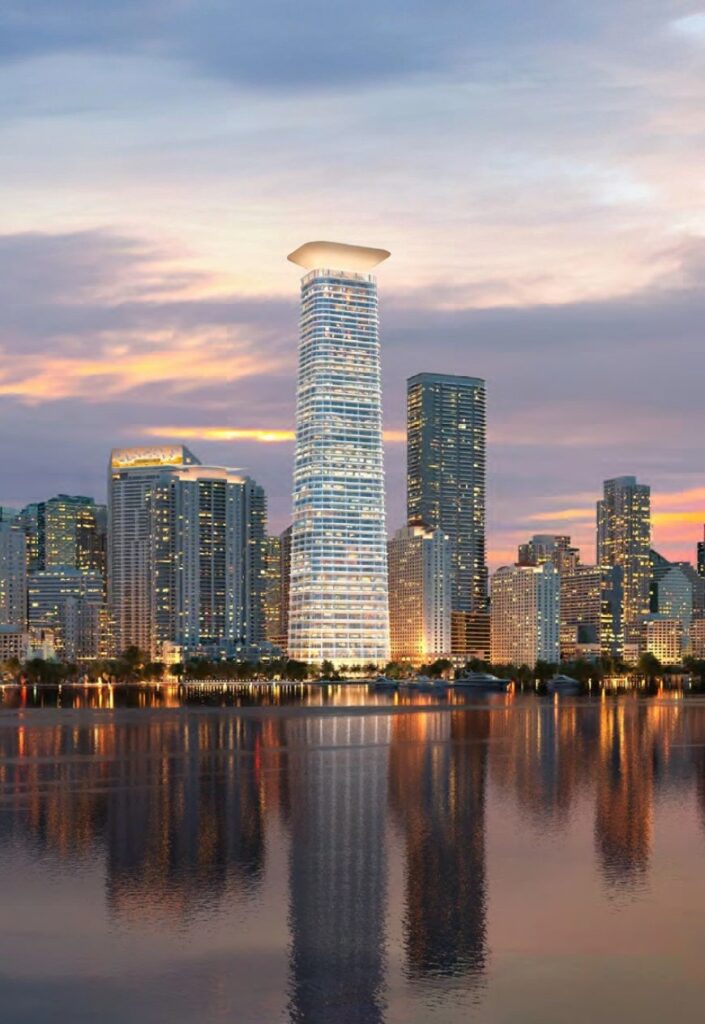
Ken Griffin’s proposed supertall headquarters for Citadel Securities is officially advancing in Brickell. After three rounds of design revisions, the most recent submitted just two months ago, the project is now moving into the approval phase in Miami-Dade County. It marks the latest step in a headquarters relocation effort that began when Citadel announced its move from Chicago to Miami. Although the firm once targeted a mid-2025 groundbreaking, rising costs and other logistical challenges have pushed that timeline back. Still, Citadel remains fully committed to the project. On November 20th, Miami’s BCC Comprehensive Development Master Plan & Zoning Committee will review plans for Citadel’s new ‘Class A, state-of-the-art, mixed-use office and hotel tower.’ The committee will also consider proposed maintenance and improvements to the existing office building at 1221 Brickell Avenue, along with the redevelopment of a parking garage designed to serve both the new and existing towers. The new headquarters will feature 1,485,174 SF of office space and 212 hotel rooms, complemented by amenities including a pool deck, dining and beverage venues, a fitness club, retail, and more. At the base of the tower, 50 executive parking spaces will be provided, with an additional 1,420 spaces available in the redeveloped parking garage nearby. As part of the latest submission, the tower’s crown has entered its newest design iteration under the supervision of the project’s architect, Foster + Partners. Earlier versions featured a relatively flat crown, which later evolved into a more open, fanned form. In the most recent redesign, the floorplates extend to cover much of the previously exposed crown base, signaling a shift back toward the earlier profile. The tower is planned to rise 58 floors, though recent elevations suggest it could exceed 60 floors, reaching approximately 1,043 FT. This height, mix of uses, and other features of the development is only possible through Citadel going through the County’s Rapid Transit Zone, designed to encourage higher intensity, mixed-use, transit-orientated development. 1201 Brickell Bay Drive, 1221 Brickell Avenue, and 1250-1260 Brickell Bay Drive were all added to the RTZ in 2022 and 2023. Beyond design updates, Citadel has also submitted its first permit since 2022, which includes the planned removal of existing trees on-site in preparation for groundbreaking. In addition, Floridian Development recently reported that multiple tower cranes have been approved for installation on-site. In total, three cranes will rise to heights of 1,298 FT, 1,298 FT, and 1,297 FT, respectively. Miami-Dade staff has recommended approval of Citadel’s master plan, albeit with several conditions, including coordination with the county’s Aviation Department, Office of Historic Preservation, and other relevant agencies. Citadel is requesting approval of the development under the County’s RTZ, as well as building closer to Biscayne Bay than code allows. If approved, Citadel has committed to several upgrades to Brickell’s surrounding infrastructure, including a $3 million contribution for maintenance, repairs, and improvements at the Financial District Metromover Station. Additionally, the project includes over $10 million in planned stormwater and pedestrian improvements throughout the area.
University of Miami Unveils Gables Village: Set to Replace the Dated Mahoney-Pearson Dorm Complex
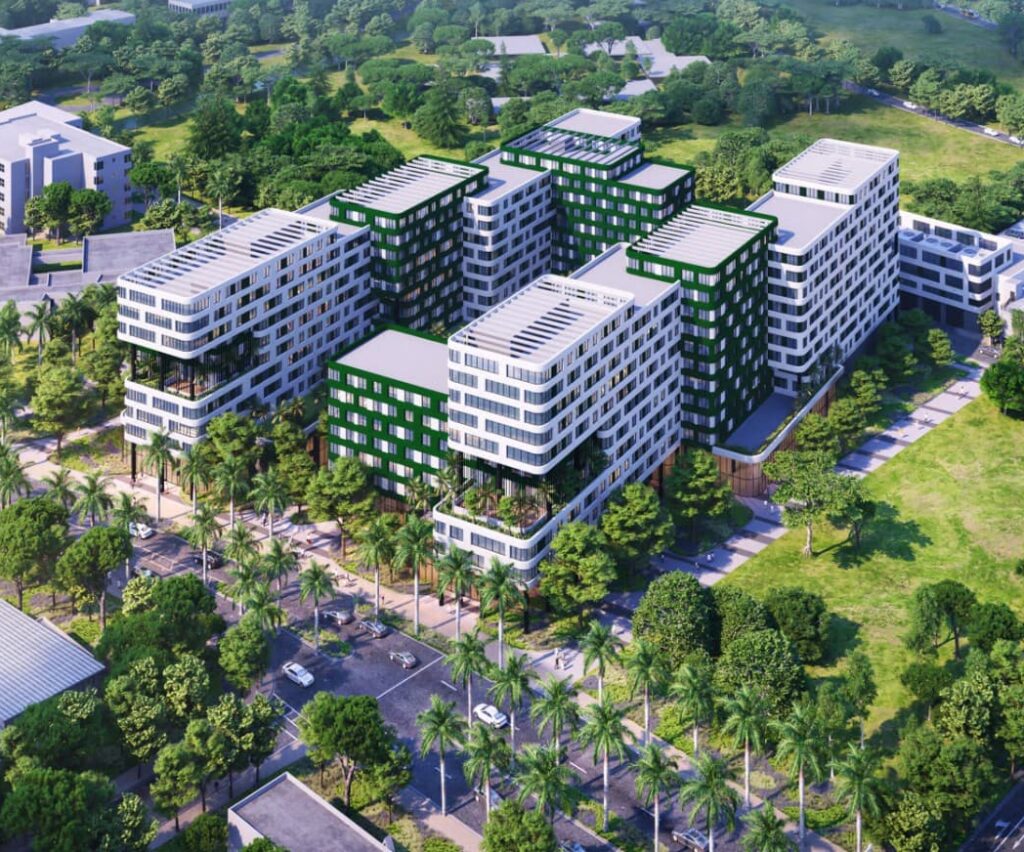
The University of Miami is preparing to completely redevelop the aging Mahoney-Pearson dorm complex, replacing it with Gables Village, a new residential district now under review by the City of Coral Gables. The project serves as the third and final phase of UM’s long-term Housing Facilities Strategic Plan, ending a multi-year effort to modernize student housing on-campus. Just a few months ago, campus officials celebrated the opening of the first phase of Centennial Village and are now nearing completion of the second. The new dormitory complex will comprise of two multi-story buildings designed by Arquitectonica, located at 1201 Stanford Drive and 1101 Stanford Drive. In total, the development will span 573,804 gross SF and introduce more than 1,000 beds, a new dining hall, and a range of amenities for incoming students. According to the University, the project is intended to provide “modern, sustainable housing that enhances the student experience for years to come.” The first residential building will rise nine stories and include 222 units, providing space for 735 beds. Units will not be limited to shared rooms; instead, the building will offer a mix of double suites, single suites, and single rooms. The second building, slightly taller at ten stories, will contain 207 units with a total of 723 beds, featuring the same unit types. Across the entire complex, single suites represent the most common room type. While the two towers are physically separate structures, they are unified through a pedestrian-oriented design featuring landscaped walkways and interconnected green spaces that link both buildings. Residents will have access to a variety of amenities, including great rooms and event space, package rooms, a 24,046 SF dining and kitchen facility with seating for 700, and multiple classrooms located on the ground floor. In addition, each floor will have access to ample natural light, along with access to amenities like viewing rooms, shared kitchens, lounge areas, study rooms, and both collective and private shower rooms, among other features. As part of the Gables Village redevelopment, the existing Mahoney-Pearson Dining Hall is slated for demolition to make way for the aforementioned new 700-seat dining facility. This replacement is both modern and updated to be closer to residents. According to elevations provided by Arquitectonica, the official architect of the project, Gables Village will feature a smooth facade complimented by large glass windows, accented in a palette of dark and light green tones alongside white. Unlike many modern apartments in Miami, the design does not include balconies. The first tower is planned to rise 118 FT, while the slightly taller second tower will reach 128 FT. In addition to the new residential towers, the University will construct a Central Energy Plant adjacent to the existing Mahoney-Pearson Garage. The 8,450 SF plant will house essential infrastructure while also featuring infrastructure space at around 10,720 SF. The Mahoney-Pearson Garage will continue to serve both residents and commuters, with its entrance relocated to the south side for access at Ponce de Leon Boulevard. Together, the energy plant and existing garage will strengthen campus infrastructure and accessibility, while supporting the functionality and sustainability of the new Gables Village complex. The Gables Village project is scheduled for review by Coral Gables’ Development Review Committee on November 21st. If the proposal is approved, campus officials are planning to begin construction in summer 2026, with the residential towers and new Central Energy Plant expected to be completed by mid-2029.
Plans Submitted to Miami’s UDRB for 805 Flagler, Featuring 354 Units in Little Havana
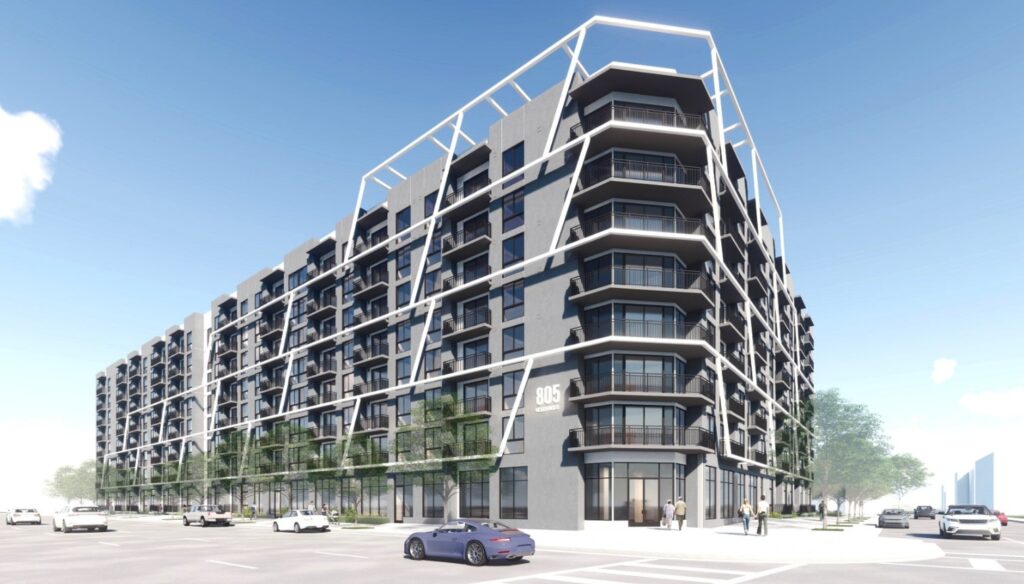
A joint venture between Brookstone Partners and the Cornerstone Group is moving forward with plans for an eight-story mixed-use development at 805 West Flagler Street, bringing a long-anticipated grocery store/pharmacy to one of Miami’s most underserved corridors. Filed under Brookstone 805 Flagler LLC, the proposal spans 14 parcels totaling roughly 103,000 SF. The developers acquired the largely vacant property for $15.8 million months ago and are now seeking approval from Miami’s Urban Development Review Board to move forward. According to recently released plans, the proposed development will span nearly an entire city block. A representative for the project described it as providing ‘infill density, reversing urban sprawl, and introducing a neighborhood-serving grocer and pharmacy with property access on three frontages.’ Designed by Corwil Architects, the building will feature a total of 354 residential units. Unit sizes will range from studios averaging 514 SF, one-bedrooms averaging 737 SF, and two-bedrooms averaging 1,081 SF. The project will also include 526 parking spaces in total, with 25 on-street spaces and 500 within a parking garage, ensuring at least one space per resident along with dedicated visitor parking. Among other amenities, there will be multiple courtyards fit with water features and seating, as well as a pool, BBQ area, and various other amenities including 8,035 SF solely for shared space on the 8th floor. On the ground floor, plans call for widened sidewalks and enhanced landscaping to improve the pedestrian experience. While early plans by the developer highlighted a potential 22,000 SF lease for an Aldi grocery store, that deal appears to have fallen through. The current plans instead show a 5,460 SF corner retail space, roughly the same in size to a typical Walgreens or CVS. From the base to the roof, the building will reach 97 FT. Corwil Architects notes that the exterior will combine aluminum balcony railings, gray-toned stucco, cement plaster finishes, and other carefully selected materials. The parking garage, often visible in modern Miami apartment buildings, is fully concealed by lined residential units. According to the architect: “The building’s structured parking podium is carefully designed to integrate seamlessly into the urban fabric. Rather than exposing parking to the street, the podium is fully lined with active residential units on all street-facing elevations. This design strategy transforms what is traditionally a service element into a vibrant, livable edge, ensuring the building maintains consistent activation at the pedestrian level”. Prior to seeking Urban Development Review Board approval, the joint venture secured key city approvals to move forward. In 2024, the City Commission amended the Future Land Use Map (FLUM) of the assemblage from “Medium Density Restricted Commercial” to “Restricted Commercial,”. The City Commission also updated the zoning for a portion of the property, changing it from T5-O to T6-8-O. As a result, current zoning supports a more mixed-use, dense development. If the developer was unable to secure standard zoning approval, Miami-Dade and the state offer alternatives. One option includes submitting the project under the county’s more flexible rules, while another route involves pursuing provisions under Florida’s Live Local Act, which encourages the inclusion of workforce housing within new developments. An Urban Development Review Board (UDRB) meeting scheduled for November 19th will evaluate the project’s design. While the board’s recommendation is advisory and not required for the project to move forward, developers often incorporate feedback or design adjustments suggested during the review process. Importantly, 805 Flagler will be the sole item on the UDRB’s November agenda.
Joint Venture Unveils 30-Story Tower at 1725 JFK Causeway, North Bay Village
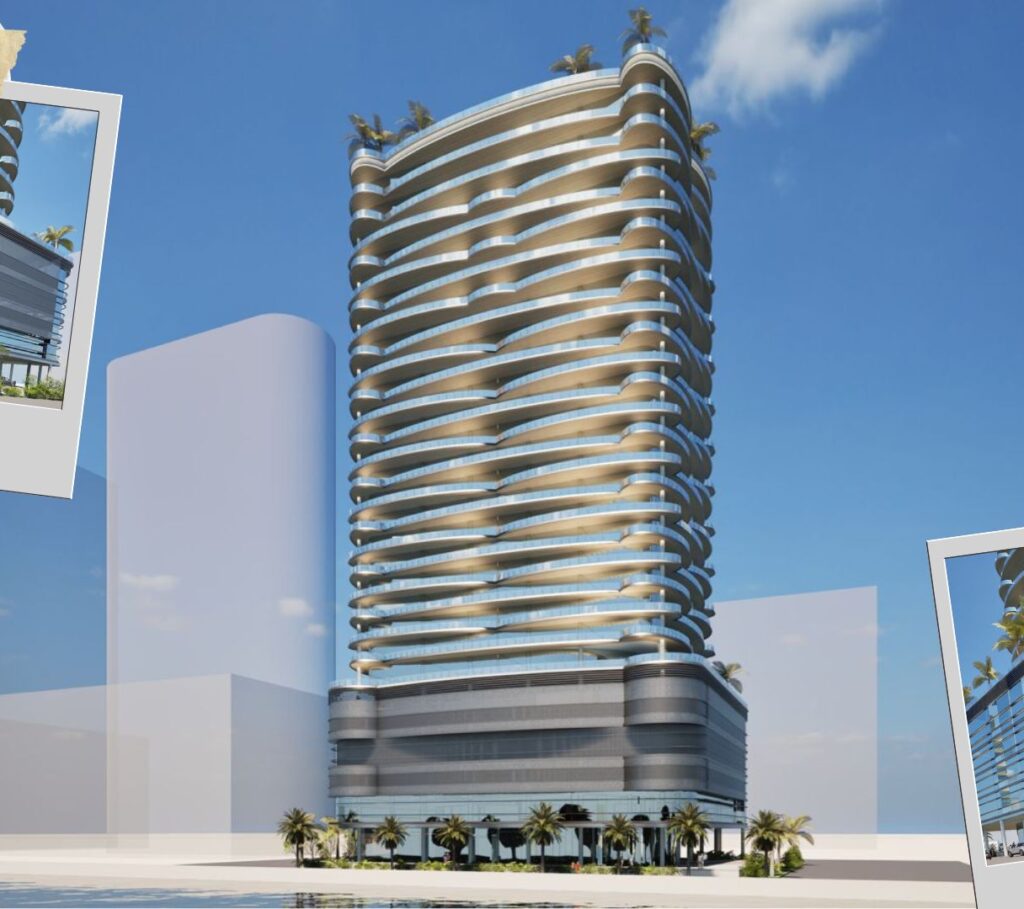
A South Florida-based joint venture, composed of MG Developer and The Prosper Group, has submitted plans to Miami-Dade County for a luxury high-rise in North Bay Village. Located at 1681 and 1725 JFK Causeway, the project is proposed on a prime 1-acre waterfront site overlooking Biscayne Bay. The joint venture acquired the two parcels for $30.9 million last year, revealing plans for a groundbreaking 2027 and a completion in 2029. The project joins a growing lineup of high-rise developments along JFK Causeway in North Bay Village, where Continuum is planning a two-tower district to the east and Sunbeam Properties is advancing a large-scale mixed-use district to the west. Designed by Revuelta Architecture International, the 30-story modern tower is set to include 147 residential units and 12 guest rooms. According to a Graham Penn, an attorney representing the project, ‘all units within the building are large, family-orientated spaces, with the smallest unit size being approximately 1,027 square feet in size.’ Split between 21 one-bedroom units, 31 two-bedroom units, 74 three-bedroom units, and 2 four-bedroom units, almost every unit will have direct access to views of Biscayne Bay. Beyond its residential offerings, 1725 JFK Causeway will include amenity spaces planned across the ground floor, level six, and the rooftop, totaling several thousand square feet. In total, six pools are planned throughout the building, four reserved for private residences and two for shared common areas. Final programming and layouts for these spaces have yet to be confirmed. Each residence will also be allocated at least one parking space, for a total of 272 spaces within the parking podium. To enhance the building’s streetscape and conceal the structure from public view, the podium will be lined with residential units along its perimeter. Plans also include 3,308 SF of ground-floor commercial space and 6,433 SF of office space. Set to rise 390 FT, the 30-story tower will feature materials such as perforated metal panels along the podium, impact-resistant glass, and glass balconies. Unlike most developments in South Florida, the project stands out for its exceptionally high glass-to-stucco ratio. In fact, if plans remain unchanged, the building will include almost no stucco at all, offering residents expansive, unobstructed views. Because the joint venture submitted the project under Miami-Dade County, it is subject to a Shoreline Development Review, which applies to properties along Biscayne Bay. The review aims to preserve public views and access to the Bay by prioritizing pedestrian connectivity, water-related activities, and open view corridors. To meet these requirements, MG Developer and the Prosper Group plan to include a public waterfront walkway, known as the Island Walk, running along the edge of the property, which will eventually link with adjacent segments to create one of the longest continuous public walkways in North Bay Village. The project also maintains a 20% view corridor along the west side of the site. However, due to the property’s strict setback requirements, fully complying with shoreline requirements would make the site undevelopable, according to the project’s representative. As a result, the developer is requesting an exception to certain setback regulations. While The Prosper Group and MG Developer continue planning for this project, both firms have been expanding their work beyond North Bay Village. Earlier this year, The Prosper Group submitted plans for one of the tallest proposed developments in Brickell, located at 1040 S. Miami Avenue, which is currently under review. The firm is also involved in a joint venture for Ora Hotel and Residences in Tampa, where sales have reportedly been strong.
The Fletcher District Gains Approval from the Florida Board of Governors, Set to Break Ground in Early 2026
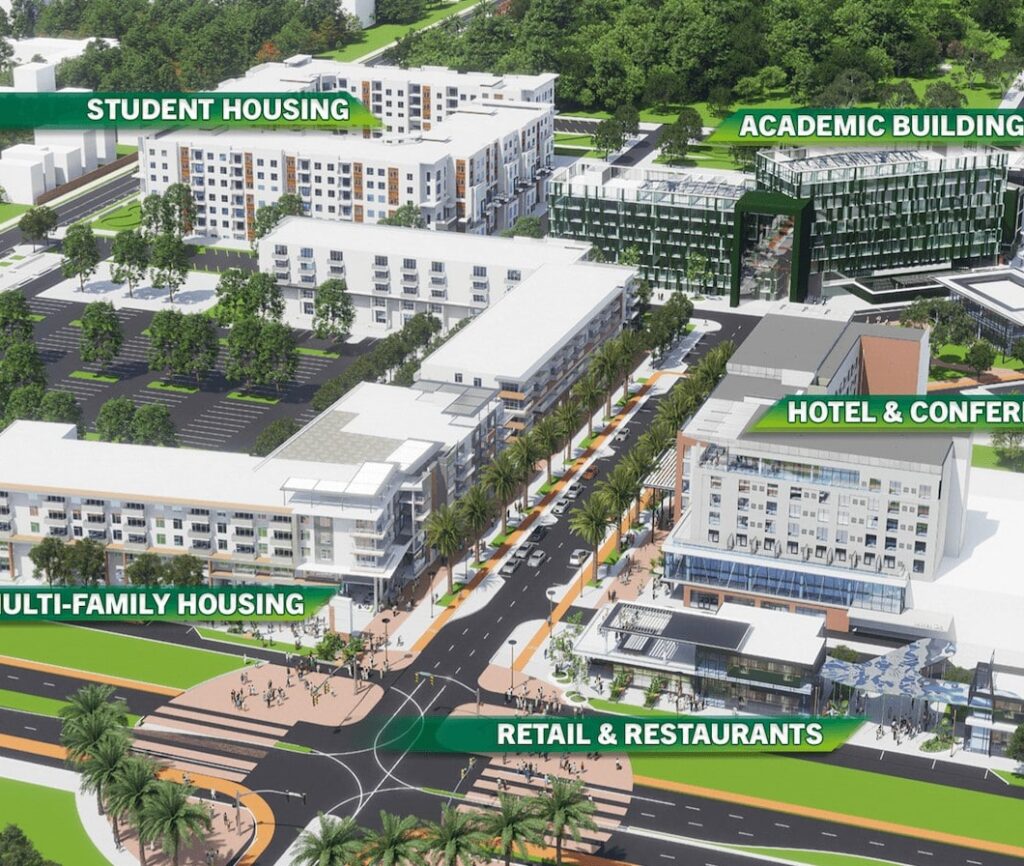
The University of South Florida has reached a major milestone in advancing its long-anticipated “Fletcher District”, a mixed-use neighborhood set to replace the former golf course known as The Claw. On November 6th, the Florida Board of Governors, which oversees the state’s public universities, voted to approve the project’s first phase. The development will transform the defunct golf course, which closed in 2023 at the corner of Fletcher Avenue and North 46th Street, into a vibrant district featuring student housing, multifamily residences, a hotel, retail space, and public amenities. Plans have been steadily progressing, with the USF Board of Trustees granting its approval on September 9th and construction expected to begin in spring 2026. Phase one will span 27 acres of the former Claw golf course’s 138-acre site. The plan includes 150 cottages, 350,000 SF of research space, 5,000 SF of conference space, a 150-room hotel, 60,000 SF of retail, 700 student beds, and 150 market-rate housing units. The development will also include over 1,000 parking spaces to support both academic and leisure uses within the district. For students seeking housing close to campus, 400 of the 700 planned beds will consist of one-, two-, and four-bedroom units, each featuring a one-to-one bedroom-to-bathroom ratio, addressing strong demand for more private student housing at USF. The 150 multifamily units will also serve university employees, faculty, graduate students, alumni, and community members, with a portion also available to the general public. According to the USF Oracle, the university is expected to generate over $509 million in profit from rent over the 40-year lease term, both from multi-family and student housing. You can find financing documents, the project’s summary, and more from yesterday’s meeting archive here. The Fletcher District will be developed through a public-private partnership between the University of South Florida and ACE Fletcher, LLC, whose members include Capstone Development Partners, Capstone Communities, Aureate Development, and Ellison Development. Under this agreement, USF will create separate ground subleases for each parcel, lasting between 40 and 99 years. The development team will design, build, finance, operate, and maintain their respective parts of the project, retain ownership during the lease, and fund their share of infrastructure and maintenance expenses. After the lease term ends, ownership of all facilities will revert to USF as required by Florida law. This means the first phase of the project, estimated at $268 million, will be funded mostly by the development team through private financing. USF’s direct financial role will be limited to constructing its own academic building and contributing to parts of the shared district infrastructure. When plans were first discussed to redevelop the golf course known as The Claw at USF, initial proposals had included parcels within the adjacent USF Forest Preserve. This sparked controversy among students and faculty, ranging from Indigenous heritage sites to critical habitat for native wildlife. After protests and study, the university clarified its intention. In a recently published FAQ the University of South Florida stated: “No. The Fletcher District is being developed entirely within the footprint of the former golf course, which was previously developed.” Instead, the adjacent USF Forest Preserve will continue to serve as a site for research, fieldwork, and educational use. The university has confirmed that there are no plans in the foreseeable future to alter or develop the preserve.
36-Story Atlantic Square Reaches Completion, Adding Mixed-Income Housing to Overtown
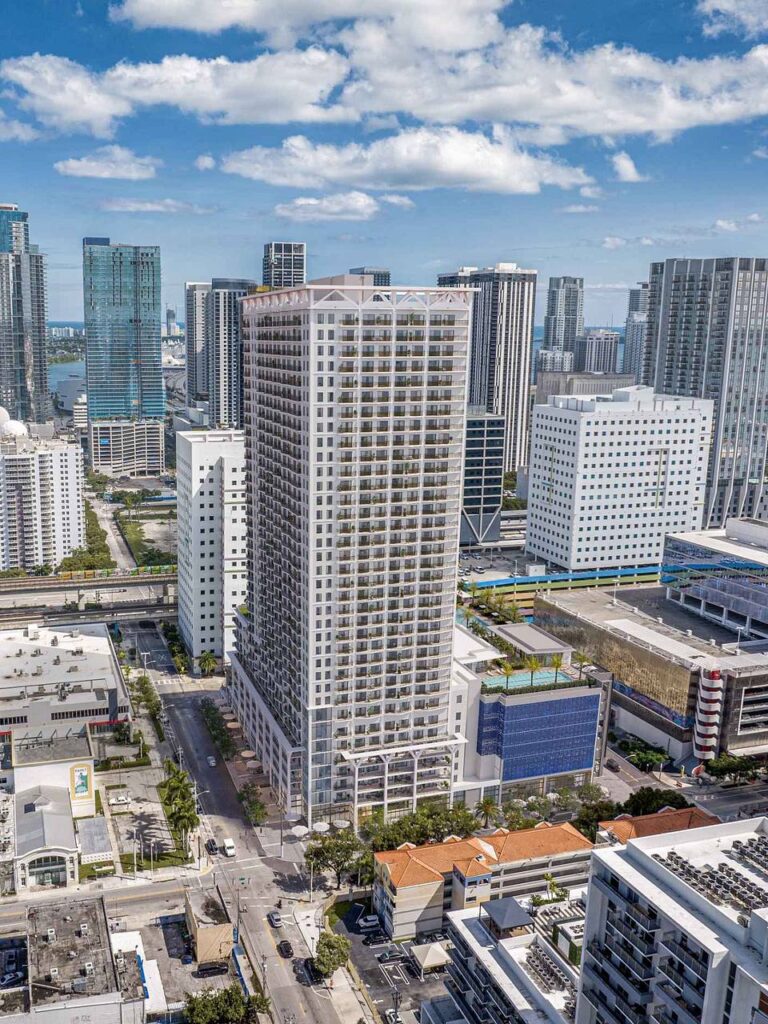
A major addition to Miami’s Overtown neighborhood has officially reached completion, marking a milestone in the community’s ongoing transformation. Rising 36 stories, Atlantic Square introduces new housing and amenities as part of the county and city’s larger effort to spur mixed-income growth and renewed economic investment in the neighborhood: bridging Overtown and Downtown Miami. Developed by Atlantic Pacific Communities and designed by Corwil Architects, the 391 FT tall tower has 616 residential units, with roughly 60% reserved as affordable and workforce housing and the remainder offered at market rate. The building replaces what was once a county-owned parking lot, transforming it into a dense, transit-oriented community in one of Miami-Dade’s most connected areas. According to the most recently submitted plans to the county, subject to minor revisions, the development includes 24,865 SF of ground-floor commercial space designed to activate the streetscape and promote walkability throughout the neighborhood. It will also provide 625 parking spaces, including 21 on-street spots, accommodating both residents and retail patrons. Atlantic Square offers a range of floor plans, from studios to one-, two-, and three-bedroom layouts. Alongside units are amenities such as pools, coworking and lounge areas, and outdoor recreation spaces including a dog park and landscaped terraces. The project also sits adjacent to key transit lines, with easy access to Metrorail, Metrobus, and Brightline. According to a quote provided by NBC6 South Florida, the county’s Director of Transportation notes, ‘We want residents here to be connected—to jobs, to schools, to opportunity—without having to rely on a car’, ‘This is the kind of project that sets a new standard for smart, equitable urban development.’ Following several years of planning, design, and construction, Atlantic Square has officially reached completion in late 2025. The project underwent multiple design changes throughout its lifetime, including updates to the parking podium. The final design features a striking blue metal facade designed by artist Marielle Plaisir, who described the work as ‘cut from aluminum with waterjet precision and bathed in my signature blue’, marking ‘a powerful new chapter in my public art journey.’ While Atlantic Square has completed construction, momentum in Overtown continues to build. Several developers are now setting their sights on the neighborhood’s next wave of projects. Most recently, Floridian Development reported on plans for Overtown’s tallest tower yet: a 55-story residential high-rise at 1210 NW 2nd Avenue, with at least 40 percent of its units designated as workforce housing under Florida’s Live Local Act.
13th Floor, Key International Unveil Nobu-Branded 74-Story Waterfront Tower at 619 Brickell Ave
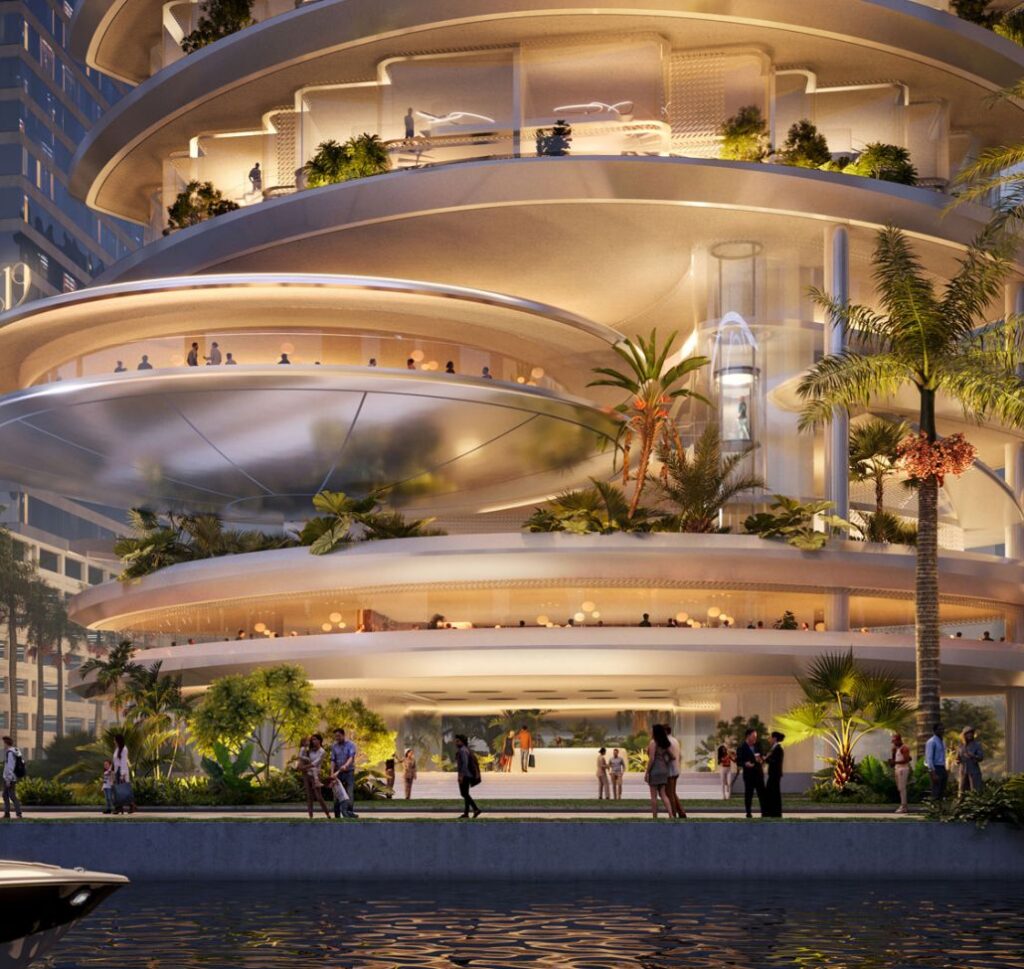
Nobu Hospitality is expanding its South Florida presence with its first branded residential project in Miami, a 74-story tower planned along Biscayne Bay in the city’s Brickell district. Developed in partnership with Miami-based firms 13th Floor Investments and Key International, 619 Brickell will bring 300 luxury condos, a full collection of high-end amenities, and a new Nobu restaurant to the heart of Miami’s core. Designed by Foster + Partners in collaboration with Sieger-Suarez Architects, the development will rise beside the historic First Presbyterian Church of Miami at 609-619 Brickell Avenue, one of the few remaining religious buildings on Brickell Avenue. In 2024, city officials removed the historic designation from the east side of the property, allowing for the future demolition of the building’s addition and surface parking lot. Plans call for 300 residences, which, according to Miami Residential, will range from one- to four-bedroom layouts. Each unit is designed by Foster + Partners to capture panoramic views of Biscayne Bay, with interiors reflecting Nobu Hospitality’s signature Japanese aesthetic. According to Nobu Hospitality, residents will also have access to 90,000 SF of private amenities, including a full-scale spa and wellness retreat, a state-of-the-art fitness center, and a poolside cafe. However, it’s important to note that unit sizes or configurations aren’t set in stone and may change at any time during the planning process. At the lower levels, Miami’s second Nobu restaurant will open within the tower, joining the brand’s existing Nobu Hotel and restaurant in Miami Beach. The new Brickell restaurant will feature a unique circular design and expansive waterfront views, envisioned as one of Miami’s most futuristic and modern dining locations. In a joint statement, Arnaud Karsenti, Managing Principal of 13th Floor Investments, and Inigo Ardid, Co-President of Key International, said: “We are honored to partner with Nobu Hospitality and Foster + Partners on this extraordinary project in the heart of Brickell. 619 Brickell represents the perfect convergence of design, service, and lifestyle — a residential experience elevated by Nobu’s world-class hospitality and commitment to exceptional service. Together, we are creating a landmark destination that reflects Miami’s sophistication and energy, and we look forward to unveiling it in the near future.” The 74-story tower will become one of the tallest buildings in Brickell. While full-scale renderings and official height counts have not been released, the building is expected to reach ‘supertall’ levels, internationally considered as structures rising above 300M. Only a handful of buildings in Brickell are planned to reach this scale, and none of them have broken ground yet.
Alta Development Advances Plans for 16-Story SOMI Walk Student Housing Near University of Miami

A new student housing tower is on the horizon for South Miami, as Alta Development prepares to move forward with SOMI Walk, a 16-story project planned near the University of Miami. The Miami-based developer has spent the past year refining the proposal through multiple planning stages and design iterations, with the latest version now submitted to the City of South Miami’s Design Review Board for review. Located at 5959 SW 71st Street and 7090 SW 59th Place, the 1.01-acre site currently houses a mix of hotel and office space that will be replaced by student housing to meet surging demand in the area. Designed by FormGroup Architects, SOMI Walk would mark one of the tallest additions to South Miami’s core, following the completion of Vox Miami nearby. According to plans submitted to the city, the development will include 173 residential units, with the potential for possible EB-5 investment funding. Units will be offered in a range of configurations, from one-, two-, three-, four- and five-bedroom layouts. Planned amenities include a rooftop deck, pools, a fitness center, wellness lounge, business center, terrace space, and more. The ground floor will include a spacious lobby, a bike shop, and a dog salon, along with a 3,168 SF public plaza for the public. Parking will occupy the first three levels, providing 173 spaces that include standard, accessible, and double-stacked lift options for residents. According to elevations prepared by FormGroup Architects, the 16-story tower will rise 192 FT at its tallest point. The facade incorporates stucco, brick, aluminum railings, and other modern finishes. Achieving this height, however, required navigating South Miami’s strict zoning regulations, which initially limited development. Because the site’s existing zoning only permits 8 stories, the developer had to make several adjustments to qualify for an additional height bonus, bringing the total to 16 floors. To achieve this, the project must contribute to open space, affordable and workforce housing, and sustainability initiatives by developing LEED Gold or LEED Platinum-certified buildings. If those standards are not met, the developer is required to make a payment in lieu of the city. Additional bonus floor area is also granted under these regulations. Prior to submitting plans to the Design Review Board, Alta Development secured approval on March 31st, 2025, for key land use and zoning changes affecting the SOMI Walk property. The updates changed the site on the Future Land Use Map (FLUM) to Transit-Supportive Development (TSD) and assigned it a TSDD zoning district, paving the way for the project’s current 16-story proposal. According to Alta Development, the team behind the development is planning to begin demolition soon, with groundbreaking in January. Once completed, it will be Alta Developments first project in South Miami.
Announcing the Floridian Development Newsletter: Daily Updates on Florida’s Growth
Florida’s development landscape is changing fast, from high-rise residential towers to transformative mixed-use districts reshaping cities across the state. With new proposals popping up weekly and projects finally moving toward construction, the need to keep track of everything happening in Florida’s built environment has never been more important. To deliver the most current, reliable, and detailed coverage straight to your inbox, Floridian Development is launching a new newsletter. Subscribing is free and provides daily emails featuring development and infrastructure news, upcoming feature updates from Floridian Development, and more, ensuring readers never miss what’s next. Receiving updates will be almost instantaneous, as the site will use automated emails that deliver notifications the moment a new article is published, faster than manual updates on Instagram, X, LinkedIn, or Facebook. Floridian Development is proud to be among the first sources to publish information on major projects across Florida, and this newsletter makes staying informed even easier. To sign up, simply visit https://floridiandevelopment.com/newsletter/ through the site’s header. After signing up, you’ll receive a confirmation email; once confirmed, you’re set to start receiving updates. No name is required, and we’ll never send spam. You can unsubscribe at any time.
The Avery Inches Towards Groundbreaking at 2517 West Kennedy Boulevard, Tampa
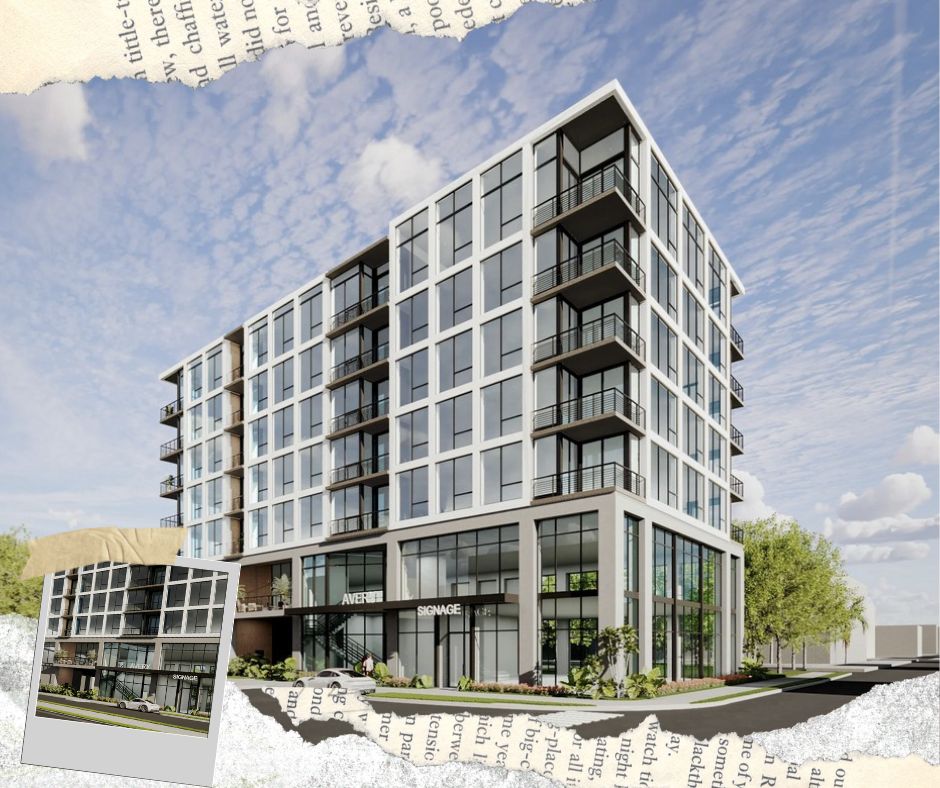
The Avery, a six-story multifamily development planned along Tampa’s West Kennedy Boulevard, is edging closer to a groundbreaking as the developer has recently filed for multiple construction permits. Located at 2517 West Kennedy Boulevard, the project will introduce new residential density to a corridor that has seen growing development interest in recent years. Led by The Avid Group and designed by ODP Architecture, the project has been in planning since 2022, when the developer purchased the site for roughly $2 million. The proposal has since gone through several design revisions over the past two years, with the latest plans reflecting the most refined vision for the property. Set to feature 36 residential units across six floors, the project will include a mix of studio, one-bedroom, and two-bedroom layouts. Unit sizes will range from 562 SF for the smallest studio to 1,333 SF for the largest two-bedroom residence, with one-bedroom units making up the majority of the offerings. Units are designed with an emphasis on natural light, efficient flow, and tall ceilings. In addition to residential space, the development will include approximately 6,130 SF of office space and 3,000 SF of ground-floor commercial space, activating the Kennedy Boulevard frontage and encouraging pedestrian activity. The building’s design also incorporates an expanded sidewalk and on-street parking. A total of 43 parking spaces will be provided in the development, with most spaces being in a surface parking lot next door. According to elevations provided by ODP Architecture, the building is set to rise 81 FT, one of the tallest buildings in the area. The modern facade will be composed of smooth stucco, exposed concrete, aluminum railings, and other design choices. According to ODP’s website, ‘the building’s clean, rectilinear volumes create a grounded podium that supports five levels of residences, articulated through recessed balconies and detailed facades. This disciplined use of concrete allows for large-format windows that animate the street rhythm and frame views above.’ The site was cleared roughly two years ago in preparation for construction. Recent permit activity includes threshold building permits, utility permits, and right-of-way applications, signaling that construction is imminent. While there is no official construction timeline, construction is estimated to begin next year.
The Gallery at Wagner Creek: First Tower of Related’s Health District Redevelopment Secures Financing
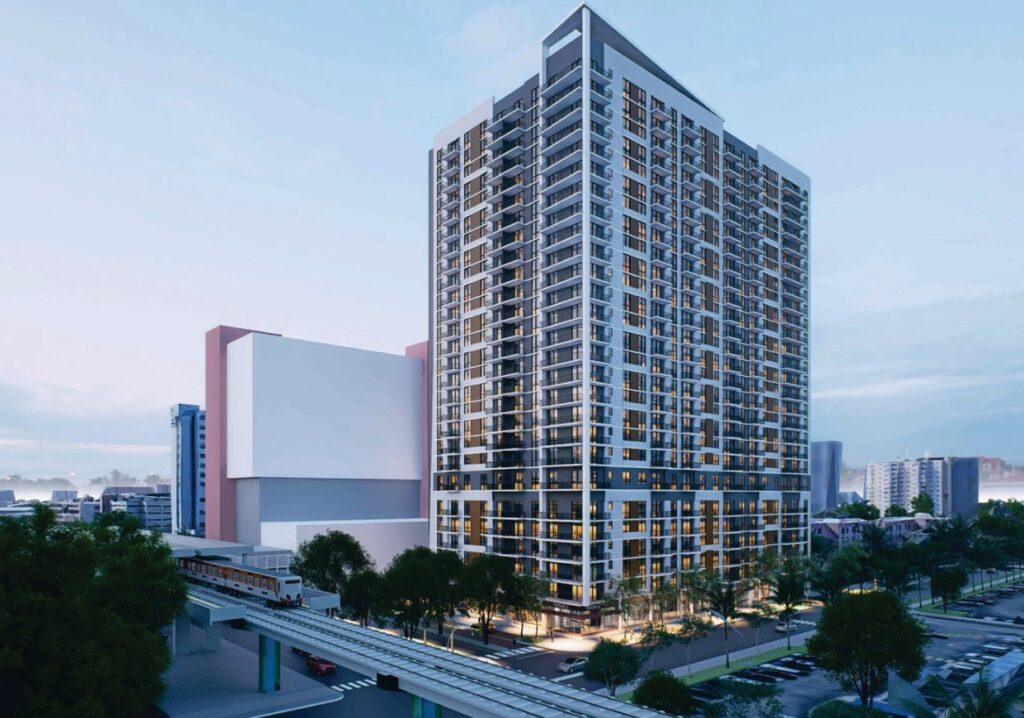
The Related Group has secured key financing for The Gallery at Wagner Creek, a mixed-income high-rise planned for Miami’s Health District that will include affordable housing. The project marks the first phase of a larger multi-tower development that will eventually involve the demolition and redevelopment of the nearby Jackson Medical Towers. Envisioned as a transit-oriented, mixed-income community, the development is located at 1165 NW 11th Street: just steps from the UHealth-Jackson Metrorail Station. On October 29th, Miami’s Housing and Commercial Loan Committee approved the allocation of $4,848,080 in Miami Forever Bonds to The Related Group. Miami Forever Bonds are part of a measure approved by voters to fund essential infrastructure, resiliency, and affordable housing projects. The $4,848,080 loan for the Gallery at Wagner Creek development is a key part of the project’s more than $190 million cost. Other sources of financing, including from the state, have also been awarded. The Gallery at Wagner Creek required financing from multiple institutions due to its large scale of affordable housing; the project will include 460 residential units, with 184 designated as either workforce or affordable housing for at least 30 years. These units will be priced for households earning between 30% and 120% of the area’s median income (AMI). Of the deeply affordable units, 70 will receive city assistance, including 35 specifically reserved for special-needs households in need of stable housing. This 40% workforce and affordable housing requirement stems entirely from the developer submitting the project under Florida’s Live Local Act. To avoid lengthy public hearings, the developer filed an administrative application, allowing the proposal to be reviewed solely by county officials. The Live Local designation also grants the developer greater flexibility, including increased height, density, and reduced procedural hurdles. A representative of the developer writes, ‘Pursuant to the Live Local Act, a maximum density of 250 units per acre is permitted. According to the revised survey, the gross acreage of the North Site is 1.98 acres permitting a maximum density of 495 dwelling units. For this first phase, the Applicant is proposing 460 units on the North Site, providing much needed affordable housing stock to the area’. According to floor plans provided by the architect, Cohen Freedman Encinosa & Associates, units will range from studios, 1-bedroom, and 2-bedroom units. Residents will have access to a range of amenities, including a pool, lounging space, a health club, co-working space, and much more. The development is also set to feature 346 parking spaces and 3,200 SF of ground floor commercial space. When the development was first submitted, parking counts were slightly higher. Elevations show a 27-story tower rising 305 FT, featuring materials such as smooth stucco, picketed railings, and louvered cladding. The building’s height is limited by nearby flight paths, with a maximum allowable elevation of 310 FT in this zone. To comply with aviation safety regulations, the roof will also include aircraft warning lights. While the project is still moving through approvals, it has already cleared several key steps. The site, currently used as a surface parking lot, has been granted site control through a ground lease, giving the developer long-term rights to design, finance, and operate the building without full ownership of the land. Construction is expected to begin in late 2026, with completion targeted for 2028.
Alta Developers Breaks Ground on Princeton Gateways Phase I, Set to Feature 308 Apartments
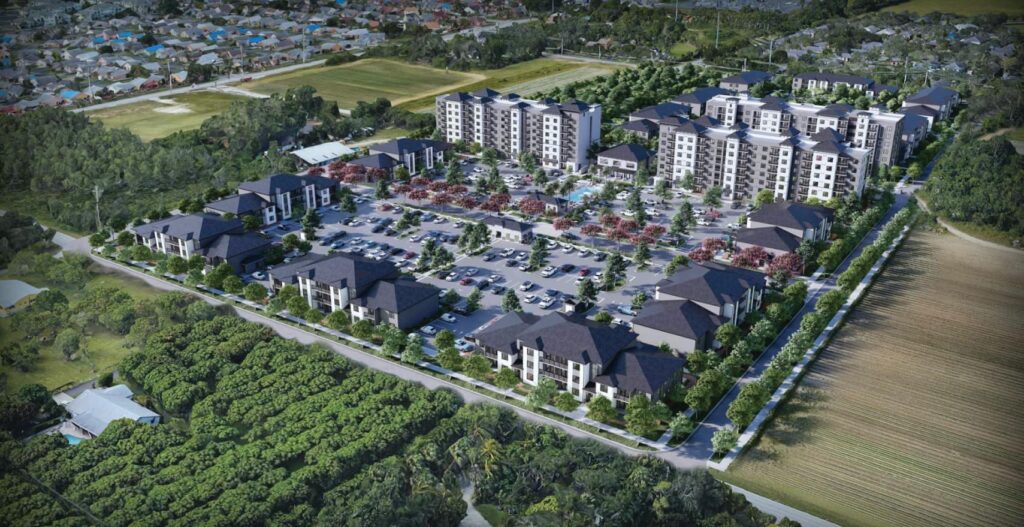
Alta Developers has just broken ground on the first phase of Princeton Gateways, also known as Princeton Commons. The project, which has been in planning since 2022, is now moving forward following a $60 million construction loan from Miami-based City National Bank of Florida. The first phase will replace three parcels located at 24450, 24500, and 24550 SW 127th Avenue with modern apartment buildings. The MSA Architects-designed complex isn’t alone. Despite being located in a relatively low-density area in Princeton, development across South Miami-Dade has surged in recent years. Limited available land has pushed traditional suburban projects to grow upward rather than outward; this groundbreaking is another example of such developments. After recently receiving ASPR approval for the first phase, the latest 2024 plans outline 308 residential units, although 384 are permitted. The mix will include one-, two-, and three-bedroom layouts, with two-bedroom units making up the majority at 61% of Phase 1. The development will feature nine buildings arranged around a central parking lot, with additional on-street parking for residents. In total, 417 parking spaces will be provided. With interiors designed by local firm Raymond Nicholas, the development will offer modern residences featuring large windows and private balconies. Ceiling heights will reach up to 9 feet 6 inches, creating bright and spacious living areas. Buildings in Phase I will range from three to seven stories, rising between 36 and 66 FT The first phase will include two seven-story buildings and seven three-story structures. The complex will also feature a white and gray color palette, accented by greenery along the facades and surrounding sidewalks. While the second phase hasn’t broken ground, it received approval earlier this year and follows a similar design and layout to the first phase. Smaller in scale, it will include 226 units spread across seven buildings, offering 1-, 2-, and 3-bedroom layouts. Residents will have access to 350 parking spaces. The construction start date is currently unknown, and unlike the first phase, the second phase’s site is not yet cleared for development. When both phases are complete, the complex will feature 534 units and 767 parking spaces. South Florida’s unique geological constraints, unlike regions such as Houston or Los Angeles, make projects like this feasible. Just months ago, a developer proposed a 25-story tower slightly further north under Florida’s Live Local Act, a landmark housing bill.
Sunny Isles Beach Set to Overtake Philadelphia in Number of Skyscrapers by 2029

Skyscraper enthusiasts across South Florida are about to witness a remarkable milestone for the region. While Sunny Isles Beach may not rival Philadelphia in population, economic scale, or national prominence, this slender barrier island city is on track to surpass the Pennsylvanian powerhouse in the number of skyscrapers. According to the Council on Tall Buildings and Urban Habitat (CTBUH), skyscrapers are defined as structures exceeding 492 FT (150 meters) in height. Over the past decade, these towering structures have increasingly reshaped South Florida’s skyline, and few places exemplify this transformation better than Sunny Isles Beach. The city’s appeal to developers lies in its prime location, relatively relaxed zoning laws, and the continued demand for oceanfront living in the region both domestically and internationally. With the upcoming completion of Bentley Residences and the two-tower St. Regis Residences complex, the city will add three new skyscrapers, increasing its total from 17 to 20 by 2029 when the final St. Regis tower is finished. Those buildings are currently working on their foundation and will quickly rise. For those familiar with the city, the real count of 17 towers in Sunny Isles Beach should be raising eyebrows. After all, it’s far above the long-accepted norm of 14. However, Floridian Development recently obtained city records and found that Trump Towers I, II, and III each reach 500 FT, not the 461 FT previously reported. That correction pushes the verified total to 17, bringing the city’s real count to light following years of misinterpreted data. According to elevations prepared by Sieger Suarez Architects, the towers each rise 500 FT starting from the lobby to the top architectural feature that conceals their mechanical components. These documents represent the most recent and final elevations for the buildings and do not reflect earlier versions. Dated late 2005, they were submitted as part of the foundation permits and reviewed prior to construction, which occurred between 2005 and 2009. This means Sunny Isles Beach is currently tied with Atlanta, Las Vegas, and Austin in terms of skyscraper count. By 2029, however, the city is set to surge ahead; it will reach 20 towers and tie with Dallas, which currently has no buildings over 492 FT under construction. Atlanta will fall just behind with 18 towers after the completion of 1072 West Peachtree Street, while Austin and Las Vegas are projected to have 19 and 18 skyscrapers respectively. The only U.S. city expected to surpass Dallas in this timeframe is Jersey City, which is also experiencing a major skyscraper boom. Even more impressive, Sunny Isles Beach is expected to exceed 20 skyscrapers in the near future, as developers continue to grab up low-rise parcels along the beachfront. Months ago, reports surfaced of a joint venture between Related Group, Dezer Development, and the BH Group acquiring the Miami Beach Club at 19051 Collins Avenue for over $100 million. The FAA recently approved an 820-foot tower on the site, which would make it the tallest building along the strip.
Azul At Blue Lagoon Proposed Through the Live Local Act, Set to Feature 250 Units
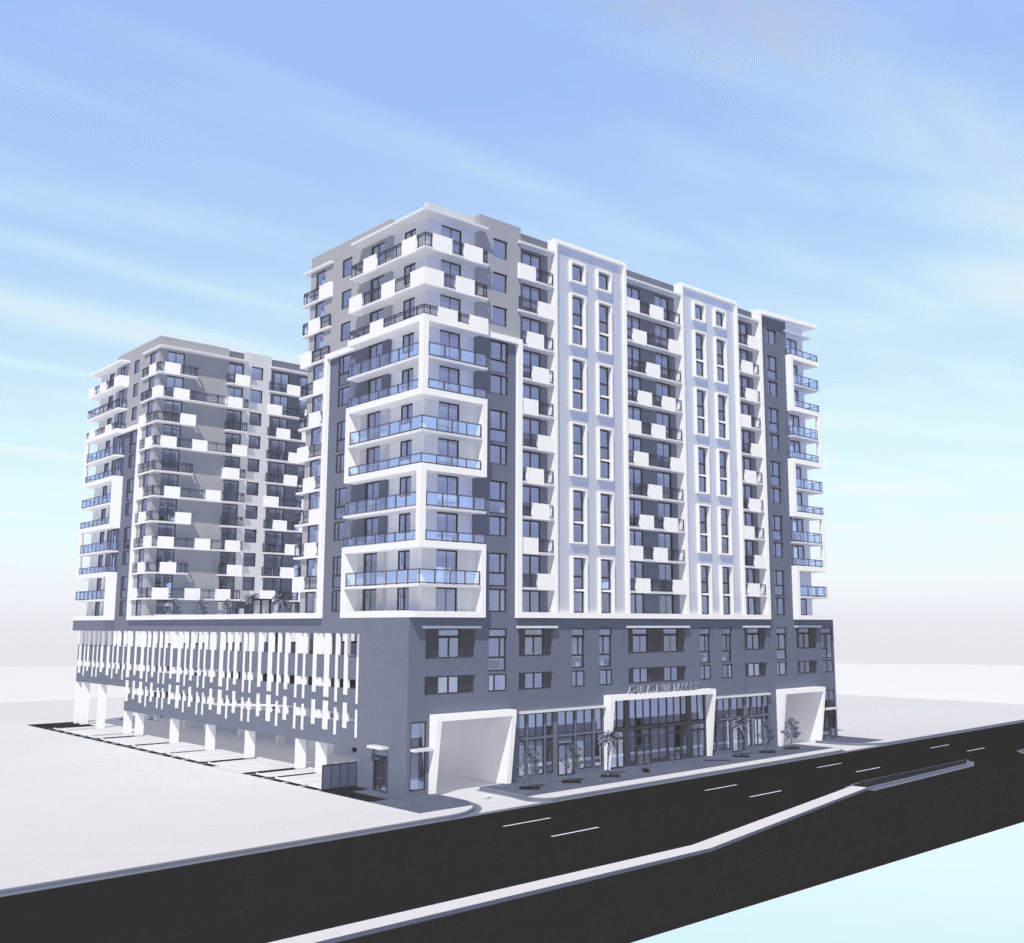
Miami’s Blue Lagoon neighborhood, an area defined by its mid-rise, office-oriented development, is seeing its first proposal under Florida’s Live Local Act. The project is known as Azul at Blue Lagoon, with plans currently awaiting Miami-Dade County approval for a 15-story residential tower made possible through the Act’s development incentives. Led by Keystone 1200, LLC, an affiliate of local firm Keystone Holdings, the proposal would rise on 1.2-acre site currently occupied by two industrial warehouses and a surface parking lot. The venture will also mark Keystone’s second Live Local project in the county, following its earlier Keystone Midway proposal, which Floridian Development previously reported on. According to plans submitted in early October, Azul at Blue Lagoon will feature 250 residential units. Under existing zoning, only 72 units would be permitted on the site, but the Live Local Act allows for a significant increase of up to 300 units in this case. By leveraging the act’s incentives, which include higher density and height limits, reduced parking requirements, and an expedited approval process, the developer must allocate at least 40% of the units as workforce housing. Most importantly, this proposal generously exceeds that threshold: approximately 54% of the building, or 136 units, will be reserved for workforce housing, priced at or below 120% of the Area Median Income (AMI). Residences at Azul at Blue Lagoon will range from townhome-style units and studios to one-, two-, and three-bedroom layouts, including optional two-bedroom units with dens. One-bedroom units will make up the majority of the development, accounting for 46% of all residences. All workforce-designated units will consist of either one- or two-bedroom layouts, ranging from around 600 SF to 900 SF. While the amenity package may continue to evolve, current plans showcase features such as a fitness center, resident storage areas, a pool deck, and multiple lounge spaces. At street level, the project will include 2,501 SF of retail space, a lobby, and vehicular access to the podium garage. The garage will accommodate 372 parking spaces, a significant portion of which will be configured in tandem layouts to maximize efficiency. Designed by FormGroup, a well-known architectural firm in the South Florida region, the building will feature a contemporary design with a concealed podium at street level, maintaining a pedestrian-friendly appearance. Balconies will incorporate a mix of metal and glass, while the facade will showcase stucco finishes in shades of blue, white, and brown. The building’s 15-story height is based on the maximum allowable height within a one-mile radius, with the precedent set by a nearby 15-story residential building at 725 NE 57th Street, located approximately 0.29 miles away. According to elevations, the building will rise 148 FT to its tallest point. Because the project is being filed administratively, there will not be a public hearing for this project. Once all is given the go-ahead, the existing site at 1200 NW 57th Street will require limited demolition.
Calle 8 Tower Undergoes Significant Changes Ahead of Groundbreaking in Brickell
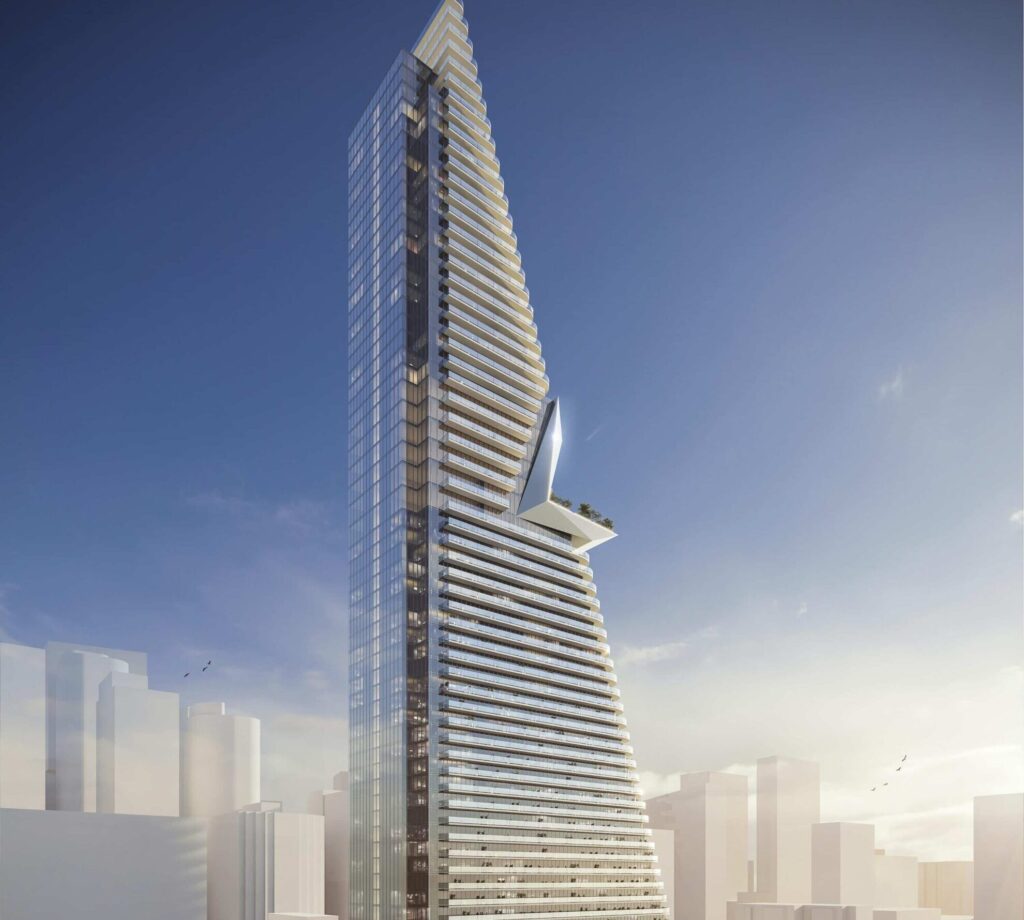
Calle 8, one of Brickell’s most distinctive proposals in both form and function, has just undergone a major change in its design. The update is being led by Millennium Developments of Brickell, an affiliate of G&G Business Developments: the same firm behind the Aston Martin Residences in Downtown Miami. G&G first proposed the project in 2023 and has since overseen several design revisions, the latest of which was submitted on October 17th. The newest plans remove the previously proposed music venue from the tower’s podium, replacing it with residential units to create an almost entirely residential tower. Despite the changes, the BMA Architects–designed building will retain its signature triangular design. Located at 190 SW 8th St, the development will now feature 500 residential units, an increase from the last iteration which called for 464. This increase comes entirely due to the aforementioned removal of the proposed music venue, which would’ve spanned over 70,000 SF. Residences will range from 1-bedroom units all the way to 3-bedroom penthouses on the top floors of the building. The building’s amenity package will remain similar in size but will feature several changes in offerings. Among the amenity package is a striking overhanging pool on the 41st floor, spanning 1,625 SF and surrounded by lounge areas. Other planned amenities include multiple bar spaces, a sauna and steam room, a spa, a beauty salon, and a dedicated wellness room. It’s important to note these amenities aren’t set in stone until construction commences. From the ground floor to the podium, the development will furthermore include 556 parking spaces, down from 653 in the original plan, along with basement parking to help minimize the podium’s visual impact at street level. The project also introduces new ground-floor spaces, including a car wash, 10,247 SF of retail space, and 3,669 SF of office space: none of which were part of the previous iteration. Beyond these functional changes, the tower’s design has also evolved. The facade now features a uniform composition of curtain glass and balconies, replacing the earlier visual disconnect between the podium, formerly containing parking and a performing arts venue, and the residential tower above. Despite these updates, the building’s overall height remains largely the same, rising 737 FT or 68 floors to its top architectural element, just seven FT shorter than the prior version. Submitted under an Administrative Site Plan Review (ASPR), the project falls within the Rapid Transit Zone (RTZ) Metromover Subzone, placing it under Miami-Dade County’s zoning jurisdiction rather than the City of Miami’s. This means the developer only needs to secure final administrative approval before moving forward with permitting and construction. The site, assembled by Millennium Developments between 2014 and 2015, was added to the RTZ Metromover Subzone through a boundary expansion approved in 2022. This zoning designation provides major incentives for developers, including increased building height and density, reduced parking requirements, and faster approvals for projects located near transit. Before qualifying for Administrative Site Plan Review, which is often much quicker than moving through a public hearing, developers must first obtain a general development plan approval. Millennium received that approval in early 2025, allowing the current ASPR submission to act as the final step before construction can move forward. While the tower moves through the final hoops before groundbreaking, it has captured the attention of international organizations including the Council on Tall Buildings and Urban Habitat. CTBUH’s Florida chapter will hold a presentation exploring the tower’s unique design, challenges, and solutions. The event will be held on October 30th. Summary of changes:
Miami-Dade Advances North Corridor TOD Master Plan with Its First Public Workshop

Miami-Dade’s North Corridor Transit-Oriented Development (TOD) Master Plan is officially moving forward, with its first community workshop scheduled for Wednesday, October 22 at the Sherbondy Village Community Center. The event, which will spam between 6:30 PM to 8 PM, will mark the first of two public workshops aiming to shape future development along Miami’s long-awaited North Corridor. Outlined in 2016 as part of the Strategic Miami Area Rapid Transit (SMART) Program, the North Corridor will extend approximately 10 miles along NW 27th Avenue, from the Dr. Martin Luther King Jr. Metrorail Station to the Broward County line. The goal of the line is to connect residents of unincorporated Miami-Dade, Opa-locka, and Miami Gardens to key destinations such as Miami Dade College, Opa-locka Executive Airport, and Hard Rock Stadium. The development will be one of the First Metrorail extensions in years, following the orange line to Miami International Airport. Among studies for the North Corridor, the county currently lacks a unified plan to guide development around its proposed transit stations. The upcoming workshop, and the planning process that follows, aims to change that. According to Miami-Dade officials, the Master Plan is being drafted to align land use, economic development, and mobility goals alongside the metro extension, ensuring that the region’s growth is sustainable and accessible to surrounding residents. Using a “5D Framework” (Density, Diversity, Design, Destination Accessibility, and Distance to Transit), the plan encourages compact, walkable, mixed-use communities around high-capacity transit. During the drafting process of the TOD Master Plan, planners hope to have a plan that will reduce car dependency and foster safer, healthier neighborhoods that connect people effectively to opportunities. The TOD Master Plan will evaluate land use within a one-mile radius of nine proposed elevated stations, assessing redevelopment potential, infrastructure needs, and pedestrian accessibility. The plan will also define strategies for creating complete streets and transit-ready communities. Progress on the Master Plan will proceed in four phases, with the final plan’s release scheduled for 2026. A second workshop will occur around March of next year. Once completed, the plan will be an additional step for the long-awaited North Corridor, which has been riddled by false promises. Once touted as reaching Hardrock stadium by the World Cup, the transit line is still undergoing funding, studies, and other concerns that have pushed the expected completion date back to 2036. A new Transit-Oriented Development (TOD) Master Plan is viewed as a must for the county, where an increasingly active corridor now demands a guide for growth. Among the projects taking shape is HueHub, a multi-tower complex with buildings rising over 300 FT. Leasing is expected to begin in December, and a new transit station is proposed just 150 feet away.
Riviera Beach Weighs In on ‘The Waterway,’ an Ambitious Three-Tower Development
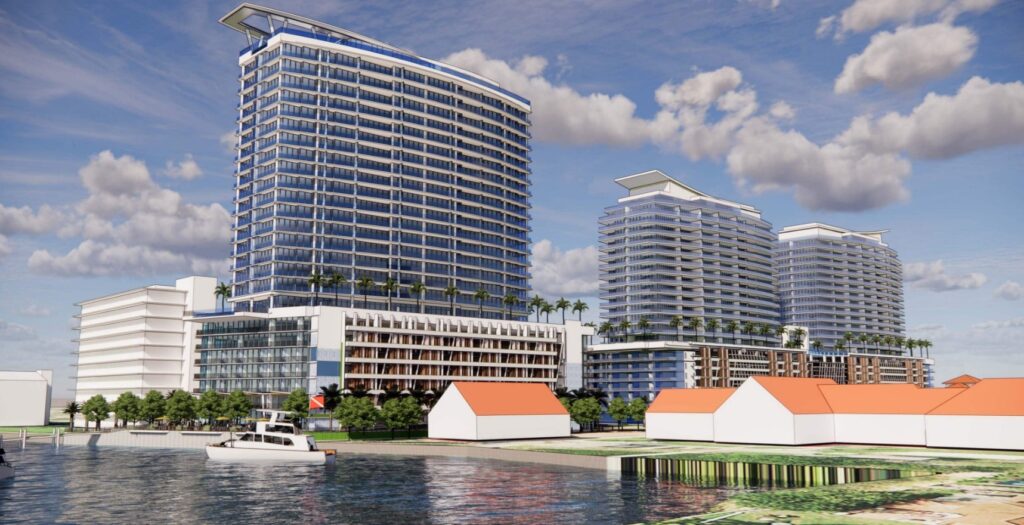
One of Riviera Beach’s most ambitious developments has arrived before the city’s Planning and Zoning Board. Called The Waterway, the project envisions a three-tower mixed-use complex spanning two parcels at 3200 Broadway Boulevard and 3140 Lake Shore Drive. Spearheaded by KMG Holdings, LLC and designed by REG Architecture, the 4.51-acre proposal will feature workforce and market rate units, along with retail, office, and other active uses. Set for review on October 23rd at 6 P.M., the Waterway development comes with a complex history. KMG Holdings, LLC acquired the waterfront parcel at 3140 Lakeshore Drive in 2018, followed by the adjacent west parcel at 3200 Broadway Boulevard in late 2020. Prior to KMG Holdings, an 18-story tower was proposed on the site in 2006. The most recent iteration would replace a 20-unit condominium built in 1967 along the waterfront, as well as a former BellSouth Communications office building. Originally envisioned as a single high-rise tower, the proposal has since expanded into a three-tower complex featuring 785 residential units. The Waterway’s three towers will offer a mix of one-, two-, and three-bedroom units. The two western towers will feature 239 and 233 units, respectively, while the waterfront-facing tower will contain 313 units. Of the total, 30 units are designated as MEAHOP workforce housing units under the Minority Employment and Affordable Housing Opportunity Plan (MEAHOP). These units are aimed at lower or moderate-income households. This requirement steams from a rule which permits height increases in exchange for workforce housing. While the two western towers comply with Riviera Beach’s 240 FT height limit, the waterfront-facing tower is proposed at 300 FT, taking advantage of the city height bonuses. This requires 60 MEAHOP units, equivalent to 30 workforce housing units, which will be concentrated in the west tower’s upper floors. Residents of the building will have access to amenities from a clubhouse, multiple infinity pools, a theater, lounge, gym, and other amenities. The development will also include access roads flanking both sides of the three-tower site, providing entry to 1,637 parking spaces for residents and retail patrons. One of the proposal’s highlights is the tower’s street-level activation and podium design, which includes 2,925 SF of restaurant space and 9,771 SF of retail and office uses. Along the waterfront, a public pedestrian promenade is planned, designed with seating, landscaping, and a proposed dock. Architectural elevations show the towers will feature a combination of curtain glass, smooth stucco, expansive glass balconies, and other design elements, including a garage wrapped in brown-toned metal louvers. The waterfront-facing tower is planned to rise 25 floors, measuring 300 FT to the roof or 305 FT at its tallest point. The two 21-story towers will then top out at 240 FT to the roof, or roughly 260 FT to their highest points. Riviera Beach’s Planning and Zoning Board is scheduled to review the proposed development on October 23rd. The board acts as an advisor to the City Council, meaning it does not grant final approvals. Instead, its recommendations, whether for approval or denial of the five items, will be forwarded to the City Council for the final decision. The development will proceed in one phase, with all three towers rising at once. If approved by the City Council, the project would represent another major investment in Riviera Beach’s evolving skyline. Traditionally a low-density city defined by smaller-scale infill, Riviera Beach has recently attracted growing interest from major developers. Firms such as Forest Development and the Related Group have introduced multiple high-rise proposals across the city, including the recently approved Oculina Development, which leverages the same MEAHOP incentives to achieve additional height.
Signs of Life Emerge for ArtsPark Lofts, Where Merrimac Ventures Plans Minor Changes
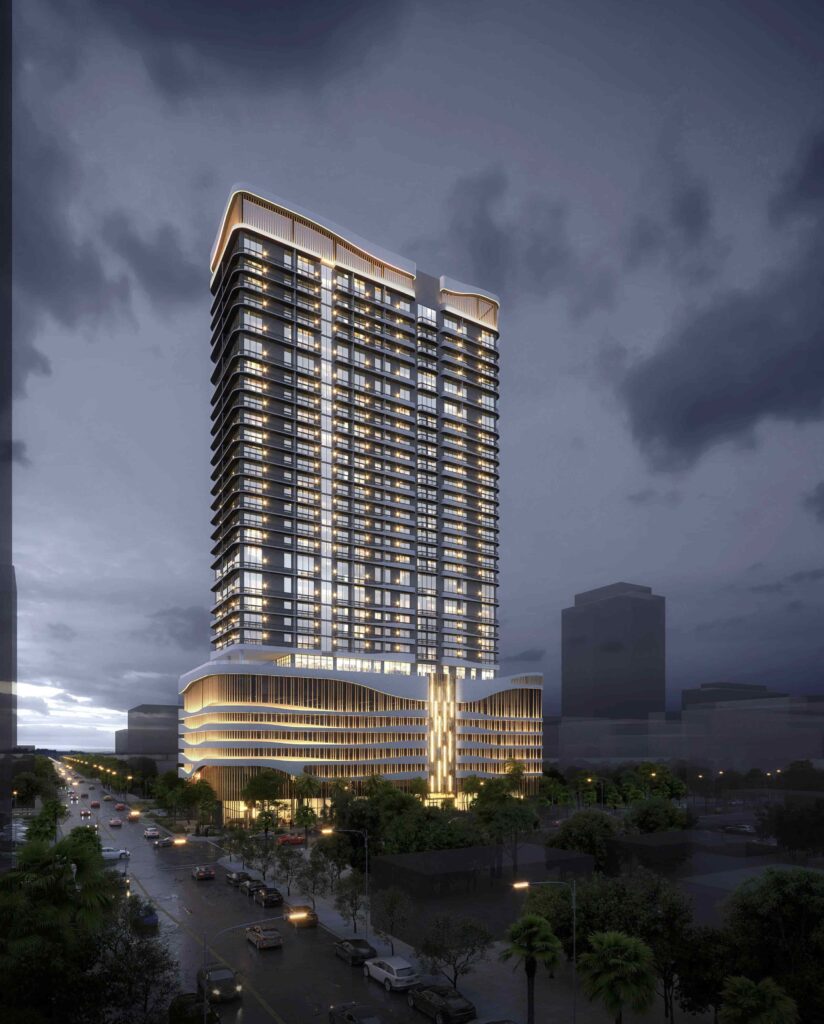
Signs of life are emerging for ArtsPark Lofts, a high-rise first proposed in 2022 for Fort Lauderdale’s Flagler Village neighborhood. Led by Fort Lauderdale-based Merrimac Ventures, the project has undergone several minor revisions over the years, including adjustments to its height, parking, and unit count. The latest amendment is now scheduled for review by Fort Lauderdale’s City Commission on October 23rd, where members will vote on the updated site plan. If approved, ArtsPark Lofts will be Merrimac Ventures’ second residential project in Flagler Village. The firm is currently building a two-tower development at 317 N Federal Highway, which broke ground last year. Located at 407-421 N Andrews Ave, ArtsPark Lofts received its first update in early 2023 when the developer increased the tower from 30 to 31 floors, mainly due to an expansion of the podium. Following this change, the developer also raised the parking count from 359 to 372 spaces. Now, Merrimac Ventures is proposing a further increase to 32 floors, adding an additional residential floor and bringing the total unit count from 289 to 301. At the same time, a slight reduction in parking lowered the total to 367 spaces. In summary, the project has evolved slightly since its original 2022 submission. The tower has moved away from a 30-story building with 289 units and 359 parking spaces to a 32-story structure, containing 301 units and 367 parking spaces. Ground-floor commercial space was also slightly adjusted, bringing total square feet from 1,914 to 1,249. While the overall design by Fort Lauderdale-based FSMY Architecture remains largely unchanged, the tower has grown slightly taller. Earlier plans had the building rising 368 FT, but the updated proposal now reaches 372 FT. While changes like these may be modest, the fact that the project is moving forward is the most important takeaway. Recently, several developments in Fort Lauderdale have either stalled or been put on hold. Shifting market conditions and rising construction costs have prompted developers, such as Woodfield Development, to pause projects like 520 Broward, a 41-story tower located west of ArtsPark Lofts. According to ApexOne, that development is now indefinitely on hold. For Merrimac Ventures, progress on the first tower of their 317 N Federal Highway development has also been indefinitely stalled, though the reasons for the delay remain unclear. According to city documents, staff recommends the proposal be considered by Fort Lauderdale’s City Commission. Although the tower exceeds the allowable height by two floors, a project representative notes that it “provides less mass than is otherwise permitted by code.”
Miami’s Urban Development Review Board Approves ABH Developer’s Wyn Park Development
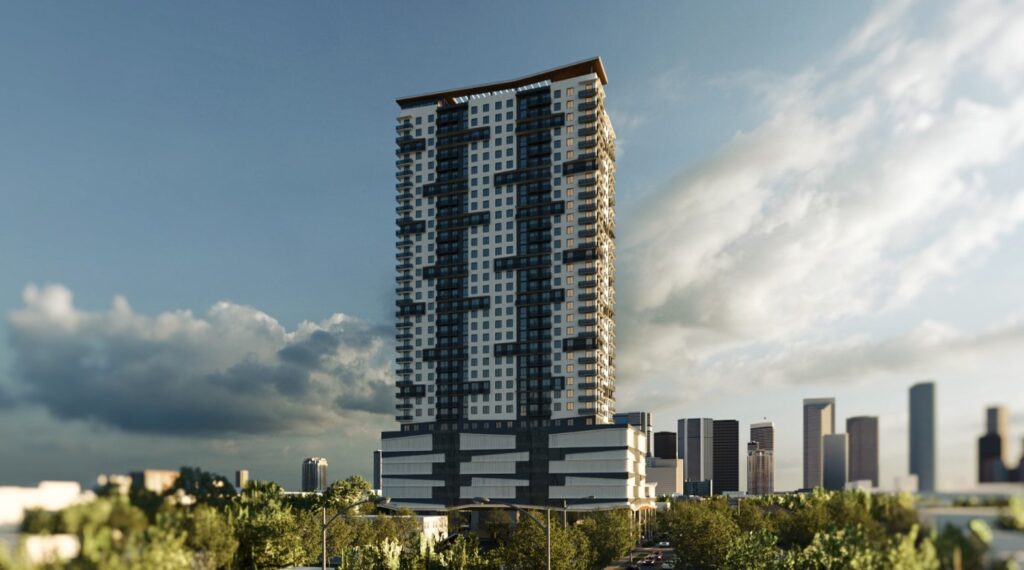
Wynwood Norte is once again emerging as a focal point for Live Local Act development in Miami-Dade, with the recent approval of Wyn Park, a new high-rise proposal that marks the third such project in the neighborhood since the law’s enactment. Once characterized by single family homes and low-rising apartments, Wynwood Norte has become a magnet for developers, fueled by the commercial and residential success of neighboring districts such as Wynwood, Edgewater, and Midtown. The latest proposal comes from ABH Developer Group, a firm with more than a dozen projects planned or underway in the area. Wyn Park will be the company’s largest undertaking to date: a 36-story residential tower planned to include 293 units, made feasible through the far-reaching provisions of Florida’s Live Local Act. By utilizing the Act, developers gain access to substantial incentives: the ability to build at the highest residential density allowed anywhere in the city, match the tallest height of a plot within a one-mile radius, and bypass many of the typical zoning constraints that once limited growth. For Wyn Park, that translates to an allowable density of up to 530 units, even though the current plan calls for fewer. The project will feature unit layouts from studios averaging 450 SF, one-bedroom apartments around 600 SF and two-bedroom homes ranging from 708 to 1,071 SF. In accordance with the Live Local Act, 40% of the units will be designated as workforce housing, reserved for essential workers such as teachers, firefighters, and other community members. This translates to 117 workforce units, each priced at or below 120% of the Area Median Income (AMI). According to a representative for the project, the development will offer ‘top-notch, beautifully designed mixed-income’ apartments. Starting from the ground floor and rising through the multi-story podium, the development will incorporate both traditional and micro-retail spaces, totaling 3044 SF. The second floor will also include 5,659 SF of office space, giving commercial activation to not one but two floors of the podium. According to Modis Architects, the official designer of the building, the podium will feature ‘perforated metal panels with tree leaf designs to conceal internal elements, soften rigid lines, and allow natural light and ventilation’. In total, the podium will house 196 parking spaces. In addition, the development will house a 1,069 SF rooftop restaurant with a deck overlooking Miami. It’ll be one of the first rooftop restaurants at that height in the area, and certainly the first in Wynwood Norte. To make the current design and specifications possible, the developer is requesting multiple waivers, including a 30% parking reduction within a transit corridor, waivers for certain elements of the parking podium, and additional lot coverage. Reviewed and approved by Miami’s Urban Development Review Board, the development features a facade characterized by charcoal and white tones, incorporating materials such as wood cladding, metal railings, metal accents, and stucco. According to The Real Deal, some board members described portions of the design as having “lego-esque” elements, while also citing an apparent disconnect between the tower and podium. Despite these concerns, the 366 FT tower ultimately received near-unanimous approval. With developers receiving approval on October 15th, the next phase will involve additional approvals from the planning department, followed by the permitting process.
Tech Tower Breaks Grounds in Sweetwater, Set to Include 517 Apartments
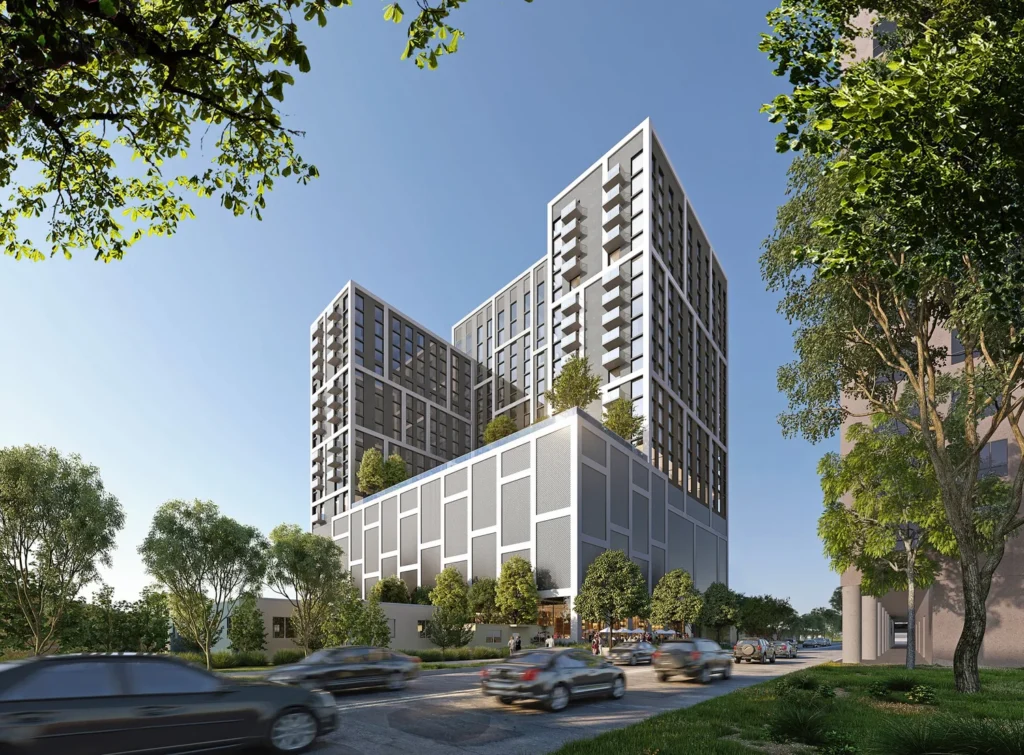
Sweetwater’s student housing construction boom is gaining even more momentum, following the recent groundbreaking of Tech Tower. On the morning of October 15, Global City Development and Gilu Development officially broke ground on the 23-story apartment tower located at 10941 SW 7th Street, where foundation work is already underway. The project marks Global City Development’s third collaboration in Sweetwater, following the successful completion of The Lapis and The One: two student housing projects in close proximity to Florida International University. The groundbreaking ceremony featured key figures from the development team along with Sweetwater Mayor Jose “Pepe” Diez. First reported by WhatNow Miami, Shawmut Design and Construction will partner with the developers to oversee construction. View this post on Instagram A post shared by City of Sweetwater (@cityofsweetwater) Tech Tower will feature 517 workforce-oriented apartments, along with 2,923 SF of ground-floor retail space. The building’s multi-story podium will also provide substantial parking for residents and visitors, rising more than 5 floors. The project received approval from the City of Sweetwater in early 2024, originally calling for 170 apartments (678 beds) and 4,202 SF of commercial space. Since then, the plans have been significantly revised. Amenities will range from a lounge, a pool on both the podium deck and the rooftop, as well as a club room. There will be around 28,000 SF of space dedicated to amenities. According to Miami-Dade County permitting records, several permits have already been approved, including misc permits like fire sprinklers. A general construction permit, however, remains pending. The filings list the project’s estimated value at over $100 million, with a total building area of 704,379 SF. Tech Tower will be the second high-rise to break ground in Sweetwater this year alone. Just last month, Casa at FIU, a 297-unit development, broke ground at 10710 SW 5th Street. The development is being spearheaded by WFHP LLC and RAL Companies. Developers such as those behind Casa at FIU and Tech Tower have increasingly turned their attention to Sweetwater due to the city’s relaxed zoning regulations and the growing demand for student housing.
13-Story Condo Proposed Along Fort Lauderdale’s Intracoastal Called Opus at 701
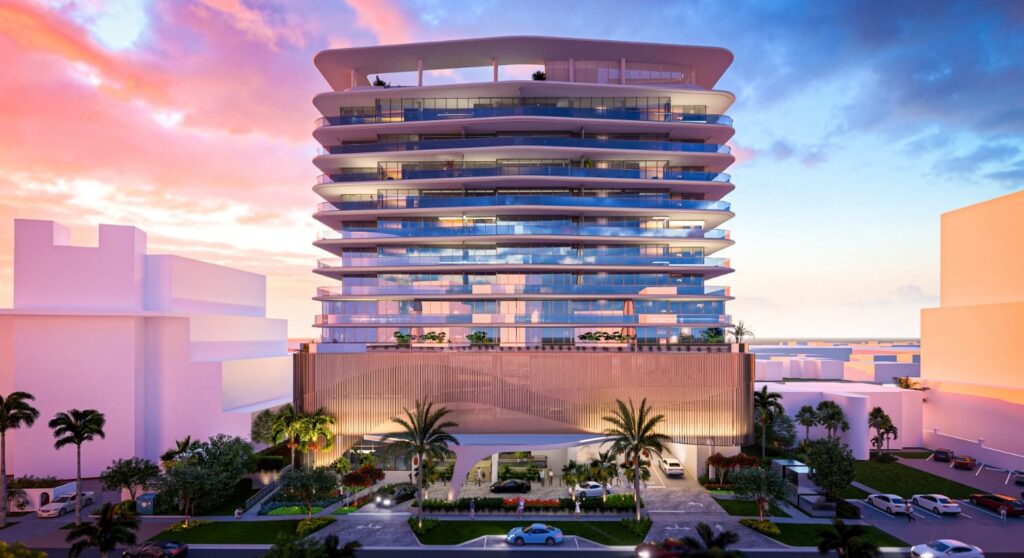
A new condominium has just been proposed along Fort Lauderdale’s stretch of the Intracoastal Waterway. Located at 623 and 701 Bayshore Drive, the project, known as Opus at 701, calls for a 13-story residential tower designed by Adache Group Architects. The building will replace two existing low-rise structures: one a multifamily rental community and the other a long-standing hotel. The combined parcels were acquired between 2023 and 2025 for $19.5 million, allowing the tower to feature a wide footprint. Led by CNB Contracting of New Rochelle, New York, the project is joining a growing wave of residential developments along Fort Lauderdale’s Intracoastal Waterway: many of which are being driven by out-of-state developers. According to plans submitted to Fort Lauderdale’s Development Review Committee, which convened on October 14, the proposal calls for 54 luxury-oriented residential units, matching the site’s maximum allowable density of 70 units per acre. The residences will include a mix of two-bedroom, two-bedroom plus den, three-bedroom, and penthouse layouts. The most common floor plan, comprising just over half of the total units, will be the three-bedroom layouts. The development will feature a variety of amenity spaces, including a spa, game room, yoga studio, fitness center, and a pool deck, along with a rooftop level with a second pool and clubhouse. In addition, the three-story podium will provide 114 parking spaces, offering residents at least two spaces per unit through a combination of compact, traditional, tandem, and mechanical lift spaces. According to elevations by Adache Group Architects, the building will rise 155 FT from street level to its highest point. The proposed height aligns with Fort Lauderdale Beach’s zoning regulations, which generally caps structures in the area around this height. Unless the developer pursues an exception or invokes the Live Local Act for the site’s commercial zoning designation, 155 FT represents the maximum height permitted for this property. Likewise, the facade will showcase a mix of modern materials and tones, including frosted glass balconies, white brick cladding, white and beige stucco finishes, and metal louvers, among other contemporary design elements. A representative from Adache Group Architects writes, “the parking podium is designed with rhythmic vertical slats, creating a wave-like motion across all four elevations. As the “wave” ascends, a horizontal canopy emerges, providing shade below. The building’s exterior palette combines soft whites on the walls, transparent glazing for unit storefronts, and champagne-colored aluminum finishes on mullions and podium screening. This sophisticated blend of colors and tones harmonizes with the lush greenery of the surrounding landscape.” Before the project proceeds to Fort Lauderdale’s City Commission, the Development Review Committee staff has recommended several changes that the developer must address. These include modifications to the podium’s screening, changes to the articulation of each balcony, and other alterations to the plans.
55-Story Tower Proposed at 1210 NW 2nd Ave in Overtown, Possible Through the Live Local Act
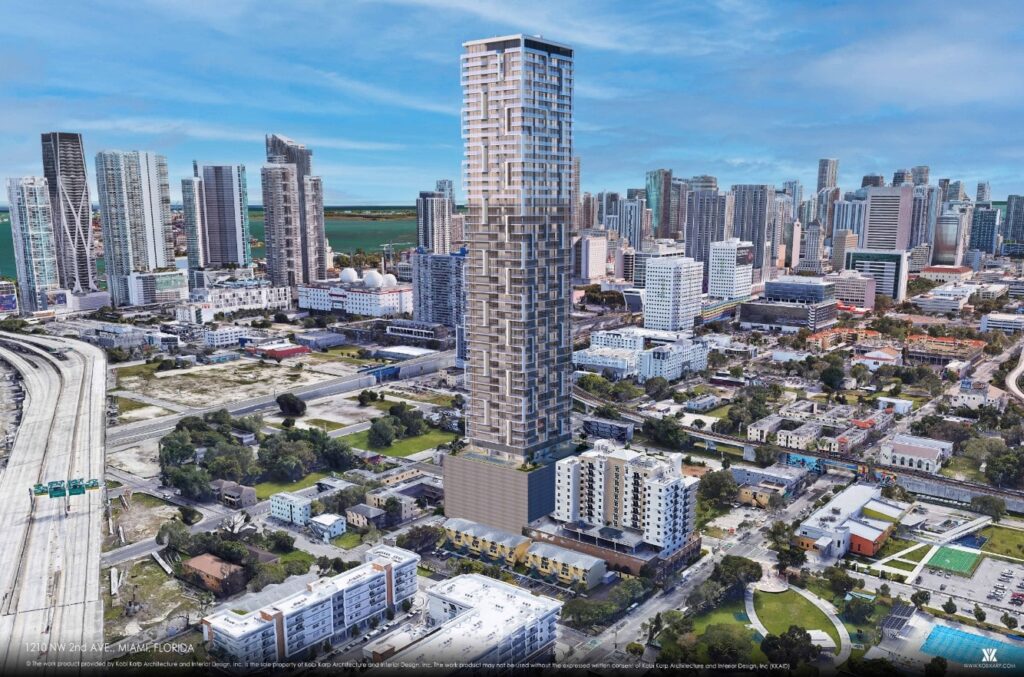
Overtown has just received its tallest skyscraper proposal yet, all made possible with the assistance of the Live Local Act. Spearheaded by David Om, LLC, affiliated with Nadlan Management & Investments, the company is planning a 55-story tower on a compact site. The property, located at 1210 NW 2nd Avenue at the corner of NW 12th Street, will feature 498 residential units. The project represents one of the few Live Local Act proposals submitted in the neighborhood to date and could very well signal the beginning of a broader wave of development across Overtown. Of the planned 498 units, 200 will be designated as workforce housing. Under the Live Local Act, any project must allocate 40% of units to households earning up to 120% of the area median income (AMI). The development will feature a mix of unit types, including studios, one- and two-bedroom apartments, penthouses, and a unique category of ‘micro-units.’ Similar to other Live Local Act projects, these micro-units are expected to measure around 300 SF, making them some of the smallest residences in the county. With 200 micro-units planned, it is possible that all workforce units will be micro-units, though that has not been officially confirmed. Despite the site’s relatively compact footprint, the development will offer a wide range of amenities, including two swimming pools, a splash pad, cabanas and resting areas, an entertainment room, a coworking space, and a rooftop deck complete with a lounge and bar. Additionally, the development will provide 154 parking spaces and a hefty 501 bicycle rack spaces. On the ground floor, the development will feature 1,824 SF of retail space and a residents’ lobby, complemented by substantial sidewalk improvements. The current lot is constrained by narrow sidewalks, utility poles, and illegal parking. The new design will include wider, greenery-lined sidewalks, creating a more pedestrian-friendly environment. The podium, rising 8 stories tall, features art that represents the ‘brilliance and resilience of Black history and culture’. The podium will highlight artwork from Miami-based artist Yana Volf, dedicated to the people who originally inhabited Overtown. Volf’s artwork is known for the fusion between realism and pixelation, showcasing portraits of neighbors who embody heritage, stories, and the ‘soul of the community’. According to elevations, the building is expected to top off at 575 FT, not including a potential buckhead that could raise it to nearly 600 FT. In line with several Kobi Karp designs, the tower will showcase a white-and-gray color palette, accented with curtain glass, stucco, and glass balconies. The property is zoned T6-8-L under Miami code, which allows a maximum of 150 dwelling units per acre along with specific parking requirements and height limits. However, under Florida’s Live Local Act, developers can exceed these restrictions by adopting the highest residential density permitted anywhere in the city: in this case, up to 1,000 units per acre. The law also allows projects to match the tallest allowable height within one mile of the site. For this property, located just three blocks from a parcel zoned for 60 stories, that height is applicable here as well. Moreover, despite providing parking, the Live Local Act permits developers to build with no parking minimums on qualifying sites. By pursuing the Live Local Act, developers can bypass lengthy rezoning processes and public hearings. The Act requires all projects to be reviewed administratively, significantly reducing the time needed for approvals.
Live Local Act Fuels Major Redevelopment of Fort Lauderdale’s Galleria Mall
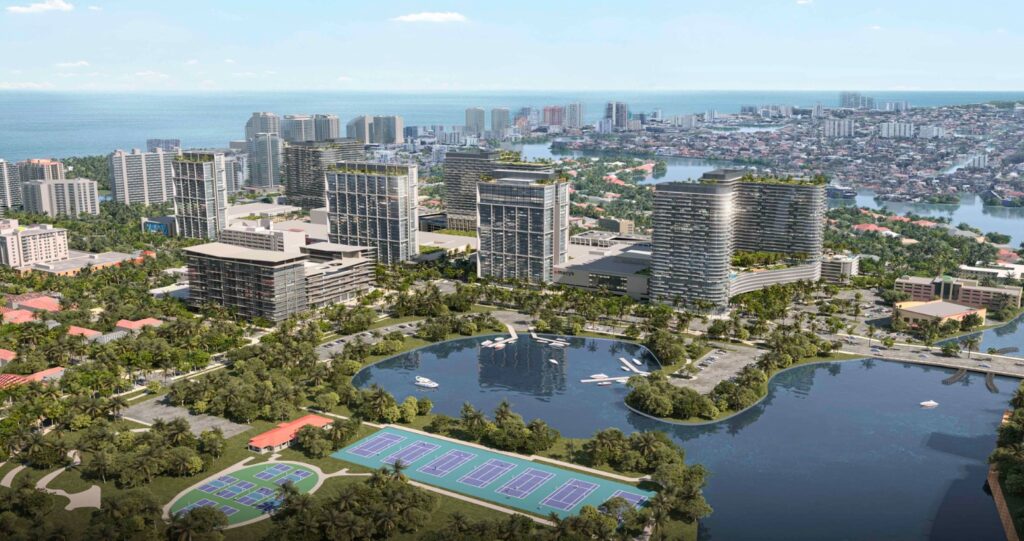
Fort Lauderdale’s long-struggling Galleria Mall is poised for a major redevelopment following its sale last month. The new owners, a joint venture between GFO Investments and the InSite Group, purchased the property for $73 million from Keystone-Florida Property Holding Group, which had owned it since 1993. The partnership’s proposal envisions a multi-tower mixed-use complex, with each tower rising about 30 stories, integrated into the existing mall site. Because current Fort Lauderdale zoning does not permit such density by right, the developers plan to utilize Florida’s recently passed Live Local Act, which allows projects that include workforce housing to skirt certain local zoning laws. According to documents obtained by the South Florida Sun Sentinel, initial plans were submitted in August, though several elements will need to be revised following feedback from the city. The proposal for 2414 E Sunrise Boulevard divides the Galleria Mall site into two sections: east and west. The east section will primarily feature residential towers, while the west section will include additional residential space alongside a hotel component. Spanning more than 31 acres, the redevelopment would become one of the largest mixed-use projects in Fort Lauderdale’s history. The Galleria East redevelopment will include five 30-story towers, featuring 1,181 market-rate units and 800 workforce housing units. 675,968 SF of the existing mall space will be retained, while an additional 127,966 SF will be devoted to health and fitness uses, as well as retail and restaurants. Designed by Arquitectonica, the five towers will showcase modern, glass-heavy facades complemented by expansive balconies. Amenity spaces will be distributed throughout the development, including rooftop areas offering views across Fort Lauderdale. On the other hand, the Galleria West redevelopment will feature four 30-story towers containing 1,161 residential units (690 market-rate and 473 workforce) along with 170 hotel rooms. The plan also retains 251,765 SF of existing commercial space, complemented by 9,140 SF of new office space and more than 5,000 SF of restaurant space. Because this large-scale redevelopment is being pursued under Florida’s Live Local Act, the partnership can match the maximum building height within one mile: in this case, 30 stories, drawn from nearby plots in Fort Lauderdale Beach. The law also allows for increased density and reduced parking minimums, all aimed at encouraging walkable workforce housing. Within this project alone, there will be 1,273 workforce units, accounting for around 40% of the total residential supply. Despite the inclusion of workforce housing, some opponents of the Live Local Act note that a unit only needs to meet 120% of the area median income (AMI) to qualify. In Broward County, this can translate to rents of $2,421 for a studio apartment. Likewise, as per the Sun Sentinel, opinions on the redevelopment are mixed. Nearby residents feel the towers may be unnecessary given the plan, and while there is general agreement that some redevelopment is needed, many question the proposed density. On the other hand, business owners who have witnessed the mall’s struggles see the project as an opportunity to increase foot traffic and boost prospects for small businesses in the area. Traffic, according to partner Russel Galbut, will also not be an issue: “For people who live and work and play in the same place — you don’t need a car”. While Fort Lauderdale advances with the Galleria redevelopment, nearby properties are also attracting new proposals. Across the street at 1040 Bayview Drive, Sunrise & Bayview Partners LLC has proposed two multifamily buildings, rising 14 and 10 stories. There will be commercial and office space, as well as 180 units. Current progress on the project is unclear, but continued interest in the area signals an impending transformation.
Related Group, LeFrak, and 13th Floor Investments File Plans for Two Multifamily High-Rises at 3650 Bird Road
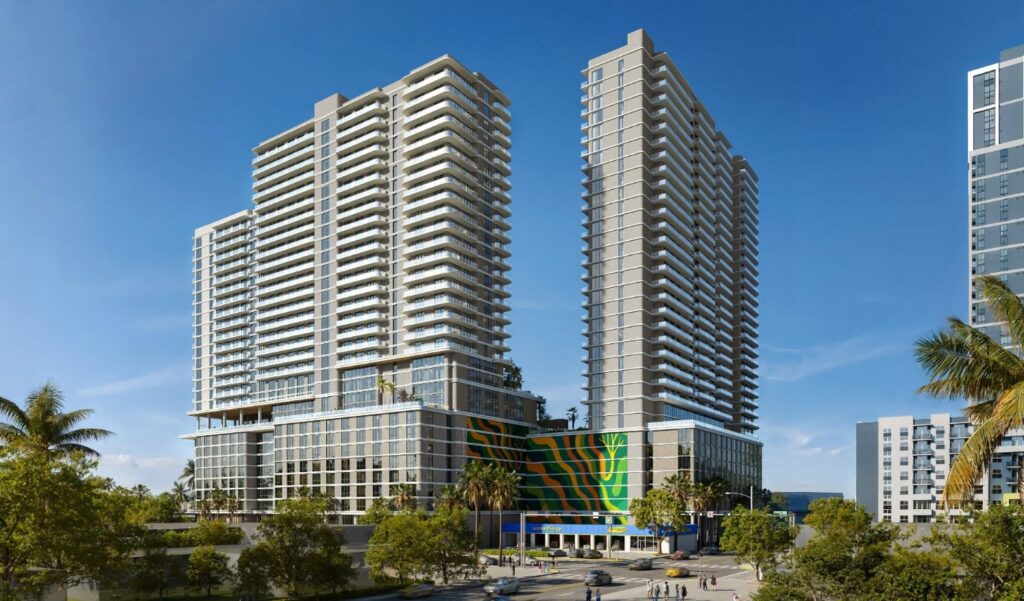
Three prominent developers, 13th Floor Investments, LeFrak, and The Related Group, have teamed up on a new mixed-use proposal near the Douglas Road Metrorail Station. Named simply 3650 Bird Road, the project envisions a two-tower development on the site at 3650 Bird Road: a property that has seen multiple multifamily proposals over the years. Purchased by the partnership for $35 million, the site is now subject to a redevelopment featuring 793 residential units, parking, retail, and other uses. Planned atop a large two-story automotive service center, the development is expected to rise in two phases. The first phase will deliver the northern tower with 415 units, followed by a western tower in phase two with 378 units. Altogether, the development will comprise 793 residences, including 100 workforce housing units, 46 studios, 288 one-bedrooms, 51 one-bedrooms with dens, 292 two-bedrooms, and 16 three-bedroom units. Units will range from 413 SF at the lowest to 1545 SF at the highest. Residents will also have access to a wide array of amenities, including paddle courts, a 22,600 SF fitness center, multiple pools, expansive outdoor spaces, and more. The development’s podium structure will also integrate 1,053 parking spaces and 48 bicycle racks: well above the zero parking minimum allowed under Miami’s Rapid Transit Zone (RTZ) code due to its proximity to the Douglas Road Metrorail station. On the ground floor, pedestrians will see benefits like street-facing retail totaling 8,273 SF, outdoor dining, and colonnades that protect the sidewalk from the elements. In addition, there will be two lobbies on either side. According to a representative of the project, “the vision behind the proposed mix of uses is to promote residents’ ability to live, work, and play in walking distance to the Douglas Road Metrorail station and the Underline.” According to elevations, phase one will rise 31 stories (350 FT), while phase two will be slightly taller at 33 stories (around 370 FT). Although current code allows a maximum of 25 stories on the parcel, the developer is taking advantage of a provision that permits buildings designed and constructed to LEED Gold standards to reach up to 40 stories. Designed by Corwil Architects, the facade will feature a modern aesthetic with glass balconies, large windows, a gray/white color palette, and other contemporary design choices. Prior to the partnership’s submission, the Shoma Group had proposed a two-tower development for the same site. Initially planned to rise 407 FT, or 40 stories each, the project would have delivered 748 residential units, 23,199 SF of retail space, and 700 parking spaces. Although the previous plan called for significantly taller towers, this new proposal surpasses it in total unit count, retail area, parking capacity, and building width. Unlike Shoma Group’s earlier proposal, Shoma One, which was filed under Florida’s recently enacted Live Local Act, the new development will proceed under the site’s existing RTZ Subzone zoning. RTZ designations encourage transit-oriented development and can offer incentives such as higher allowable density, reduced parking requirements, and other flexibility within designated rapid transit areas. As of October 2025, no construction permits have been filed. If approved, 3650 Bird Road will continue the ongoing historic transformation of the lots surrounding the Douglas Road Metrorail Station.
21 Hollywood Inches Closer to Topping Out in Hollywood’s Royal Poinciana Neighborhood
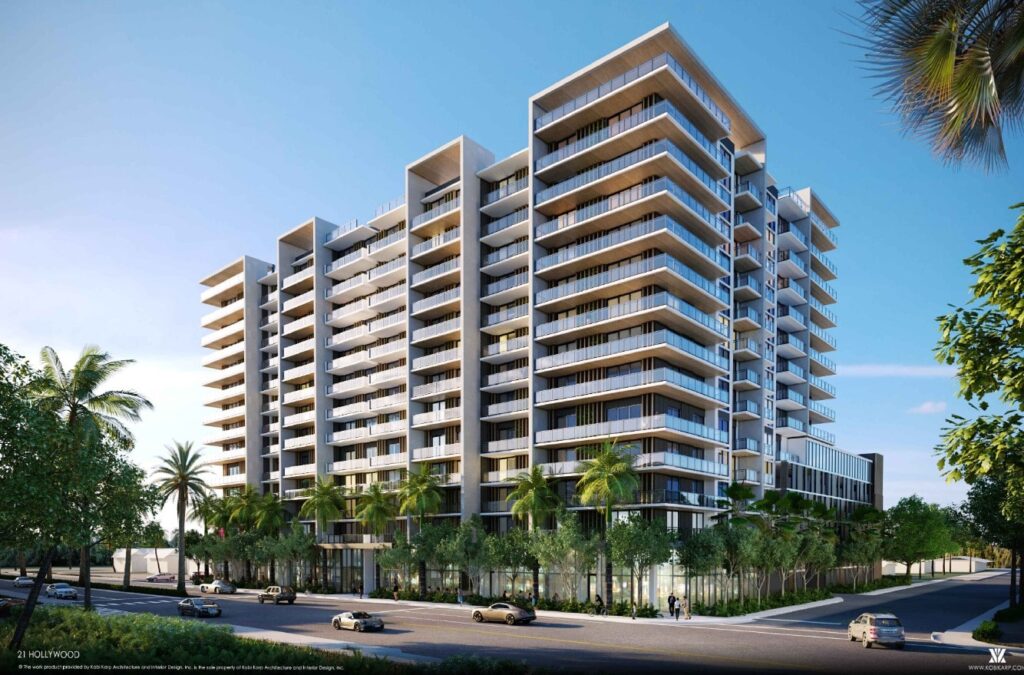
Construction on Hollywood’s latest multifamily high-rise is commencing, bringing the city’s modest but impressive skyline further north. Known as 21 Hollywood, the luxury rental community has already climbed several floors, with crews now working toward the eighth. The project was first presented to Hollywood’s Planning Board in late 2023 from Bardi VP, affiliated with South Florida–based Starlife Group. When complete, the 14-story building will deliver 200 units, ground-floor retail, parking, and amenity space, marking Starlife Group’s first high-rise development. Vertical construction, according to Florida YIMBY, is being handled by Starlife Builders, a construction subsidiary of Starlife Group. Prior to vertical construction, the developer held a ceremonial groundbreaking in December 2024. Over 480 foundation piles were drilled into the ground, marking several months of preparation before the building could begin vertical ascent. Located at 2100 N Federal Highway, the structure is expected to top off at 154 FT in early November, with completion anticipated in 2026. Construction crews have begun installing the first windows and concrete slabs that will frame the building’s facade, which is planned by Kobi Karp Architecture to feature dark slate and off-white stucco, glass railings, aluminum vertical slats, and other contemporary materials. In a recent post, Starlife Group founder and CEO Gevorg Shahbazyan shared a progress photo of the tower’s ascent. The structure already stands as the tallest building in the surrounding area by far. The photo also highlights the 85 FT pool structure, which was recently completed. View this post on Instagram A post shared by Gevorg Shahbazyan (@gevorg.shahbazyan) According to planning documents from the City of Hollywood, the building will not only include 200 residential units, but 9,977 SF of retail and 299 parking spaces. Planned amenities range from a pool, a yoga/pilates room, a cycle studio, a barbecue area, an outdoor movie theater, a children’s playground, and much more. As 21 Hollywood continues its rise, the densification of Hollywood’s urban core is also underway. In late August, construction crews topped out on the Residences at Beverly Park, an 11-story multifamily development bringing 115 affordable units to the area. With multiple buildings coming online in the following years, Hollywood is shaping out to be one of Broward County’s densest cities, attractive for both incoming residents and developers.
Mixed-Income Apartment Seeks Redesign at 3917 N Nebraska Ave in Ybor Heights, Tampa
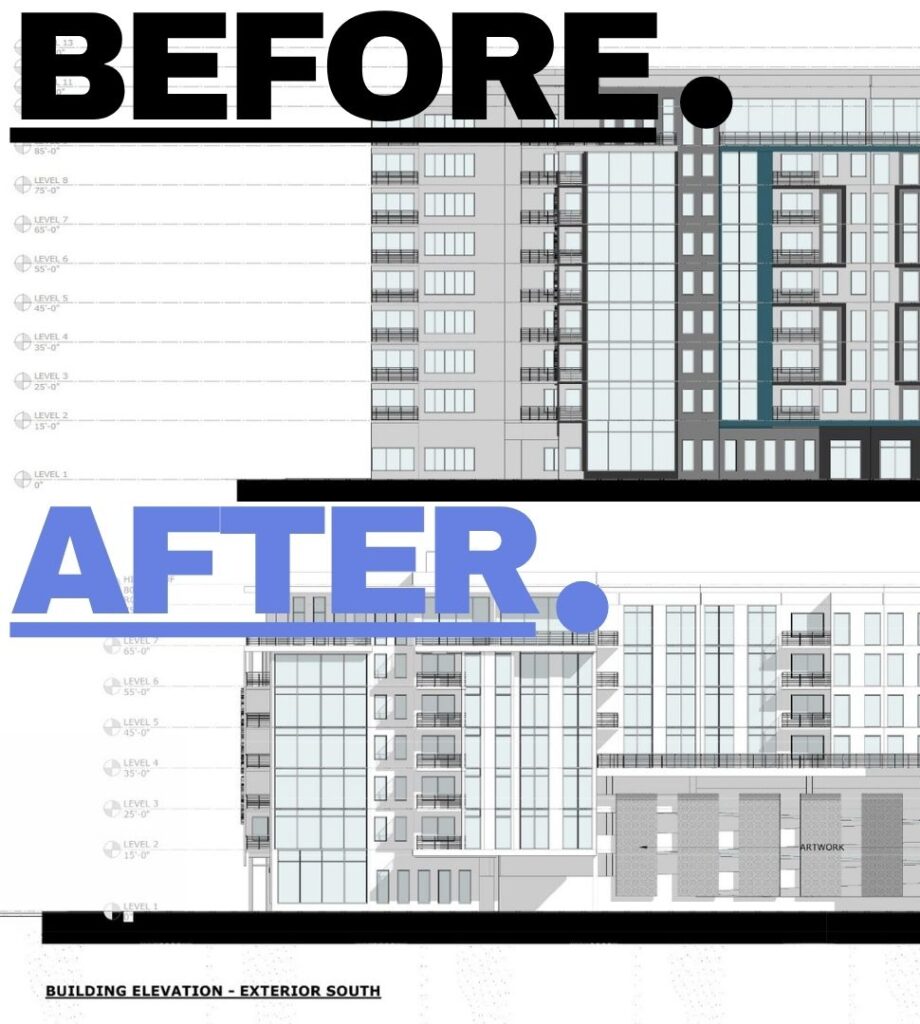
Channelside Partners, affiliated with Tampa Bay-based developer Abacus Group, is returning to the drawing board for an apartment project in Ybor Heights. Tentatively called Ybor Heights Apartments, the development was first submitted in September of last year but was unexpectedly withdrawn. The original proposal called for a nine-story building at 3917 N Nebraska Ave, utilizing the Live Local Act. Now, revised plans take a more scaled-down approach, removing the Live Local Act in favor of another pro-development statute recently passed by the Florida Legislature. If permitting and approvals proceed smoothly, the project would be among the first large-scale apartment developments in the neighborhood. Submitted last month, revised plans now call for a seven-story apartment building, two stories shorter than the previous proposal. The project will include 257 units, 27 of which will be designated as affordable, solely in studio, one-, and two-bedroom layouts. Residents will have access to 259 parking spaces, falling short of the 392 spaces required by city code. In addition, the development will provide 26 bicycle parking spaces. These details differ significantly from the original plans, which featured 296 units and 419 parking spaces. However, the commercial component has remained largely unchanged. The original proposal included 2,729 SF of commercial space with outdoor seating, while the revised plans call for roughly the same: 2,649 SF of commercial space accompanied by large sidewalks and outdoor seating. One of the more notable revisions involves the project’s facade, with significant changes to both active use and exterior treatment. Along E 33rd Ave, the originally planned walk-up units have been replaced with parking and mechanical spaces. Architect Baker Barrios has also reworked the facade design, shifting from a mix of dark teal, stone gray, and dark gray tones with large blue windows to a simplified all-white exterior. The altered project plans to cut the Live Local Act component, which would have required at least 40% of units to be designated as affordable (up to 120% of the local AMI). Instead, the developers are now proposing the project under Florida Statutes § 166.04151, also known as the Affordable Housing Statute. This statute only requires 10% of units to be affordable, in exchange for incentives such as allowing housing atop commercial or industrial land. By opting for this approach, the developer is giving up certain benefits available under the Live Local Act, including tax exemptions and access to dedicated funding. The site for the new project was purchased for nearly $2.4 million in 2023, previously occupied by a Walgreens that closed as part of the company’s nationwide downsizing. Any redevelopment will require demolition of the existing structure and new building permits, none of which have been filed as of October 2, 2025. This proposal isn’t unexpected, however; as the neighborhood piques developer interest, just a few blocks away, Robles Park is being cleared to make way for a major mixed-use redevelopment that promises new housing, retail, and community amenities.
Calle 8 Hotel Seeks Rezoning of 710 SW 16th Ave for a Nearly 150-Room Project
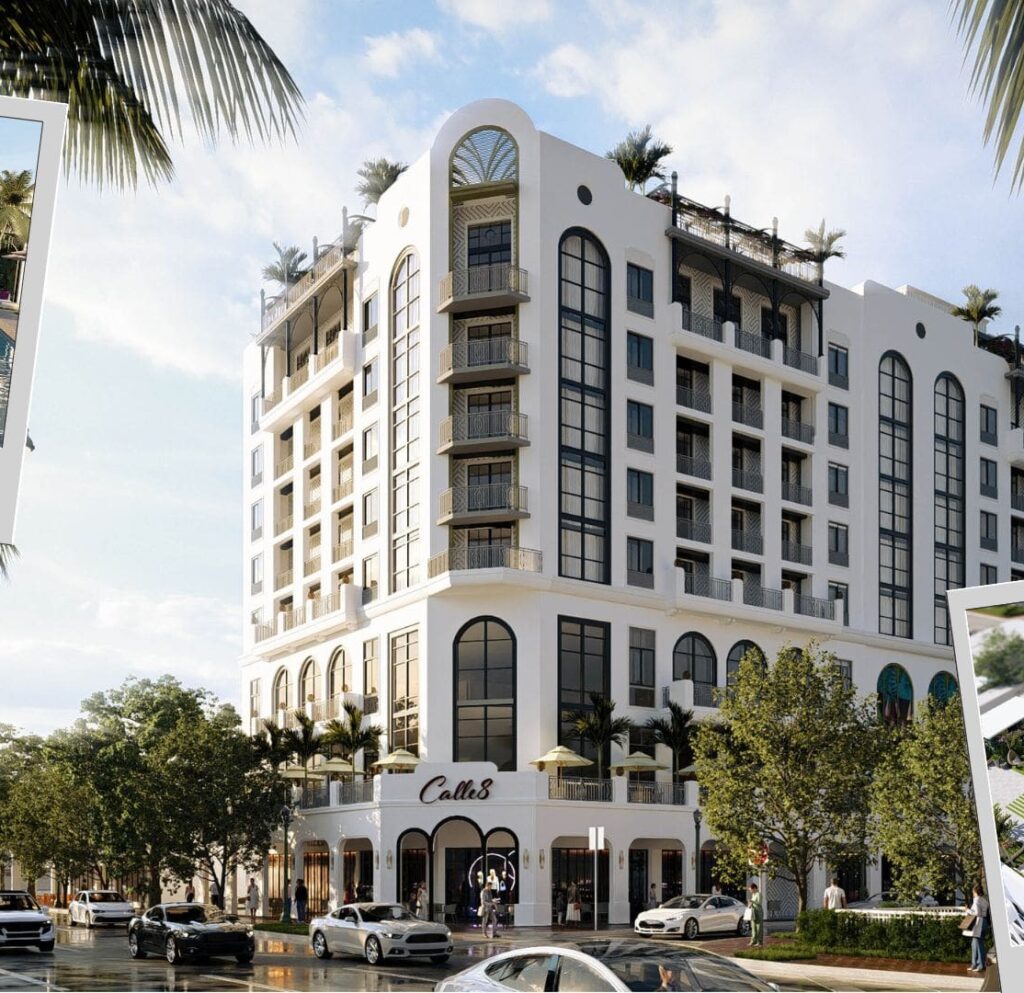
A new 8-story hotel is being planned along Little Havana’s iconic Calle Ocho corridor, where developer 1603 SW 8 Street, LLC, tied to North Park Ventures from Chicago, is seeking City Commission approval to rezone a site currently occupied by a surface parking lot. The proposal, designed by Modis Architects, would replace a half-acre assemblage with a 149-room hotel, filling a gap in an area that currently lacks hotel options. While Miami’s Planning, Zoning and Appeals Board has already given the project near-unanimous approval about a month ago, the final decision now rests with the City Commission. Located at 710 SW 16th Ave and 1603 SW 8th St, the developer plans to redevelop both a surface parking lot and two low-rise structures from the early 1900s. The rezoning request only applies to the northern parcel at 710 SW 16th Ave, which would shift from T5-O to T6-8-O and more than double the allowable density. The southern parcel, 1603 SW 8th St, is already designated T6-8-O. According to a representative from the project, ‘Calle Ocho is locally and internationally known as a major tourist destination but lacks lodging options. The project proposed a hotel to incentivize tourists to not only visit but stay on Calle Ocho and, in-turn, stimulate the economic development of the area”. First reported by the South Florida Business Journal, beyond plans for 149 hotel rooms, there will be 17,030 SF of commercial space, a rooftop pool, and 128 parking spaces. The facade, featuring large windows with a white and dark brown palette, is described by Modis Architects as “inspired by architectural elements from Havana and tells a story of grandeur with tropical elegance that celebrates the spirit of Cuba and offers guests an elevated experience. This hotel aims to become not just a place to stay, but a destination that embodies the joy, history, and the vibrancy of Calle Ocho.” The developer will have to obtain permits for both demolition and construction if approved by Miami’s City Commission. As of now, there are no substantial permits pertaining to demolition or site prep for the property. A name for the hotel isn’t finalized but plans hint at ‘Calle 8 Hotel’.
West Palm Beach’s City Commission Unanimously Approves 5400 N Flagler Condo Project
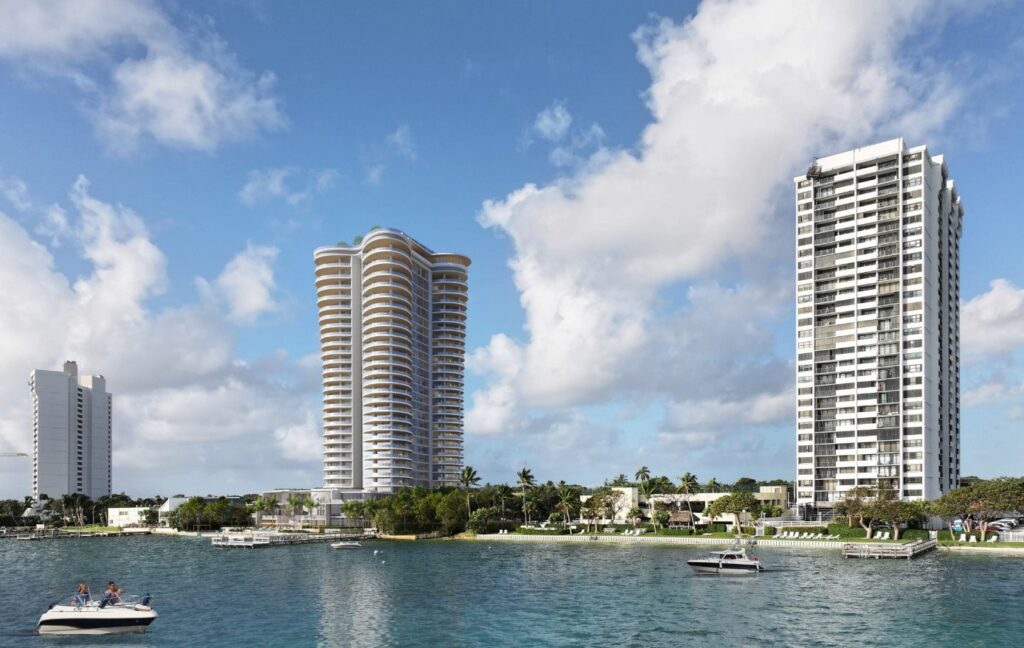
After months of review, a 31-story condo tower planned for 5400 N Flagler has cleared its final hurdle in West Palm Beach. On September 29th, West Palm Beach’s City Commission voted unanimously to approve the condo project from Canada-based Great Gulf. It will be the last step before the developer can begin permitting, considering the project had already secured unanimous support from the Planning Board. Rising on a 2.46-acre site, the tower will bring 97 condominium units and mark Great Gulf’s second condo venture in the city. Designed by Spina O’Rourke + Partners and Safdie Architects, the 380 FT tower (one of the tallest in West Palm Beach) will feature wraparound balconies, a mix of unit types, and extensive resident amenities. For instance, the building will include townhomes, two- to four-bedroom units, and penthouses, with 207 resident parking spaces. Amenities will include a rooftop pool, guest suites, event/fitness rooms, lounges, libraries, and landscaped garden areas. The project has undergone slight revisions since its submission a month ago, particularly along North Flagler Avenue. In response to concerns about a “blank wall effect” at the podium level, the developer has incorporated active residential amenities on the east side of the building, including a dog spa and a bicycle club for residents. A pedestrian sidewalk along N Flagler Drive will also be expanded, while landscaping and open space remain central to the design. The developer is requesting four waivers, covering density regulations, acreage, minimum setback requirements, and driveway requirements. Some of these requests have drawn concerns from both city staff and nearby residents. In particular, waiver 3, which seeks a reduction in minimum setbacks for the proposed high-rise, was flagged as inappropriate by staff given the building’s 380 FT height. The official position is that a structure of such height should maintain a larger buffer from neighboring properties. As a result, staff has recommended denial of this waiver, while the other three are supported. In addition, to address questions and concerns from the surrounding community, the developer held several outreach sessions with the Palm Beach Chamber of Commerce, the Northwood Harbor Association, and residents of Palm Beach House. Representatives of these groups noted that the developer was professional and transparent, was willing to adjust features of the project, and engage in discussions when concerns were raised. Even with these efforts, many residents voiced objections during the meeting. Most came from Palm Beach House, the neighboring condominium, where residents expressed concerns about dust, noise, blocked views, and potential structural damage during construction. The City Commission approved the rezoning of the property from Multifamily High Density Residential to Residential Planned Development, along with the requested waivers, despite some staff and resident concerns. With approvals in place, Great Gulf can now proceed with demolition and permitting. Construction is expected to take approximately three years, not including potential delays.
The William Launches Sales in North Miami Beach with 374 Residences
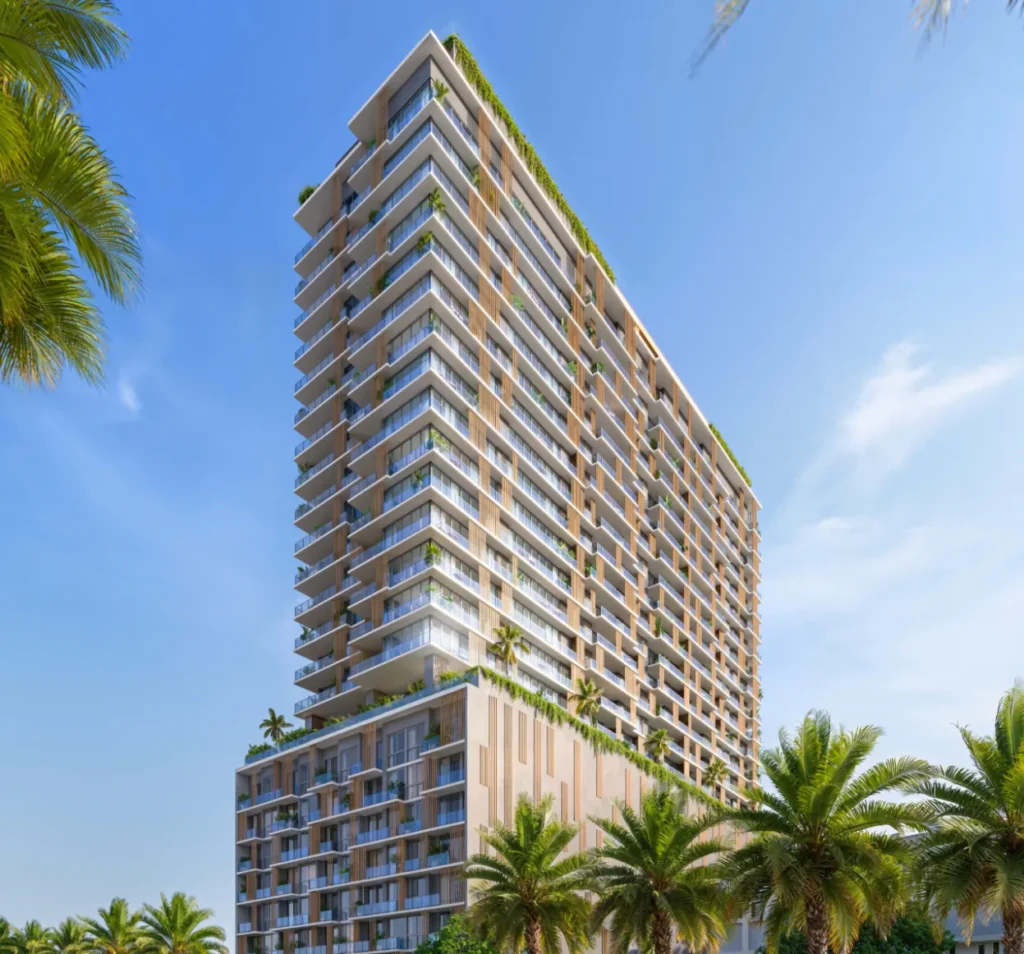
Sales have officially launched for The William in North Miami Beach, a 25-story condo tower planned by Blue Road Development and Illia Development Group. The project, which is targeting a groundbreaking in the middle of next year, will deliver 374 residences and marks Blue Road’s second condo venture in the city, following the topping out of Nexo Residences. The William is planned on a 1.1-acre site that the development team purchased in late 2022 for $7.5 million. Positioned as one of the first high-rise projects in the neighborhood, it is being marketed by Fortune International Real Estate, with EB-5 investment expected to play a role in funding the development. Units will range from studio, one-, two-, and three-bedroom layouts. According to The Real Deal, sizes will span from 552 SF studios to 1,412 SF three-bedroom condos. What stands out in the permitting documents is the unit mix: of the 374 residences, 30 are categorized as lodging units. The reason for this designation remains unclear, as the developer has stated the project will operate as long-term residences rather than short-term rentals. The building will include a plethora of amenities for residents, including a fitness center, coworking lounge, self-serve market, indoor lounge, kids’ playroom, outdoor bar and terrace, and much more. In fact, over 40,000 SF of the building is dedicated towards amenity use. In addition, the ground floor will feature 4,526 SF of retail space, along with a residential lobby and parking access. The project’s podium will span several levels, providing a total of 448 parking spaces reserved for both residents and retail patrons. Designed by Behar Font and Carlos Ott, the most recent plans submitted to the city show the tower rising 25 stories, reaching a height of roughly 270 FT. This represents a modest increase compared to the original submission, which features a 23-story building designed by Bermello Ajamil & Partners. The updated design incorporates a modern facade with wood paneling, glass balconies, and stucco finishes, giving the project a contemporary look. Because the development was only recently approved by North Miami Beach staff, the next step will involve clearing the site. This will require demolition of the existing low-rise structure as well as removal of the surface parking lots currently occupying the property.
The Satori at Lighthouse Point Planned in Pompano Beach, Set to Deliver 187 Units
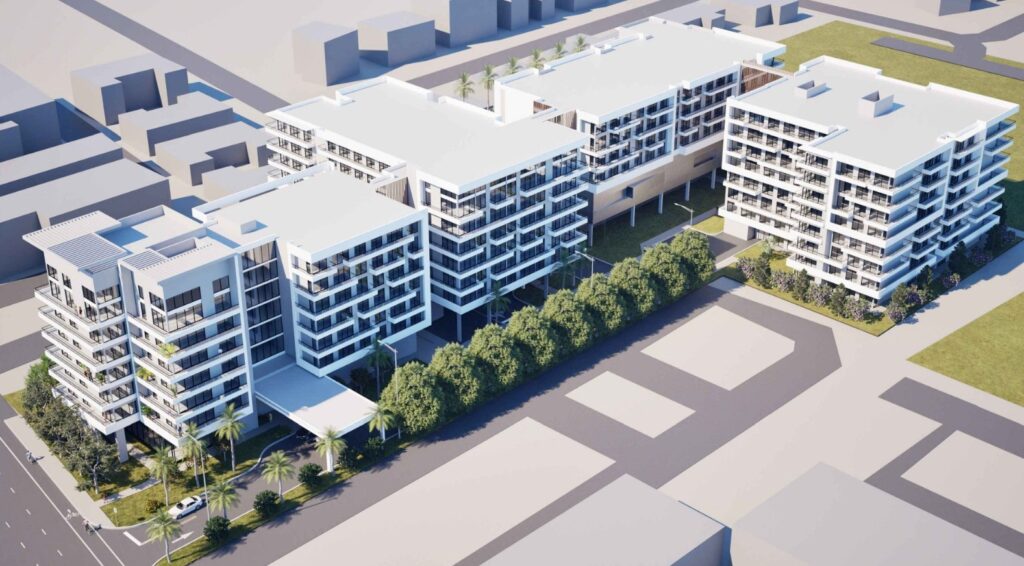
Plans have been unveiled for The Satori at Lighthouse Point, an eight-story residential development proposed in Pompano Beach. Led by South Florida–based 4211 N Fed, an affiliate of 1112 Development, the project is aiming to bring 187 units to the North Federal Highway corridor. The site at 4211 North Federal Highway was purchased by the developer earlier this year for $5.89 million, signaling continued investment in the N Federal Highway corridor. The site is currently occupied by the Lighthouse Point Hotel, a cluster of low-rise buildings that would be demolished in order to make room for the new 8-story project. The proposals envision units of various sizes, from studios, one-bedroom, two-bedroom, and three-bedroom apartments. According to a representative of the project, units will be directed towards “young professionals, families, and even seasonal residents”. Apartments will be moderately sized, ranging from 814 SF at the lowest, to 1,811 SF at the highest. One of the more unique features of the complex is that, of the 187 planned units, 27 will be flex units. Flex units are extra units allowed under the county rules, designed to increase residential density and include affordable housing. In addition, the proposal calls for a multitude of amenities from a fitness center, clubhouse, pool area/lounge, and more. Residents will have access to 336 parking spaces, of which 38 are dedicated to guests. Planned as a collection of three eight-story buildings, each rising 90 FT to the mezzanine, the complex is being designed by Delray Beach-based Madsen Design and “embraces a contemporary design while harmonizing with other modern residential buildings in Pompano Beach.” “The composition is articulated through a series of volumes defined by a dynamic interplay of terraces, which shape the façade rhythm and introduce a layered geometry that softens the massing while enhancing visual interest. Their irregular pattern breaks the uniformity of the elevation, creating a sense of movement and individuality across the complex, giving each building its own identity within the overall ensemble” according to an architectural comment. The Development Review Committee is scheduled to convene on October 1st to discuss the proposal. As with many projects in Pompano Beach, the development will likely undergo multiple rounds of review before moving forward.
Plans Filed for Six-Story Boutique Hotel at 6945 Abbott Avenue in North Beach
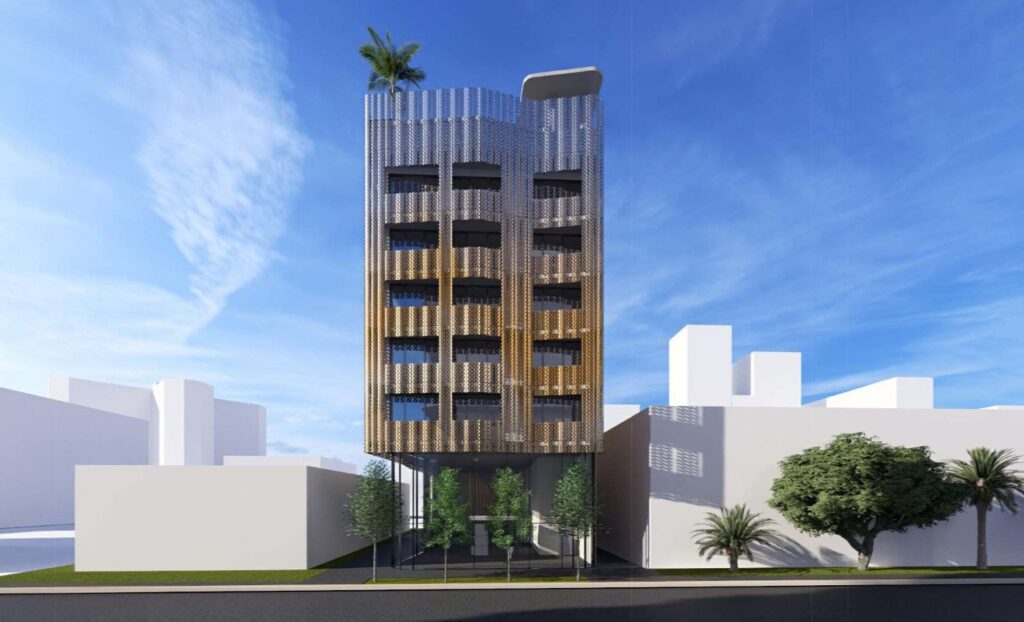
North Beach’s wave of developments is continuing, as plans for a six-story boutique hotel on Abbott Avenue was just submitted. The project, led by South Florida-based Abbott M 6945, calls for 48 boutique hotel rooms on a 6,150 SF site. The new hotel would more than quadruple the room count on the site, replacing the 11-room M Hotel. Scheduled for review by Miami Beach’s Design Review Board on October 23rd, the proposal would rise alongside multiple under construction buildings in the area, including The Ella, 71 Nobe, and more. According to plans submitted to the city, each of the 48 hotel rooms are planned at roughly 300 SF, offered in layouts with either one king bed or two queen beds. While plans remain subject to change, the proposal outlines amenities such as a gym, rooftop pool, rooftop lounge deck, and an exterior plaza. The documents do not specify whether the property will operate under a hotel brand. The ground floor of the project will feature a hotel lobby and 1,106 SF of commercial space. Notably, the plans include no on-site parking. Instead, the developer proposes a bike room and two designated on-street spaces: one for guest drop-offs and another for loading. Surrounding the site, the project also features pedestrian improvements, including wider sidewalks. Designed by M77R Architecture, the hotel is planned to rise 90 FT at its tallest point. Its most distinctive feature will be its colorful perforated metal facade, described by the project team as “a consonant blend of sophisticated yet vibrant materials that speak to the Miami Beach aesthetic. Intentionally placed large glass windows provide for functional design with framed views while ensuring safety and energy efficiency. The clean lines of the structure are accentuated by sleek curves, polished stone and/or concrete elements, creating a clean modern aesthetic.” According to recent satellite imagery from March, the site hasn’t been demolished yet. Demolition work, including permitting, will be fairly easy given the site’s limited size.
West Palm Beach Approves Initial Phase of Rybovich Marina Makeover by Huizenga and Integra
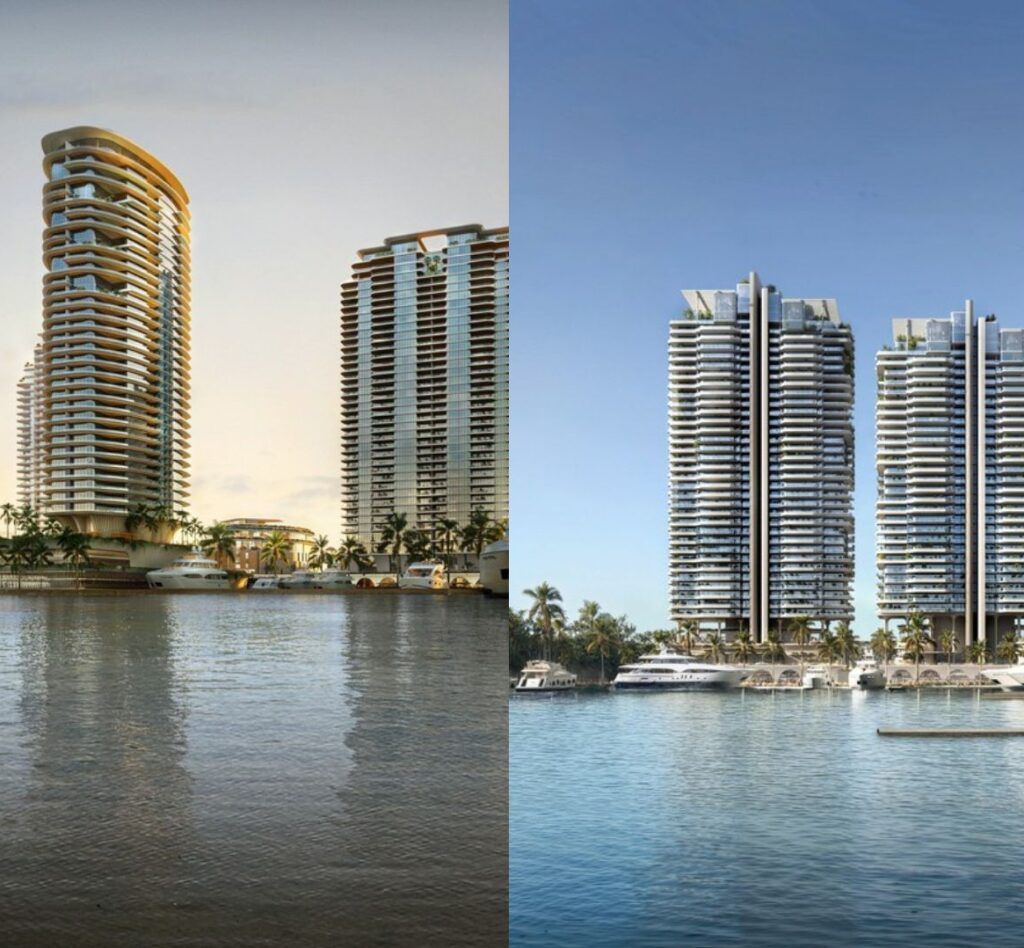
Plans for the redevelopment of the Rybovich Marina are officially advancing, with the Huizenga family and Integra Investments winning approval from West Palm Beach’s planning board. Reviewed on September 16, the proposal outlines a multi-billion-dollar transformation of the city’s waterfront, centered around four condo towers. The first phase, approved at the recent meeting, calls for two multifamily buildings totaling 259 units, while the remaining phases will come before the board at a later date. Overall, despite significant changes to building heights, development features, and structural design, the board found the updated plan acceptable. The first phase of the development centers on two towers rising on the west side of the site. The tallest of the pair will reach 36 stories, climbing to 461 FT at its peak: securing the title of West Palm Beach’s tallest building. This tower is planned to house 112 condominium units and provide 181 parking spaces. Beside it, a 34-story tower will stand at 422 FT, containing 147 units and a significantly larger parking garage with 681 spaces. In addition to the residential towers, the total development will deliver a mix of commercial and recreational spaces. Plans call for 3,355 SF of marine storage, 60,937 SF dedicated to a private club (w/ the option for membership outside the development), and 20,691 SF of office space. Retail and restaurant space will also face the waterfront. A defining feature of the project is its expansive pedestrian promenade, crafted to enhance walkability along the waterfront. This pedestrian-focused element extends onto North Flagler Drive, where wide sidewalks, expansive greenery, and podium setbacks create a more welcoming streetscape than many neighboring developments. In response to design guidelines, the developers also reduced the scale of parking garages from the original plan, lowering their heights by several FT. The tallest garage will now rise to just 50 FT down from 75 FT. Features such as EV charging stations, carpooling areas, bicycle parking, golf cart parking, a bus stop, at least one bike-share station, and more were added through micromobility requirements. Planned at a later, unannounced date, the second phase of the project will introduce two residential towers at slightly shorter heights. One is planned to rise 374 FT while the other will reach 418 FT, together adding 401 residential units to the development. While the proposal was approved, West Palm Beach staff actually recommended denial of one element due to multiple concerns, including the increase in permitted height, the relocation of all retail from North Flagler to the Promenade, and other issues. For example, city requirements call for 25% active use along North Flagler, yet all retail has been shifted to face the waterfront, with over 50% of these ‘active uses’ serving private marina facilities. Hence, staff recommended denial of the site plan.
Vera Fund Proposes Redevelopment of 2810 & 2800 E Oakland Park Boulevard in Coral Ridge
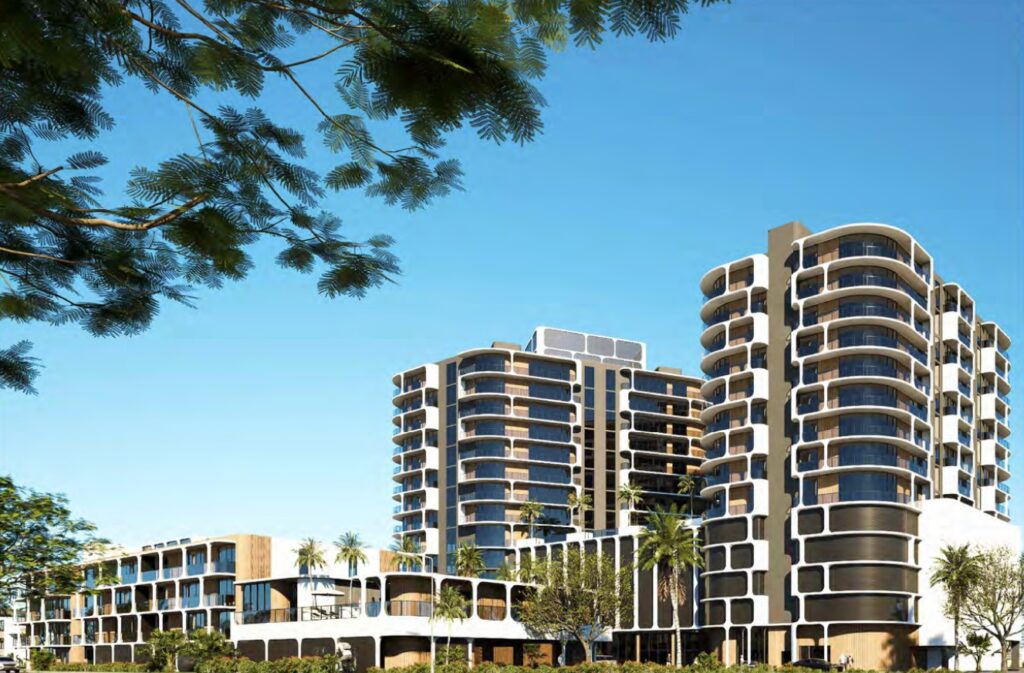
Two parcels in Fort Lauderdale’s Coral Ridge neighborhood are poised for transformation, with two multifamily buildings now in the pipeline. Aventura-based Vera Fund has filed plans to redevelop two sites, one at 2800 East Oakland Park Boulevard, replacing two existing commercial structures with a pair of multifamily high-rises. Just to the south, a surface parking lot at 2810 East Oakland Park Boulevard will be redeveloped into a multifamily low-rise. The projects are set for review before Fort Lauderdale’s Development Review Committee on September 23rd, signaling the next step in Vera Fund’s efforts to move forward with the plans. Zeroing in on 2800 East Oakland Park Boulevard, plans call for two 14-story high-rises connected by a shared parking podium. The development will include 94 residential units across both towers, offered in two-, three-, and five-bedroom layouts. Unit sizes will range from 1,575 SF to 3,510 SF, placing them safely in the luxury category. Residents will also have access to more than 7,000 SF of indoor amenity space, along with a pool deck. The ground floor of the project is planned to include 4,900 SF of commercial space and 3,250 square feet of co-working space, complemented by expanded sidewalks and landscaped greenery. Parking will total 218 spaces, available to both residents and retail patrons. On the south side of the site, the parcel at 2810 East Oakland Park Boulevard is planned for a much smaller building, rising just four stories. The development will include 18 residential units and 36 parking spaces. Unlike the larger structure to the north, this building will be composed entirely of two-bedroom units, ranging from 1,125 to 1,500 SF. Amenities include common areas, a co-working lounge, pool, and more. According to elevations provided by the architect, Idea Architect, the project will feature some of the tallest buildings in the Coral Ridge neighborhood. The pair of twin 14-story towers will rise to 160 FT, while the shorter building will stand at 50 FT. Designed with a contemporary aesthetic, the facades will feature materials such as smooth stucco finishes, tinted glass railings, wood trims, metal mesh, and other modern elements. Vera Fund is seeking entitlements with the intention of selling the property rather than developing it directly. According to Broward County property records, the firm acquired the assemblage in late 2023 for $10.425 million. As of now, no permits have been filed for demolition, site work, or building construction at both properties.
Crews Prepare for Historic Concrete Pour at The Residences at 1428 Brickell on September 19
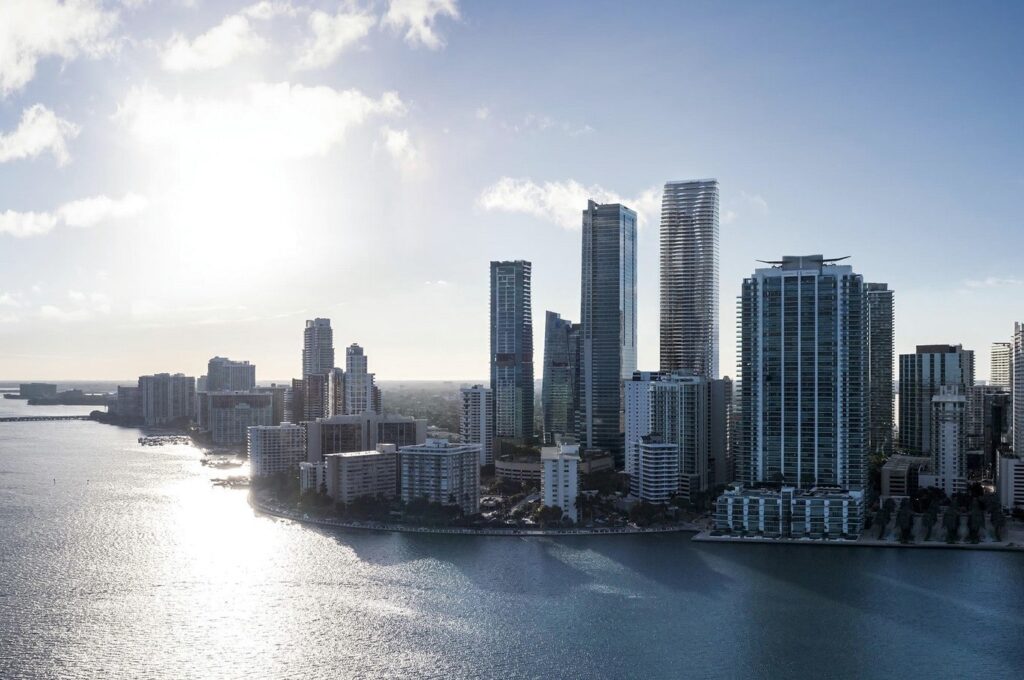
Crews behind 1428 Brickell are preparing for a historic milestone. On September 19, a massive foundation pour will begin at 8 p.m., led by C & C Concrete Pumping. With Capform as shell contractor, UES handling concrete testing/threshold inspections, and Coastal Construction serving as general contractor, the team will pump an estimated 13,000 cubic yards of concrete into place. The operation is expected to last 30 continuous hours, supported by five concrete pumps working simultaneously. Reinforcement steel is already in place, setting the stage for one of the largest foundation pours in Miami’s history. Comparable pours include the foundations of the Aston Martin Residences, Panorama Tower, and the Waldorf Astoria Miami, all of which exceeded 10,000 cubic yards. Setting the stage for this pour has been a lengthy process. Unlike many Miami developments that rise on vacant land or low-lying structures, 1428 Brickell required the demolition of a multi-story office building totaling roughly 100,000 square feet. The demolition process stretched over several months before crews could begin preparing the site for piling. According to recently submitted building permits, 1428 Brickell will include 197 residential units, a 163,014 SF multi-story parking garage for residents, and an 844 SF professional office/bank space. The tower is planned to rise 70 stories, reaching 867 FT in height, as featured in a previous submission to the Urban Development Review Board (UDRB). Above all, 1428 Brickell is being promoted as one of the most innovative towers in the neighborhood, thanks to its proposed use of photovoltaic glazing. On the building’s west-facing facade, designed without balconies, around 500 solar-integrated windows will generate renewable energy for the tower. According to the developer, the facade is expected to produce thousands of kilowatt-hours annually while also reducing CO₂ emissions. For updates on the foundation pour, the developer is expected to share progress through posts and stories on the 1428 Brickell Instagram account. Update: Pour rescheduled to Friday (Sept 26th).
Turkey-Based Developer Shelton Eyes North Miami for First U.S. Project

A new private residential tower is on the way in North Miami: Shelton Miami. Planned for 1998 NE 135th Street along Little Arch Creek, the 11-story building will feature 18 residential units. Spearheaded by Shelton, a Turkey-based company with completed projects in both Bodrum and Ankara, the firm’s venture in Miami will be the first project outside of Turkey. The Planning Commission of North Miami will review and offer changes for the project on September 18th; however, it’s just one step for the company as final approval lies in the hands of City Council. The project’s 18 planned units will be luxury-oriented, featuring two five-bedroom residences per floor from levels 3 through 11. Each unit will average around 3,000 SF, placing them on the larger end for Miami’s metropolitan market. Because the development exceeds the lot’s allowable density of 8.8 units (or 25 units per acre), the developer is requesting a Conditional Use Permit to allocate nine additional units from the city’s density pool. According to the developer’s website, “Shelton Miami offers the ultimate in seaside living. With its private pier and boat services, it provides an experience akin to a yacht club. In a region like Miami, where supply is low and demand is high, these limited-edition residences promise an exclusive lifestyle. Shelton Miami is not just a living space but also a high-yield investment opportunity.” Beyond its boating amenities, plans for the project also include a swimming pool, sauna, steam room, gym, and more. The ground floor will offer 38 parking spots in a tight layout. By using mechanical parking lifts instead of traditional spaces, each unit is granted more than one parking spot. This approach also reduces the need for a parking ramp, freeing up level 2 for a lobby, amenity space, and other uses. Mechanical lift parking is becoming increasingly common in the Miami region. Designed by Kobi Karp Architects, the building will rise 11 floors to a height of 121 FT. Its facade will feature pure white stucco, frameless glass railings, expansive glazing, wood paneling, and fluted stone accents. If constructed, Shelton Miami would join North Miami’s growing market for both market-rate and luxury housing. Multiple developers have already capitalized on the region’s demand. According to Floridian Development’s database (Floridian Advanced), around 30 residential projects at or taller than five stories are either under construction or proposed in the area.
Casa at FIU, a 297-Unit Student Housing Project, Breaks Grounds in Sweetwater

Construction is officially underway on Casa at FIU, also known as Novu FIU, a massive off-campus housing project in Sweetwater. Touted as a state-of-the-art development for the region, plans by developers WFHP and RAL Companies call for a 297-unit development, enough to house almost 1,000 students. As the project begins construction, a formal groundbreaking ceremony was held last week, bringing together the developers, key partners, and Sweetwater Mayor Jose Diaz. Mayor Jose Diaz, who spoke at the event, called the development an opportunity that will “serve FIU students and further strengthen our community”, beyond that, Casa at FIU “highlights the City of Sweetwater as not only a place to live, but also a city of growth, opportunity, and innovation.” View this post on Instagram A post shared by City of Sweetwater (@cityofsweetwater) Designed by Niles Boston Associates and situated on a narrow assemblage at 10710 SW 5th Street, Casa at FIU will join the growing cluster of student housing high-rises in Sweetwater. Just last summer, Terrazul, another large student housing development blocks away, received approval for occupancy. With Casa at FIU now breaking ground, it marks the next significant addition to the area’s rapidly expanding student housing market. JWR Construction Services, the general contractor for the project, will oversee the project’s completion. Foundation work is set to begin, following the developer’s recent securing of all necessary permits, such as general construction and site work approvals. The existing buildings on-site have already been demolished as well. When Floridian Development first reported on the project a few months ago, Casa at FIU was noted to rise 20 floors and span 676,465 SF. According to Miami-Dade permitting, the estimated construction cost is $105.5 million. Residents will enjoy a range of amenities, including ample parking, a dedicated amenity level on the seventh floor with lounge space, a pool, and more. While a formal construction timeline has not been released, the project is expected to be completed by late 2027 or possibly early 2028.
Pendry Tampa Lands Record-Breaking $520 Million Construction Deal

Pendry Tampa, a luxury hotel and condominium tower planned by Two Roads Development, has just secured $520 million in construction financing. The deal, announced Monday, includes funding from Sculptor Real Estate and Nuveen Green Capital. Construction, led by Florida-based general contractor Coastal Construction, has been at the topic of discussion in the region for weeks. The project has recently overseen slowed on-site activity; now, with financing achieved, the project is back on-track. While the financing is historic for its size, another aspect of the deal is equally noteworthy. Of the $520 million granted, $290 million came from the largest C-PACE transaction in the nation’s history. C-PACE transactions provide developers with long-term financing for energy-efficient and resiliency-focused building improvements, such as water and energy conservation measures, storm infrastructure, and more. In the case of Pendry Tampa, this financing likely supports the tower’s mechanical systems, sustainable energy features, and resiliency upgrades, helping Two Roads Development finance construction costs. According to Hotel Investment Today, Nuveen Green Capital highlighted the significance of the deal, with Ryan Doyle, senior director of originations, saying, “We are thrilled to have closed the largest C-PACE transaction in history, partnering with Two Roads Development and Sculptor Capital on this transformative luxury property that will redefine Tampa’s skyline. This historic milestone showcases the growing sophistication and scale of C-PACE financing and its capacity to support major developments.” The news is both exciting and reassuring for many local real estate enthusiasts, especially given the lot’s history. Over the years, multiple projects on the site have fallen through, including the cancelled Trump Tower Tampa. Pendry Tampa broke ground and began foundation work in late 2023, but construction only reached a few floors above ground before slowing. With financing now in place, the project is set to return to its regular pace. According to Floridian Development’s database, the historic project will rise 38 stories, reaching 444 FT, making it one of Tampa’s tallest developments. Plans call for 200 condominium units, 220 hotel rooms, 656 parking spaces, extensive commercial space, and amenities.
Grupo T&C Submits Edge House Residences to Miami’s Urban Development Review Board

Grupo T&C, an experienced Peruvian developer, has officially submitted plans for Edge House Residences to Miami’s Urban Development Review Board (UDRB). Planned to rise 56 stories atop a 0.64-acre lot at 1825 NE 4th Ave, the building has been in the planning stages for months. Launching sales for buyers in spring of last year, buyers have the opportunity to choose from 608 fully furnished residences, offering the option to purchase without rental restrictions: a common feature in many of Miami’s pre-construction projects. With the tower recently breaking ground, the upcoming UDRB hearing will mark the first step toward official approvals as crews begin foundation work. According to the document submitted yesterday, the 608 units at Edge House Residences will be divided among studios, one-bedroom, and two-bedroom layouts, with the largest units measuring 1,224 SF. Although Miami’s code allows 500 units per acre, meaning the site could normally accommodate only 322 units, the full 608 units are classified as “lodging” because they have no rental restrictions. This gives the development a density of 304 units per acre, slightly below the maximum of 322. Residents will have access to a range of amenities, including 293 parking spaces, most of which will be served by mechanical lifts. The ground floor will feature a lobby and amenity areas in place of commercial space, so there will be no retail. Additionally on the ninth and tenth floors, the building will offer a pool deck, wellness spa, fitness center, lounge, co-working space, and additional amenities. The area surrounding the building will feature wide sidewalks, on-street parking, and extensive landscaping to enhance the pedestrian environment, in line with most Miami developments due to code regulations. Likewise, instead of extending the building to cover the entire lot, the right side of the property will include a landscaped recreational area. Designed by Miami-based Kobi Karp architects, the building will be among the tallest in the area, rising 630 FT. According to a letter provided by Kobi Karp, the facade of the building is described as “contemporary and refined, emphasizing slender verticality and clean horizontals. The building features a continuous 3-foot-deep balcony wrapping around the north, west, and south elevations—providing functional outdoor space, enhancing façade depth, and offering passive shading. The absence of balcony breaks allows for a more streamlined, sculptural form with an elegant silhouette.” Meanwhile, the podium “is clad in a louvered metal screen system that blends warm tones of gold, bronze, and brown. This artistic treatment elevates the parking levels into a design feature, rather than a concealed element, and introduces a sophisticated rhythm to the lower façade. This screen also supports ventilation requirements while maintaining a cohesive architectural language throughout the podium” The development is scheduled for UDRB on September 17th at 2:00 P.M. Approval is not necessary for the project to move forward but is generally recommended.
The Calta Group Plans Anatomia, a Live Local Tower in Allapattah

The Calta Group is bringing Miami’s Live Local Act to Allapattah with plans for Anatomia, a 30-story tower designed by Corwil Architects. Filed for 1433 NW 13th Terrace, the project marks one of the first Live Local proposals in the neighborhood since recent revisions took effect. Earlier this year, Floridian Development reported on a 23-story tower set to replace industrial land nearby; similarly, Anatomia would rise on a 1.06-acre site now occupied by several low-rise buildings. According to the submitted plans, Anatomia will provide 499 residential units, including 210 reserved for workforce housing. All workforce units will be studios or one-bedrooms, while the market-rate mix will range from studios all the way up to three-bedroom apartments. The addition of workforce housing comes as a regulatory requirement under the Live Local Act, which grants developers additional height, density, and parking reductions in exchange for designating 40% of units as workforce housing. While the legislation allows for up to 1,000 units per acre on the site, the developer is opting for 210 units per acre. At the ground level, Anatomia will offer 11,849 SF of commercial space, along with a residential lobby, bike room, and mechanical areas. A key feature of the design is its emphasis on the pedestrian realm, with wide sidewalks and extensive landscaping enhancing the streetscape. Above, the tower’s eight-story podium will integrate residential liner units to conceal a 498-space parking garage from public view. While Live Local projects in transit-oriented districts are permitted to void parking entirely, the developer has opted to include substantial capacity. This ensures at least one parking spot for each unit. Beyond the podium, levels 9 and 10 will be dedicated to resident amenities, including a pool deck and over 17,000 SF of shared spaces. Residents will even have access to a rooftop lounge and terrace, offering views of the Miami River and the wider city. Set to become one of the tallest buildings in Allapattah, Anatomia is planned as a 30-story tower (31 stories including the rooftop deck), rising 350 FT. Corwil Architects describe the design as follows: “The tower is defined by curving vertical bands that rhythmically rib the structure, giving the impression of an exoskeletal support system. These bands rise continuously from the ground to the sky, functioning as both architectural expression and functional dividers for the private terraces on each floor. At the rooftop, these bands intersect to form a dramatic frame, offering panoramic views for patrons of the rooftop lounge, and providing pedestrians at street level, an intriguing roofline” The development will head to the Urban Development Review Board on September 17th at 2:00 PM. If the development wins all necessary approvals, demolition and site preparation will be extensive. Beyond the multiple low-rise structures on-site, there’s a 7-story office building that will need to be demolished.
The Future of Fort Lauderdale’s City Hall: Inside the Six Competing Designs

Plans to redevelop the empty lot once home to Fort Lauderdale’s City Hall is moving forward after six developers recently submitted proposals to design, finance, construct, and operate the new City Hall. This initiative, which has been in the works for nearly two years, is one of the top priorities for the city following the destruction of the previous City Hall. For context, in April of 2023, a record storm flooded many parts of Fort Lauderdale, including the old city hall’s basement. The storm flooded the City Hall basement with over eight feet of water, causing irreparable damage to the vital functions of the building like servers, electricity, and more. As a result, the building was permanently closed, forcing the city to relocate its staff away from City Hall to dispersed locations. The site of the new City Hall is now ready for redevelopment. Demolition has been completed, and essential preparations, including the installation of irrigation lines, the erection of chain-link fencing, and hydroseeding for vegetation, have been carried out. The site will remain in this condition until a development team is ready to begin construction. The first proposal for the site was submitted by Meridian Infrastructure North America on May 15, 2025. Other developers were then given a 60-day window to submit their proposals, from June 3 to August 5. That window is now closed. Here are the six proposals: Fort Lauderdale Civic Partners: Head developer Meridian, in collaboration with contractor Suffolk, architect Zyscovich, engineer Keith, and other key partners, has put forward a proposal for a new city hall design. The team has proposed three potential approaches for the new city hall: a comprehensive plan, an optimized plan, and a baseline plan. Option 1, the comprehensive plan, envisions a facility of about 340,000 SF anchored by a 12-story office tower atop a two- to three-story podium. This option will incorporate a wellness center, childcare center, public gallery, and other city services, along with 40,000 square feet of flexible space. Option 2, the optimized plan, scales back the size while still addressing the community’s main needs. It features a 10-story office tower atop a two- to three-story podium. The proposal will maintain key city programs but with fewer amenity spaces. Option 3, the baseline plan, represents the most bare-bones proposal. With a seven-story office tower over a two-story podium, the proposal offers limited shared areas and only the necessary administrative functions within the smaller tower. Across all proposals, parking will be accommodated mainly in the adjacent garage that serves multiple buildings, including the site of the former City Hall. In addition, portions of NE 1st Street are planned to be reimagined as a paved pedestrian plaza, open to both people and cars. Fort Lauderdale Civic Partners notes that construction on the council chambers will start in August 2026, with the full complex scheduled for completion by February 2029. Meridian has shown confidence in carrying out the plan, ensuring the project stays on time and within budget: “What differentiates FLCP from simply a contractor team or other P3 developers is our role as a true long-term infrastructure partner, not just as a builder or an investor alone. We combine fast-tracked delivery with a generation-spanning investment commitment, staying accountable for operations and maintenance for decades. This means Fort Lauderdale gains not only cost and schedule certainty for construction, but a long-term partner that is financially and contractually aligned to deliver a high-quality asset that lasts.” FTL Beacon Collaborative: FTL Beacon Collaborative, which has completed more than 78 public-private partnership (P3) projects and developed over 200 civic facilities through its partnerships, is aiming to capture the attention of Fort Lauderdale leaders with a proposal designed by Miami-based Arquitectonica. In addition to Arquitectonica, the team will include lead developer Gilbane Development Company, associate developer Godart Florida Real Estate Investments, lead design-builder Gilbane Building Company, and other companies. The proposal envisions an all-glass building designed to be both climate-ready and energy efficient. Horizontal sunshades will line portions of the facade, reducing heat while allowing natural light to enter. The ground floor will also be elevated to protect against future flooding, while windows will be engineered to withstand Category 4–5 hurricanes. As the tower rises, a sloped roof ending at 229 FT will conceal the parking podium. Unlike other proposals, this design places integrated parking at the rear of the building, helping to reduce demand on the existing parking garage. Before breaking ground, FTL Beacon Collaborative estimates the pre-development process to take around 20 months. This includes negotiations, design tweaks, and permitting before the project can begin with foundation work. Final completion of the structure is estimated to be in mid-2027. Balfour Beatty: Balfour Beatty, an internationally recognized infrastructure company, is partnering with lead designer DLR Group, architect Kobi Karp, civil engineer CMA, and other collaborators to design, build, and finance the new city hall. The firm has been active in South Florida for more than nine decades and currently represents over 225 employees across the region. Balfour Beatty’s proposal, like Meridian’s, will give the city three options: redeveloping the City Hall alone, creating a multi-tenant facility, or redeveloping both the City Hall site and adjacent parcels such as the neighboring parking garage. Concept one will be entirely dedicated to public use, featuring a mid-rise building clad in glass. It will include public offices, community space, common areas, and potentially a library. Commercial space will be minimal, as the proposal focuses primarily on civic functions such as providing a new chamber. Concept two builds upon the first concept but on a larger scale. In addition to the public elements, it will incorporate several additional floors for retail, private office space, and other uses. Balfour Beatty emphasizes that this version can generate revenue, in hand reducing the amount of public funding required for the City Hall construction. The company has also expressed interest in leasing a portion of the new office space, as the firm’s current regional lease is ending soon. Concept three goes further,
Midtown Capital Partners Proposes Astor Progresso Village: a 249-Unit Multifamily Building in Fort Lauderdale

A new multifamily project is on the horizon for Fort Lauderdale’s Progresso Village: Astor Progresso Village. Planned by Midtown Capital Partners, the 12-story building would rise at 4 NW 7th Street, replacing an automotive junkyard the firm acquired for $9.4 million in late 2022. The development is proposed to deliver 249 residential units, commercial space, and more, marking the second development for the site. Midtown Capital Partners, in partnership with Prospect Real Estate Group, had previously envisioned a 167-unit project called Astor Water Tower before changing their plans to the current design. If built, Astor Progresso Village will be part of the burgeoning wave of multifamily construction in the neighborhood. According to plans submitted to Fort Lauderdale’s Development Review Committee, Astor Progresso Village will feature 249 residential units, including 180 studios, 30 one-bedroom units, and 39 two-bedroom units. Studio apartments will range in size from 407 to 551 SF, while the two-bedroom residences will be the largest, spanning between 922 and 1,267 SF. Residents will have access to a pickleball court, gym, synthetic lawn, pool, amenity deck, and other amenities. At street level, the project will deliver 1,665 SF of commercial space, along with sidewalk enhancements, improved landscaping, parking, and a residential lobby. Parking is one of the development’s more unique features: while many South Florida buildings rely solely on podium structures, Astor Progresso Village will introduce a rare basement level beneath its multi-level podium. Altogether, the design features 308 spaces for residents and guests. Maintaining the height of the previous proposal, the building will rise 12 stories, measuring 120 FT. Its facade will feature a mix of design elements, including wooden louvers along the podium, mural walls, opaque accent panels, glass railings, and stucco finishes in dark teal, gray, off-white, and other color choices. The Development Review Committee is scheduled to convene on September 9th to review the project. Following the DRC process, the proposal will move to the Fort Lauderdale City Commission for final approval or denial. Staff comments recommended further discussions and several design modifications to better align with the city’s goals of ‘active street frontages, ground level uses, enhanced streetscapes with shade trees, inclusion of usable open and plaza space, pedestrian scale architecture, high-quality building material’ and more.
Developers Submit High-Rise Plans for ‘The Gaspar’ in Downtown Tampa
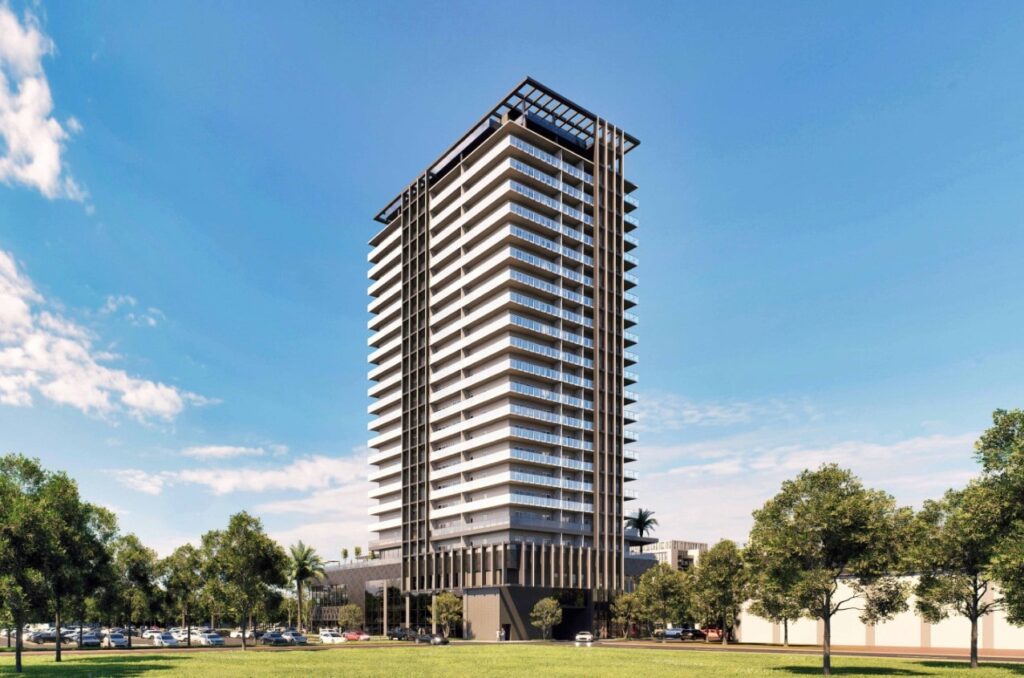
One of Downtown Tampa’s most distinctive residential developments is on the way: The Gaspar. Led by developer Berts Real Estate in partnership with consultant Flamingo Homes, the 23-story tower is planned for one of the city’s most size-constrained lots. Located at 1307 N. Jefferson Street, the 0.33-acre site will feature 188 residential units, along with commercial space, office space, and one of the most innovative parking systems on Florida’s West Coast. The project, scheduled for administrative review by Tampa’s Design District Review, may signal the start of a broader trend toward compact developments as developers seek new land opportunities in the city, a shift already visible in South Florida. According to plans released yesterday, the 188-unit building will offer a mix of studio, one-, two-, three-, and four-bedroom residences. Studios and one-bedrooms will make up the majority of units, followed by two-bedrooms. Studio layouts will range from approximately 400 to 600 SF, while the largest residence will be a 4,885 SF penthouse. Despite the limited footprint of the site, residents will have access to a full suite of amenities, including a pool, gym, lounge, and amenity deck. One of the most notable features of the development is its podium, which will include the residential lobby, 2,424 SF of commercial space, 5,327 SF of office space, and a structured mechanical parking system. The system will provide 88 automated parking stall spaces, three accessible spaces, and 72 bicycle parking spaces, equivalent to 18 additional parking spots under Tampa code, bringing the total parking supply to 109. By utilizing automation, the podium design is more efficient and compact, while also reducing risks typically associated with conventional garages, such as ‘tight ramps, dark stairwells, and vehicle theft or damage’ Designed by MGBA Architecture, the tower will rise 23 floors to a height of 281 FT, presenting a tall, slender structure in gray and white. Its facade incorporates fiber cement panels, frosted glass, perforated screening, and other modern design elements. According to the architect, ‘The tower’s massing is artfully broken into distinct volumes unified by a sculptural black steel feature that performs multiple roles: it offers solar shading, structural expression, and vertical coherence. This multipurpose architectural gesture ties together disparate programmatic elements and introduces a kinetic, tactile identity to the building.’ Due to the lot’s constraints, the development team is requesting several variances. One relates to parking: while zoning regulations require 114 spaces, the project is proposing the equivalent of 109. Because the City of Tampa’s code encourages reduced parking ratios and development near transit, the team is confident this variance aligns with the city’s goals. Among other requested variances is a concern for street wall transparency. Although traditional regulations require parking to be concealed, the design instead showcases the mechanical parking behind glass curtain walls at the podium level, creating an intentional visual for pedestrians. According to Anchor Real Estate, the project’s head of sales, prices start at $399,000. While the current sales status is unclear, reservations were reported to be strong when they opened on September 12th of last year.
Lofty Brickell and The Standard Residences Brickell Inch Closer to Topping Off

One of the largest multifamily developments along the Miami River is slowly coming to fruition. Construction crews for Lofty Brickell and the Standard Residences Brickell are now inching to the 30th floor respectively. Construction has been moving steadily and is on-pace for a completion in 2027, thanks to the experience of the general contractor: G.T. McDonald Enterprises. According to plans submitted for Lofty and The Standard, both buildings have around 15 floors left to go, and with a pace of about 1 floor every week, the building will top out in just over 3 months. Lofty Brickell and The Standard Residences Brickell mark the next major undertaking for G.T. McDonald, following the recent topping out of Miami River Tower 1, now renamed Flow on the River and scheduled to open this October. Beyond these two developments, the Miami River corridor is entering a period of near-full buildout. Projects such as Faena Residences Miami River, Miami Riverbridge, and Miami Riverside Center are preparing to bring hundreds of hotel rooms, residential units, retail space, and more to an already fast-growing stretch of the riverfront. Together, the towers will deliver close to 800 units. Designed by Arquitectonica, The Standard Residences Brickell will rise 44 stories with 422 units, while Lofty will stand 43 stories and feature 362 units. A shared parking structure will provide 932 parking spaces for residents, alongside proposed high-end dining, retail offerings, office space, and an upgraded riverwalk for pedestrians. Once topped out, Lofty will rise 535 FT while The Standard Residences will rise to 525 FT. These two towers are not the final piece of the puzzle for the Miami River, however. A new project, originally proposed by Newgard Development Group and later acquired by Prosper Group alongside a confidential partner, is also on the horizon. Known as Two Riverside, (though the name may change as plans are refined) the tower is expected to rise 59 stories, or 719 FT, making it one of the tallest buildings along the river. While it remains uncertain whether the new ownership will preserve the original design, the project promises to bring another striking addition to the district. If you want to see a live feed of construction for both towers, click here.
Partnership Seeks Approval for Updated Bocora Residential Center in Boca Raton

Another Boca Raton office park is seeing residential development take over underutilized space. At the Amtec Center, a partnership operating as Amtec of Boca Raton is proposing an eight-story residential building on the park’s northwest corner. The project, led by seasoned developers Beztak and Wexford, is returning to the city’s Planning & Zoning Board with revised plans that include additional residential units, a commercial fitness center, and other changes to the original approval. Located at 6419 Congress Avenue, the proposal is scheduled for a board review on September 4, where the partnership is seeking a recommendation for approval. Submitted earlier this week, revised plans boost the project’s total to 298 apartments, up from the 277 previously approved. Of those, four will be designated as affordable housing, with the rest at market rate. This expansion adds 21 new units, increasing the overall living space by nearly 25,000 SF. The residences will feature a mix of layouts, including one-bedroom, two-bedroom, and three-bedroom typologies. Residents of the planned development will have access to a variety of amenities, including a pool, outdoor lounge areas, a business center, and a dog park. A parking garage connected to the building will hold 636 spaces, giving some residents access to more than one spot, while the entire office complex will provide 1,389 spaces in total. The ground floor will also feature a 2,086 SF commercial fitness center, along with resident amenity areas, a lobby, and landscaped green space with new sidewalks. The project, designed by Arcadis, has undergone several design revisions since its original approval. Stone veneers were replaced with stucco, while balconies and decorative metal accents were introduced to improve the exterior. Portions of the garage were lowered, and the overall development will now rise eight stories: reaching 94 FT. As the Bocora Residential Center moves closer to breaking ground, it continues a trend of office parks in Boca Raton being redeveloped with housing. Projects such as Suriana Boca, Ceru, and Avalon 850 Boca have already added multifamily communities in similar settings. The city has seen steady growth in this type of development as demand for rentals increases. About 7,600 new apartments are planned in Boca Raton, which is four times that of what’s been delivered between 2022 and 2025 according to Yardi Matrix. Major office campuses are also being converted: the former Office Depot headquarters is set to be redeveloped with 500 apartments, retail space, and an Equinox gym, while long-term plans for the Boca Raton Innovation Campus call for thousands of apartments, retail, and other uses alongside existing offices. Although the planning board may recommend approval on September 4th, final approval lies within City Council.
The City of Aventura Set to Review Uptown Aventura by Royal Palm Companies

Aventura’s Local Planning Agency and City Commission is preparing to review one of the city’s largest mixed-use proposals to date. The project, known as Uptown Aventura, is being led by well-known developer Daniel Kodsi of Miami-based Royal Palm Companies. Plans submitted to the city outline an all-encompassing community, bringing together a mix of residential units, hotel rooms, retail space, open green areas, and expansive parking. The development site, located at 21440 Biscayne Boulevard, was recently secured through a $31 million land loan through MG3 Group. Spanning 13.93 acres, the assemblage is envisioned as a district of its own, blending multiple uses into one cohesive development. Because of this scale and complexity, the Local Planning Agency and City Commission will review several items tied to the district when it meets on September 2. Planned with 975 residential units across a mix of low-rise and high-rise buildings, the development will offer a range of living options, from traditional apartments to branded residences. Units will range from studio, 1-bedroom, 2-bedroom, or 3-bedroom apartments. Residents will also have access to an extensive list of shared amenities, including pools, a linear park, and additional recreational features. Among the residential component, the project also features 528 hotel rooms distributed between two high-rise towers. It’s unknown what the hotels will be branded as, but they will likely be luxury. The development will incorporate 107,656 SF of retail space designed within a pedestrian-orientated district. Features such as widened sidewalks, landscaped areas, covered parking, and other design elements are planned to enhance the experience for both visitors and tenants. To handle the influx of shoppers, hotel guests, and residents, the project will provide 2,490 parking spaces: 2,430 being garage parking and 60 being surface parking. While elevation drawings haven’t been provided by the developer, the development will feature a mix of 5-floor apartment buildings along NE 214th St, a 20-floor mixed-use building, 8-floor apartments, and a 30-story mixed-use building. This means the tallest building will likely rise taller than 300 FT, making it one of the tallest buildings in Aventura. According to the South Florida Business Journal, Kodsi described the project as a “major mixed-use project in Aventura which will change the landscape of the city.” He anticipates approvals by early fall, although no groundbreaking date has been announced. Meanwhile, RPC is dealing with legal challenges tied to its Legacy Miami Worldcenter property, where construction shortfalls and multiple allegations have surfaced. It’s unknown whether those issues will impact Uptown Aventura, but Kodsi’s confidence and track record suggest the firm is determined to push the project ahead. Set for review, the committee will analyze items such as changing Aventura’s Comprehensive Plan FLUM, rezoning of the assemblage to zoning district TC4, and other necessary changes. While the joint meeting between the Planning Agency and City Commission on September 2nd is vital, the development will get final approval from the City Commission on October 8th, 2025.
Planning Board to Review 44-Unit Parkside Vue Development in Hollywood
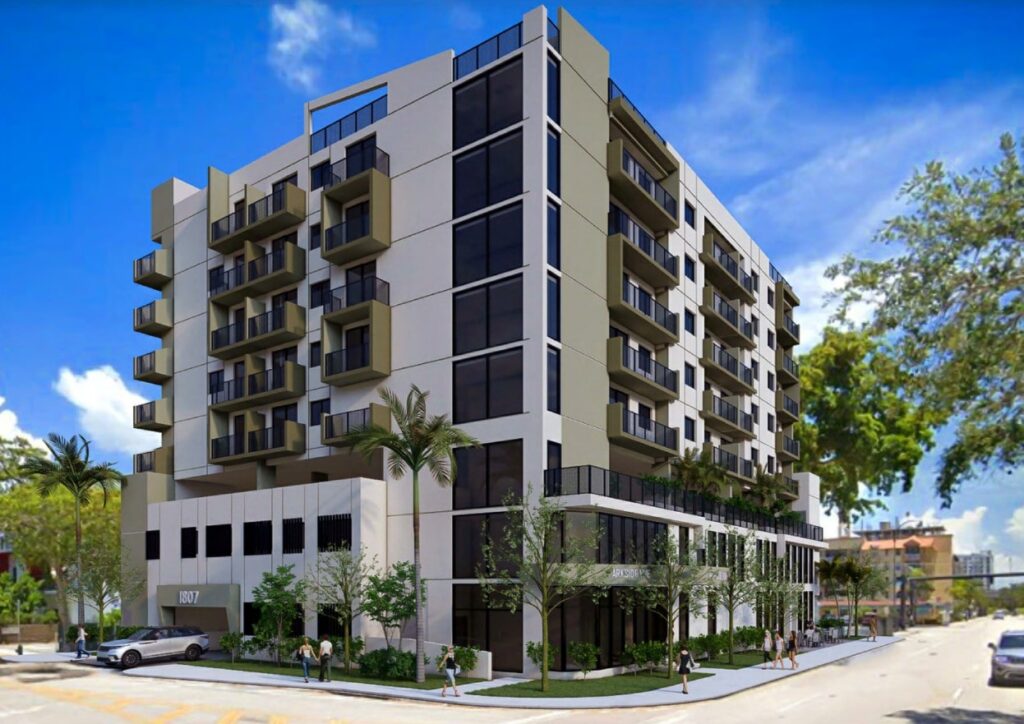
Parkside Vue, an eight-story multifamily development, is advancing to Hollywood’s Planning and Development Board. Situated at 1809 Madison Street, between South Federal Highway and Madison Street, the project will feature nearly 50 residential units, ground-floor retail, and structured parking. The project team is entirely South Florida–based, with Hollywood developer Las Villas JDL, LLC spearheading the development and collaborating closely with Skin Architectural Group on the design and planning. Mid-rise developments such as Parkside Vue are becoming increasingly common across Hollywood, where developers have been filing a steady wave of four to eight-story apartment projects on land historically designated for single-family housing. The Planning and Development Board is set to review the proposal on September 9th, acting as one of the final steps before groundbreaking can begin. Prior to this stage, the development has gone through several design revisions and technical changes during under regulatory boards. Plans released recently showcase a total of 44 units, split between 2 bedroom/2bath or 1 bedroom/1bath orientations. The average unit size is 667 SF, with residents having access to a meditation garden, recreational garden, gym, and a pool at their disposal. Likewise, there will be access to 62 parking spaces throughout the podium for visitors, residents, and retail patrons alike. These specifications largely remain the same as the developer’s submission in late 2023, with only minor changes such as design adjustments. Meanwhile, on the ground floor, there will be 1,500 SF of commercial space fronting South Federal Highway. The commercial space will extend two floors, although it’s unsure what type of retail the developers are catering towards. Surrounding the development, sidewalk space will be extended and include bicycle racks, greenery, and other improvements. According to elevations provided by Skin Architectural Group, the 8-story building will rise 87 FT to the upper roof, or about 77 FT to the roof of the tallest occupiable unit. Previously, the building was given a red and white facade, but the new facade has been updated to feature a color portfolio of sage, oyster, and truffle. Along the facade, there will be impact fixed windows, glass railings, aluminum railings, and other architectural elements. Once approved by the planning board, minimal on-site work will be required. The property has been vacant for several years, and aside from minor site work such as tree removal, the developers can begin construction once financing, permits, and other necessary approvals are in place.
Fort Lauderdale City Commission to Consider Redevelopment of Pan American Estates Mobile Home Park
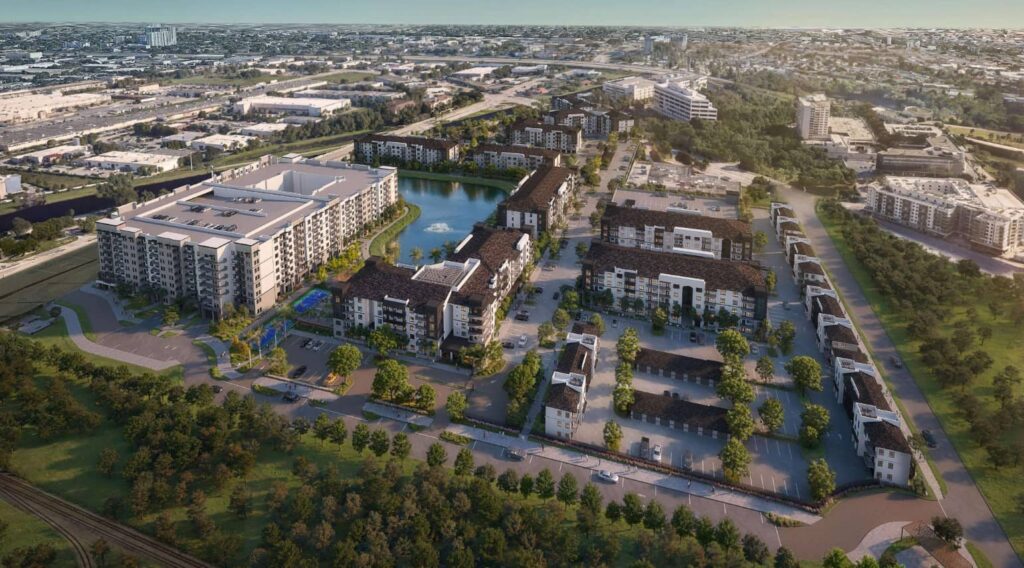
A major redevelopment is planned for the Pan American Estates Mobile Home Park in Fort Lauderdale’s Cypress Creek neighborhood, where a proposal to replace the 22.8-acre community with a 973-unit apartment complex is moving forward. Located at 150 NW 68th Street, the project will head to the City Commission on September 3rd after securing approval from Fort Lauderdale’s Development Review Committee last year. The redevelopment is being led by Saulo Perez of Cypress Development LLC, who acquired the property in October 2023. The project has gone through several revisions, with the most recent submission making slight adjustments to what was previously shown to the Development Review Committee. Current plans call for 973 units overall, consisting of 20 rowhomes, 57 three-bedroom units, 369 two-bedroom units, 512 one-bedroom units, and 15 studios, with an average size of 987 SF. Of the total, 75 units will be designated as affordable housing. The development will include 9 five-story apartment buildings with varying designs, an eight-story building positioned in the northwest corner of the site, and 5 three-story rowhome structures, mostly along NW 66th Street. Construction is planned in three phases, beginning with 328 units in the first phase, followed by 290 units in the second, and 355 units in the third. Future residents will have access to a variety of amenities, including communal spaces, plazas/gathering areas, pocket parks, swimming pools, and pedestrian pathways. To accommodate the anticipated influx of residents, the development will provide 1,572 parking spaces and 312 bicycle parking spaces. Designed by MSA Architects, buildings will feature grey and white accents with abundant greenery. The facade will be finished with siding, Bahama shutters, elevated porches, black aluminum railing, and other architectural elements. According to the elevations, the average building will rise around 60 FT with exception to the rowhomes (33 FT) and the 8-story building (88 FT). While the project now moves into the final stages before construction, the property has been marked by controversy. After the sale of Pan American Estates Mobile Home Park, more than 200 families were given six months to vacate the area. Residents were offered up to $14,000 for relocating early, though many told NBC6 they felt the compensation was insufficient. In response, the developer noted that all households were provided the required six- month notice under Florida regulations and ‘ownership is offering a generous incentive package, far exceeding the statutory minimums, to assist residents in their relocation efforts.’ While this is one example, multiple mobile home parks across South Florida are experiencing a similar fate, as limited land and rising demand for housing push developers to pursue large-scale multifamily projects. These efforts are a recurring tension in development, where concerns over resident displacement clash with the region’s growing need to expand housing supply. Recent imagery shows that the site has already been cleared. Permitting activity has also been ongoing for some time, with the latest application requesting a site work master permit to begin phase 1 of construction.
McKibbon Hospitality to Bring Dual-Branded AC Hotel and Moxy to 111 N Meridian Ave, Channelside
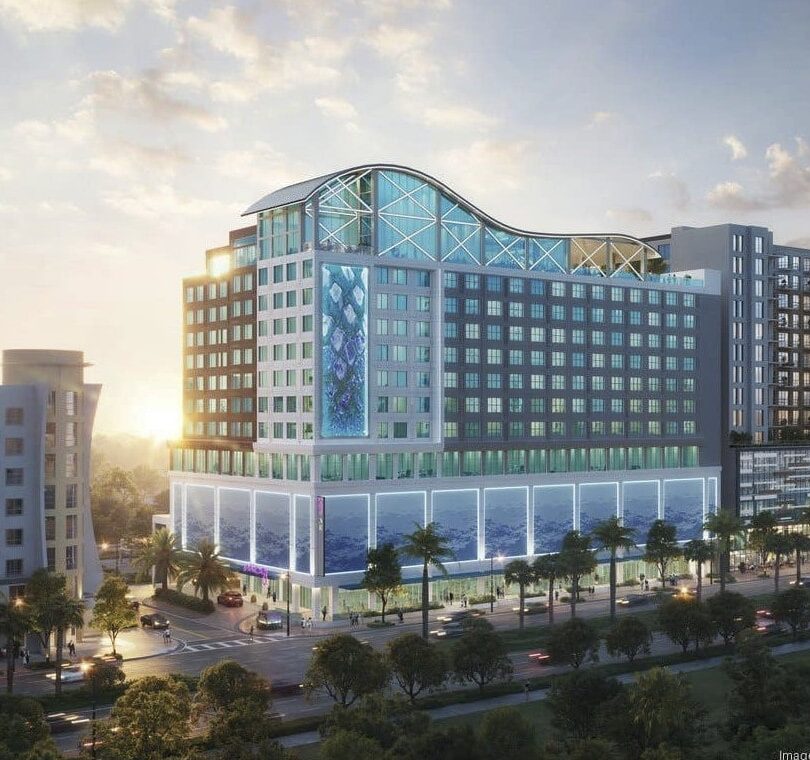
A new hotel is set to rise in Tampa’s Channelside district, becoming the largest by both height and room count. Developed by McKibbon Hospitality, a veteran hotel operator and developer, the project will introduce a dual-branded AC Hotel and Moxy by Marriott. The site at 111 N. Meridian Avenue was once planned for a storage facility by UDR, but McKibbon acquired the property for $9 million earlier this year and shifted the plan toward hospitality. With plans coming to fruition, the development will be the second dual-branded hotel in Channelside. Approved by City Council, the development will include 175 hotel rooms under the AC Hotel flag and 135 rooms under Moxy by Marriott. Plans also feature ground-floor retail, a large lobby, and guest amenities such as a pool, bar, and meeting and event space. According to a planning document provided last month, the current proposal provides 57 parking spaces, though that number could change as the design advances. The building, which will rise 13 floors or 170 FT, was lauded as a great addition architecturally for the area. Councilman Charlie Miranda called it “a nice addition and a beautiful design” in which it “fits the area”. Renderings and elevations provided by the architect show a unique roofline, blue and white accents, and a masked podium intended to improve the streetscape along Meridian Avenue. According to the Tampa Bay Business Journal, the project is still in the design phase, with permitting and financing to follow. McKibbon is aiming for a February 1, 2026 groundbreaking. “We have really great hospitality lender relationships, and we have a few earmarked for this deal that have already expressed interest,” said J.B. McKibbon, president of McKibbon Equities. Speaking before City Council, he added, “We have been trying very hard to build a new product in downtown for quite some time.” The rezoning received unanimous approval from City Council, with a second hearing scheduled for September 18. Because UDR demolished the site prior to this proposal, McKibbon has to do little site preparation before moving forward with foundation work and vertical construction.
Plans Unveiled for USF’s Long-Awaited Fletcher District
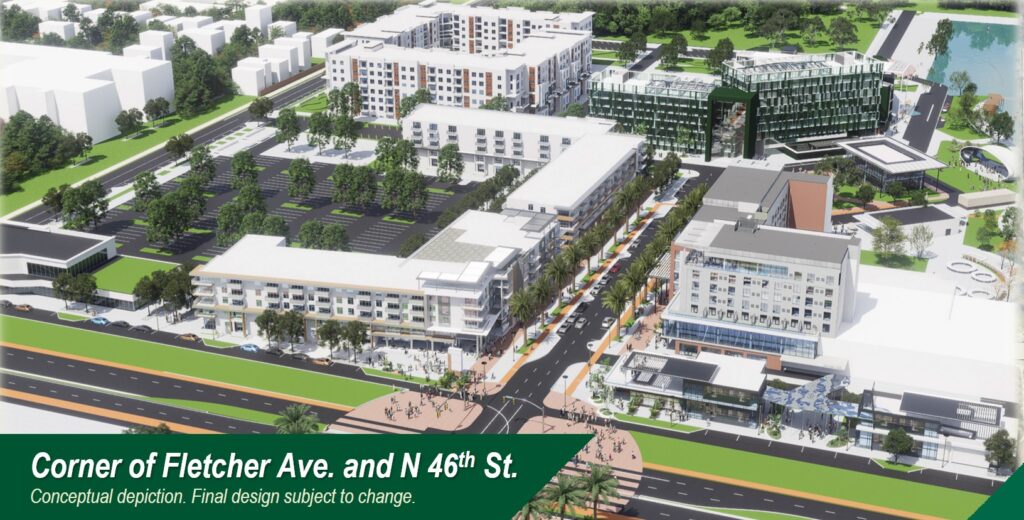
The University of South Florida is moving forward with plans to redevelop its recently shuttered golf course, The Claw, into a vibrant mixed-use district. On Friday, the Board of Trustees Finance Committee unveiled the first phase of the Fletcher District, a 27-acre project that will bring student housing, multifamily residences for faculty and graduate students, a hotel and conference center, retail space, recreational areas, and a USF-led academic research facility to the campus’s northern edge. More specifically, there will be 700 units dedicated towards student housing, 150 for multi-family housing, and 60,000 SF of retail. The project will be developed through a master development agreement with ACE Fletcher, LLC. While the project site is held by the Board of Trustees for the Internal Improvement Trust Fund (BIITF) on behalf of the State of Florida, USF controls it through a long-term ground lease that is awaiting extension. This dynamic means any ground sub-leases that USF wants to issue will require approval by the BIITF. Likewise, USF will directly fund the academic research building and portions of district infrastructure using university proceeds, bonds, philanthropy, and other financing tools. Meanwhile, other district assets will be the responsibility of other parties. Although the plan appears to be coming together now, the project has faced its fair share of hurdles. In 2021, USF proposed redeveloping a 769-acre tract along Fletcher Avenue, a site that included wetlands and sandhill preserves, but the effort met significant pushback. With the university’s golf course now closed and financially unsustainable, USF is embracing this new path forward. Jennifer Condon, USF Chief Financial Officer, noted “It will truly be a place to live, work, learn and play, and with the home football games and national performances at the on-campus stadium a short walk away”, “The Fletcher District will undoubtedly be an integral part of the many new exciting experiences coming to the home of the Bulls” according to the Tampa Bay Times. While the unveiling is a step forward, USF still has to receive approval by the full Board of Trustees on September 9th and by the Board of Governors on November 6th. Once all approvals are met, the first phase of the district is estimated to begin construction in spring 2026, with completion in summer 2028. Later phases have not been announced, but USF has more than 100 acres to work with.
Meet Ponce 8, Coral Gables’ First Live Local Project
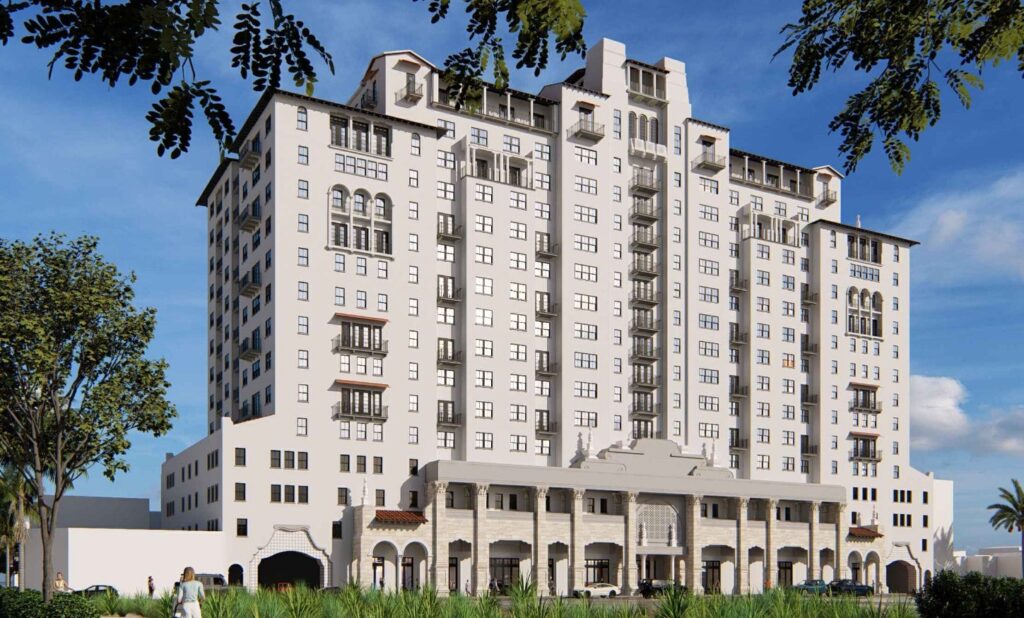
Coral Gables is preparing to review its first ever Live Local Act project, as Shoma Group’s ‘Ponce 8’ undertaking heads to the Development Review Committee. Slated for review on August 29th, the proposal would introduce a 16-story Mediterranean-inspired tower along the city’s northern edge, marking Shoma Group’s first high-rise in Coral Gables. More than just another development, Ponce 8 will act as a test case for the city’s approach to the Live Local Act: a piece of legislation that has already stirred debate and controversy in several South Florida communities. Located at 3808 and 3850 SW 8th Street, the site has had a history of failed proposals. Originally put forward by Fifield Companies as an 11-story building with 103 residential units, the project has since been reimagined by Shoma Group as a larger, more ambitious proposal. The most recent plans, released last week, outline a 16-story tower with 201 residential units, 40% of which will be reserved for workforce housing in accordance with the Live Local Act. Units will range from studio, 1-bedroom, 2-bedroom, and 3-bedroom homes. Because the development has to provide 40% workforce housing, or about 81 workforce units, the developer has been granted higher density and FAR. Although it hasn’t been confirmed which units will be designated as workforce housing, they will likely include all studios and some one-bedroom units: what the project’s representative describes as “adequate, of high quality, and does not create a cost-of-living burden for our community’s workforce.” Residents will have access to a pool, lounging space, a clubhouse, office space, and other amenity offerings. Uniquely, the project provides views of Coral Gables on level 16 with an open terrace. However, plans are still preliminary, and amenity space can change at any time. The ground floor will feature 4,941 SF of commercial space, a lobby, and covered sidewalks for protection from the elements. While the building’s frontage will not include landscaping, a secluded paseo with greenery will be incorporated at the rear of the development. Above the ground floor, a multi-story, enclosed podium designed to reflect the character of the residential units will be constructed. Inside the podium will be space for 345 cars, much higher than the city requirement of 282 parking spaces. Designed by PPK Architects the project’s 16 stories will reach 195 FT to the top of the parapet, or 155 FT to the roof of the 16th floor. Its facade embraces Mediterranean styling, incorporating ornate detailing, clay-tiled roofs, coquina stone, and other intricate features. The choice to include this styling is not just to pay homage to Coral Gables’ styling, but to be granted benefits under the Mediterranean Design Bonus regulations such as increased FAR or height. Because the Live Local Act requires administrative review, this project will not go before the City Commission or other public boards for approval or public comment. Instead, it will proceed to the Development Review Committee, which functions primarily as a technical checkpoint. The committee reviews projects for code compliance and may offer recommendations, but it does not have final approval authority. According to the developer, construction is estimated to begin in the second quarter of 2026, with completion expected in the second quarter of 2028. Based on this timeline, the developer will have to obtain demolition permits, site work/foundation permits, and other approvals fairly quickly to be on-schedule.
5400 North Flagler Condo Project Approved by West Palm Beach’s Planning Board
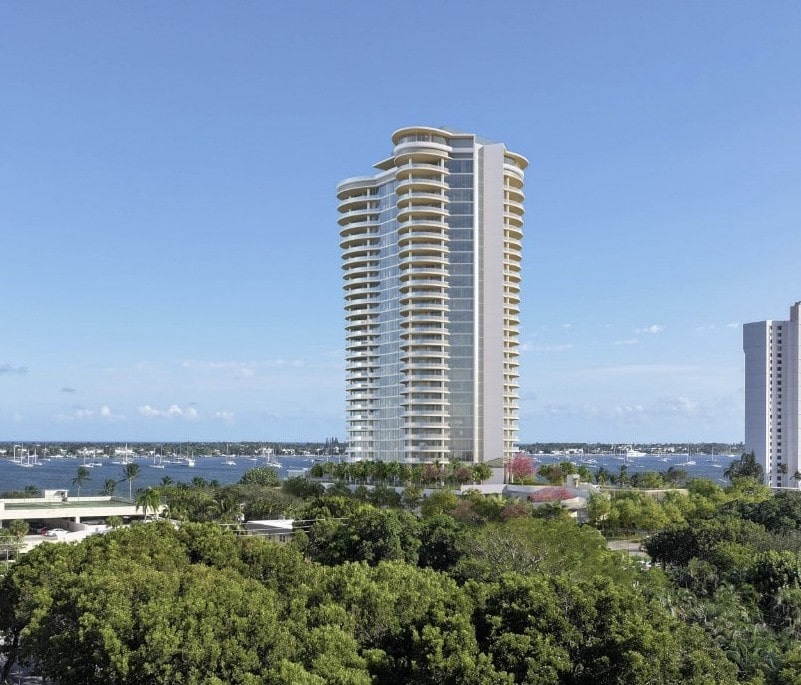
5400 North Flagler, a condominium project from Canada-based Great Gulf, has just received approval from West Palm Beach’s Planning Board. Approved plans call for a 31-story tower in the historic Pinewood Park neighborhood, marking a significant addition to the area’s skyline. Designed by Spina O’Rourke + Partners and Safdie Architects, the tower is envisioned as a modern yet expected addition to the Flagler Corridor. In recent years, developers such as the Related Group have capitalized on the area’s location and views, requesting multiple rezonings for luxury high-rises along the corridor. Set to replace a 72-unit low-rise built in 1966, this 97-unit tower is no exception to the wave of redevelopment in the area. Planned as a luxury high-rise, the development will feature a mix of residences, including townhomes, two-, three-, and four-bedroom units, as well as penthouses. While the building is significantly larger than the existing 72-unit complex, the total number of residences will only increase to 97, resulting in minimal added density. Amenities will include 209 parking spaces, a rooftop pool, guest suites, event and fitness rooms, garden areas, libraries, lounges, and much more. The 31-story tower is set to rise 380 FT at its peak or 360 FT to the roofline, according to project elevations: making it one of the tallest buildings in West Palm Beach. Its facade will feature glass balconies, white stucco, mesh screening, and other modern design elements. During the planning process, the building’s unique form was designed to help preserve view corridors for nearby condominiums. ‘We believe that our proposal is better than what could potentially be built on the overlay’ according to the project’s representative. Before reaching the Planning Board, the project went through multiple community outreach programs including meetings with the Palm Beach Chamber of Commerce, Palm Beach House, and the Northwood Harbor Association. During those discussions, the development team agreed to reduce height, relocate loading areas, and make other adjustments in response to community feedback. Even so, some residents who spoke at the Planning Board hearing raised concerns about potential impacts on sewer and water capacity, traffic, and other infrastructure. The Planning Board ultimately voted to rezone the property from Multifamily Density Residential (MF32) to Residential Planned Development (RPF) and approved several requested waivers. Despite the board’s decision, city staff had actually recommended denial, pointing to multiple areas of noncompliance with development regulations. Among their concerns were limited street-level activation, inadequate screening of the parking garage and its vehicular ramp, and other design issues mainly focused on the building’s interaction with the neighborhood. Board members were aware of these issues and urged the developer to continue collaborating with staff to improve the project’s design and compatibility as the project moves forward. While Planning Board approval marks an important step, the proposal must still go before the City Commission for final vote. A recording of the meeting can be viewed below.
Mizner Plaza Hotel Advances to Boca Raton’s Planning Board
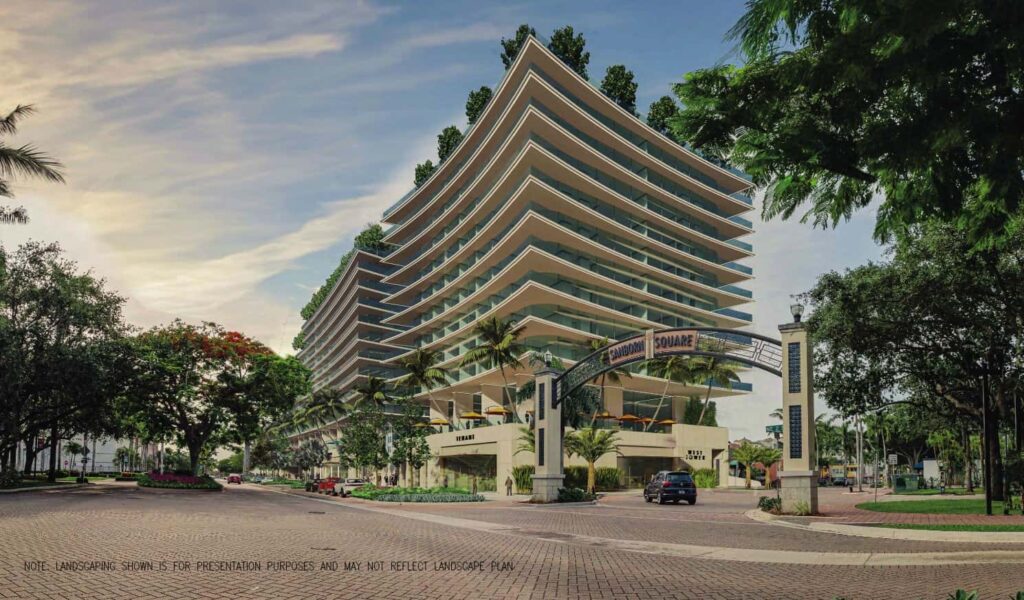
The Mizner Plaza Hotel, a proposed hotel development near Boca Raton’s Mizner Park, is moving forward to the city’s Planning Board. Spearheaded by entrepreneur and philanthropist couple James H. and Marta T. Batmasian, the project would replace the aging Mizner Plaza shopping center, built in 1969, and several other low-rise structures at 132 and 190 NE 2nd Street. Plans call for two multi-story hotel buildings, retail and restaurant space, and a new public park on a city-owned parking lot. On August 21, 2025, city staff will review the sale of the property for the park and consider approval for the hotel’s design and construction. According to the application, the project would feature two 12-story buildings designed by HdA Architects, offering 242 luxury rooms ranging from 380 to 1,100 SF. Guests can enjoy a multitude of amenities including pool decks on the fourth and twelfth floors, as well as ground-floor and rooftop dining. The development includes 18,840 SF of retail space and 10,600 SF of restaurant space on the first two floors, plus 5,400 SF for a rooftop restaurant: bringing the total commercial space to 34,840 SF. To serve both hotel guests and retail visitors, the Mizner Plaza Hotel will include on-street and underground parking, totaling 400 spaces across the project. Because the new public park will replace an existing city-owned parking lot and some on-street spaces, 27 parking spaces will be relocated within the garage and along the street to maintain availability. The project is designed with pedestrian experience as a top priority, according to the development’s representative. “Pedestrian accessibility was a paramount consideration for this project,” the representative wrote, noting that the plans “incorporated walkways and connections on all sides of the property to enhance downtown mobility for the community.” The site will be planned with a wide boulevard-like pedestrian walkway, immense greenery, and a bike lane for mobility. According to elevations provided by the architect, both buildings will rise 141 FT above ground. The facades will feature an all-glass curtain wall system with transparent glass balconies. The east building includes a sloped facade, creating setbacks and generous balcony space for residents. Before the project can proceed, the sale of the city-owned property must be finalized. The land was appraised at $2.37 million by the city, but the Batmasians are requesting a full discount, citing the cost of replacing parking spaces and building the new park. However, city staff rejected a 100% reduction, instead setting the purchase price at $883,558 with a 10% deposit required before the sale can move forward. The agreement also outlines that the land will not officially sell until all improvements are completed, and construction must begin within two years of the sale’s approval.
Croissant Park North & South Planned to Deliver 4 Towers in Fort Lauderdale
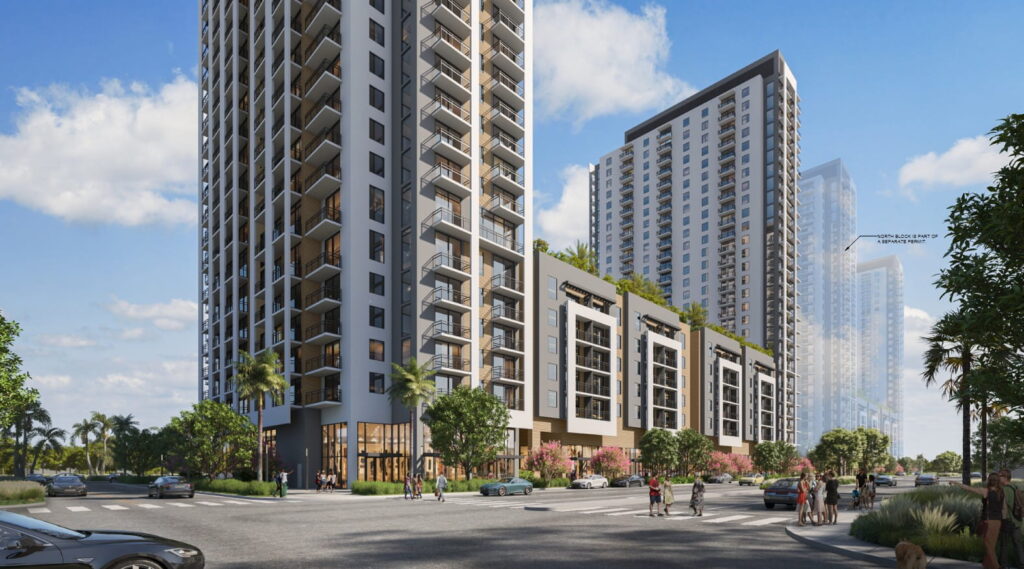
A new multi-tower development has just been proposed in Fort Lauderdale under Florida’s Live Local Act. Filed by South Andrews Holdings LLC, affiliated with Fort Lauderdale-based Murphy Property Group, plans by the developer call for a four-tower development on the edge of the Poinciana Park neighborhood. Coined ‘Croissant Park North’ and ‘Croissant Park South’, the development will rise at 1711 S Andrews Avenue and 1801 S Andrews Avenue, set to replace multiple low-rising structures. While development in the Poinciana Park neighborhood is not out of the norm in recent years, this development will mark the tallest and densest structures in the area, assisted by sweeping development benefits under the Live Local Act. If built, the project would deliver 932 units in total, with 466 apartments in both Croissant Park North and Croissant Park South. Each pair of towers will also include 187 workforce housing units, bringing the total to 374. In doing so, the proposal meets Live Local Act requirements, which mandate that 40% of units be set aside as workforce housing and that at least 65% of the development be residential. The four towers will feature a mix of one-, two-, and three-bedroom units, ranging from about 700 SF to 1,200 SF for larger layouts. Residents would also have access to a wide range of amenities, including but not limited to gyms, lounges, barbecue areas, pools, and outdoor seating. Designed by Fort Lauderdale-based FSMY Architects, the ground floor aims to significantly enhance the pedestrian experience in the neighborhood. Each pair of towers will feature walk-up units, lobby space, expanded sidewalks, greenery, on-street parking, and 7,613 SF of retail per lot: 15,226 SF across both sites. Parking will be integrated into the tower’s enclosed podiums, providing 630 spaces per lot, or 1,260 spaces total for residents and retail visitors alike. According to the elevations, all four towers will rise 28 stories, reaching a height of 302 FT at their tallest point. The building’s facades will feature metal balconies, square windows, and a color palette of brown, white, and gray. Characterized by sharp corners and modern design elements, the towers will be a contemporary addition to the area’s skyline. Because the development is proposed under the Live Local Act, the property will not go through a public hearing, but rather advance administratively. The developer will still need to comply with design requirements and zoning regulations outside the scope of the Act, but the overall approval process will be much faster. Plans, obtained through a public records request, are dated late 2024. While a groundbreaking date has not been announced, both lots will require extensive demolition before construction can begin.
From the Clevelander to Collins Avenue: Tracking Miami Beach’s Live Local Development Boom
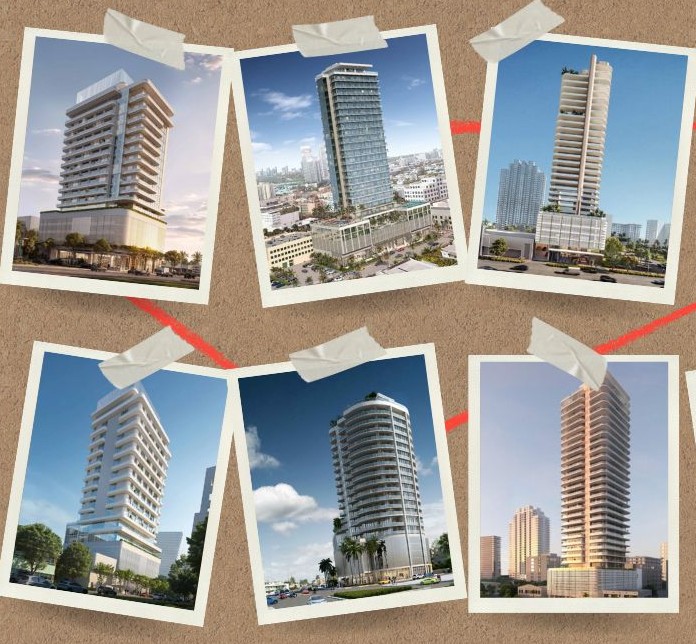
Miami Beach faces a turning point in its development future. After passing in the State’s legislator and undergoing multiple revisions, the state’s Live Local Act, designed to fast-track workforce housing, has catalyzed a wave of development proposals across the city. From North Beach, Normandy Isle, South Beach and other iconic neighborhoods, developers have proposed buildings ranging from 8 to 31 floors. While the law aims to address Miami Beach’s workforce housing needs following a historic and recent population decline, it has also fueled heated debates over balancing growth with historic preservation, creating pushback from both neighbors and local politicians. Foreshadowing a Future Controversy first arose after the Live Local Act began with a heated proposal: plans to redevelop the Clevelander with a high-rise. Owned by the Jesta Group, the project originally called for a high-rise building featuring workforce housing, immense commercial space, and residential units above. The plan immediately drew pushback from preservationists, anti-development activists, and local officials concerned about the scale and impact on the iconic Art Deco corridor. In fact, former Mayor Dan Gelber called it the “worst idea ever,” adding that “the Jesta Group should be ashamed.” In response, Jesta Group revised the proposal, lowering the height while retaining the affordable housing component, though controversy continues over the project’s compatibility with the surrounding historic neighborhood. Despite the backlash, the Clevelander was a pioneer regarding the Live Local Act, signaling the beginning of a new wave of development in Miami Beach’s most well-known neighborhoods. Following the lead, developers like Russell Galbut and his firms GFO Investments and Crescent Heights, as well as multiple out-of-state developers, have begun proposing high-rise projects along Alton Road and other major corridors. Whether these developers succeed depends on the approval process, as well as compatibility with historic preservation. The Incentives Behind It All The influx of development proposals is not coincidental. The Live Local Act offers developers several incentives to promote workforce housing across Florida. For one, qualifying projects can move through the approval process administratively, avoiding lengthy public hearings as long as they comply with standard regulations. Developers can also take advantage of the maximum density allowed in any municipality, utilize certain height bonuses, and build up to 150% of the highest FAR permitted in the jurisdiction. Beyond zoning benefits, the state may grant tax incentives to projects that meet affordable housing requirements. These benefits are key to the influx of developments, as they allow multiple projects to pencil. In exchange for these advantages, developers must designate at least 40% of units as workforce housing, defined as units restricted to households earning no more than 120% of the area’s median income. Additionally, at least 65% of the building must be devoted to residential uses, with the remaining 35% available for non-residential uses such as commercial or office space. Critics, however, have argued the lack of affordability seen in these projects According to Bilzin Sumberg, developers in Miami-Dade can charge as much as $2,604 for a studio apartment or $3,867 for a three-bedroom unit: prices that remain out of reach for many households. This rent limits come entirely from the act’s laxed income limits placed at 120% AMI. On the other hand, supporters of the Live Local Act have strongly argued that increasing the housing supply and situating units closer to jobs will ultimately reduce traffic, ease housing costs, and improve overall quality of life in local communities. Because the Act allows projects on industrial, commercial, or mixed-use parcels, developers have focused on Miami Beach’s major corridors, including Collins Avenue and Alton Road. In a public records request to Miami Beach, here are the most recent Live Local Act projects submitted to the city thus far, beginning with 740 Alton Road. 740 Alton Road Plans by GFO Investments, affiliated with developer Russell Galbut, call for a 28-story building along Alton Road. There will be 100 units, 1,494 SF of retail, 2,134 SF dedicated to a private club, and 106 parking spaces for residents and retail patrons. 40% of the units will be workforce, translating to 40 out of the 100 proposed units. The building, designed by RSP Architects, will be among the tallest on Alton Road, measuring 410 FT to the highest point. 1826 Collins Avenue Developers Lefferts and Crescent Heights are moving forward with plans for 1826 Collins Avenue, a 15-story, 223 FT tower that will bring 29 residential units to the area. Twelve of the units will be designated as workforce housing, meeting the Live Local Act’s 40% affordability threshold. The project also calls for 3,500 SF of office space and 37 parking spaces. The official architect is Built Form Architecture. 7401 Harding Avenue Currently owned by Calvin Gaeta Development Co. Inc., the property is slated for a 170-unit high-rise, with 72 units (42%) designated as workforce housing. The building, designed by Urban Robot Associates, will rise 23 stories and stand 243 FT tall. On the ground floor, plans include 7,699 SF of commercial space, along with 174 parking spaces in the tower’s podium. Just months before proposing this high-rise, the developers presented to Miami Beach’s planning board a five-story mixed-use building with only eight units. 42 Collins Avenue Proposed by Brooklyn-based 42 Collins Avenue LLC, plans filed with the city outline a 180-unit tower, with 72 units (about 40%) designated as workforce housing. All workforce units will be studio floor plans, a format common among Live Local Act projects. Designed by Built Form Architecture, the building is set to rise 28 stories and reach 374 FT in height. The ground floor will feature 3,700 SF of commercial space, with 194 parking spaces housed in a multi-story podium. 1575 Alton Road Also proposed by Crescent Heights, 1575 Alton Road is planned as an 18-story tower with 92 residential units. 37 units, or around 40% of the units are workforce housing. The project will include 8,549 SF for either office or fitness center use, along with 87 parking spaces. While not the tallest Live Local Act proposal on Alton Road, the
FAA Filings Advance The Bluffs in Clearwater Toward 2026 Groundbreaking
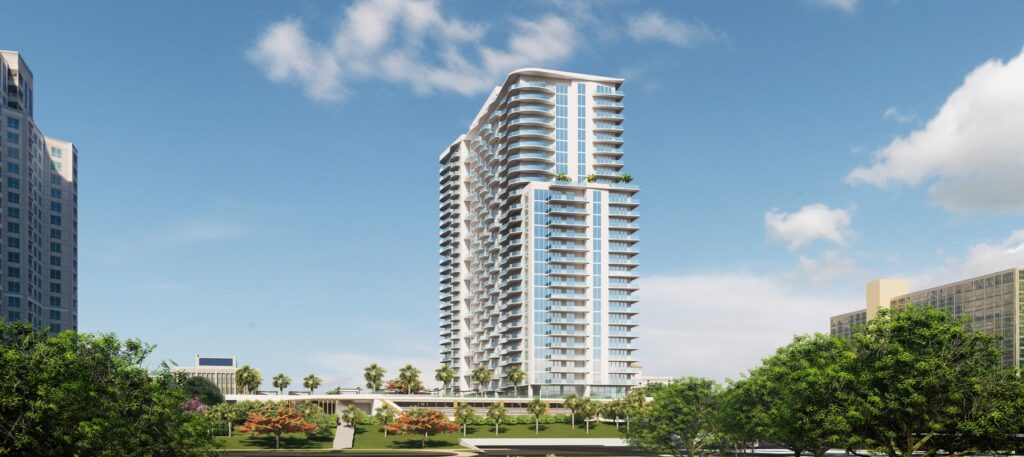
The Bluffs in Downtown Clearwater is taking another step forward towards construction. Developers Gotham Organization and the DeNunzio Group recently submitted FAA filings for crane use and building height evaluation, key early steps toward their targeted January 2026 groundbreaking. The move follows land acquisition and City Council approvals earlier this year, and will be an early measure of whether the developers can deliver on their promise to complete the apartments on schedule. The project is aiming to erect one 400 FT crane for the project. According to the general contractor, Moss Construction, the crane will initially stand at 250 FT before climbing to its full height as the project nears topping out. FAA evaluation of the crane filing is still underway. For a brief period, from June 1, 2026, to December 23, 2027, it will be the tallest structure in Clearwater. Also filed was a building height evaluation. As per the filing, the structure will rise to 302 FT to its tallest point, or about 337 FT when factoring in the site’s 35-foot elevation. The filing notes that the height comes from a two-floor podium topped by a 28-story residential tower. Touted as the largest investment in Downtown Clearwater to date, the project will span 620,000 SF and include 400 rental units, more than 10,000 SF of retail space, and 440 parking spaces, about half of which will be underground. The Bluffs in Clearwater did not reach this point without challenges. Last year, the developers scaled the project back from two towers to one and revised several agreements. In fall 2022, voters approved plans for roughly 600 apartments, but the developers later cited rising interest rates and other external factors as reasons to reduce the scope to 400 units in a single tower. Additionally, the original $15.4 million sale price for the lot was reduced to $3.45 million following negotiations. While the City of Clearwater lost out on certain benefits from the deal, the developer’s steadfast commitment to moving forward on the project, indicated by these recent FAA filings, will hopefully push this investment further to reality. According to TBN Weekly, former council member Mark Bunker was optimistic for the project despite setbacks: “I’m excited that we’re actually getting this done,” “I think it’s an important next step to taking back the downtown”.
New Tower Proposed at 6985 Collins Ave, Replacing Normandy Plaza and Crystal Beach
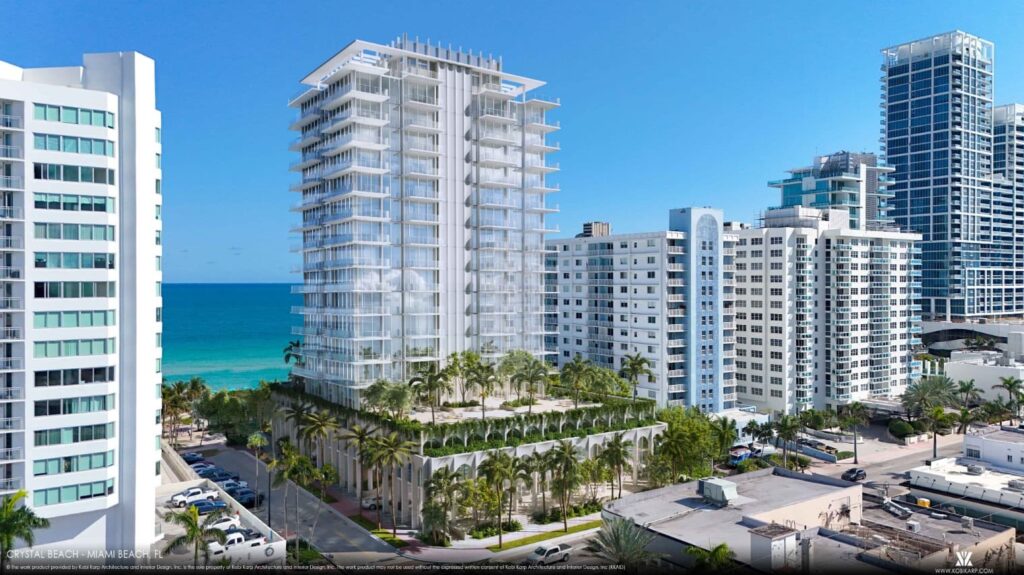
Miami Beach’s Historic Preservation Board is set to review plans for yet another residential tower along Collins Avenue. Developers BHK Crystal Beach, a partnership affiliated with the BH Group and the Kolter Group, are seeking approval for a 17-story luxury residential tower at 6985 Collins Avenue. The project would require the demolition of two existing landmarks: the Crystal Beach Suites Hotel and the historic Normandy Plaza Hotel. In their place, plans call for a modern glass tower designed by Kobi Karp Architecture, spanning the 1.1-acre oceanfront site at Collins Avenue and 71st Street. Plans recently submitted to the city indicate the partnership is seeking a luxury addition to Miami Beach, with only 37 residential units spanning from floors 5 to 17. This equates to just two to three units per floor, keeping the project well below the maximum allowable density. Likewise, the average unit size per home will be 2,911 SF, but penthouses on the top floors reach up to 4000 SF. Residents will have access to a range of amenities, including a pool, lounge areas, and additional facilities. The ground floor of the building is designed with pedestrian safety and street activation in-mind. Large sidewalks, retail space, a concealed drop-off zone, and bicycle parking on the ground floor are all designed to create a more pedestrian-friendly environment. Above that, two podium levels of parking will be concealed from public view, providing 86 spaces: ensuring at least two parking spaces per residence, retail parking, and guest parking. The proposed tower will reach 225 FT, rising 17 floors with an additional rooftop deck on the 18th level, a height typical for North Beach. In addition, its facade will combine curtain glass, glass balconies, and white finishes, giving the building a modern look. In a letter to the City of Miami Beach, the developer’s attorney described the project as a “beautifully designed residential building that will add positively to the surrounding neighborhood.” Unfortunately, preserving the Normandy Plaza Hotel structure is not in the cards for the developer, as demolition is now permitted for the property. For context, the building was declared unsafe in 2018 after sitting vacant for nearly five years. In the summer of 2019, the City of Miami Beach suggested multiple plans for the property, including full demolition and the selective preservation of certain facade elements. Although the process of finding a demolition contractor occurred later that year, the work never proceeded. The developers behind the current project, however, plan to follow the city’s earlier recommendations. Significant portions of the facade will be carefully removed and donated to a university, museum, or other civic institution. In addition, an organization will have the opportunity to laser scan and document the exterior for educational purposes, ensuring that the architectural legacy of the Normandy Plaza Hotel will live on. The design of the new building’s facade will also incorporate elements that pay homage to the historic structure. Regarding the Crystal Beach Suites Hotel, constructed in 1950, the building is classified as non-contributing within the North Beach Resort Local Historic District. Although it undergoes the same historic review process as other district buildings, its lack of historical significance to the area means demolition or alterations are typically less controversial. In contrast, the Normandy Plaza Hotel dating back to 1936, is a contributing structure, making any proposed changes subject to further scrutiny due to its historical importance. The Historic Preservation Board is set to review the proposal on September 16th, 2025 at 9 A.M. Like multiple projects put forth for the board, multiple revisions and reviews are typically required before moving forward. This project is likely no exception.
‘Federal Apartments’ Proposed in Fort Lauderdale at 845 NW 11th Avenue
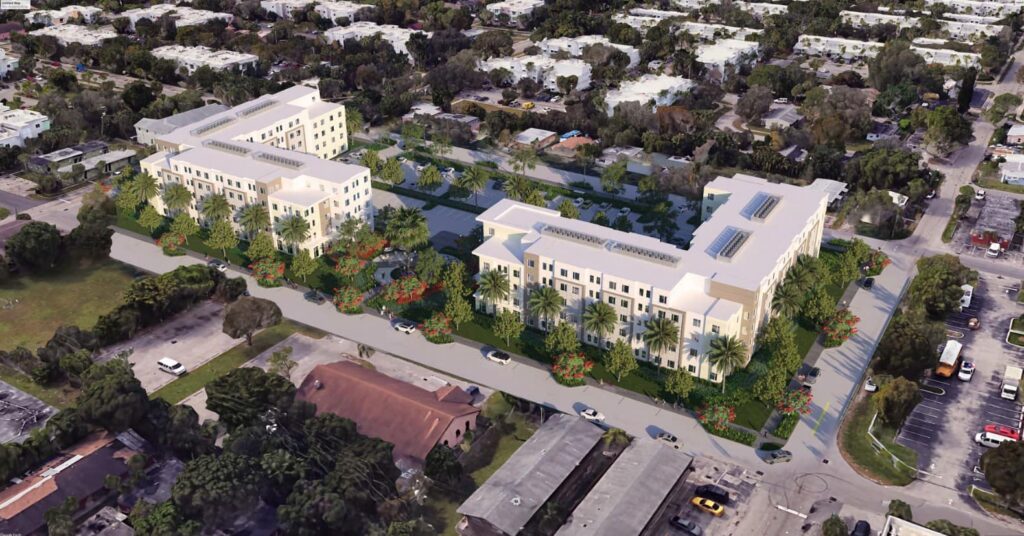
A new affordable housing project has just been announced in Fort Lauderdale’s Homes Beautiful Park neighborhood. Called ‘Federal Apartments’, it’s being spearheaded by Boca Raton-based MRK Partners, a firm with extensive experience in attainable housing construction. Located at 845 NW 11th Ave, plans include the construction of 164 affordable housing units. While this announcement is one of the first major developments for the Homes Beautiful Park neighborhood, it comes amid a pivotal wave of housing investment in the area. Both the nearby Progresso Village and Dorsey Riverbend neighborhood have overseen the construction of dozens of affordable housing units in recent years, stemming from investments like Mount Hermon Apartments or even The Arcadian. Plans released a few days ago offer some insights into the project’s plans. The development, for one, will be split between two buildings. In addition, both buildings will contain around 80 units, with units spanning between 2-bedroom, 3-bedroom, or 4-bedroom floor plans. The minimum unit size is also 767 SF: much higher than the floor of 400 SF. While both buildings won’t include retail space, rather opting for units, residents will have access to around 3,000 SF of amenity space on the ground floor, including a business center, community room, and more. Residents can also make use of the 173 parking spaces and 18 bicycle parking spaces on-site, ensuring at least 1 parking space for each resident. Around the property will be extensive greenery and sidewalk space for both pedestrians and residents, featuring playgrounds, a courtyard, and benches. Designed by TAT (The Architectural Team), renderings and elevations depict two five-story buildings rising 54 FT, taller than most surrounding structures. The development will feature a modern architectural style with “painted stucco in yellow, white, gray, and brown tones, accented by white aluminum windows, doors, and rooftop screening. These materials are arranged to create visual variety and transitions across the façades.” Before construction can begin, the developer must demolish 23 low-rise structures containing 88 residential units, along with a two-story leasing office. Built in the 1950s, these buildings are now considered dated. It remains unknown whether displaced residents will be given priority for the new affordable units, as plans are still in the preliminary stage.
$60 Million in Federal Funding Killed for Miami’s ‘I-395 Underdeck and Heritage Trail’
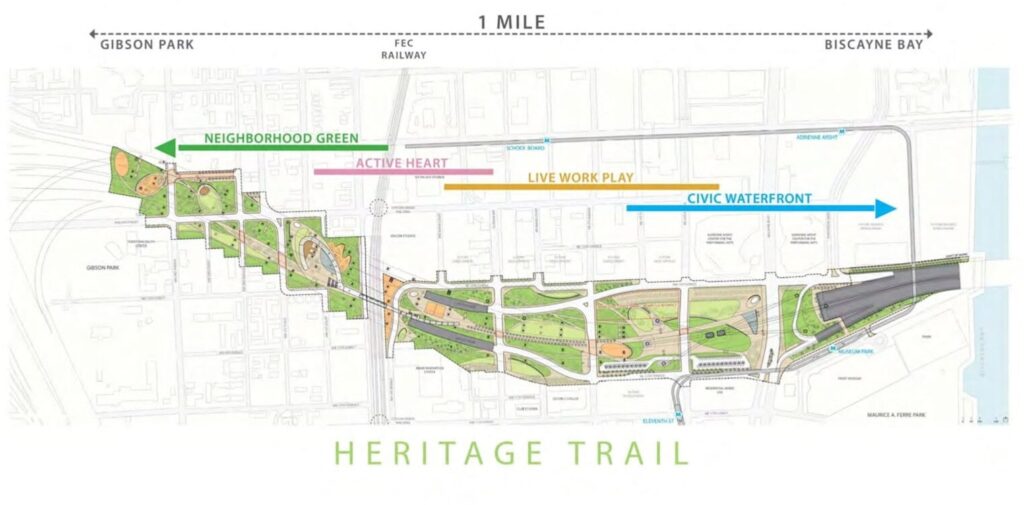
Funding for Miami’s Underdeck and Heritage Trail project has been wiped out. Last week, the city learned that the entire $60 million allocation for the project would be rescinded. The cut originates from the passage of the “One Big Beautiful Bill” in Congress, which eliminated all unobligated funds from the Neighborhood Access and Equity Program: now renamed “Reconnecting Communities.” In Miami’s case, the money was considered unobligated because construction had not officially begun. In a letter provided by Loren Smith Jr, deputy assistant secretary for policy at the DOT, he wrote, “Connecting Miami: I-395 Underdeck and Heritage Trail will undergo and unobligated balance recission of $60,353,730.00”, “H.R. 1, One Big Beautiful Bill” rescinds all unobligated balances from the NAE Program”. The Underdeck was planned as a way to reconnect residents and businesses in Overtown on both sides of the highway, transforming 33 acres into public open space with walking and biking paths, plazas, children’s play areas, water features, spots for food and drink, and so much more. The funding cut couldn’t come at a worse time. Weeks before, news was announced that the Underdeck and Heritage Trail secured the last pieces of financing needed for the project. To unlock the $60.3 million federal grant, the city needed to chip in $10.8 million of its own financing and sign an agreement with FDOT. Earlier this year, $3.8 million from the city was committed, and this week commissioners were approved $3.5 million each from the Omni and SEOPW CRAs, covering the rest of the local share. Together with $11.5 million recently received from FDOT, the project’s total budget was expected to reach about $82.7 million. With the federal funding now off the table, the city will have to find a way to replace the $60 million shortfall before it can even tap into the money already committed by the City of Miami and FDOT. Speaking to the Miami Herald, Commission Chair Christine King, whose district includes the park, said “I am not discouraged”, “If we have to do only a section at a time, that space will be representative of our struggles, our culture, and our resiliency.” Adding to the irony, plans and construction for Miami’s Signature Bridge project, which includes highway upgrades, is still moving forward. Its budget has swelled to $866 million, and the completion date has slipped from fall 2024 to late 2027, and now to late 2029. Far from being just a road improvement project, the bridge features six towering arches that serve both as structural supports and aesthetics. Yet, unlike the Heritage Trail, its funding comes entirely from the State of Florida. However, Miami is not alone. Multiple cities across the U.S. have had funding cut on projects, including Austin. In a similar fashion, Austin’s I-35 cap-and-stitch program lost $105 million in federal funding. The project would’ve delivered above-ground parks and recreation facilities that hid I-35 from public view. Both the Underdeck and the I-35 cap-and-stitch program have one thing in common: both were designed to reduce the harm historically done from highway projects.
Live Local Act Spurs High-Rise Proposal at 824 Alton Road in Miami Beach
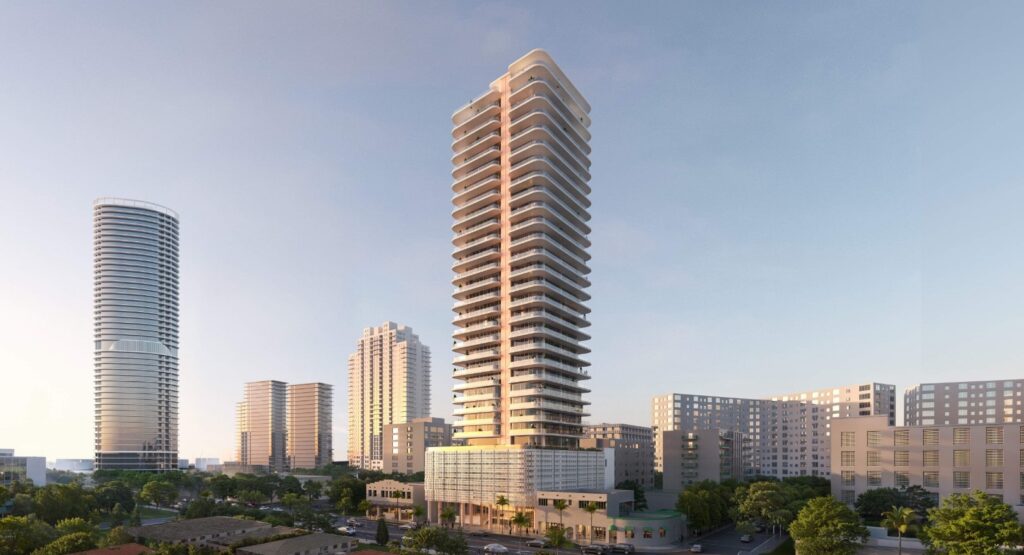
Miami Beach is set to review another Live Local Act proposal, this time from 824 Alton Road, LLC, an affiliate of Crescent Heights. Recently obtained through a public records request, plans submitted in September 2024 call for a high-density residential project on a surface parking lot along Alton Road. The proposal features a 31-story tower designed by RSP Architects and will add to a growing list of tall, high-density developments in Miami Beach’s West Avenue neighborhood. According to plans, the development will include 120 residential units. Because the Live Local Act requires workforce housing in exchange for certain development benefits, this project will include 48 workforce units (priced at 120% AMI and below) and 72 market-rate units. The residences will range from studios, one-bedroom, two-bedroom, three-bedroom, and four-bedroom layouts, with all workforce housing units designated as studios. Residents will enjoy an extensive range of amenities, featuring a dedicated sixth floor for amenities with a pool, lounging deck, and additional facilities. The rooftop will also offer a large pool, expansive terrace, and a private club spanning nearly 3,000 square feet. Meanwhile, on the ground floor of the development, there will be 2,931 SF of retail space, a spacious lobby, and dedicated bicycle parking. Above this level, a four-story parking podium will provide 119 vehicular spaces serving both retail customers and residents. Designed with breeze block cladding, the podium will ensure proper ventilation while maintaining a hidden appearance from public view. According to elevations submitted to the city, the tower will rank among the tallest residential buildings in the area, rising 31 stories and reaching 404 FT at its highest point. The building’s facade will be fully clad in glass, complemented by curved glass railings that soften the rectangular form of the tower. However, the project is not without challenges. Live Local Act projects in Miami Beach have sparked controversy since the law took effect locally. City leaders have publicly criticized the legislation, warning that “without critical protections, the Senate version of the bill could open the door to the bulldozing of Miami Beach’s world-famous Art Deco Historic District — replacing iconic, low-scale, two- and three-story historic buildings with modern high-rise towers and forever erasing the architecture that defines the city’s identity and drives its economy.” While the proposal at 824 Alton Road would not demolish any historic structure, rather just a surface parking lot, some residents and officials remain concerned that the Live Local Act is eroding neighborhood character by allowing high-rise development in areas historically protected from such development. The law enables developers to bypass traditional zoning, permitting greater height and density than otherwise allowed in exchange for workforce housing. Because the site contains no historic building, the project avoids the intense preservation battles that have long surrounded other Live Local proposals. As a result, its approval will fall largely on whether its design is deemed compatible and compliant with the Live Local Act. Plans received indicate the design does not meet the city’s compatibility standards. The South Florida Business Journal has reported the same thing. Editor’s note: This story is ongoing. Plans obtained by Floridian Development are the most recent available, but they still require revisions. It’s unknown when the developer will update plans.
Cranes Rise as Construction Begins at Ambar Station in Naranja, South Miami-Dade
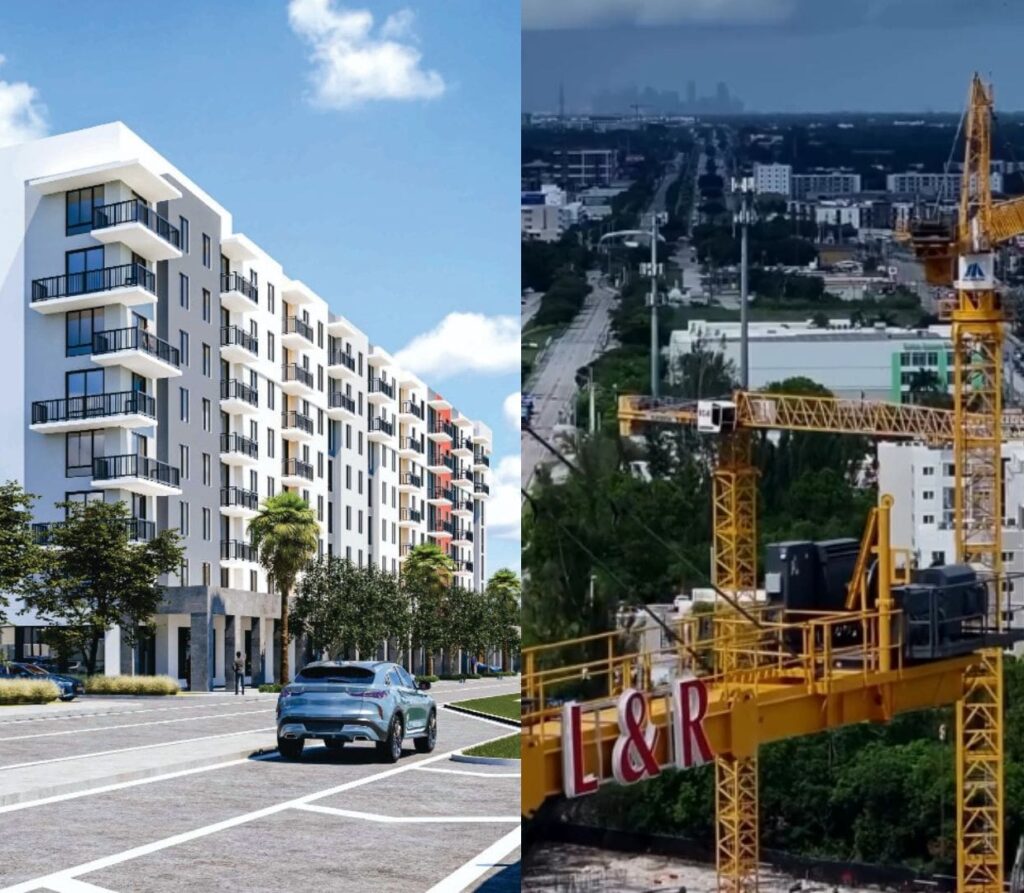
Construction is fully underway at Ambar Station, a multifamily development led by Jacksonville-based Vestcor. The project recently broke ground after Miami-Dade County commissioners approved up to $128 million in financing, made possible through the Housing Finance Authority (HFA). The HFA raised the funds by issuing special revenue bonds, which will help cover both the acquisition and construction costs of the development. Located at 27860 S. Dixie Highway, the project is being managed by general contractor First Florida Constructors, with L&R Structural Corp serving as the shell contractor. According to a recent Instagram post by L&R, construction crews have already begun foundation work and have erected five tower cranes to support the multiple multifamily buildings planned for the site. As per a comment provided by L&R Structural Corp, all five tower cranes were installed in an impressive 10 calendar days. At this current pace, construction is expected to go vertical quickly, with multiple structures topping off in the near future. View this post on Instagram A post shared by L&R Structural Corp. (@lrstructural) The development received administrative site plan approval in late 2024 and is currently awaiting substantial compliance approval from Miami-Dade County. According to the latest documents, the project will include 576 units spread across four buildings. All units will be reserved for low-, moderate-, or middle-income individuals and families, with a mix of one-, two-, and three-bedroom layouts. On the ground floor, Ambar Station will offer 839 parking spaces, well above the 244 spaces required. These additional spots will accommodate residents as well as support 5,800 SF of commercial space planned for the ground floor. Designed by Anillo Toledo Lopez Architecture, building 1 will rise eight stories (approximately 86 FT), building 2 will also be eight stories (about 88 FT), while buildings 3 and 4 will each be three stories tall (around 36 FT). The facade will feature a blend of colors atop stucco and concrete, including paint colors such as Whea, Superwhite, and Alsea. Ambar Station joins a burgeoning trend of multifamily developments in South Miami-Dade. Just blocks away, the Richman Group recently completed Vista Sur, an eight-story apartment community. However, this is not Vestcor’s first multifamily project in Miami-Dade County or South Miami-Dade: the company has previously completed developments like Ambar Trail, Ambar Key, and The Ambar within the county.
HueHub, a Nearly $1B Attainable Housing Development, Advances Under Live Local Act
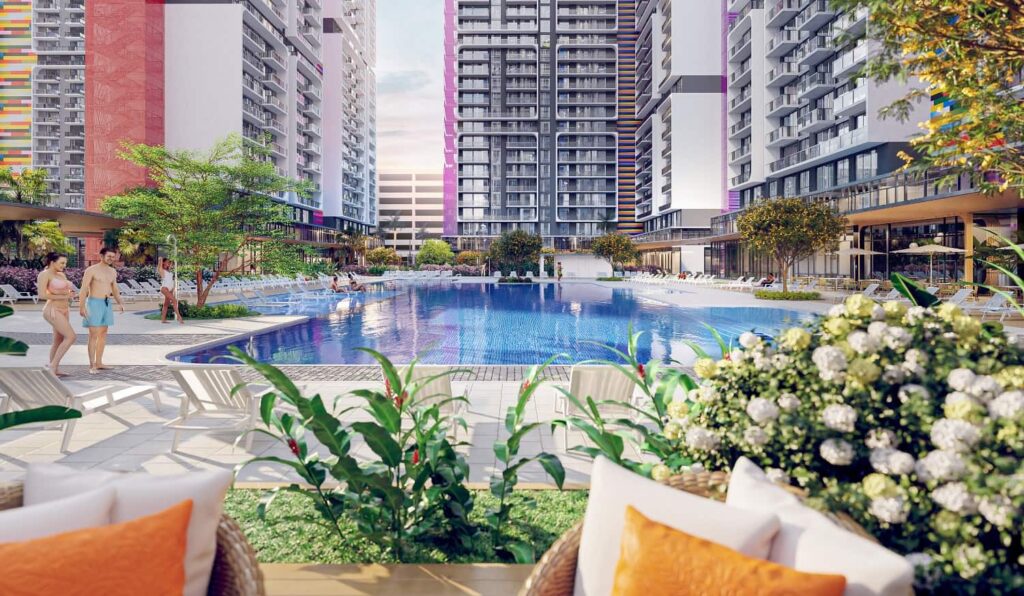
More than two years after Florida passed its landmark Live Local Act, the largest development under the legislation has been officially approved. Known as HueHub, the project will rise at 8400 NW 25th Avenue in Miami-Dade County, transforming the corridor with seven high-rise towers and thousands of “attainable” housing units. Spearheaded by Pablo Castro, through 27th Avenue Hollandpark Ecoresidences, LLC, the development secured approval in early July and is targeting a groundbreaking in late 2025. According to final plans submitted to Miami-Dade, HueHub will deliver 4,032 residential units, along with 20,742 SF of retail, 14,480 SF of office space, and 5,037 parking spaces across two garages. The residential mix will include fully furnished studios, one-bedrooms, and two-bedrooms, with rents aimed at affordability: $1,300 for studios, $1,600 for one-bedrooms, and $1,900 for two-bedrooms. In a statement to the South Florida Business Journal, Castro framed the project as a community-focused initiative: “HueHub is of course a real estate development, but that is actually secondary in my mind to helping solve our community’s biggest challenge – access to attainable housing.” His team aims to provide a price point for new housing often out of reach for many in Miami-Dade. Residents of HueHub will have access to a broad range of amenities designed to meet both lifestyle and professional needs. Planned amenities include coworking spaces, podcast studios, pickleball courts, a lap pool with a pool bar, childcare facilities, a library, learning center, art gallery, and even a two-acre park. One of the biggest resources to tenants is the proximity to Miami’s Metrorail, which will allow residents different options of travel beyond the vehicle. Designed by Arquitectonica, the development will feature seven towers rising 35 stories, reaching 320 FT to the roof and 350 FT to the mechanical top. The design features art-lined elevator cores, metal balconies, and other design and material choices to soften the feel of the otherwise high-density district. On the ground floor, pedestrians can expect to see added improvements to the streetscape, with wider sidewalks and greenery. Although the project secured zoning approval in July, no construction permits have been filed as of early August, according to Miami-Dade records. Before the planned 2025 groundbreaking, the developer will need to demolish 65 existing structures on the 14-acre site: buildings constructed between 1950 and 1990. The estimated total cost of the development stands at $880 million, making HueHub one of the largest private residential investments in the region’s recent history.
Embassy Suites to Add 17-Story ‘Tampa Hotel’ Tower in Downtown Expansion
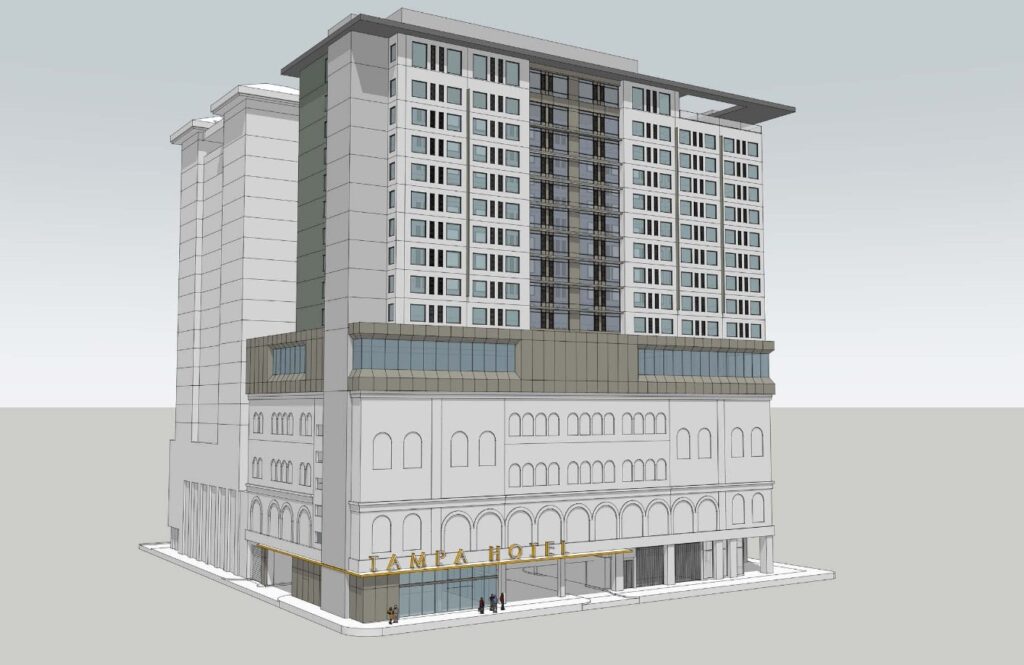
A second tower may soon rise at the site of Embassy Suites by Hilton in Downtown Tampa. Located at 513 South Florida Avenue, adjacent to the Tampa Convention Center, the expansion will rise atop the existing tower’s parking structure. While this expansion will be the first for the property, the original tower, owned by RLJ Lodging Trust and a fixture in the area since opening in the 2000s, recently completed millions in renovations. The upgrades included improvements to both the tower’s interior and exterior. Now, this new expansion will almost double the number of hotel rooms on the property, bringing it from 360 to 575 with the addition of 215 new hotel rooms. According to plans submitted to the City of Tampa, the new tower will be coined ‘Tampa Hotel’ and include 10 floors of hotel rooms, amenity spaces, and a check-in area, all built atop a 7-story parking podium. The amenity spaces will include a fitness center, meeting rooms, and a rooftop pool with a sun deck, which will be among the tallest rooftop pools in the city. The project will also yield 4,500 SF of new cafe and restaurant space, bringing the total across the property to 8,532 SF when combined with the existing hotel. No additional parking is planned as part of the expansion. The existing parking structure, which contains 237 spaces, already exceeds the minimum required under Tampa’s zoning code. For lodging uses, the code requires just one parking space per 8 rooms, meaning only 72 spaces are needed to accommodate both the existing and proposed towers. The planned expansion includes extensive renovations to the ground floor of the existing parking garage, transforming the current parking area into a dedicated drop-off zone and an elevator lobby designed to efficiently handle the anticipated increase in guest traffic. There will be 3 vehicular exits/entrances on the ground floor. Designed by Allen + Philp Partners, the new tower will rise 17 stories, reaching a total height of approximately 217 FT: nearly matching the height of the original Embassy Suites building. The facade is planned to incorporate a blend of modern materials, including metal panels, granite coatings, glass, and stucco accents. As this is the initial design submission, the tower is expected to undergo multiple revisions throughout the planning and construction phases, meaning its final appearance may evolve. Before construction can begin, the project must go through several approval steps, with the City of Tampa’s Design District Review being a key step. While a construction timeline hasn’t been shared as of now, it’s estimated construction won’t begin until 2027 or later.
River District 14 in Allapattah Reaches 4th Floor, Construction Webcam Now Live
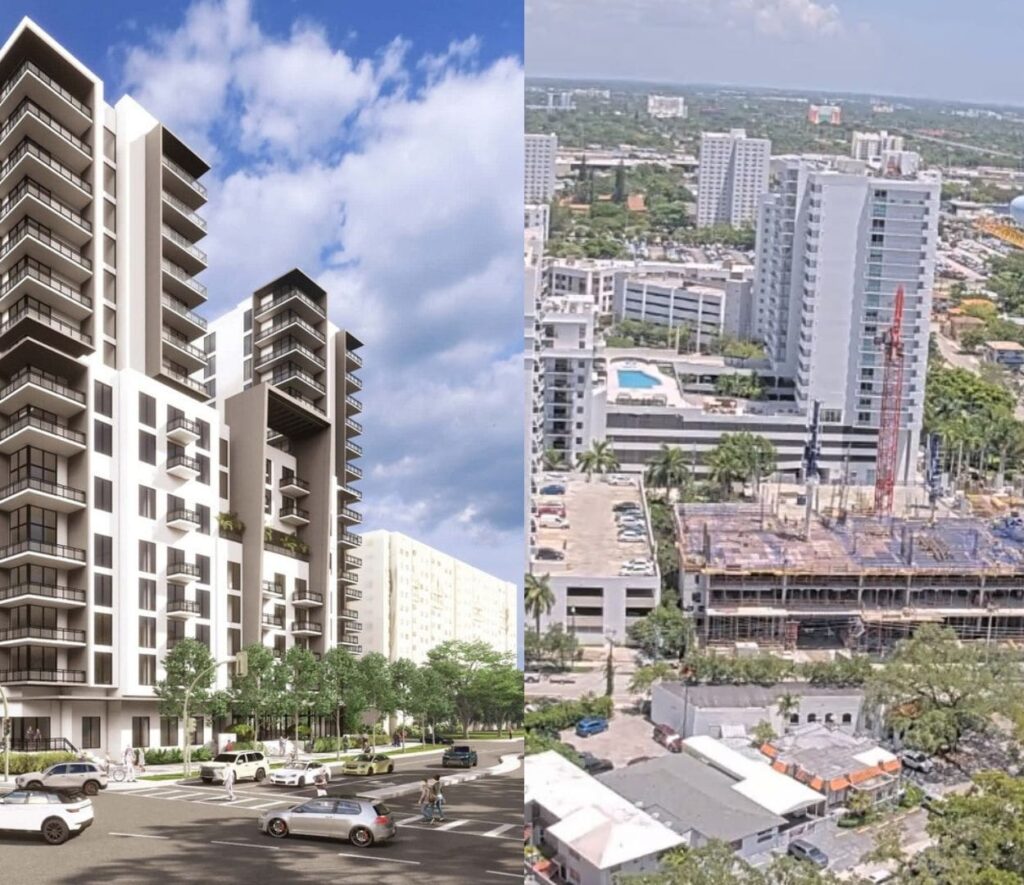
River District 14 is officially rising, and progress appears to be moving swiftly. Eight months after breaking ground, the 16-story residential tower in Miami’s Health District has moved beyond site work and into full vertical construction. Spearheaded by Alta Development and designed by Behar Font & Partners, the building has reached its fourth floor as of late July, signaling a steady pace towards completion. In fact, crews are now averaging a new floor every 10 to 12 days, with the tower well on track to topping off by late 2025 to early 2026. Located at 1420 NW 14th Avenue, River District 14 will join a growing trend of multifamily development reshaping Miami’s Health District, an area once characterized by medical campuses but now changed from incoming residential projects. Just blocks from the recently completed mixed-use River Landing, the project will yield 283 residential units, 326 structured parking spaces, and a long list of amenities, including a pool deck, coworking lounge, indoor pickleball courts, and more. Construction is being overseen by Jaxi Builders, which is currently managing several multifamily projects across South Florida. According to City of Miami permitting, River District 14 is anticipated to cost over $80 million, with financing supported by a $77.8 million loan secured from Forman Capital in 2024. The project also marks the first collaboration between Forman Capital and Alta Development. As per the project’s official website, a live construction webcam is also now active, offering the public and prospective buyers a live feed of the tower’s rise. The feed includes a timeline feature, allowing viewers to scroll through previous construction dates. You can view the live stream here. Once completed, River District 14 will stand 16 floors and 180 FT tall, akin in scale with nearby residential projects like Modera Skylar, Somerset Tower, and other buildings. While Miami’s Health District, and frankly Allapattah as a whole, has long been characterized by an uninviting pedestrian environment, River District 14 is aiming to reduce that. The project includes substantial enhancements to the public realm, such as widened sidewalks, new greenery, and improved streetscape design. The development will also feature ground floor walk-up residential units.
Hillcrest Village, a Proposed Affordable Housing Development in Hollywood, Moves Forward
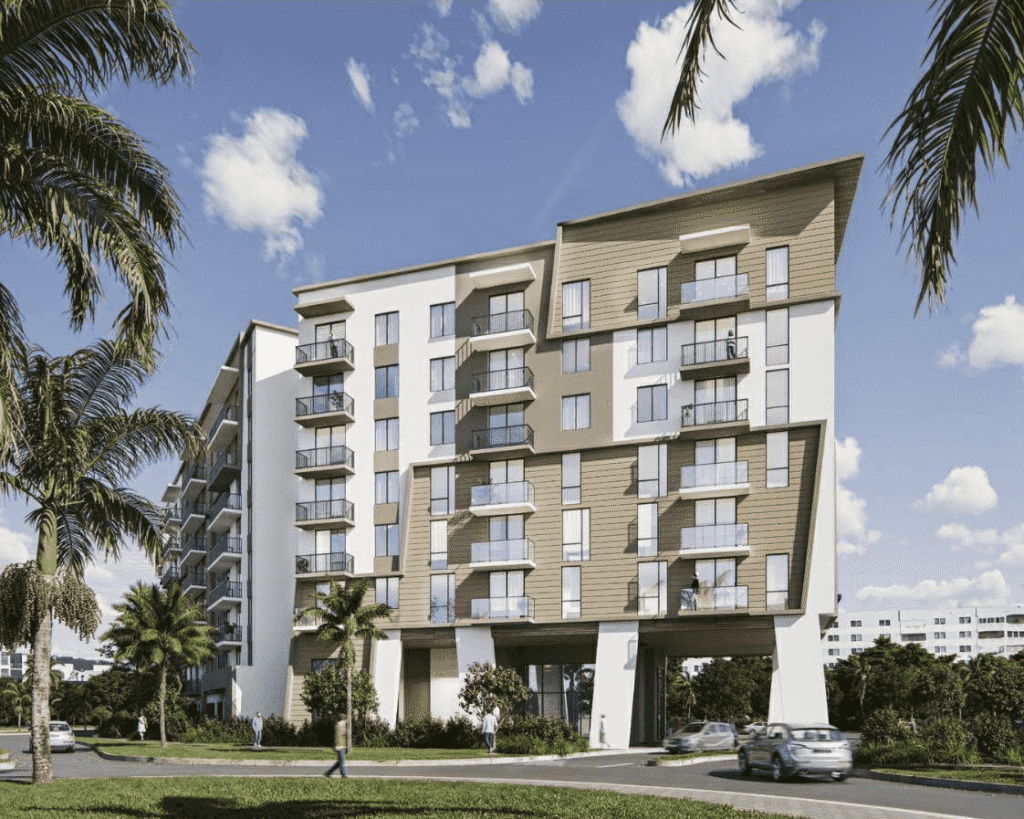
Hillcrest Village, a development by Tobin and the Housing Trust Group, is reaching one of the final stages of approval. After going through minor design variations and changes with the city of Hollywood for years, the development is awaiting final planning board approval. The long-awaited project will be located at 1101 Hillcrest Drive in the Hillcrest subdivision, which currently serves as a mixed-density community catering towards apartments, single family homes, or townhomes. Hillcrest Village will be fully affordable: all 110 planned units will be priced at 80% of the Area Median Income and below. According to the developers, there will be 71 one-bedroom units, 31 two-bedroom units, and 8 three-bedroom units. Of the 110 total units proposed, 15% (17 units) will be put aside for households earning no more than 30% of the Area Median Income, 47% (52 units) for those earning up to 60% AMI, 28% (31 units) for those at 70% AMI, and the remaining 9% (10 units) for households earning up to 80% AMI. This mixed-income distribution ensures a blend of both deeply affordable and affordable units. The Housing Trust Group aims to prioritize leasing for existing Hillcrest residents, as well as local teachers, city employees, and other essential workers. The demand for affordable housing in South Florida remains exceptionally high, driven by a widening gap between wages and the region’s rising cost of living. When Pinnacle Housing opened a lottery in 2024 for just 113 affordable units in Hollywood, more than 21,000 people applied. Tenants will have access to a range of amenities, including a swimming pool, fitness center, business center, outdoor playground for families, and a management office. The ground floor will feature 157 parking spaces for residents. Because the development replaces an existing parking lot used by a nearby charter school, 24 of those spaces will be reserved for school faculty and staff during school hours and made available for building guests during non-school hours. Designed by Realization Architects, the building will rise 8 stories and reach a height of 94 FT. Its exterior will feature a combination of stucco, brown-toned finishes, aluminum and glass railings, and other modern materials. Before the project can officially move to permitting and construction, the Tobin Group and Housing Trust Group must gain approval from Hollywood’s planning board on August 12th, followed by final approval from the City Commission at a later date.
1600 Washington Avenue Set for Transformation with Proposed High-Rise Tower in Miami Beach
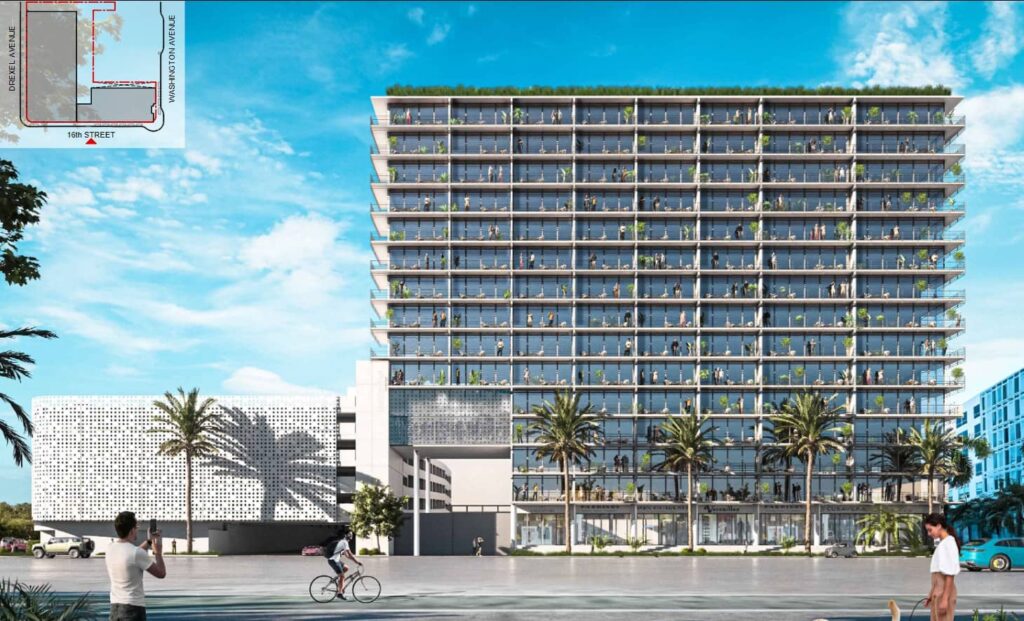
A major property owner has unveiled ambitious plans for a residential high-rise along Miami Beach’s historic Washington Avenue. Positioned at 1600 Washington Avenue, just steps from Lincoln Road, 420 Lincoln Road Development is proposing a 15-story residential tower on land it’s long been familiar with. Led by Ambassador Paul Cejas, the firm owns the adjacent parking garage and several neighboring parcels, giving it a strong local presence in the area. The new high-rise will replace two low-rise buildings dating back to 1938 and 1952. The project will deliver 210 residential units described by the developer’s attorney as “reasonably priced” for “entry-level professionals, young families, or others who work in the City.” According to the attorney’s letter, this new housing addresses Miami Beach’s recent population decline: a concern the City Commission attributes in part to a shortage of “competitively priced housing options.” The development also claims it can assist with traffic congestion by easing the burden of long commutes on residents who are currently priced out of the city. Unit sizes will vary, with floor plans averaging 739 SF and ranging from a compact 550 SF to a larger 1,112 SF layouts. Residents can also look forward to shared amenities including a rooftop deck with a pool, garden, and lounge areas designed to enhance the building’s living. Due to the site’s narrow footprint, ground-floor retail will be limited to 6,900 SF, with no on-site parking provided. Instead, parking and additional retail space, totaling 20,378 SF, will be accommodated within the adjacent parking garage, which already serves the surrounding area. The tower and the garage will also be connected, integrating the two properties. In total, 492 parking spaces within the existing structure will support the new residential and commercial uses. Designed by firms Ten Arquitectos and Beilinson Gomez Architects, the tower is designed to be a modern addition to the skyline, with aluminum sliding doors, smooth stucco finished, curtain glass, and other features planned for the building’s facade. According to elevations, the building will measure 164 FT to its tallest point. Because the project exceeds 50,000 SF and is located within the CD-3 zoning district, a Conditional Use Permit (CUP) is required. As part of the request, modifications to parking requirements are also being proposed. As per the developer, the project meets the applicable criteria underlined in the city’s zoning code. This isn’t the first proposal for the site. Ambassador Paul Cejas has proposed a residential building designed by Stantec in the past, but plans fell through after years of inactivity. Miami Beach’s Planning Board will discuss the newest proposal and its associated requests on September 9th, 2025, at 9 AM.
SobelCo’s ‘South Broadway Condominium’ Project Wins Approval in Riviera Beach
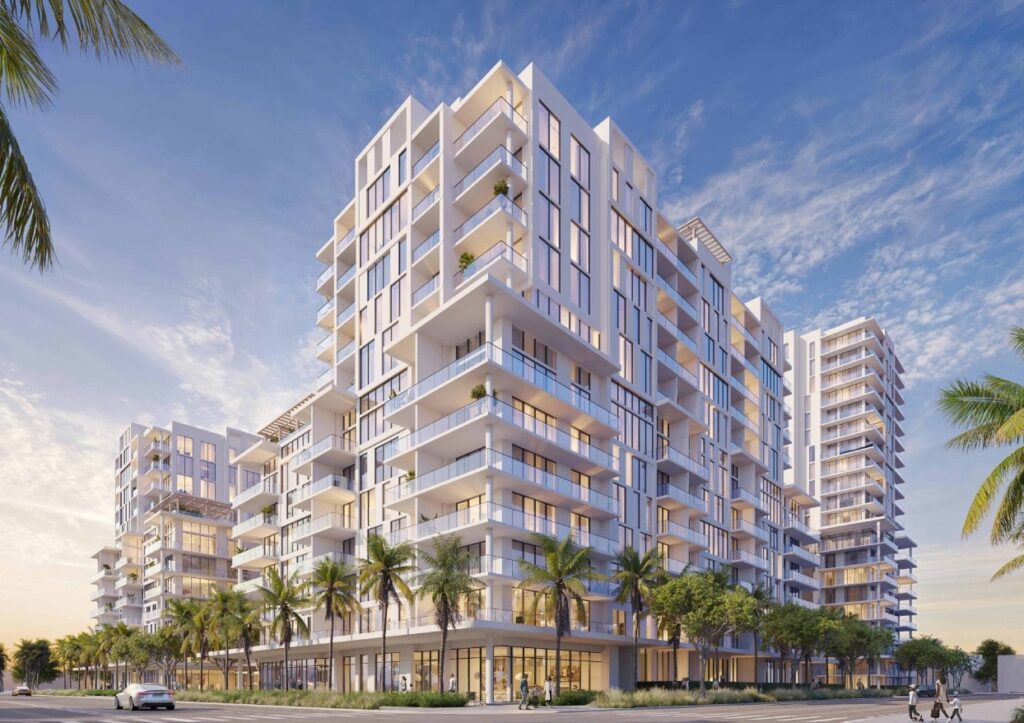
SobelCo, a development firm based in Boca Raton, has recently scored approval for a high-rise development in Riviera Beach called ‘South Broadway Condominium’. The development, which is located on the corner between W 11th St and Broadway at 1117 Broadway Boulevard, will be steps away from the Port of Palm Beach and the newly completed Marina Village. While the development will be one of Riviera Beach’s tallest proposals in years, it isn’t the city’s first recent high-rise plan. In fact, Riviera Beach has seen growing interest from developers eager to capitalize on its waterfront views and amenities. On Thursday, July 24, the Riviera Beach Planning and Zoning Board voted unanimously to approve both the site plan and rezoning request. The development will feature 508 condominium units, ranging from one-bedroom residences to two-bedroom units, with sizes spanning from 872 to 1,467 SF. According to The Real Deal, the homes will be marketed toward young professionals working in or near West Palm Beach, with prices starting just below $1 million. Residents and visitors to the development’s 10,000 square feet of retail and restaurant space will have access to 1,083 parking spaces: 1,066 in a parking garage and 17 along nearby streets. Although plans remain in the early stages, the building is expected to offer a wide range of amenities, including four pools, lounge areas, and other recreational features. According to elevations, the building will actually be separated into 4 distinct towers, connected by a shared podium. Two buildings will rise 13 floors or 139 FT, while the other two will rise to 20 floors and measure 214 FT. Interestingly, the building’s tallest portion will face a side street, Avenue E, rather than Broadway. The facade will feature curtain glass, glass balconies, and brown aluminum decorative panels covering parts of the exposed garage. Before the project can move forward, SobelCo must still gain approval from the Riviera Beach City Council. However, with the old buildings on-site recently demolished, little preparation remains before construction can begin.
Integral Development Secures $9.7M for 100% Affordable Ashley East Tampa Project
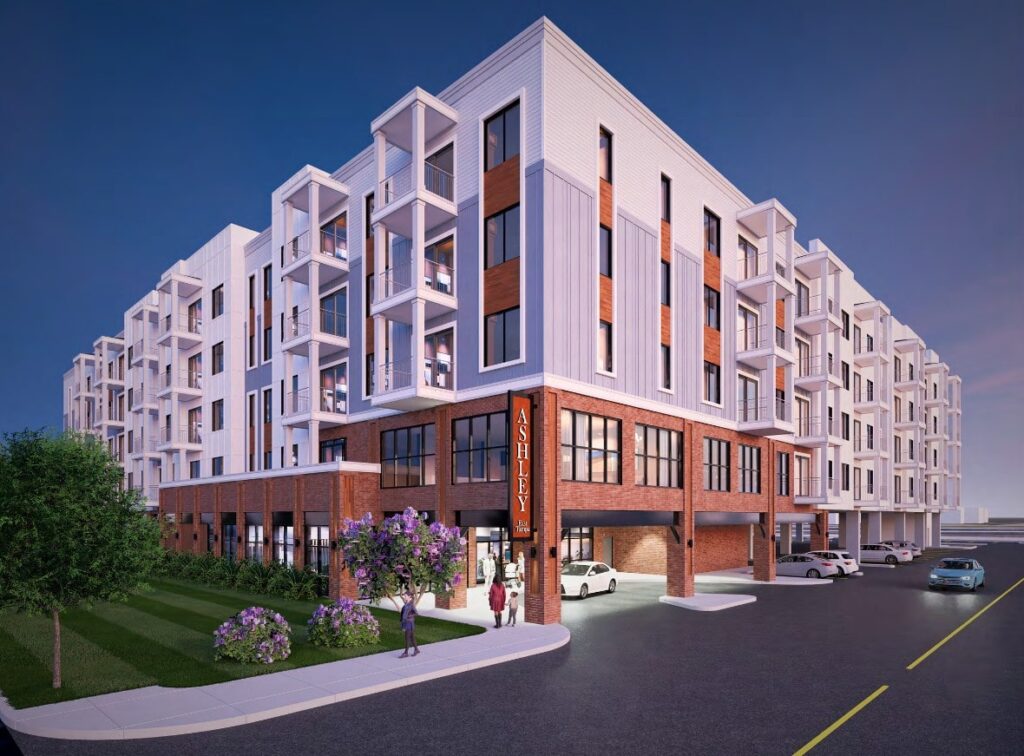
The East Tampa Live-Learn development, a transformative project combining job training with 100% affordable housing, has just cleared a major milestone. On July 24th, Tampa’s Community Redevelopment Agency Board approved $10 million in funding to support the development of the housing component: bringing the long-envisioned community center one step closer to breaking ground. Developed by Atlanta-based Integral Development, the project, coined Ashley East Tampa, will feature 118 affordable units atop city-owned land at 3105 E. Columbus Drive. All units will be restricted for incomes earning at or below 80% of the Area Median Income. More specifically, there will be 23 units placed for those at 30% AMI, 15 at 50% AMI, 43 at 60% AMI, and 37 at 80% AMI. With a mix of studio, one-bedroom, and two-bedroom floor plans, the development is designed to feature both individuals and families: ensuring every unit meets the definition of true affordability. The ground floor of Ashley East Tampa will include over 200 parking spaces, serving both residents and visitors to the nearby future job training facility. Along East Columbus Drive, a landscaped linear park will also buffer the building from the street. While the development itself includes no retail or commercial space, a separate commercial facility, developed by the Tampa Bay Economic Development Council, will rise to the west. This neighboring space will house areas for local businesses, provide vocational training opportunities, and serve as a hub for workforce development. The $9.7 million in CRA funding approved for Ashley East Tampa will support soft costs, site acquisition/parking infrastructure costs, and construction costs. This funding represents approximately 22% of the project’s total development cost. While the project was largely well received by board members, a few concerns were raised around the parking supply and the distribution of affordable units. For instance, Lynn Hurtak, an advocate for reduced parking minimums in Tampa, questioned the need for the parking count. In response, development representatives noted that the parking amount was carefully designed to meet resident demand without creating overflow onto nearby streets. In a city like Tampa, where driving is often the only practical mode of transportation due to the lack of mass transit options, parking remains a controversial issue. Though higher parking requirements drive up the cost of construction, developers are often left with no choice. While Ashley East Tampa secured CRA funding, the project still awaits rezoning approval from Tampa’s planning department. As per a timeline shared during the meeting, construction is expected to begin in May 2026. Kareem Brantley, representing the Integral Group, noted the importance of moving forward with the project: ‘Time is of the essence’, ‘if you don’t move projects forward, the only thing that’s going to happen is the cost is going to go up’.
Hibiscus Grove Breaks Ground in West Perrine, Promising Hundreds of Affordable Units
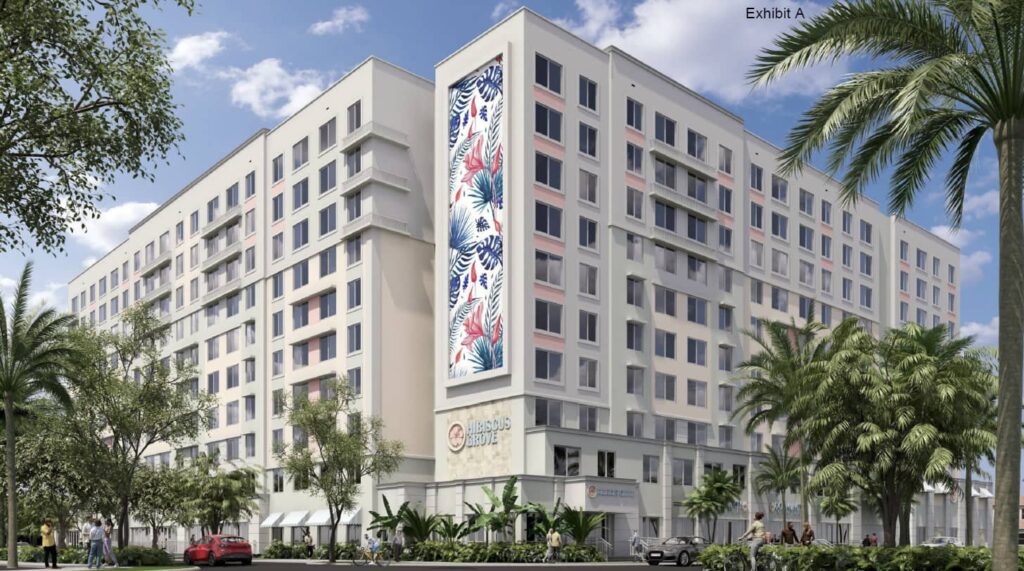
The push for more affordable housing in Miami-Dade has materialized in West Perrine. On Tuesday, July 22nd, Integra Investments along with key Miami-Dade officials like Mayor Daniella Levine Cava and Kionne L. McGhee held a groundbreaking ceremony for Hibiscus Grove. The project, which is a part of a growing trend toward greater density along the South Miami-Dade Busway, will deliver 270 fully affordable units to South Miami-Dade. Units will range from one-, two-, and three-bedroom units, aimed at providing housing for households earning 30%, 60%, or 80% of the Area Median Income. On the ground floor of the development, community benefits do not stop. There will be roughly 5,000 SF of retail space and a 2,700 SF community center leased to the West Perrine Community Redevelopment Agency. The project’s financing was made possible in large part by support from Miami-Dade County, which awarded $5 million in Documentary Stamp funds. The West Perrine CRA also contributed a $2 million loan and $1 million in Tax Increment Financing. The groundbreaking comes as Miami-Dade’s prepares to launch the county’s first all-electric Bus Rapid Transit line, known as the South Dade Transitway. Located just steps from Hibiscus Grove, the new transit option will provide affordable housing residents with a reliable alternative to car travel. It’s important to note, however, that Floridian Development first reported on Hibiscus Grove last year following a proposal to amend unit counts from 270 to 300. That amendment also included a height increase from 10 to 11 floors and additional parking. Despite this, more recent renderings displayed on-site, coupled with county-issued press releases still citing 270 units, suggest that Integra may have opted to scale back toward the original plan. While the 300-unit ASPR amendment remains approved, the available evidence points to a return to the 270-unit proposal. According to Miami-Dade permitting, all permits filed for the building have already been issued. The building is estimated to cost $40 Million once all is said and done.
Water Street Proposes a Mixed-Use Garage as the District Looks for More Parking
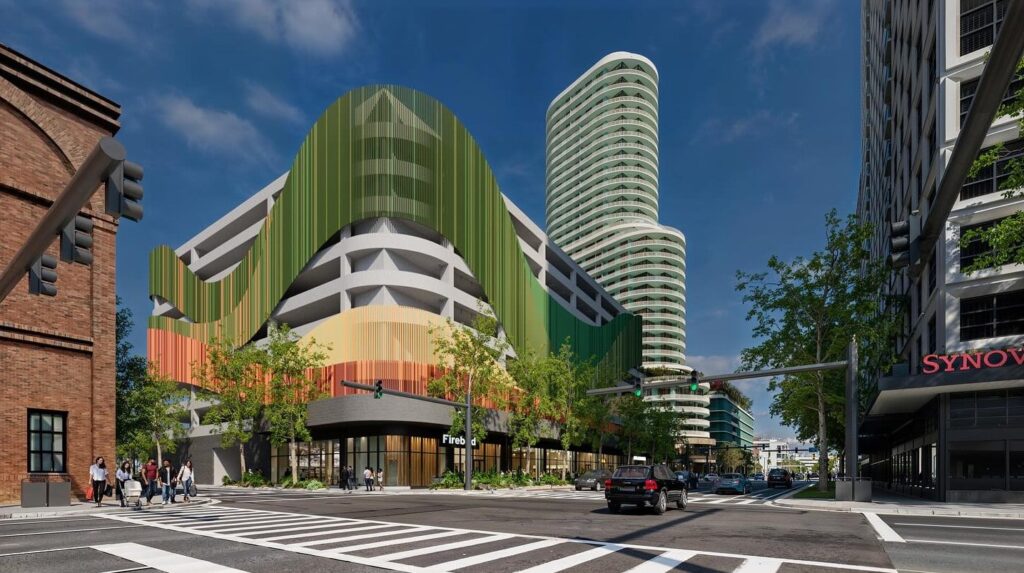
Water Street’s latest addition in its second phase has just been revealed, signaling a major departure from earlier plans. Announced last Friday, the newly unveiled project is a mixed-use parking garage that will take the place of a previously proposed office tower. Originally, the site was intended to host a Class A office building with thousands of square feet of build-to-suit workspaces. Instead, it will now feature a garage offering 675 parking spaces, retail space, and a rooftop area. In a design review board application submitted amidst the press release, the project plans for “the construction of a 10-story mixed parking garage with +/- 19,000 SF of retail and +/- 5,000 SF of restaurant on the first floor and roof deck with +/- 8,500 SF of restaurant totaling +/- 317,885 gross square feet of developed area.” The team behind Water Street Tampa has further clarified these numbers, indicating the building will have 38,000 SF of retail in total and stand 124 FT tall. Alongside the announcement were plans for a one-acre park designed to serve as a hub for concerts, community events, and retail markets. Although the exact location hasn’t been confirmed, it’s likely to be located at Water Street’s 400 Channelside lot, as earlier statements had suggested the area would feature an entertainment venue and community gathering space. Other possible locations include parcels north of E Cumberland Avenue. Although the announcement may come as a surprise, discussions about addressing parking demand have been ongoing for several months. The Tampa Bay Business Journal previously reported that Brad Cooke, executive vice president of development, admitted that SPP “rose-colored glasses on parking” during phase one’s development. Initial hopes for the district imagined a future centered around walkability, with a range of accessible transit options reducing the need for cars and making parking garages like the Cumberland garage unnecessary. However, with transit funding in Tampa now depleted, that vision has dimmed, and the team behind SPP has shifted to a more pragmatic approach. Both the parking garage at 302 S Nebraska Ave and the community park have an anticipated completion in 2027. The design review board submission filed with the City of Tampa on Friday marks the first step toward making that vision a reality.
The Habitat Group Advances Through Permitting for 4 of Their Brickell Projects
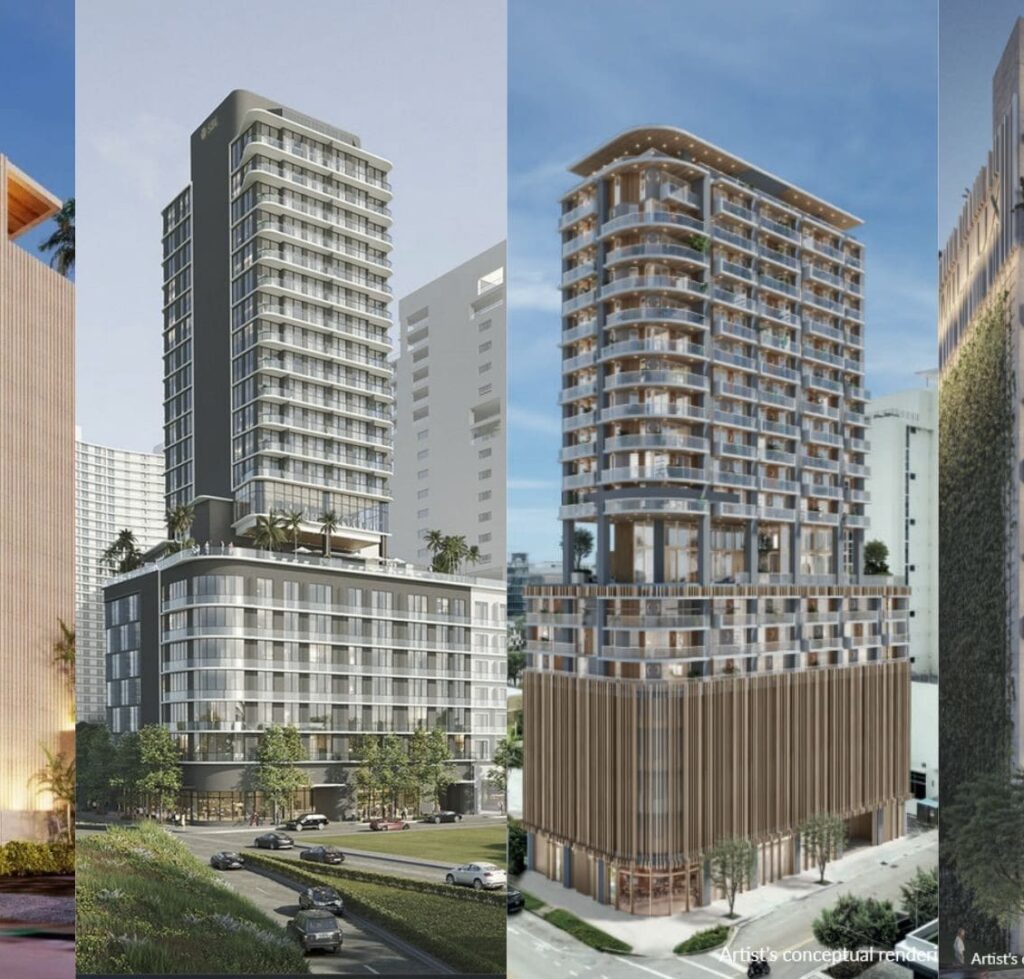
As the Habitat Group is finalizing construction on Smart Brickell’s second tower, the company is moving forward in the permitting process for not one, but four, distinct developments in Brickell. The developer’s latest proposals, including Smart Brickell Luxe, Season One, Millux Place, and Parkside have all had permits submitted for their eventual construction, though some appear to be progressing towards completion more quickly than others. Of the permits submitted, the Habitat Group has filed for master construction permits, foundation permits, demolition permits, tree removal permits, and more. The first project, Smart Brickell Luxe, appears to be the furthest along out of the four projects. The development, which recently received construction financing, has already completed the instillation of all foundation piles according to a LinkedIn post by the project’s architect: Alex Ginard. This aligns with city records, which show foundation and site work permits have been fully approved. Among foundation permits are a vertical construction permit and a master construction permit, both of which require applicant corrections. Parkside is the next fastest-moving project. The 185-unit project at the edge of Brickell has already secured foundation permit approval and is currently under review for its master construction permit. While construction has yet to begin on-site, permitting activity suggests that groundbreaking could happen in the near future. The remaining two projects, Season One and Millux Place, are moving at a steadier pace, with 80 and 99 units respectively. Both recently submitted master building permits. Season One’s was filed on April 25th and accepted on June 23rd, while Millux Place’s was filed on May 14th and accepted on June 18th. Both permits are now undergoing review. However, before construction can officially commence on both projects, they require the submittal and approval of a foundation permit: something both projects do not have. With foundation work already completed at Smart Brickell Luxe and Parkside nearing construction, Habitat Group’s multi-site expansion is moving forward with steady speed. Likewise, the continued progression of Season One and Millux Place through the permitting pipeline suggests that all four projects could be under active construction within the next year, setting the stage for a significant wave of units to come online by the end of the decade in Brickell.
Preliminary Plans Revealed for Gallery at Little Havana at 1275 SW 1st St
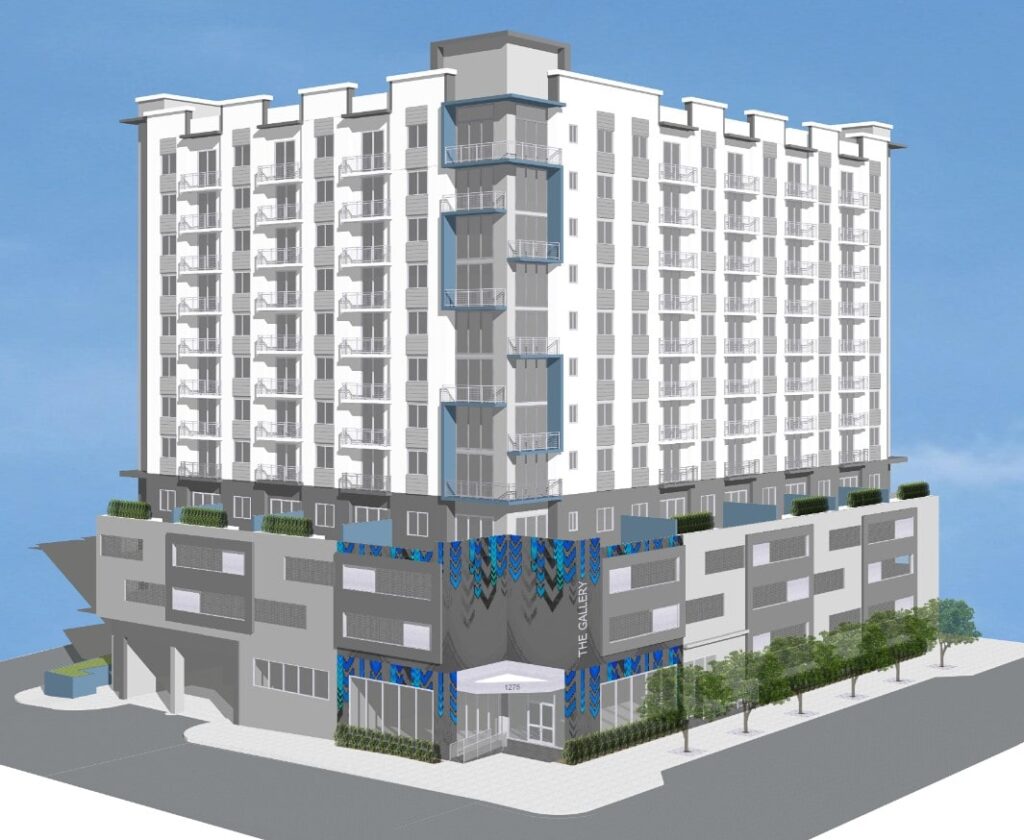
The Related Group is doubling down on its affordable housing push in Little Havana with a new project: Gallery at Little Havana. Situated at 1275 SW 1st Street, early plans designed by Cohen Freedman Encinosa & Associates envision a 12-story high-rise in an area characterized by relatively low and mid-density housing. Although the project is still preliminary, an attorney representing the project has noted its ‘entirely’ affordable, bringing much needed housing to the area. The development will replace 2 three-story affordable housing buildings on-site, which, according to property records, were built in 1985 and contain 28 units. The proposal to revitalize this Miami-Dade site is part of a long-standing deal between the developer and the county, in which the Related Group is positioned to lease multiple sites across Miami-Dade for new development. Like Related Group’s recent Gallery at Marti Park in Little Havana, the project will benefit from the expanded Rapid Transit Zone (RTZ), a designation that offers increased height, density, and reduced parking requirements to developments near transit corridors. In addition, it will utilize the Live Local Act, which is expected to streamline permitting and unlock further incentives. Planned to include 130 units, the building will offer a mix of one- and two-bedroom layouts, ranging from 610 to 980 SF. Residents will also have access to over 2,500 square feet of amenity space, private terraces for each unit, and parking accommodations for 118 vehicles and 12 bicycles. According to elevations submitted by the architect, the building is expected to rise 141 FT to its crown. The podium will span the first three levels, with residential floors beginning on level four. As the project remains in a preliminary phase, all elevations and design elements are subject to change. Before the project can move forward, the development will have to complete its pre-application request, which is still currently under review. Likewise, there have been zero permits filed on the site yet relating to the project’s preparation, including demolition, tree removals, or foundation work.
Integra Investments Advances Redevelopment of Annie Coleman 14 into Mixed-Income Housing
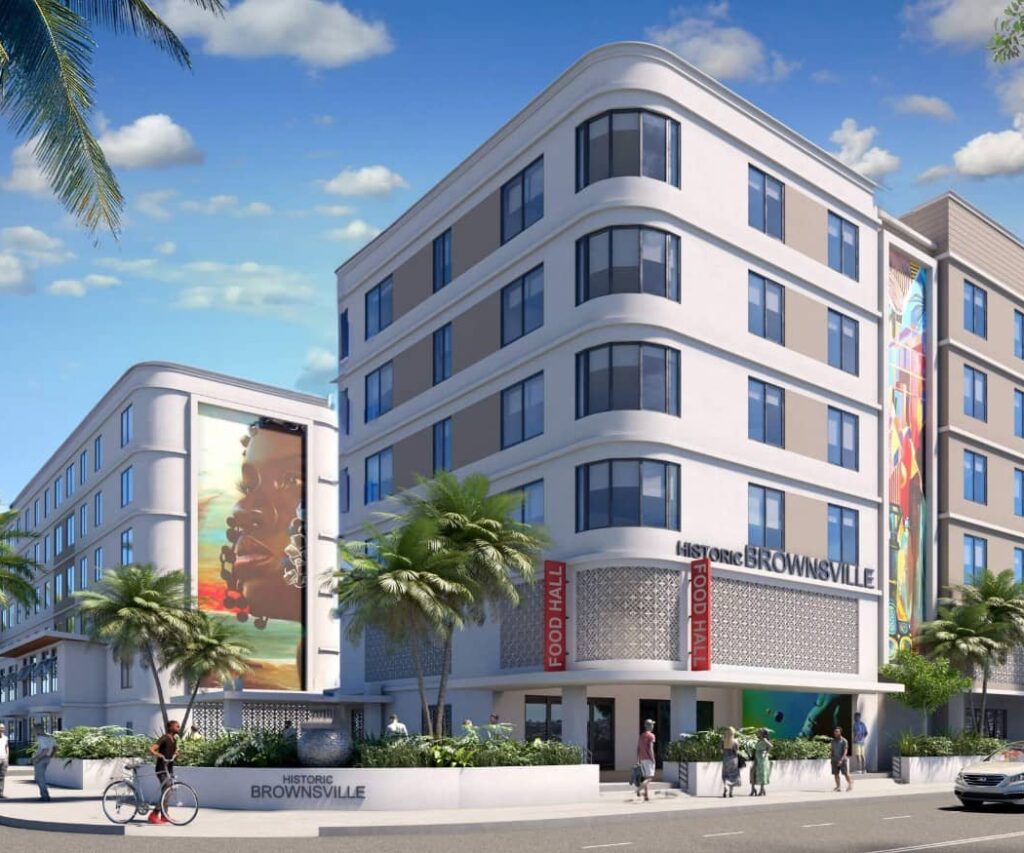
Integra Investments is moving forward with the redevelopment of a portion of Annie Coleman 14, a public housing community featuring 60 residences in Brownsville, Miami-Dade. Located at 2101 NW 52 Street, the property entered a Work Order Proposal Request on August 10th, 2023, whereas Miami-Dade essentially called for qualified developers to redevelop the site into mixed-income housing. Integra Investments was the sole bidder, and is now proposing the development of 316 units, of which 60 will replace the existing units built on-site. More specifically, the 316 residential units will be divided between 156 one-bedroom, 92 two-bedroom, 40 three-bedroom, and 28 four-bedroom apartments. Of these, units are designated across four income levels: 20% of units at 120% AMI, 18% at 80% AMI, 50% at 60% AMI, and 12% at 30% AMI, ensuring a broad range of income levels. Additionally, the project will include commercial space, a food hall, and 371 parking spaces. Residents will benefit from a variety of on-site amenities and community enhancements, such as a playground, covered outdoor patio, fitness center, laundry facilities, community room, and an on-site police workstation. Returning residents occupying the 60 replacement units will also receive 3 years of free high-speed internet. The redevelopment, designed by Lantz Boggio Architects, will consist of a six-story building accented with murals along its facade. Landscaped greenery will compliment both the street and the structure, while walk-up units along NW 21st Avenue will create a more welcoming pedestrian realm. As part of the redevelopment, Miami-Dade County stands to receive over $136 million through a combination of financial agreements, including a Master Development Agreement and a 99-year ground lease with Integra. This revenue includes capitalized ground lease payments, annual rent, developer fees, and a percentage of the project’s net cash flow. From the developer fees, 5% will be directed to the Brownsville Civic Neighborhood Association, while 10% of both net cash flow and residual profits will support the Brownsville Historic Endowment for the Curation of Public Art. The Housing Committee unanimously approved the resolution to award development rights to Integra, with final approval now pending from the Board of County Commissioners. The project is expected to close in late 2027, requiring Miami-Dade County to provide a solution such as interim housing support for displaced residents during the redevelopment period.
VDG Land Gets Green Light for Mixed-Income Apartments Aimed at Breakers Hotel Staff
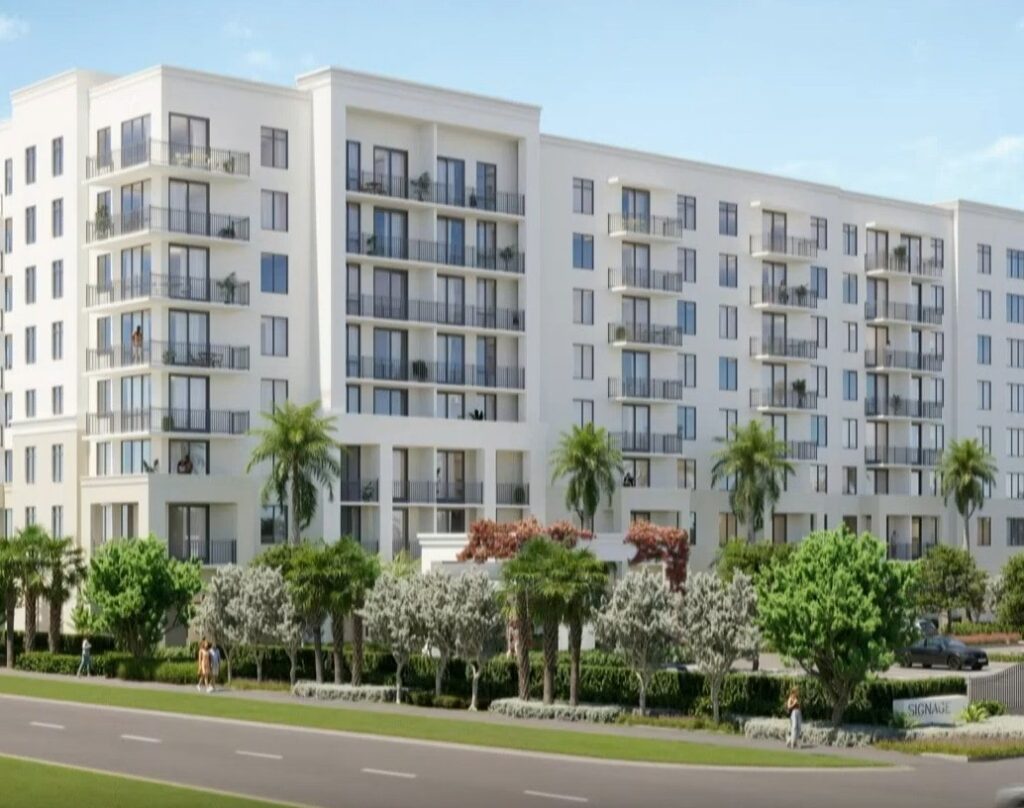
VDG Land Company has just gained approval from the City of West Palm Beach’s Planning Division for their newest proposal: an 8-story multifamily building aimed at housing Breakers Hotel employees. Located on a 2.46-acre site at 2410 and 2460 North Australian Avenue, the site will include 155 units, of which 51% of the units are designated as workforce. Residents will have access to a variety of recreational amenities, including a pool, sports field, clubroom, fitness center, conference room, salon, and a dedicated shuttle service for Breakers employees. On the south portion of the site, there will be 65 parking spots available for employees. Although architectural elevations were not shown during the meeting, the project, designed by Spina O’Rourke & Partners, is expected to reach approximately 80 FT in height, making it the tallest building in the surrounding area. While VDG Land Company owns the northern portion of the site, the southern portion actually belongs to the City of West Palm Beach. As such, the city is negotiating a land agreement with the developer that would allow the integration of the southern portion, home to a water pump station and largely vacant land, into the overall project. Under the terms of the deal, the vacant land surrounding the pump station will be converted into surface parking for Breakers employees, and in return, the city will receive infrastructure upgrades to the water pump facility. At the planning board meeting, the proposal was unanimously approved given the developer meet conditions requested by staff. The approval means a change to the property’s Future Land Use (FLU) and zoning designations. Specifically, the northern portion of the site was reclassified from Neighborhood Commercial to Multifamily High-Density Residential, while the southern portion shifted from Recreation and Open Space to the same residential category. The approval marks one of the many steps in a years-long effort by the Breakers Hotel to house and/or benefit employees. In a quote provided by CBS 12, a Breakers representative noted, “The independent resort, one of Palm Beach County’s largest private employers, makes an unrivaled commitment to its team by offering comprehensive benefits, robust resources for associates and their families, and excellent compensation—all part of its employee-centric culture.” The development still needs to move through additional approvals, permitting, and demolition work before construction can begin.
Mill Creek and Group P6 Gain Planning Board Approval for ‘Modera Boca’ in Boca Raton
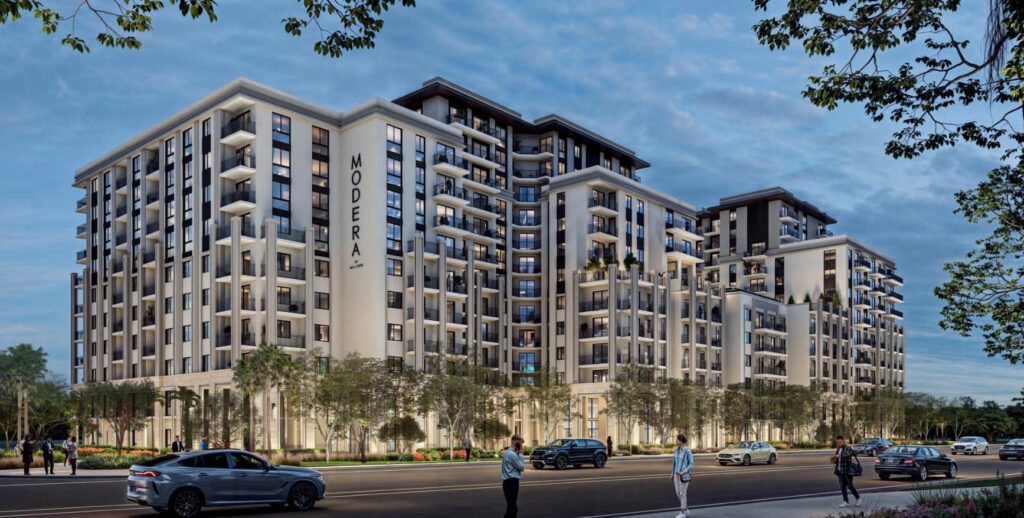
Mill Creek Residential is slowly expanding their ‘Modera’ brand across South Florida, and downtown Boca Raton is the next destination. The firm, along with partner developer Group P6, recently submitted plans to Boca Raton’s planning and zoning board for a 12-story building at 400 S Dixie Hwy in Boca Raton, set to replace an existing office on-site. The building will be called Modera Boca. The development, which was reviewed by staff in late June, received unanimous approval for various reasons, including the site’s emphasis on greenery and design. While the approval isn’t the last remaining piece before construction can begin (that lies in the hands of city council members at a future meeting), the approval is one step in the right direction for Mill Creek Residential. Plans for Modera Boca include 306 units, ranging from studios, 1-bedroom, 2-bedroom, 3-bedroom, and penthouse units. Units will range from 701 SF at the lowest, to 2,870 SF at the highest. Residents will have access to various amenities throughout the building, including but not limited to a clubhouse, fitness center, a pool, amenity room, and lounge areas. Boca Raton places a strong emphasis on architectural quality and visual harmony, and the building’s design and landscaping align closely with the city’s standards. For instance, while the ground floor includes zero retail space, the development includes the construction of a new linear park along SE 3rd St, featuring widened sidewalks and abundant greenery. “We wanted to make sure that front was very vibrant. So we have zen gardens. We have putt-putt golf. We have sitting areas. We have green walls. We have a lot of activity going on in our property on Dixie Highway even before you get to the building,” according to a quote provided by Sun Sentinel of Ele Zachariades, an attorney for the project. According to submitted elevations, the building will reach a height of 142 FT at its tallest point. Parking, totaling 468 spaces, will be accessed via a private alleyway at the rear of the property, where a screened parking podium will be strategically positioned to face away from public view. This configuration minimizes visual impact while improving traffic circulation. Although Boca Raton’s code traditionally requires 538 parking spaces for a project of this scale, the developers secured a reduction by lowering parking ratios for studio and one-bedroom units.
Cassa Residences, a 17-Story Tower, Approved in Aventura
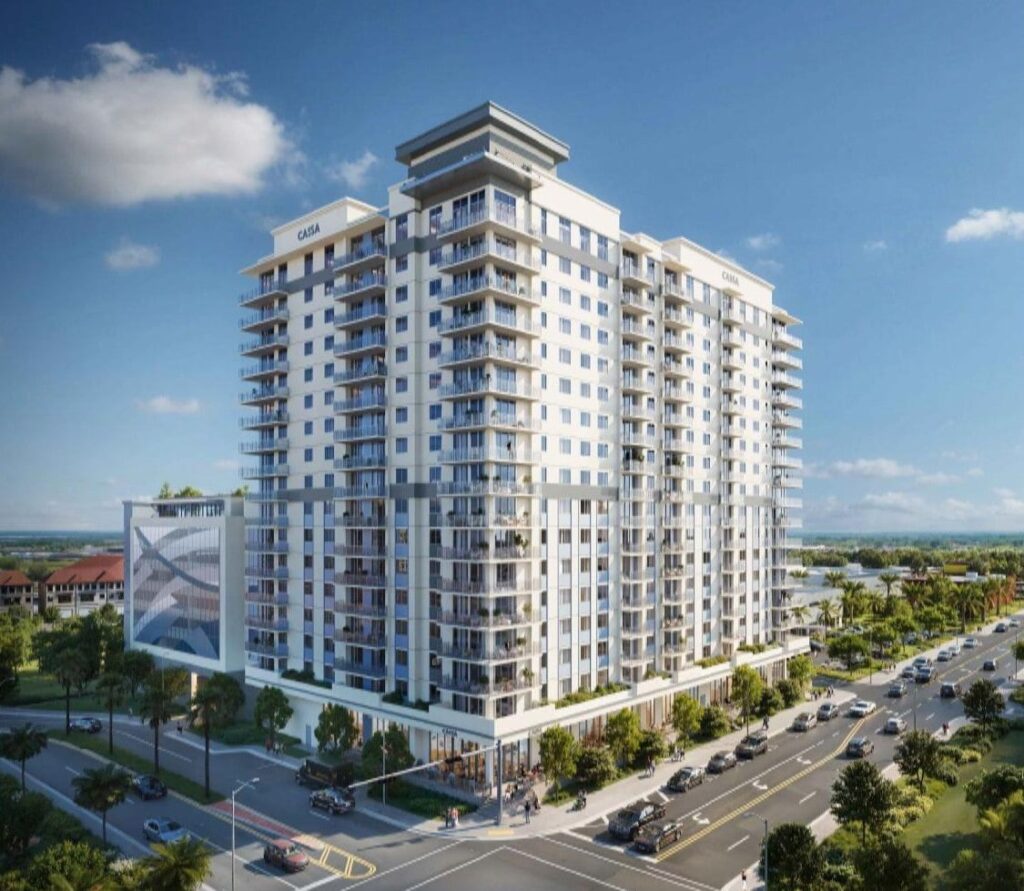
Cassa Residences, a development by The Lojeta Group and Miami Off Center Associates, was recently approved for a 17-story tower in Aventura. The multifamily high-rise proposed at 2850 NE 187th Street will replace a low-rising retail building from the early 1980s. The developers sought multiple code exceptions, including conditional use approval to allow greater height and density, a reduced floor area minimums for one-bedroom units, and various variances like a change in required setbacks. While full plans such as elevations or a site plan have yet to be submitted, the project is expected to include 208 residential units, approximately 12,000 SF of ground-floor retail, and 456 parking spaces. The 17-story tower will rise to 174 FT in height, not including architectural ornaments or mechanical elements. Designed by Cohen Freedman Encinosa and Swerdoe Architecture, the tower is thoughtfully positioned with the front facing NE 187th Street, while a screened parking garage will face NE 28th Street, minimizing visibility from the public realm. In exchange for the requested code deviations, the developers have proposed several public benefits. These include 12 designated Hero Housing units intended for essential workers such as firefighters, teachers, and healthcare professionals. In addition, the development team will contribute $1 million toward capital costs for the construction of a new charter school, along with an additional $1,000 per Hero Housing unit: totaling $12,000. The vote, in a joint meeting with Aventura’s City Commission and Planning Board on July 1st, reached almost a unanimous approval for all items presented, with the sole no vote being Commissioner Clifford B. Ain. A primary concern voiced in the meeting is the future concern of the Live Local Act. The Live Local Act has rendered cities like Aventura unable to control development that exceeds city-approved density and height. This approval, in hand, theoretically reduces the possibility of a future taller, denser building on-site. Although an official construction timeline has not been released, progress is expected to be relatively smooth given the development team’s experience and the minimal demolition required on-site. According to Aventura requirements, building permits must be consistent with submitted drawings unless changes are made through an administrative site plan approval.
Rio Vista Apartments Proposed Near the Miami River
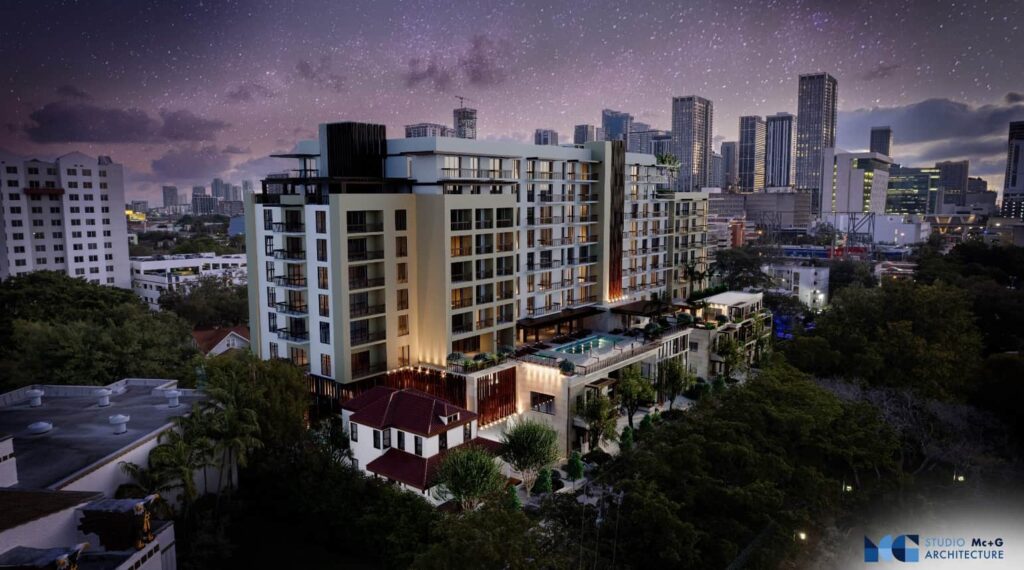
Bricka CB Development, a collaboration between Bricka Real Estate and CB Development, has proposed a multi-story residential building near the border between Overtown and Downtown Miami. Located at 413 NW 3rd Street, the development will sit in front of Lummus Park, a waterfront park nestled in the Lummus Park Historic District. Plans include the construction of a 10-story tower, designed by Studio Mc+G Architecture, set to include 140 units. Units will range from studios, 1-bedroom, 2-bedroom, and townhome units. While plans are not finalized, the building will include abundant amenity space for residents including lounge space, a gym, a pool, and other amenities. The ground floor has been designed to meet historic preservation standards by integrating the existing 1920-built home at 453 NW 3rd Street into the project’s layout. The historic building, offering nearly 3,000 SF of interior space, will be preserved as part of the overall development. Surrounding the preserved home, the project will feature street-level townhomes, a lobby, and a parking podium discreetly hidden from public view. The garage will accommodate approximately 160 vehicles, with an additional 10 parking spaces provided along the street. To improve walkability and the overall streetscape, the development will also include wider sidewalks and added landscaping throughout the property. According to elevation plans, the building will rise 130 FT to its tallest point, aligning with the scale of other recent developments in the neighborhood. The design also pays homage to the area’s historic character through a careful mix of materials and finishes, including coral walls, terracotta finishes, bronze detailing, and traditional stucco. Before the project can move forward, it has to gain approval by Miami’s Urban Development Review Board. The meeting will be held on July 16th, 2025.
7501 NE 2nd Avenue Joins Miami’s Growing List of Live Local Projects in Little River
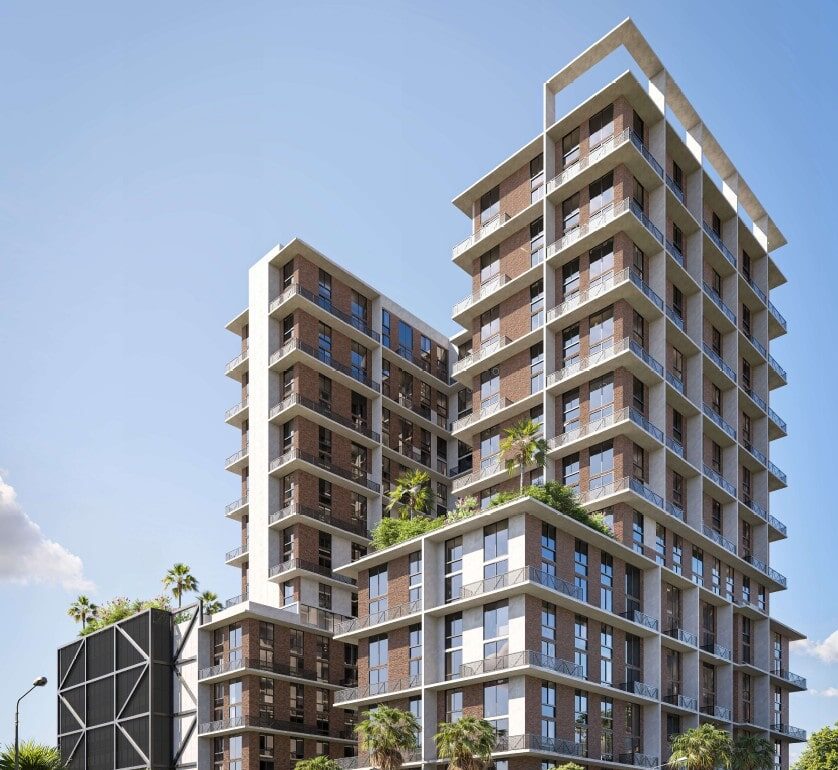
Miami’s Little River neighborhood is facing yet another ‘Live Local Act’ high-rise. The development, which will rise on the corner of NE 2nd Avenue and NE 75th Street, is joining a growing cluster of planned and already completed high-density projects in an area once conceived as an industrial corridor. Backed by Midtown Capital Partners and designed by Corwil Architects, the development will bring a U-shaped 22-story building to the area, containing ground floor retail, amenity space, and a blend of workforce and market-rate units. The building is proposed to include approximately 350 residential units, offering a mix of studios, one-, two-, and three-bedroom configurations. Under traditional zoning regulations, this level of density would be considered highly uncharacteristic. The site lies within a T6-8-O zone, which typically limits density to 150 homes per acre. However, the Live Local Act significantly expands that threshold, allowing up to 1,000 homes per acre for qualifying projects. This dramatic increase in allowable density comes with a condition: developers must reserve at least 40% of the units for workforce housing, defined as housing to those earning up to 120% of the Area Median Income (AMI). For this development, that requirement translates to a minimum of 140 workforce units, with the most common workforce unit being a 1-bedroom and 2-bedroom unit. On the ground floor of the project, there will 5,912 SF of retail, a lobby, and a leasing office facing NE 2nd Avenue. To handle an increase of pedestrian traffic from retail patrons and residents, the existing sidewalk will be expanded to 28 FT. The project will also include 406 parking spaces: significantly fewer than what the Miami’s zoning code would typically require. While standard code would call for 575 spaces for a development of this scale, the project qualified for a 30% reduction due to its location within a designated transit corridor, where walkability and public transportation access justify lower parking counts. According to elevations, the 22-story tower will rise to a maximum height of 235 FT. While the site’s zoning traditionally caps buildings at 8 floors, the project is leveraging height from 1 mile away. In this case, the Magic City Special Area Plan (SAP), located within one mile of the site, permits buildings up to 25 stories. Located at 7501 NE 2nd Avenue, the existing property will require extensive demolition before site work can begin. While the UDRB will approve or deny the project based on compliance with code and design standards on July 16th, the project lies in a contested area that may bring challenges to the project’s approval down the line. For instance, The Magic City Innovation District, which is located blocks away, has been facing years of community concerns regarding displacement from gentrification.
Seven Broadway by YTECH Submitted to Miami’s Urban Development Review Board
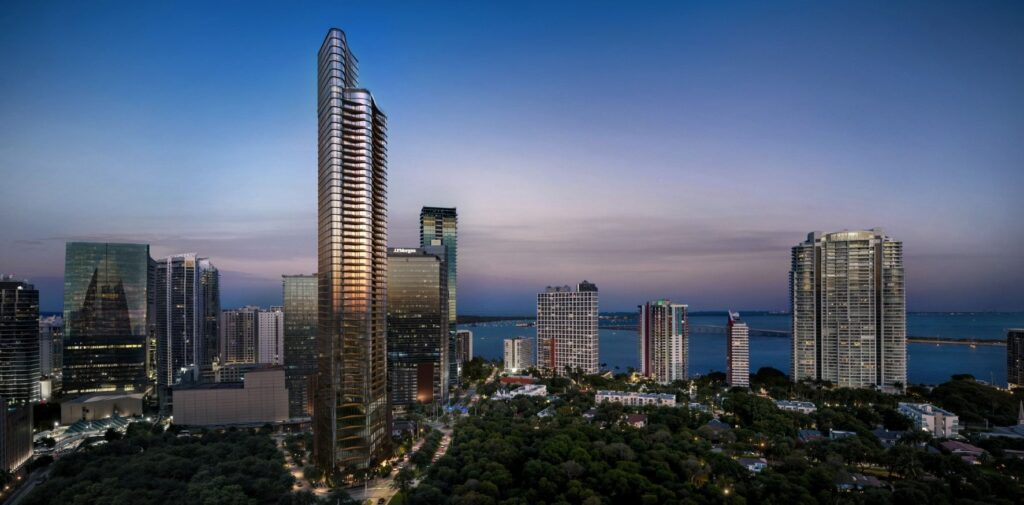
YTECH is back with another skyscraper in Brickell: this time dubbed Seven Broadway. After teasing the tower a month ago, YTECH has finally submitted official plans to Miami’s Urban Development Review Board, unveiling new information to the public. The building, designed by world renowned KPF Architecture, will sit at a corner lot in South Brickell, almost serving as an entry point to the neighborhood. The 54-story tower, which is bound by SW 15th Rd and SW 1st Avenue is located at 75 SW 15th Rd. Planned to include 113 residences, the tower will offer generously sized units ranging from 1,380 to 5,932 SF. Layouts will span one-, two-, and three-bedroom configurations, with the top floors reserved for 3 full-floor penthouses on levels 46 through 48. While still in early stages, current plans call for a resident-exclusive amenity level on the 50th floor, featuring a lounge, rooftop terrace with views of Brickell and Biscayne Bay, and a pool. According to the tower’s floor plans, there will be no retail space at ground level. Instead, the developer has designated the ground floor for a residential lobby and a private office space for staff. Parking will be housed in the basement and on floors 2 through 7, offering a total of 193 spaces. To maximize efficiency, the building will use mechanical parking lifts, allowing 2 vehicles to occupy the footprint of a single traditional spot. Mechanical parking lifts have become increasingly common in South Florida residential developments, enabling projects with limited area, like this one, to maximize parking without sacrificing key space. Elevations provided by KPF showcase the 54-story tower rising 682 feet. While the building reaches 54 stories to the mechanical roof, the highest occupiable floor is level 50. To maintain a clean street presence, the design cleverly conceals resident parking behind a fully glazed podium, rather than offering art or a mesh facade. This seamless integration reflects KPF’s focus on fluidity in the design. According to a letter provided by the firm, ‘the project offers soft geometries throughout, including the building envelope which is accentuated by an undulating profiled horizontal band. This feature looks to add richness in material, color, and movement through the dynamic swell as it goes around the building form. To maintain the single expression, the tower façade continues down through the parking podium ensuring a high caliber aesthetic. The ground floor boasts a glass storefront allowing visibility into activated program.’ Before the project can break ground, the site has to be demolished. YTECH has already demolished the eastern building on-site but has not filed a demolition permit for the western building. A hearing for the project will be held on July 16th at 2 P.M., where Miami Urban Development Review Board Staff will analyze the project’s design efforts and compliance with code.
Banco Santander Advances Towards Construction with Newly Filed Permits
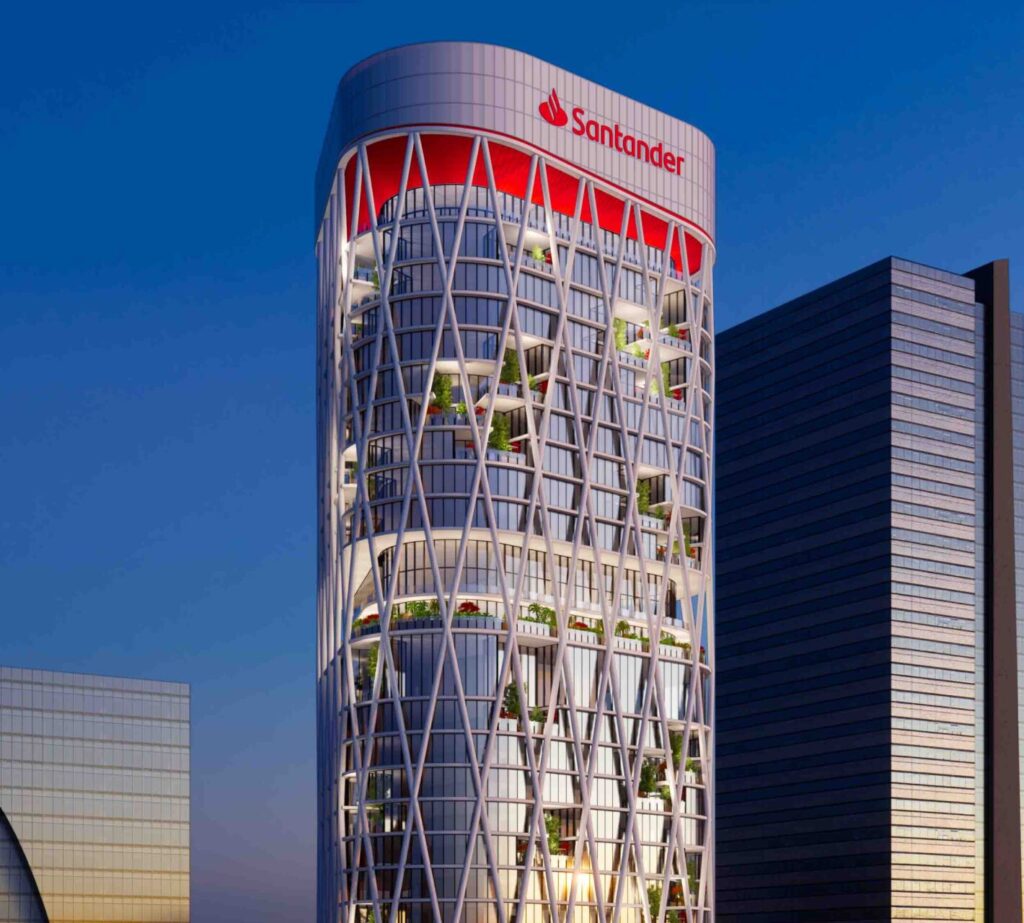
As demolition crews wrap up work on Banco Santander’s 14-story office tower in the heart of Brickell, plans for their newly proposed 40-story office tower are slowly chugging along. In fact, construction permits have recently been filed for the tower’s eventual rise, including a foundation and site work permit, a master construction permit, and a phased vertical construction permit. While all three permits remain under review, their eventual approval will pave the way for construction to officially begin on Brickell’s tallest office tower, surpassing the recently constructed 830 Brickell. The first permit submitted, the master construction permit, has been under review for about 80 days and still requires several revisions before it can move forward. Coastal Construction is listed as the general contractor on record for the project. According to the building permit, the tower will include 634,890 SF of office, 38,865 SF of restaurant space, 35,542 SF of recreational SF, and 39,981 SF of retail. To house both patrons and office workers alike, the tower’s 15-story podium will include 519,500 SF of parking. While plans filed to Miami’s Urban Development Review Board last year indicate the 40-story tower rising to 765 FT, new plans show a slight reduction to 758 FT. In all, the tower’s impressive height will rack a steep construction cost, with more than $200 million spent in construction alone. The most recent permits filed, the foundation/site work permit and the vertical construction permit, were both submitted on March 19th of this year. Miami staff accepted the foundation permit in late April, while the phased vertical construction permit was only approved recently on June 2nd. As of July, Banco Santander has yet to announce a groundbreaking date. While Miami’s office market has seen a sharp slowdown due to a steep decline in preleasing activity, it remains unclear whether Banco Santander plans to secure office leases before beginning construction or will proceed regardless of market conditions. The tower’s mixed-use design, including substantial retail space alongside office areas, could provide a strategic advantage in this uncertain environment. Rilea Group is serving as the coordinating developer, with Handel Architects responsible for the tower’s design. The building’s design is touted as ‘among the world’s most sustainable office buildings’, with the diagrid design handling gravitational and wind loads, in turn reducing structural concrete by more than 30%. Along the tower’s facade, terraces will provide both open space and shading from the Miami sun.
Swerdlow Group & SJM Partners Plan Major Redevelopment of 40-Acre County Site in Miami-Dade
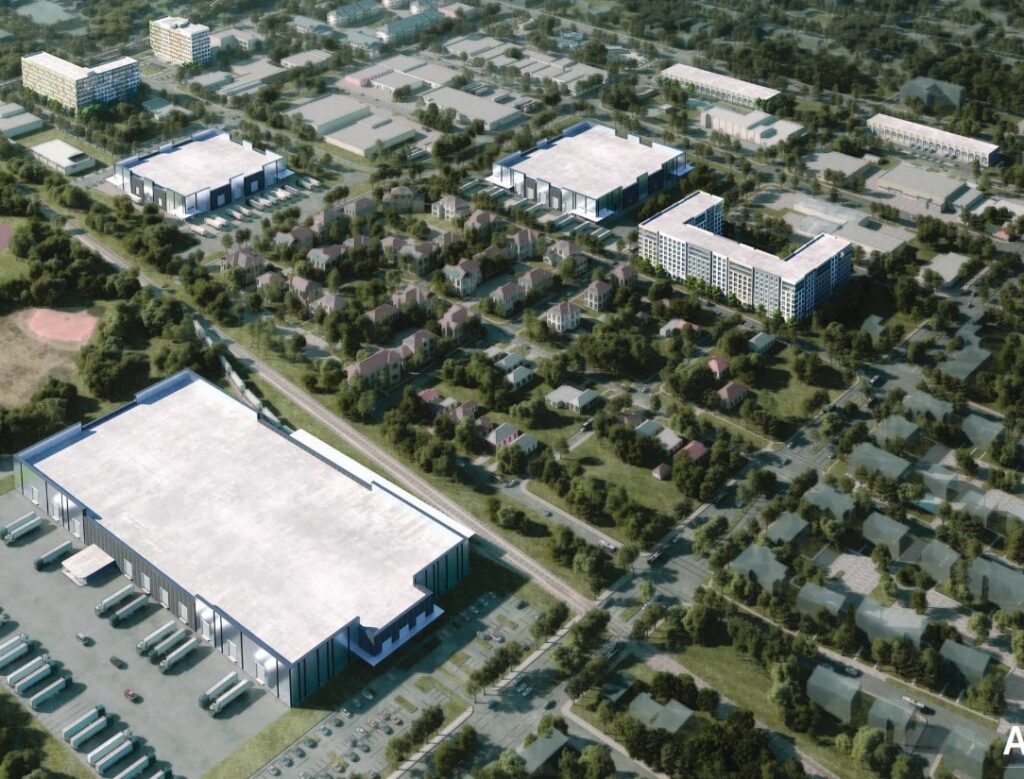
After gaining approval for Miami-Dade’s largest affordable housing project in the county’s history, the Swerdlow Group is back with another mega-project, this time under a joint venture coined ‘SG Ponciana Ventures’. The partnership, backed by Michael Swerdlow of the Swerdlow Group, Stephen Garchik of SJM Partners, and Alben Duffie, are seeking approval for a land deal with Miami-Dade that would deliver around 40 acres of retail, housing, and industrial uses to suburban Miami-Dade. The development of county-owned land will proceed in three phases within close proximity of Metrorail service, providing alternative transit routes to the new residents and workers. Phase 1 will deliver 155 affordable housing units for seniors earning up to 60% of the area median income, along with two retail spaces designed to attract both national and local tenants. It will also include 251,000 SF of industrial space for MedLog, an affiliate of the Mediterranean Shipping Company: the world’s largest shipping container operator. MedLog’s facility is expected to create approximately 300 logistics and supply chain-related jobs. Phase 2 will add a 110,000 SF small-bay industrial facility and 175 affordable and workforce housing units for residents earning between 60% and 120% of the area median income. The final phase, Phase 3, will feature a 479 unit mixed-income residential building, another 110,000 square feet of industrial space, and 15,000 SF dedicated towards Unite Here HEAT. Unite Here HEAT will be a training facility offering workforce re-entry training, restaurant space, immigration services, and language classes. Residents no matter the building will have access to high-speed WIFI, a communal swimming pool, adequate parking for vehicles, parking areas for bicycles, a washer and dryer in every unit, as well as other modern amenities. While already existing, the Frederica Wilson Community Health Center will be doubled in size to accommodate the demands of the community. The deal between Miami-Dade and the developers will consist of a proposed purchase of MedLog’s industrial site for $33 million, deducting costs for environmental cleanup and improvements. In addition, for every affordable housing unit constructed, the developer must pay the County $5,000 per unit until closing, 15% of net cash flow from operations, and 30% of all developer fees for units constructed under the Low-Income Housing Tax Credit Program. Workforce and market-rate housing will also pay the county $5,000 per unit, but only 10% of net cash flow from operations. Arquitectonica and Bruce Retzsch are the main architects of the project, while Coastal Construction will serve as the general contractor. Although phasing is still preliminary, the project is estimated to take 7 years or around 80 months once permitting commences.
4th Avenue Apartments Moves Forward, Set to Replace the Historic Tamborello Bros. Service Station in Ybor City, Tampa
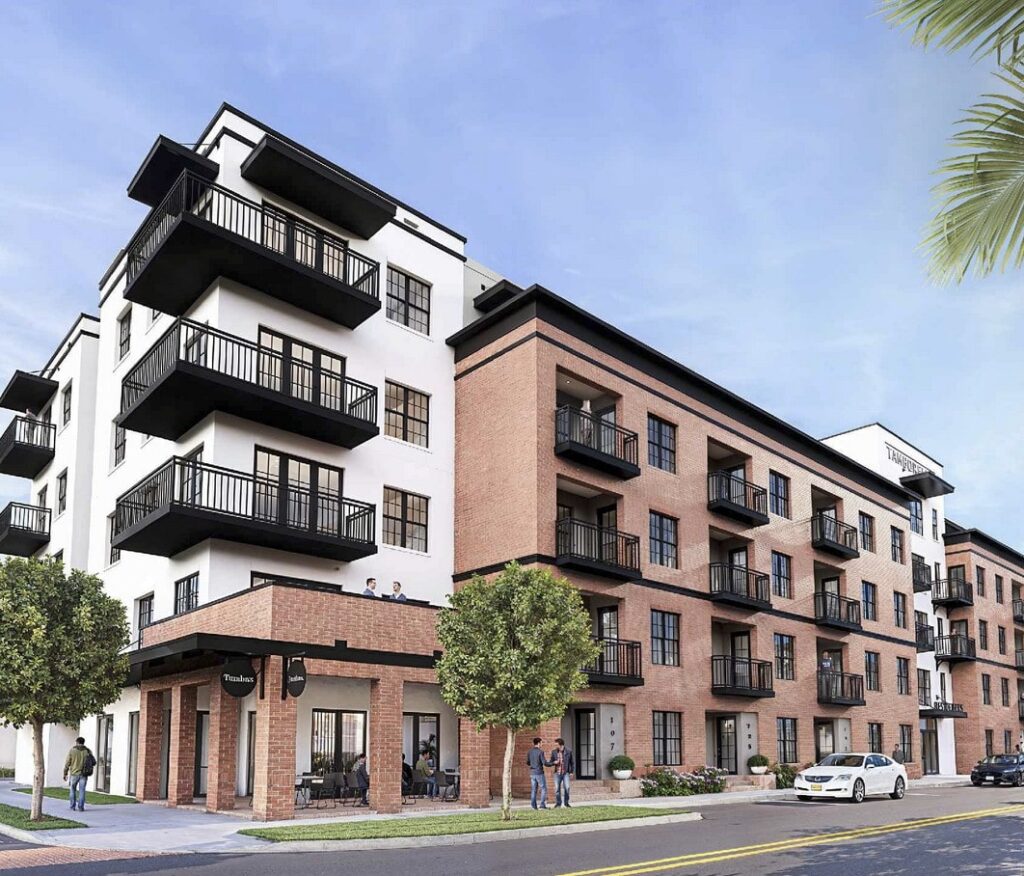
After nearly three years of working through Tampa’s Barrio Latino Commission, the development team behind ‘4th Avenue Apartments’ is advancing with a revised proposal for their five-story residential project in Ybor City, with eventual construction in the near future. The development, spearheaded by James Hettinger, LLC and Clendenon Properties, LLC, features an updated design by GROH Architecture with significant adjustments to the building’s height and layout. While original plans approved in March 2024 included a 56-FT facade along 4th Avenue, the revised version lowers that to only 44 FT. This visual setback introduces a private balcony for residences but also creates a visual improvement of the facade along 4th Avenue. Because the setback removed a large portion of interior space, the building will be pushed further back on the site to preserve the original unit count of 93 apartments, maintain the total parking count, and retain the corner bodega. This shift allows for larger floor plates and the integration of a mechanical lift parking system. The update eliminates the need for off-site parking leases originally planned for in the old proposal, as 97 spaces will now be accommodated on-site. Additionally, the corner bodega will be slightly expanded from 803 to 883 SF. While the overall unit count remains steady, the updated design adjusts the apartment mix slightly, increasing the number of studio and two-bedroom units while reducing one-bedroom units. The project also retains its commitment to high-quality materials, featuring red brick facades, metal railings, mosaic flooring, and Cuban tiles at the bodega entrance, elements encouraged in Ybor City. Poised to occupy nearly half of the block between E 4th Avenue and N 17th Street, the new development will involve the demolition of the former Tamborello Bros. service station: a significant part of Ybor’s history that operated from 1946 to 2016. Although the building’s official name has yet to be finalized, renderings feature the word “Tamborello” displayed at the top, suggesting both a tribute to the site’s past and a possible name for the future residence. The development has already been in a public hearing, with another taking place on July 31st at 10:30 AM. No construction permits, including foundation work or demolition, have been filed for the property at 1715 E 4th Ave.
Floridian Development Introduces ‘Floridian Advanced’, a Free Service Providing Comprehensive Development Info Across Florida
Floridian Development is proud to introduce Floridian Advanced, a free, easy-to-use tool designed to help anyone stay informed about the major developments shaping Florida’s future. From towers rising in downtown Miami to mixed-use communities planned in Tampa or Fort Lauderdale, Floridian Advanced brings all the details together in one centralized platform, no paywalls, no sign-ups, no stress. Florida’s real estate landscape is constantly evolving, with hundreds of new developments proposed, approved, or breaking ground every year. For many, keeping track of these projects means sifting through complicated planning documents or relying on hidden, outdated reports. Floridian Advanced changes that. It offers a clear, well-organized view of the latest projects with data pulled directly from official sources and presented in a clean, simple format. But this isn’t just a site about unit counts. Each listing on Floridian Advanced is thoroughly researched to provide enhanced context, including details like total square footage, floor count, proposed height, number of parking spaces, retail/commercial components, and more. Most entries also include site plans, elevations, or architectural renderings when available, offering visual insight without needing to go through city PDFs or planning agendas. Getting started is simple. Just click the Floridian Advanced tab in the header. You’ll be greeted by a home screen that explains how the system works and how to navigate it. From there, select the city you’re most interested in, and explore away. Each project is categorized by status or type, from multifamily to office or planning to construction so you can filter based on what matters most to you. Who’s this for? Floridian Advanced was built for anyone with a stake or interest in Florida’s growth. Whether you’re a broker trying to understand the local pipeline, a journalist seeking accurate project data, or a resident curious about what’s being built down the block: this platform is for you. This release marks an exciting step forward in Floridian Development’s ongoing mission: to make Florida’s evolving real estate environment more understandable, transparent, and accessible to those who care about it most. Today’s update is just a start to an exciting evolution for the website. Stay tuned for updates including a development map, added cities, and cosmetic/technical updates designed to make your life easier.
Sky-High Plans: Related Group and Macklowe Plan Two 43-Story Towers at 8000 East Drive, North Bay Village
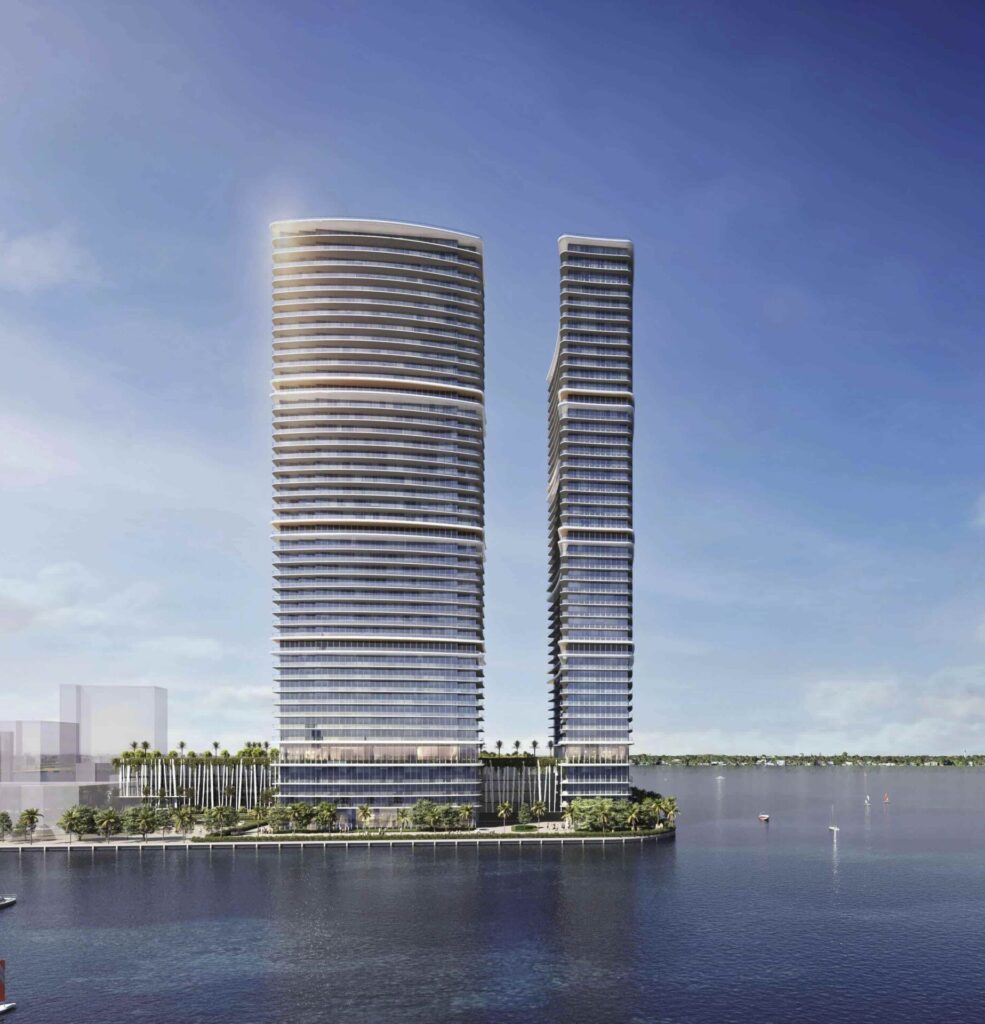
High-rise development in North Bay Village shows no signs of slowing down. The Related Group and Macklowe Properties have recently proposed plans for a pair of 43-story towers to North Bay Village’s planning board. Designed by Arquitectonica, the glass-clad towers are the latest in a growing trend of high-density proposals in the area. Like several recent projects, the development is seeking a Special Area Plan, which allows for a more unified site plan and can enable zoning exceptions that wouldn’t typically be allowed under existing zoning regulations. Although plans may evolve, the current proposal calls for 364 residential units, 201 in the northern tower and 163 in the eastern tower. Units will be offered in one, two, three, and four-bedroom layouts, with an average size of 2,138 SF. To accommodate residents, the developers have proposed 798 parking spaces. Although this is below the recommended count, the developers have assured planners that, based on their extensive experience, the proposed number is actually optimal for a project of this scale. Among other plans, the development also includes a 25-foot-wide Island Walk for the public, along with enhanced landscaping that contributes to a total of 9,000 SF of waterfront public park space. It’s worth noting that Island Walks are a required feature under North Bay Village development regulations, aimed at improving waterfront access and connectivity for island residents. On the other hand, the tower’s occupants have access to more than 100,000 Gross SF of amenities, spread between the development’s deck, ground floor, and level 5 of both towers. While the exact plans for the amenity space haven’t been released, the site will also have access to over 40 boat slips along the Biscayne Bay, complemented by a marina dockmaster. According to the project’s elevations the two towers will rise 497 FT to the 43rd floor. This height does not include the mechanical roof, which brings the total height to well over 500 FT. Such height would not be allowed under traditional zoning but is made possible through the Special Area Plan (SAP). Through massing studies, the development team found that by consolidating the project into two taller towers, rather than three shorter ones, view corridors and open space will be preserved. City staff agree with this assessment. Elevations also grant insight into the towers’ design: while the buildings appear nearly identical, the northern tower is the widest, followed by a slimmer eastern tower. Likewise, the facade will primarily consist of curtain glass wrapped in glass balconies, though this treatment will not extend across the entire structure. The rear of the towers will feature what appears to be stucco with artistic patterns, although the design isn’t finalized. City staff has recommended approval of the project, contingent on resolving a few minor issues. However, a staff recommendation does not guarantee approval. While the North Bay Village Commission considers staff recommendations during the final decision-making process, it ultimately isn’t the final say during the approval or denial process. If approved, the developers will have two years to obtain a master building permit as a general requirement, with a maximum of two one-year extensions possible. Failure to secure the permit within that timeframe will render the project’s approval null.
One of the Largest Live Local Act Projects in Miami-Dade, Park Residences, Unveils Renderings
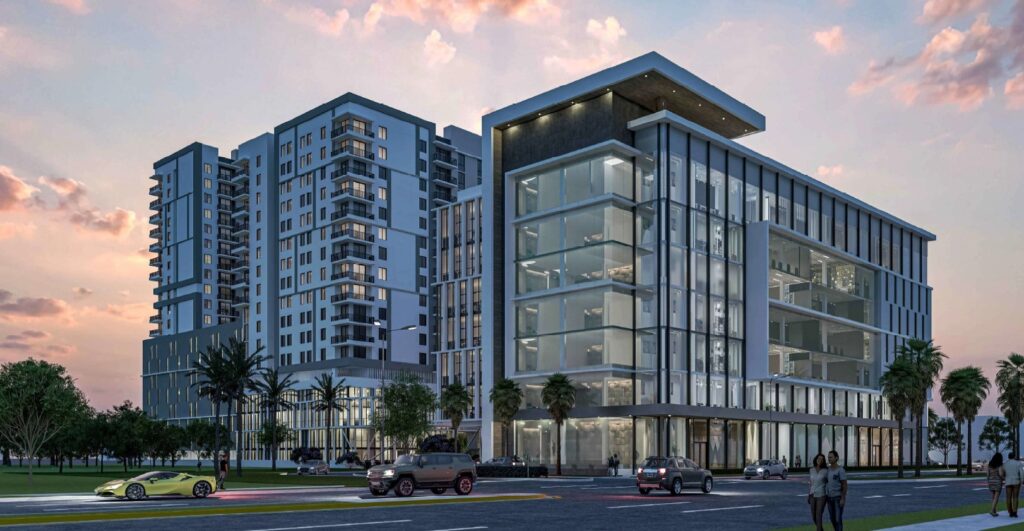
7350 Coral Way Prop. Co, led by Russel Galbut of GFO Investments and Dr. Jorge E. Perez of KIDZ Medical Services, has officially unveiled renderings for one of the biggest Live Local projects in Miami-Dade. The large development, coined Park Residences, was originally submitted to Miami-Dade staff in early 2025 and featured a mixed-use project containing retail, medical office space, and a residential tower. Since then, while plans have changed very little, renderings have been released showcasing more of the development’s design by the project’s architect: Anillo Toledo Lopez. Located at 7350 Coral Way, the mostly vacant property is planned to feature 410 residential units, about 90,000 SF of net leasable office space, 7,000 SF of retail, and 950 parking spaces: unchanged from last submission. Under the Live Local Act, which encourages higher density in return for providing workforce housing, 40% of the units will be set aside as workforce housing. This translates to 246 market rate units and 164 workforce units. Workforce housing units, as per the Live Local Act, are defined as units priced for households earning up to 120% of the Area Median Income. As noted by Bilzin Sumberg, Live Local projects in Miami-Dade County are permitted to price studio units at a maximum of $2,604 and one-bedroom units up to $2,788 as of 2025. The residential tower is planned to rise 19 stories, while the medical office building will reach 7 stories. New renderings reveal a pedestrian walkway connecting the tower’s podium to the standalone office structure. Likewise, earlier massing studies didn’t fully reflect the office building’s design, but the latest photos outline a sleek, mostly glass facade that will complement Coral Way. According to the project’s letter of intent, the medical office component will focus on pediatric care, aligning with Dr. Jorge E. Perez’s background with KIDZ Medical Services. Although construction permits and final approvals are yet to come about, the expertise behind 7350 Coral Way Prop. Co suggests the development is likely to proceed fairly smoothly.
Alexander Goshen Proposes Five-Story Apartment at 5802 N Florida Ave in Seminole Heights, Tampa
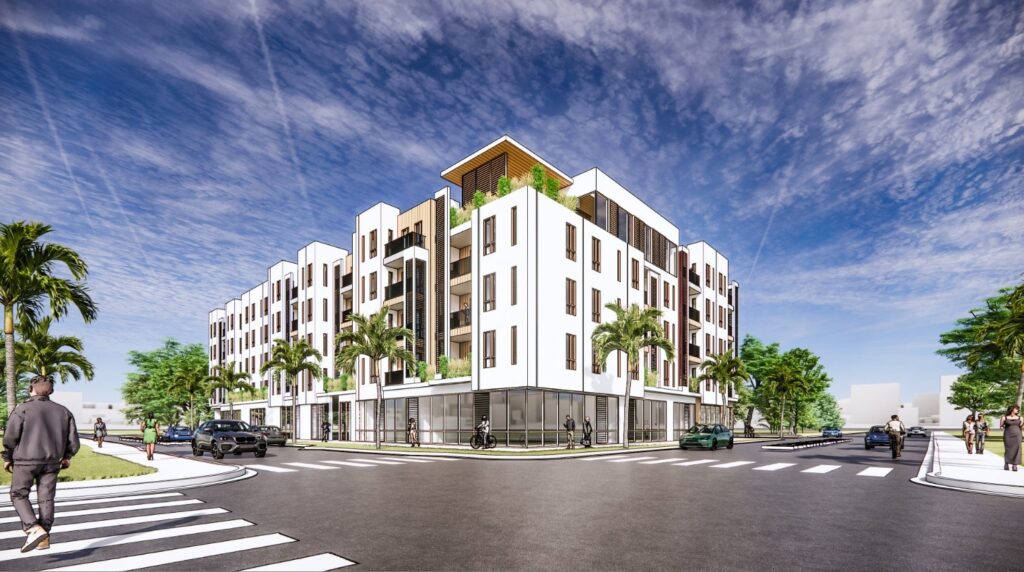
Fort Lauderdale–based Alexander Goshen is the latest developer to zero in on Seminole Heights. The firm recently filed a rezoning request for 5802 N. Florida Ave that would clear the way for a five-story building at the corner of Florida and Henry Avenue. The move adds momentum to a neighborhood already reshaped by new capital and infrastructure upgrades, from updated streetscapes to the introduction of mid-rises such as Notch, Hite and Avenue Lofts. Details of the project remain preliminary, but early plans envision a promising development that would bring 67 homes, retail, and further pedestrian activation to one of Florida’s fastest-changing areas. At street level, the proposed development aims to further expand upon Florida Avenue’s commercial scene with 5,269 SF of ground-floor retail space. Behind the storefronts, plans call for 56 parking spaces to serve both residents and retail patrons alike, a figure that falls short of the 73 spaces typically required under city code. The building will also include 35 bicycle parking spots, although only 5 are required. Designed by Goode Van Slyke Architecture based in Atlanta, elevations showcase the 5-story apartment measuring 57 FT. The building’s facade is expected to include a blend of materials, including white stucco finishes, aluminum balcony railings, and vertical plank accents for added texture. Preliminary renderings also suggest a rooftop deck may be included at the corner of Henry and Florida, though detailed floor plans haven’t been released yet. Before Alexander Goshen entered the picture, the site had a proposal for a series of three-story townhomes by Middle Bay Homes. It’s unclear why those plans never moved forward, but all associated commercial construction permits were eventually withdrawn, leaving the property vacant and well-positioned for new development. With minimal site preparation required, aside from limited clearing of existing greenery, the property offers a relatively quick work schedule in the case that construction begins. Still, the proposed project must first receive site plan approval from Tampa planners before any work can officially begin.
One North Birch Proposed in Fort Lauderdale Beach, Featuring 21 Residences
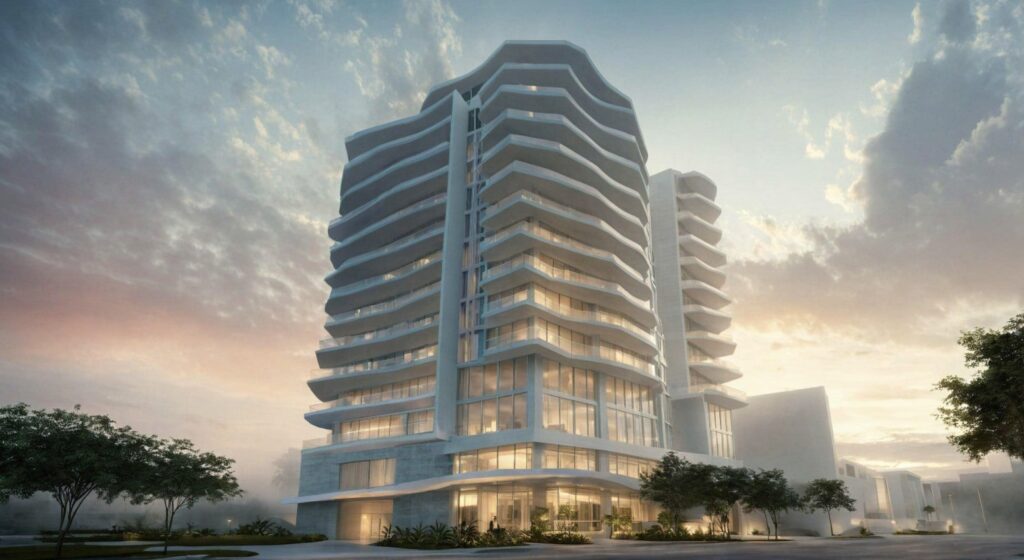
One of the last remaining undeveloped sites along Fort Lauderdale Beach’s Intracoastal Waterway is on track to become home to One North Birch, a multi-story condominium proposed by Las Olas Harbor Club, LLC. The firm, led by entrepreneur Sophia Mylona, is seeking review from Fort Lauderdale’s Development Review Committee to move forward with a 13-story residential project. Proposed with a collection of “boutique” residences, the tower will include 21 units, with around 2 units for every floor. Although the developer could provide higher density (specifically 75 units per acre) plans have instead opted for 45 units per acre in order to create more spacious units. In fact, units will be around 4000 SF each. Residents of One North Birch will have access to a range of planned amenities, though preliminary. Plans include a pool, fitness center, club room, and even a future dock. All homes will have access to parking on floors 1 and 2, made possible by parking lifts. This increasingly popular feature in South Florida developments allows for a more efficient use of space, enabling Las Olas Harbor Club, LLC to expand amenity offerings while maintaining a seamless building facade free of a visible parking podium. The ground floor of One North Birch will exclude retail space in favor of a spacious lobby. Pedestrians can also expect to see noticeable streetscape enhancements, including upgraded sidewalk infrastructure, added greenery, and other improvements. Current site conditions show several nuisances to walkability, such as utility poles, overgrown trees, and other physical barriers. The developer plans to replace this with a 7-foot-wide sidewalk, buffered by landscaped edges to create a more accessible and safe pedestrian environment. As per elevations, the tower’s 13 floors will measure 163 FT to the tallest point on the tower, making it among the tallest buildings in the area. Designed by Garcia Stromberg Architecture, the building’s facade will be almost entirely composed of curtain glass, wrapped with large glass balconies for residents. The development at 1 N Birch Road will be met with review by Development Review Committee staff on June 24th, 2025. According to a case comment report filed before the meeting, there appears to be little revision needed to the design before it can move forward.
The Growin Group Proposes Two Multifamily Buildings in Ojus Along NE 191st and NE 190th Street
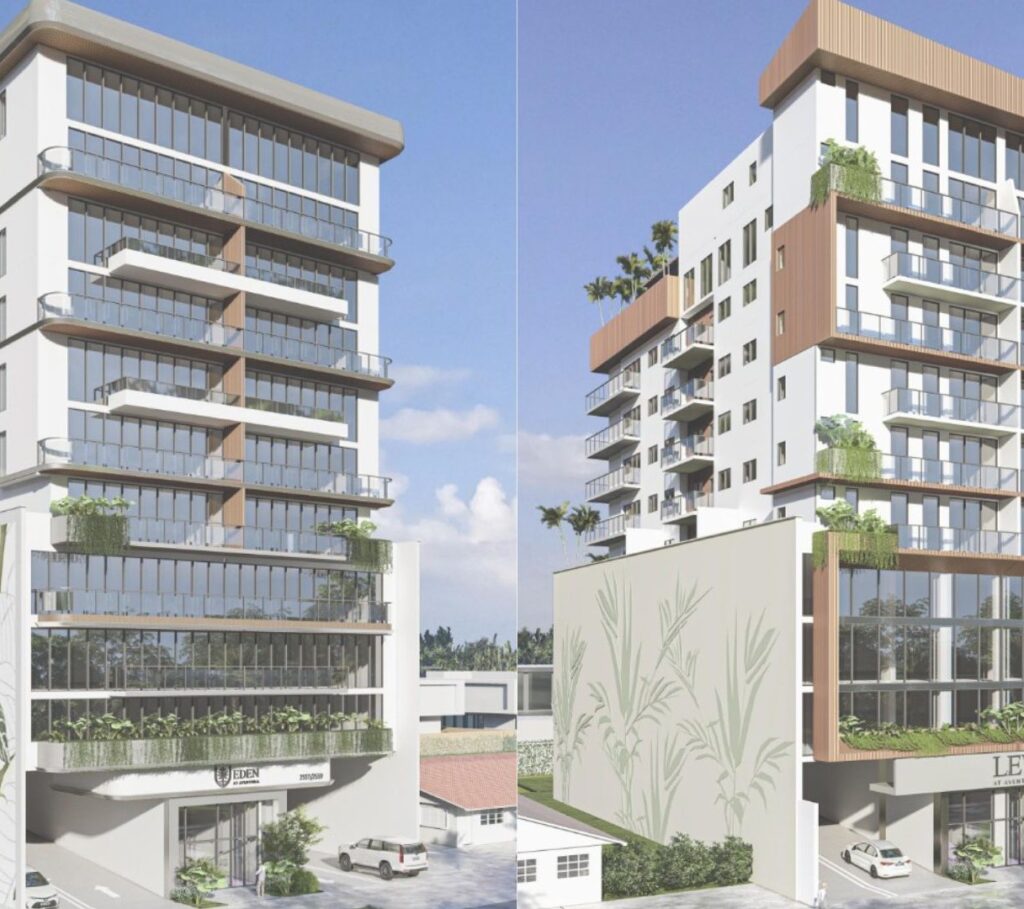
A South Florida-based real estate and investment firm, coined the Growin Group, is planning to join a plethora of developers investing in Ojus. Ojus has recently been caught in a whirlwind of development activity, sparked by the creation of the Ojus Urban Area District (OUAD) in 2006 and following amendments aimed at promoting mixed-use, pedestrian-friendly growth. Although the region didn’t see major developments until the completion of Beacon Tower in 2017, the area has been steadily developing office and multifamily development ever since. Building on this momentum, the Growin Group plans to develop two nearly identical highrises: Eden at Aventura and Lev at Aventura designed by Gaviria Architects. Both buildings will offer the public 32 residences to choose from, ranging from 1 bedroom + den, 2 bedroom, or 3 bedroom units. Units will be generously sized, with none measuring less than 790 FT and most homes being planned as 2 bedroom layouts. Residents will have access to a fitness center, sauna, and additional amenities such as a rooftop pool. The podium of each tower will also feature amenity spaces and storage areas designed to screen parked vehicles from public view. Each podium will accommodate parking for 60 cars, creating an approximate unit-to-parking ratio of 1:2 for both developments. Given the site’s extremely condensed footprint, zero retail space will be planned. Instead, the ground floor will be composed of a lobby, bike storage, entrances and exits for parking garage circulation, and more. Because plans appear to be preliminary, not much information is given regarding both buildings and their heights. While written statements call for both buildings to be 10 floors, this doesn’t factor in the ground floor which, in actuality, makes both buildings 11 stories tall. Given the standard in most developments is to provide ceiling heights of around 10 FT, it’s estimated the buildings will be at or more than 110 FT each. Lev at Aventura will be located at 2520 NE 191 St while Eden at Aventura will be located at 2557 NE 190 St.
Newly Released Renderings Showcase ‘Isle of Dreams,’ the First Phase of Sunbeam Property’s Vision for North Bay Village
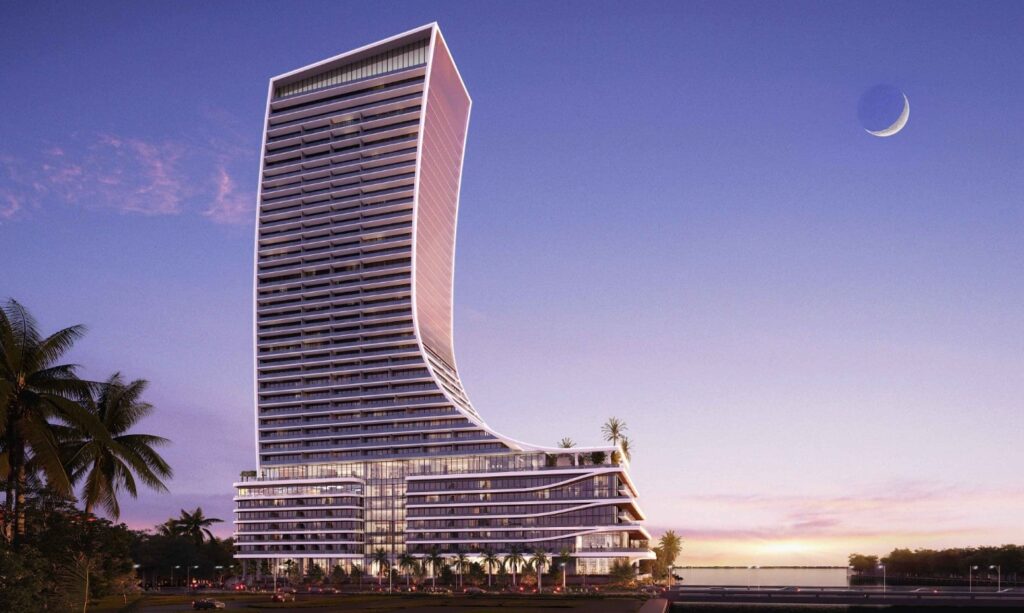
Sunbeam Properties has unveiled new renderings for the first phase of its massive North Bay Village development, a tower coined Isle of Dreams. When Floridian Development initially reported on the project, details were still in the early stages. At the time, there were no official renderings; in fact, only elevation drawings were available that offered a basic outline of the tower’s form. Now, as Sunbeam Properties seeks approval from Miami-Dade planners for several special exceptions, setback deviations, and other changes, the developer is preparing to move forward with construction. Andy Ansin, the owner of both Sunbeam Properties and WSVN Channel 7, has previously expressed that financing will not be an issue. Built-up cash from years of operation has led the company to develop the property no matter the market condition. According to the new application, there have been no major updates to the tower’s design, including its unit count, commercial space, or other key components. As a recap, Isle of Dreams is set to include 246 residential units, 23,043 SF of commercial space, and seven levels of parking. The tower will stand 39 stories tall, reaching 460 FT to the roof and approximately 490 FT to its highest architectural point. Arquitectonica, the project’s architect, designed the tower as a landmark development that intentionally pulls the building mass away from the waterfront to prevent the “walled off” appearance often seen in similar projects, according to a letter of intent. A standard and required feature of all new developments in North Bay Village is the inclusion of an Island Walk, and in this project, it will span over 200 FT in length and 15 FT in width. Lined with greenery, the walkway will offer direct access to waterfront retail and provide seating areas where residents are given unobstructed views of the water. While Isle of Dreams and its accompanying Island Walk are the first glimpse into the development, there will be an additional 7 to 9 more towers. In total, the Sunbeam mega-development is aiming to construct 1936 units, close to 5000 parking spots, 300 hotel rooms, 670,000 SF of commercial space, and around 200,000 SF of office space. Towers, like this one, will rise between 240 to 650 FT, marking them as the tallest buildings in Miami-Dade outside of Miami and Sunny Isles Beach. Before work on the Isle of Dreams can start, the developer must tear down an existing 4-story building on the property. In addition to launching the first phase, the developer has already demolished two radio towers on an adjacent parcel to make way for phase 2.
Three 1,300 Foot Cranes Filed for Citadel’s Soaring Supertall HQ at 1201 Brickell Bay Drive
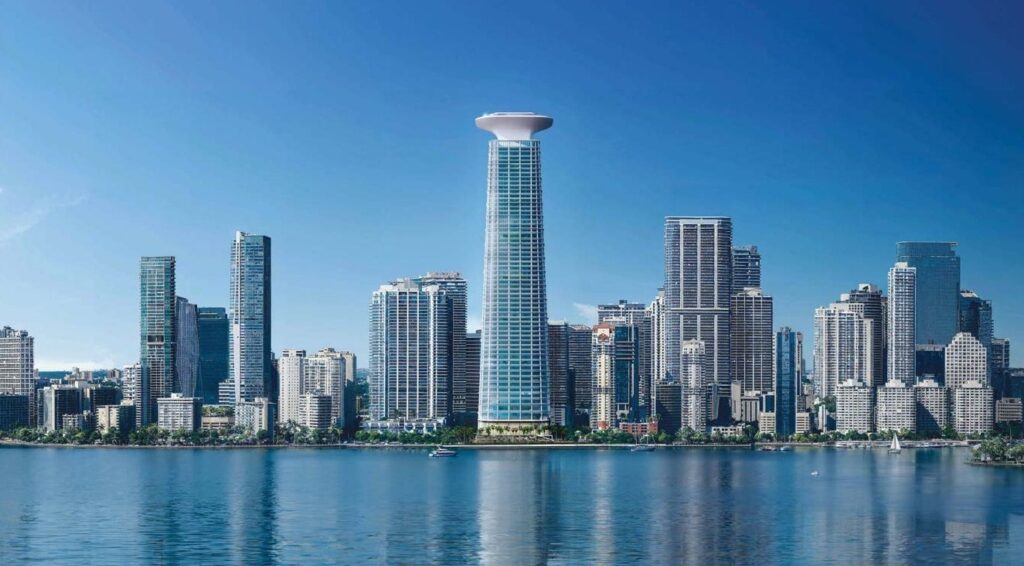
Citadel’s long-anticipated supertall headquarters in Brickell is taking a major step forward. This week the firm submitted plans for three towering construction cranes each soaring close to 1,300 FT, signaling significant momentum ahead of the project’s targeted Q3 2025 groundbreaking. This news comes as Citadel recently submitted new designs for its planned supertall, featuring a wider and more prominent crown. As the company led by Ken Griffin finalizes the design stages and acquires necessary FAA approval, the site only needs appropriate construction permits before work can begin. Per FAA filings, the three cranes will climb to 1,298 FT, 1,298 FT, and 1,297 FT respectively. They’re all slated to rise from 1201 Brickell Bay Drive, where the ground level sits just three FT above sea level. While the FAA application was submitted recently, meaning it’s still being studied for adverse aviation impacts, they will be the tallest cranes submitted in Miami’s history. In fact, they will surpass the height of the impressive tower cranes rising at the Waldorf Astoria construction site. Below is a map outlining the cranes locations. Both 1298 FT cranes will rise on the east and west portions of the property, while the 1,297 FT crane will rise on the south portion. According to the FAA, the tower cranes will be working from October 17th, 2025, all the way to April 17th, 2027. While this number is usually a rough estimate, it aligns with the Q3 2025 groundbreaking date. If Citadel’s headquarters breaks ground this year, it will rise alongside the Waldorf Astoria Residences in Miami, making Miami the second U.S. city to have two or more supertalls simultaneously under construction. No other city in the country other than New York holds that title.
Darryl Shaw’s Ybor Harbor Will Soon Call Home to a New Stadium for the Tampa Bay Sun FC
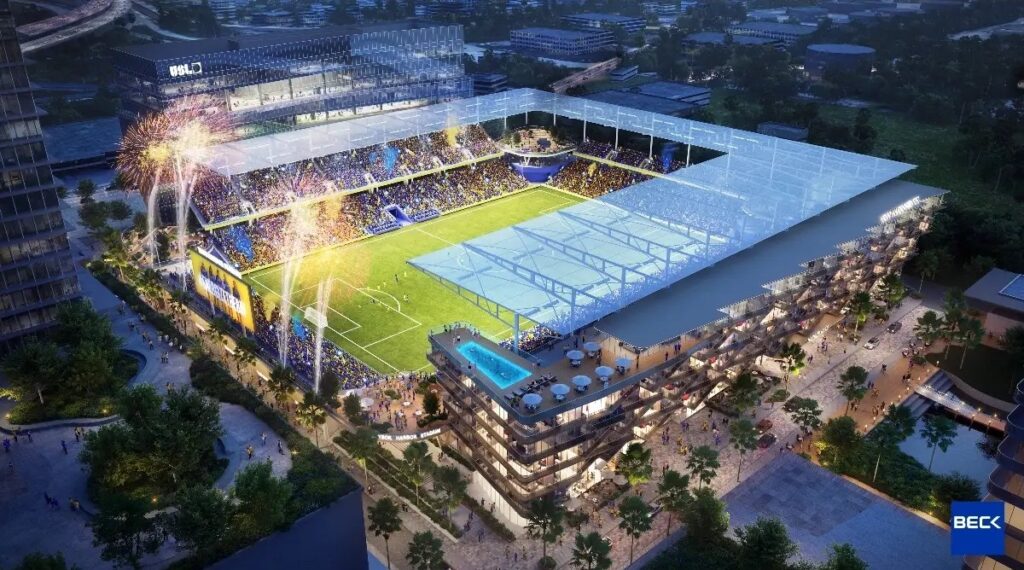
Set between Ybor City and the Port of Tampa, the Ybor Harbor development will soon call home to one of the only soccer stadiums in the U.S. built for a women’s professional soccer team. The 15,000-seat stadium, designed by The Beck Group and spearheaded by Darryl Shaw, is trying to ride the momentum wave of the Tampa Bay Sun’s impressive season, as the team just won the USL Super League’s championship. Women’s soccer in particular is gaining traction across the United States, and the USL along with Darryl Shaw want to be part of the movement. “By collaborating with Darryl Shaw and Tampa Bay Sun FC, we’re accelerating the growth of women’s soccer while creating lasting benefits for Tampa Bay” according to Alec Papadakis, USL Chief Executive Officer. “The growth of women’s soccer” is evident: just a few months ago, the CPKC Stadium in Kansas City became the first soccer stadium “purpose-built for a women’s professional sports team”. The USL, which is already based in Tampa, will soon gain a new state-of-the-art headquarters integrated into the stadium complex. Renderings reveal an office building with direct views overlooking both Ybor Harbor and the stadium itself. Plans also feature a boutique hotel positioned along the waterfront as part of the overall development. Although the stadium’s main purpose is to host women’s soccer, Darryl Shaw has emphasized that it will also serve as a venue for other sporting events, concerts, festivals, and community gatherings. Aside from Amalie Arena, inner-city Tampa lacks a flexible space of this kind, and the new stadium is expected to create a more active community. Ybor Harbor is planned to include over 100,000 SF of open space, and this development emphasizes that priority. Renderings/plans outline large sidewalks, potential retail venues, and greenery that compliment the stadium. Once completed, Ybor Harbor will include 800 hotel rooms, 150,000 SF of street-level retail space, 500,000 SF of office space, and 4,750 residential units with 10% put forth for affordable housing. Ybor Harbor is an ongoing initiative, and while a construction timeline has not been released, it will take some time before the first groundbreaking. What about the Tampa Bay Rays? Although a potential stadium for the team was envisioned in late 2022, documents for Ybor Harbor submitted to City Council in 2023 made no mention of a baseball venue. In fact, incorporating one would require slashing several planned high-rises due to the already tight footprint of the Ybor Harbor site. This update comes as Darryl Shaw recently stated that finding enough land within inner Ybor for a baseball stadium is no longer feasible. Meanwhile, foundation work for multifamily developments, historic restoration, and other construction efforts have been long ongoing in the region. Cost and a construction timeline have not been released, but according to the Tampa Bay Times, the goal may be to develop the Tampa Bay Sun’s stadium through a “public-private” partnership common with recent stadium construction.
37-Story Tower Proposed in Wynwood Norte at 70 NW 36th Street Through the Live Local Act
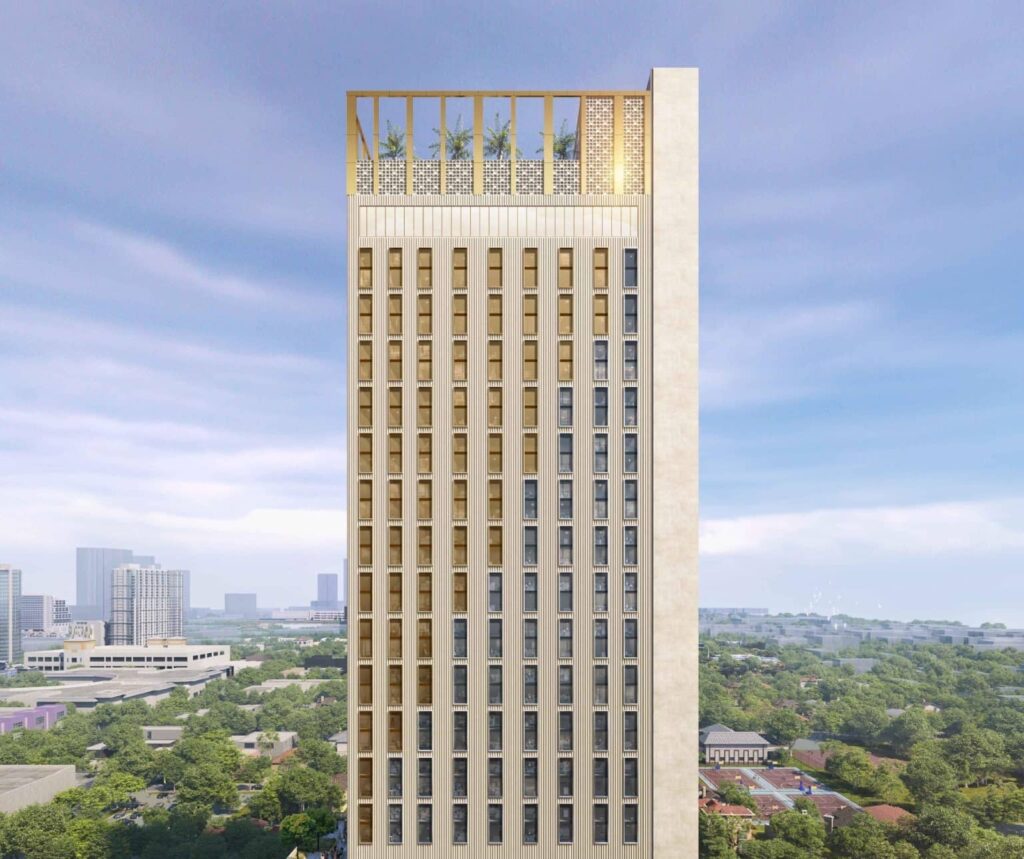
Wynwood Norte is starting to see taller and denser development take hold, sparked by spillover from nearby neighborhoods and rules set by the Live Local Act. It wasn’t too long ago when another developer proposed the ‘Wynwood Tower’ slightly north of NW 36th St, featuring one of the tallest towers in a one mile radius. Now, 36th Street Owner, LLC is looking to join developers recently eyeing the area with a high-rise proposal at 70 NW 36th Street. The close to half-acre lot will soon call home to a 37-story tower along NW 36th Street, a major thoroughfare connecting to neighborhoods like Midtown, Edgewater, or Wynwood. Proposed with a total of 330 units, the development will feature a blend of typologies from studios, 1 bedroom, or 2 bedroom apartments. Density is almost entirely from the Live Local Act, as current zoning only permits 150 homes per acre, compared to Live Local density of 1000 homes per acre. In this case, the developer could only build close to 65 units under traditional zoning, but with the Live Local Act, they’re now permitted up to 436 units. In exchange for increased housing density, the developer will provide 132 workforce units. Below is a table for more information provided by Arquitectonica: the project’s architect. The current site at 70 NW 36th Street is currently home to a car dealership, with surrounding sidewalks that provide little width or protection for pedestrians. The newly proposed tower envisions a change to that, with widened sidewalks, increased greenery, and a residential lobby on the ground floor. While there will be no retail space, plans are still preliminary and subject to change. On the top of the tower will be a pool deck for residents, along with a bar, lounge area, and other amenities. To accommodate the anticipated increase in neighborhood residents, the project will include 190 parking spaces: made possible through a 30% parking reduction and participation in a “payment-in-lieu” program. Essentially, the developer pays the city a fee for each required parking space not provided on-site. In this case, the developer is offsetting 76 parking spaces through payment-in-lieu. Lastly, the tower will measure 421 FT to the tallest point, or about 377 FT to the tallest occupied floor. While current zoning only allows heights between 9 and 12 stories, the Live Local Act can take the highest allowable height from 1 mile away and apply it on-site. In hand, the developer now has a potential height of 60 floors, although the developer is only applying for a 37-story tower. Before demolition and site work can begin, the developer must gain necessary approvals. The first step is approval for Miami’s Urban Development Review Board on June 18th. The project’s architect, Arquitectonica, will be reviewed based on architectural consistency, design standards, and compliance with code.
Aria Reserve Skyclub Unveiled as the Last Phase in Melo Group’s Aria Reserve Development
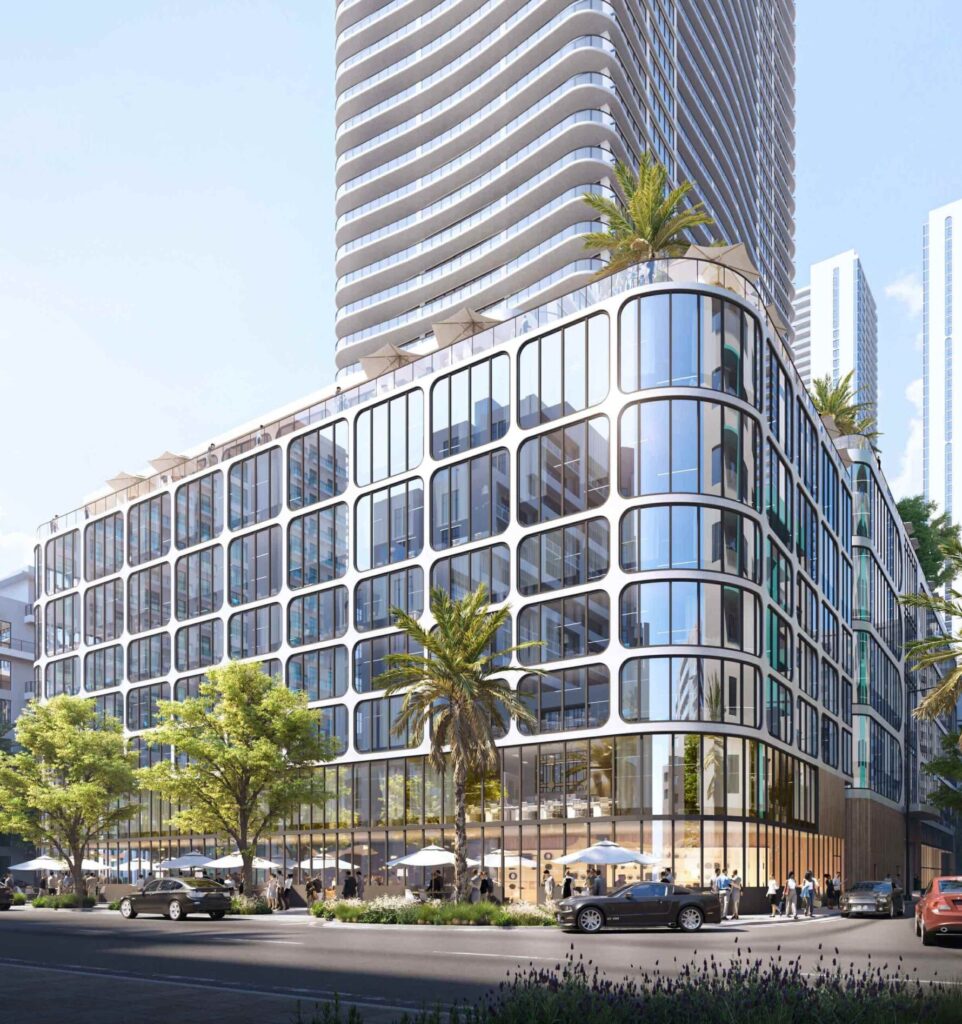
While construction crews are nearing up work for Aria Reserve’s North and South tower in Edgewater, the Melo Group is eyeing the last parcel for the third and final tower. Coined ‘Aria Reserve Skyclub’ the proposed tower will sit atop a 1.35 acre lot in the heart of Edgewater. Located at 500 NE 24th St, the mixed-use tower will be unlike its counterparts in that it provides a mix of uses, from office space, retail and restaurants, to finally residential space. In Aria Reserve Skyclub, the Melo Group is proposing approximately 430 residential units, composed of either 1 bedroom, 2 bedroom, or 3 bedroom orientations. The average unit size in Aria Reserve Skyclub will be around 1,403 SF. Once constructed, all three towers in the area will provide a combined 1,172 units to Edgewater, only comparable to the scale of development found in the Paraiso District. The Arquitectonica-designed tower is devised with foot traffic in mind, utilizing a mix of ‘landscape design’, ‘inviting public sidewalk space’, and a ‘variety of active, habitable spaces’. The podium and ground floor, which are almost exclusively wrapped in glass, will feature a range of uses including 6,924 SF of retail space and around 77,000 SF of office space. Office space will not be constrained to any side of the podium, sharing views between both the east and north side of the tower’s base. Previous records showed the tower containing around 62,165 SF of office space, but that appears to have increased according to newly released documents. Concealed behind curtain glass and office space is 520 parking spaces inside the tower’s podium, granting parking space for office workers, retail patrons, and residents/guests. Although The City of Miami’s code required 775 parking spaces in the development, the developer is only providing 520. While full-scale renderings of the tower have yet to be released, elevations offer a clear sense of its design. The tower is expected to rise 49 floors, measuring approximately 531 FT in height. These elevations also reveal details about the podium’s appearance along the southern edge. Facing the alleyway, the podium’s all-glass design transitions to a perforated metal garage. Although the lot is currently used to house construction equipment for the two towers currently under construction, the Melo Group only has to demolish a 2-story apartment on-site to begin full foundation and structural work. Because the Melo Group moves historically fast on all projects, including Aria Reserve, it’s estimated construction is in the very near future.
The Melo Group Proposes ‘Biscayne 18’, a Two-Tower Project in Miami’s Edgewater Neighborhood
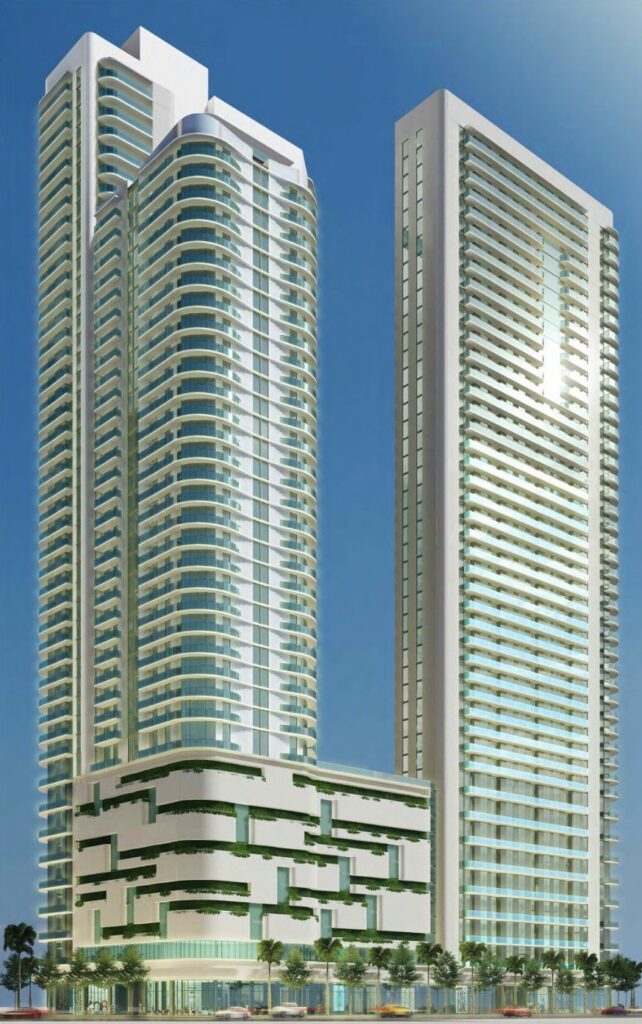
The Melo Group is planning to develop one of the last untouched parcels along Biscayne Boulevard in Edgewater. The company, which already has hundreds of units under construction across Miami, wants to build a two-tower apartment project spanning an entire city block at 331 NE 18 Street. The 1.57 acre parcel has been in the works for years, with the Melo Group having purchased the whole block in late 2019 for close to $30 million dollars. Now, the long-awaited plans are coming to fruition, with the company proposing a total of 1,178 units. There will be 589 rental units per tower, composed of either 1 bedroom, 2 bedroom, or 3 bedroom units. Unlike many recent proposals, this project’s increased density isn’t due to the Live Local Act. Instead, it fully complies with standard Miami zoning, leveraging its transit-accesible location to build more densely. While traditional zoning allows only 500 units per acre, Miami21 allows for a 50% increase in density for projects designated as “Transit Orientated Development”. According to the Architect of Record, G3aec, one of the star features of this development is its ‘refined and articulated street-level experience’. Almost 25,000 SF of retail space (24,930 to be exact) will be placed along the entire tower’s ground floor. Because the tower takes up an entire city block, the development will provide a pedestrian paseo on the ground floor, connecting the east and the west sides of the ground floor for improved connectivity. Also included is enhanced sidewalk infrastructure to handle the expected increase in foot traffic. To handle both retail patrons and the tower’s residents, there will be 1,472 parking spaces and 1,178 bicycle rack spaces in the tower’s 8-story podium. However, the parking figure is actually much lower than originally required. According to the City of Miami, the project requires 1,947 parking spaces, but is allowed multiple 30% parking reduction waivers. The tower’s podium will feature residential units along portions of its base, while the remaining parts will be ‘entirely concealed from public view’ using a ‘combination of vegetation and glass arranged in a seemingly random pattern’. This approach to podium design has become increasingly common in recent Melo Group developments. For example, projects like Downtown 6th incorporated fake windows to create the illusion of an active façade, masking the presence of a parking podium. As per the tower’s elevations, both will rise 46 floors or 465 FT to the roof. The tower’s facade will be entirely composed of glass railings, white stucco, and impact resistant curtain glass. To break up the massing of the towers, the L-shaped design will include varying heights. G3aec and the Melo Group’s design efforts will be met by Urban Development Review Board consideration on June 18th at 2 PM.
South Miami-Dade’s Goulds May Soon See Its Tallest Building at 25 Stories Via the Live Local Act
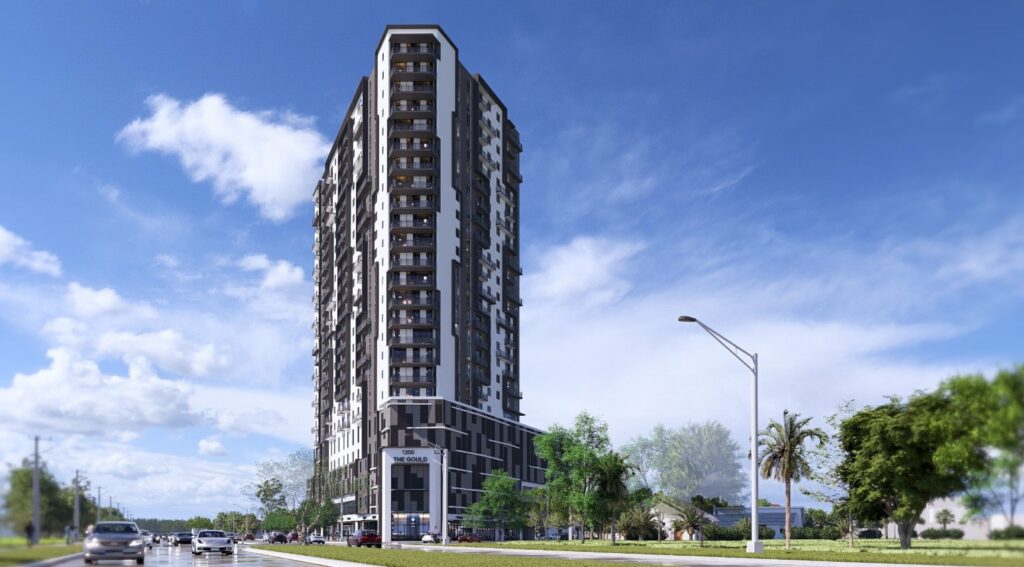
Southern Miami-Dade is nothing short of low density. The region is home to a seemingly equal population of agricultural products and people alike, with newly developed subdivisions in walking distance from farms. But neighborhoods such as Naranja, Princeton, or Goulds have been facing a large transformation in recent years. Driven by limited land within Miami-Dade’s Urban Development Boundary and growing housing demand, developers have rapidly built medium density apartments, filling nearly every lot available along the South Miami-Dade Busway. But one developer is taking this transformation to another notch: RSS Developers. Rather than following the trend of 5-8 story buildings, the company is planning to build a 25 floor building on a wedge-shaped 1.42 acre lot. The highrise, designed by Modis Architects, will include 300 residential units, with a mix of studios, one, two, and three bedroom apartments. One bedroom units are the most common typology, making up 37% of the total inventory. This level of high density development is only made possible by the Live Local Act, which actually allows more units at a maximum of 320. In exchange for the added density, 120 units will be set aside as workforce housing, priced at or below 120% of the Area Median Income. The ground floor will oversee a range of uses, including 5,919 SF of commercial space, a lobby/leasing area, a bike parking room, and other miscellaneous uses. One of the most significant changes to the current site is the addition of wide sidewalks and enhanced landscaping. This transformation is beneficial for pedestrians who currently rely on a thin strip of sidewalks to traverse the busy and notoriously dangerous South Dixie Highway. The development will also provide a total of 290 parking spaces, split between on-street parking and spaces within its 6-story podium. This total accounts for several parking reductions available to the property, such as a 25% reduction for workforce housing and a 30% reduction for being within a quarter-mile of a bus stop, among others. As for the building’s height, the 25-story tower is set to reach 262 FT, which complies with current regulations. For instance, Live Local Act developments are permitted to match the maximum height allowed within a one mile radius. In this case, a nearby property located 0.57 miles away permits buildings up to 25 stories tall, enabling this project to follow suit. The entirely vacant lot at the corner of S Dixie Hwy & SW 214 St requires little site work before construction can begin. If the tower breaks ground, it will be a moniker not only for future development in South Miami-Dade, but also the lengths development under the Live Local Act can go.
Seven Park Proposed in Hallandale Beach, Providing 124 Infill Housing Units
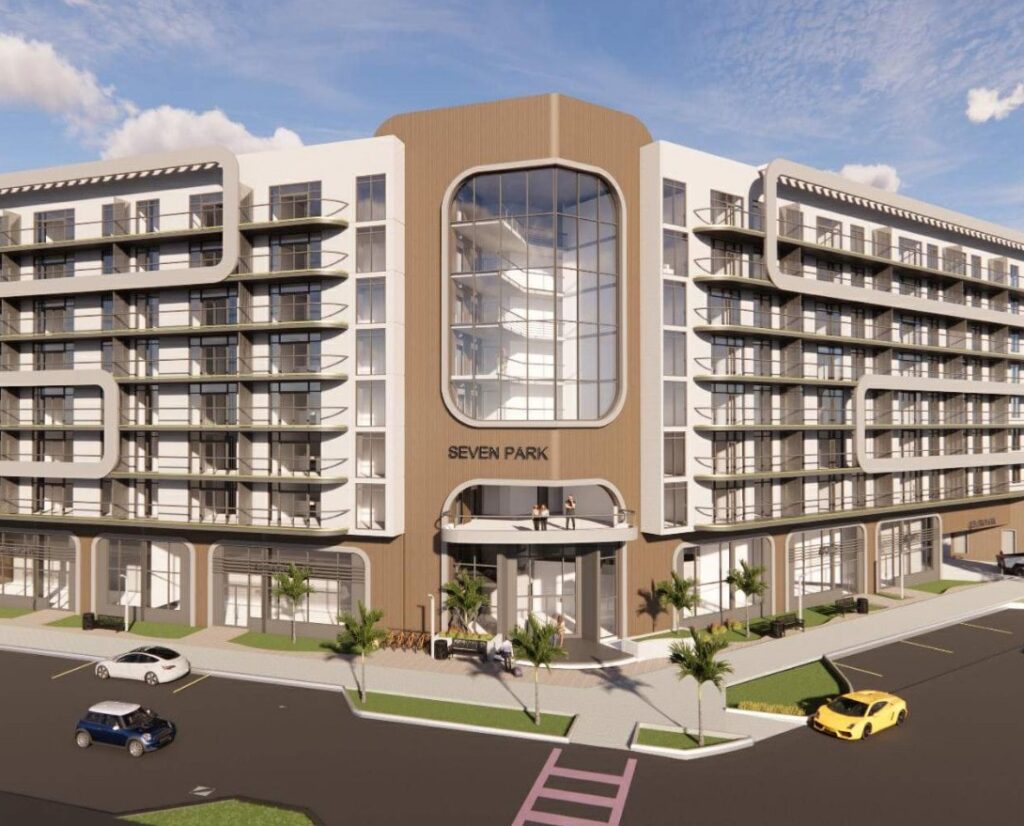
Seven Park, a proposed multi-family housing project by 221 Developers, will soon rise near Peter Bluesten Park in Hallandale Beach. Located at 220 SE 7th St, the SKLARchitecture-designed project has already been through multiple approval processes, and was formerly coined as ‘Vita at the Park’. Now at the Planning Board of Hallandale Beach with a new design and naming scheme, the 8-story development is proposing 124 residential units. Comprising of 6 efficiency units, 76 one bedroom units, and 42 two bedroom units, there will be housing catering towards a mix of incomes. In fact, the building will have 23 ‘moderate housing units’ proposed out of the 124 units. Moderate housing units are homes where the rent is priced at an affordable rate for moderate incomes. The proposal of moderate housing units is not without reason, however; as the development can now achieve higher density than previously allowed. According to ground floor drawings, the building will include a parking garage enclosed by 4,150 SF of retail space, greenery, improved sidewalk infrastructure, and a lobby. Atop the buildings podium will sit extensive amenity space for residents, including but not limited to a pool and lounge space. Given Broward County’s limited public transportation options, the development will include 159 parking spaces, of which multiple spaces will be located on the ground floor for retail patrons. However, despite the project’s generous parking count, it’s actually lower than required under code: Hallandale Beach actually requires 169 parking spaces. Building elevations outline an L-shaped design which, according to SKLARchitecture, will ensure that ‘residents enjoy unobstructed views of the park from both sides of the structure. This layout not only enhances the visual connection from the units looking at the surrounding park on the north side but also provides ample natural light to the residential units’. The building’s 8 floors measure out to 91 FT from the ground floor, or 93 FT at street level. The development will face either approval or denial from Hallandale Beach’s Planning & Zoning Board today at 6 PM (6/10/25 6:00 PM).
Over 400 Mixed-Income Apartments Coming to Progresso Village at 312 NW 7th Street, Fort Lauderdale
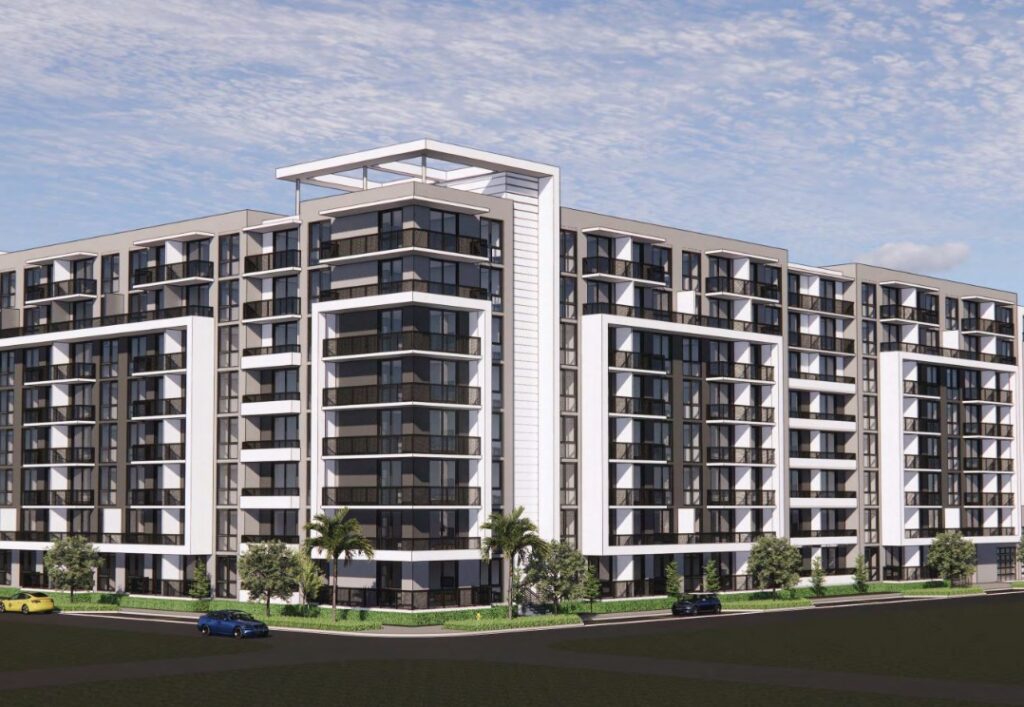
Home Venture Investments, a development firm based in Hollywood, Florida, is moving forward with a midrise proposal in Fort Lauderdale’s Progresso Village. Designed by FSMY Architecture, the multifamily apartment building will rise behind The Six13 at 312 NW 7th Street, and together, the two developments will fully occupy the block between NW 7th Street and NW 3rd Avenue. The project is expected to include 442 residential units, of which 10% are allocated as affordable units. This translates to 379 market rate units and 43 affordable units, split between either studio, 1 bedroom, or 2 bedroom orientations. Although Progresso Village has historically been low density and focused on single family homes, despite substantial upzoning, the proposed development aims to ease the transition through improved ground floor design. The street level will feature residential units with direct street access, 1,667 SF of commercial space, and upgrades to both landscaping and sidewalk infrastructure. Notably, the project will offer nearly 19,000 SF of open space, as well as a central courtyard that acts as one of the several amenities for residents, such as a pool, rooftop lounge, and more. To accommodate both residents and retail customers, the building will provide 581 parking spaces (a reduction of 119 spaces from the required 700), made possible by an approved parking reduction under the code. According to elevations, the building will rise 8 floors and measure 91 FT. Designed with a modern look, the facade will be primarily composed of a gray and white color pallete, as well as large impact resistant windows and metal railings. On the south side of the development is an open-air parking garage, with little screening to hide the garage from the outside environment. As per comments by Fort Lauderdale’s Development Review Committee, staff has found that the building design must include changes including the addition of ‘enhanced architectural screening’, facade articulation, and a stepback above 65 FT. Other comments can be found here: https://www.fortlauderdale.gov/home/showpublisheddocument/90015. The scheduled meeting to review the development is set for June 10, 2025. If the project acquires all necessary approvals, the developer will be required to demolish the existing low-rise structures on-site before construction can begin.
Preliminary Plans Released for a 41 Floor Tower at 1399 SW 1st Avenue
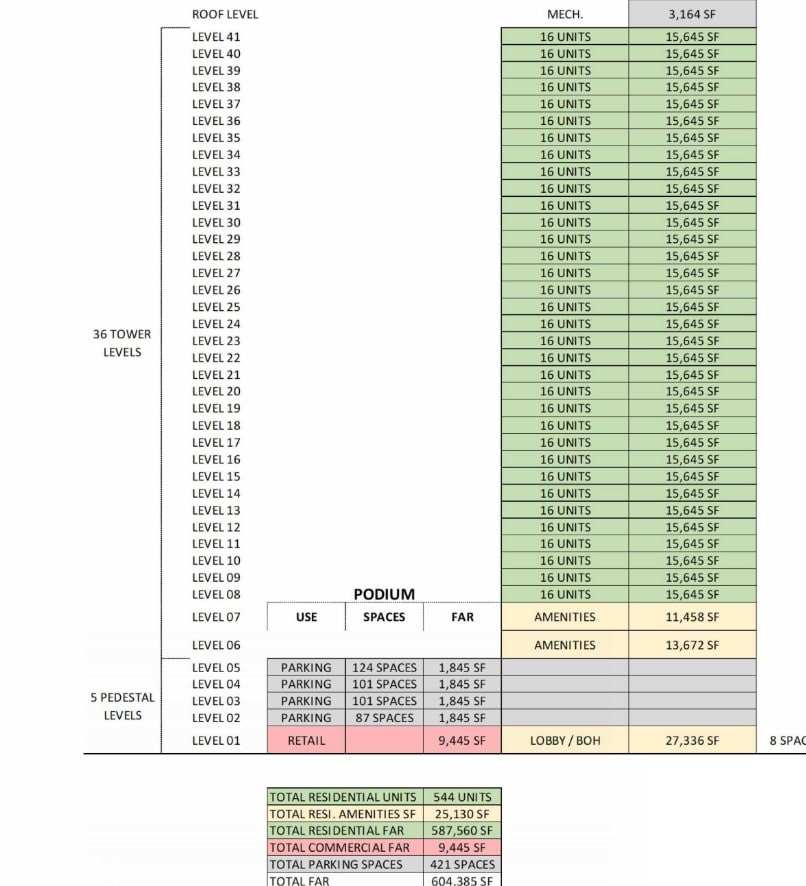
Preliminary plans have been released for a 41-story tower in Brickell, poised to fill in one of the last pieces of undeveloped land south of Downtown Miami. The project, spearheaded by CF TSG Brickell, LLC and designed by Arquitectonica, is planning the tower at 1399 SW 1st Avenue. The around 1-acre lot was recently added to the Metromover Subzone following an expansion in 2024 that left multiple properties, such as this one, under RTZ regulations. The RTZ framework offers a streamlined approval process, first through a Special Exception and then via Administrative Site Plan Review, making it attractive to developers. In the case of CF TSG Brickell, the developer will take advantage of the county’s relaxed density, parking, and other regulations only found under the subzone. For instance, the property will include 544 units through an applicable 500 units/acre density. 12.5% of units, or around 68 units, will also be designated as workforce housing units with rents priced no further than 140% of the area’s median income. Residents will have access to around 25,000 SF of amenity space, including a gym, spa, pool, outdoor lounge seating, and more spread out between 2 floors. Families may even have access to a kids or teens room. However, it’s important to stress that plans are preliminary, meaning amenity spaces can change any time throughout planning. There will be 9,445 SF of retail space on the ground floor, replacing the current Mexican Consulate on-site. Although exact designs haven’t been released, sidewalk space will be expanded, complimented by greenery, and partially covered by a colonnade that provides both shade and protection from the elements. To factor in both retail and density, the project will likewise include 421 parking spaces, some of which are located on-street: although zero parking spaces are required under the Metromover subzone. According to elevations, the tower will measure 459 FT to the highest point, or about 431 to the highest occupied floor. The tower will be alike any tower in Brickell given its above-ground podium: accounting for 4 floors of parking in total. While no permits have been filed both through the county or the city, the development is expected to begin demolition after gaining final approval. Current property data shows demolition crew must first begin with a 3 floor building constructed in the late 70s before foundation and site plan work can begin.
‘Arch Creek’ Proposed to Construct 293 Units at 2056 NE 140 St, North Miami Beach
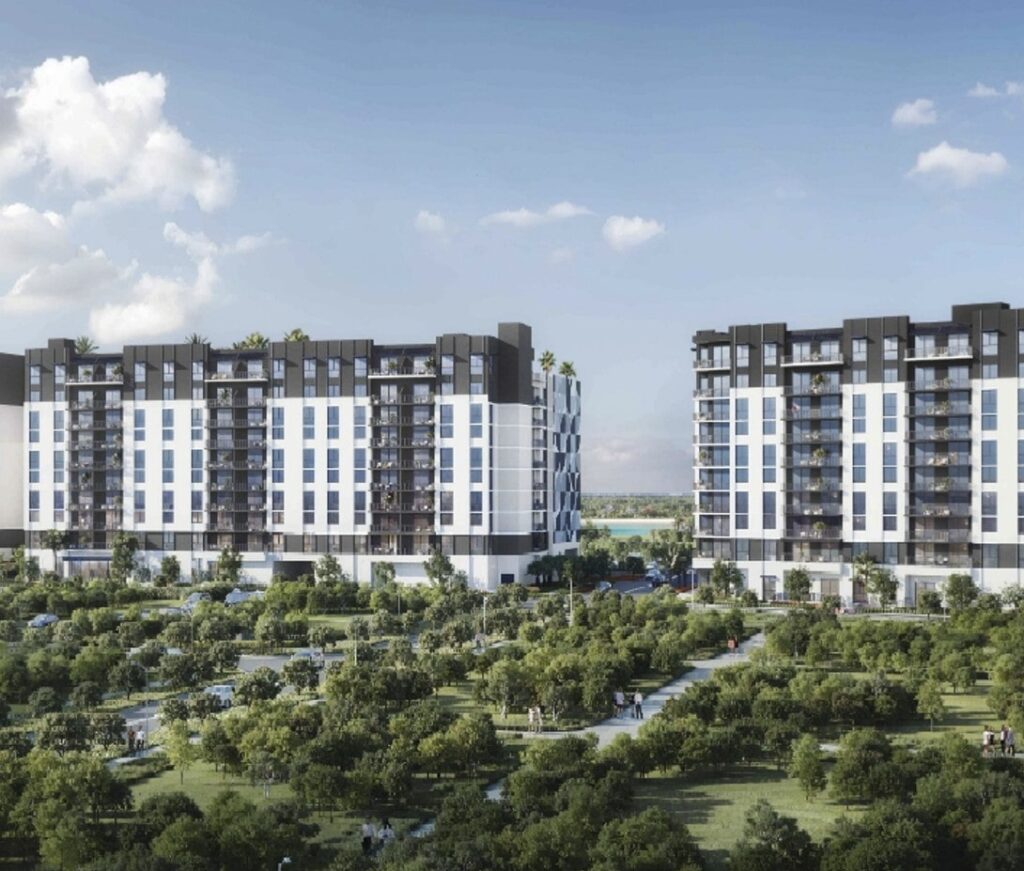
Arch Creek Equities, affiliated with PACE Equity, is planning a new multifamily development on a recently acquired 2.5-acre assemblage at 2056 NE 140th Street. Situated at the edge of North Miami Beach, the site lies in a rapidly evolving area overseeing a wave of new multifamily proposals, thanks in part to the upcoming Northeast Corridor rail line and relaxed zoning regulations. Designed by Cohen Freedman Encinosa & Associates, the project is aiming to deliver 293 residential units, split between studio, 1 bedroom, 1 bedroom + den, and 2 bedroom units. The minimum unit size is 550 SF, although most of the building will be composed of 1 bedroom and 2 bedroom units rather than studios. Unlike many recent multifamily proposals in South Florida, this project will not use the newly enacted Live Local Act nor apply for a Special Area Plan. Instead, the developer is requesting one variance and a few minor exceptions to existing zoning rules. For example, while current zoning allows buildings up to 8 stories or 110 FT, this project would rise to 10 stories and 121 feet: slightly taller than what’s normally allowed. The developer is also seeking exceptions to design rules, such as the requirement that residential units must completely wrap the parking garage. Because the site is relatively narrow and the garage faces a dead end street, the NMB Community Development Director has granted an exception for the design. On the ground floor, the developer has decided not to include any retail space on the, opting instead for street-facing residential units. Improvements will also be made to the pedestrian environment, with existing sidewalks and landscaping, originally designed for single-family homes and low-rise apartments, being upgraded to wider sidewalks to enhance pedestrian safety and accommodate for higher foot traffic. Since no retail is planned, no on-street parking will be provided; instead, all 419 parking spaces will be located within the parking garage for residents. Although planning staff has recommended the project for approval ahead of the Planning and Zoning Board meeting on June 9th, it must still receive final approval from the Mayor and City Commission. If approved, demolition on the site is expected to begin shortly after.
Adam Neumann’s Flow Seeks Second Round of Approvals for Three Highrises in Aventura
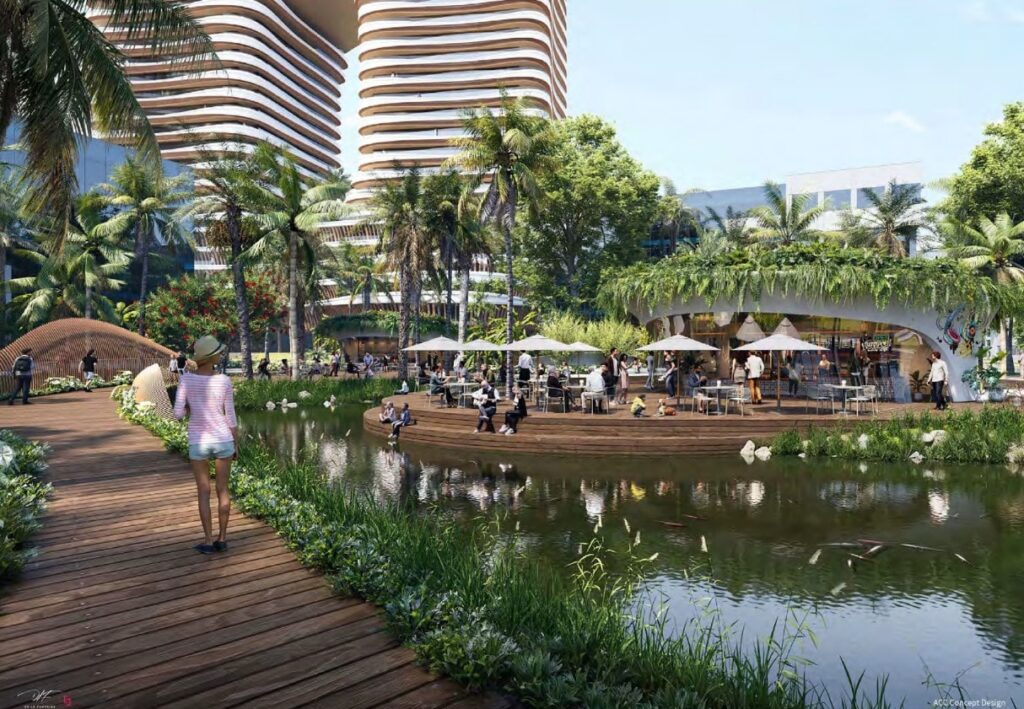
After gaining its first round of approvals from Aventura’s City Commission, Adam Neumann’s Flow company is heading back for a second round. The recently proposed three-tower project is requesting special approval to build additional height, density, and floor area than normally allowed by Aventura code. The preliminary concept design by De La Fontaine Architecture and Zyscovich Architecture envisions curvaceous towers opening up to immense public space for residents and the public alike. These towers will have room for 675 units, with unit sizes ranging from a minimum 500 SF for studios and a minimum 1250 SF for 4 bedroom units. While city code permits 25 units per acre and past proposals gained special approval for 50 units per acre, this development is actually proposing 65 units per acre: a level of density never seen before with this property. 39,000 SF of retail, along with added public space, widened sidewalks, and increased greenery will aim to improve the pedestrian activation in the area. This level of both foot and car traffic will be supported by multiple nodes of transit, such as the project’s ideal proximity to Brightline’s newest station as well as multiple bus stations. However, despite the project’s location near transit, the development will still include 1,709 parking spaces, 1,000 of which located in the tower. While this total is actually lower than the 2,271 spaces required by city code, it may still be more than necessary given the site’s strong transit access. The project is also seeking a significant height exception, with all three towers proposed at 29 floors or 311 FT, far exceeding the current code restriction of 10 floors or 100 FT. Plans and elevations show that the design incorporates amenity spaces not only atop the shared podium but also on the rooftops of the towers themselves. Residents can enjoy features like lounge areas, bars, and even a rooftop lap pool above the 29th floor. The proposed development with multiple conditional use approvals is not walking away for free. In return, the project promises immense public benefits to the city, including $4,250,000 towards various school-related assistance, 50 shared bicycles, 25 community cars, 20 HERO housing units (housing assistance for teachers, military, etc), and more. Located at 20801 Biscayne Boulevard, the project has already received staff recommendation for approval. After the development acquires necessary approvals from the city commission, it can commence with demolition of two parking garages on-site before beginning fountain work.
Gallery at SoMi Parc Proposed at South Miami Gardens Site
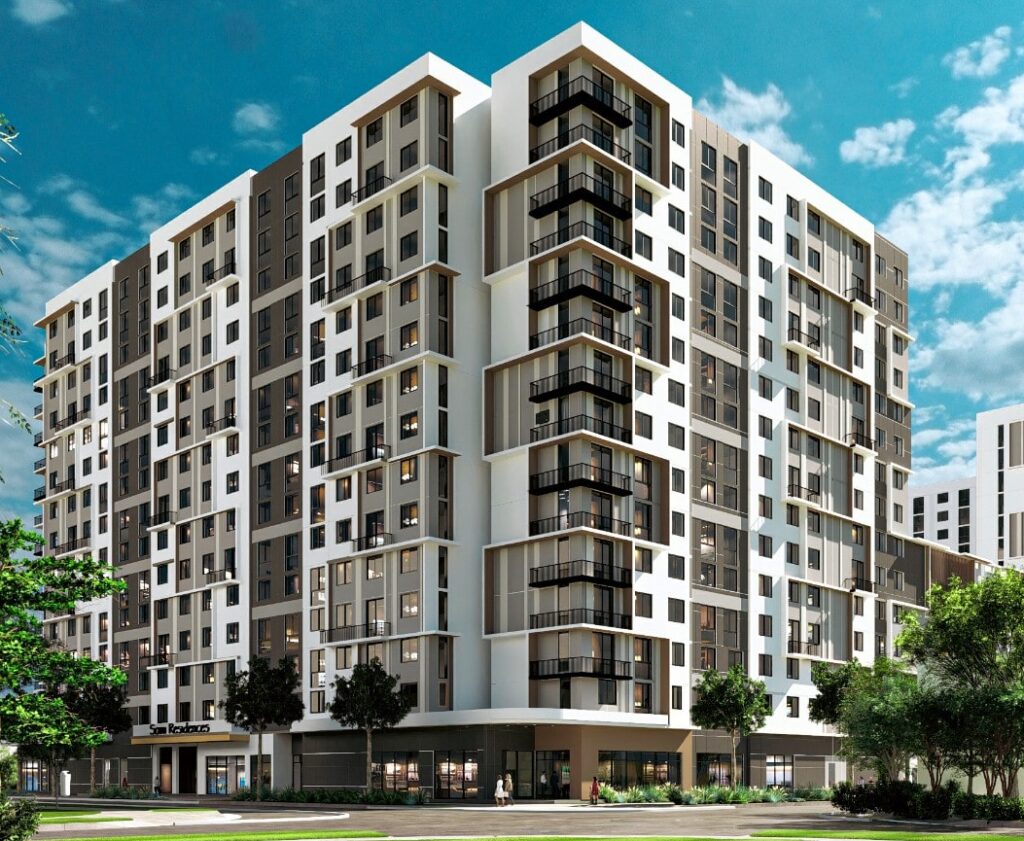
The Related Urban Development Group is beginning the next phase of redevelopment at the South Miami Gardens public housing complex. The company recently completed their first phase in the area, following a competitive bidding process in 2020 that left Related Urban as the sole company to redevelop the housing alongside PHCD. That first phase relocated all existing residents of the complex into newly constructed units, marking a 3.26-acre site available for the next phase of development. In late May, Related Urban followed through by submitting plans for phase two: two 15-story towers featuring abundant retail space and mixed-income housing. Gallery at SoMi Parc is planned to include 700 units of mixed-income housing whether it’s workforce housing, affordable housing, or market-rate units. Given the recent reduction in average unit size across Miami-Dade and the push to include microunits (units below 400 SF), the project’s average unit size of 682 SF and the choice to include zero studios within both towers is a welcomed feature of the development. Units will range from 1 bedroom to 2 bedroom units. Although the property will follow existing rules set under its RTZ designation, it will specifically use the Live Local Act to boost density. Current density only supports 125 dwelling units per acre, meaning only 530 units are possible. With the Live Local Act, the development can now support up to 250 units per acre. Also included in the development are 724 parking spaces, 8,633 SF of retail, and 39,703 SF of office space, comprising a total of 48,336 of usable ground-floor space. By learning from the poor planning practices of public housing in the past, the new complex will breathe life into the area with shops, restaurants, financial institutions, and more on the ground floor. While the design is still early and subject to change, current drawings showcase an improvement in the pedestrian realm on-site. For instance, sidewalks will be expanded and buffered by landscaping, improving the pedestrian safety in the area. Designed by Miami-based Modis Architects, elevations feature two 15-story structures measuring 153 FT tall. Both structures are separated by a screened parking garage, following the design theme of gray, brown, and white tones on a textured facade. While they likely wont be the tallest structures on-site given the recent wave of proposed highrises in South Miami, they will still stand out as one of the tallest. Gallery at SoMi Parc will proceed in 2 phases, with the west building beginning construction first followed by the east. Before construction can begin, Related Urban must receive approval from Miami-Dade planners and demolish the existing structures at 5961 SW 68 Street. Because the current site is vacant and only includes relatively old, low-lying structures, demolition will be easier.
LivWrk Revises Wynwood Proposal to Feature Three 45-Story Towers at 2400 N. Miami Avenue
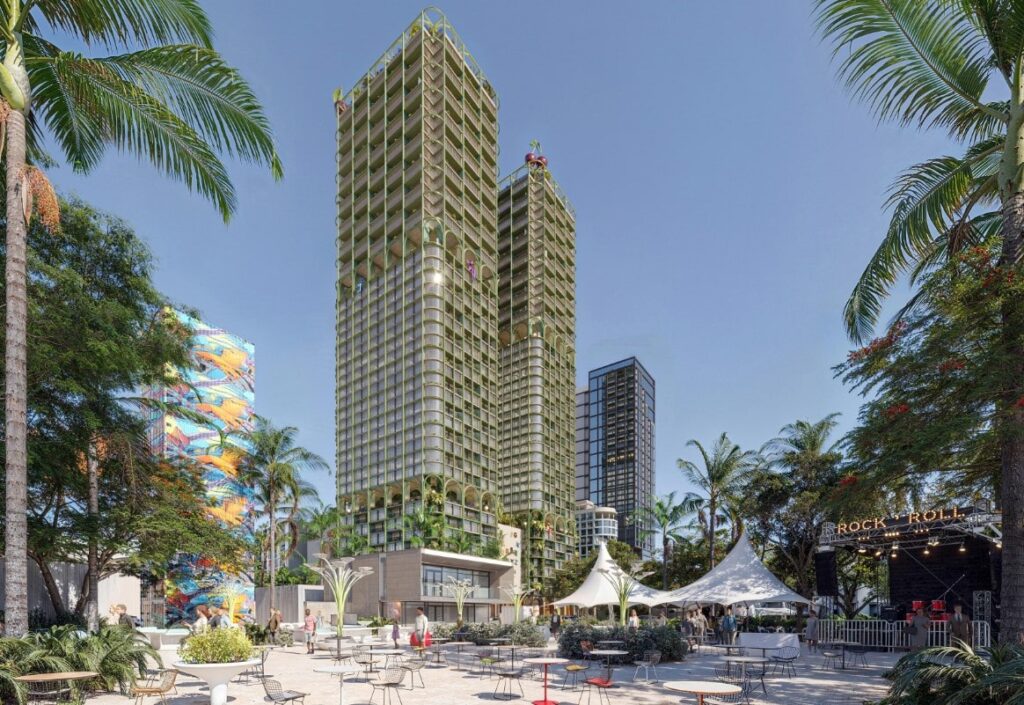
LivWrk is entering Miami’s Wynwood neighborhood with a striking proposal: three art-adorned towers that would become the tallest buildings in the area. This isn’t the first plan for the lot, though. Back in early 2022, LivWrk brought a more modest proposal to Miami’s Development Review Board featuring 542 residential units along with retail, office, and hotel space across two 12-story towers. But with the recent signing of the Live Local Act, in turn allowing greater height, density, and loosening other restrictions, the developer has returned with a much larger vision. The new MKDA-designed three-tower project, set to go before the Wynwood Design Review Committee on June 3rd, would include 1,363 residential units. Inside the towers, there will be a mix of layouts from studios, 1 bedroom, 2 bedroom or even three-bedroom apartments. Like many developments under the Live Local Act, the project is required to include workforce housing, with 40% of the units (547 in total) set aside. These rents are ideally aimed at middle-income renters like teachers, healthcare workers, fire fighters, and other vital industry workers. All workforce units will be built as studios and one-bedroom apartments throughout most levels of the towers. This kind of density, over 1,300 homes into just two acres, might come as surprising, but it’s entirely legal thanks to the Live Local Act. In fact, under the law, the site could support up to 2,000 units without special exceptions due to a new density of 1000 units per acre. While the original proposal called for high-rises at both 2400 N Miami and 2500 N Miami, two sites separated from each other by a minor road (see diagram), the new proposal is only aiming to redesign the 2400 N Miami lot. Likewise, the site at 2400 N Miami will be alike the original proposal in that it heavily prioritizes the pedestrian. According to site plan drawings, there will be 23,152 SF of retail space on the bottom of an 8-story podium available for restaurants, shopping, and more. The 8-story podium, lined by abundant public art displays and units, will feature 950 parking spaces: slightly higher than the required 912 under code. However, it’s important to note that this low parking minimum is actually supported by multiple parking reductions due to the development’s proximity to transit. This prioritization of the pedestrian is further supported by the inclusion of key design elements like a 5,328 SF pedestrian passage, expansion of existing sidewalks by more than 10 FT, and elements in the facade that shade pedestrians from the harsh Florida sun. According to elevations, all 3 towers will rise 45 floors and measure 487 FT each. Along the facade includes cutouts aimed at bringing light into the tower’s amenity portions on both floor 9 and 29. Art pieces like cherries will sit atop the tower, aiming to give the structures a characteristically Wynwood feel through unique and colorful art. Before construction can begin, LIVWRK must demolish the existing structures on the parcel which includes multiple retail buildings, greenery, and a surface parking lot. Replacement greenery will be abundant all throughout the tower, as evident through the tower’s renderings.
Continuum Floats Possible 600-Foot Tower at 1855 JFK Causeway in North Bay Village
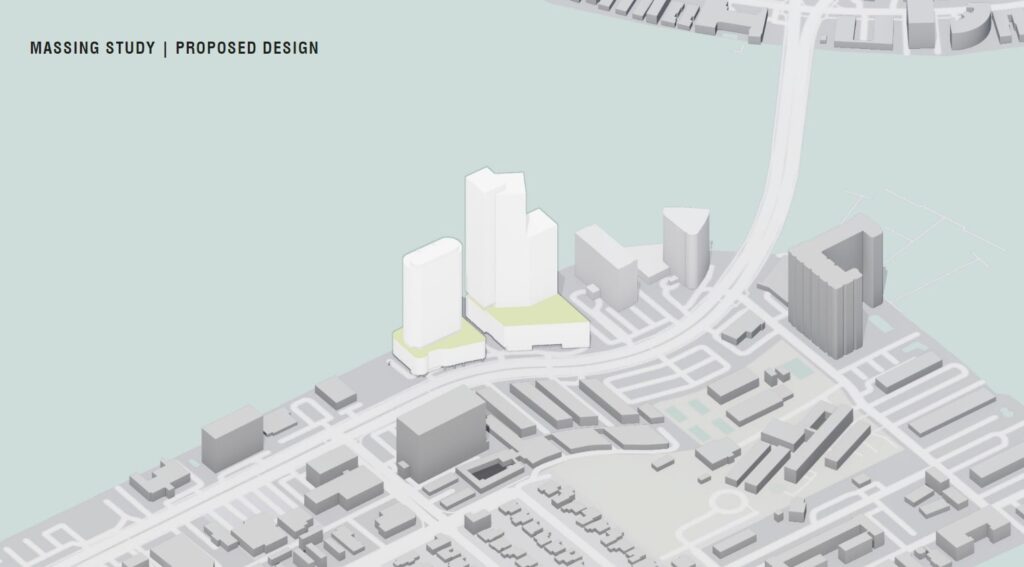
The Continuum Company, a New York-based developer, is seeking zoning changes for two properties it owns along the JFK Causeway in North Bay Village, including the site of the recently proposed Continuum Club & Residences. The amendments plan to alter existing zoning from T6-30 to the area’s own “Continuum Waterfront District Special Area Plan”. The Special Area Plan will grant The Continuum Company increased heights on both properties, as well as altered density, changes to floorplate limitations, and certain benefits only applicable under the Continuum Waterfront District Special Area Plan. Both properties, 1755 and 1855 JFK Causeway, have already secured rounds of site plan approvals, with construction underway for Continuum Club and Residences at 1755 JFK Causeway. The newly proposed Special Area Plan (SAP), however, alters both site’s previously approved heights and density. For example, the Continuum Club & Residences now proposes 236 residential units (up from the previously approved 198) by reducing the amount of planned non-residential space. On the other hand, a prior proposal for 1855 JFK Causeway that featured 345 residential units and 273 hotel rooms has been revised to include 311 residential units and 200 hotel rooms, making room for expanded non-residential uses such as amenity spaces, offices, and similar functions. Additionally, one of the most significant zoning changes is the increase in height limits: the Continuum Club & Residences can now measure up to 440 FT (40 stories), while the east tower is permitted to rise as high as 600 FT (60 stories). A 600 FT tower would be the tallest in North Bay Village. The development also features expanded open space, civic areas, and pedestrian-friendly elements such as an 18-foot-wide “Island Walk,”: a waterfront sidewalk accessible to both residents and the public. Additional improvements include 60-foot-wide view corridors, made possible by the tower’s respective driveways. As part of the approval, 5% of the total unit pool (28 units) must be provided for non-subsidized workforce housing. If The Continuum Company decides not to build these units, they are required to pay a fee toward workforce housing initiatives. According to documents, all designated workforce housing units are planned within the east tower, the tallest structure. While the decision to pursue the Special Area Plan (SAP) may seem like a surprise given both properties already have approvals and one is under construction, the decision comes after recent changes to North Bay Village’s zoning code. Updated code now allows the Commission to grant allocations in development capacity or height within an SAP to promote “public waterfront access, expanding open space, and enhancing the Village’s public parks to better address the recreational and open space needs of its residents.” If approved, the project must follow a strict timeline. The developer must obtain a master building permit within 2 years of approval, with only 2 additional one-year extensions if requested. This means the developer is given 4 years to break ground after approval, or the project’s approval and subsequent zoning changes are null. According to a staff report, the proposed SAP is “consistent with the redevelopment goals of the North Bay Village Comprehensive Plan, the pillars of the NBV100 Master Plan, and the vision for the Kennedy Boulevard district.” The North Bay Village planning board will review the ordinance and make recommendations, either approving or denying it. The final decision will be made by the Village Commission on June 17, 2025. Although staff can give guidance, the final vote may deviate from recommendations.
Group P6 Updates Their Proposal for ‘The Gateway Residences’ in Ojus: Adding More Density and Height
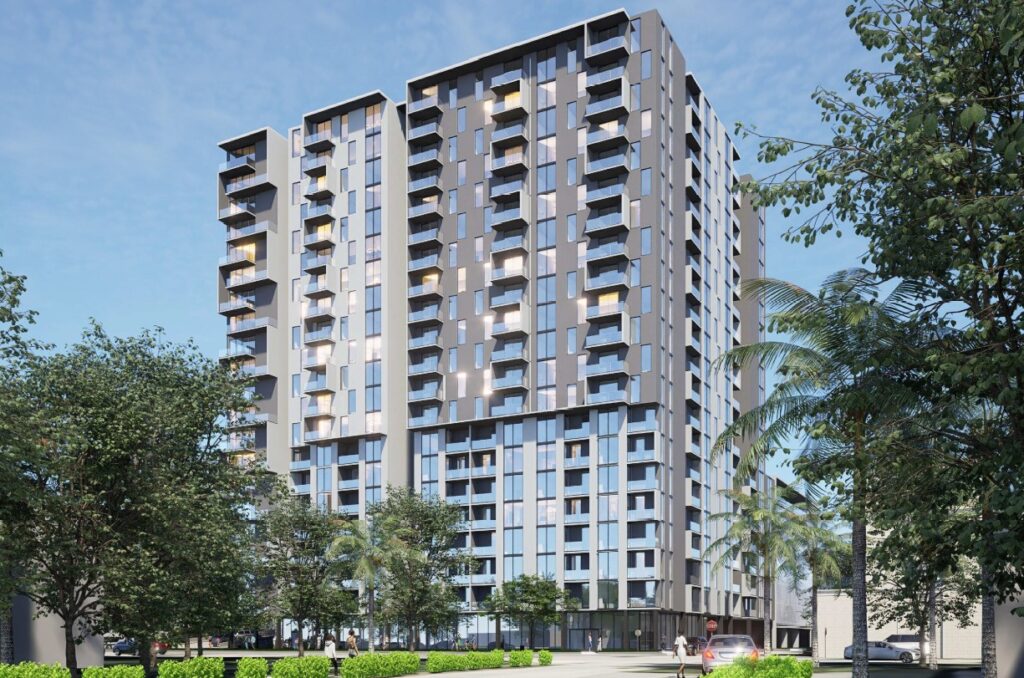
After gaining final approval for their flagship Ojus/Aventura project coined ‘The Gateway Residences’, Group P6 is resubmitting the project with plans for higher density and other benefits under the Live Local Act. Group P6 is not alone in the rush to secure land or approvals amid the Live Local Act’s impact. In fact, dozens of Live Local Act projects have been submitted in Miami proper alone. Newly submitted plans for ‘The Gateway Residences’ by Idea Architects call for the development to have 365 residential units, 4,300 SF of retail/co-working space, and 443 parking spaces. Units will range from studio, 1 bedroom, 1 bedroom+den, 2 bedroom, 2 bedroom+den, 3 bedroom, and 3 bedroom+den orientations. The majority of the building will be composed of 1 bedroom and 2 bedroom units, making up more than half of the units proposed. As per Live Local Act requirements, the developer must make 40% of the units affordable, hence at least 146 units will have their rents priced at or below 120% of the Area Median Income. This marks a significant change from the original 2023 proposal, which included 195 residential units, 453 parking spaces, more than 18,000 SF of retail space, and approximately 100,000 SF of office space. The revised plan nearly doubles the residential density while significantly reducing the commercial footprint. Thanks to the Live Local Act’s provision allowing developers to apply zoning regulations from within a 1 mile radius, the project could update its tower massing closer to NE 26th Avenue. Previous massing were restricted to the east side of the property, as that side was under relaxed density restrictions unlike the west side. Below shows a comparative analysis of massing changes. The revised development proposal now envisions a 21-story tower reaching 227 FT in height, slightly exceeding the original plan of 17 floors and 208 FT. While current zoning permits high-rises up to 15 stories, the project qualifies for an additional six floors by meeting specific criteria. Likewise, the ground floor which prioritized retail and other uses now features co-working space, a lobby, and more. The project’s pedestrian activation like wide sidewalks and sufficient greenery remained consistent between both proposals. Before moving forward, Group P6 must demolish the existing properties at 2630 NE 203 St and 2600 NE 203 St and gain approval for the project. If built, it will rise among higher density projects currently sprouting in Ojus, Miami-Dade.
Keystone Holdings Proposes ‘Keystone Midway’, a Mixed-Income Live Local Project in Fontainebleau
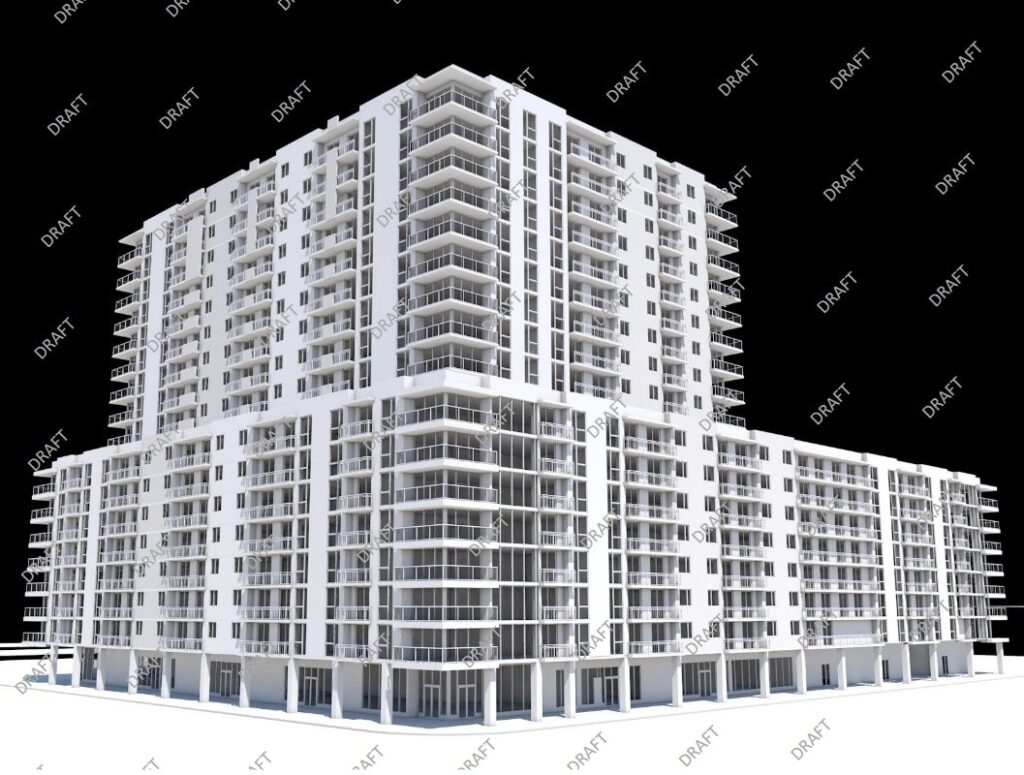
A developer is proposing a mixed-income housing project in Fontainebleau under Florida’s Live Local Act, continuing a trend of residential developments emerging in commercial and industrial zones. Keystone Holdings plans to build the multi-story high-rise on commercial land near Midway Crossings, a major shopping center home to high traffic and zero high density residential. The project, named Keystone Midway, is making use of improved density, quicker approval times, and other benefits like parking reductions associated with the Live Local Act. If built, the development hopes to establish a mixed-use environment in an environment currently dominated by commercial uses. The development will include the construction of 477 units, with at least 40% of the units designated as “affordable/workforce” housing. This translates to 191 affordable units, priced at or below 120% of the Area Median Income. Units will range from 1 bedroom, 1 bedroom/den, and 2 bedroom apartment orientations. Based on rent cap data from Bilzin Sumberg, developers are allowed to price one-bedroom units at $2,788 and two-bedroom units at up to $3,345, which heightens concerns regarding the true affordability of all Live Local Act projects, not just Keystone Midway. Because the development utilized the Live Local Act, density boosted from an allowable 125 dwelling units per acre to an allowable 250 dwelling units per acre. To house said units, located within the tower’s podium are 639 parking spaces, reduced from the 792 required spaces under code. This reduction was made possible through a 25% parking reduction waiver for workforce/affordable units in Miami-Dade. All parking spaces will be masked from the public with the inclusion of podium-lining units, allowing for enhanced pedestrian activation and aesthetics. The property is also fronted by a bus station, giving residents mobility options. While the plans are still a draft, the developer is proposing a range of uses on the ground floor, from 8,624 SF of retail space to residential amenity space like a pool, hot tub, and more. Existing sidewalks of around 5 FT will be expanded to a maximum width of around 30 FT. Although greenery is not included in the site plan, the developer will likely provide it given code requirements. Lastly, elevations provided by FORMGROUP Architecture, the architect responsible for prelimintary drawings, showcase a tower rising 18 floors or measuring 183 FT. This height not only eclipses the nearby building, but rises akin to a residential tower at 9595 Fontainebleau Blvd: the current tallest in Fontainebleau, FL. Although the Live Local Act allows for increased height limits, this benefit is not needed on this property as current code actually allows for unlimited building height. As of now, no permits have been filed for the site: none for demolition, building, or site planning. While the developer is required to obtain all of these before breaking ground, if this project moves forward, it could become one of the first examples of Live Local development actually taking shape in Miami-Dade, especially in areas farther west where no such projects have broken ground to date.
First Work on Tampa’s New Green ARTery Begins
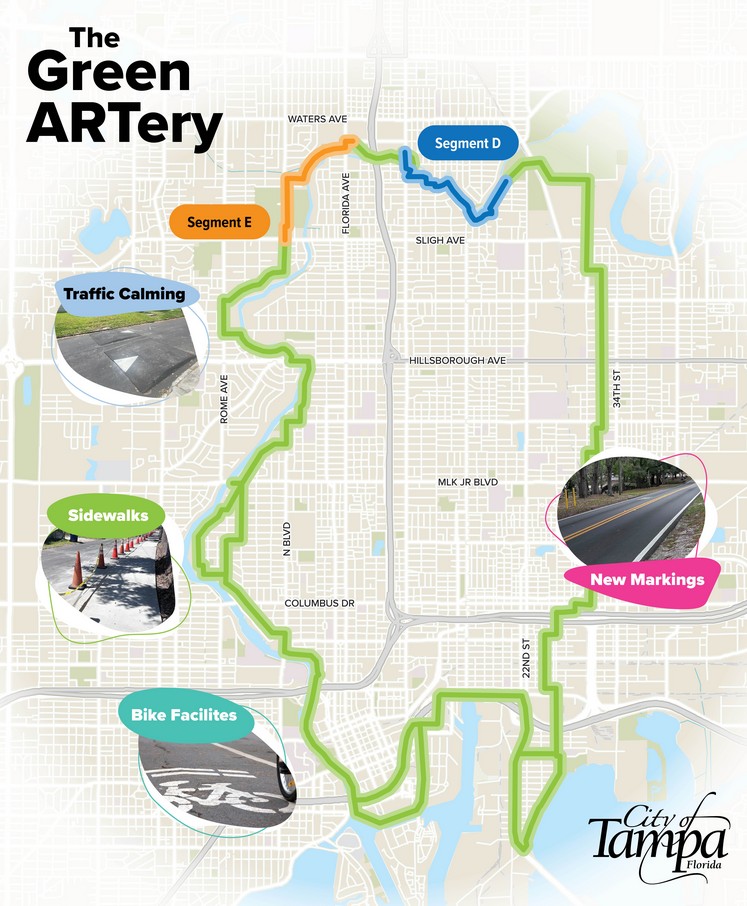
After being proposed in 2010 and undergoing planning for more than half a decade, Tampa’s Green ARTery is beginning its first two segments: Segment D & E. The pedestrian-orientated vision was jump-started in the spring, and involves the construction of an uninterrupted pedestrian-orientated trail where cyclists and pedestrians can enjoy Tampa’s urban landscape under the comfort of traffic calming methods, art, and tree canopies. According to the City of Tampa, residents will see “nearly 4,000 feet of new and widened sidewalks, fresh paving, lower speed limits, solar-powered flashing crosswalk beacons, improved roadway markings, signage, and more.” The first two phases of the initiative will cost around $1.7 million, with half of the funding deriving from FDOT grants and the remainder from multimodal impact fees. Segment E, with an estimated cost of $1,188,166, will link Lowry Park to River Tower Park. The segment will span approximately 1.3 miles and will include widening existing sidewalks, adding new sidewalks with grass buffers, and installing bicycle/pedestrian crossing signage at multiple intersections. According to meetings held during the planning process (which are subject to change), North Boulevard will feature shared lane markings, resurfaced pavement, and reduced speed limits of 25 MPH. Meanwhile, Kirby Street and River Shore Drive will be retrofitted with speed cushions, lower speed limits, a new 5 FT sidewalk with a buffer, and additional improvements. In the final section of segment E, along North Florida Avenue, existing sidewalks will be widened from 5 FT to 8 FT. More information is available at this link: https://www.tampa.gov/project/trans20032. The last segment that began construction is segment D. Despite being at a lower cost of $532,787, the project will actually span more mileage at around 1.4 miles. Like segment E, the project will include “Share the Road” markings, new 5-foot sidewalks, and more. Sidewalks will be provided on the east side of Van Dyke Place and from Hamilton Heath Drive to Hollywood St. Across the entire section includes bicycle boulevard markings and speed cushions on streets such as Park Drive, East Park Circle, and E Patterson St. More information ca be found here: https://www.tampa.gov/project/trans20031. Construction on both segments are estimated to be done by mid-August, while the entire ARTery will be entirely completed by 2030. Throughout the Green ARTery’s phasing, more than 20 neighborhood groups will be involved.
Kolter Urban Enters the Miami Market With Two Highrises on the Border of Miami’s Design District at 3801 Biscayne Blvd
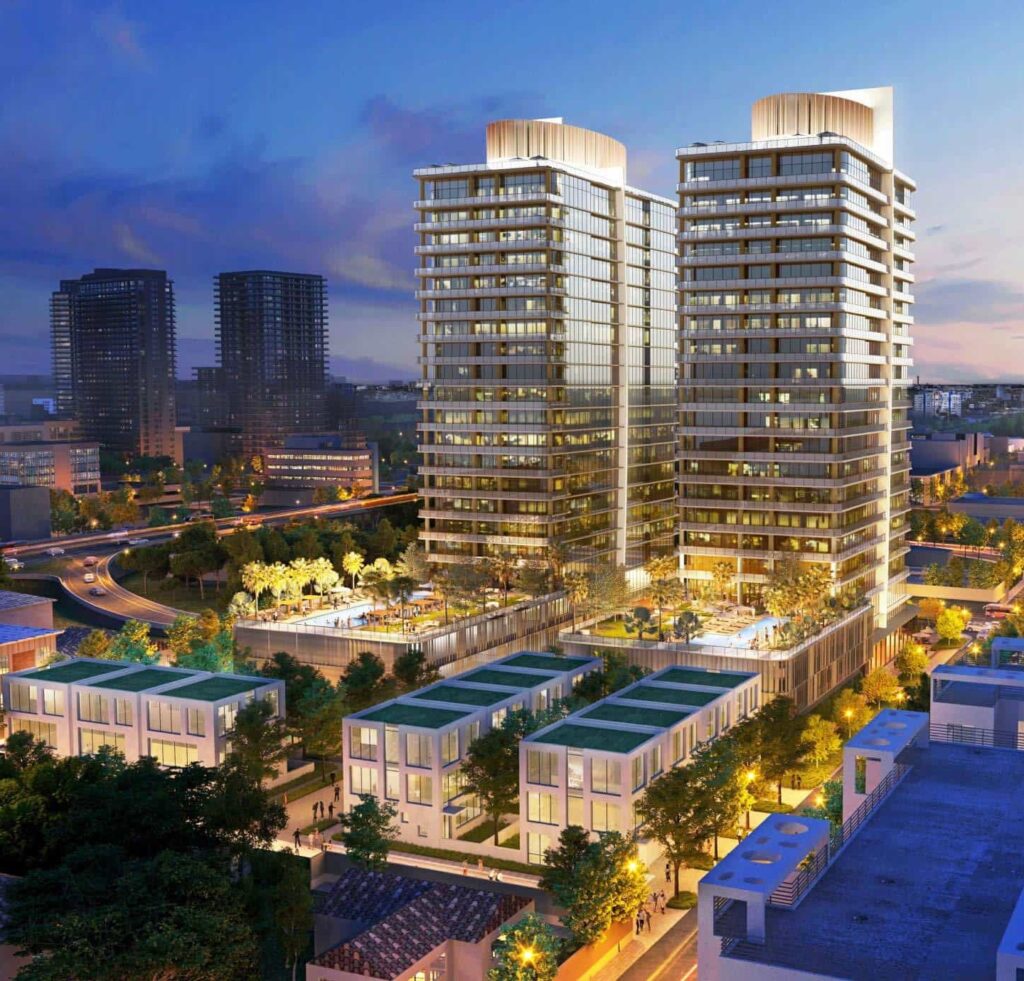
Kolter Urban, a firm which boasts high-rise developments in multiple Floridian cities, is breaking into the Miami market with a twin tower project on the border of Miami’s Design District. Designed by the infamous Miami-based firm Arquitectonica, the project is planning to bring two 20-story towers with ample ground floor retail space, parking, and condos. More specifically, the development will include a combined density of 164 units, 8,874 SF of commercial space, 374 parking spaces, 2 hotel rooms, and around 50 bicycle parking spaces. Units will be split between 1 bedroom, 2 bedroom, 3 bedroom, 4 bedroom, and penthouse orientations. Units will be generously sized, with 1 bedroom units having an average size of 3,500 SF between both towers, although unit size is preliminary/still in the planning process. Kolter Urban and Arquitectonica will face review of their design considerations on May 21st by the Urban Development Review Board. Located at 3801 Biscayne Blvd and 3883 Biscayne Blvd, the tower is designed to abide by all zoning regulations, hence the tower includes no waivers, variances, or the utilization of the Live Local Act. For example, the tower is split between two zoning designations of T6-12-L and T4-R. T6-12-L boasts increased density and the ability for towers, while T4-R restricts development to low density multifamily housing. This is reflected in the tower’s plans, which features transitional density from high-rises to townhomes. The townhomes are part of a future phase and are not included in the plan’s submission. The planned towers aim to enhance the pedestrian experience along Biscayne Boulevard by incorporating retail spaces that face the major throroughfare. The project also features extensive greenery along the sidewalks, promoting “walkability, sustainability, and the integration of vibrant public spaces”. Additionally, the plans include elevation drawings showing that both towers will measure 293 FT. These elevations showcase a mix of design elements such as glass railings, bronze glass curtain walls, bronze stucco finishes, and other architectural details. Before construction can begin, Kolter Urban must demolish multiple structures on the site, with many dating back to the early 1900s. In total, demolition must encapsulate 8 properties including offices, retail, multiple single family homes, and the iconic Biscayne Medical Plaza building. As of May 19th, 2025, no permits have been filed recently relating to demolition, site preparation, or construction, although that may change in the distant future.
New ‘Sense 22’ Residential Tower Proposed as HA Emprendimientos Grows Edgewater Brand
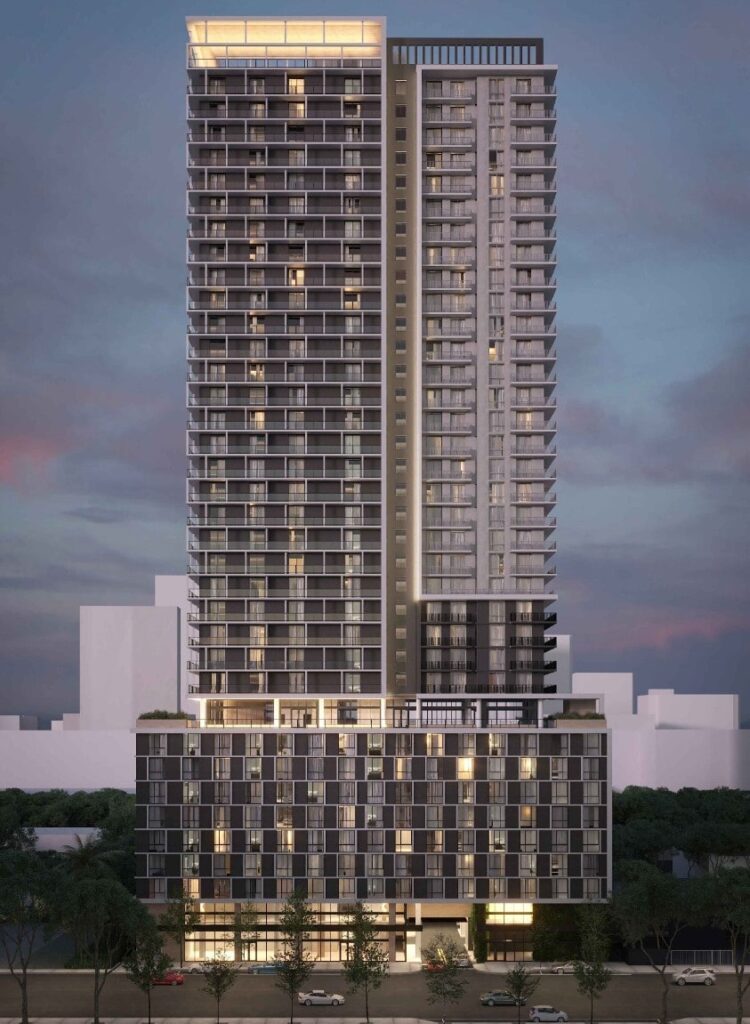
HA Emprendimientos, headquartered in Argentina, has submitted plans for ‘Sense 22’ to Miami’s Urban Development Review Board (UDRB). Located on the outskirts of Miami’s Edgewater neighborhood, the project comes amid an unprecedented surge in development in Edgewater, sitting just blocks away from the newly announced Braman Motors Campus: a major mixed-use project that will include two new towers, car shows, and more. The developer is planning to utilize the recently enacted Live Local Act, which allows for higher density and height for the exchange of affordable housing. Designed by Anillo Toledo Lopez Architecture, the tower is a continuation of the ‘Sense’ brand in Miami, with projects like Sense Edgewater 28 already rising out of the ground. The project is aiming to move forward on May 21st with a hope for approval by UDRB staff. The project is planned to include 328 residential units, of which 40% are affordable rentals. This translates to 132 units being designated as affordable. In addition, the project will have units split between studio, 1 bedroom, 1 bedroom + den, and 2 bedroom orientations. 1 bedroom and 2 bedroom units make up the bulk of the units, as they consist of about 83.5% of total units. However, despite having a high density of around 449 units per acre, the project is actually entitled to higher: 1000 units/acre, with the possibility for 730 units. Further bonuses are provided to the developer, including parking reductions. Because the development is located in an opportunity zone close to public transportation and located within the Omni Redevelopment Area, it’s entitled to a 30% reduction in parking, bringing down required parking from 525 to 367. The developer will include 372 parking spaces. Although the ground floor does not feature any retail, the pedestrian activation is generally an improvement for the area. For instance, the property will ‘boast a parking structure lined with apartments along the entirety of its street frontage, an open and inviting street-level facade characterized by storefront glass, and tower elevations with varied architectural treatment’ according to the property’s letter of intent. More specifically, the area’s approximately 4-foot sidewalk at 138 NE 22nd Street will extend to nearly 16 FT, along with adequate street parking and greenery. The current pedestrian activation will greatly benefit from this improvement, as current site photos showcase the sidewalks abutting the property facing neglect with trash, overgrown greenery, and crumbling concrete. Elevations feature a 36-story tower rising 381 FT, although the tower could ‘technically’ rise 80 floors within its right as per the Live Local Act, albeit the FAA usually forces towers to comply to around 600 FT in height in Edgewater. Elevations also outline features such as a rooftop sky lounge on floor 36, or an amenity deck on the 9th floor. Amenity spaces include a clubroom, gym, seating areas, wellness room, co-working/podcast areas, and more. To conclude, the project’s specifications are as follows:
Embattled Property at 340 Biscayne Listed for Redevelopment Amid Bankruptcy and Debt Dispute
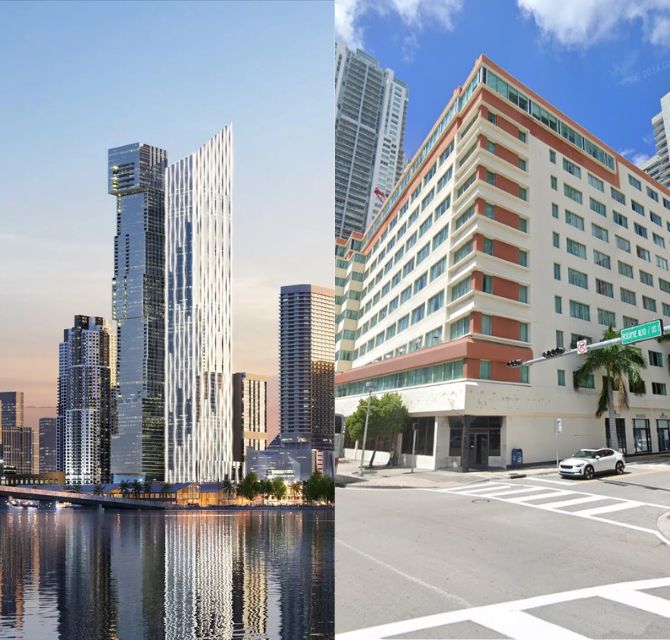
Following multiple bankruptcies in an attempt to reorganize debts and prevent foreclosure on the property, 340 Biscayne Owner LLC is listing their Holiday Inn property at 340 Biscayne Blvd on the market. The move comes at a time when multiple developers are eyeing land along Biscayne Blvd for redevelopment: primarily ‘supertall’ redevelopment. At both 130 Biscayne Blvd and One Bayfront Plaza, developers have planned two distinct supertalls to rise alongside The Waldorf Astoria Residences Miami. First reported by The Real Deal, Gilberto Bomeny, affiliated with 340 Biscayne Owner LLC, is advertising the site after bankruptcy court Judge Laurel Isicoff approved the marketing of the property under Hilco Real Estate Sales. The site, home to a multi-story Holiday Inn built in 1950, has been battling financial distress since its first Chapter 11 bankruptcy filing in 2021. While a federal court allowed the hotel’s loan to be extended so operations could continue, New York-based Cirrus Real Estate eventually took over both the land and outstanding debt from Kawa Capital, a move 340 Biscayne LLC claims happened without their consent. In 2023, 340 Biscayne regained ownership of the land through a new deal with Cirrus, securing a $70 million loan that went into default in 2024. To complicate matters, 340 Biscayne claimed that Cirrus deliberately backed them into a corner by ignoring a potential parking lot redevelopment that would’ve provided short-term revenue to offset debt. The company also accused Cirrus of charging interest rates above 25%, a rate exceeding Florida’s legal usury limits. In November 2024, Cirrus attempted to foreclose through a UCC filing, but 340 Biscayne responded by filing for Chapter 11 once again, temporarily delaying foreclosure and opening the door to find a buyer or redevelopment partner. While Cirrus is primarily concerned with zero payments made towards the existing debt, the company also believes the filing of multiple bankruptcies is giving the company little leverage. According to marketing material provided by Hilco Real Estate Sales, the property will be called Regalia on the Bay, rising 82 floors: a height allowable under Miami21 zoning. There will be 374 residential units, 120 hotel rooms, and 500 parking spaces in a tower designed by Arquitectonica. The project will be in proximity to multiple parks, retail, and public transit including Miami’s Metrorail and Metromover. The development is one of the many sites along Biscayne Blvd to hit the market. Another site close-by is 400 Biscayne Blvd, which was listed by PMG Development not too long ago. The listing allows interested parties to either partner with the property owner on the redevelopment, refinance the defaulted $70 million loan, or purchase the site. Expressions of interest are due by June 16th. If a deal is made, Cirrus and 340 Biscayne Owner LLC will be one step closure to resolving debt issues.
Phase Two of Adela at MiMo Bay Submitted to Miami’s Urban Development Review Board
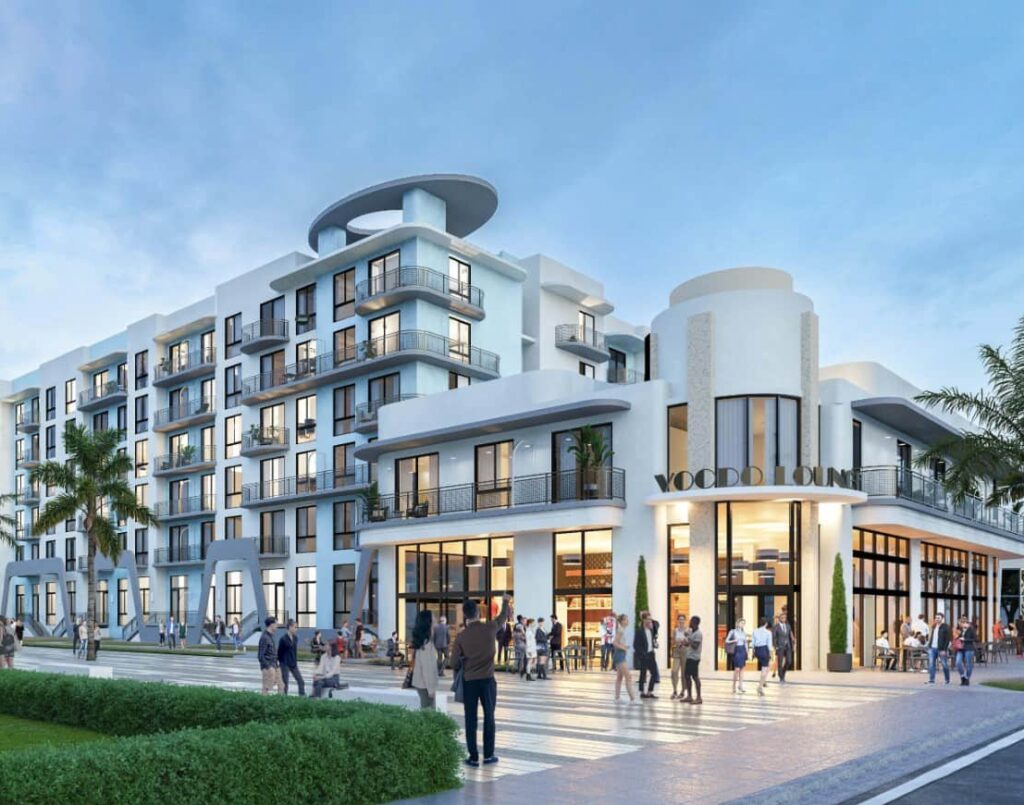
Phase two of Adela at MiMo Bay is moving ahead, spearheaded by Atlanta-based ACRE Real Estate. The project took a major step forward after a rezoning and FLUM amendment were approved on November 21, 2024, allowing for greater density than before. The site at 645 NE 64th Street in Miami is now cleared for up to 337 units, with a maximum building height of 75 feet. As part of the agreement, at least 20 units must be set aside as workforce housing, with 16 of them reserved for households earning 80% or less of the Area Median Income. ACRE has previously expressed interest in moving forward on the property, which will prove beneficial given the developers are allowed at most 3 years to obtain building permits. Thus, the UDRB hearing for the development on April 23rd will be one of the first steps in the right direction, with board members approving or denying the design by Corwil Architects. Likewise, the developer has already submitted permits, including a general construction permit, a site work permit for foundation tasks, and a tree permit that includes the removal of multiple palm species, oak trees, a mango tree, banyan tree, and more. As per the covenant, the developer must “preserve, relocate, or replace all on-site trees to the greatest extent practicable”. The developer is following the agreement by planting all necessary trees, such as bald cypresses, palms, and more to compensate for lost greenery. No permits have been approved yet. True to a letter provided in the application, the design is meant to not only express homage to MiMo’s design history, but provide setbacks between the development and Legion Park through a pedestrian-orientated paseo. On the portion of the building facing Biscayne Boulevard, there will be 7,086 SF of commercial at a reduced height of 35 FT in accordance with neighborhood height restrictions. Despite consideration into the development’s height, design, and affordability, residents have expressed concern regarding future traffic and density. Several residents also believe the multifamily building is only the beginning to increased heights granted under the Live Local Act. To accommodate both residents and commercial tenants, the project will include 524 parking spaces: slightly below the 557 required by the Miami21 Code thanks to a 10% reduction granted through a waiver. Plans also include 40 bicycle storage spaces. According to elevation drawings, the building will stand 6 stories tall, measuring a height of 83 FT to the tallest point or 72 to the highest occupied floor. The garage will be fully wrapped with residential units, helping to enclose it and create a more pedestrian-friendly streetscape. In addition, the buildings facade will be composed of coral stone cladding, wire mesh railings, aluminum metal cladding, and green walls to enhance the building’s architectural style.
‘The Aurea’ Revealed by The Allen Morris Company & Black Salmon as the First Residential Tower in Highland Park
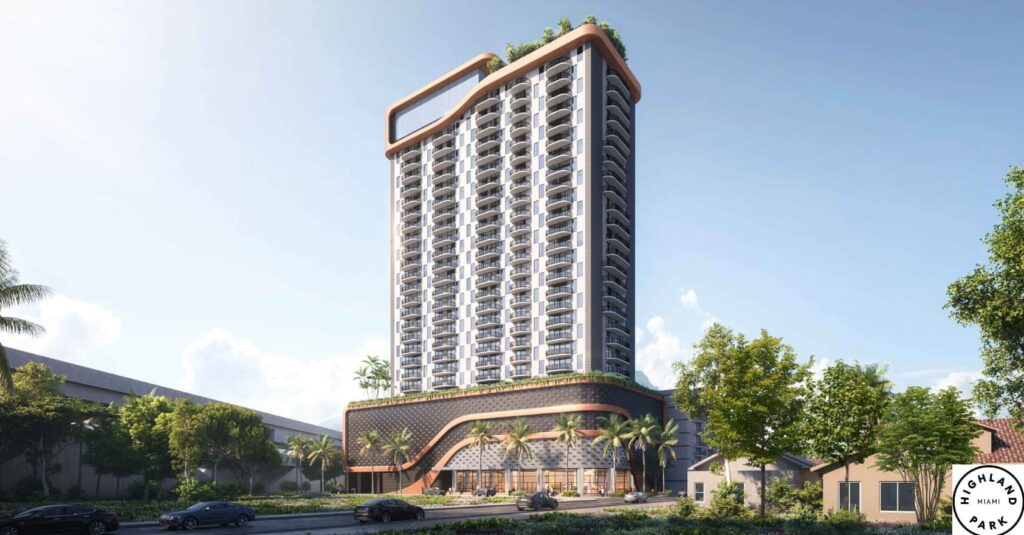
The Allen Morris Company and Black Salmon have recently paired up to introduce its first residential tower in Highland Park, a development unveiled in 2023 that called for over 1,000 residential units, distinct office space, hotel rooms, and more: all within a 6.4-acre master plan. The first tower, coined ‘The Aurea’, is set to feature 352 units, retail space, and parking using Florida’s recently enacted Live Local Act. Situated in close proximity to rapid transit, the development at 1321 NW 9th Avenue currently features T6-8-O zoning, which entails a maximum building height of 8 floors and 150 units per acre. With the Live Local Act, the property is now granted zoning from within a mile away, with the possibility for 1,000 dwelling units per acre. In the case of ‘The Aurea’, the property will feature density of 416 units per acre, divided into units composed of either studio, 1-bedroom, or 2-bedroom apartments. As is the standard for all Live Local projects, developments must designate 40% of its units as workforce housing, priced for households earning up to 120% of the area’s median income. These units target the “missing middle”: vital workers like teachers, nurses, and first responders who earn too much for low-income housing assistance but still face challenges when affording market-rate rent. ‘The Aurea’ will include 141 of these specialized units, with residents no matter the income level having access to an amenity deck on the top floor, equipped with a liquor lounge, swimming pool, barbecue area, lounge seating, and more. The highrise will incorporate 291 parking spaces and 360 bicycle parking spots within its podium, despite the Live Local Act waiving parking requirements for developments in transit orientated areas. The project also aims to enhance the pedestrian experience through thoughtful street design, including widened sidewalks up to 25 feet and a public courtyard on the east side of the property, complete with art installations and a water feature. The property also features a 3,611 SF retail space on the corner of NW 13th St and NW 9th St. According to elevations, the tower will rise 300 FT at its tallest point, comprised of parking from floors 2 to 6, residential units from floors 7 to 28, and amenity deck on level 29. Designed by Arquitectonica, the project, “draws inspiration from its transit-oriented surroundings by translating that movement directly into thegeometries of the facades of the project. These facades are divided into three zones vertically – the podium,the tower, and the rooftop amenities where each zone displays a distinct yet cohesive language.”
Little Havana Gets One of Its First Live Local Projects at 531 SW 7th Street
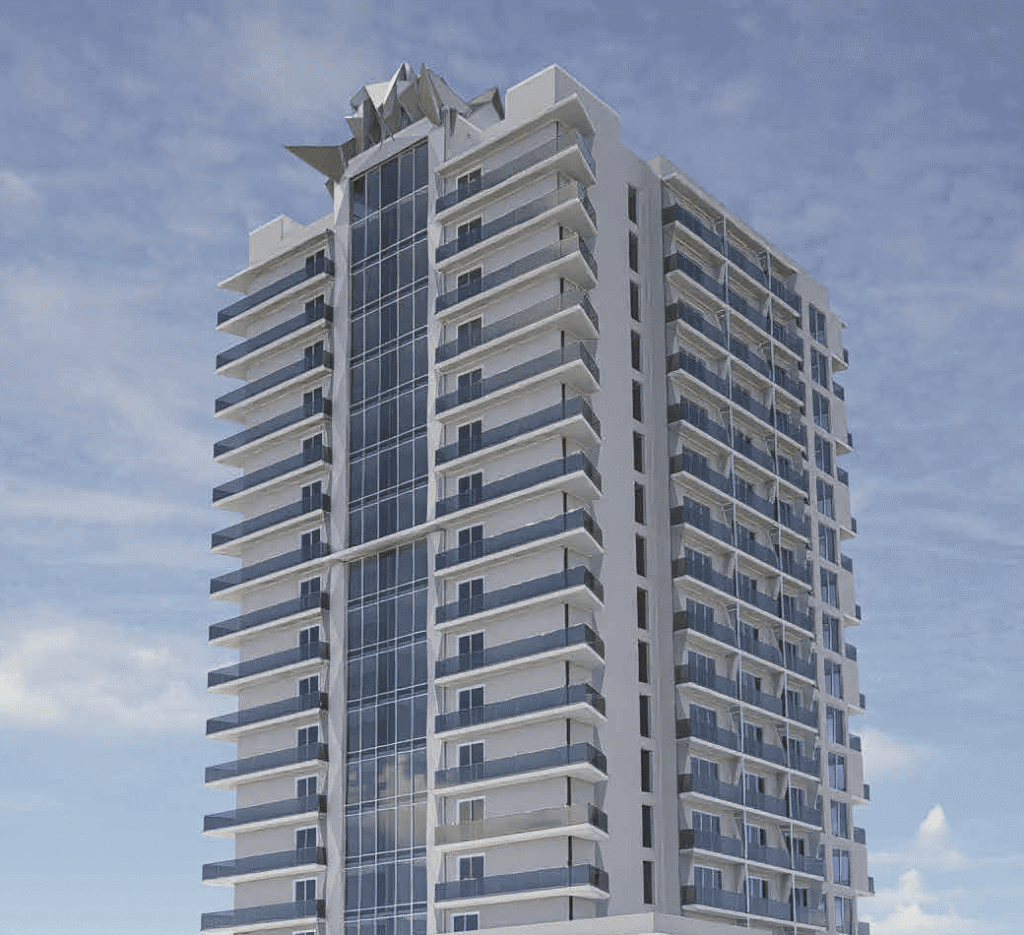
22 Liam Properties LLC, a company based in Sunny Isles Beach, is making a splash in Little Havana with one of the area’s first Live Local Act projects. Purchased in 2023 for $3,490,000, the on-site parcel at 531 SW 7th Street will be developed into a 23-story tower home to 166 units, with the company tapping into the design expertise of Steven L Cohen and Associates. Passed in 2023, the Live Local Act makes projects such as 531 SW 7th Street viable under the bill’s unique policy created to spur housing. The current zoning under T5-L, a zoning designation that only allows heights up to 5 stories and density of 65 units per acre, would require a formal rezoning. However, with the Live Local Act permitting zoning regulation from more than a mile away, the property now utilizes T6-24, creating for a maximum height of 24 stories and a maximum density of 1,000 units per acre without government say. Housing will be divided into 114 studios, 33 1-bedroom apartments, and 19 2-bedroom apartments. Since the Live Local Act requires 40% of the units to be workforce housing, 67 of the units are workforce and 99 are reserved for market-rate uses. All of the workforce housing will consist of studio apartments: a common choice among Live Local Act developers aiming to make their projects financially possible. Units will range from 395 SF at the lowest to 1,405 SF at its highest. Tenants no matter the income will have access to the property’s amenities which range from a pool and spa to other smaller uses. On floors 1 through 7, 214 parking spaces are strategically positioned on the back of the building for units to line the facade at SW 7th St, a major thoroughfare. Although code requires 267 parking spaces, the Live Local Act grants developers a 20% reduction in parking spaces if the project is close to transit. In this case, the project is 2616 FT away from the Brickell Metrorail station. In addition to housing, the developer plans to activate the ground floor with 403 square feet of commercial space. The project’s pedestrian friendly design is poised to enhance the pedestrian realm by widening the sidewalk from approximately 7 feet to 17 feet. Currently barren, the sidewalk will be lined with new greenery, adding shade to pedestrians. Elevations feature a podium composed of “sharped-edge shape decorative metal screening panels” that “further enhance the sharp edges characteristic of the building design”, leading up to the main tower which incorporates large balcony space adorned by glass railings. At the top of the building, a decorative crown will top the highrise at 262 FT: the tallest architectural point of the building. Urban Development Review Board members will determine the design efforts for 531 SW 7th Street on April 23rd, 2025 at 2 P.M.
Another Live Local Project Is Coming to Miami: This Time in Allapattah at 1344 NW 22nd Street
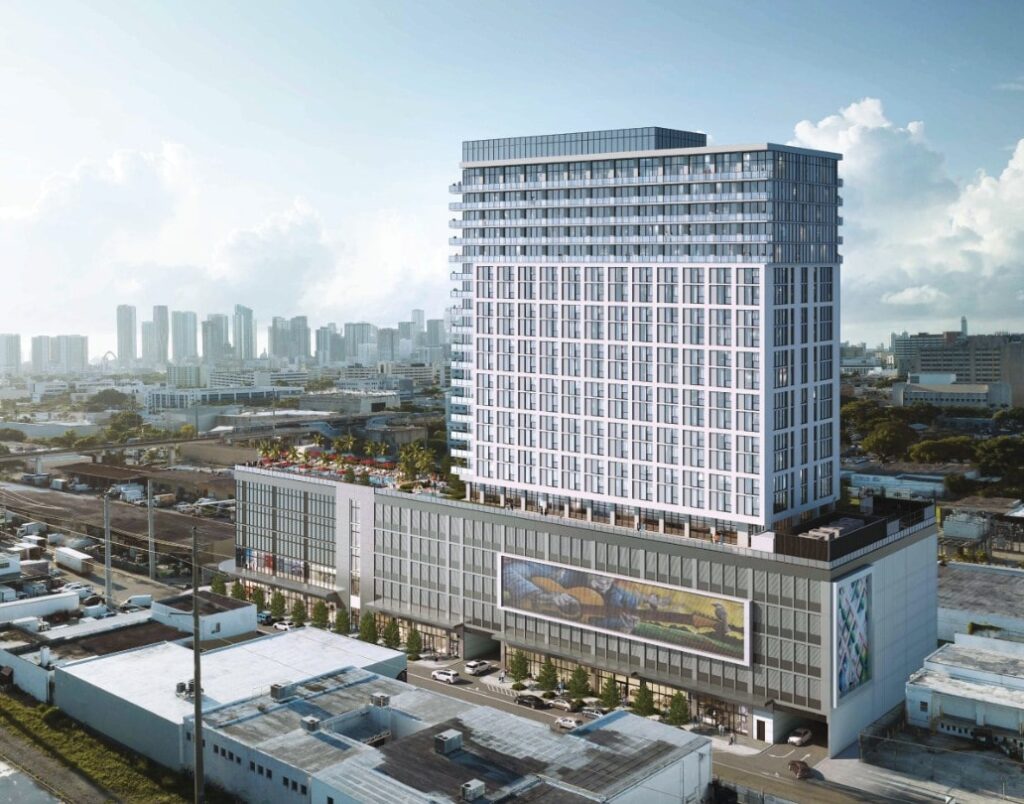
Developers have quickly begun to capitalize off of the Live Local Act. Joe Acquisitions, LLC, a company managed by Vertical Real Estate’s Lyle Stern and Kerry Newman, is no exception. The company is tapping into Miami’s recent surge of Live Local Act projects with a proposal to transform a 1.17-acre industrial site in Allapattah, currently occupied by warehouses and parking lots, into a highrise featuring 400 residential units. Of which, 160 units are workforce housing, mandated by the Live Local Act’s 40% affordable housing requirement that necessitates the construction of cheaper housing in exchange for higher density and a quicker permitting process. The developer is also requesting a warrant for the construction of 40 microunits out of the 400 units proposed. Microunits will be in the upper 300 SF range, significantly smaller than studios. Beyond microunits, there will be studio, 1-bedroom, and 2-bedroom apartment orientations. The average unit size comes in at 580 SF, uniquely smaller than other nearby apartments. Because providing smaller workforce units closer to the bottom floor allow developers to profit off of certain Live Local projects, workforce apartments will be added between floors floors 6 to 12, and occasionally throughout floors 13 to 18. More expensive, larger units will be on the higher floors. The 23-story tower, set to rise 276 FT, will bring 17,800 square feet of retail space to the area, spanning two levels at the base. While 335 parking spaces are planned, zoning doesn’t actually require any. A 20-FT-wide sidewalk lined with varied greenery aims to create a more inviting, pedestrian environment. Designed by Built Form architecture, the project will feature a predominantly flat facade, an uncommon design choice in Miami where towers typically include balconies. Portions of the building will be adorned with artwork and screening, including an artistic kinetic wall by Extech on the podium that moves with the wind. Located at 1344 NW 22nd Street, the development sits near Miami’s Metrorail, positioning it as a transit-oriented project.
‘Wynwood Tower’ Proposed as Tallest Building in Wynwood Norte
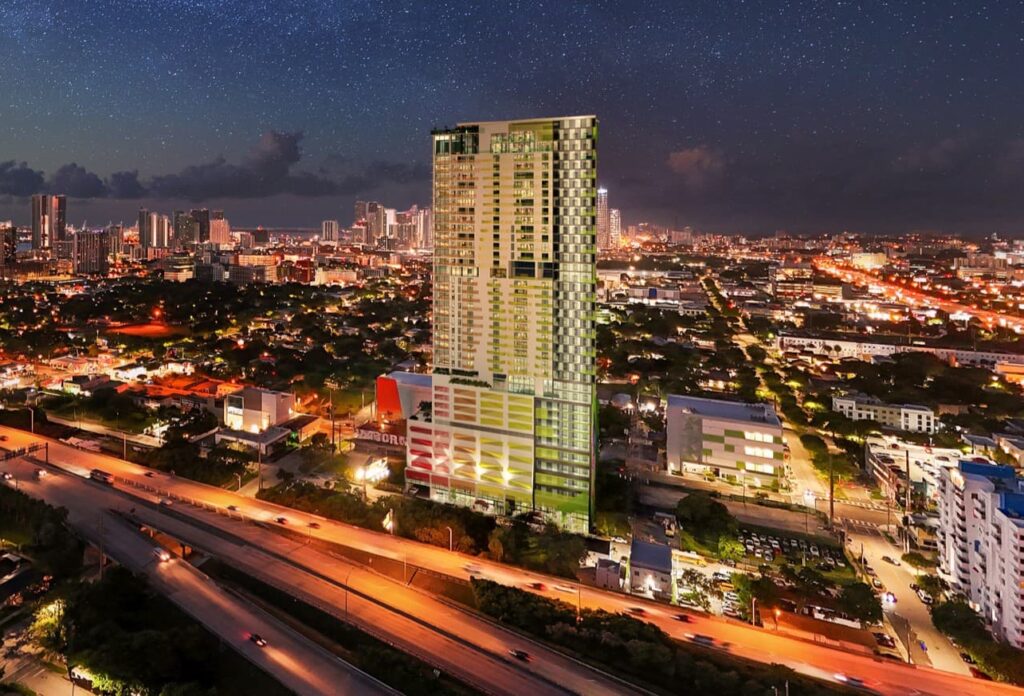
A 41-story skyscraper titled Wynwood Tower is coming to the edge of Wynwood. The Florida-based developer, AG Wyn, is proposing the skyscraper as part of the Live Local Act, a recently enacted housing law aimed at spurring higher density housing in commercial or industrial areas. The half-acre property located at 330 NW 37th St will eventually be home to a 398,983 SF structure with 234 residential units, assisted by added density by the Live Local Act. Under regular zoning, the property is allowed 150 dwelling units per acre, but with the live local act, the property is permitted a maximum of 1000 dwelling units per acre. Because the live local allows developers to liberally enact zoning 1 mile away, at least 40% of proposed units must be affordable in exchange. This translates to at least 94 units priced to residents earning up to 120% of the area’s median income. Units will be between studios, 1-bedrooms, 2-bedrooms, and ultimately a 4-bedroom penthouse orientation. Designed by Valle Valle and Partners, the firm envisions the tower as a unique reflection of Wynwood Norte, including “a vibrant mix of color, dynamic geometry, and striking details that elevate the architecture”, “these elements work together to create a visual impact that reflects the spirit of Wynwood Norte, ensuring that the structure stands out while harmonizing with the surrounding artistic environment”. Miami’s Urban Design Review Board will consider Valle Valle and Partner’s design efforts on April 16th at 2 PM. As per previous meetings, the board has the power to direct projects they deem unsuitable architecturally. The project will house not only residents, but 5,664 SF of commercial, co-working space, and guest parking, necessitating the proposal of 376 parking spaces: much higher than the 314 required under code. Parking will rise from the 2nd floor all the way to the 11th floor until reaching an amenity floor. Amenity space is abundant all throughout the tower, with residents having access to a club house, jacuzzis, barbecue spaces, gym, and eventually a sky lounge with a game room and balcony on the 25th floor. Ground floor improvements are a significant benefit for pedestrian mobility in the area, with wider sidewalks, increased greenery, and retail space spanning not one but two floors. 6-street facing parking spaces will also serve as retail parking and drop-off zones for guests. A spacious lobby will face NW 37th St for residents, while mechanical usages mainly geared towards electrical and fire usages will face away the street. The tower will measure 441 FT to the tallest architectural point. If built, the tallest comparable structure nearby would be Paraiso Bayviews, almost a mile away. Because the tower is 41 stories and the maximum allowable height under the Live Local Act for this parcel is 36 stories, the developer must contribute to public benefits, such as transit improvements or funds towards affordable housing. Technically, public bonuses allow a maximum height of 60 floors, albeit the developer did not fully utilize the height incentive. Under traditional zoning coined T6-8, developer can build up to 8 floors as of right and 12 floors with added public bonuses. The boost in height and the cheaper land found in Wynwood Norte make developments such as Wynwood Tower feasible, even with given affordable housing requirements.
Braman Motors Proposes Braman Miami Campus, Featuring Over 1,000 Residential Units, Office, Car Showrooms, & More
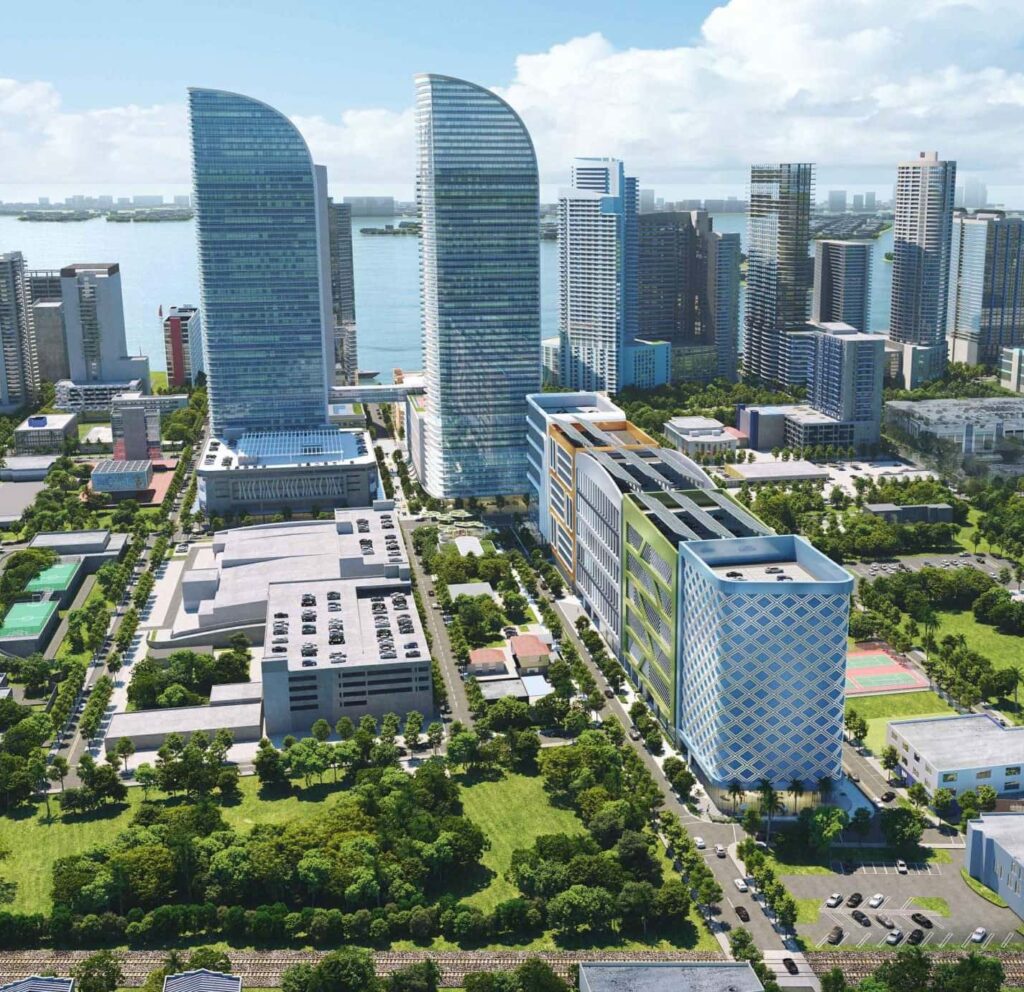
For decades, Braman Motors has been synonymous with Miami’s car culture, dealerships lined along Biscayne Boulevard. But now, the automotive giant is thinking bigger. On company-owned land in the heart of Edgewater, Braman Motors is beginning its first stage of a master planned community. The planned development encapsulates the Braman Miami Campus SAP, a special area plan enacted in 2022 to plan for future expansions. Braman plans to update the SAP with updated land use guidelines, zoning, and a development agreement to solidify developer rights for construction and proposal. The expansion will include the construction of new parking garages for car storage, showrooms, retail, residential towers, and more. Braman eventually envisions a district with ‘cohesive streetscape, vibrant public open spaces, including a woonerf, and improving mobility within this central, urbanized area”. An auto-related campus exansion is at the heart of Braman’s thinking, with the belief that autombile services are a critical value to a city’s transportation service and future. Designed by Arquitectona, the multi-year development will include 4 phases. Phase 1 will comprise the construction of an elongated parking garage along NE 20th St featuring service bays, inventory space for cars, a body shop, paint shop, a multi-level showroom, and more. In all, the development will include a total of 2208 parking spaces in the garage orientated for staff/customer parking, inventory, and other car-related uses. The garage will be among the tallest in Miami, rising akin to residential buildings nearby and measuring a confident 11 floors or 185 FT. The garage is a downside to Miami’s prioritization of units lining podiums, a positive in any urban setting, but Arquitectonica attempts to disguise it through the use of various facades designed to mimic car grills. Phase 1 also plans to pedestrianize NE 20th Terrace, adding greenery, pavers, and bollards to create a more walkable environment. The sidewalk will be widened and outfitted with lighting, public art, and seating. Renderings show the space could host car shows or other public events. The second phase calls for a 60-story residential tower with 1,111 parking spaces in the podium, along with 624 residential units, 27,520 square feet of commercial space, 57,176 square FT of office space, and a range of amenities for residents. Units will include studios, one, two, and three-bedroom apartments. The tower will reach 649 FT: identical to other towers in Edgewater. Drawings also show a potential rooftop restaurant on the 13th floor, though details have not been finalized. The third phase proposes an identical residential tower, but with a podium geared toward showroom space instead of office and retail. The showroom will span 50,669 SF. Despite including the same amount of floors, 60 to be exact, the tower will rise taller at 655 FT. Included in the large structure will be 550 units, primarily aimed at two and three-bedroom layouts. Most importantly, the tower will have no parking spaces, with parking provided off-lot. A two-floor pedestrian bridge will link floors 12 and 13 of the first residential tower, designed to connect amenity and commercial space to the second residential tower to promote connectivity between the development. Likewise, unlike phase 2, phase 3 will have an amenity deck much closer to ground floor, with a pool, outdoor seating, lounge, and more included on floor 3. The last and fourth stage includes the redevelopment of an existing shell gas station built in 2009. Renderings showcase gas pumps shaded by hubcap-like awnings, as well as a 838 SF retail shop. While the construction timeline is not definite, recent activity on-site such as the demolition of 120 NE 20 ST prompts Floridian Development to estimate construction of phase 1 in the near future.
Okan Tower Seeks Approval for Cranes Soaring Over 1,000 Feet, Set to Rise Among Miami’s Tallest
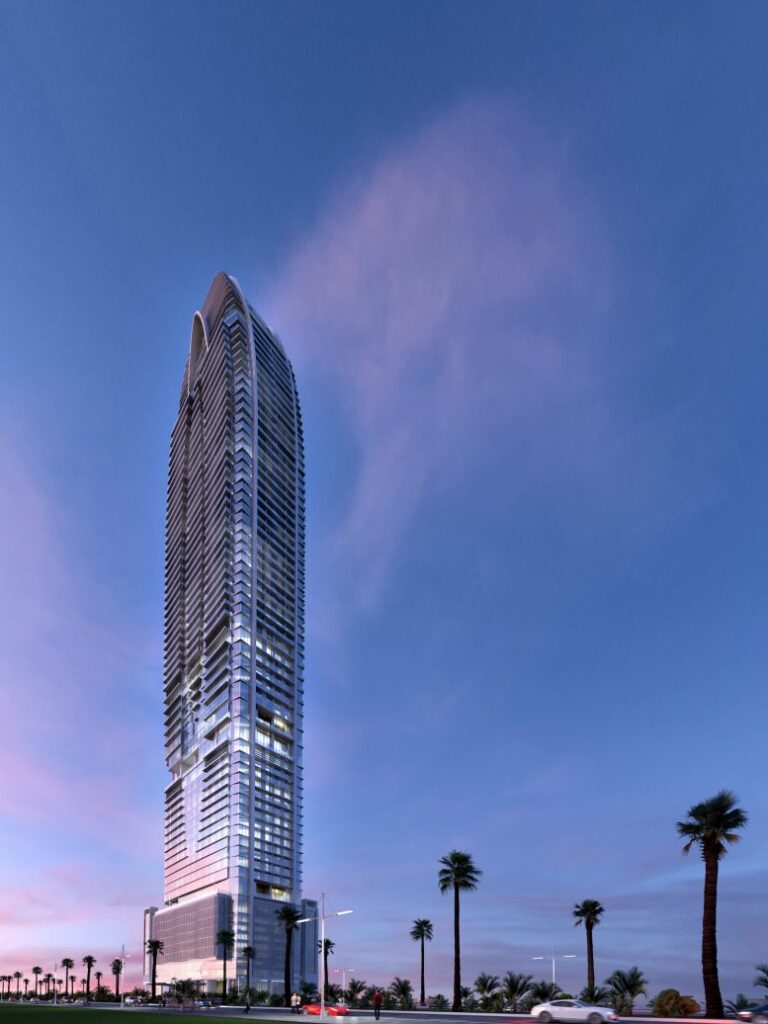
Now nearing its 20th floor, The Okan Group, Civic Construction, and other affiliates have filed for construction crane adjustments; adjustments that would bring Okan Tower’s two tower cranes to one of the tallest structures standing in Miami. Back in late 2022, plans were already in place for two massive tower cranes: one expected to reach 1,010 feet and the other 975 FT. Both of those were given the green light, but a more recent FAA filing is now seeking to bump their heights up to 1,051 FT each. If approved, they’d be amidst the tallest cranes in Miami, second only to the ones rising above the Waldorf Astoria property, which each measure over 1,200 FT. The new permits were just filed, on April 3rd to be exact, so they’re still waiting on approval. Okan Tower is being built alongside several other skyscraper developments within the Miami Worldcenter district. Located at the intersection of N Miami St and NE 1st Avenue, the area includes a monumental four skyscrapers under construction: The Crosby, Miami Worldcenter, Downtown 6th, and The Okan Tower itself. Although the project has stalled multiple times, either through inspection, permitting, or timeline issues, the developer is back on track for a completion date of 2027 as per The Florida YIMBY. Designed by Behar Font & Partners, Okan Tower will include 389 condominium units, a 316 room hotel managed by Hilton Hotels, and over 60,000 SF of office space in a 70-story shell. The tower features a tulip-like design, soaring over 900 FT and including amenity spaces such as a rooftop pool, kid’s rooms, fitness centers, saunas, lounges, and more. On the ground floor, pedestrians have expanded sidewalks, retail space, and increased greenery. Although not outlined in renderings, the tower is actually surrounded by multiple towers that block views on the South, East, and North side until rising above 500 FT. The development is located at 542 N Miami Ave, Miami, FL 33136.
GFO Investments’s Sole Proposal for Miami-Dade Courthouse Revealed at 73 West Flagler St
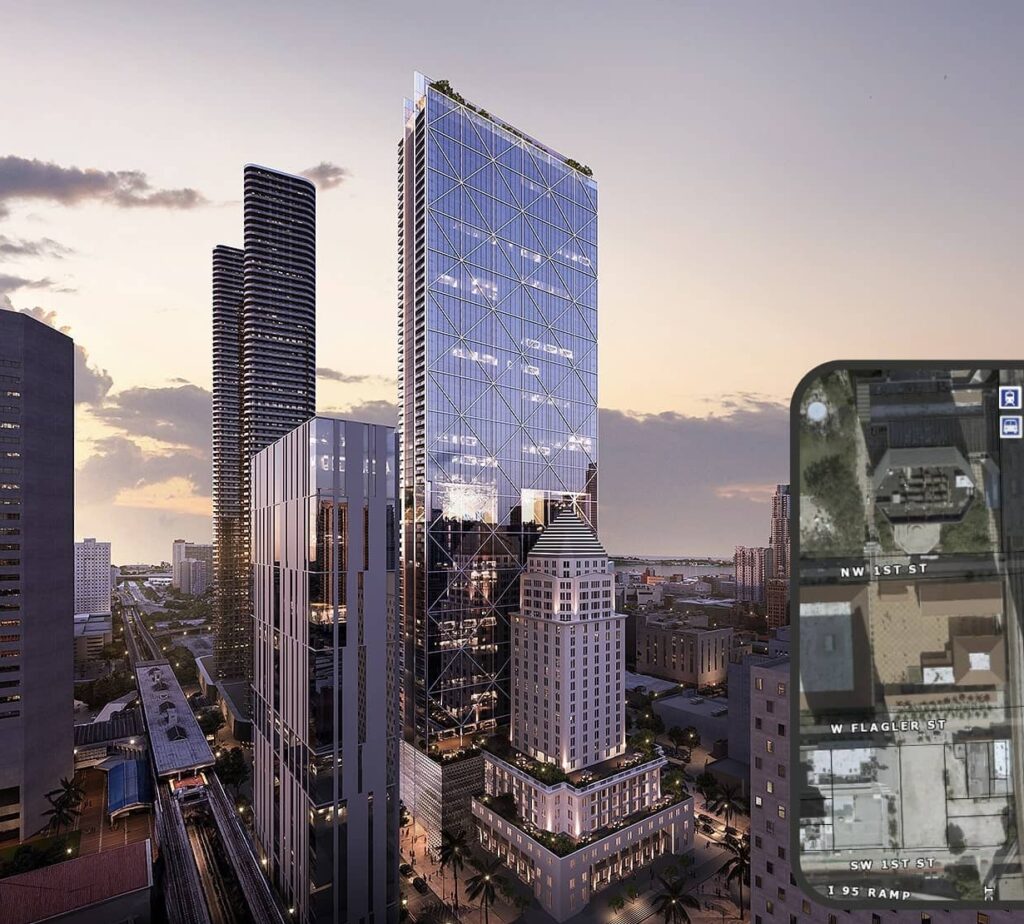
GFO Investments has officially publicized its redevelopment proposal for the historic Miami-Dade Courthouse located at 73 W Flagler St. First reported by Commercial Observer, the proposal includes a mixed-use residential tower to be built on the northern section of the site. The new skyscraper will replace parts of the existing podium and ground-floor stairwells, meanwhile preserving the courthouse tower in its entirety. The project will feature a combination of condominiums and rental units, along with common spaces, ground-floor retail, ample parking space, and pedestrian green space. GFO Investments was the sole bidder for the purchase of Miami-Dade’s historic courthouse, after the county opened the property up for redevelopment in April 2022 through an ‘expression of interest’. At the time, county officials had estimated the building’s value at around $53 million. In early 2025, GFO submitted a formal bid to acquire the courthouse for that exact amount. But the payment wasn’t entirely in cash: part of the offer involved a land swap. Under the proposal, GFO would give the county a parcel the company owns at 54 W Flagler Street to cover the remainder of the cost. In February, County Commissioner Eileen Higgins approved a motion to reject the bid, not because of opposition with plans or the developer, but to give the county more time to negotiate under IO 8-4. IO 8-4 allows Miami-Dade the time to negotiate the land swap and cash incentive, with a private land appraisal to ensure the land is worth the committed cash. “Because we only got one bidder, I think it doesn’t make any sense to send this out again,” Higgins said during the meeting. “We’re only going to get one bidder.” Once all plans are approved, the developer must respect the historic preservation guidelines put forth by the Miami-Dade County Historic Preservation Board, which include taking steps to curtail harm to the historic structure during the construction of the mixed-use building.
Ocean Dadeland at 9180 & 9200 S. Dixie Highway Moves Forward with Permitting
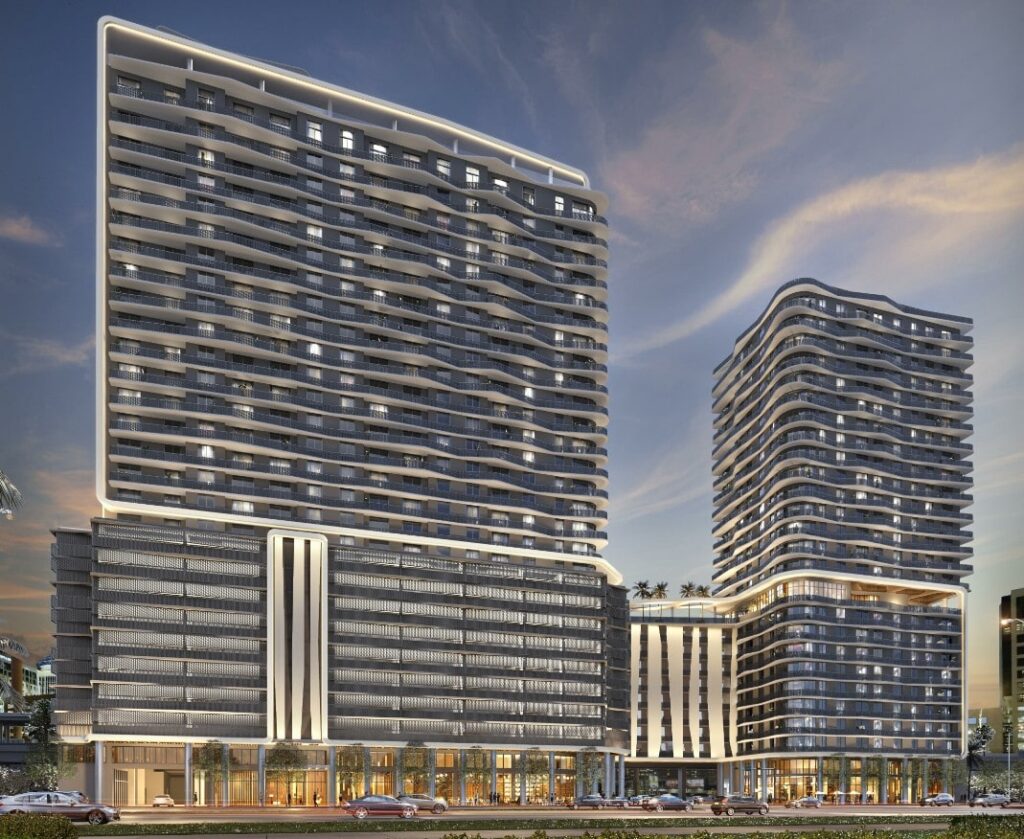
Plans are moving ahead for a major two-tower project in the heart of Dadeland, Florida at 9180 & 9200 S. Dixie Highway. The project, which was revealed in 2022 by Florida Value Partners and Atlantic Pacific Communities, has recently received multiple approvals and is awaiting for certain permitting to begin. Despite going through multiple design tweaks by Corwil Architects, the project is virtually unchanged from its 2022 submission, with plans calling for one 25-story tower and one 20-story tower adding 500 multifamily units, 665 parking spaces, and 4,850 SF of retail space collectively. Since final plans were quietly submitted on March 20th, 2024, permitting activity has surged. Both towers are moving through permitting together, which potentially indicates the towers breaking ground together. Demolition plans have been filed for two properties: a 1,757 SF site at 9180 S Dixie Hwy and a 4,094 SF site at 9200 S Dixie Hwy, the current location of Shorty’s BBQ. Additionally, a tree permit for 9200 S Dixie Hwy details the planned removal of a Mahogany tree south of the property, along with other vegetation. All demolition and tree permits for the site have been approved and await the go-ahead. Replacement greenery will be provided by Witkin Hults + Partners, which plans to add palm trees, shrubbery, and trees along both the sidewalk and the amenity deck. Two general construction permits also remain under review, with recent activity as of March 31, 2025. The larger building is set to span 578,957 SF with an estimated cost of $120 million, while the smaller structure will cover 201,756 SF and is calculated to cost $40 million. These costs translate into their unit counts, with the larger south building proposing 324 units while the smaller north building will contain 176 units, with layouts ranging from studio apartments all the way to 3-bedroom apartments. According to Florida Value Partners, the project will have an average unit size of 833 SF. Besides permitting also comes height approvals. FAA activity indicates two temporary construction cranes filed for the site, both reaching 420 FT each. According to letters issued in February, both structures were determined to be “of no hazard to air navigation”. Work schedule outlined on the permit points to construction beginning in September and ending in March 2027. Whether this schedule is correct is unknown, as multiple economic or permitting factors can stall or accelerate the development.
Swerdlow Group’s Massive Little River Redevelopment Advances to Miami-Dade Commission with Revised Plans
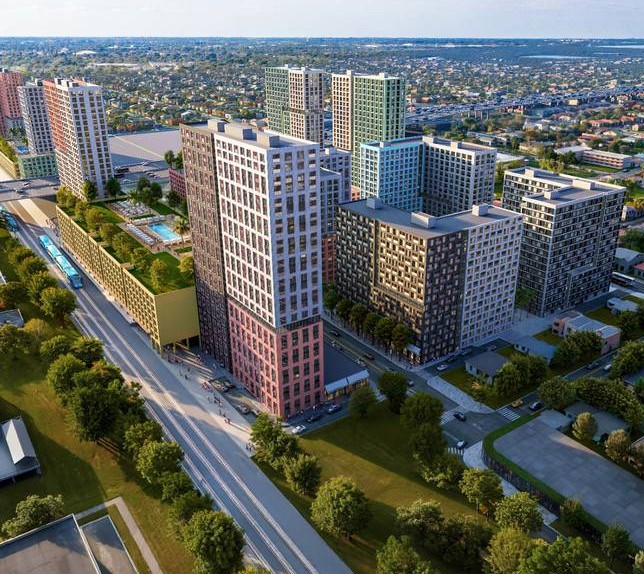
Signs of life are emerging for AJ Capital Partners and Swerdlow Group’s massive redevelopment project in Miami’s Little River neighborhood. The redevelopment project is advancing to Miami-Dade’s Board of County Commissioners on April 1st, after the housing committee voted unanimously for the project to move forward. Plans began last year, when the Swerdlow Group responded to a WOPR initiated by the country, requiring the redevelopment of blighted county land for housing, retail, and more under the Rental Assistance Demonstration program. The Swerdlow Group’s ambitious redevelopment plan will deliver 5,730 housing units to Little River, as well as 370,000 square feet of commercial space, office space, schools, a new Tri-Rail station, and around 250,000 square feet of pedestrian-orientated green space. Units will be situated in towers of around 20 floors: a reduction from the original vision of varied heights pictured last year. In agreement with Miami-Dade’s workforce and affordable housing priorities, the project will also exclude market-rate units, instead developing 3,446 workforce condominiums and 2,284 affordable rentals. Housing will be available in various layouts, including studio, one-bedroom/one-bath, two-bedroom/one-bath, two-bedroom/two-bath, three-bedroom/two-bath, four-bedroom/two-bath, and five-bedroom/two-bath configurations. The average SF per unit will be 683 SF, with the maximum unit size being 2,212 SF, ideal for large families. Residents will have access to free internet for three years, swimming pools, outdoor recreation for children, bike parking, playgrounds, and more. As part of the redevelopment, 314 new RAD units will replace the existing public housing units poised for demolition at Victory Homes, New Haven Gardens, Gwen Cherry Properties, and Newberg. Phase 1 will deliver 691 affordable units, including the 314 RAD replacements, ensuring all necessary units are built to prevent public concerns regarding displacements. Current RAD residents will be able to transition directly into the new units in 1 day without prolonged displacement. According to the Miami Herald, Swerdlow anticipates breaking ground on Phase 1 next year. Outside of Miami-Dade’s land given to Swerdlow through a 99-year ground lease, the company is also investing significant money into the area with private capital. These off-site parcels will create 2,100 market rate units, 293,000 SF of retail space, and office space. To better picture the plans, all workforce and affordable housing units under Miami-Dade land is drawn in red and yellow, while off-site investment provided by the Swerdlow group is in blue. Fears of gentrification have plagued Little River and Little Haiti development projects for years, especially regarding the Magic City Innovation District which oversaw waves of protests throughout its planning stages. Swerdlow emphasized his plans to make the district a “real neighborhood” with a mix of incomes according Miami Herald. Time will tell if the neighborhood proves a success for everyone in the community. The project is estimated to create 3,840 new construction jobs and 518 permanent jobs. Likewise, the Swerdlow Group is complying with the federal Section 3 program, providing 30% of the 518 permanent jobs to those with low or very low income brackets.
Student Housing Advances at 10710 SW Fifth St in Sweetwater, Set to House 800+ Students
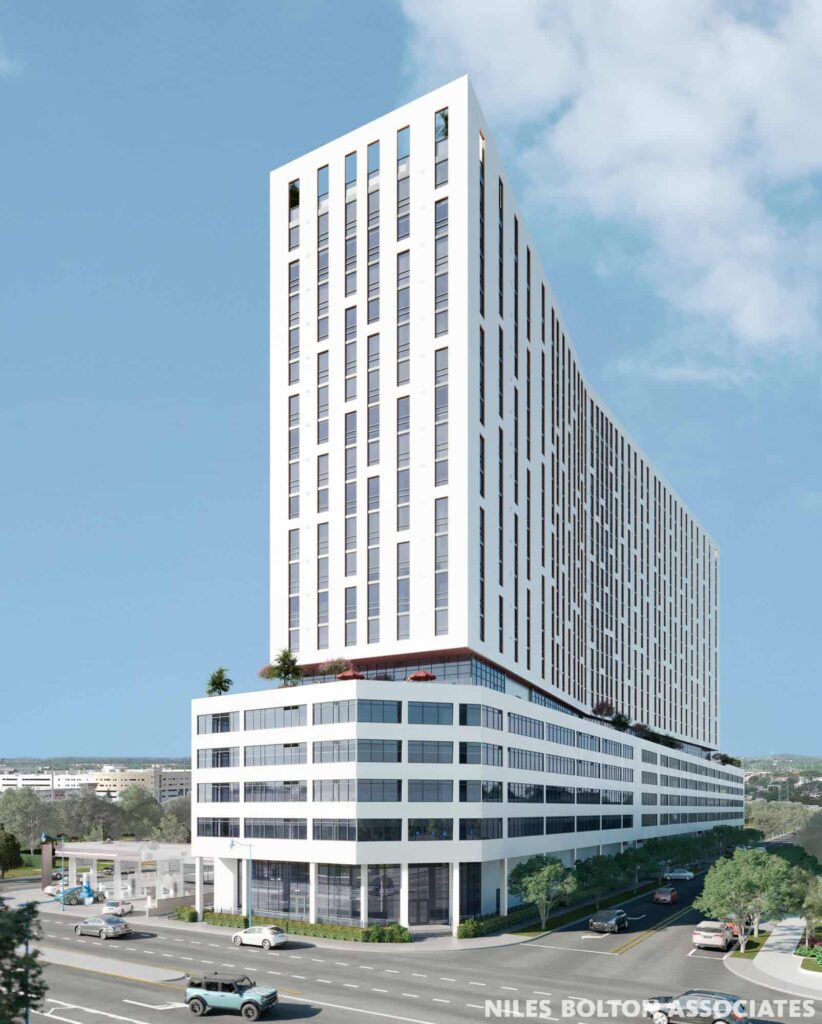
Workforce Housing Partners and RAL Companies are moving forward with plans for a 20-story student housing project in the heart of Sweetwater. The project, designed by Niles Boston Associates, will be the first student housing project by Workforce Housing Partners and RAL Companies in Sweetwater, potentially signaling future investment in the area. The development will include housing for approximately 820 students, extensive parking from floors 1 through 6, amenity space, and other uses. Units will be from studio apartments at minimum to five-bedroom layouts at maximum. According to Miami-Dade permitting, the project will be 676,465 SF and include an estimated cost of $105,500,000. Amenity space for students will be located on floor 7, with benefits such as lounge space, a pool, and more to be included in the property. Active-use liners will front SW 107th Ave, a major thoroughfare, and partially line SW 5th St. Pre-construction efforts are progressing smoothly, with tree permits, demolition permits, and a site plan permit already secured. The project is now awaiting a general construction permit before full-scale development can jump-start. Recent aerial imagery and site photos confirm that demolition is complete, clearing the property of seven apartment buildings constructed between 1970 and 1972. Documents linked to the project also suggest “Novu Sweetwater” as a potential name, though it remains speculative. Meanwhile, JWR Construction Services has recently been awarded a pre-construction contract. The property, spanning 10742 SW 5th St, 10752 SW 5th St, and 10710 SW 5th St, was acquired for $10.5 million in November 2022. The developer recently secured a $9 million bridge loan from Elite Lending to support the project. The development site is positioned between Terrazul Miami and Identity Miami, both of which rise to a similar height.
Phase Two of The Link at Douglas Moves Forward with Crane Permit Approvals and Design Tweaks
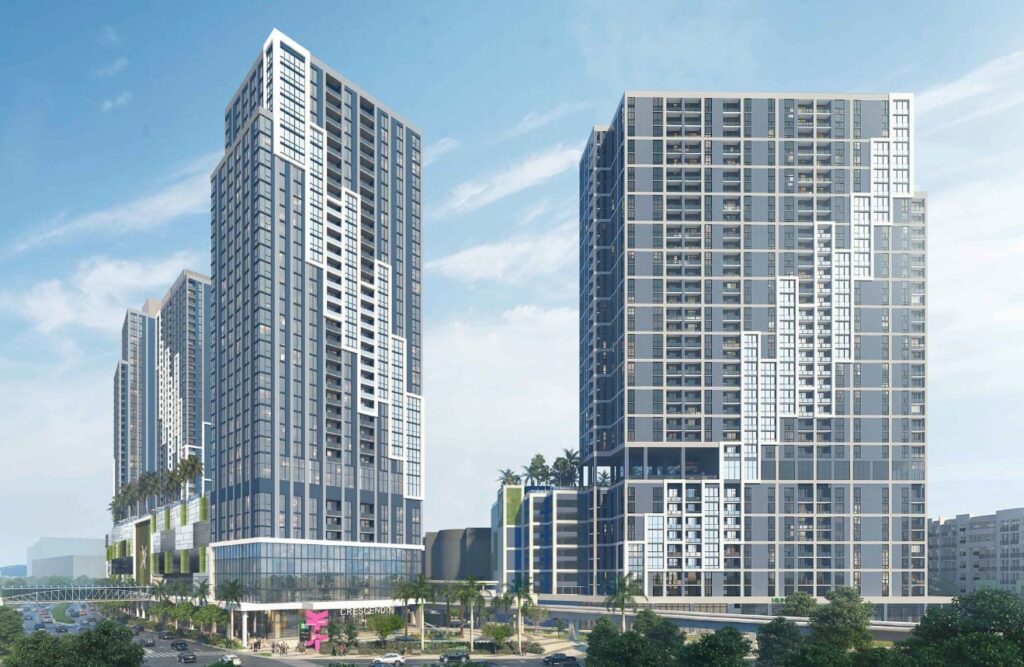
A pair of new residential towers will soon rise alongside Cascade at Link and Core at Link, marking the next phase of a mega-development near the Douglas Metrorail Station. Spearheaded by Adler Development and 13th Floor Development, phase two of The Link at Douglas will deliver 824 residential units, 920 parking spaces, and ample ground-floor open space near rapid transit. When updated plans were revealed in 2023, the project originally included 815 units, 936 parking spaces, and 27,247 SF of co-working space. However, recent revisions have increased the unit count by 9 while reducing parking by 16 spaces: an adjustment made possible by the removal of co-working spaces on levels 2-4 on the tower’s podium. Minor height changes were also made to the first tower, which has been reduced from 36 stories (411 FT) to 35 stories (396 FT). The second tower remains unchanged at 37 stories. Unfortunately, elevations also highlight a reduction in parking podium treatment, removing spandrel glass aimed at mimicking active floors to colored metal. Designed by Arquitectonica to complement Cascade at Link in both design and functionality, the new towers will not include ground-floor retail. Instead, the ground level will feature lobby space, amenities, mechanical areas, and residential drop-off zones accessible by a colonnade. Retail needs for the community are already met by Cascade at Link, which houses tenants such as Milam’s Market, a full-fledged grocery store, and Belly Fish. Additionally, the project will integrate The Underline and contribute funding for improvements to the Douglas Road Metrorail Station. Crane permits have been approved for the site and sponsored by L&R Structural Corp. The permits cover the shorter tower facing Douglas Road, as cranes of 509 FT and 471 FT are planned. While not a definitive schedule, the crane is said to be in use from April 1, 2025, and July 31, 2026. The second tower’s scheduling is unknown, with no FAA crane applications available for the second tower.
Le Jeune Palms Proposed in Flagami, Miami, Featuring Over 100 Hotel Rooms & 197 Residential Units
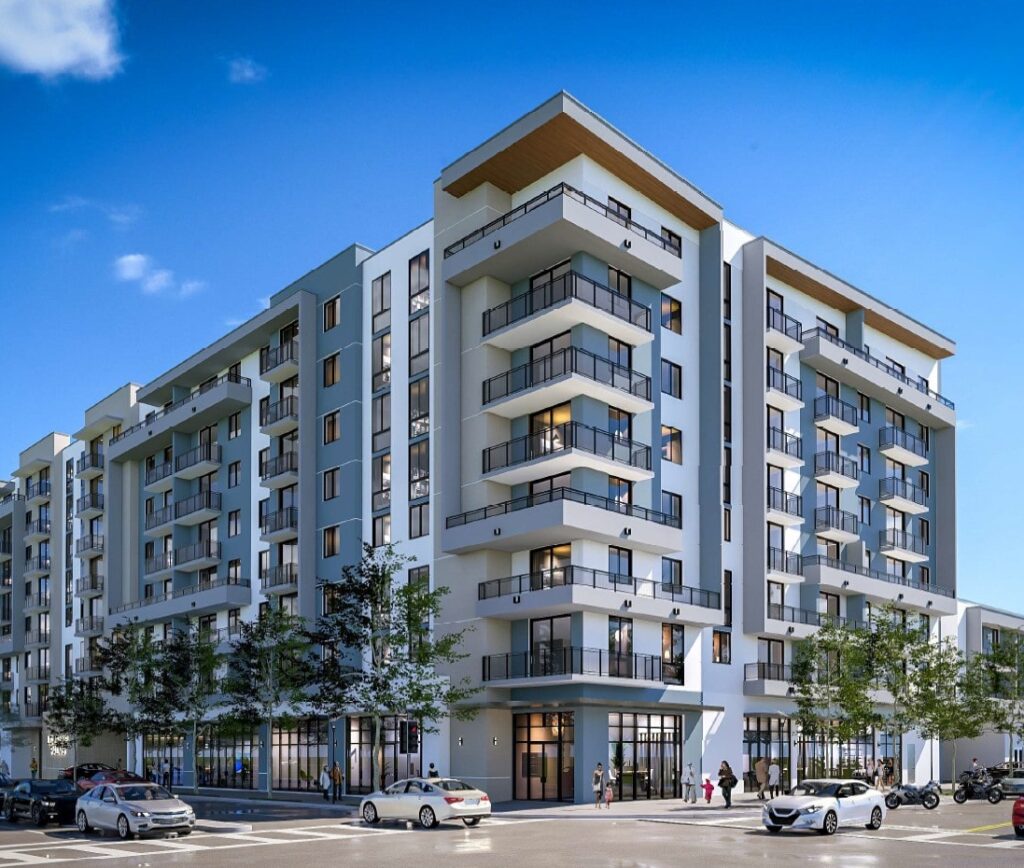
A mixed-use development is poised to replace a surface parking lot fronting at NW 7th St and NW 42nd Ave, two major throughfares in Miami. The development, spearheaded by Le Jeune Palms, LLC, will plan for hotel, retail, and multifamily space in 3-story and 8-story buildings. The lot was originally granted this density from a City Commission approval in early 2022, allowing the lot to go from Low Density to Medium Density. According to zoning sheets provided by the project’s architect, Modis Architects, the property will include 197 units, 132 lodging units, and 426 parking spaces. Units will be offered at 1-bedroom, 2-bedroom, and 3-bedroom orientations, with about an average 800 SF unit size. While it’s not specified, units will likely be all market-rate as no public benefit bonuses nor Live Local Act regulations are required. The ground floor of the development will feature 12,698 square feet of commercial space along NW 43rd Ave and NW 7th Ave, as well as residential lobbies, hotel amenities, and extensive landscaping. To enhance the currently limited pedestrian experience, the existing five-foot sidewalk will be widened to between 10 and 20 feet in select areas. Unlike typical mixed-use projects that share a podium, the hotel and residential components will stand separately. Both the 8-story hotel and the 8-story residential building will rise 91 FT, while the 3-story units close to single family homes will measure 32 FT. The positioning of lower density near single family homes is strategic: “It respects urban scale by positioning taller buildings along main roads and three-story residential structures adjacent to existing homes, ensuring a harmonious transition” according to a narrative provided by Modis Architects. The property, located at 4255 NW 6 Street, will face a vote for approval from the Urban Development Review Board on March 19th, 2025, at 2:00PM. Public comments are allowed.
Miami’s Downtown Development Authority Reveals an Interactive 3D Mapping Tool for Miami Skyscraper Developments
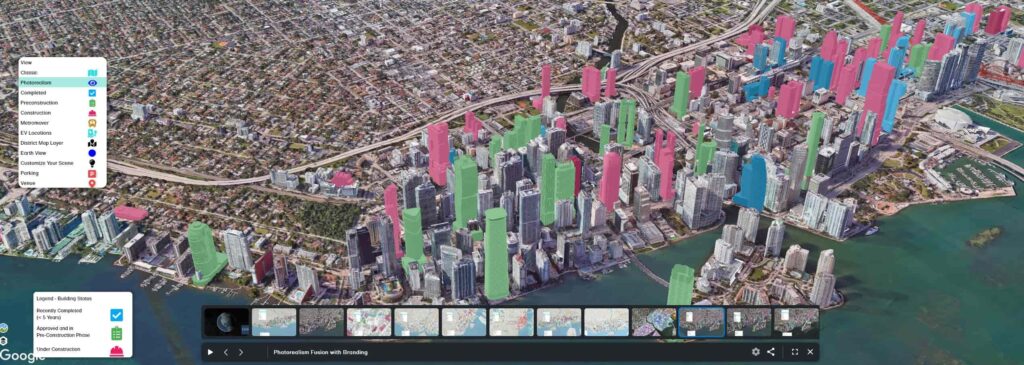
Miami’s Downtown Development Authority launched its newest edition of an interactive 3D Development Mapping tool, featuring highrises and supertalls extending from Brickell to Edgewater. The partnership between CyberCity3D, NextSpace, and Miami’s DDA has culminated into a program featuring under construction, proposed, or even recently completed projects. With a simple click on a 3d project, users can find the project type, developer, address, and status. Along the map also includes Metromover locations/routes, parking, and the ability to change the map to multiple unique layers including a Google Earth overlay. According to WorldRedEye, the program features 7,000 modeled buildings and 70 projects to track. A toolbar at the top allows users to scroll through day/night cycles, find the walkscores of certain neighborhoods, and even measure distances between projects through an advanced ruler. On March 6th, officials unveiled the interactive tool as well as the I-395 bikeway and pedestrian project at the Frost Planetarium. The official platform, accessible at this link, is still in progress, with updates planned to address any current gaps or inconsistencies. Designed primarily to cover Downtown, Brickell, and Edgewater, the tool also highlights major infrastructure initiatives. Among them is the Miami I-395 Signature Bridge, which includes a detailed structure report and a direct link for further information.
The Sabet Group Proposes a 33 Floor Residential Tower in Miami’s Onni District
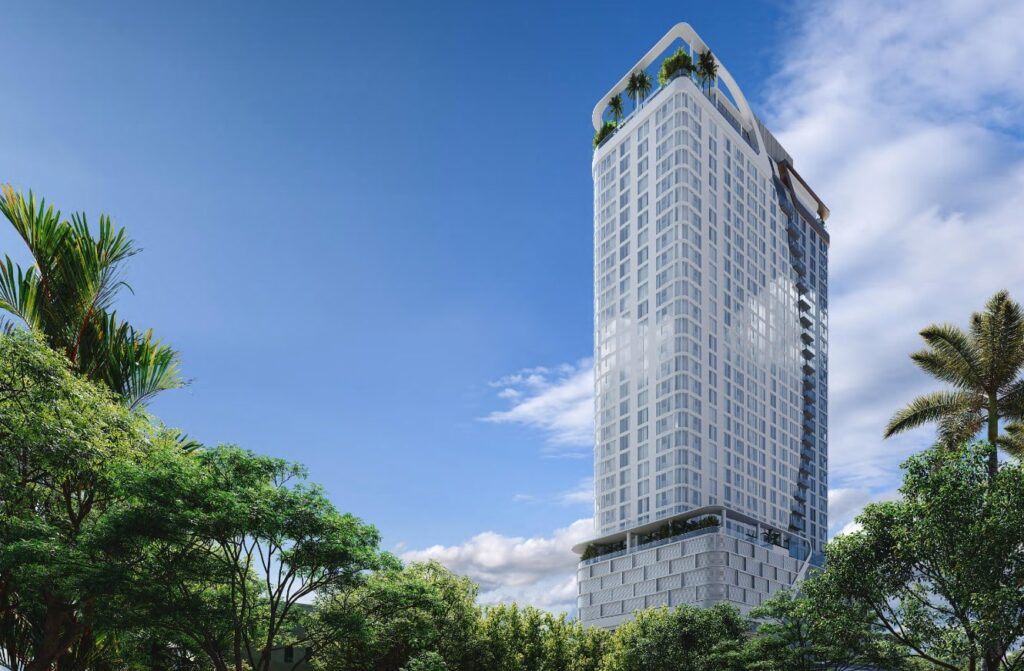
Another residential tower is coming to Miami’s Onni District. Plans for the project, named “1600 Edgewater”, surfaced after LA-based Sabet Group submitted documents for an upcoming UDRB meeting on Wednesday. The proposed 33-story tower will bring 282 units to the area, offering studio, one-bedroom, and two-bedroom apartment orientations. To build taller and include more floor space than typically allowed, the developer is using public benefit bonuses, which require setting aside a portion of the units as affordable housing. As part of this agreement, 20 of the 282 units (about 7%) will be reserved for residents earning at or below 60% of the Area Median Income. This, in turn, permits the plot’s max height to increase from 24 floors to 48 floors. Written documents originally outlined 6,615 square feet of retail space, but updated plans from February 2025 appear to show an increase to 9,519 square feet, which includes a rooftop restaurant. Likewise, despite the large podium, the project is actually including lower parking than required. This is possible with a 30% parking reduction waiver, bringing the required parking from 467 spaces to 328. The developer will construct 352 parking spaces in both the podium and on-street. The 33-story tower is set to rise 384 feet, making it one of the tallest properties in the area. The design features a podium spanning the first eight floors, with residential units occupying levels 10 to 33. Level 9 will house an extensive amenity deck, including a pickleball court, jacuzzi, cold plunge tub, and other recreational spaces. At the top, a rooftop restaurant, swimming pool, and outdoor seating will offer panoramic views of the city. Kobi Karp is the main architect, while the site’s address is 1600 NE 2nd Avenue, Miami, FL.
10 & 15 CityPlace Break Ground in West Palm Beach, Delivering Close to 1 Million Office SF
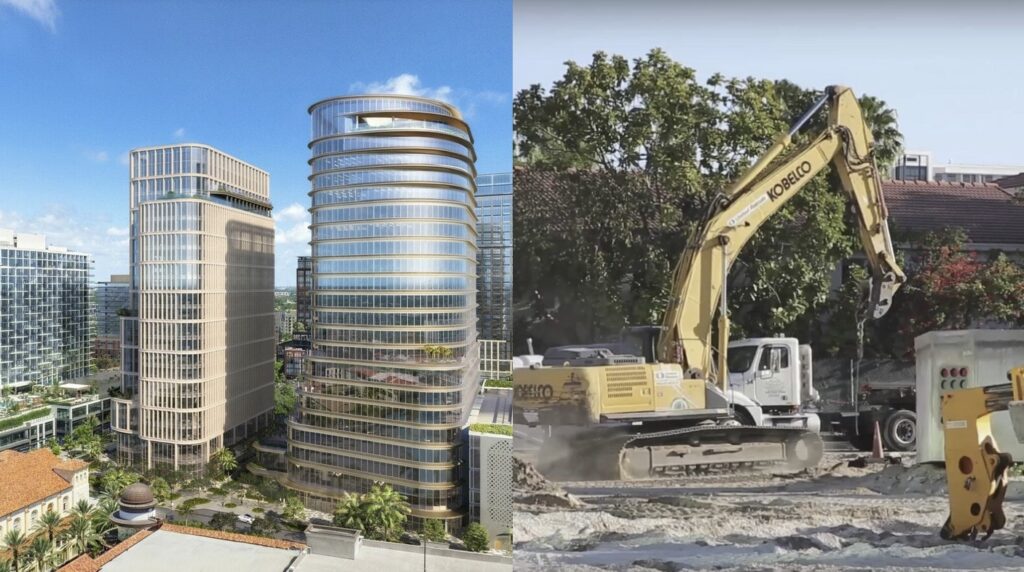
Ground has officially broken on two new office towers in West Palm Beach’s latest neighborhood, coined “CityPlace.” The two developments, 10 CityPlace and 15 CityPlace, will collectively deliver nearly 1 million square feet of office space. According to Related, 10 CityPlace will feature 480,000 square feet of office space, while 15 CityPlace will offer close to 500,000 square feet. The groundbreaking ceremony was attended by notable figures, including Stephen M. Ross and West Palm Beach Mayor Keith James. During his speech, Ross emphasized the significance of the milestone: “Who would ever think that a 1 million-square-foot office structure would be going up in West Palm Beach?” The Cleveland Clinic announced merely days ago plans to construct a large outpatient facility at 15 CityPlace; leasing reached a record 70% milestone before groundbreaking even began. Among City Place is the proposed 515 Fern office tower and the recently constructed multifamily building named The Laurel. 10 CityPlace and 15 CityPlace were presented to the West Palm Beach Planning Board in December of last year, showcasing plans for 63,890 square feet of retail space, 9,899 square feet of public space, and an 11,522-square-foot paseo. The paseo will divide the two towers, creating a pedestrian-friendly corridor that leads directly to the city’s newest Brightline station. 10 CityPlace, located to the west, will measure 22 floors and be 327 FT tall; 15 CityPlace, the east tower, will be slightly taller coming in at 24 floors or 338 FT. Plans originally showed a parking podium incorporated into 15 CityPlace, but plans have since changed, pushing it closer to the nearby railroad tracks. In total, both towers will include 1,366 parking spaces. 10 CityPlace is designed by KPF Architects and located at 550 S Rosemary Avenue while 15 CityPlace is designed by Arquitectonica and located at 545 Hibiscus St.
Gallery Riverwalk Proposed by the Related Group Aimed at Providing Affordable & Market-Rate Housing
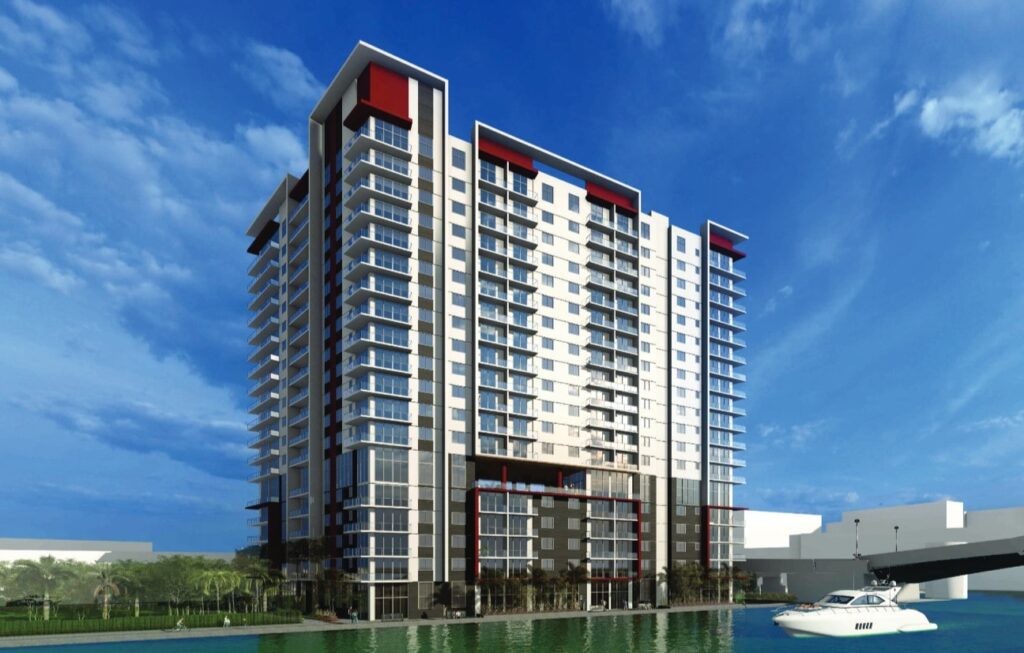
The Related Urban Development Group has unveiled plans for a mixed-income high-rise along the Miami River. Redevelopment opportunities of the lot began on July 15th, 2024, when Miami-Dade staff issued a Request for Proposal on a property located at 1175 NW South River Drive, seeking a developer who’d construct a mixed-income building consisting of affordable, workforce, and market rate units. Staff is recommending approval for a Master Development Agreement and a 99-year ground lease with Miami-Dade. According to the Master Development Agreement, the Related Group must construct 236 mixed-income apartments, with 36 of them being RAD Project-Based Vouchers (program aimed at providing Section 8 housing) available to the public. Units will be split between studios, 1 bedroom, 2 bedroom, and 3 bedroom orientations. To be more specific, units will be 490 SF at minimum and 1195 SF at maximum, with the average unit totaling a small, but comfortable 724 SF. Likewise, there will be 188 parking spots that translates to .8 parking spaces per unit. The tower will be 170,870 SF in total, with 1,550 SF of it as a large retail space situated close to a newly planned riverwalk. Elevations are not available, but the building will measure 19 floors comprising of 5 podium floors and 14 residential floors. On floor 6, there will be a common space filled with amenity facilities including a pickleball court, a pool, a bar, a health club, and more. Once constructed, the property is estimated to generate $270,169,284 dollars in revenue consisting of ground lease payments, developer fees, and more over the 99-year ground lease. This development is one of the many multifamily high-rises planned in recent months by the Related Group on Miami-Dade land, including Gallery in the Grove recently planned in Coconut Grove. The project even shares a similar form factor as Gallery in the Grove, even including the same architect: Cohen Freedman Encinosa.
‘Park Residences’ Proposed with a Blend of Office and Multifamily Space in Coral Terrace, Miami-Dade
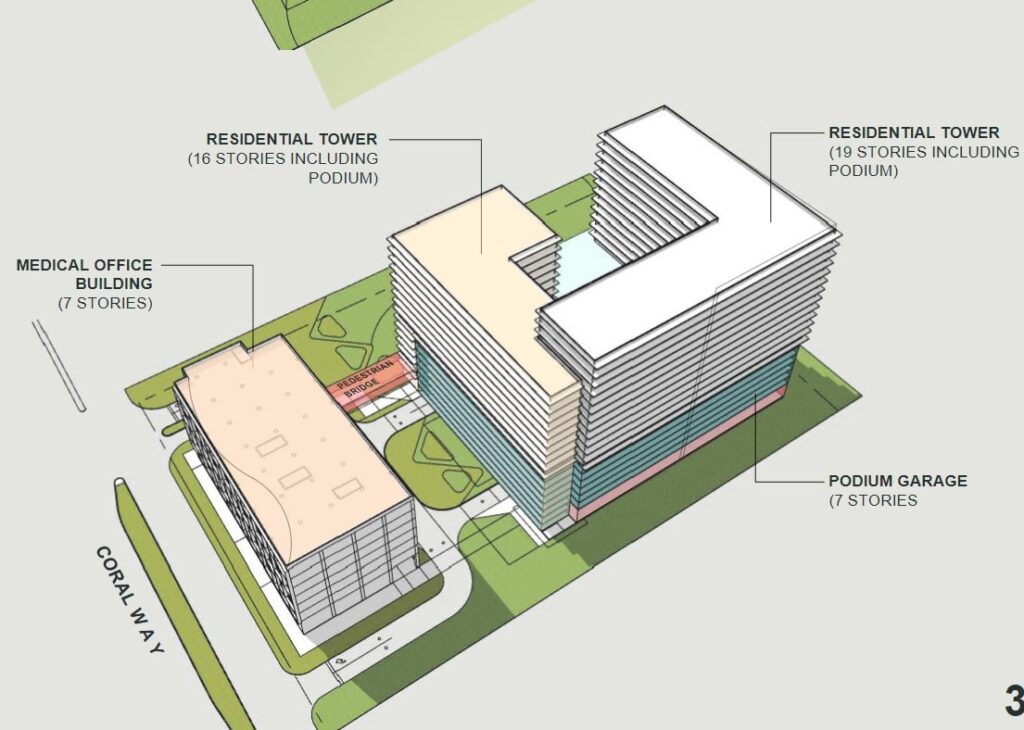
7350 Coral Way Prop. Co. has recently filed a pre-application meeting with Miami-Dade, requesting administrative site plan approval for a mixed-use project consisting of office, retail, and multifamily space. The two-building development coined ‘Park Residences’ and designed by Anillo Toledo Lopez will utilize Live Local Act benefits, in hand delivering workforce housing and commercial space along Coral Way. The Live Local Act has prioritized immense density along industrial corridors, and this project is a byproduct of such legislation. Previous zoning regulations allowed zero residential, but with the Live Local Act, 250 units per acre can be built at maximum so long as 40% of the constructed units are designated as “affordable/workforce”. This translates to 246 market rate units and 164 workforce units. Units will be in either studio, 1 bedroom, 2 bedroom, or 3 bedroom orientations. In addition, there will be 950 parking spaces, 90,000 SF of medical office space, and 7,000 SF of retail space. According to elevations, the residential tower will rise 19 floors while the medical office building will measure 7 floors. This comes out to a height of 88 FT for the office building and 190 FT for the residential tower, making it the tallest building to be constructed in the area thus far. Likewise, the residential tower is set back 220 FT from coral way in an attempt to hide the project’s podium, but also its massing. To alleviate this set back, a pedestrian bridge will be constructed in-between the office and the tower’s base. The development is still preliminary, with renderings likely at a later date. The future development is located at 7350 Coral Way on an 4.11 acre parcel, currently housing a grass lot with an unpaved parking lot. Little site preparations are needed in the event the developer gets funding and begins.
PBA University Proposes 25-Story Dormitory and Parking Garage Amidst Plans to Expand Student Enrollment
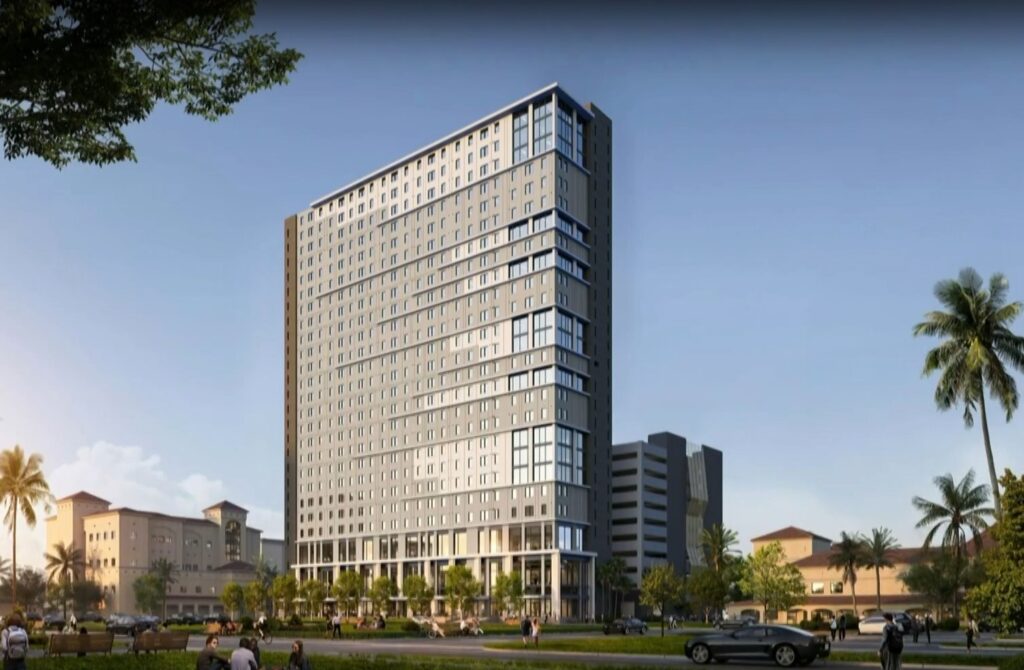
Palm Beach Atlantic University, a private faith-based institution in the heart of Downtown West Palm Beach, has proposed a 25-story dormitory highrise as well as an 11-story parking garage amidst its plans to increase student enrollment from 3,000 to 5,000. Plans include the construction of a 355,510 SF building with 275 units (990 beds), a 5,275 SF fitness area, and 888 parking spaces with active uses on the ground floor. Cube3 is the official architect. The proposal was passed 5-1 on February 19th, with Sam Fisch being the only member voting no. All members expressed concern regarding the podium’s height and lackluster active use liners. “I don’t think anyone has a problem with the height of the dorm or even the architectural style itself… I think its just having a massive massive parking garage… in a main thoroughfare right at the border of the city” according to a comment by Sam Fisch, albeit all board members seemingly agreed. As per the approval agreement, there comes multiple conditions requested by staff and the planning board, such as ones addressing the podium’s impact by pushing for a necessary redesign. Although the Planning Board’s approval is just a recommendation, it signals a positive advance for the University. The tower will be 300 FT tall, consistent with heights of surrounding buildings like Forte, The Bristol, or La Clara, which reach similar heights. Likewise, the University expressed its distance from single family homes in its effort to justify the height. On the ground floor, there will be a large buffer zone consisting of greenery and seating between the residential dormitory and the street. A service road will also separate the parking garage and the dorm. The university is requesting 4 waivers at 1200 S Dixie Hwy, such as an increase in the maximum building height currently allowed. Among the waivers is also an amendment to the PBAU CSPD Master Plan. The property is set to reach the City Council for approval before permitting can finally begin.
Renderings Released for 1414 Brickell, One of the Tallest Proposals in Brickell

1414 Brickell, LLC, associated with Fortune International Group, has revealed plans for one of the tallest proposals in Brickell. Plans originally surfaced in October of last year concerning a pre-application with Miami-Dade, revealing an 81-floor tower designed by Arquitectonica. The developer is continuing these plans, albeit with minor tweaks to the exterior design. Plans include a mixed-use 81-story tower with 560 units, 84 hotel rooms, 117,310 SF of usable office space (145,950 GSF), 6,038 SF of commercial space, and 1,226 parking spaces. Significant density and height pictured in the renderings below are made possible given an RTZ District Subzone designation approved for the property on February 21, 2024. However, because the project exceeds certain zoning allowances, the property necessitates a Special Exception under Miami-Dade. The tower is no long subdivided into rectangles, but will feature a sleek, flat, highrise with square cutouts for greenery and large balcony space. In addition, the parking podium will be masked with glass, uncharacteristic of most towers in Brickell. Elevations showcase a 1010 FT “supertall” tower, the max height permissible according to the FAA. The bottom floor will consist of retail, a gallery, and parking. Then, floors 12 to 23 will contain office and hotel space, followed by residential uses from floors 24 to 79. Finally, on floors 80 to 81, there will be sizeable residential amenities with a pool deck overlooking the Atlantic Ocean. Site plan photos show retail fronting SE 14th St, S Miami Ave, and Brickell Avenue. Sidewalks will also extend generously to 15 FT, giving significant pedestrian improvements to the area. According to floor plans, units will be in studio, 1 bedroom, 2 bedroom, and 3 bedroom configurations for most of the tower. The project still needs to move through a separate Administrative Site Plan Review, where final renderings and polished plans will be released for extensive review. Current renderings are for reference only, and will likely change.
Sunbeam Unveils Isle of Dreams, the First Phase of a Controversial Property Redevelopment
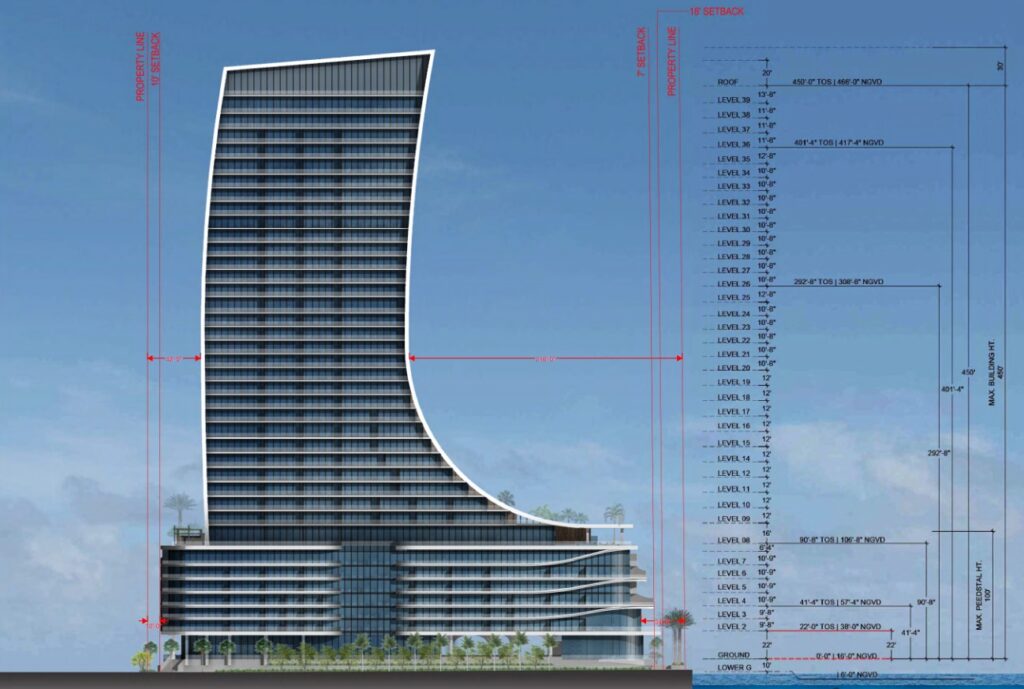
Sunbeam Properties, affiliated with WSVN 7News, has launched the first phase of its contentious multi-block redevelopment in North Bay Village. The project is part of the Sunbeam NBV SAP, a master plan approved in 2022 outlining proposals for towers soaring up to 650 feet. Encompassing 13 acres, the master plan imagines a mix of residential, retail, office, and hotel space, with Isle of Dreams marking the first step in bringing this vision to life. Isle of Dreams, designed by Arquitectonica, will be a 39-floor residential tower with 246 units, 7 floors of parking, and 23,043 SF of commercial space. Although renderings are not yet available, the project’s elevations offer insight into its height and overall form. The development will rise to 490 FT at its tallest measurable point, making it the highest tower within a two-mile radius until reaching the 492 FT Akoya Condominium, which is only two feet taller. To help balance the tower’s height, developers have proposed several setbacks, as proposed in a letter of intent submitted for the Miami-Dade Shoreline Review. A 35-FT setback from the bay is planned, aligning with standard requirements. However, given the tower’s 490-foot height, a larger setback of 75 FT is required: something Sunbeam Properties has not included. Instead, the developer will take advantage of an exemption permitted under code by incorporating a public bay walk. The company must also address visual corridor concerns. To accommodate this, a 68-FT-wide setback will be included on the west side of the property, exceeding the required 57 FT. Additionally, the tower’s curved design creates further visual corridors at higher elevations. Site plan details underline retail spaces along Adventure Avenue and the newly proposed bay walk. Likewise, the property will be complemented by about 18,720 SF of landscaped area, encapsulating dog parks, sidewalk greenery, and bay walk beautification. The developers must first demolish a 4-story office building on site, constructed in 1957 and located at 1400 79th Street Causeway. The property is owned by Sunbeam properties, and while phasing is unknown, previous statements from the company indicate confidence for the project’s speed. This submission also fulfills a city requirement mandated in late 2022, requiring Sunbeam Properties to file building permits within 2 years.
3000 Waterside Submitted to Fort Lauderdale’s Planning and Zoning Board
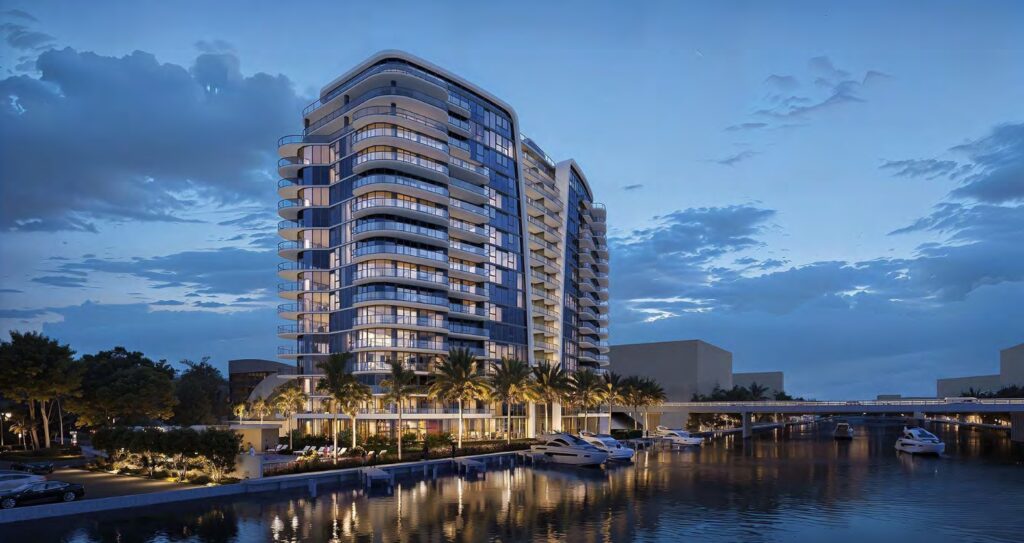
3000 Waterside by Claridge Homes has been submitted to Fort Lauderdale’s Planning and Zoning Board, aiming to satisfy conditional use requirements, adequacy standards, neighborhood compatibility regulations, and other municipal guidelines necessary for the project’s approval. The development, which remains mostly consistent with a prior submission to the city’s Development Review Committee in May 2024, is set to feature 129 residential units, 4,935 square feet of commercial space, and 310 parking spaces. The most notable revision from the earlier proposal is a reduction in commercial space along East Oakland Park Boulevard, where plans show a retail slot scaled down from 1,500 to 935 square feet. However, the 4,000 square feet of restaurant space overlooking the Intracoastal Waterway remains unchanged. The project will measure 19 floors, 164 FT to the roof, or 186 FT to the highest point. The tower will rise around the same height as the many other towers near the Intracoastal. Additionally, the development includes an articulated parking garage with a diverse range of materials from perforated metals, stucco, and wood finishes: an effort to enhance pedestrian aesthetics. The current site is a grass lot. The property, located at 3000 E Oakland Park Blvd, was home to a standalone parking garage and a low-rise building before being demolished in 2023. The project’s official architect is FSMY, based in Fort Lauderdale.
‘Gallery in the Grove’, a Mixed-Income Building Proposed in Coconut Grove
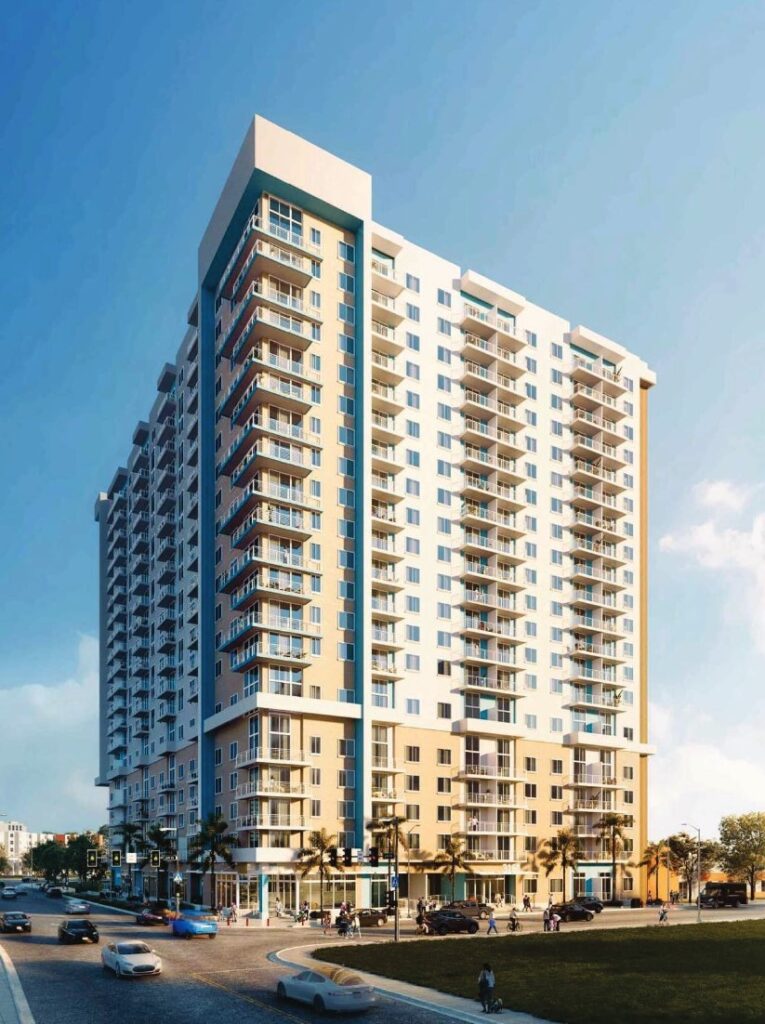
Gallery in The Grove, a mixed-income high-rise, is being proposed by The Related Urban Development Group to transform the Gibson Plaza housing site at 3160 Mundy Street in Coconut Grove, Miami. The project is the final qualifier for a previous ‘Request for Proposal’ (RFP) instituted in 2023, aiming to develop the site into a mixed-income building with market rate units, workforce housing, and affordable units. Gallery in the Grove will include 345 units, a 7,800 SF library, a 5,500 SF wellness center, and 303 parking spaces. To be more specific, there will be 36 units, 163 1 bedroom units, and 146 2 bedroom units. The building will encapsulate approximately 248,265 net rentable SF. The tower will demolish existing housing on-site. However, current units are not public housing, but apartments with existing HAP contracts with the US department of Housing and Urban Development. Hence, the demolished site will transfer its existing HAP contracts to the new tower, while also incorporating deeply affordable units (exactly 46 units through the Restore-Rebuild program). The new highrise will be among the tallest towers in the area, rising 20 floors or 213 FT according to elevations. For context, the recently constructed Cascade Link at Douglas rises 37 floors and is merely blocks away. The highrise will be among 2 other buildings on site also with attainable housing. Site plan photos show the mentioned 7,800 SF library fronting Douglas Road, with linear units lining the parking podium to provide adequate pedestrian activation along both Day Avenue and Douglas Road. A wellness center will front Mundy Street and Day Avenue. Likewise, residents have access to an amenity deck on level 6, adding a large pool, seating, a club room, a health club, and co-working space. Cohen Freedman Encinosa is the official architect on site. The development is located at 3160 Mundy Street, Miami FL.
Legacy Miami WorldCenter Is Still Stalled. Here’s What We Know
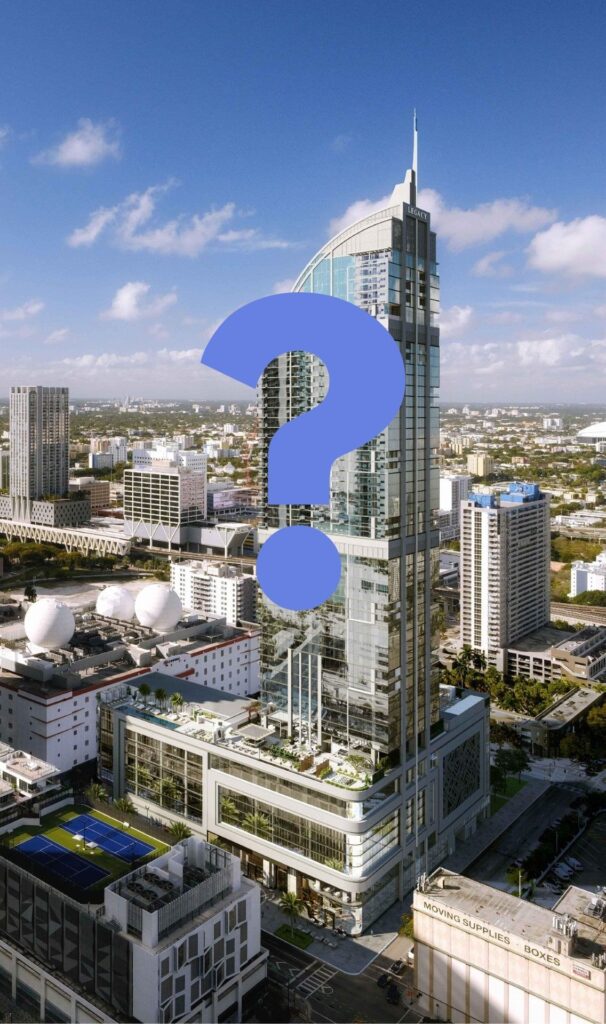
Legacy Miami WorldCenter is still stalled. The project, which broke ground in late 2021, rose about 20 floors before stalling last year. Problems arose when the developers behind the project found that the slabs for the towers included incorrect placements of plumping and electrical. Because the project changed from design usages throughout the years, changes were not reflected in the new floor plates. According to the Real Deal, the luxury mixed-use tower was aimed to restart months ago, with a letter sent out to buyers indicating completion of revised plans necessary to restart construction. Construction has still not restarted. According to a webcam provided on the official developer site, the site has not changed in about a year. In addition, the western crane on site looks to have its head dismantled. Efforts to revive the long-stalled project have played out in the site’s permitting history, with a plethora of filings between late 2023 and early 2024. The developer submitted a series of phased permits, covering building, electrical, mechanical, and plumbing work, signaling an attempt to restart construction. Yet, in a reversal, every permit was either revoked or canceled, leaving only stand-alone elevator permits for construction use intact. Despite multiple inquiries, Floridian Development has received no response from the developer regarding the project’s phasing. More tellingly, not a single new permit has been submitted or approved in the past year, raising questions about whether the project has quietly slipped into limbo. The development will include 310 short-term rentals, a 219 room hotel, a wellness center, and immense retail space if built. The condo portion of the project has sold out.
Sonesta International Hotels Introduce ‘The James Hotel & Residences Downtown Miami’, Rising 82 Floors
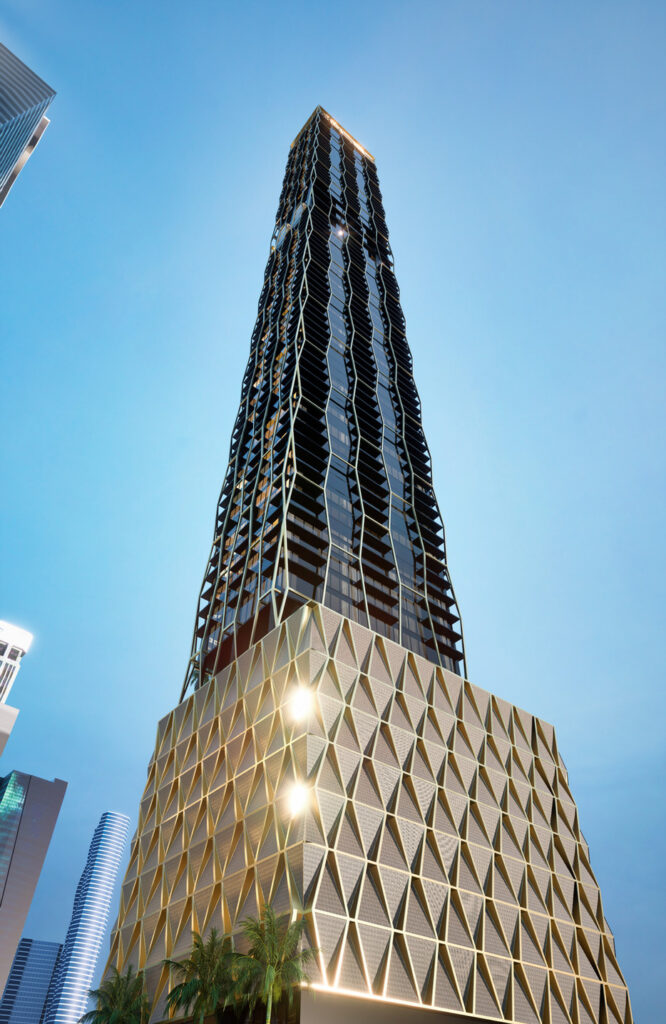
Mint developers and Sonesta International Hotels Corp have joined ties to develop ‘The James Hotel & Residences Downtown Miami’ according to Hotel Investment Today. The property is among the many supertall residences planned in Miami, with an estimated construction cost of $850 million for 82 floors of hotel rooms, residences, and parking spots. Specifically, there will be 336 fully furnished residences with approximately 200 units participating in a hotel leaseback program, amenity space, and restaurants that include the highest bar and restaurant in the Americas. Sales for the development will begin in the second quarter of 2025. Sonesta Hotels, a corporation that racked over $300 million dollars in revenue in 2024 and owns more than 1,100 locations worldwide, will develop the supertall as a sister property to the ‘James Hotel’ in South Beach. Mint developer’s Daniel Berman says funding is secured for the first round of funding, with groundbreaking on the first quarter of 2026. Mint developers is a collaboration between Big Development, AD1, and To The Stars. ‘The James Hotel & Residences Downtown Miami’ was originally revealed as ‘Two31 Flagler’ a few months ago by Big Development, encapsulating 83 floors and 369 residences rather than a mixed-use orientation of hotel and residences. The supertall will open in late 2028 once planning and construction finalize. Idea Architects is the project’s designer, with the property’s location at 231 E Flagler St, Miami.
Related Group Scales Down Apogee West Palm Beach After Board Rejection
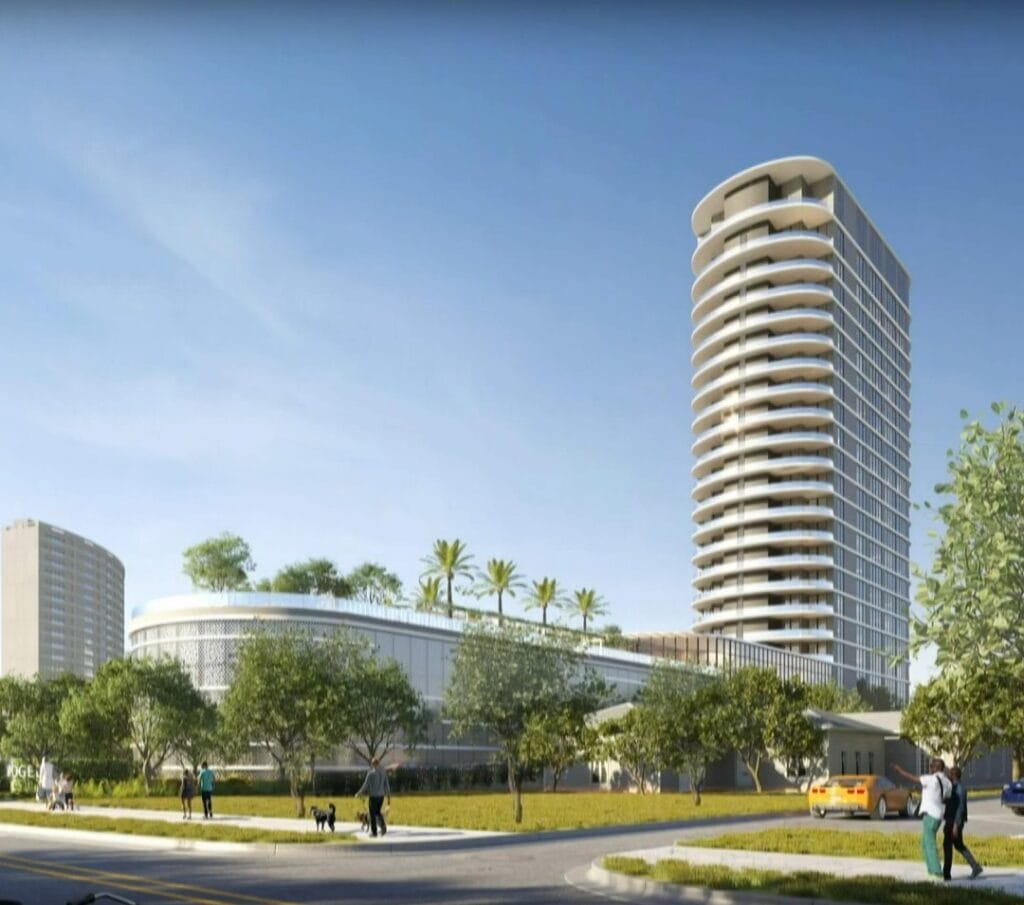
The Related Group is back with a re-imagined proposal for its luxury condominium development, Apogee West Palm Beach, located at 4906 N. Flagler Drive. After facing unanimous rejection from the West Palm Beach planning board on December 19, 2023 due to concerns over its height, massing, and impact on neighboring single-family homes, the developer has returned with an adjusted proposed aimed at addressing city requirements. On top of this, multiple nearby community members expressed concern regarding the height of the development along such a constrained lot size, making approval seem ill-sighted. The Related Group showcased the redesigned project at a Planning Board Meeting on January 22nd, 2025. The revised plans now feature a slender 21-story tower with 39 condo residences (4 fewer than the maximum allowed) along with 99 parking spaces. Standing at 255 feet to the mechanical floor, the new structure is 52 feet shorter (an 18.15% reduction) than the original proposal, reducing massing impacts for nearby residents and complying with necessities outlined by the City of West Palm Beach. Part of the new proposal comes different waivers. Of the 6 waivers previously requested, 1 was removed. Waiver 3 which initially presented an around 3 FT deviation from a required 20 FT setback was slashed. Likewise, staff findings found the new proposal to comply with development standards. Despite complaints still arising by some residents, the project was recommended approval by the City of West Palm Beach’s planning board. “We have to balance a lot of needs here. Needs for the whole city, not always just individual neighborhoods”, “there is a huge demand in the city for housing, there is a need for investment in the north end”, “city staff’s issues were addressed, so they have done what we asked of them” according to Steven A. Mayans, chairperson of the board who originally called for denial of Apogee West Palm Beach. Site plans by the project’s architect, Arquitectonica, outline new sidewalks, greenery, public art, and a street-facing garage that aims at blocking the tower’s elevation from pedestrian view. The development is located at 4906 N. Flagler Drive, blocks away from Related’s newly constructed Icon Marina Village
Preliminary Plans Revealed for a Hotel Building at 111 N Meridian Ave in Channelside, Tampa
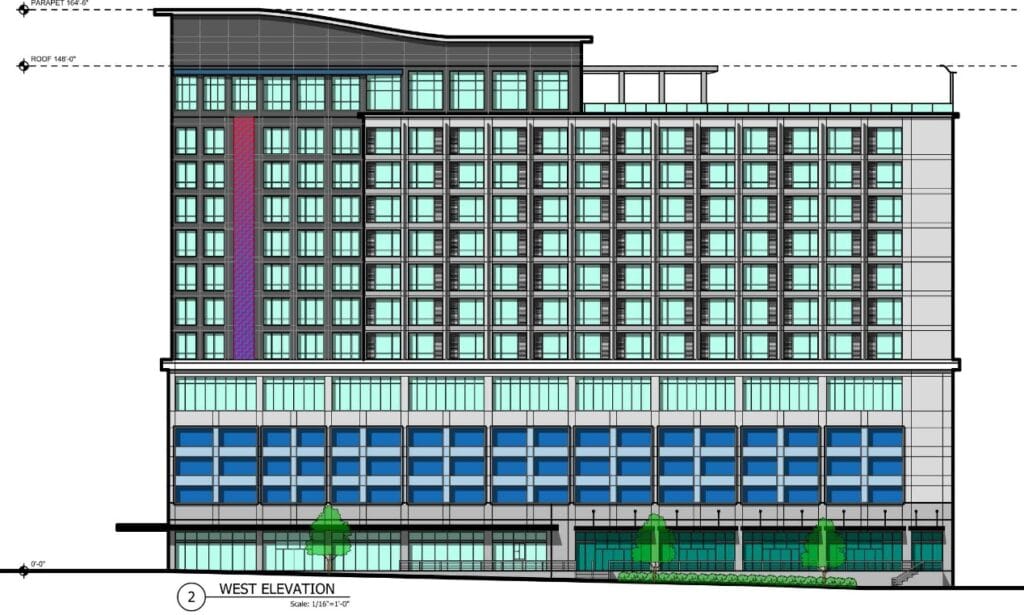
A rezoning application was recently filed on January 20th, entailing a proposed hotel featuring extensive retail space along N Meridian Avenue and hotel amenities and rooms. An original rezoning plan was approved by the Tampa City Council in 2019, outlining a first phase that later constructed 330 units and a phase two featuring a mini warehouse facility with ample commercial space. As per a new rezoning application, phase two will instead create a close to 500,000 square feet building (495,132 SF) developed by McKibbon Equities. According to the property’s site data, the project will include 304 hotel rooms, 35 parking spaces, 13,000 SF of retail on the bottom floor, and a 4,800 SF ‘AC Cafe’ along East Washington Street and North Meridian Avenue. Likewise, a large sidewalk lining newly planned landscaping will compliment the project’s massing. The development will request no waivers, with close to zero setbacks along any portion of the development. Uniquely, the site plan hints at the hotel being an ‘AC Hotel’ with the projects name being ‘MHG Tampa DT ACH-MX, LLC’ and the site plan showing an ‘AC Cafe’, albeit it’s all speculative and naming isn’t confirmed. Elevations draw out a 13 floor tower measuring 164 FT to the building’s parapet or 148 FT to the roof. Because the project is preliminary, rendering unfortunately aren’t available. Current processing status indicates the project is in its earliest stage: application review and traffic analysis, with closure occurring in the distant past. The project is located at 111 N Meridian Avenue.
315 NE 3rd Street Proposed in Fort Lauderdale
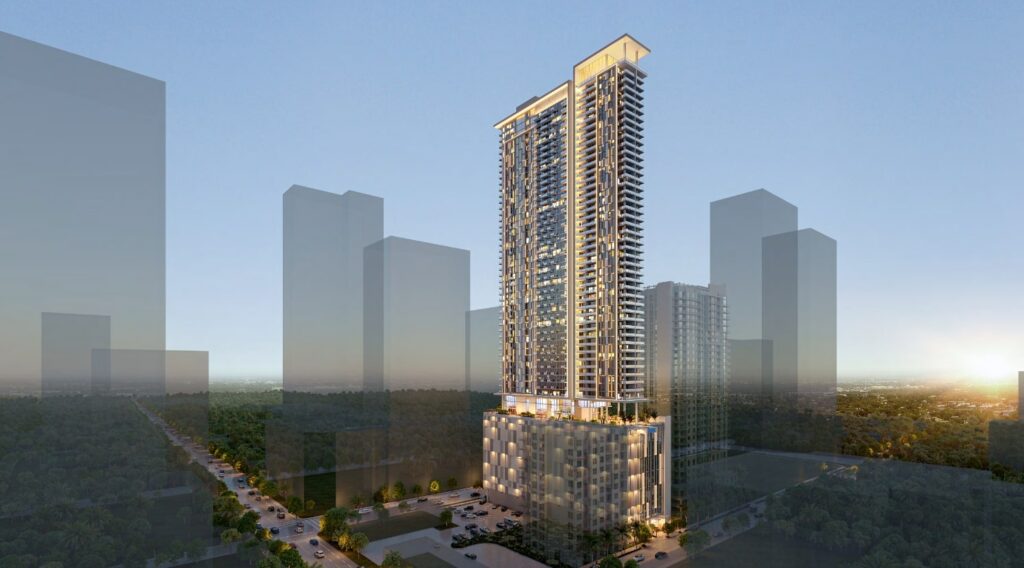
Arosa Developers, based in Brooklyn, have submitted plans for a slender tower along a linear parking lot at 315 NE 3rd Street. Plans originally called for “Selo Hotel Condo” by H Group Capital, although the project fell through following a $5.75 million dollar foreclosure. The building is being designed by FSMY Architects and is planned to include 607 units, 3,727 SF of commercial space, and 659 parking spaces. Units range from studio apartments, 1 bedroom units, 2 bedroom units, and 3 bedrooms units at a max of 1,416 SF. The property will rise atop a 52 space parking lot built to house cars from “Nola Lofts”, an adjacent high-rise building built in the 2000s. Hence, of the 659 parking spaces will be 52 reserved for Nola Loft’s residents. Additionally, The tower will be the tallest in Fort Lauderdale, reaching heights 54 floors. As per basic Fort Lauderdale code requirements, provided open space is supposed to compose of at least 10% of the site’s area. In this case, the 27,624 SF lot needs at least 2,762 SF of open space. The developer will extend beyond this requirement, with a total of 20,288 SF. The same rule applies for landscaping, with 1,390 SF given on site. According to site plans, the tower will front both NE 2nd Street and NE 3rd Street. A lobby will face NE 3rd Street along with a 816 SF commercial unit equipped with an ADA accesible ramp. On the other side, a large 2,910 SF commercial space is proposed. Elevations feature a high-rise rising 603 FT to the architectural top, with spandrel glass mimicking linear units along both streets. A preceding FAA application filed in August indicated a height of 615 FT, albeit FAA filings aren’t symbolic of a tower’s height as they can go higher than planned elevations. Location: 315 NE 3rd Street
First and Fifth Back to the UDRB with a New Design Following Board Rejection
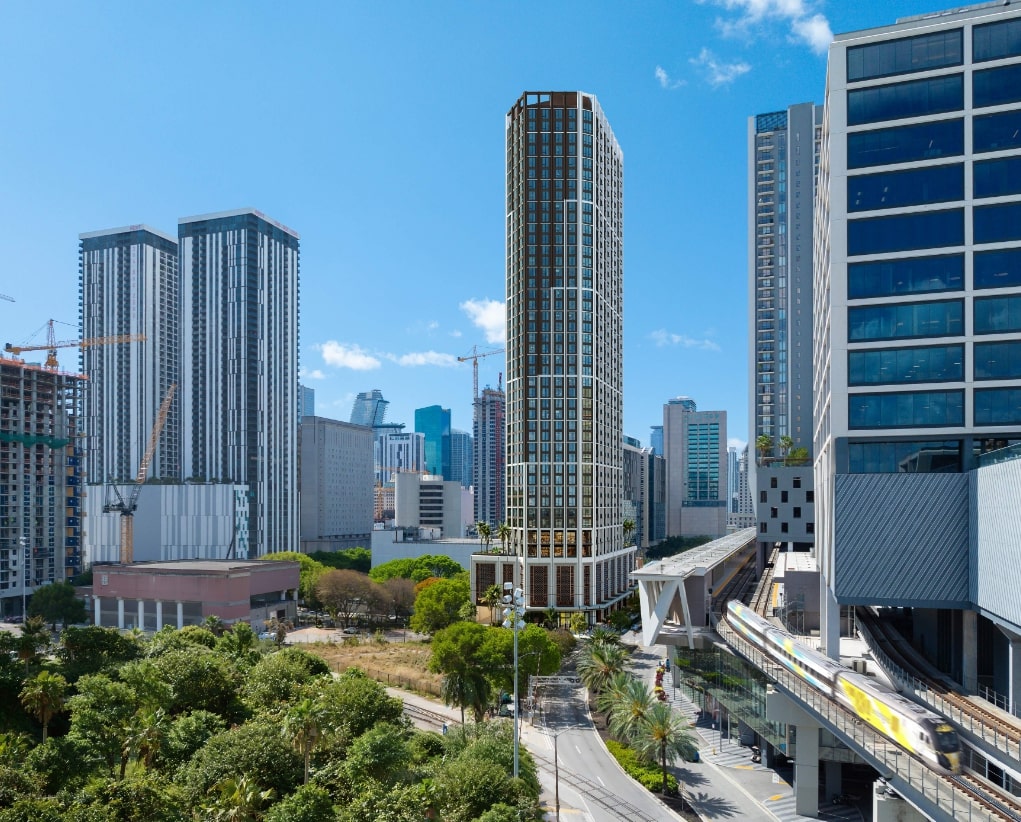
When multiple developers geared up to showcase their projects to Miami’s Urban Development Review Board last year, approval was not only on the minds of developers: but also architects. One of which was First and Fifth, designed by ODP Architects and led by Oak Row Equities. However, the board rejected the project after presentations concluded, with the ultimate concern being the lack of cohesiveness between the podium and the building’s main facade. The podium, drawn by inspiration from Salvation Army Citadel’s Venetian Gothic Style, was described as “not even close to that” by Anthony Tzamtzis, a board member of the UDRB. ODP is now back to the drawing board with an updated podium, completely dismantling the tower’s unique arches along the podium. “The simplified arches of the historic building have been reimagined to carry a modernized orthogonal geometry in our proposed design”, “the metal screen’s design abstracted from the historic windows of the Citadel, serves both aesthetic and practical purposes” reflected by Kurt Dannwolf, president of ODP architects. The colors and materials used on the new garage screen create a visually cohesive development, drawing inspiration from Miami’s historic past while still retaining separate identities between the old and the new. Despite minor changes in the design, the skyscraper includes the same plans: a height of 517 FT measuring 45 floors. Likewise, it’ll include 526 units, 161 parking spaces, 530 bicycle parking spots, and 6,637 SF of commercial space, virtually unchanged from the previous submission. Elevations on the other hand have changed to reflect the newly unified podium and facade, as well as showcasing the tower’s homage to the Salvation Army Citadel. The project will subsequently face the board again on January 15th, 2:00PM with hopes of approval. However, it’s worth noting UDRB approval isn’t vital to a project’s overall approval. The project’s location is 49 Northwest 5th St, Miami.
Early Live Local Plans Released for ‘Azul at Blue Lagoon’ near Miami International Airport
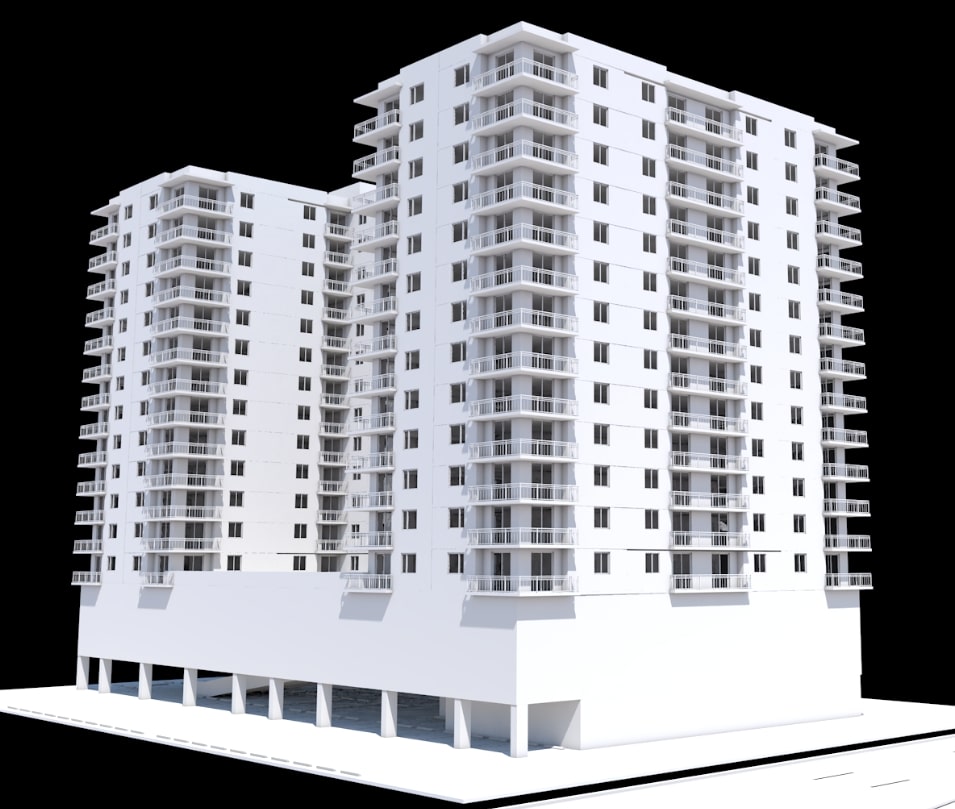
Keystone Holdings has released preliminary plans for apartments blocks away from Miami International Airport. The development was filed on January 6th, 2025 under a pre-application request. As per a written statement and multiple detailed plans, the plans will progress pursuant to the Live Local Act and Miami-Dade’s Workforce Housing Development Program, adding at least 114 workforce units out of the 284 proposed. The units will range from studios, 1 bedroom/1 bath, 1 bedroom/1 bath + den, and 2 bedrooms/2 baths. The smallest unit size is a 464 SQFT studio. Among the 284 proposed units is 266 parking spaces reduced from a required 439 spaces via a 25% parking reduction. This parking count is entirely possible due to the property being within 660 FT of a smart corridor. In addition, the development includes no retail space or office space, although it’s worth noting the plans are still extremely early regarding stages of design. The developer is requesting 4 administrative changes, ranging from increases in lot coverage from 40% to 50%, to a reduction in the number of parking spaces lower than the 25% reduction already filed. Lastly, elevations and site plans showcase a development measuring 16 floors to 156 FT, with lobby space fronting NW 57th Avenue. These elevations feature a parking podium wrapping around the entire base, totaling 3 floors. The property is positioned at 1200 NW 57 Avenue, Miami, Florida 33126. The official architect is FORMGROUP.
80 Floors in Miami’s Omni District From the Live Local Act? The CITT Annual Workshop Weighs in.
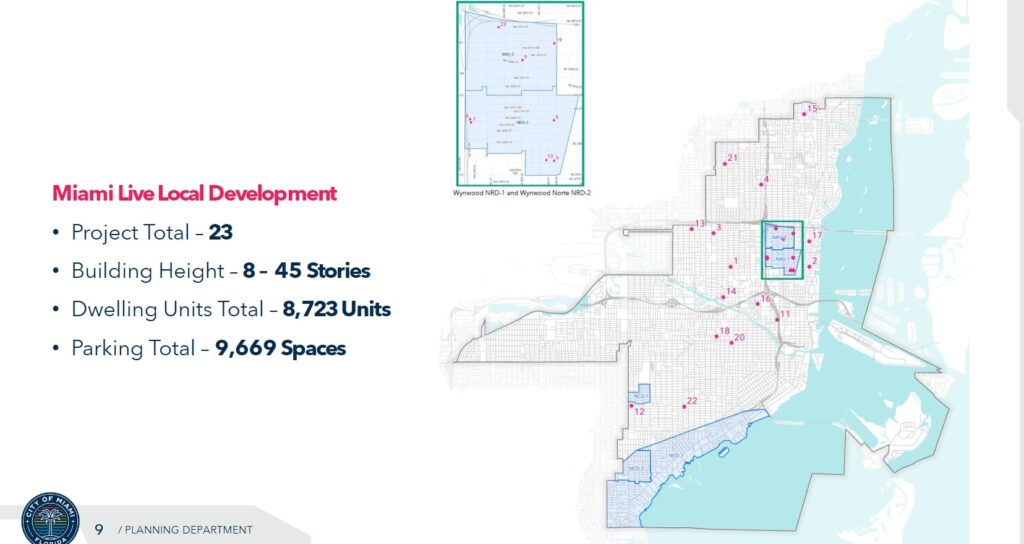
Miami’s long-awaited ‘Citizens Independent Transportation Trust’ held its municipal workshop last month. Attendees discussed a plethora of topics including Miami’s SMART Program, biking networks, and future projections. However, one agenda item stood out the most due to its unique findings: the impact of the Live Local Act on Miami. Background on the Live Local Act The Live Local Act was passed on March 23, 2023 but later updated in 2024. It seeks to supersede local government regulations concerning height, density, and zoning to improve housing costs by streamlining the development of workforce and market-rate housing. This is accomplished by applying the existing zoning from a property located one mile away to the new site. The law has also removed rent control, intending to instead utilize city-owned, commercial, or industrial properties for appropriate workforce housing development. Developers who choose to build upon underutilized land may qualify for expedited building permits, reduced parking requirements, or even tax credits. To qualify, plans must allocate 40% of existing units as affordable and ensure that over 65% of usable square feet is designated for residential use. According to state law, affordable housing is considered to be at 120% of the area median income, which some critics argue is still too high to be really considered ‘affordable’. What Did They Find? A PowerPoint presented last month revealed that Miami currently has 23 Live Local projects already submitted, a number likely to have increased since then. The heights of these projects range from 8 to 45 floors, totaling 8,723 units and 9,669 parking spaces. Most units are clumped near Wynwood and Edgewater, but developments go all the way to city boundaries. A context map taken from Arquitectonica’s 2110 N Miami Avenue presentation shows that large areas in Edgewater and the Omni District are set to benefit from heights of up to 80 floors, with potentially unlimited floors via added benefit heights. Although 80 floors can’t be built due to FAA regulations, neighborhoods such as Overtown and Wynwood will still reap significant advantages, as existing height limits restrict higher development. Even the newly named ‘Wynwood Norte’ neighborhood can see developments rising up to 36 floors with a 24-floor bonus height, with FAA height limits at 500 FT and 450 FT at the end of the neighborhood. From 24 Floors to 80 Floors Take 1361 NE 1 Avenue in the Omni District as an example. Current zoning under ‘Urban Core Transect T6-24‘ permits a maximum height of 24 floors. With the live local act and T6-80 lots (lots that permit 80 floor buildings) less than a mile away, the property now gains from almost unlimited height. Despite the heights being misleading because of FAA regulations allowing a 649 FT maximum height, that still encapsulates about 64 stories which is much higher than any other existing building in the neighborhood. For example, Art Plaza built by the Melo Group is a 32-floor building recently completed in the Omni District using T6-24 zoning. Located less than 50 feet from 1361 NE 1 Avenue, it’s restricted to a maximum height of 24 floors, or up to 48 floors if it meets certain city benefits. This 48-floor limit is considerably lower than the 649-foot height cap permitted by the FAA and the Live Local Act. The Live Local Act ultimately marks a shift away from local governments and conventional zoning, reshaping not just Miami but cities across Florida. Given the prospects of high-rise buildings detailed in this report, community stakeholders need to participate in discussions that balance density with the quality of life. Additionally, the increase in workforce housing alongside a greater housing supply will ultimately help alleviate Miami’s housing crisis.
‘The Helm’ Planned in Miami’s Design District With Mixed-Income Units & Office
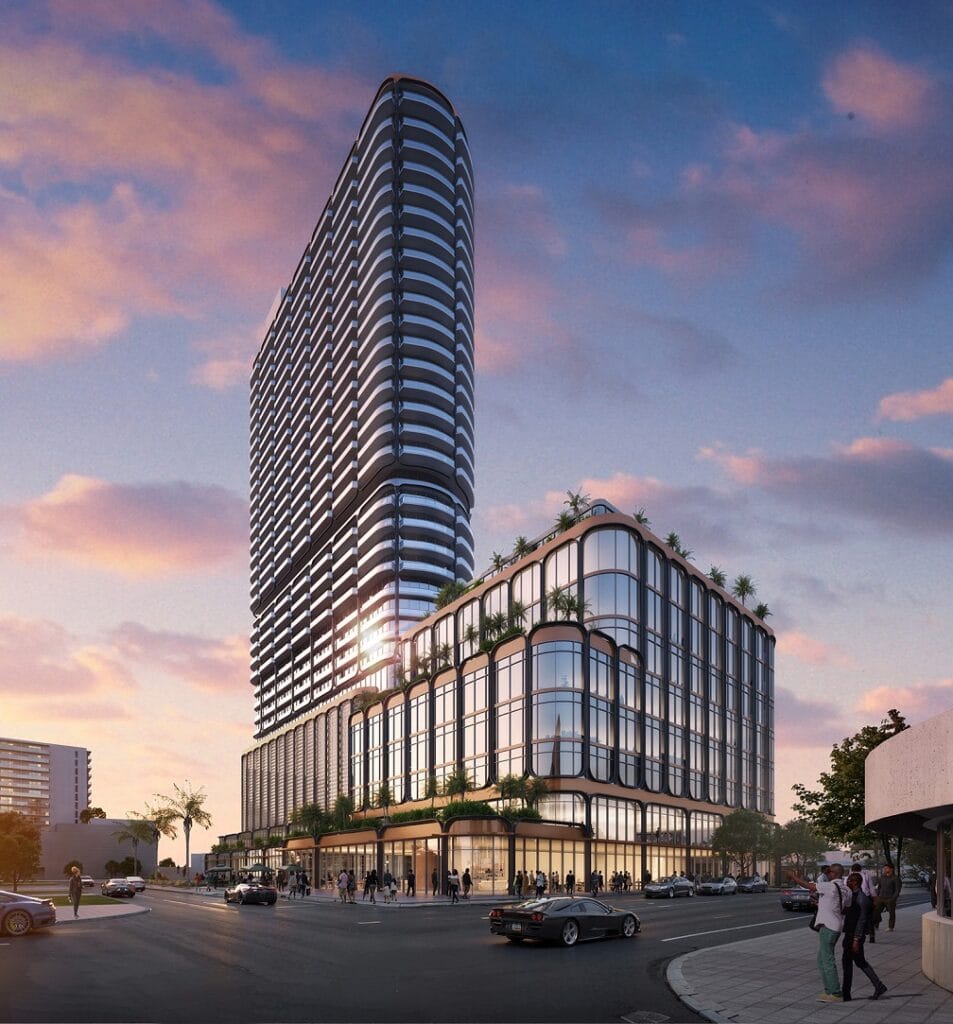
Helm Equities is planning a 36-story mixed use building in Miami’s Design District according to CityBiz. The development will replace the previously proposed Parterre 42 project, which recently started leasing class A office space at 4201 Northeast Second Avenue. The new building will consist of 278 residential units, 83,338 square feet of office space, 620 parking spots, and approximately 45,000 square feet of retail space. The project will cost 500 million and encompass about 500,000 SF of usable SF. CityBiz also cited a recent Kimley-Horn traffic study, which found a reduction of about 29% to 37% of traffic compared to the previous office space planned. Since the development is taking advantage of the Live Local Act, regulations require that 40% of the units be priced at 120% of the Area Median Income. As a result, the project will have 116 rental units on the lower floors, with condominiums on the upper levels. If the development utilized existing code, the max height would be 5 floors. While official elevations or site plans are not available, the project will add wraparound retail and 35,000 square feet of open space at the ground level to enhance the building’s base. In addition, the tower is split into two sections, with an office portion and a residential portion linked by a courtyard. The building will join a plethora of other developments in Miami by achieving LEED Gold and WELL gold certifications. The Real Deal noted that construction will likely begin in the fourth quarter of 2025, but the date isn’t set in stone. Cube 3 is the official architect. The site is located at 4201 Northeast Second Avenue.
Construction and Tree Permit Filed For 2900 Terrace in Miami
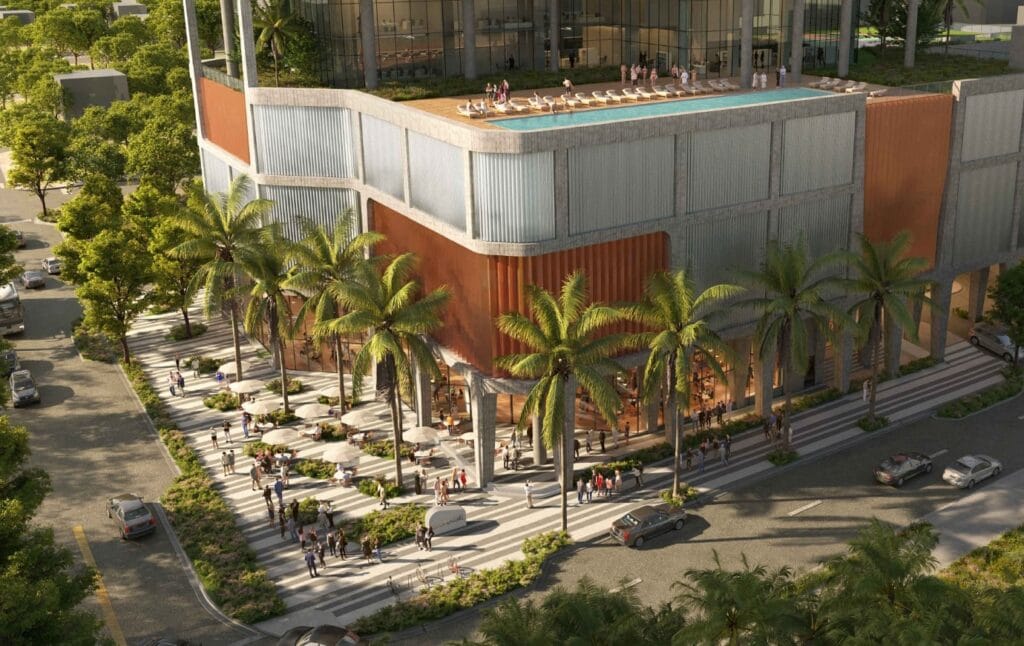
Permitting is progressing for 401 NE 29th St (formally known as 2900 Terrace) in Miami’s growing Edgewater neighborhood. The project filed for a site work permit on October 7th and a tree permit on October 4th. Both permits will prepare the site for vertical construction, likely to commence next year if plans progress smoothly. As per a previous UDRB filing, the tree permit will remove 15 trees of the existing 18 on site. Replacement trees include 38 palms and trees varying from large to medium sizes. Shrubs will be planted as decorative landscape, encapsulating 710 native to imported flora. The project is especially unique in Edgewater due to its emphasis on landscaped open space. While code requires only 6,091 SF of open space, developers intent to build 13,185 SF of landscaped open space. The filed site plan permit will handle excavation, foundation piles, and soil improvements. The general contractor for the project is Coastal Construction. In addition, all permits filed are in the approval process, incorporating both the tree and site plan permit and an additional construction and phased permit. Progress for the tree and site work permit last had activity around Dec 12, 2024. The project was approved by UDRB staff on November 15, 2023, set to feature 324 units, 504 parking spaces, 52 bicycle spaces, and ample retail space in a 32 floor tower. The developer for the site is LNDMRK Development & Oak Row Equities, while the main architect is Arquitectonica.
‘One W12’ Moves Forward With Submission to Miami’s UDRB
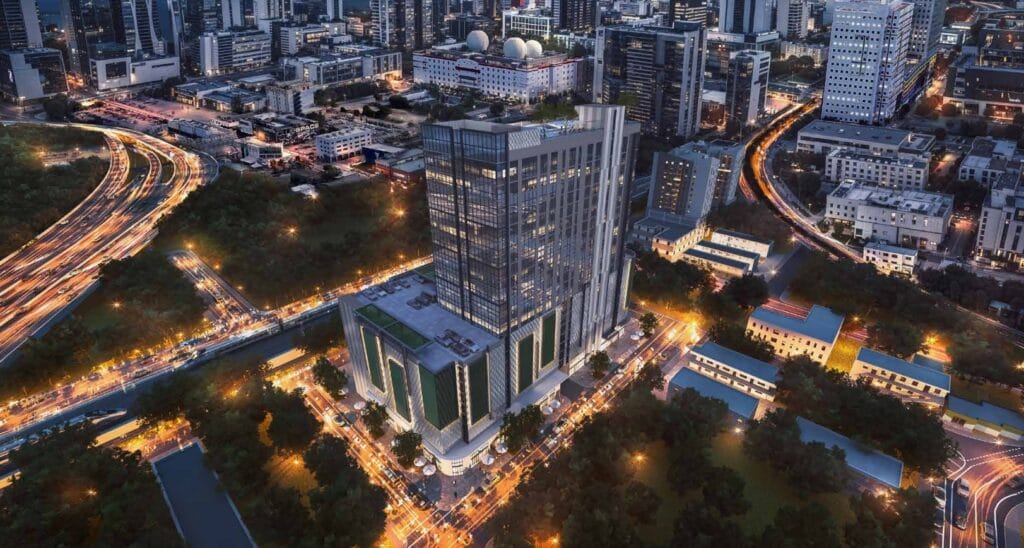
Property Markets Group is progressing with plans for One W12, a residential tower set to redevelop an entire block of vacant land in Overtown, previously used to house construction equipment for nearby infrastructure projects. The property was originally granted a City Center MUSP for a 25 floor tower containing 412 residential units and 23,000 SF of retail space. Presently, developers will amend the MUSP to instead feature a 22 floor tower with 372 dwelling units, 208 micro units, 816 parking spaces, and 380 bicycle parking spaces. The development will additionally include an immense array of ground floor uses including town home-style units, bike storage, amenity space, a lobby, and 4,892 SF of commercial space. The original MUSP included three waivers that will be continued onto this project. Of the waivers, most notably is a waiver for a 30% reduction in parking. However, the developer is using none of the benefits because a 30% reduction in parking would mean 196 parking spaces required: the developer is adding more than 800. Elevations feature a 246 FT highrise, shorter than previously approved. The tower’s podium will measure 8 floors of the 22 existing floors. Likewise, the design of the podium is attempting to break up its immense mass by adding a diverse selection of materials, colors, and visual breaks pictured below. Large sidewalks along the project will adorn native greenery and reduce the imposing effect of the podium. Miami planners originally called for balconies, but the architects politely declined, citing balconies reducing the overall feel of the project. The site is located at 1129 NW 1st Court with proximity to the metrobus, the metrorail, the metromover, and the brightline station all within walking distance. Cube 3 is the main architect on record.
36 Floor Highrise Proposed in Edegwater With an X-Bracing Design at 422 NE 29th St
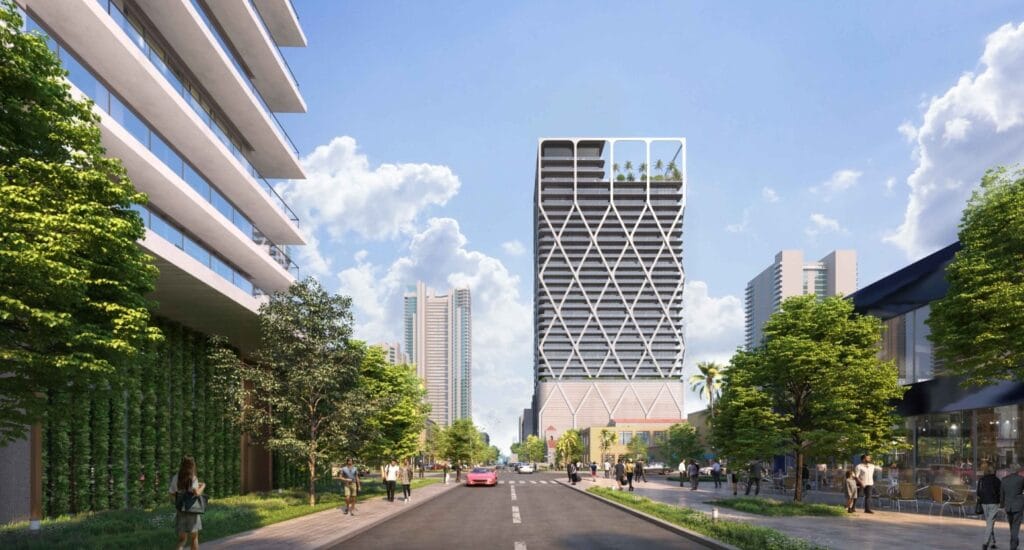
Black Salmon is proposing a 36 floor residential building in Edgewater, all atop a decently sized 44,491 SF lot adorning abandoned parcels, homes, and a church. The church, constructed in 1997 and coined Mission San Francisco and Santa Clara, will be preserved for future use according to site plans. The developer will also purchase a Bonus Floor Area to build the 552,326 SF project that exceeds applicable FLR. When developers purchase Bonus Floor Area, they must contribute to Miami’s Public Benefit Trust fund, which aims to improve infrastructure, transit, affordable housing, or parks. Likewise, the developer is planning density above permitted use. The applicant will pursue excess density via the Attainable Mixed-Income Housing Transfer of Development Density Program. The project will feature 229 residential units, 4,416 SF of retail space, and 397 structured parking spaces. Units range from 1 bedroom, 2 bedroom, 3 bedroom, and 4 bedroom configurations. According to site plan drawings, the church will maintain surface parking while lobby and retail space will front NE 29th St. Although the tower is a generous 36 floors, heights will rise even taller with the highest measurable point reaching 406 FT. The tower’s design is unique with its cross-bracing design extending across the entire facade. Unfortunately, the project proposes a hefty podium with little architectural or artistic flare. Black Salmon is proposing 4 waivers, including a waiver to reduce frontage, side, and rear setbacks above the tower’s 8th story; a waiver to allow parking within the 2nd layer on the principal frontage; and a waiver reducing spacing of vehicular entires, specifically lowering it from 60 feet to 23 feet. The project’s main architect is Arquitectonica. The address is 422 N.E. 29TH ST Miami.
Eight Floor Apartment Building Proposed in Princeton, Miami-Dade

Aconcagua Developers, LLC is proposing a new apartment building in Princeton under a recent pre-application request. The development, designed by Caymares Martin, will measure 8 floors and include 162 units and 307 parking spaces, although only around 209 are required without reductions. The development is proposing no waivers or conditional use permits to increase density, instead solely utilizing the zoning already on the site. After the pre-application is completed, an administrative site plan review will take place. The 2.7 acre lot is located under Miami Dade’s “Princeton Community Urban Center District (PCUC)”, formed to promote density in the growing South Miami-Dade region. Lawmakers adopted the PCUC in 2006 following calls for increased walkability, sustainable development, and residential growth to meet the expanding population. The PCUC and this development itself is safely in the County’s Urban Development Boundary (UDB), which conserves agricultural land to create a buffer between urban areas and the Everglades for environmental conservation and smart development. Because the lot is zoned into two portions, R (lower-density up to 2 floors) and RM (higher density of up to 12 floors), a 2 floor parking garage will be on the R portion and an 8 floor building will be on the RM portion. According to site plan drawings and elevations, the tower will rise 78 floors and include a fairly uniform facade with glass balconies extending about 6 FT. Large sidewalks will also be included, generously extending 28 FT from the lobby to the street. Native greenery will line the sidewalks and street parking. Units range from 2 bedroom or 1 bedroom configurations shown below. The property is located at 12867 Southwest 248th Street, Miami-Dade.
Miami Beach’s “First Street & South Pointe Stormwater Improvements Project” Progresses to Bring Much Needed Flooding Relief

Miami Beach is continuing their progress on a comprehensive stormwater improvements project in the South of Fifth Neighborhood. The project was recently highlighted in a Hybrid Meeting on November 12, 2024 to discuss the latest developments, along with updates on the project’s development phase. The First Street & South Pointe Stormwater Improvements project originally began when its conceptual layout was proposed in 2022. Since then, multiple public meetings were held to incrementally present the design to the community. The design is now mostly complete, with construction commencement likely happening soon. The goal of the project is to decrease flooding while enhancing the walkability, safety, and aesthetics of the neighborhood. A PowerPoint from April, 2024 highlights such improvements for Washington Avenue and 1st Street. An underground water treatment and pump station will be constructed at the intersection between Washington Avenue and First Street. By the pump station will be a newly-built station for above-ground electrical components, such as a generator in case of power outages. All electrical components will be shielded from the public via an enclosure wrapped in greenery and perforated metal. 1st Street will be entirely reconstructed, both for pedestrian safety and road raising. The road will be raised by around 1.5ft to protect homes and businesses from rising waters, while widened sidewalks and native greenery will be included for expanded pedestrian improvements. As per a graphic from early 2024 that’s likely been updated, the road will be cut to 2 lanes: a 50% reduction from the original amount of lanes. Parking will not significantly reduce for 1st Street or for the adjacent Jefferson Ave. In total, proposed infrastructure improvements include 4 drainage wells, with 2 along Alton road and 2 along Washington Avenue. Pictures below show the improvements done to flooding after construction is completed. Ideally, once all planned South of Fifth Neighborhood upgrades are completed, flooding will cease to exist. The project will begin in 4 phases, with the first phase including the underground pump station for $80M, the second phase constructing improvements for 1st street at $24M, and phase 3 and 4 building improvements to both Washington Avenue and Alton Road at $34M and $40M respectively. The total construction timeline is 51 months, or 4 years and 3 months, with the longest phase being phase 4. Construction on 1st Street will close westbound traffic, though one eastbound lane will remain open during the work.
Gasworx’s First Phase Moves Forward With Permitting in Ybor City
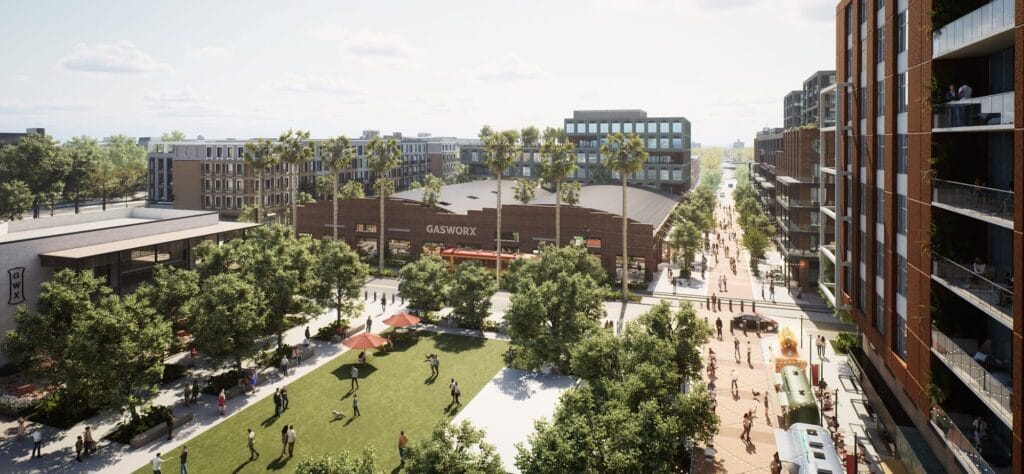
Gasworx Tampa, a development aimed at historic restoration and revitalizing southern Ybor City with housing, retail, and office, is progressing with extensive permitting. Gasworx was touted in early 2020 as a “development that will reconnect a community with its rich cultural heritage and to restore Ybor City to its rightful place as one of America’s truly great neighborhoods.” Developers now have an opportunity to deliver on that promise. The project’s first phase began construction in early 2020 with La Union, a 317 unit apartment building, and later W2, a 390 unit apartment building that broke ground in early 2024. The remaining parcels in phase one are now moving forward with 516 units, 108,000 SF of office space, and 87,000 SF of retail space. Additionally, phase one will feature a new TECO Streetcar station next to a proposed park, all part of the development. The permitting covers three new blocks: E1, E2, and E3. All three blocks have respectively filed their demolition permits, utility permits, construction permits, and site work permits. Block E1, located at the northern end, will feature 140 residential units along with 18,000 square feet of retail space. This block is already prepared for construction following a demolition permit issued in 2020, which demolished a two-story building surrounded by vacant lots that were previously used for parking. Block E1 already has a filed utility permit to add four wastewater service connections and a site/foundation permit, both pending a client response to proceed. Additionally, a construction permit has been requested for a parking deck to provide parking spaces for both the retail and residential units. Block E2 is somewhat complicated, with parts of the existing warehouse being torn down to make way for an office building featuring 108,000 SF of office space and 12,000 SF of retail space. The Gasworx team is dedicated to honoring Ybor’s historic roots in their development, translating into the brick warehouse constructed in 1952 being repurposed to house unique retail spaces. Block E2 has a construction permit submitted for the office building, as well as a utility permit, a demolition permit, and a site/foundation work permit in process, all awaiting client response. Block E3, set to be the tallest building in phase one with 376 units and 29,000 SF of retail, is moving quickly. Crews have already demolished the existing structure on the site, thanks to a demolition permit obtained in 2023. The removed building was a three-story office constructed in the 90s. Lot E3 is the quickest moving parcel, with a complete construction permit, utility permit, and site/foundation permit already submitted. While the construction and utility permits are still under review, the site/foundation work permit has been granted. According to Businesswire, Suffolk Construction will break ground on the rest of phase one this summer.
New Design and Specifications Revealed at Earlington Heights Workforce Housing
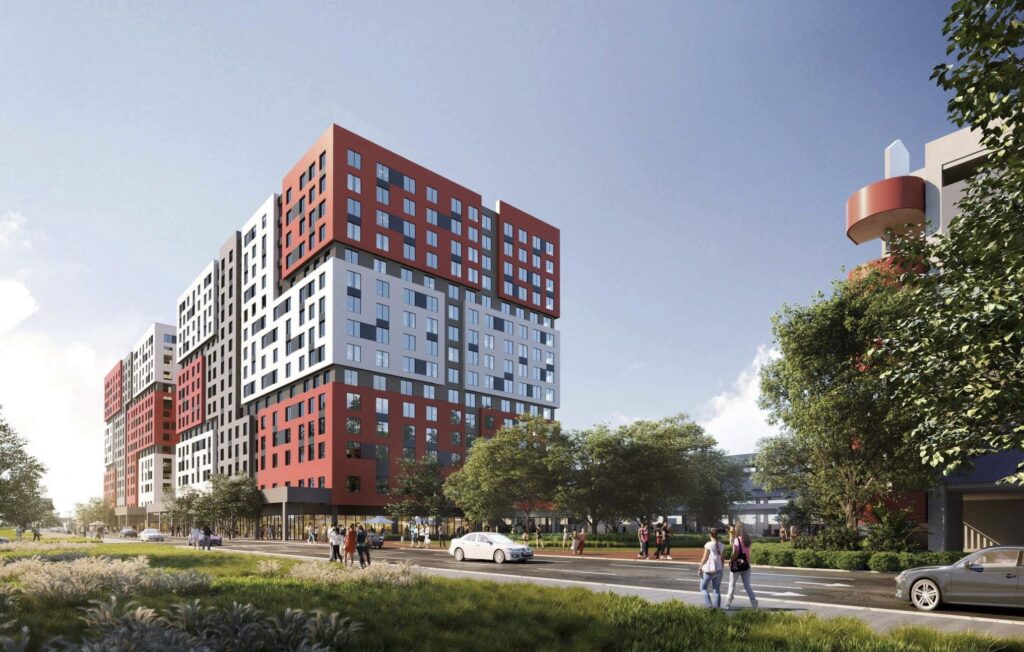
Earlington Heights, a transit-orientated development in Brownsville, is moving forward with new facade treatments and floor plans. The development was originally proposed in June of 2024 by Vivian Dimond, a principal at Bayshore Grove Capital. Plans showcased two 15 floor towers containing 856 workforce units, 33,827 SF of retail space, and 0 parking spaces due to transit reductions. The development is working to keep most of the original specifications, but with changes to the retail space and parking. The updated plans are reducing the retail space to 29,009 square feet. Reduced retail space derives from lowering the grocery store from 23,590 SF to 20,063 and replacing a front-facing retail space with a leasing center. Included among retail is a daycare center and space for a non-profit. Additionally, there will be 41 additional parking spaces. The 856 units are still 100% workforce, ranging from studios, 1 bedrooms, 2 bedrooms, and 3 bedrooms. Workforce Housing according to Miami-Dade is housing that’s within 60% to 140% of the county’s area median income “($42,600 to $99,400, respectively, for a family of four)”. Elevations showcase two 175-foot, 15 floor buildings that underwent some value engineering. Rather than incorporating large floor-to-ceiling windows along parts of the facade, with white and brown accents, the development will feature a new color palette of white, gray, and red. Both buildings are designed in a U-shape, framing around a central courtyard that hosts a swimming pool and other amenities.The park-and-ride garage, used also by the two towers, will keep its original design. The garage will be wrapped in a facade of blue and purple, along with red stairwells and added landscaping. The development is extremely transit-orientated, flanked by a metrorail station leading to Downtown Miami and a Metrobus depot. Unfortunately, the amount of bus drop-off stations at the depot will be slashed by around half, reduced from 15 to 6, creating future dents in bus-ridership near the Earlington Metrorail station. In all, the developer is hoping housing nearby the Earlington Metrostation will spur not only transit ridership, but further capital investment in the area. The development is designed by Arquitectonica. The location is 2100 NW 41 Street.
Mixed-Income Housing Revealed at River Parc According to Preliminary Plans
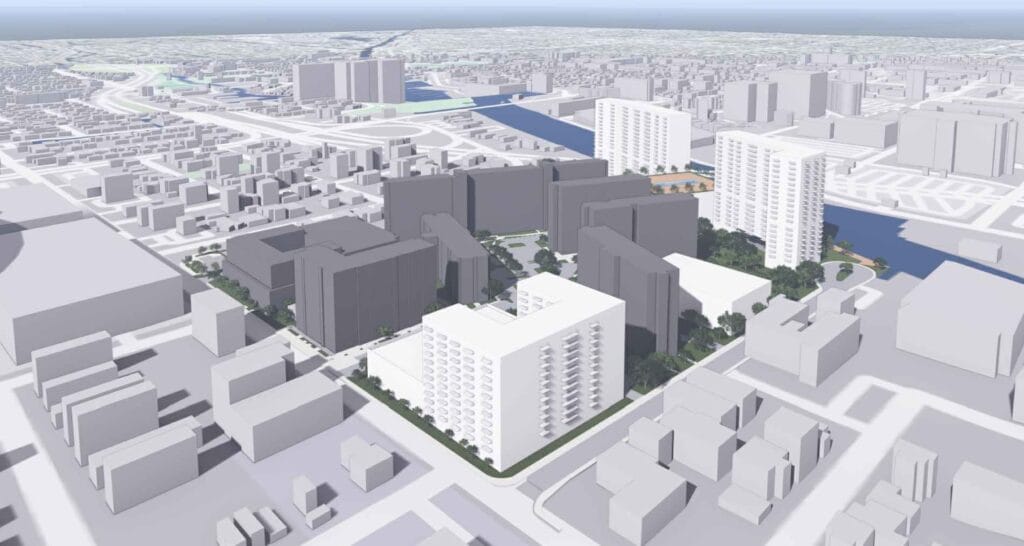
The ‘Related Urban Development Group’ has announced plans to build hundreds of new homes at River Parc, a revitalized public housing community in Miami. As per a recently filed pre-application request, the developer indicated that they will take advantage of the newly assigned SMART Corridor Subzone and the recently enacted Live Local Act to increase density and height. Currently, the site has 1,379 units and 659 parking spaces. Conceptual plans suggest that plans call for nearly double that, adding 1,038 additional units to create a total of 2,417 homes. It’s uncertain if all the new units will be designated as affordable and workforce housing, or if some will be market-rate. However, the Live Local Act dictates that at least 40% of the units must be affordable. The plans also feature 1,500 additional parking spaces, raising the total amount of parking to 2,159 spaces. With nearly one parking space per unit, it’s likely there will be some market-rate component this time around. Additionally, there will be 22,527 square feet of commercial space added along both the Miami River and NW 7th St. Elevations reveal plans for three new towers. The two tallest will be situated along the Miami River, both reaching 21 floors or 246 FT tall. The shortest proposed tower will stand at 145 FT, measuring 14 floors along NW 7th St. The rental towers will be developed in phases, with the two tallest being built in two separate phases. Site improvements include a riverwalk that will extend up to 28 feet and new green spaces, such as a small park preserve. The site’s location is 800 NW 13 Ave, Miami. It’s well within multiple transit modes including the MetroMover and multiple bus stops.
Tampa’s Green Spine Cycle Track Continues Construction in Ybor
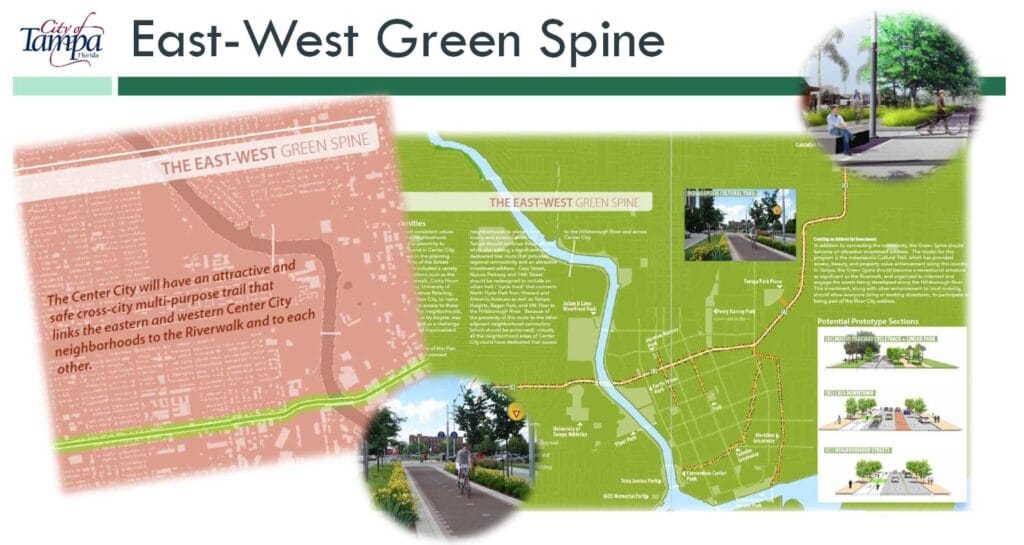
The City of Tampa is moving forward with the next stage of the Green Spine, a bike path that runs from North Hyde Park to V.M. Ybor. The Green Spine was first introduced in the early 2010s as part of the InVision Tampa Center City Plan, aiming to create “an appealing and safe cross-city multi-use trail that connects the eastern and western neighborhoods of Center City to the Riverwalk and to each other.” The entire Green Spine spans 3.4 miles, with the construction for phases 2a, 3a, and 1 already completed. The current phase, phase 3, includes segments 3B and 3C, with a total cost of $1,830,338 for capital improvements. The segment will feature two-lane bike paths with 3-foot concrete buffers, providing better protection for cyclists compared to existing bike lanes in Tampa that use cost-effective flex posts or paint. Construction began in August 2024 and is slated for completion by September of the following year. Recent site photos show that construction on segment 3B (Nuccio Parkway) is already under way, while construction for phase 3C has not yet started. Phase 3C along N 15th St will remove an estimated 42 parking spaces, with 52 remaining. It will develop a connection from Cuscaden Park to North Hyde Park, sparking significant improvements in the neighborhood/surrounding areas ranging from reduced gas consumption, increased tourism, improved water and air quality, and increase community connectivity. To contact the City of Tampa regarding concerns or suggestions, click here for Segment 3C and here for Segment 3B.
Redevelopment Plans Revealed for Miami’s Abandoned INS Building

Miami’s former Immigration and Naturalization (INS) building at 7880 Biscayne Blvd has a new plan: a 12-story building designed by Stantec. Originally left abandoned in 2008, the INS building was planned to be the “Triton Center” by Chinese developers. When plans fell through around 2021 because of permit inactivity and funding issues, the property was already more than a decade vacant, creating visual and safety problems for local residents. LGE 79, LLC is planning to breathe new life onto the lot with 35,044 SF of commercial space, 355 units, and 589 parking spaces. Units will all be market-rate and range from studios, 1 bedrooms, 2 bedrooms, and 3 bedrooms. The project aims to exceed the maximum lot coverage through the flexible lot coverage program, however, it complies with the rest of Miami code standards. In addition, the developer is seeking multiple waivers including a 10% reduction of guest parking, commercial parking, and residential parking. Because of the project’s proximity to mass transit (Metrobus routes 3 and 203), Miami code allows for a reduction in parking to promote walk-ability and transit use. The tower’s configuration is designed to minimize impacts to local residents. The site’s location is within two major thoroughfares with a multitude of retail space and car traffic, allowing for high density without proximity to single-family homes. Likewise, the project adds much needed housing, walk-ability, and retail space for the area. The different heights and facade coloration’s were designed to create the “feel of a multitude of buildings”. According to elevations, the mid-rise will measure 167 FT to the upper roof level, encompassing 12 floors. Site plan drawings showcase commercial space fronting 79th street, NE 5th Avenue, and Biscayne Boulevard. The largest space is a 21,017 SF grocer commercial space designed for a small grocery store or a large retail store. Palm trees and native greenery will line the sidewalk. Sidewalks will extend around 20 FT to the tower’s facade, including multiple visibility zones for drivers. The site’s location is 7880 Biscayne Blvd.
Cymbal Proposes Mixed-Used Tower in Miami With 239 Affordable Units
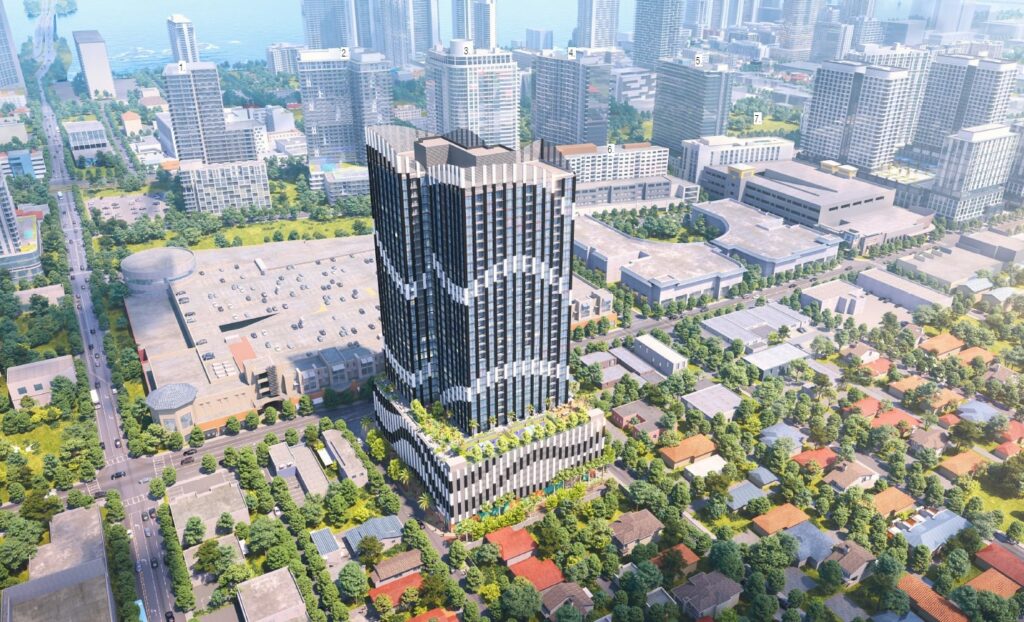
Cymbal Development is proposing a new mixed-used tower in Miami’s Midtown neighborhood designed by Arquitectonica. Like many other developments, the property is planning to utilize Florida’s recently passed Live Local Act, which allows sites to have added density, height, and parking reductions if 40% of the units remain affordable for 3 decades. According to the site plan, the development will include 598 units, although 1,357 units are permitted. 239 units will be affordable (120% AMI) and 359 will be market rate. All affordable units will be studio apartments ranging from 420 SF to around 470 SF. Also included is 18,108 SF of retail space and 4,547 SF of office space. Miami 21 code mandates that the development has to provide 815 parking spaces. Nevertheless, the developer has the option to request a waiver for a 30% reduction, which would bring the required number down to 570 spaces. They plan to use only part of this waiver, leading to 654 spaces instead. This exceeds the suggested 1:1 ratio between units and parking needed to ensure sustainable development in Miami. The developer is proposing 3 waivers in total, the parking reduction waiver is not part of that. Site plan drawings reveal adequate pedestrian activation such as units lined along the podium, a more than 20 FT sidewalk, greenery, and outdoor seating. Elevations indicate the tower to be 35 floors or 400 FT to the elevator, making it the tallest tower if built in Midtown. The property is located at 3466 N Miami Avenue. It’s well within multiple bus stops and the awaited Northeast Corridor rail project.
Ultimate Wynwood Proposing 524 Affordable Units Using The Live Local Act
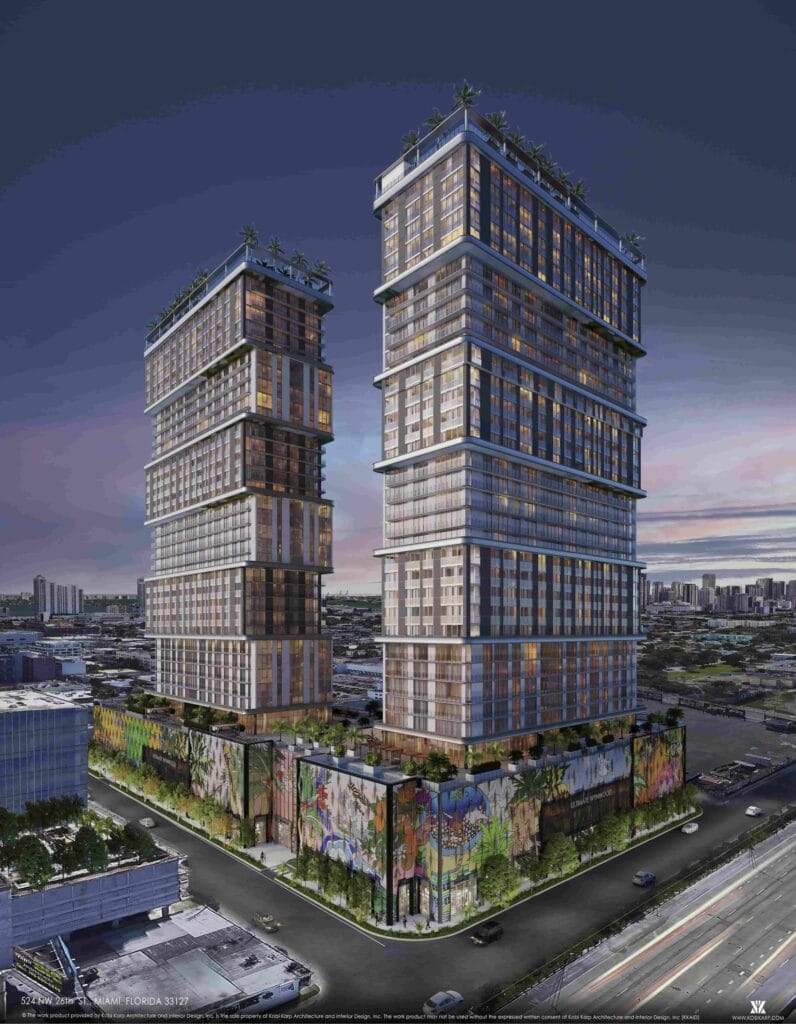
Ultimate Equity, LLC has presented plans for a dual high-rise development in Wynwood called “Ultimate Wynwood”, designed by Kobi Karp Architects. The project aims to be built on an 83,492 square foot lot near I-95, and will take advantage of development bonuses provided by the Live Local Act, allowing for greater density and height under the existing zoning regulations. Planning data indicates that the high-rises will feature a total of 1,300 residential units, 1,099 on-site parking spaces, and 21,601 square feet of commercial space. Thanks to the Live Local Act, which allows 40% of the proposed units to be designated as affordable, 524 units will be affordable housing and 776 units are market-rate. Affordability will be maintained for 30 years. On top of Live Local Act benefits, the developers will include multiple waivers such as two 30% parking reductions for commercial uses and residential uses, a waiver to allow one industrial berth to substitute two commercial berths, and a waiver to permit up to “ten percent waiver related to drive aisle width”. Parking reductions are allowed because the property is under a Transit Corridor area as dictated by the City’s Transit GIS layer. According to elevations, the project will include “seamlessly integrating art and nature to honor the neighborhood’s vibrant character”. These artistic elements are lined along the project’s podium. Likewise, both towers will rise 36 floors to 395 FT at its bulkhead. Elevations also uniquely show two basements parking levels. The project is located at 590 NW 26 St
1175 NE 125 Street Proposed in North Miami With 348 Units
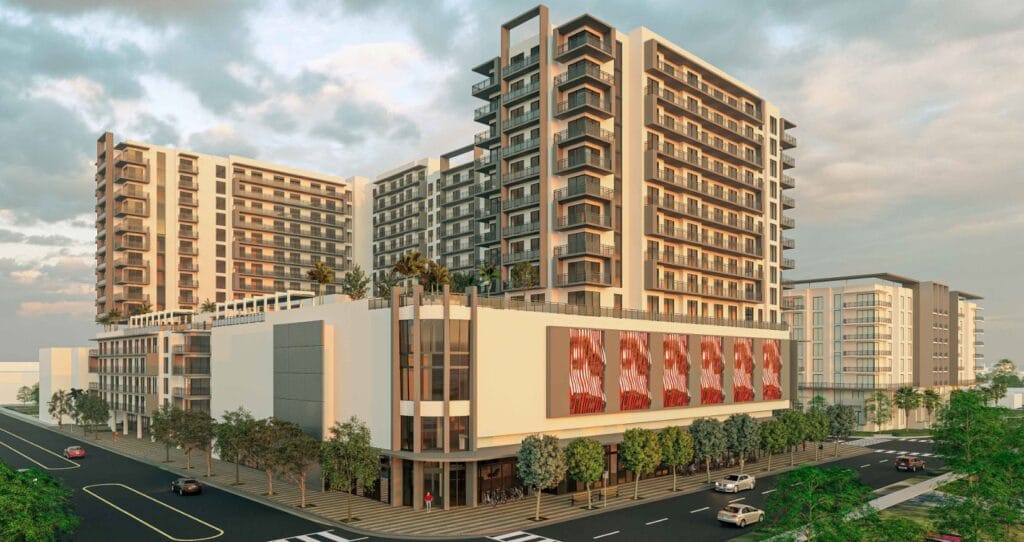
Tate NM 125, LLC is planning to build a 17-story highrise in the heart of North Miami’s Transit Station Overlay District. Designed by Behar Font Architects, the project aims to secure a Conditional Use Permit to increase the site’s density to 150 dwelling units per acre, with a maximum height of 200 FT and various commercial uses. The developer intends to use most of these benefits. For instance, the development will include 348 units, around 40,000 SF of commercial space, and rise 167 FT. While North Miami code requires the proposal to have 674 parking spaces, the developer lowered it by 5.64% by incorporating bicycle and hybrid parking spaces. Hence, with added reductions, there will be 636 parking spaces. Residents will also benefit from 172 bicycle spaces on the ground floor, promoting pedestrian activity. In term of design, the highrise will feature public art consisting of green walls and decorative metal grill panels on the podium. Abstract art may be included on the western portion of the property. Additionally, the development looks to be prioritizing expansive sidewalks, ranging from a minimum of 21 FT to a maximum of 40 FT. A significant aspect of the development is the inclusion of a large retail space suitable for a grocer or a large retailer. This is vital for the local community, as the USDA indicates the development is under a tract where more than 100 households don’t have access to a vehicle and is farther than 1/2 mile from a supermarket. However, the development has some potential concerns including its focus on providing only market-rate housing, especially considering the census tract’s significant population of low-income individuals. The development is located at 1175 NE 125 Street.
Tampa’s TECO Streetcar Has Been Free Since 2018: That May Soon End
Fare-free ridership on the TECO Streetcar Line is quietly coming to an end, ending close to 6 years of free service. The Florida Department of Transportation’s final grant to maintain fare-free service will last until January 5, 2025. The news comes as ridership reaches record highs. A report from July shows that ridership hit 112,999, contributing to around 1.43 million trips in 2024 so far. The Streetcar Line introduced fare-free riding in 2018 thanks to a $2.7 million grant from FDOT, funding the service until 2021. Afterward, an additional grant of $1.4 million was provided to continue the service from 2021 to 2023. Concerns about the end of fare-free ridership resurfaced in 2024. FDOT has committed to a $700,000 grant for this year, but no promises have been made for the future. The team behind Tampa’s TECO Streetcar is working to change that. A Public Hearing on potential fare adjustments is scheduled for November 7, 2024, from 5:30 PM to 7:00 PM, providing opportunities for public comments and survey feedback. The leaders are eager to hear from community members and potentially gather insight into reinstating fare-free ridership. Additionally, seven stations will host Q&A sessions for residents to voice their concerns directly. Fare-Free ridership has been vital for Tampa’s economy. Dense neighborhoods like Tampa’s Water Street District, Channelside, or Ybor, have relied on the streetcar both for tourists and local passenger travel. If fare-free ridership ends, community investment is feared to dwindle. If you’re concerned about fares ending and can’t attend in-person sessions, there’s also an available online survey: TECO Streetcar Survey.
Ombelle Moves Forward With New Renderings and Facts
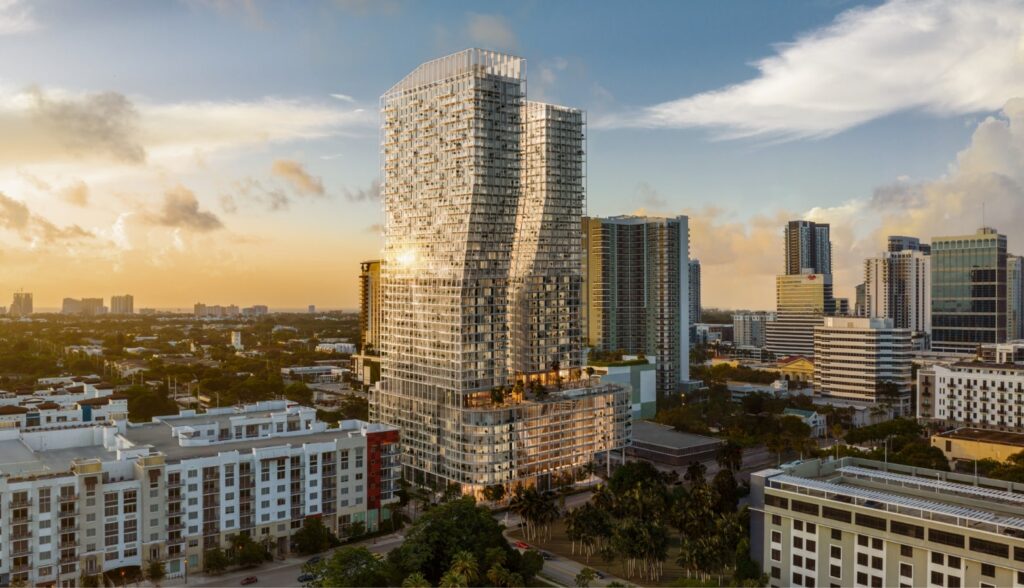
Ombelle, a two tower development in the heart of Fort Lauderdale, is moving forward with new renderings, a sales site, and more. The news was broken by Vince (@Vince_954) on X, and attached was an image of the new sales site at 5 NE 3rd Ave CU#103. Originally designed to be apartments, the development now features 775 condos in two 43-floor towers. Both towers will rise 525 FT. According to a DRC submission around 2 years ago, Ombelle will likewise include 11,217 square feet of commercial space and 1,100 parking spaces (although parking is likely reduced due to lower units). Units range from studios, 1 bedrooms, 2 bedrooms, 3 bedrooms, and penthouses. All residents will have access to 100,000 SF of amenities both inside and outside the tower. Ombelle is designed by ODA with sales & marketing by Douglas Elliman. The tower comes at a time where Fort Lauderdale is experiencing an increase of residents, and in turn, density in the downtown core. The development features wide sidewalks, liner units along the podium, close distance to the nearby Brightline station/bus stations, and active corner retail entry. These pedestrian-orientated features are meant to increase walk-ability in Fort Lauderdale. The tower is located at 300 NE Third Ave. The website is ownombelle.com
2501 Galiano Proposed in Coral Gables Reaching 177 Feet
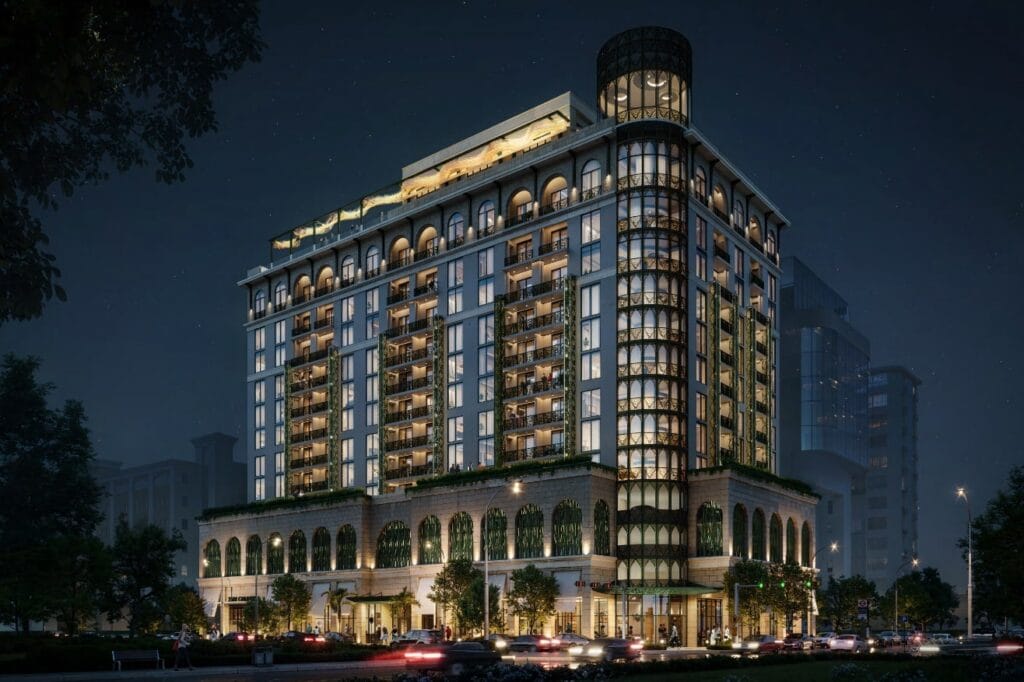
2501 Galiano Holdings has submitted plans for a residential tower in Coral Gables. The development, designed by Bermello Ajamil & Partners, will include 93 units (85 condos and 8 lodging units), 117 parking spaces, 33 bicycle spaces, and 7,863 square feet of retail. Bermello Ajamil and partners notoriously designed the tower with an ornamental crown, tall ceilings, and a generous base that makes the tower measure as tall as 177 feet (13 floors). For higher density and floor counts, the development is requesting a comprehensive plan map amendment, changing the property from Commercial Medium Rise Intensity to Commercial High Rise Intensity. Likewise, to grant the property cohesive zoning, a zoning map amendment will change the property designation from MX2 to MX3. Developers are also proposing two design variances. One is to reduce the parking structure setback from 20 feet to 0 feet while the other is to allow the setback height to start at 48 feet, not 45. Developers in Coral Gables commonly buy TDR’s, or development rights, to obtain higher FAR. In this case, the developer increased the site’s FAR by 25% to 4.375. Around 19,000 SF was purchased. The Site’s location is 2501 Galiano Street, Coral Gables.
516 Feet Tower Proposed in Miami’s Omni District at 1315 NE Miami Ct
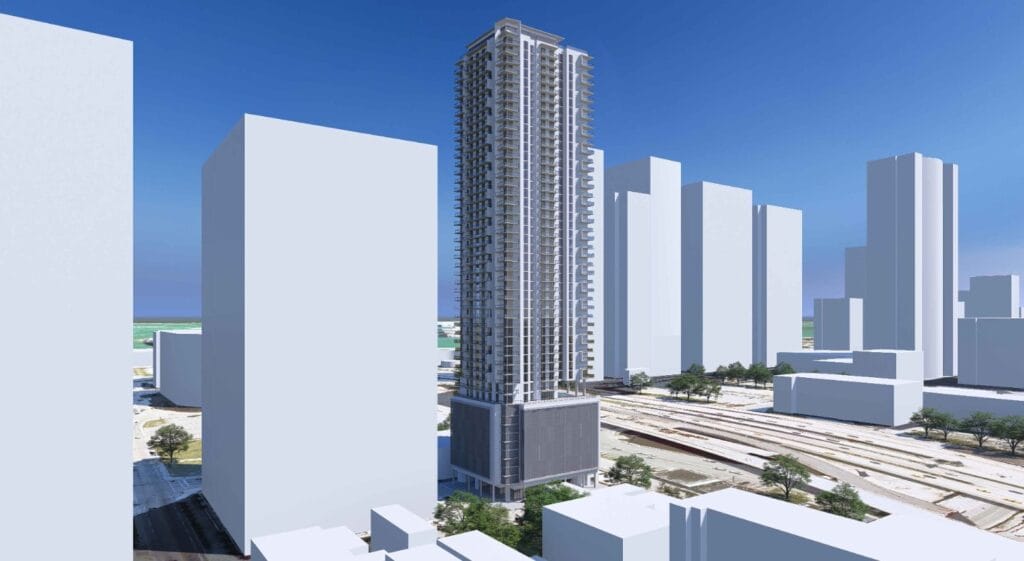
1315 Partners LLC has submitted a 50 floor tower in Miami’s growing Omni District. The tower, designed by Behar Font Partners, will be the tallest tower in the Omni District if built. The developer recently had the property added to the Metromover Subzone RTZ. Under section 33C-15 of the county code of ordinances, notable development parameters are required in the development like 12.5% of the units being workforce housing, elderly housing, certain density bonuses, and no parking requirements. In total, the project will include 378 units (of which 48 are workforce), 1,150 square feet of commercial space, 321 parking spaces, and 12 bicycle parking spaces. Units range from studios, 1 bedrooms, and 2 bedrooms. The development will rise 516 feet to the highest occupied floor, not including mechanical space making the tower measure around 530 feet. A generous pedestrian realm is included with a 10 foot sidewalk and a 15 foot colonnade, creating 25 feet of sidewalk space. The parking podium is screened from outside elements, although Miami-Dade code stresses the importance of residential units lining podiums. A large lobby is also added between NE 13th Terrace and NE Miami Court. The site’s location is 1315 NE Miami Ct.
Empire Brickell Moving Forward With Construction Permitting
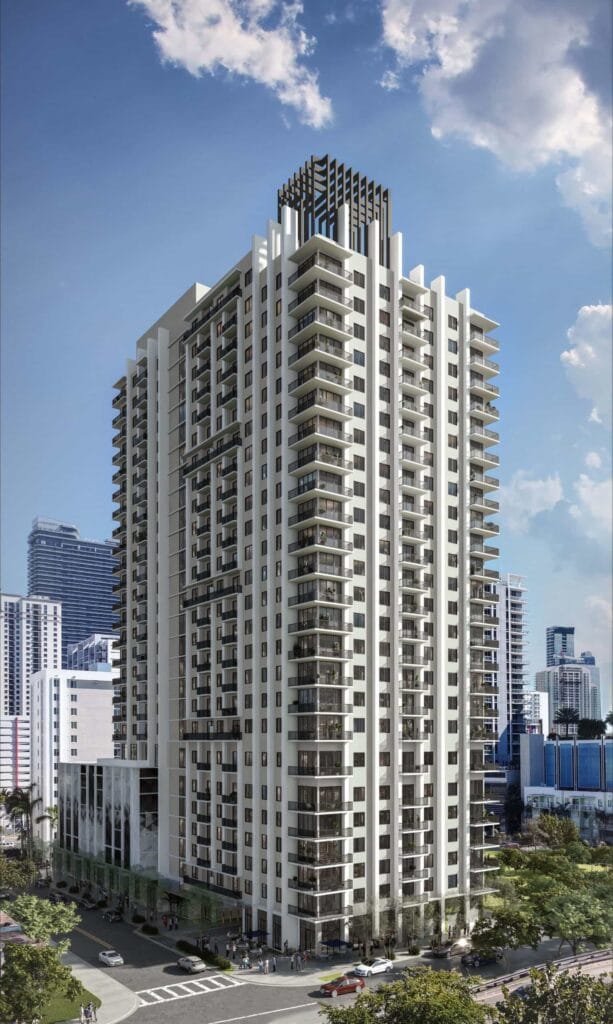
Empire Brickell, a 26-story tower by the Swiss-based Empira Group, is advancing rapidly towards construction. When finished, it will join the growing number of multifamily developments near key transit nodes such as the Metrorail. This transit-focused project will include 310 residential units, 2,450 square feet of commercial space, and 380 parking spots. Three significant construction permits have already been applied to Miami’s permitting software, indicating swift progress to meet the expected 2026 opening date. Of the three permits are a phased vertical construction permit, a site plan improvements permit, and a master building permit. The three permits aren’t final and still need time for approval. Thus, the site work permit is awaiting applicant corrections, the phased permits need applicant uploads, and the master building permit is still in-review. The building can move forward with construction in conjunction with JAXI Builders (the project’s General Contractor) once approved. Demolition has already finalized on the site weeks ago as per recent photos and google satellite imagery. Corwil architects is the main architect. The project is located at 901 Southwest 3rd Avenue.
1414 Brickell Ave Supertall Proposed Rising a Staggering 1010 FT.
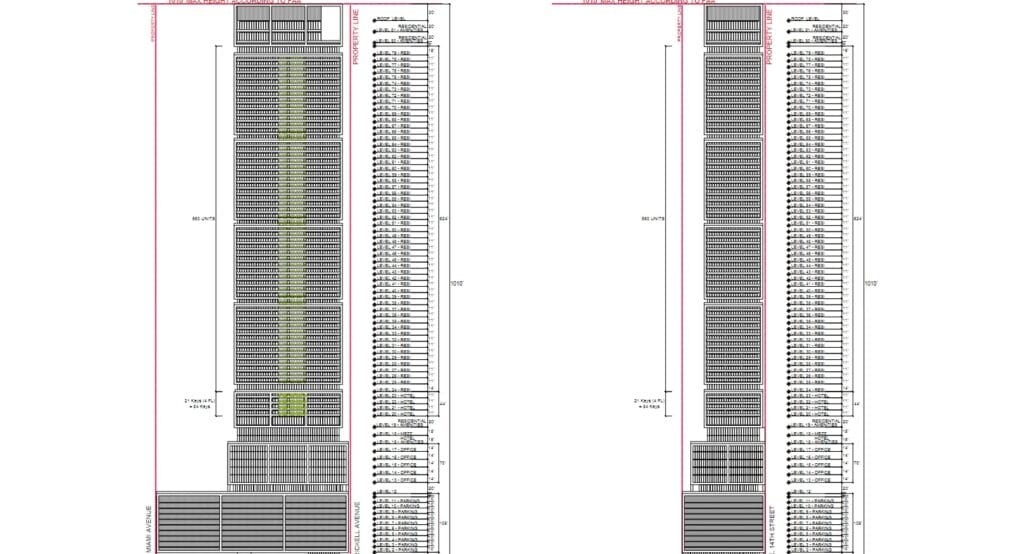
1414 Brickell, LLC has submitted a pre-application to Miami-Dade County for a proposed development located at 1414 Brickell Avenue and 1421 S. Miami Avenue. The proposed mixed-use development would be situated within the RTZ Metromover subzone of Miami-Dade, helping encourage the county’s vision for mixed-use, dense projects near transit. The project would consist of an 81-story tower with 560 residential units, 84 hotel rooms, 117,310 square feet of usable office space, 6,038 square feet of retail space, and 1,226 parking spaces. Update: Renderings revealed featuring a new design. While renderings and final designs have not been released, preliminary drawings show a decidedly tall tower at 1,010 feet. Along a portion of the tower is green space, and the podium is 10 floors of parking. Office space will sit closer to the ground floor, followed by a hotel, and then residential units. The Miami-Dade County Board of County Commissioners designated the 1414 Brickell Avenue and 1421 S. Miami Avenue as within the RTZ Metromover subzone on February 21, 2024. The Properties are subject to the planning and zoning jurisdiction of Miami-Dade County despite being located in the City of Miami. For that reason, the lot mainly follows county planning and zoning jurisdiction.
Updated Plans for The Valley at 22nd in Miami-Dade Expand Workforce Housing & Units
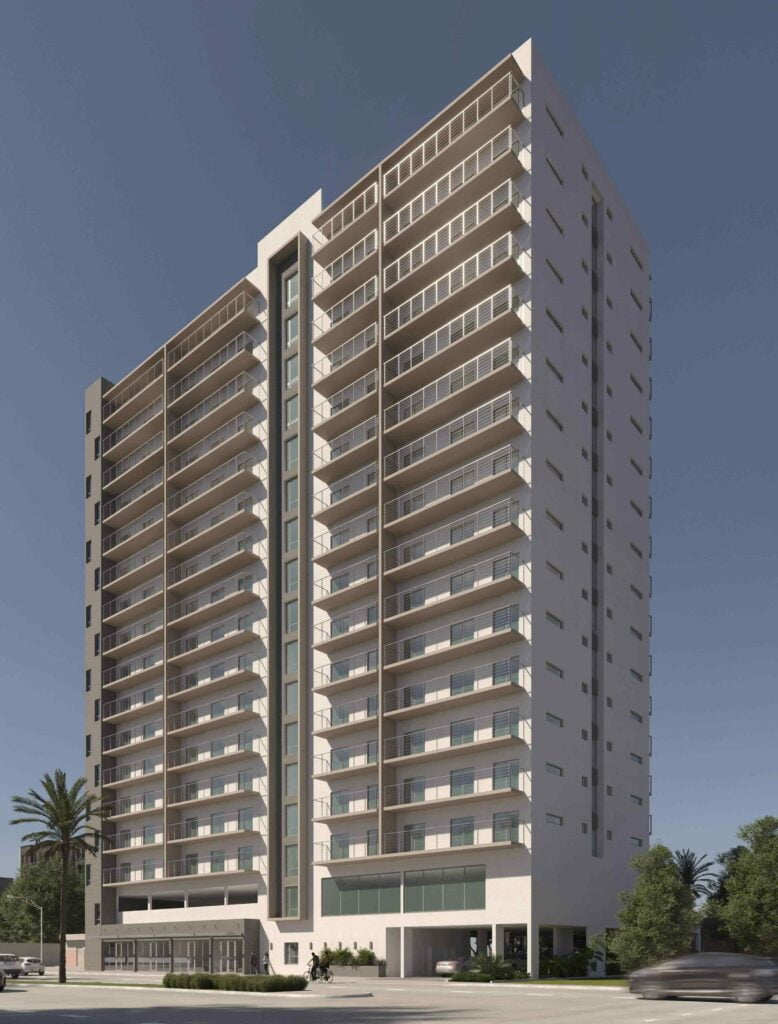
The Valley at 22nd by VMS Architecture and Ballybunion Investments is moving forward with new density/heights according to a recent Pre-Application filing. The proposal is located at 5712 NW 22nd Ave in unincorporated Miami-Dade (Brownsville). The project was originally submitted as an 8-story apartment complex with 67 units, 24 parking spots, and 1,850 SF of commercial space. The developers, however, are planning to increase those numbers. The new project will measure 17 floors and include 150 units, 1,052 SF of commercial space, and 47 parking spots. This will measure out, in total, to 126,787 SF of build-able space. Likewise, the highest occupied point will be 176 FT, making the tower the tallest in the area if built. The units will be a mix of workforce housing and market-rate units ranging from one to two bedroom apartments. One bedroom units are 550 SF and two bedroom units are 810 SF. Meanwhile, the low parking requirements are due to reductions allowable under Miami code. For instance, the required 190 parking spaces are reduced 25% if the project includes workforce housing, 20% if its within 1/4 mile of a bus stop, and 60% for parcels between 15,000 and 30,000 SF. This project meets all those requirements, meaning 0 parking spaces can be built if needed. As per Miami-Dade property records, the developer acquired the lot for $490,000 in 2021. The developer will most likely sell the property according to for-sale signs captured by google imagery in August, 2024. The lot currently houses an abandoned grass lot, creating limited environmental impacts in the case of demolition.
Broward County Transit Operations Facility Revealed in Pompano Beach

Broward County Transit has unveiled redevelopment plans for the COPANS Transit Facility at 3201 W. Copans Road, which currently services as a key operational facility for the county’s bus fleet. The project will involve five buildings, with three existing structures— the refueling building, the bus wash building, and the operations building—being renovated. Planned upgrades to the operations building include a new exterior facade, enhanced CCTV access, and other improvements for departments like IT. Building 1 is set to be demolished to make way for a new 200,000-square-foot maintenance facility. This facility will feature electric bus technology, charging stations, and office space. Its roof will house additional bus charging stations, and the building’s eastern side will include ramps for continuous bus circulation during charging. Solar panels will cover the rooftop, providing an efficient, sustainable, and cost-effective way to charge the buses. A new two-story, 16,900-square-foot training facility will soon be constructed to enhance bus driver training, featuring state-of-the-art driving simulators and in-person learning spaces. As part of this development, the facility’s entrance will see upgrades with proximity card readers, improved guardhouse security, and better access throughout the site. To ensure the property is prepared for future weather events, two on-site lakes and an enhanced drainage system will be added. Additional improvements include expanded bus maintenance parking, pedestrian-friendly pathways, utility upgrades, and fresh landscaping to improve the site’s overall appearance. Spanning approximately 27 acres (or 1.1 million square feet), the property will feature 261,360 square feet of gross industrial space. To accommodate staff and visitors, there will be 514 parking spaces along with 20 bicycle parking spots. In a project narrative, Arcadis, the prime consultant, emphasized that these upgrades reflect ongoing activity and pride in the property’s value to the community. The site is also expected to act as a catalyst for future transit expansions, paving the way for growth in the years to come.
“House of Wellness Hotel” Proposed in Brickell Using Rapid Transit Zoning
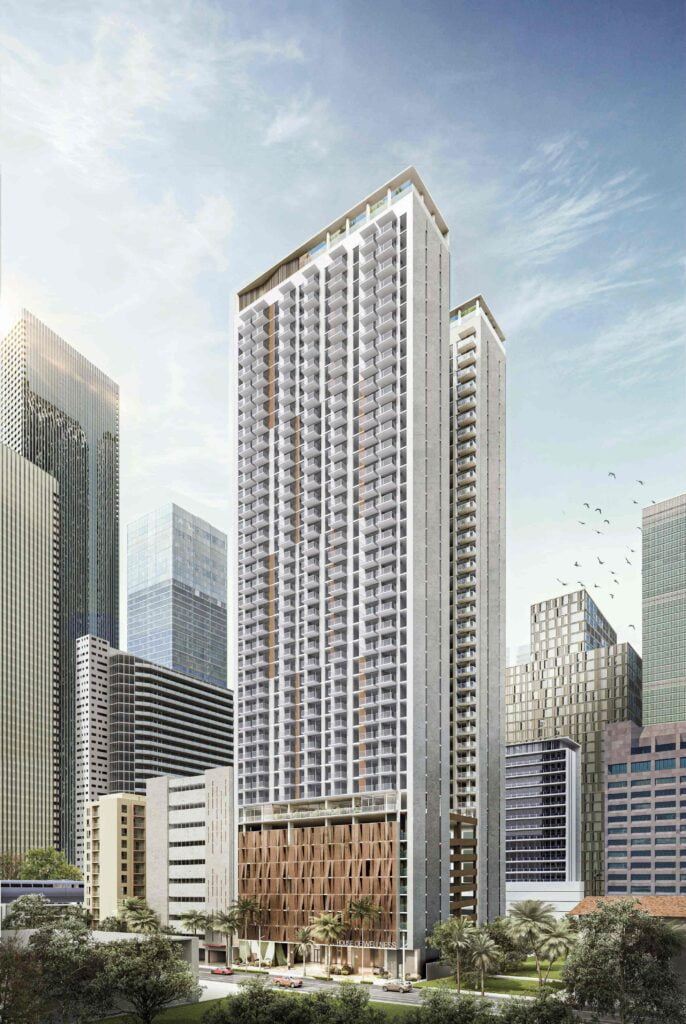
North at Brickell VI, LLC has submitted a Pre-Application for a new tower in Brickell named “House of Wellness Hotel”. The developer is hoping to gain a Special Exception for the development plan by designating the property as part of the “Metromover Subzone of the Rapid Transit Zone”. Through this path, the developer can achieve higher density/height for the project. It should be prefaced that the site plan, floor plans, building elevations, and overall design of the building is for reference only. The final plans will be submitted later after the developer gains the Special Exception approval. However, the height, density, and zoning parameters used in this application follow what’s allowed under the RTZ Metromover subzone. Additionally, the developer has proposed offering a monetary contribution towards improvements in the Metrorail station area, perhaps to facilitate the approval process. “House of Wellness Hotel” will include 832 hotel rooms, a 3,260 SF lobby, 347 parking spaces (although none are required under the RTZ subzone), and 12 bicycle spots. As per the site plan data, the tower will measure 43 floors or 437 FT. If the developer decides to change the height, RTZ zoning permits unlimited heights with heights only subject to FAA approval. Studio Mc+G Architecture is the main architect. The development will span 3 parcels at 132, 142, and 152 SW 9th Street.
Link at SOMI Proposed on South Miami’s City Hall Property
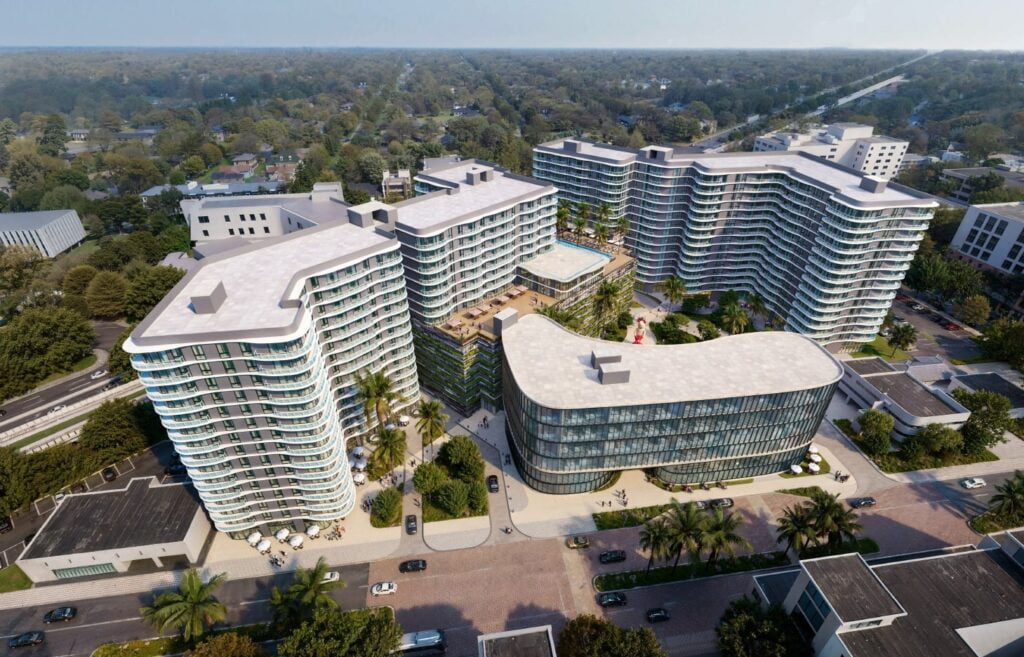
13th Floor Investment has announced plans for a comprehensive redevelopment of the South Miami City Hall site named Link at SOMI. The process began when the City of South Miami issued a request for proposals on June 3, 2024, selecting five qualified developers to submit plans for the project. These developers included the Related Group, 13th Floor Investments, Integra, Adler Group, and Sonnenblick Development. By the conclusion of the bidding process, 13th Floor Investment emerged as the sole qualified bidder, with the other developers opting to withdraw from the process. An Evaluation Committee convened on August 6, 2024, to assess 13th Floor Investments’ redevelopment proposal. The committee consisted of six members, each with the ability to score up to 600 points, resulting in a total possible score of 3,600. The current proposal received 2,308 points, reflecting several concerns raised by the committee. One significant issue was the estimated $30 million cost for the new civic building, which does not include infrastructure or furnishings. Likewise, it was considered overly generous. In response, 13th Floor Investments assured the committee that the company would absorb any cost overruns and debt can be paid off with the land lease. Below is an economic summary for context. A formal selection and award to the proposal by the City Commission will take place on September 17th, 2024. Members of the public have the opportunity to participate via a phone line or zoom. Link at SOMI will proceed in two distinct phases. The initial phase will feature a 6-story, 70,000-square-foot civic building to accommodate city operations, alongside a 15-story multifamily residential tower containing 335 units and a 7-story parking garage with 360 spaces. The second phase will complete the full build-out of the site, introducing an additional 15-story residential tower with 335 units and a second 7-story parking garage offering 550 spaces. Both parking structures will be topped with 8 floors of residential units, making the majority of the buildings proposed 15 stories. Both phases combined will add 670 units, 910 parking spots, and 27,846 SF of commercial space. As part of the agreement with the City of South Miami, the development will also include several civic improvements to the existing site. These enhancements will feature a dog park, a playground, active retail spaces, a civic plaza, and a 27,500-square-foot park named Jean Willis Park. Central to the project is a 70,000-square-foot civic building, which will be divided into three sections: 30,000 square feet allocated to City Hall, 25,000 square feet for a new police station, and 15,000 square feet dedicated to a public library for Miami-Dade County. 10% of the units are dedicated to workforce housing. This includes 7 studios, 24 one-bedroom units, 34 two-bedroom units, and 10 three-bedroom units. Rents will be priced at 120% of the Area Median Income and housing will be prioritized for essential workers. 13th Floor Investments is proud to propose a program that waives all upfront fees like amenity fees, association fees, and application fees for city workers residing on the property. Corwil Architects is the main architect. RJ Heisenbottle is the historic preservation architect. The project is located at 6130 Sunset Drive.
2157 Flagler Residences Unveiled in Little Havana, Miami
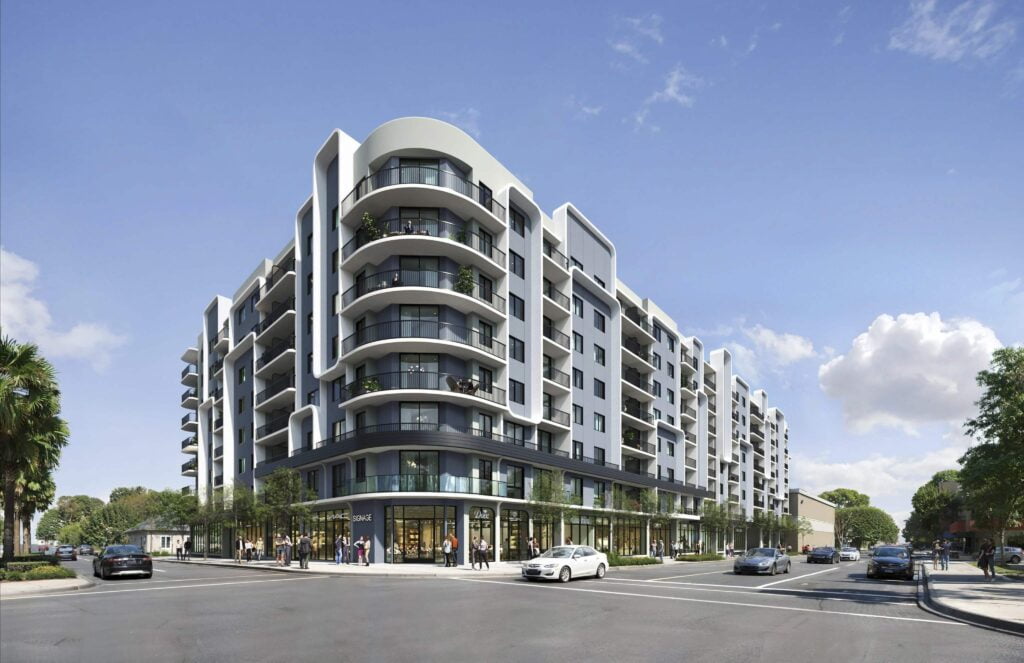
WR Flagler, LLC has submitted new plans under Miami’s Urban Development Review Board for an 8 story residential building. The building coined “2157 Flagler Residences” will be between 2157-2199 W Flagler St Miami. As per site plan data, the building has a proposed 197 units, 14,412 SF of commercial space, and 315 parking spots. To reduce the required parking spaces under code, the developers are requesting 3 waivers regarding parking deductions. Waiver one allows for a 10% reduction in parking for residents, waiver two allows for a 10% reduction in guest parking, and waiver three allows for a 10% reduction for commercial parking. In a letter, developers outlined that lowered parking is acceptable due to sufficient nearby transit. In addition, the development will include 26 bicycle racks. According to elevations, the building will rise 95 FT or 85 FT to the highest occupied floor. Materials chosen by the architects include aluminum picket railings, aluminum frames for doors/windows, a perforated metal screen to properly hide the parking garage, and more. Corwil Architects is the main architect.
Sunset Place Redevelopment Released Featuring Immense Retail, Housing, and Entertainment
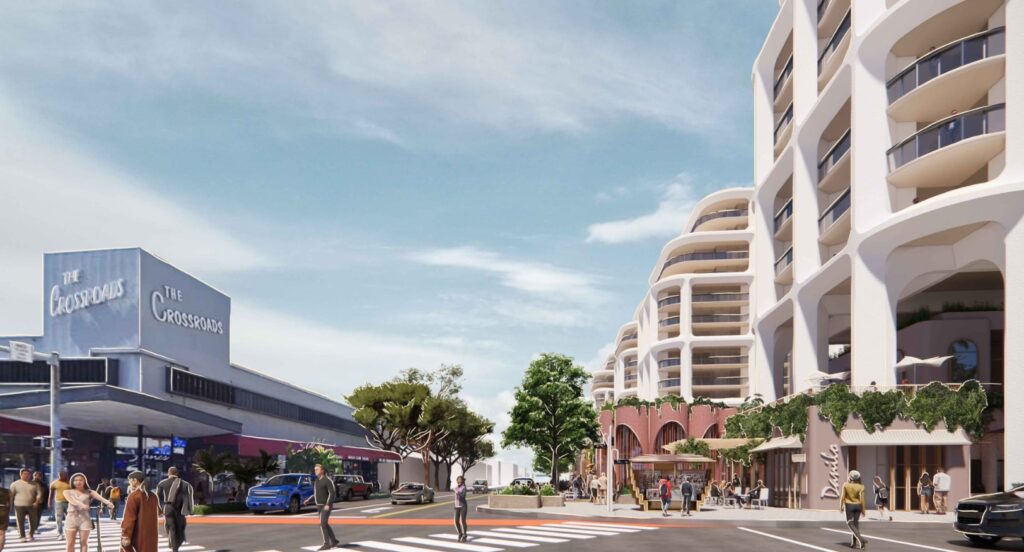
Midtown Development, the proprietor of Sunset Place in South Miami, is gearing up for an ambitious redevelopment of the site. Once a thriving mall after its opening in 1998, Sunset Place has faced a prolonged downturn in the 21st century, with numerous redevelopment efforts faltering over the years. Now, the developers are presenting a new vision to the South Miami Planning Board, aiming to breathe new life into the property with immense retail and residential space. The new master-plan will consist of 7 high-rises, ranging from 15 to 33 floors. To contribute to a mixed-use, transit-orientated vision, developers are planning 1,513 units, 287 hotel rooms, a movie theater/performing arts theater that holds a maximum of 1,300 seats, 149,506 SF of retail, and 50,892 SF of office space. Units range from studios, one-bedrooms, two-bedrooms, and three or more bedroom configurations. The developer is also planning 2,418 parking spaces to accommodate for residents and visitors. 213 bike spaces are required under South Miami code, and will be included in the parking garage. The development is entitled to two bonuses (Tier 1 & 2) for increased height, density, and more. Without the bonus, the high-rises would measure between 4-17 floors at the highest. The development is divided into four zones to minimize disruption to existing single-family homes. The Sunset Zone, located along Sunset Drive, is the farthest from US Highway 1. Following it are the Village Zone, Central Zone, and lastly, the Gateway Zone, which is closest to US Highway 1 (also known as South Dixie Highway). The Gateway Zone will feature the tallest buildings, with towers reaching 33 floors, while the Sunset Zone and Village Zone will have buildings up to 15 floors. For a visual overview, please refer to the illustration below. According to elevations, two buildings in the Sunset Zone and Village zone will both rise 15 floors. One is 181 FT and the other is 212 FT (Height difference due to mezzanine level). In the central zone, two buildings will measure a respective 21 floors and 25 floors. The 25 Floor tower is 346 FT and the 21 floor tower is 284 FT. In the Gateway Zone, three buildings are planned to reach a maximum of 33 floors. One building will stand at 357 feet, while the other two will each reach 426 feet. The difference in height, despite all having 33 floors, is due to a mezzanine level at the top of the two taller buildings. If constructed, the 426-foot height will become the tallest point south of the Douglas Road Metrorail Station in Miami. Heatherwick Studio recently unveiled a video showcasing the architecture and design of Sunset Place. The studio emphasized their aim to preserve the character of Sunset Drive while enhancing it by introducing lively storefronts and creating several pedestrian-only streets. The video can be seen here. ODP is the architect of record. The development is located at 5701 Sunset Dive, South Miami, FL 33143.
New Renderings Revealed For Banco Santander’s Flagship Office
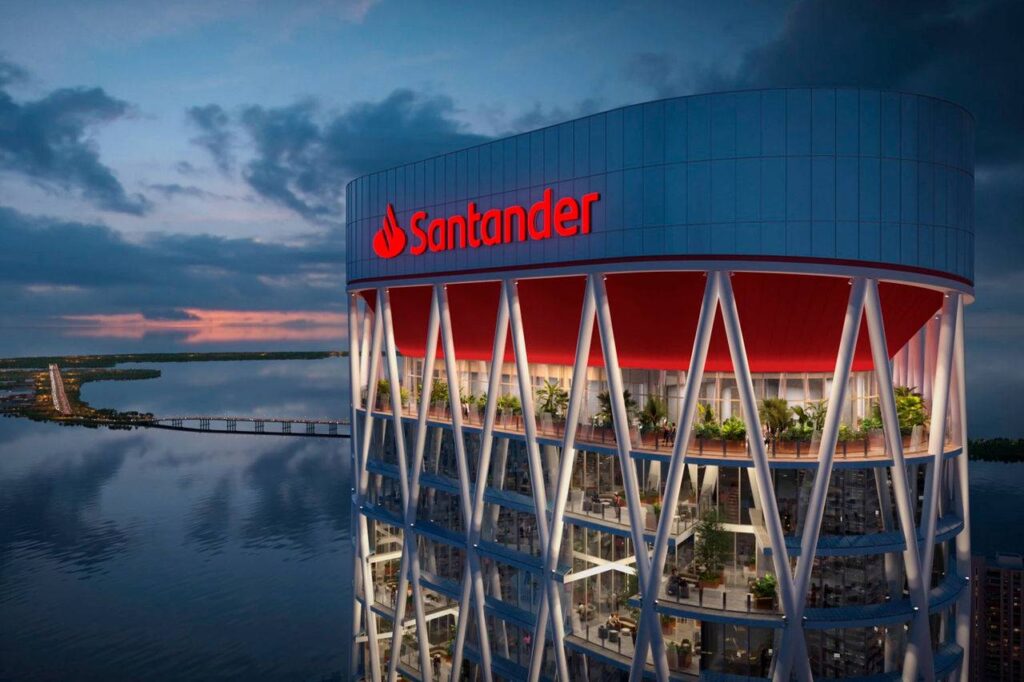
Banco Santander has unveiled updated renderings for their planned 40-story office tower at 1401 Brickell Avenue, which will be named Santander Tower. It will replace the current 14-story structure on the site. Earlier renderings didn’t include the tower’s logo or depict it within the Miami skyline. The new renderings, however, showcase significant ground-floor activation, immense greenery, a spacious lobby, and a view of the building at dusk and day. A video was also released showcasing a dynamic fly-around view of the office spaces, amenities, and what appears to be solar panels integrated into the building’s façade. The video highlights the sleek design and sustainable features of the tower. According to the Bank, construction will have the highest international standards for sustainable construction as well. According to plans released in February, the building will include 612,918 SF of office space, 107,953 SF of commercial space, and 1,496 parking spaces. It will rise 765 FT, around the same height as the adjacent building named, “Four Seasons Hotel Miami”. According to the bank, total demolition of the existing structure will occur in the next few weeks. BG Demolition, a company based in South Florida, will handle the demolition. As construction and demolition progresses, Banco Santander will move their employees to temporary office space in Brickell and Coconut Grove. Handel Architects and Bernadi & Peschard Arquitectura are the architects.
1st Affordable Building Revealed for Rome Yards in Tampa
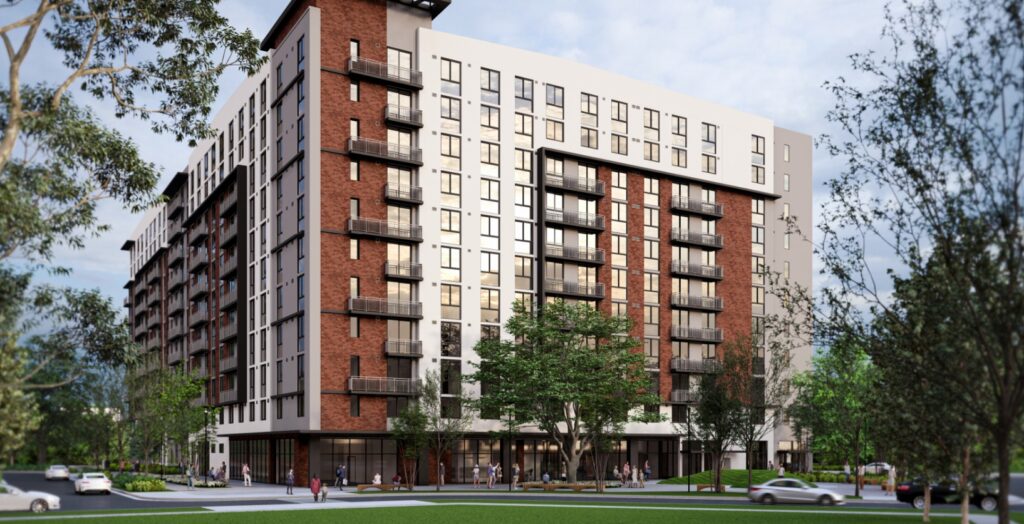
On September 6th, Related Group and The Tampa Housing Authority revealed plans for their first building at Rome Yards called Gallery at Rome Yards. The building is part of phase 3A. According to a recently filed PD-A Incremental Review Application, phase 3A will include a residential building measuring 11 floors tall and a 4 story parking garage. The 11 floor building will measure 150 FT. As per the site plan table, the multi-family building will include 234 units. The 234 units include 60 one-bedroom units, 152 two-bedroom units, and 22 three-bedroom units for families. Eighty percent of the units are for low-income individuals/families at or below 80% of the Area Median Income. The leftover 20 percent is reserved for workforce housing. According to The Tampa Bay Chamber, workforce housing is for individuals making between 80% and 120% of the Hillsborough Country Area Median Income. This includes individuals who are typically teachers, fire fighters, retail workers, construction workers, and more. To handle the excess demand from move-ins, a parking garage with 447 spaces will be built adjacent to the tower. 266 parking spaces are reserved for the first tower, while the others are for future buildings. On the bottom of the parking garage is a workforce training center and 5 live-work units. Rome Yards broke ground on May 21, 2024. Rome Yards will span 18-acres along the Hillsborough River and include 954 units designated to affordable and workforce needs. The current site has no existing buildings beyond surface parking and construction equipment for nearby projects. Zyscovich is the main architect. The first building is located at 2609 N Rome Ave.
2215 NW 1st Place Submitted to Wynwood Design Review Committee
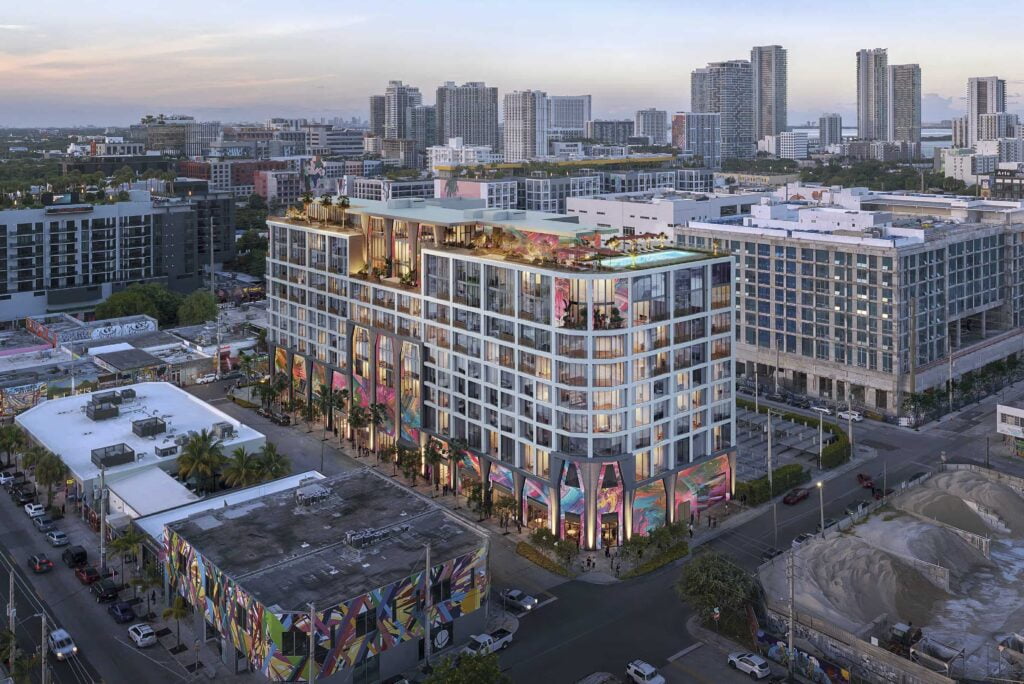
Whale & Star Wynwood Owner, LLC has submitted new plans for a project located at 2215 NW 1st Place and 170 NW 23 Street. Plans include an 8-story mixed use building with 214 hotel rooms (between floors 2 and 5), 87 multifamily units (between floors 6 and 8), 87 parking spaces, and 313 bicycle spaces. To activate the ground floor for pedestrian traffic, the lobby will be accompanied by 8,935 SF of retail/restaurant space. Seeing that there’s been a flurry of development in Wynwood, it will be one of the shorter buildings in the neighborhood measuring 132 FT. Like many Miami projects nowadays, the project is requesting a slight increase in density in exchange for providing public benefits. For instance, under existing code, the building can only rise to 5 floors. Since the project is using Wynwood’s NRD-1 Public Benefits Program, planners are allotted a 50% density bonus and a max benefit height of 106 FT for habitable floors. Likewise, to meet the standards for Wynwood’s neighborhood characteristics, the project is including elevated art treatment by Goldman Global Arts. Six waivers were requested. These waivers ranged from increases in maximum allowed lot coverage, a reduction of parking by 30%, an allowance of parking within the mezzanine level, and more. It should be prefaced that the requested waivers don’t allow for taller heights nor increased density, but to enhance the overall design and function of the building. ODP is the architect of record while HWKN Architecture is the design consultant.
Renders and Designs Revealed for Citadel’s New Global Headquarters
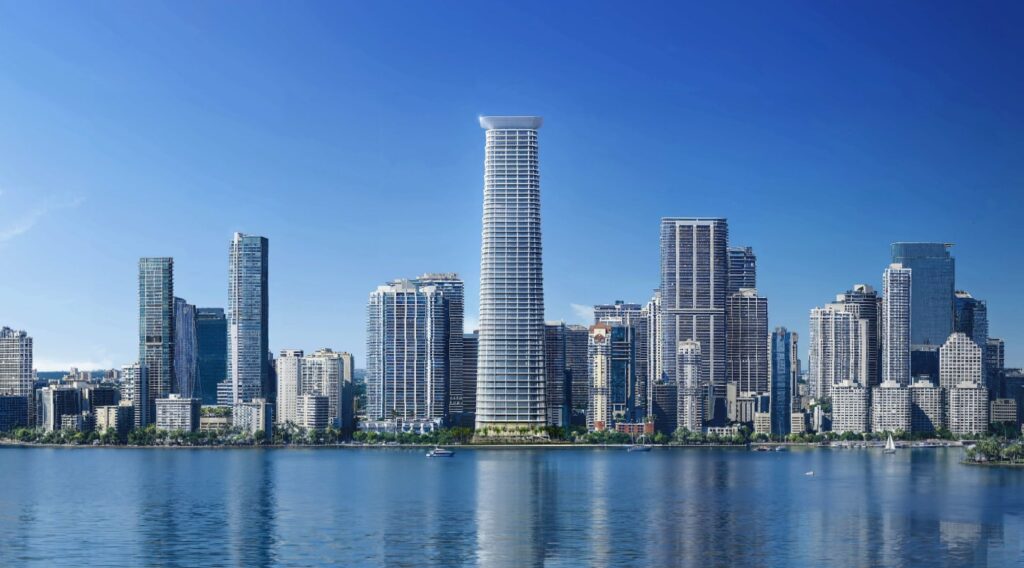
Plans have been unveiled for Citadel’s new global headquarters at 1201 Brickell Bay Drive. The project will cover about 4.17 acres, including the sites at 1201 Brickell Bay Drive, 1250-1260 Brickell Bay Drive, and the 1221 Brickell Avenue parcel, which currently houses an office building. The developer intends to pursue this project under Miami’s RTZ Metromover Subzone, which allows for higher-density and transit-oriented development. According to the application, the tower is classified as a supertall structure (exceeding 300 meters) and will reach a height of 1,028 feet, comprising 54 floors. If built, it will become the second tallest tower in Miami, just behind the Waldorf Astoria Miami which stands at 1,041 feet. In addition to its height, the developers intend to construct 1,293,373 square feet of office space, 413,476 square feet dedicated to a hotel with 212 rooms, and approximately 23,590 square feet for restaurant and retail use. Below are elevation counts. Although official plans show the tower at 1,032 FT, the ground level doesn’t begin until it’s 6 FT off the ground, making the tower 1,028 FT in actuality. To accomodate for on-site visitors, the tower will include 50 below-grade parking spots with additional parking being used at 1221 Brickell Avenue and 1250-1260 Brickell Bay Drive. The development will proceed in planned phases, beginning with the renovation of the main office tower and a new parking structure at 1221 Brickell Avenue to accommodate the new headquarters. There’s approximately 1420 parking spaces between 4 basement levels and 8 parking tiers. Below are new facade treatments for the parking deck at 1221 Brickell Avenue. The buildings at 1250 and 1260 Brickell Bay Drive will be demolished to create space for outdoor public seating. Likewise, the tower is connected with its environment, having a large, accesible baywalk with trees and a 55.92′ setback. Fronting the baywalk is dining space and an outdoor terrace. The design architect is Foster + Partners while the architect of record is AAI Architects, P.C.
Lofty Brickell Debuts a New Webcam for Construction Progress
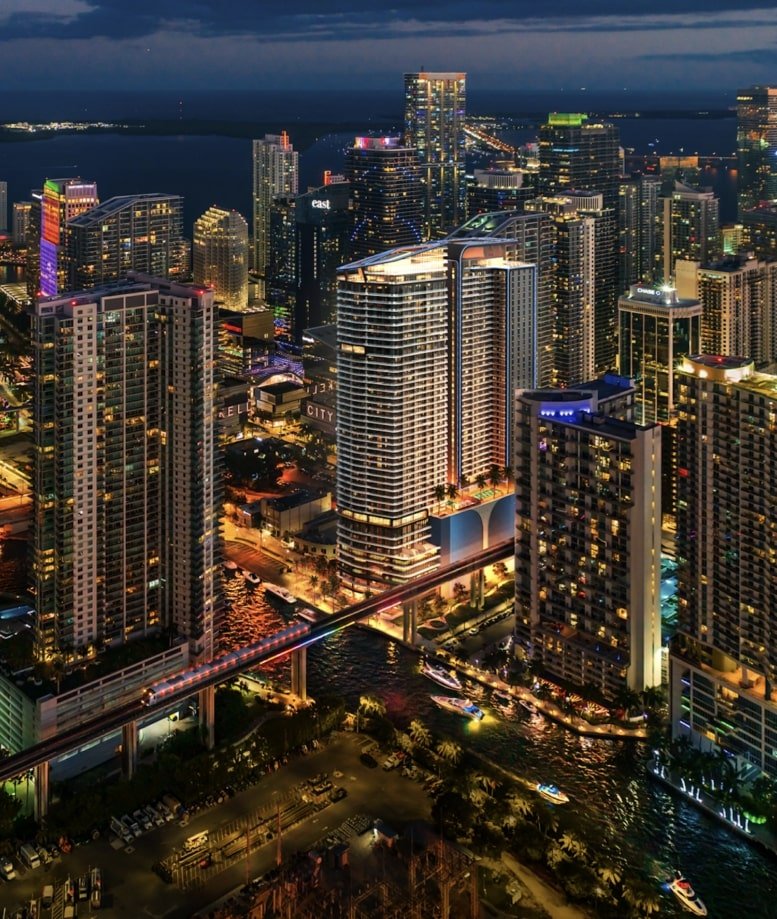
Newgard Development’s flagship project coined “Lofty Brickell” now has a live webcam for construction progress. Lofty Brickell is part of a two tower complex currently under construction named “One Brickell Riverfront”. Both towers will possess 784 units, 919 parking spaces, retail, and 13,170 SF of office space. The live webcam is accessible here: Webcam According to the live view, both towers have their foundation and pilings ready to go for a concrete pour. There are two tower cranes on site with the southernmost crane fully erected. G.T. Mcdonald Enterprises is the general contractor. They’ll oversee the construction of both towers, the enhanced riverwalk, and other improvements to pedestrian experiences. Newgard has approval for both construction and foundation work. According to construction permits, both towers will rise at once instead of having a phased plan. Lofty Brickell will be a multi-family condo with 362 units and the southernmost tower will be a rental project with 422 units. Arquitectonica is the architect. The location is 99 SW 7th St, Miami.
Melo Group Breaks Ground on “Downtown 6th” in Downtown Miami
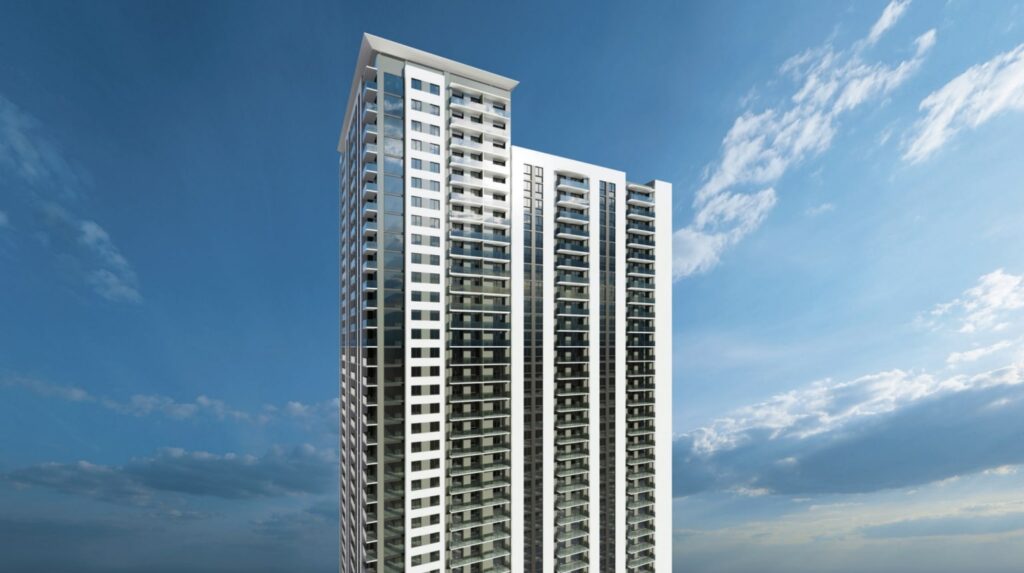
Melo group has broken ground on their 54 story, 581 feet tower in Downtown Miami named Downtown 6th. According to South Florida Business Journal who originally reported the groundbreaking, Melo Group hopes for completion to be in about two years. The project will contain 824 units, 639 parking spaces, and 2,427 SF of retail space. Uniquely, the parking podium is wrapped in habitable units and colored protective glass, giving it enhanced pedestrian views. The development is also in proximity to a plethora of development including Okan Tower, 501 First, 600 Miami Worldcenter, Natiivo Miami, and the Crosby. According to building permits, Melo Group filed for both structural permits and site plan permits under Melo Contractors Corp. Both permits are under review but on track for being approved shortly. The site is already demolished and ready for construction. Melo Architecture and G3aec are the architects. The location is 46 Northeast Sixth St, close to multiple transit modes including Miami’s Metromover, Metrorail, and Brightline station.
455 Foot Crane Submitted For the “Harrison” in Tampa’s Encore District
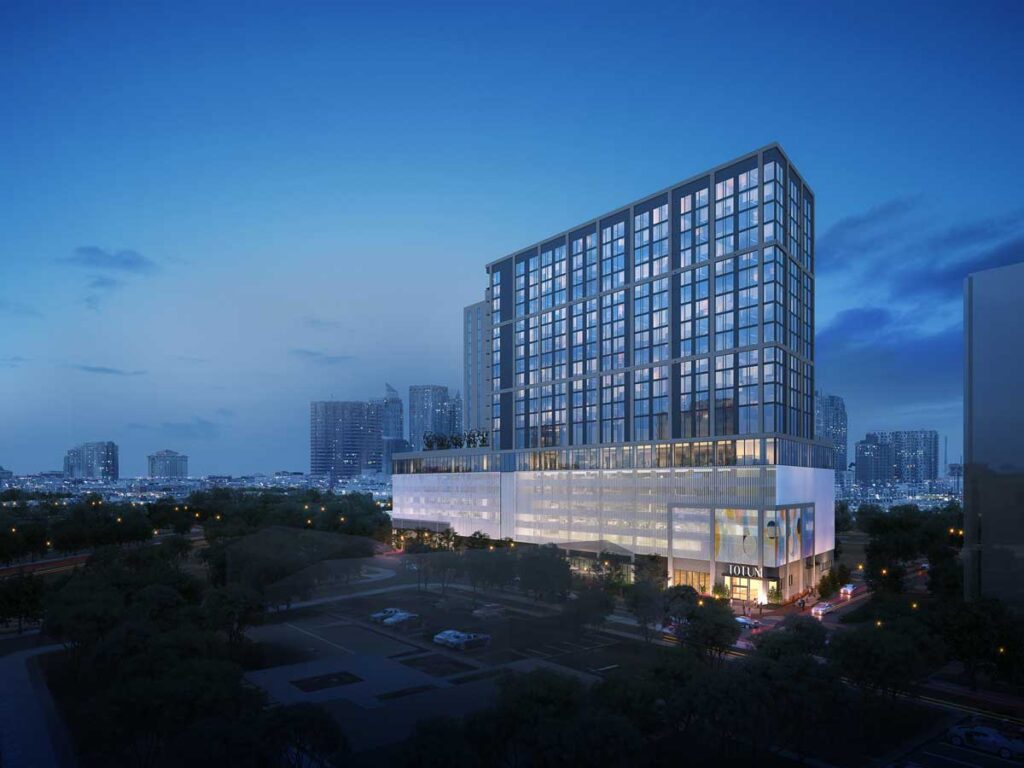
Aureate Development’s “Harrison” tower in Encore is moving forward. The tower, currently under construction, had 2 crane submissions filed to the FAA in May and July. According to previous submissions, tower crane one will rise 360 feet while tower crane two will rise 290 feet. However, new plans released show the 2nd crane refiled at a staggering 455 FT. According to the work scheduled on the crane, construction will progress from September 1st, 2024 to January 30th, 2026. The tower will be the tallest in Tampa’s Encore District if built. At 237 FT or 20 Floors, the building will house a generous 294 units. Likewise, there will be 23,824 SF of retail (for potentially a grocer), 43,884 SF of office, and 467 parking spaces (although 430 are required under code). Aureate development is planning another tower next door called Muse at Tampa. Construction hasn’t begun for that tower. Baker Barrios is the main architect. The location is 1280 E. Harrison St.
16 Floor Tower Proposed Near Miami’s Culmer Station
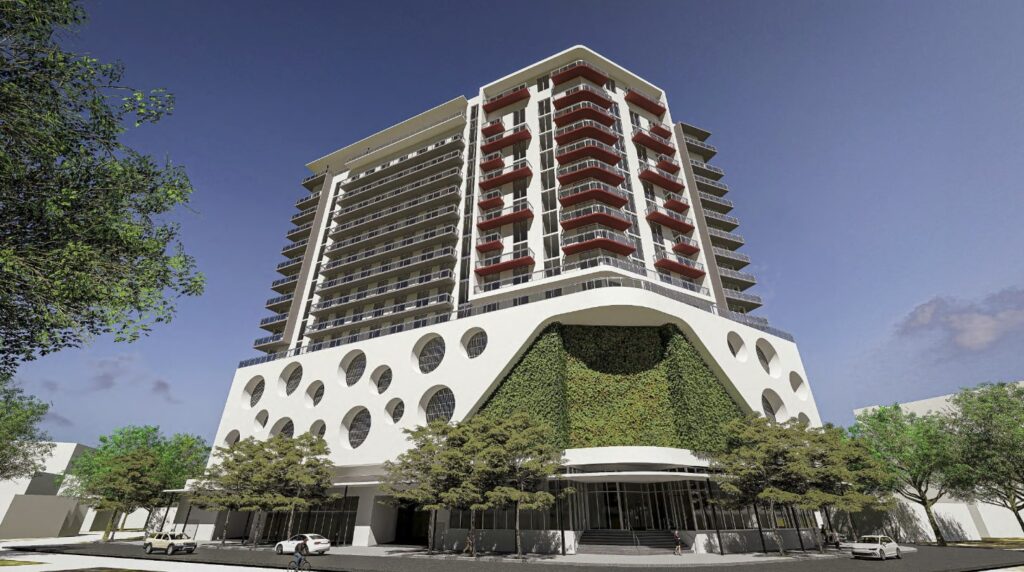
UBC Miami, LLC has submitted new plans for a multifamily development near the Culmer Metrorail Station in Miami. The developer intends to capitalize on the zoning benefits available under the Rapid Transit Zone (RTZ) Smart Corridor Subzone, which offers increased density allowances and reduced parking requirements for developments that support transit-oriented growth. Given that the project is LEED certified, the developers are granted additional flexibility regarding height and density parameters. As a result, the proposed development will feature 119 residential units, 123 parking spaces, and 12 bicycle parking spaces. Of the 119 units, 65 are 1 bedroom (or 1 bedroom + den) and 54 are 2 bedroom. Interestingly, despite the project’s proximity to transit, the ground floor will not include any retail spaces. According to plans, the building will rise 195 FT or 16 floors. Of these, the first five floors will form a pedestal, with four of those floors dedicated to parking. The tower’s podium will feature a “live green wall” designed by Behar Font. Additionally, circular, perforated metal-covered cutouts will be incorporated into the podium, giving it an artistic flare. The location is 1136 N.W. 8TH AVE. Behar Font is the main architect.
Biscayne Shores Revealed in Miami at 11400 Biscayne Blvd
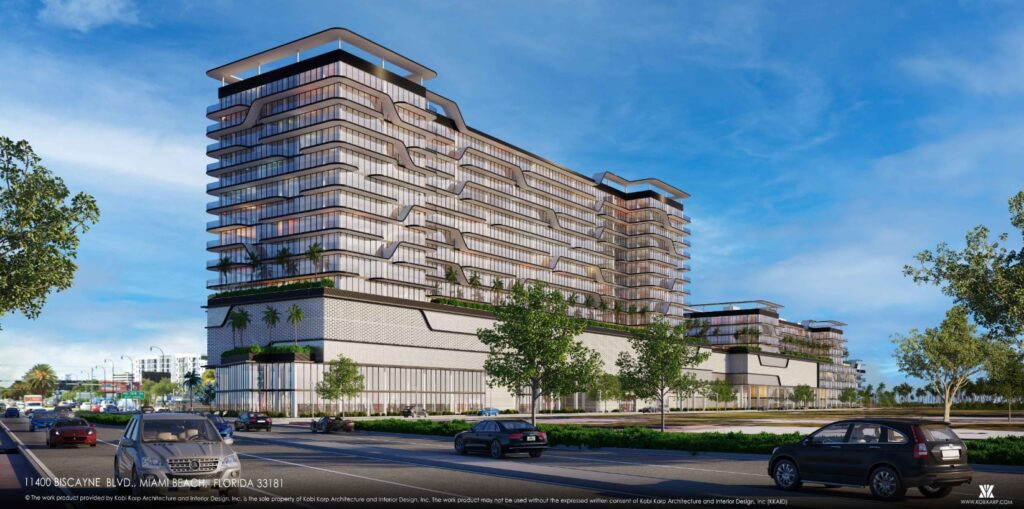
Biscayne Shores Development Group LLC, an affiliate of Ben Josef Group Holdings based in NYC, has revealed new plans for a 15 floor tower in Miami. The development will have 561 units, 20,000 SF of commercial space, 723 parking spots, and 16 bicycle rack spaces. 12.5% of the units and an additional 14 of them will be set aside for workforce housing. Its also worth noting that these plans are still conceptual and can change. The developers are amending Miami-Dade’s Comprehensive Development Masterplan’s High Density Residential text to allow 150 units per acre and a FAR of 3.0. These changes in text will only apply to select properties, like this one. Likewise, the Future Land Use Map will be changed to High Density Residential for the entire property. The tower will reach a peak of 179 FT fronting Biscayne Blvd and a peak of 107 FT fronting NE 14th Ave. The architect is Kobi Karp.
Modera Aventura Phase Two Revealed in Ojus
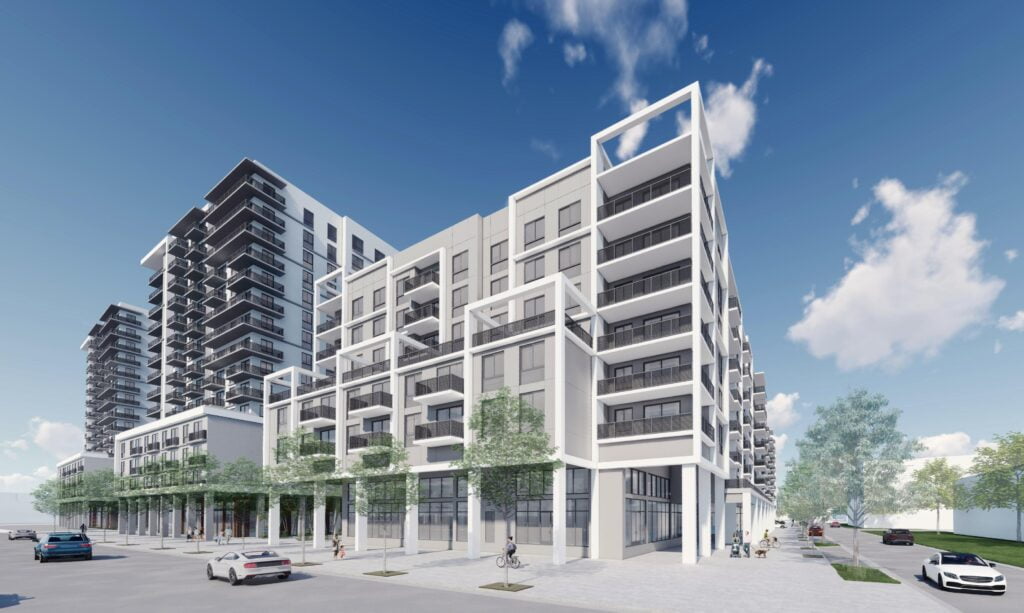
Millcreek Residential, based in Boca Raton, has submitted their updated plans for Modera Aventura’s phase two. The project is coming back to Miami-Dade staff due to modifications in approved density and height. Modifications include lowering the height of the second phase from 15 floors to 8 floors, lowering density from 420 units to 251 units, and lowering parking from 557 spaces to 358 spaces. Likewise, the developers are providing 6,906 SF of commercial space on the ground floor. The mid-rise will rise to 94 feet and features a lower profile, distinguishing it from its taller counterpart in phase one. Phase one, which is currently under construction, has reached its full height of 15 stories by topping out weeks ago. The project complies with OUAD (Ojus Urban Area District) regulations and aligns with the district’s objectives by featuring a mixed-use design, enhancing pedestrian sidewalks, incorporating greenery, and being near transit options like the new Brightline Aventura station. However, Millcreek is not the first developer in the area. The OUAD was established in 2006 to allow higher density development in exchange for better walkability and other improvements. Since then, developers like Millcreek Residential have been drawn to the area, resulting in a surge of multifamily development. The address is 2681 NE 191st Street. Corwil Architects is the main architect.
New Renderings & Design Released for Miami Riverside Center
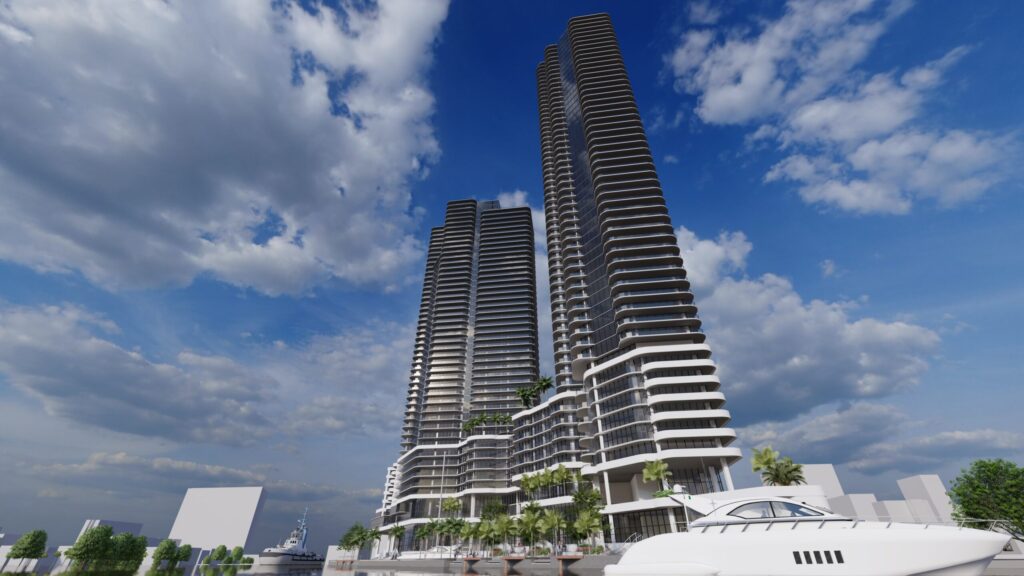
Adler Development has revealed a twin tower project on the current site of Miami’s Riverside Center city administration complex at 444 SW 2nd Ave. The project, designed by Nichols Architects, will feature two slender, glass, residential towers both rising around 50 floors. According to Adler Development, there will be public access to a new multi-level restaurant complex, a public river walk with improved landscaping, and more along the Miami River. The tower’s river facing facade has aesthetics and functionality in mind by adding podium units to mask a multi-level parking garage. Morgan Sirlin, the Vice President of Adler development, stated that the company doesn’t anticipate any groundbreaking “until 2027 at the earliest”. Density for the project is unknown as the project is still in the design stage. The property is currently owned by Miami-Dade, but Adler development has a contract with Miami officials to build a new headquarters near the site of Inter Miami CF’s new stadium in exchange for land and development rights. Plans were proposed years ago, but were scrapped. Below were previous renderings with a master vision of 4 towers. The northern portion of the property is already under development, including two high-rises coined Modera Riverside and Nexus Riverside 1B.
“Uptown Harbor” by Dezer Development Subject to Site Plan Approval in North Miami Beach
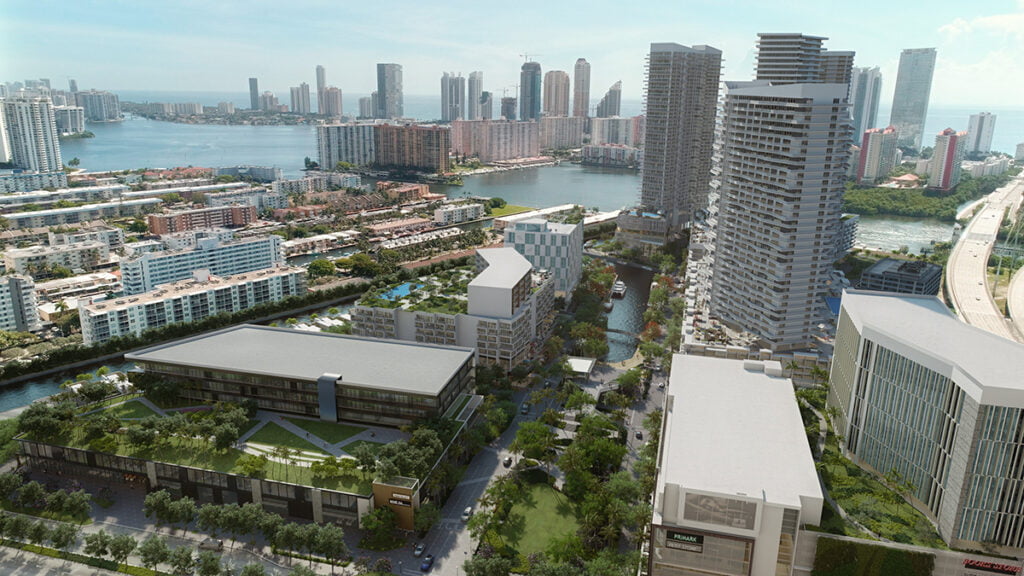
“Uptown Harbor” by Dezer Development is subject to a site plan approval by the Planning & Zoning Board of North Miami Beach on August 12th. The project was originally proposed on November 10th, 2020 and had approval for both a development agreement and a conceptual plan. Up until May 9th, 2024, progress has been continuous. There will be eight blocks. In total the development will have 335,109 SF of commercial-retail space, 197,768 SF of office space, 2,000 residential units (subject to change), a 244-key hotel, and 4,743 parking spots. However, the developer is entitled to slightly more SF of commercial-retail space/residential units per a city and developer agreement. In this post, there will be an in-depth analysis for each block. Starting with block S1. Block S1 will border NE 163rd St and NE 36th Ave. It will be 21 floors high or 283 FT. It will contain 98,943 SF of commercial, 177,368 SF of office space, and 878 parking spots. Uniquely, North Miami Beach has minimum and maximum parking requirements. The developers could’ve had 641 parking spots on block S1 or 1,105 parking spots at max. The next phase is the S2 block, introducing two residential towers standing at 38 and 35 stories with heights of 394 FT and 364 FT respectively. Together, the buildings will add 643 residential units, 32,004 SF of retail space, and 1,070 parking spaces to the area. The towers will be anchored by a shared parking podium, designed to integrate seamlessly into the streetscape. Street-facing residential units will line the interior roads, while a masked parking garage will be positioned along NE 163rd Street to minimize its visual impact. The towers are also setback from the major thoroughfare via a slender park. The tallest block is Block S3, with two high-rise towers set to become the tallest in North Miami Beach. One will rise 48 stories to a height of 493 FT, while the other will reach 45 stories at 463 FT. The development will introduce 832 residential units and 22,398 SF of retail space, all supported by a multi-level podium housing 1,791 parking spaces. If completed as planned, these towers will be the tallest in North Miami Beach. Moving to block S4, there will be one tower at 46 floors or 486 FT. It will distinctively have no parking spots, with offsite parking provided by block S3. There will be 33,111 SF of commercial, 20,400 SF of office, and 336 residential units. Transitioning over to the N-labeled blocks, block N1 will function as a community focal point. The 6 floor, 83 FT building will contain 131,658 SF of commercial space, 17,398 SF of gym use, a police sub-station, a fire rescue station, and a 2,141 SF community center for residents. To accommodate the various uses, the building will have 617 parking spaces on site, more than the 605 maximum North Miami Beach sets. Block N2 will be split into a residential and hotel block. The residential block will be 12 floors or 152 FT. There will be 153 units, 27,177 SF of retail space, and 215 parking spots. The hotel block will be west from it. The wedge-shaped building will also rise 12 floors but be 147 FT. There will be 244 hotel rooms for guests and 2,529 SF of commercial. Parking is provided on the residential N2 block. The final block named TH will have 36 town homes with waterfront access. The project will be in four phases. The first phase will be construction Block N1 (the community center) and Block S1, the 21 floor office and retail building. The second phase will involve constructing roadway improvements, park space, the canal, and other bay walk features. The third phase will undergo the construction of a waterfront promenade by constructing retail, restaurants, and other uses along the water from block S2, S3, and N2. The fourth and final phase will be the construction of all major condominium towers, the hotel, rental apartments, and town homes. Dezer Development is requesting multiple administrative waivers. Waivers range from allowing more than 14 floors on specific plots, requesting garage screening instead of liner units, and more. A total of 15 waivers are requested. The architect is Zyscovich Architects. The location of the master-development is 3501 Sunny Isles Blvd.
Tower Cranes Submitted For Waldorf Astoria Reaching Over 1,200 FT.
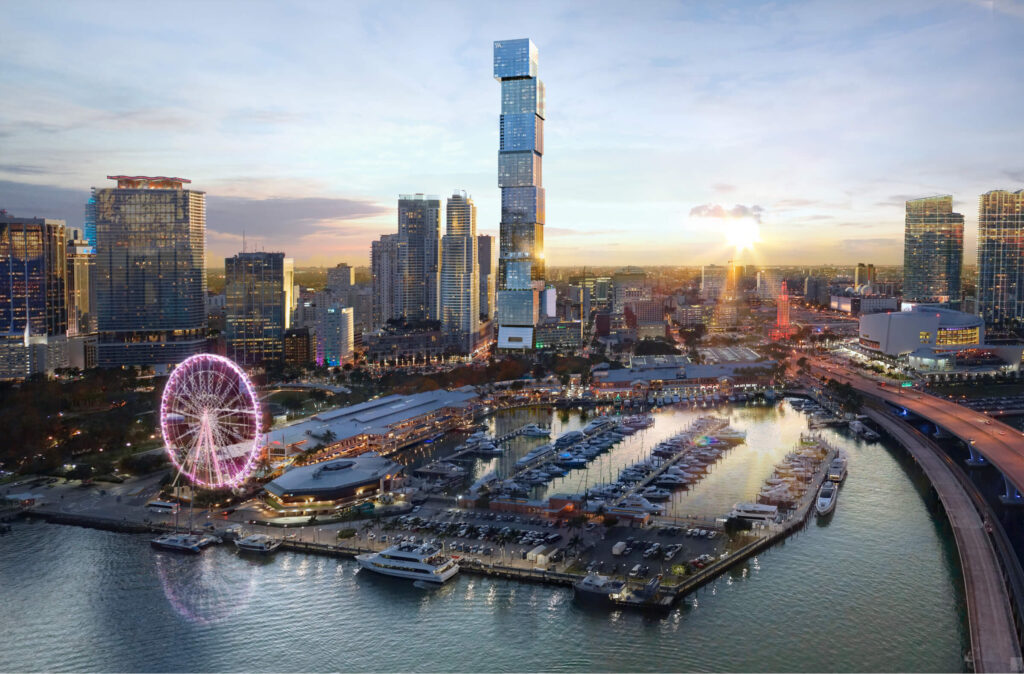
PMG development has submitted on Wednesday two tower cranes on the site of Waldorf Astoria Miami, a new supertall set to be one of the tallest towers in America. Tower crane one will rise 1,273 FT off the ground or 1,284 above sea level. It will be the southernmost crane on the property, bordering Biscayne blvd. The crane is already erected, but not at its fullest height. The second crane submitted will be 1,227 FT or 1,238 FT. It will be on the northern portion of the property. Like the southern crane, it’s already erected. Back in the summer of 2023, two tower cranes were submitted at the site but slightly lower in height and different in location. The installed cranes today don’t match the FAA filings, hence the new submissions. One crane that shifted the most was Crane #1, going to the southern part of the property instead of the middle. These new filings will be subject to FAA approval, and will most likely receive approval shortly. The project site is 300 Biscayne Boulevard. The tower will feature 360 residences.
Stormwater Improvements Project Begins in Ft. Lauderdale’s Dorsey Riverbend Neighborhood
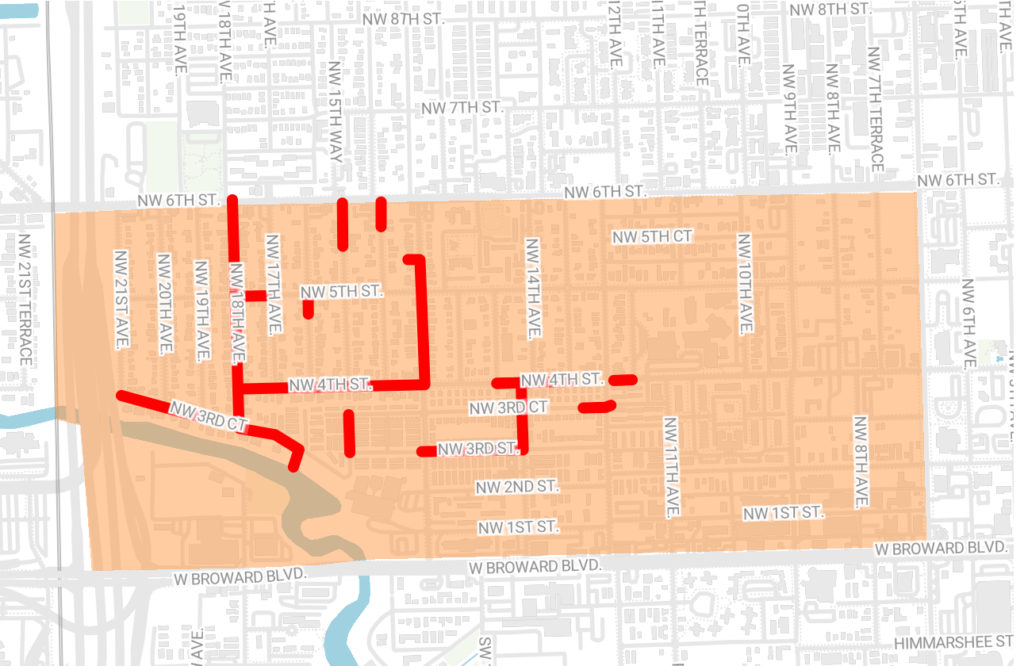
The city of Fort Lauderdale is beginning its Stormwater improvements project in the historic Dorsey Riverbend neighborhood. Man-Con, Inc will install 21,000 feet of stormwater pipe, install 90 drainage structures, install a new sewer pump station, reconstruct swale areas, trim trees, restore pavement, reconstruct driveways, and relocate nearby water and sewer lines. Construction began on Monday, July 22, 2024 and will continue to late 2026. Work will happen on weekdays between 7am and 6pm. For more information: use the website for the City of Fort Lauderdale. Stormwater improvement projects are especially necessary at a time where Fort Lauderdale has been hit with historic flooding. In early April of 2023, some parts of the city received more than 25 inches of rain while surrounding cities saw as high as 17 inches. Dorsey Riverbend is just one of the seven vulnerable neighborhoods highlighted in a $200 million plan to update drainage. Others include Durrs, Progresso, Victoria Park, and Southeast isles. The end goal is for the installed infrastructure to withstand about 10 inches of rain in a 24-hour period. Improving stormwater infrastructure is a race against the clock. Canals that flooded in the past would drain their water out onto the ocean, but recently the ocean’s rising waters has caused problems with natural outflow.
Shoma One Moves Forward With Permitting and New Designs
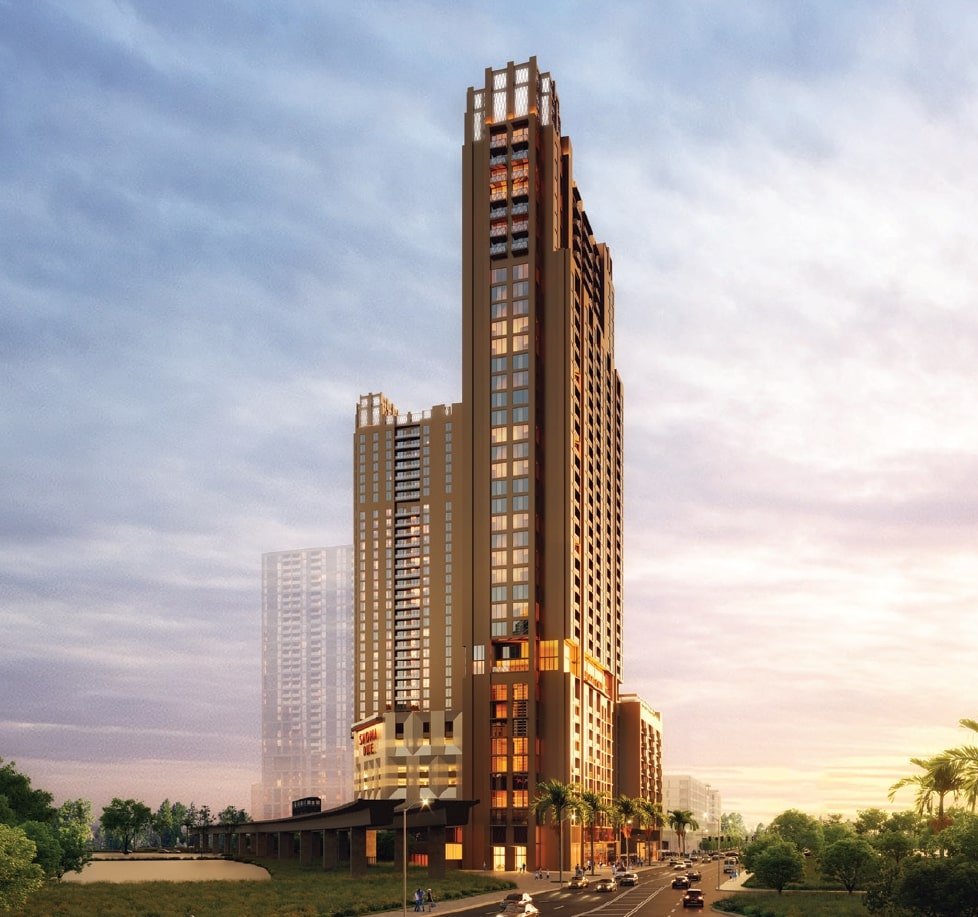
Shoma One at 3650 Bird Rd is moving forward with updated designs and permitting. The project previously announced in early 2024 will have 748 units with 94 of them being workforce units to meet a 12.5% minimum requirement. The 12.5% requirement derives from a workforce housing development program that permits the Shoma Group to add 6 floors of additional height in exchange for workforce housing. Plans previously called for 718 parking spots, but the developers scaled it down to 700. It’s worth noting that there’s no minimum parking requirement in “Rapid Transit Zones” of Miami. Additionally, there will be 22,453 SF of retail and 30,245 SF of open space. 24 Bicycle Parking Spaces will be provided. There’s two towers both rising 40 floors or 407 FT to the roof and around 440 FT to the top (estimate to the top as there’s no elevations past the roof line). Previous elevations show a different crown, one that has a circular, decorative feature at the top. The new crown is tiered, featuring a series of successively receding levels, giving it a distinctive, stepped appearance. Now, the developers are moving forward with permitting. On may 14th, 2024 total demolition permits were filed that aren’t yet approved. Once those permits are approved and demolition commences, the developers are expected to move forward with foundation/structural permitting and construction. The architect is Bermello Ajamil & Partners.
Miami Stands Out Nationally with a Staggering 44 High-Rises and 15,066 New Units Under Construction
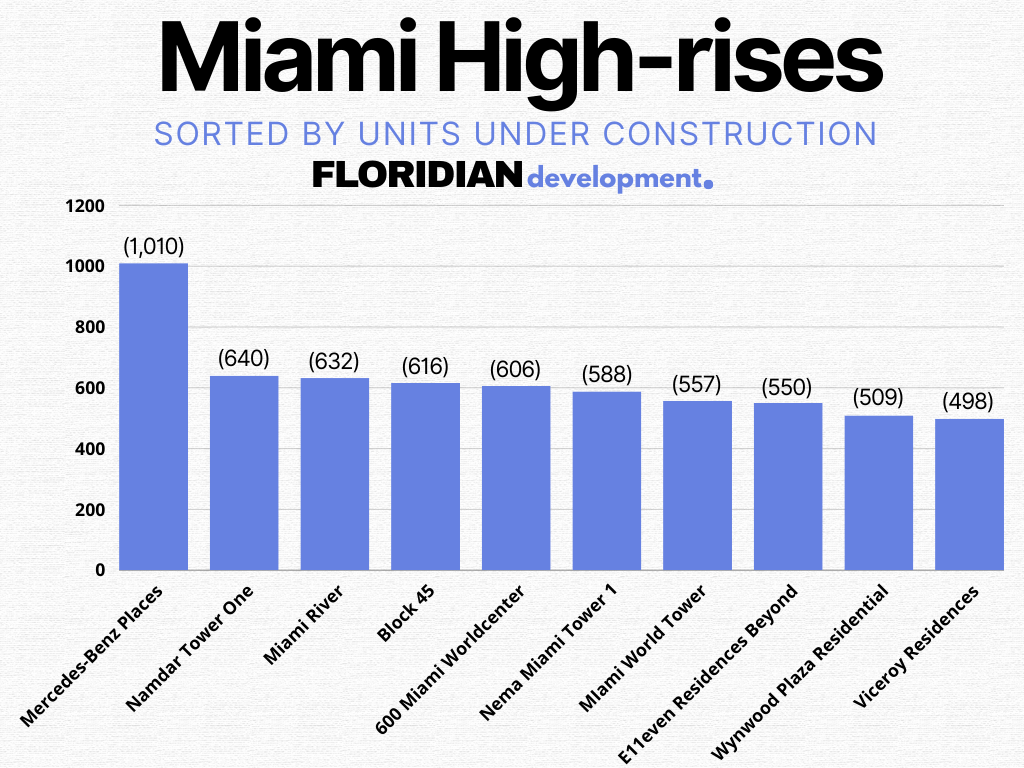
Miami is undergoing a historic boom in high rise construction. In a list compiled by Floridian Development’s independent analysis (subject to minor errors), Miami has 44 high-rises under construction. These high-rises will add 15,066 multifamily units, office SF, and other uses to the market. This data only pertains to city boundaries and doesn’t include high-rises from Sunny Isles, Miami Beach, and the rest of South Florida as others lists notably have done. Note: Construction is when piles are driven into the ground and foundation work begins. Demolition or site clearing is not counted as construction. Under Construction High-rises (More than 12 floors) in Miami’s City Boundaries: Out of the 44 high-rises under construction in Miami, 40 are primarily residential and account for 15,066 units. Three of the high-rises are mostly office-use while one is dedicated to medical research and care. High-rises in Miami are reaching new heights. Waldorf Astoria Miami is at the forefront. Towering 1,041 FT, it will be Miami’s tallest residential tower in decades. It’s also the tallest tower under construction outside of NYC (in the U.S.) and Miami’s first supertall. Other notable towers on the list are Okan Tower and The Cipriani Residences, both of which will exceed 900 FT. Miami’s development pipeline exhibits significant variation in unit counts. The towers with the highest number of units include Mercedes-Benz Places, Namdar’s First Phase, and Miami River. Mercedes-Benz Places will provide 1,010 market-rate units. Miami’s high-rise construction consists of both market-rate and affordable/workforce housing, though the majority of the projects are geared towards market-rate units. Miami’s high-rise development is particularly notable on a national scale, largely due to the city’s emphasis on taller buildings. While comprehensive lists for each city detailing developments with 12 or more floors may be limited, CTBUH’s data tables provide valuable insights. For instance, Miami currently has 17 towers under construction that exceed 492 feet (150 meters, or approximately 45 floors), surpassing New York City’s 13. It’s important to note that NYC is the only city with more high-rises under construction at lower heights than Miami. Despite this, Miami’s focus on taller structures makes its development impressive and competitive, second only to New York City’s sheer scale of construction. Miami’s allure to domestic migrants makes the city appealing both for business and development. Even so, many critics highlight the city’s inefficiencies to deliver adequate traffic improvements or transit improvements amidst the growth in development. Likewise, Miami City Commissioners recently reinstated parking minimums, forcing more cars on the road.
Shoreline Review Submitted for “The St. Regis Residences” in Miami
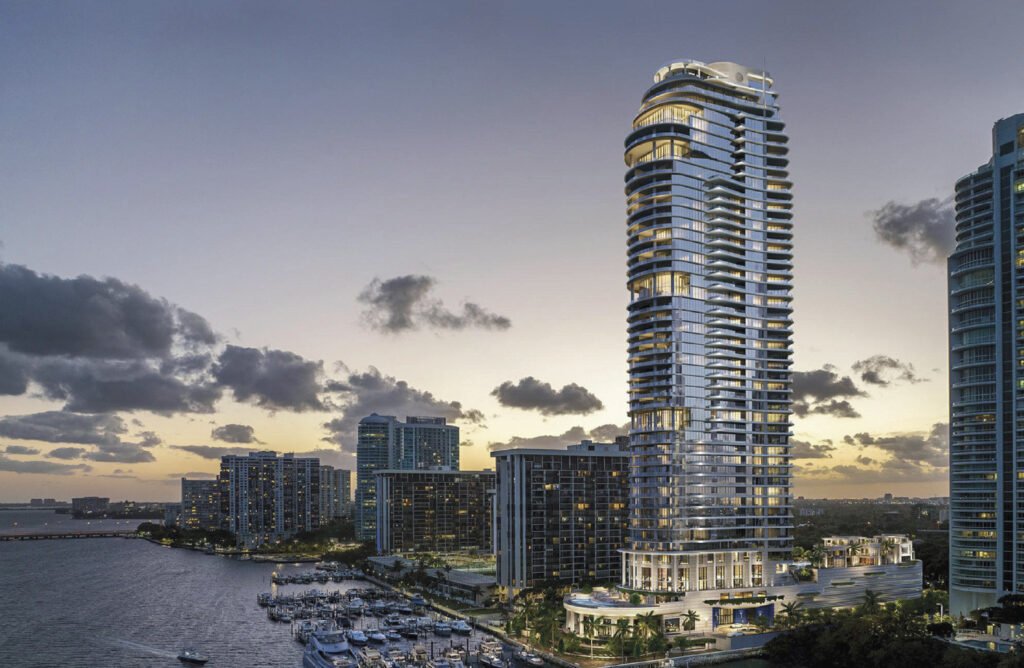
Related Group’s “St. Regis Residences” submitted site plans for a shoreline development review on July 18th. The tower, announced in the past, will rise 48 floors and feature 152 residences. Part of the site plan highlights the benefits to pedestrian connectivity and experience. On both the east and west portion of the property, there will be a public baywalk access path that leads to 450 additional linear feet of baywalk. The property is raised from the ground, making steps and a sloped pathway necessary for accessibility. The tower will be setback 50 feet from the water. Likewise, If plans materialize, the baywalk will have a public “lawn sculpture”, cast in place benches, and other lighting features to enhance the pedestrian experience. Along both the property’s frontage and baywalk will feature adequate native and foreign greenery. The tower will be the 621 FT tall, the tallest on the strip. The Design Architect is RAMSA (Robert A.M. Stern Architects), and the Architect of Record is CFE (Cohen Freedman Encinosa & Associates). The tower will rise at 1809 Brickell Ave.
FAA Grants Crane Approvals to Ombelle in Fort Lauderdale
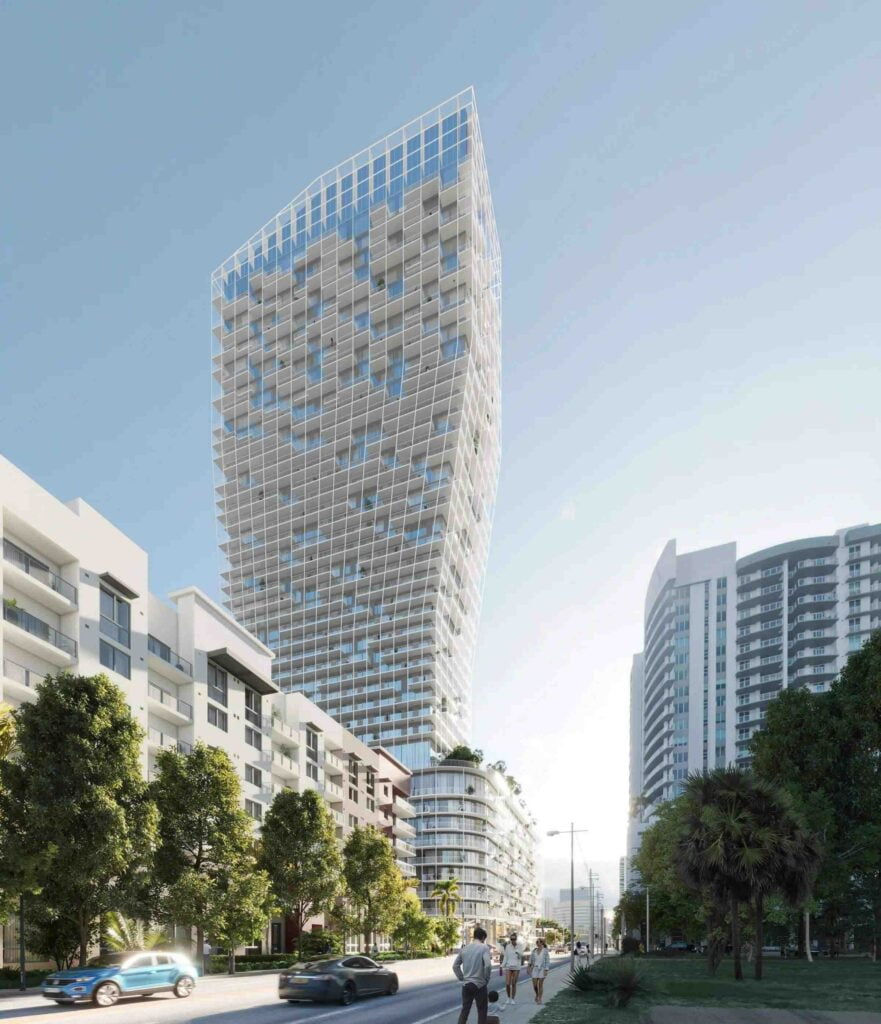
Ombelle, a project in Fort Lauderdale featuring two 43 floor towers, has recently received approval for two tower cranes. Both tower cranes will rise 620 FT on different portions of the site. In a document by the FAA, both filings were given a “determination of no hazard to air navigation for temporary structure”. The document also mentioned that the cranes exceed obstruction standards, but aren’t a hazard to air navigation. These filing approvals come at a time where fence permits, demolition permits, and more were approved. The current site today shows wooden fencing installed and a cleared lot. Construction permits like structural or foundation permits aren’t filed yet, but the developer (Dependable Equities) still has movement in the Accela portal. Ombelle will include 1,100 apartments, 11,217 SF of commercial space, and 1,100 parking spaces at 300 3rd NE 3 Ave. Photos and plans credited to ODA Architecture.
“Hibiscus Grove” Proposed in West Perrine with Affordable and Workforce Units
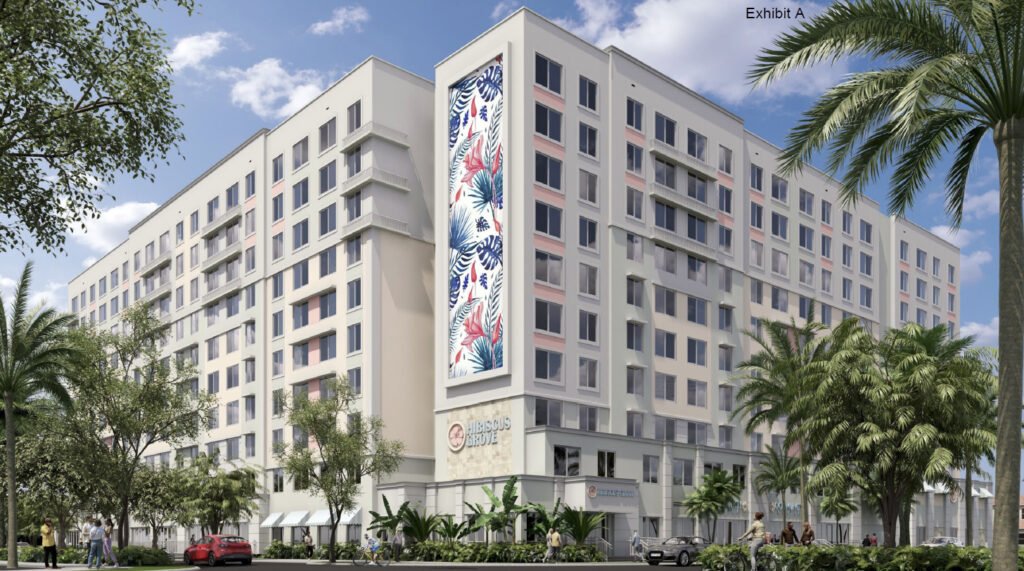
Hibiscus Grove, a newly proposed affordable and workforce housing development by Integra is moving forward. The development has already been through rounds of approvals and previously received the go-ahead for 270 units, but the company is hoping to amend their site plan for 300 units. Exact numbers are unknown, but the developer has stated they’ll provide 40% or more of the units as affordable housing. This means at least 120 units will be designated as affordable housing, providing much needed housing relief for the area. To accommodate the planned 300 units, there will be 295 parking spaces and 12 bicycle parking spaces. On the bottom floor, pedestrians and residents alike have access to 5,751 SF of retail space, a community center, and a leasing office. In terms of the pedestrian realm, current sidewalk space will be expanded in hopes to alleviate future foot traffic. Because the development is transit accessible, a new sidewalk will also be built that connects the tower to the existing busway. Canopy greenery is significantly reduced from the existing site (67,425 Sf of canopy reduced to 11,100 SF via plans last year). Replacement greenery will be a mix of native and foreign landscaping that provides shade. According to elevations, the tower will rise 11 floors or 107 FT to the roof and about 117 FT to the elevator shaft. As per site plan drawings, the developer is opting to place the parking garage along W Indigo Street rather than creating a highrise podium both to reduce costs but also improve facade aesthetics. The location is 9948 W Hibiscus St, Unincorporated Miami Dade. Renderings and drawing are from Lantz-Boggio Architects & Interior Design.
Hallandale Beach Proposes Sweeping Amendments to Residential Development Regulations
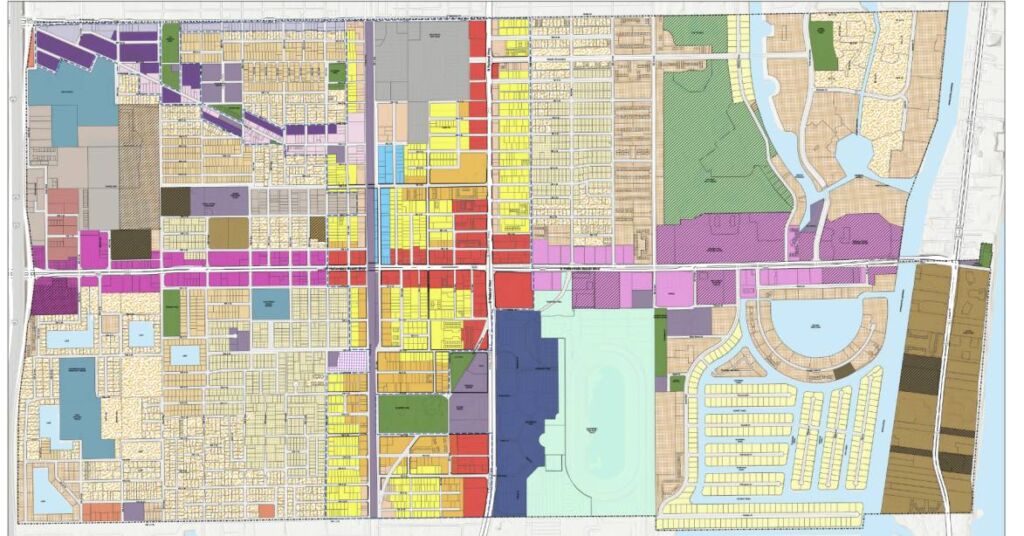
Hallandale Beach’s Planning and Zoning Board will vote on amending multiple residential development regulations. The meeting will take place on July 24, 2024 with staff recommending approval. Part of their recommended approval comes at a time where the “necessity for additional housing typologies continue to emerge. Smaller units provide an opportunity to expand the housing stock to include unit types that accommodate the diverse lifestyles and needs of the community”. The first to be amended is the minimum yard setbacks in the RD-12 district. Minimum yard setbacks were cut to the equivalent of single-family setbacks in the area. Likewise, in the past multifamily buildings (3 units or more) were forced to undergo a town-home typology. Now proposed changes allow for multifamily in any configuration. However, density in the RD-12 district will be decided later on. The minimum unit size for multifamily buildings citywide is reduced to 450 SF. When affordable housing units are at least 15% of the building, the minimum unit size can be reduced to 400 SF (Down from, 450 SF). Likewise, units with a minimum floor area of 500 SF can be counted as half a unit. For multi-family buildings, previous parking requirements were 1.75 spaces for every efficiency unit, 2.0 spaces for every 2 bedroom unit, and so on. Now, there will be a simplified requirement of 1.5 spaces per units. 10% of required parking will be added on as “guest parking” as is the standard for years. To sum:
Conceptual Site Plan Revealed for Citadel’s New Headquarters
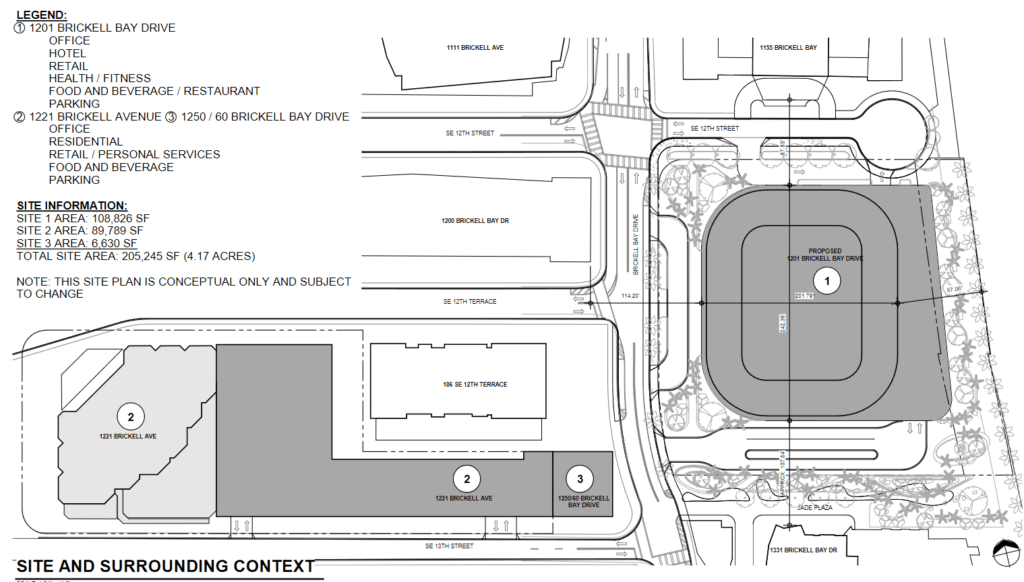
A pre-application was filed on Friday (7/19/24) for 1201 Brickell Bay Drive, the site of Citadel’s new global headquarters. Although plans aren’t official and the purpose of the pre-application request was to review the RTZ site plan approval process, it’s progress. In an attached letter, plans call for the development to be in phases. The first phase will be the office at 1201 Brickell Bay Drive using applicable RTZ regulations. According to plans, the headquarters will be mixed-use. There will be a flagship hotel, office space, retail, health/fitness, food/beverage, and ample parking. Likewise, there will be a large baywalk with trees and a 55.92′ setback. On the right side of the lot, there will be a hotel drop off and an office drop off at the tower’s frontage. If conceptual drawings materialize, there will be a public terrace overlooking Biscayne Bay. Drawings show the tower as rounded. As it rises, it will slope upwards into a tapered design (please see example image below). As reported months ago, Foster and Partners will be the main architect. The architect on record according to conceptual plans is AAI architects.