South Florida faces a unique development challenge. With the Everglades to the west, the Urban Development Boundary to the south, and the Atlantic Ocean to the east, land suitable for new development is notoriously limited. As a result, developers are often perceived as having two choices: redevelop existing properties in urban areas with larger, newer projects or build on remaining greenfield sites.
Greenfield sites are vacant parcels free from environmental contamination and often considered the easiest land to develop. Yet a third category exists: brownfields.
Brownfields are properties that contain, or are suspected to contain, environmental contamination due to previous uses. They can include industrial facilities, former commercial sites, aging strip malls, and even golf courses where decades of pesticide and herbicide use have left environmental impacts.
Historically, developers have not avoided these sites because they are unfamiliar. Rather, brownfields often carry substantial costs and risks associated with environmental remediation, community opposition, and lengthy approval processes. As a result, many industrial and environmentally impacted properties throughout South Florida have remained undeveloped despite growing demand for housing.
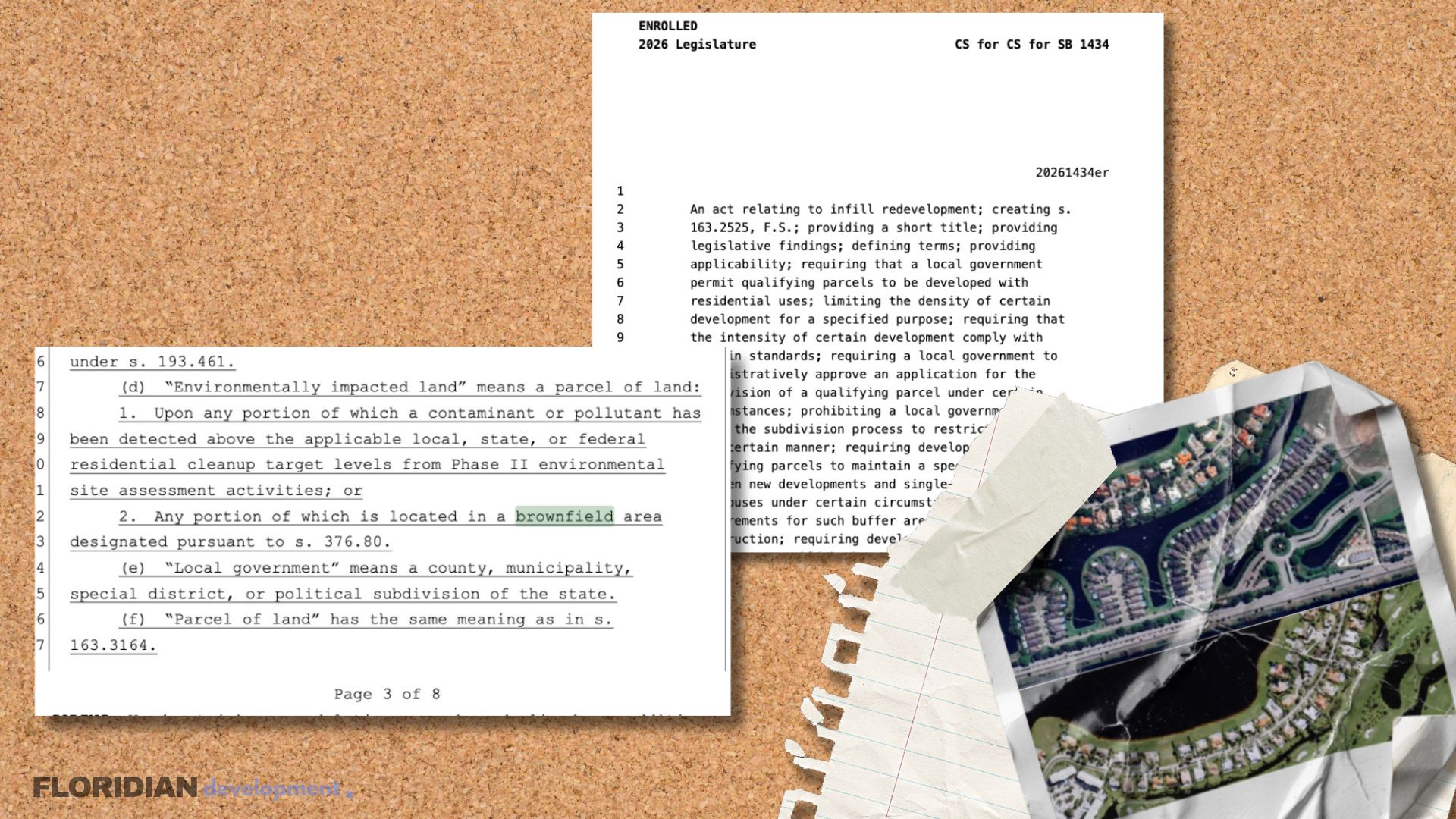
The State of Florida is now attempting to change that. On May 21st, 2026, Governor Ron DeSantis signed Senate Bill 1434 into law. Known as the Infill Redevelopment Act, the legislation is designed to encourage residential redevelopment on qualifying brownfield sites by streamlining approvals and creating a more predictable development process.
The legislation was largely driven by housing affordability concerns and targets the region of Florida experiencing some of the state’s most acute housing pressures: South Florida. To qualify, projects must be located in counties with populations exceeding 1.475 million residents and containing at least 15 municipalities. Currently, only Miami-Dade, Broward, and Palm Beach counties meet those criteria.
Despite the law’s limited geographic reach, the amount of land designated as brownfield sites is significant. According to state records, Miami-Dade County alone contained 92 designated brownfield sites as of 2024.
Not every brownfield, however, qualifies for redevelopment under the new law. Eligible parcels must generally contain at least five acres and be adjacent to land zoned for residential use. In addition, projects developed under the legislation must be exclusively residential. Given those requirements, many of the region’s brownfield sites would remain ineligible.
For projects that do qualify, the law establishes a defined development framework. Under the density provisions, residential projects may utilize either the average density of all adjacent zoning districts that permit residential uses or 25 dwelling units per acre, whichever is lower. The legislation does not establish a specific height limit or floor area ratio, leaving those regulations largely subject to local interpretation.
The law also includes compatibility requirements. Projects adjacent to single-family homes or townhomes must provide a minimum 20-foot buffer between new and existing development.
Despite this, the primary benefit of the legislation is not increased density but increased certainty. Environmental remediation requirements remain in place, meaning contaminated land must still be cleaned before development can proceed. The advantage instead lies in the administrative approval process, which bypasses the lengthy public hearings often associated with rezonings and development approvals.
For observers familiar with Florida housing policy, that raises an obvious question: Why not simply use the Live Local Act? After all, Live Local projects similarly benefit from administrative approvals and, in many cases, can achieve significantly greater density and height allowances.
The distinction lies in the type of land each law targets. The Live Local Act generally applies to commercial, mixed-use, and industrial properties, while Senate Bill 1434 extends redevelopment opportunities to a broader range of sites.
Golf courses are one notable example.Many golf courses contain elevated levels of environmental contaminants due to decades of pesticide and herbicide applications. Yet unlike industrial or commercial properties, golf course redevelopments in South Florida generally cannot rely on the Live Local Act’s streamlined approval process.
Under the Infill Redevelopment Act, those sites may now have a path toward administrative residential redevelopment. To prevent abuse, however, the law establishes additional safeguards for recreational properties.
Any golf course or recreational facility proposed for redevelopment must have been inactive for at least 12 months. Developers must also pay double the applicable parks or recreational facilities impact fee and provide notice to adjacent property owners outlining their redevelopment intentions. Following that notice, nearby property owners have 90 days to determine whether they wish to organize and purchase the property themselves.
If acquired through such a process, the property must remain recreational or open space for at least 30 years. The purchase price may not exceed 110 percent of the amount originally paid by the developer.
Because the legislation is specifically focused on infill redevelopment, it also establishes clear limitations on where it can be used. Agricultural land, publicly owned parkland, sites located within one-quarter mile of military installations, certain utility-owned properties, and land outside urban growth boundaries are all excluded from eligibility.
Senate Bill 1434 joins a growing list of Florida housing measures enacted in recent years. Among the most consequential remains the Live Local Act, which has undergone multiple amendments since its original passage.
Today, the Live Local Act allows multifamily development at the highest density permitted within a jurisdiction while permitting developers to utilize qualifying heights from nearby properties located as far as one mile away. Together, these laws have positioned Florida among the nation’s most development-friendly states, increasingly shifting housing decisions away from discretionary local approval processes and toward administrative review.
The contrast with other states is notable. In California, Senate Bill 79 required years of political debate and multiple revisions before ultimately becoming law. The final legislation primarily focused on increasing housing developments near transit, with certain properties allowing nine stories (given proximity to tier 1 transit).
Florida’s approach has been considerably broader. Under the Live Local Act, developers can in some circumstances pursue towers many times taller on qualifying sites without requiring proximity to major transit, given that local height regulations support such development.
Whether one views that as a solution to housing shortages or an erosion of local control, the direction is clear: Florida continues to remove barriers to residential development at a pace few states have matched.