7410 Collins Avenue, an 11-Story Live Local Act Project, Approved in Miami Beach
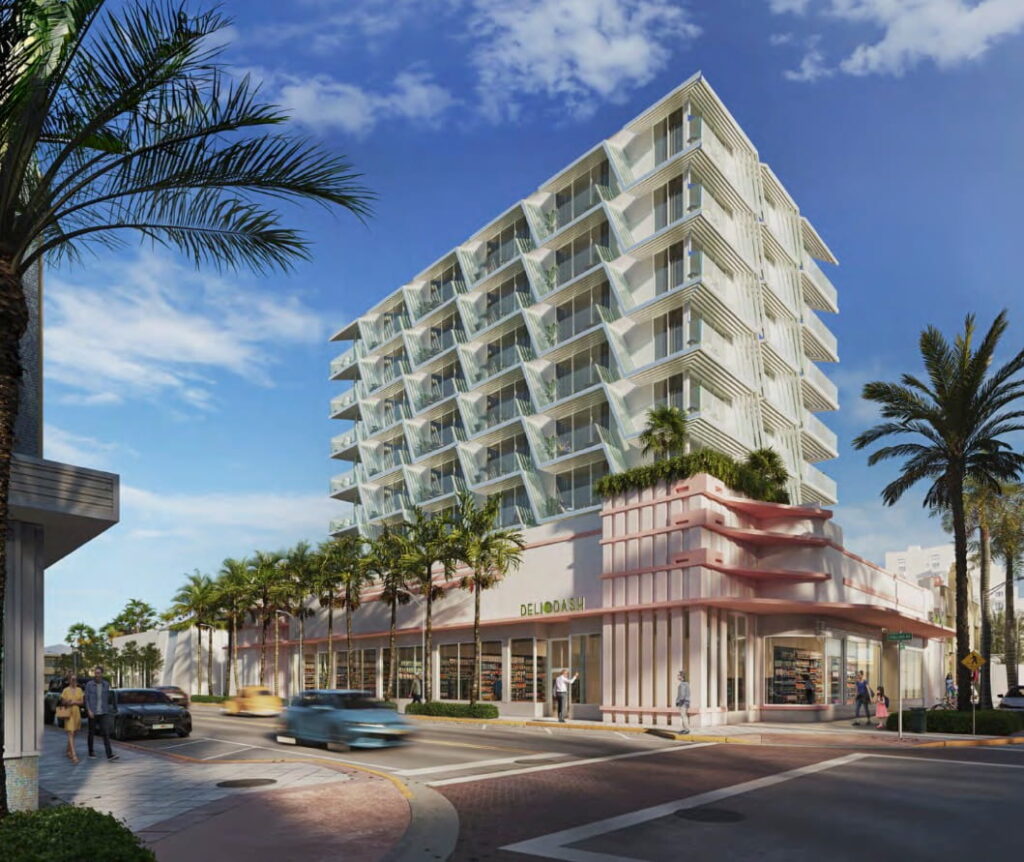
The Live Local Act is once again reshaping Miami Beach’s skyline, with the owners of a historic property at 7410 Collins Avenue securing approval for an 11-story high-rise. The approval places the project among a small handful of successes: just four developments have won approval under the act in the city, out of more than fourteen submitted, most of them high-rises. 7410 Collins Avenue is leaning on the state’s landmark housing law to unlock both greater density and additional height than existing zoning would normally allow, flexibility that has translated into a 50-unit building spanning a mix of income levels. It’s a dramatic jump from what zoning alone would permit, but this kind of Live Local Act-driven change is quickly becoming standard practice for new proposals in the city, much to the frustration of anti-high-rise advocates. Nowhere is that shift more visible than at this site. The project is rising on the footprint of a one-story commercial building constructed in 1950 as a supermarket and now home to a CVS. The road to this approval didn’t start this year, either. Developers originally submitted plans for a five-story structure on the property and won approval from city boards, including Miami Beach’s Historic Preservation Board. That earlier proposal called for 18 luxury units, 8,379 square feet of ground-floor retail, and 25 parking spaces. But as the Live Local Act gained traction across the city, a five-story building began to look like a missed opportunity. The developer went back with a new proposal, more than doubling both the density and height of the original plan. Inside the Proposal Approved in July, the development’s 50 units will split between 30 market-rate units and 20 workforce housing units priced at or below 120 percent of the area median income. That workforce housing component is a direct requirement of the Live Local Act, which grants zoning enhancements in exchange for setting aside at least 40 percent of units at or below that income threshold. Units will range from 664 to 900 square feet, each with its own balcony, and residents will have access to two stairwells and two elevators. On the 11th floor, the building will feature a rooftop pool alongside 876 square feet of additional amenity space, outdoor seating, and landscaping. Because the lot is tightly constrained, the project will include just 25 parking spaces on the second level. Additional parking will be available on-street and at a nearby parcel serving as overflow capacity during periods of higher demand. Designed by Urban Robot, the building will feature a bold, colorful palette spanning pink, light teal, and white tones, wrapped in stucco, concrete, floor-to-ceiling windows, and glass balconies. The ground floor will house 8,535 square feet of retail space and a 2,397-square-foot lobby, along with bike racks and a renovation of the historic facade, including repainting and both interior and exterior updates to the original structure. Moving Ahead 7410 Collins Avenue is the latest example of the Live Local Act’s core trade-off in action: greater density and height in exchange for zoning flexibility. But the law has also drawn significant pushback from cities across South Florida, largely because it allows qualifying projects to bypass public board review and move through the approval process administratively. That lack of public input has fueled a sharp and often heated divide between developers and residents. Critics also argue that the affordability promised under the law is often overstated. While Live Local Act projects are required to meet certain rent limits, those limits can still allow for substantial costs. According to rent limits published by Bilzin Sumberg, studio units under the law can be priced as high as $2,862 a month, a figure that’s arguably far from affordable by most standards. Whether those limits move the needle in the short term remains an open question. But pro-housing advocates maintain that increased supply, over time, tends to ease pricing pressure rather than worsen it.
The Triangle Breaks Ground in Miami’s Health District, Among the First Live Local Act Projects to Reach Construction
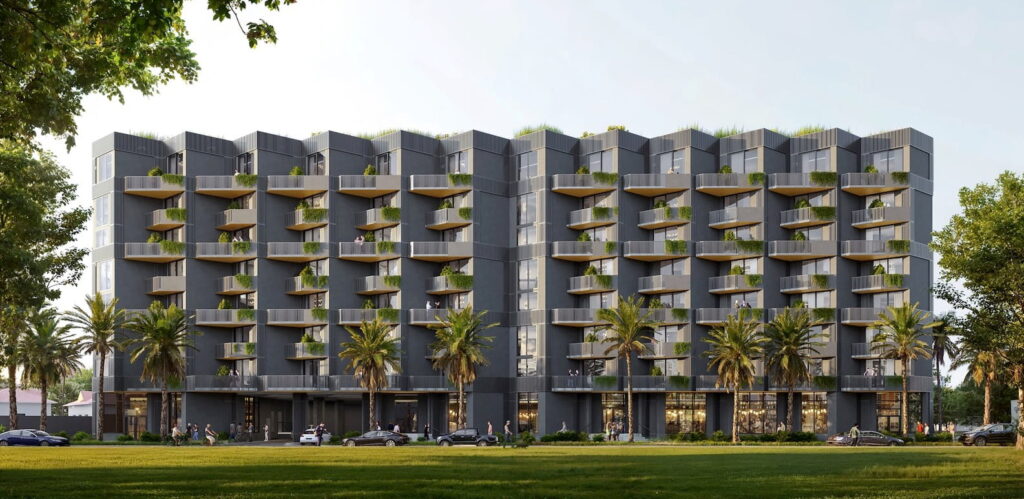
Ground has officially broken on The Triangle, a proposed workforce housing development in Miami’s Health District spearheaded by Miami-based developer DFRE. The project is being built under Florida’s Live Local Act, the state’s closely watched pro-housing law that grants zoning exceptions and faster approval timelines in exchange for setting aside at least 40 percent of units as workforce housing. With construction now underway, The Triangle stands as one of the first developments to bring the legislation from paper to pavement. The project takes its name, and its distinctive shape, from the land beneath it. Designed by ODP Architects, the building is molded around a quirky, just-under-0.7-acre triangular lot that DFRE purchased in 2019 for $1,675,000. The site had sat as an undeveloped grass lot for decades before the project’s approval finally gave it a path forward. Once complete, The Triangle will offer 112 rental units, all priced at income-restricted rates for households earning up to 120 percent of the Area Median Income. That goes well beyond what the Live Local Act requires: the law mandates that only 40 percent of a project’s units be priced at that income threshold, but DFRE opted to apply it across the building’s full inventory. Units will average around 450 square feet, each with a private balcony, and residents will have access to a 10,000-square-foot pool terrace on the fifth level, along with gathering spaces, grilling areas, and additional amenity space throughout the building. “Our responsibility extends far beyond developing real estate,” said Daniel Dias, principal at DFRE, in a statement. “With The Triangle, we’re turning a site in the heart of the Health District into attainable, well-designed housing for the people who serve this community. It’s about giving Miami’s workforce the opportunity to live closer to where they work while creating a place that strengthens the neighborhood for the long term.” At street level, the project is designed with pedestrian activity in mind, featuring expanded sidewalks and added greenery. The ground floor will also house a 3,500-square-foot fitness center along with several entrances leading into the building’s parking garage, which architecture firm ODP says will hold 72 spaces. In total, the development will span 121,636 square feet across eight floors, rising to roughly 80 feet. Its exterior will combine tall windows, stucco finishes, and metal balconies, set against a color palette of browns, grays, and blacks. The $35 million project is slated to top off in mid-2027 and reach completion in early 2028, positioning it to become one of the state’s first fully realized Live Local Act developments. That distinction carries weight in a county known more for proposals than completions. According to Floridian Development’s analysis, only around 100 projects taller than five stories are currently under construction countywide, a figure that underscores how significant this single groundbreaking could be. If The Triangle delivers as planned, it may signal the start of a broader wave of Live Local Act projects moving from concept to construction across South Florida.
Mandarin Oriental Hotel and Residences Begins Construction on Miami’s Brickell Key
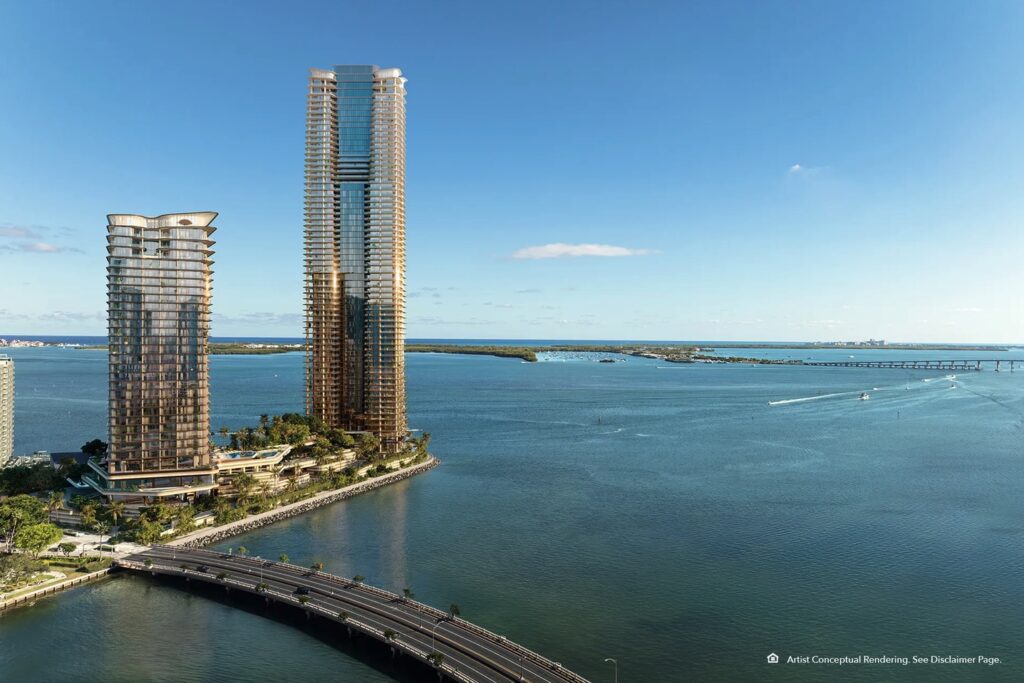
Construction has officially kicked off at the site of the Mandarin Oriental Hotel and Residences, one of Miami’s most closely watched condo and hotel developments. Crews recently began deep soil mixing ahead of the development’s planned October groundbreaking date, a technique essential for towers of this scale. The process strengthens the ground before foundation work can start, which is particularly important given Miami’s sandy, often unstable geology. With that process underway, the 294-unit, 149-key development is on track to begin rising next year across its two planned towers. This progress comes not long after the original Mandarin Oriental hotel was brought down to make way for it. Built in 2000 and home to 326 hotel rooms, relatively young by most building standards, the tower was demolished in a controlled implosion that drew onlookers from across the city. In the months since, debris cleanup from that demolition has neared completion, and in the areas already cleared, deep soil mixing is now moving forward. Below is a video outlining recent construction milestones. Click to view and expand. That sequence of ground preparation before vertical construction is not unique to this site. A similar approach is playing out a short distance away at Citadel’s new global headquarters, a project Floridian Development has also covered, where foundation work is only now getting underway after months of soil improvement. The parallel makes sense: Brickell Key is an artificial island, which makes this kind of ground preparation especially critical. None of that work is happening without oversight. The construction activity, located at 750 Claughton Island Drive, is backed by a steady stream of county permitting, with several permits either issued or under review. These include approvals for soil improvement tied to the deep soil mixing, site cleanup, a foundation permit for the hotel tower, and a master building permit for the residential structure. According to the issued master building permit, the project carries an estimated cost of $226 million and will add 1,286,326 square feet of new construction to the site. Much of the momentum behind this groundbreaking can be traced back to strong sales performance, with units in both the north and south towers repeatedly breaking records when they first hit the market. That demand stems in large part from the site’s location. Positioned on Brickell Key, the property offers one of the few unobstructed waterfront views left in Miami, with water visible in three directions, a rarity that has commanded both premium pricing and sustained buyer interest. It’s a location that will pay off further once the towers themselves take shape. Upon completion, the development will offer some of the highest vantage points in Miami. The taller of the two towers will rise 66 stories to a height of 850 feet, while the shorter hotel tower will reach 33 stories and 426 feet. Designed by Kohn Pedersen Fox, both structures will be wrapped in balconies and floor-to-ceiling glass, with an ornate crown detail capping each tower. Within those towers, the residential and hotel components are split by structure. The south tower, the taller of the pair, will house 228 residential units, while the north tower will include 66 residences alongside 121 hotel rooms and 28 hotel-branded residences. Across both, residents will have access to an extensive amenity package, including multiple outdoor spaces with sweeping views, pools, private waterfront cabanas, sports courts, a spa, a wellness deck, and resident lounges. Some pieces of the picture, however, are still coming into focus. Details such as commercial square footage or parking spaces aren’t yet available, since Swire Properties and Mandarin Oriental have not submitted those plans to public boards for review. Even so, the development is likely to feature commercial space and adequate parking for each resident once those details are finalized. Construction is expected to conclude in 2030.
Urbanica Reveals Plans for 28-Story Tower at 7915 East Drive in North Bay Village
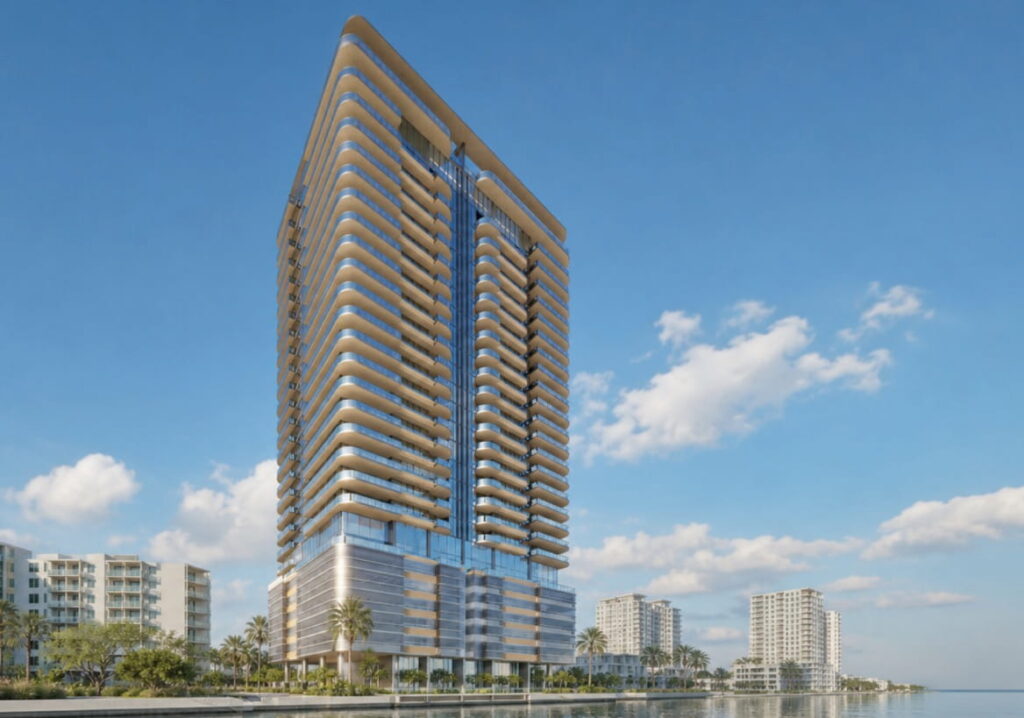
North Bay Village’s ongoing development surge shows no signs of slowing, with plans now revealed for a 28-story luxury tower from Urbanica Development, a firm with several other high-profile projects already underway across South Florida. Despite its height, the building will be relatively exclusive, offering just 70 residences and joining a growing lineup of upscale high-rises reshaping the area, alongside projects like Pagani Residences and the Tula Residences. The tower is planned for 7915 East Drive, where it would replace Bayview Villages, a 41-unit low-rise condominium dating back to 1959. No sale has yet been recorded on the property, with the site’s last transaction going back to 2008. Still, if Urbanica moves forward as expected, the parcel should go under contract before long, clearing the way for demolition soon after. The project, designed by Revuelta Architecture International, was submitted to county planners just days ago and is now working through the approval process. Residences at 7915 East Drive will range from two- to four-bedroom-plus layouts, with the smallest unit measuring 1,997 square feet, putting the development firmly in luxury territory. Every unit will come with its own private balcony and floor-to-ceiling windows, while additional design details and finishes are expected to be announced closer to launch. The building’s amenity package is extensive, featuring a fitness center, a lounge, a library, dedicated kids’ and teens’ rooms, a theater, a spa, a shared living room, and rooftop pools. An expansive lobby and drop-off area will welcome residents and guests, while 142 parking spaces will serve both. At ground level, the project will introduce a public waterfront path dubbed the “Island Walk,” functioning much like a baywalk. The walkway will run along a newly raised seawall and include a wood dock and landscaped greenery, adding a required public amenity to what is otherwise a private development. In a letter of intent, representatives for the developer wrote that the team is “excited to bring this residential development proposal to this area of the Village,” adding that they believe the plan “will contribute positively to the community through the inclusion of the Island Walk.” Rising 339 feet, the tower will lean into a contemporary look, with a beige-and-gray color palette and a facade dominated by glass, including glass balconies stretching across much of the building’s exterior. The parking podium will be wrapped in perforated aluminum, a common architectural technique that shields parked cars from view while still allowing air to flow through the structure. The proposal is now moving through the approval process, and early signs point to a relatively smooth path forward. The property is already zoned for a tower exceeding 300 feet with up to 70 units, meaning the project meets the area’s core density and height requirements. The main outstanding item involves a handful of minor setback exceptions the developer is requesting as part of the review.
New Plans Revealed for Nine Hundred, a 540-Unit Tower a Decade in the Making
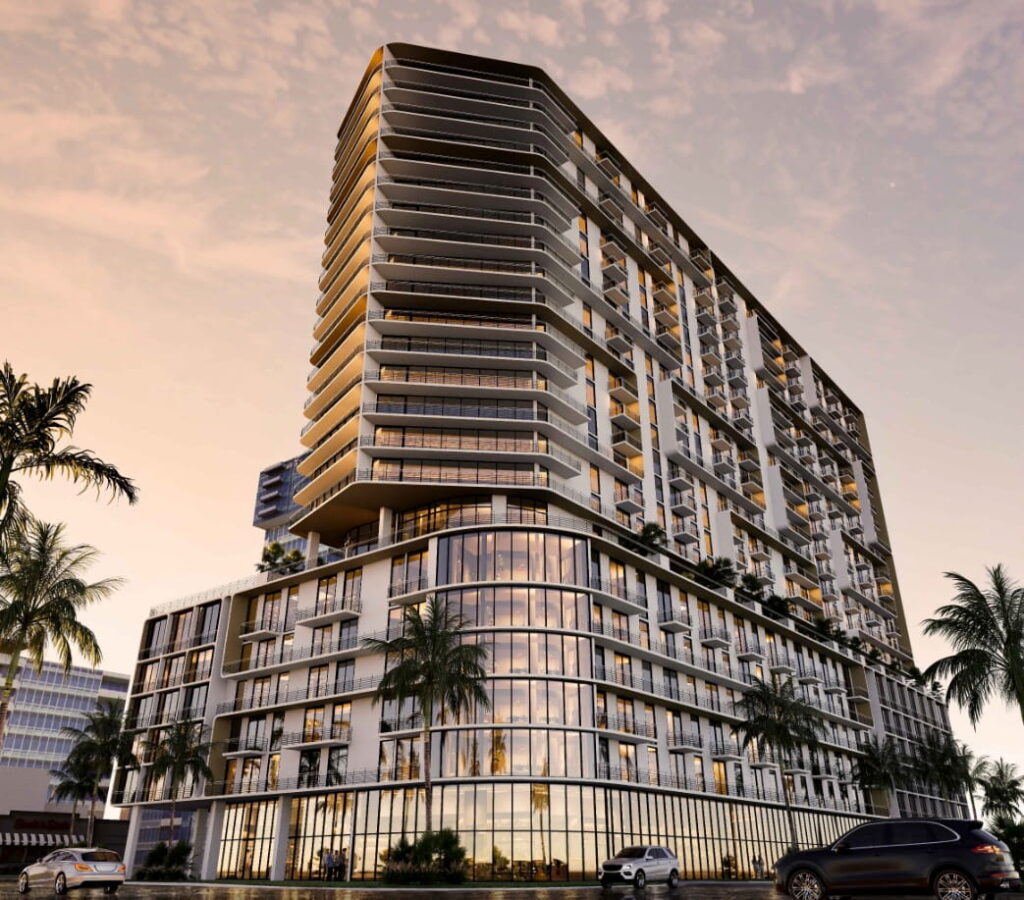
Back in 2019, things seemed to be finally moving for a grassy, undeveloped lot at 900 S Federal Highway in Hallandale Beach. The site’s owner at the time, LeaseFlorida, had just won sign-off from city planners for a 23-story mixed-use tower, a plan first floated three years earlier in 2016. The proposal called for a blend of residences and hotel rooms, topped off with retail space at street level. That approval landed during a building boom sweeping the surrounding blocks, one that hinted at the emergence of an entirely new high-rise corridor beyond the city’s usual waterfront skyline. Yet even with the green light in hand and momentum building around it, LeaseFlorida’s vision for the property never got off the ground. More than ten years after the idea was first pitched, the site may be on the verge of a breakthrough. New plans filed with the city in recent weeks reveal a fresh direction for the parcel, this time spearheaded by Northlink Capital, which bought the land in 2022 for $26 million, a striking jump from the $1.5 million price tag when the lot was originally assembled back in 2001. Northlink’s project, dubbed Nine Hundred Hallandale Beach, takes a very different approach than its predecessor, packing in far more residential density. The current plans call for 540 units spanning studios up through three-bedroom layouts, averaging more than 20 apartments per floor, with some floors holding as many as 29 units. That marks a sharp pivot away from the 2016 concept, which had paired 320 apartments with 140 hotel rooms. This time, hospitality is out of the picture entirely, replaced by a residential-first vision loaded with resident perks. Amenities include a spacious lobby, a pool deck, outdoor lounge areas, landscaped green space, and roughly 5,000 square feet of indoor amenity space tucked onto the seventh floor, with more offerings woven throughout the building. At street level, the project sets aside about 6,000 square feet for commercial use, while the lower floors, one through eight, are largely given over to parking, totaling 638 spaces. Idea Architects is behind the design, which nods to the original proposal’s bones while giving it a more contemporary facade: floor-to-ceiling glass facades, metal-clad balconies, white stucco finishes, and generous 10-foot floor-to-floor heights. Once complete, the tower would rise to about 258 feet, still 23 stories tall. The proposal is currently working its way through city review, and the developer has already covered all required fees. Still, there’s ground left to cover, including a series of public board hearings before the project can clear Hallandale Beach’s full approval process. No construction schedule or groundbreaking date has been set. But if the plan wins approval by late this year and permitting proceeds without major snags, breaking ground sometime in 2027 is a realistic possibility. After years of false starts on a lot that has sat empty far longer than anyone anticipated, Nine Hundred Hallandale Beach may finally be the project that turns this long-dormant patch of Federal Highway into something real.
Nexo Residences Achieves TCO as 15-Story Tower Adds to North Miami Beach’s Growing Pipeline
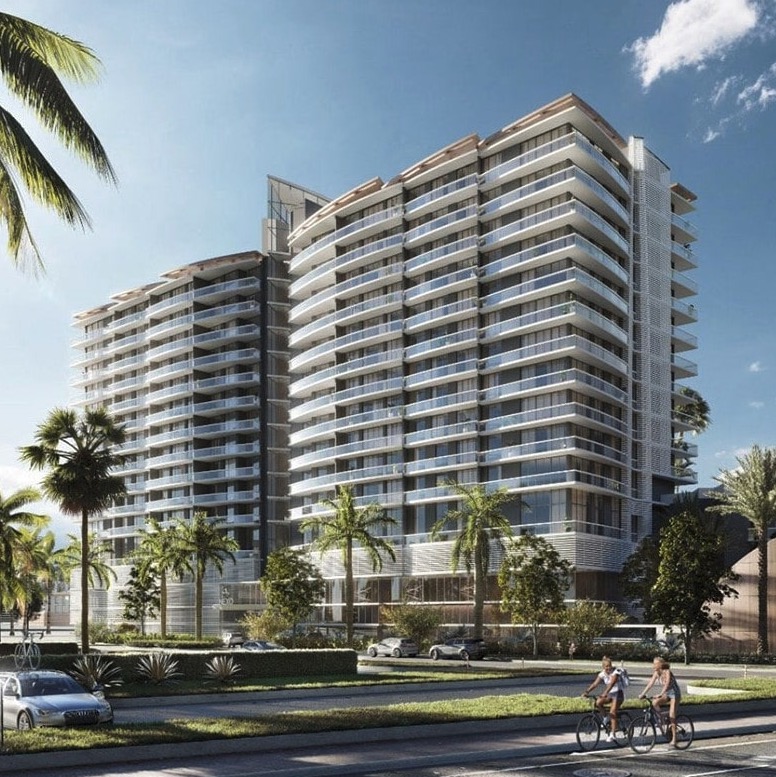
A new 15-story tower is nearing the finish line in North Miami Beach; known as Nexo Residences, the project has received a temporary certificate of occupancy and is preparing to welcome residents. The milestone brings the 254-unit development closer to completion in a part of the city where the surrounding landscape remains largely dominated by single-family homes, strip malls, trailer parks, and low-rise apartment buildings. The TCO, announced recently by the project’s general contractor Kast Construction, allows residents to safely begin moving into the building while crews finish remaining minor construction and site work. For Nexo, the approval marks the latest step in a development process that has taken roughly three years since construction began. Located at 13899 Biscayne Boulevard, Nexo was originally proposed in the early 2020s as a condominium development with flexibility for short-term rentals. Fortune International Group and Blue Road acquired the property for $16 million in 2022 before construction officially began in 2023. Now, the project is largely complete. Floridian Development recently visited the site to document its progress, with photos showing a substantially finished building. The exterior is now complete, including its paint, windows, and balcony glass, giving the tower its finished appearance as residents begin moving closer to occupancy. The remaining work is largely limited to smaller details across the property. Crews have been wrapping up sidewalk and landscaping improvements, interior lobby work, and other finishing touches needed to fully complete the development. “Reaching TCO is a milestone worth celebrating and a reflection of the hard work, coordination and dedication behind the project” according to Kast Construction’s social media team. “Congratulations to our team and all of our partners who helped make it happen.” At buildout, Nexo Residences will contain 254 units across 15 floors, with residences ranging from studios to four-bedroom layouts. The project will also offer a range of amenities designed around resort-style living, including a pool deck, co-working spaces, a rooftop deck, fitness center, outdoor spaces, and other resident amenities. A concealed parking garage will provide 396 spaces to serve the building’s residents and visitors, keeping the majority of the parking away from the street-facing portions of the development. Rising approximately 192 feet, Nexo is also notable for where it sits within North Miami Beach. Despite the city’s broader development boom and growing multifamily pipeline, the immediate surroundings of the project remain relatively low-density. That contrast makes Nexo one of the more prominent structures in its immediate surroundings. As additional developments move through the pipeline, however, the tower could become an early indicator of the larger shift underway across North Miami Beach, where taller residential projects are beginning to emerge alongside the city’s traditionally low-rise landscape.
Construction Advances on Citadel’s Headquarters; Foundation Permits Filed
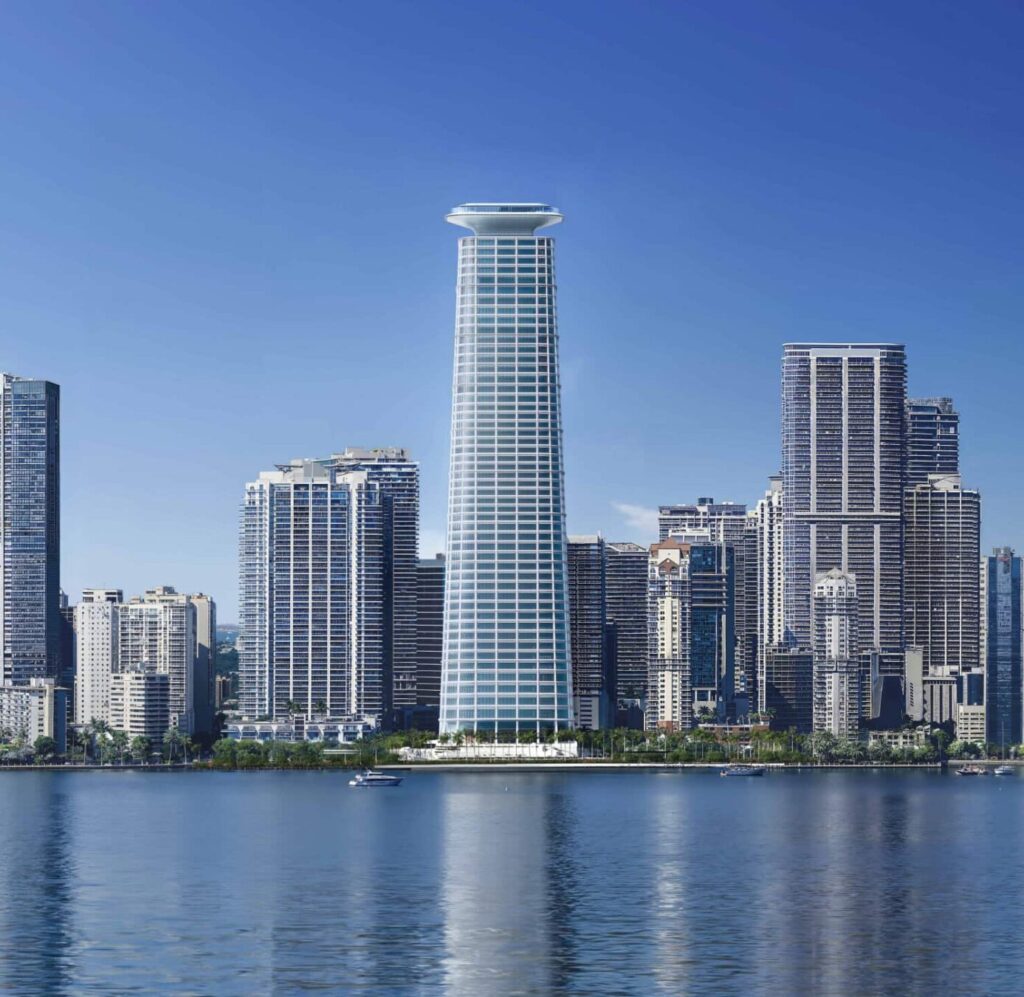
Citadel’s long-awaited Miami headquarters is finally beginning to take shape. After years of planning and multiple redesigns, crews are now advancing toward foundation construction on the $2.5 billion project at 1201 Brickell Bay Drive. Once completed, the tower will rise roughly 954 feet above Brickell Bay Drive and stand as one of Miami’s most prominent office buildings, marking a new chapter for a site that has been years in the making since Citadel purchased it in 2022 for a record-setting $363 million. Permitting Progress According to Miami-Dade County permitting records, a $25 million foundation permit has been filed for the project and remains under review. Additional permits covering site access and a water main have also been submitted, indicating that the development is approaching the next major phase of construction. That filing follows an $11 million soil improvement permit issued for the site earlier this year, under which crews spent the spring performing deep soil mixing to strengthen the ground beneath the future headquarters ahead of the massive structure planned above it. Machinery associated with Keller, the foundation contractor believed to be performing the soil improvement work, has been visible across the property throughout that process. Crews have used large silos and other equipment to supply cement for the deep soil mixing work, gradually hardening the ground across the site. With that phase now progressing toward completion, crews are expected to move into foundation construction, beginning with the installation of the rebar cages that will support the tower, with vertical construction expected to follow later this year. A general contractor for the development has not yet been publicly identified, in part because of the limited information available through Miami-Dade’s permitting records, though that is expected to become clearer as construction advances. From Supertall to Office Tower The project has changed considerably since it was first proposed. It was originally planned as a 1,043-foot supertall skyscraper with a hotel component, but the latest design eliminates the previously planned 212-room hotel entirely, following Citadel founder and CEO Ken Griffin’s continued push to expand the firm’s footprint in Miami. That single change set off a cascade of adjustments to the tower’s height, floor count, and overall program. That expansion has coincided with Griffin’s increasingly visible tension with New York’s business environment. The issue drew renewed attention recently after New York City Mayor Zohran Mamdani proposed a 5% pied-à-terre tax while standing outside Griffin’s $238 million Manhattan penthouse, purchased in 2019. Citadel COO Gerald Beeson pushed back against the moment, arguing that the proposal unfairly singled out Griffin. With the hotel gone, the building lost the height it needed to justify its original scale. Floor count dropped from 63 stories to 52, and the tower’s height fell from 1,043 feet to approximately 954 feet, putting it roughly 30 feet below the 984-foot threshold generally used to define a supertall skyscraper. But the loss of the hotel also freed up room within the tower for a different use. Despite becoming shorter, the headquarters will actually contain more office space than originally planned, with the latest filings calling for approximately 1.642 million square feet of office space, about 150,000 square feet more than the previous proposal. That tradeoff, more office space packed into a shorter tower, explains why the project’s overall footprint still shrank even as its core purpose sharpened. The redesigned headquarters will contain more than 1.71 million square feet of total space, down from the roughly 2.12 million square feet originally proposed. While the tower itself has been scaled back and reoriented, it will continue to include significant public-facing elements along Brickell Bay Drive. Plans call for a baywalk with expanded sidewalks, landscaping, and public art, along with nearly 70,000 square feet of retail space at the lower levels. Near the top of the tower, filings also call for a rooftop pavilion, though its eventual use has not yet been finalized. The Team Related Companies is developing the headquarters, with Foster + Partners leading the architectural design. Field Operations is serving as landscape architect, Kimley-Horn is handling civil engineering, and Adamson Associates Architects is serving as architect of record. No formal completion timeline has been announced, but given the scale and complexity of the project, construction is expected to extend well into the early 2030s once vertical work officially begins.
Related Ross Unveils Plans for Residences at 464 Fern Street, Featuring 194 Units
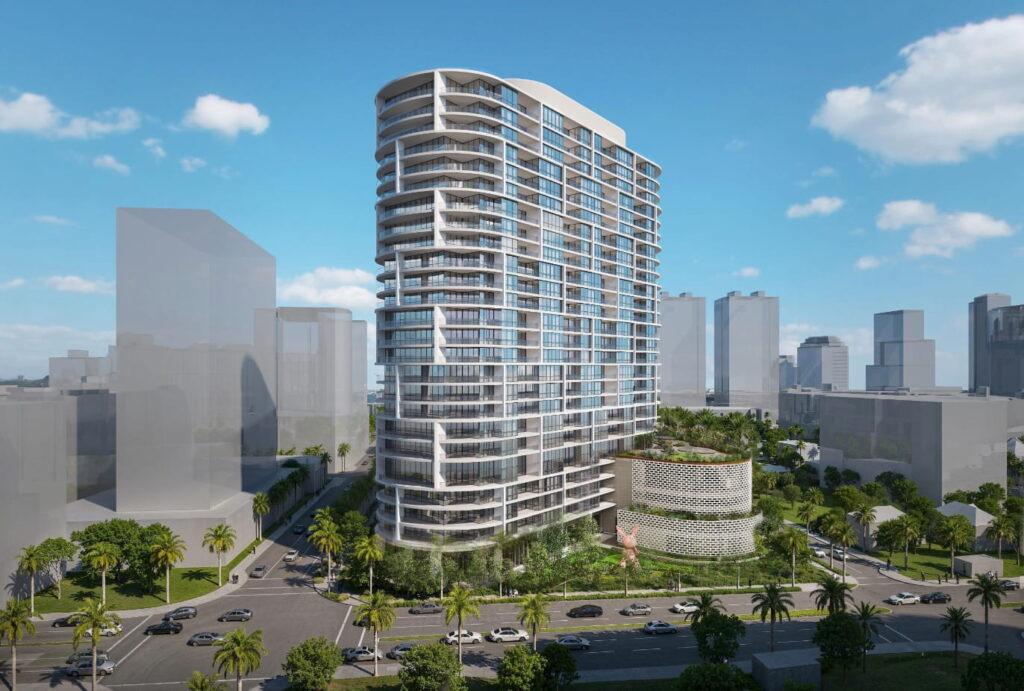
Related Ross’s transformation of West Palm Beach shows no signs of slowing down. The developer has filed plans for the Residences at 464 Fern Street, a 25-story luxury residential tower that would add another major project to the city’s rapidly changing downtown skyline. Designed by Roger Ferris + Partners, the architecture firm behind the now-under-construction Shorecrest condominium, the project would further expand Related Ross’s growing residential presence in West Palm Beach. The project is planned for a 2.64-acre site that Related Ross acquired for $55 million in May, representing a substantial increase from the $17.1 million paid for the property in late 2021. Before Related Ross acquired the site, the nearly full city block had already been through several development proposals, including plans for a high-rise and a later mid-rise project backed by 13th Floor Investments, Wexford Real Estate Investors, and L&L Holding Company. Now, Related Ross is proposing a significantly larger residential development for the property. Submitted to the Plans and Plats Review Committee in mid-June, the project calls for 194 large-scale residences (likely condos). Units would begin at two bedrooms and extend through four-bedroom layouts, positioning the development toward the upper end of West Palm Beach’s increasingly active luxury residential market. A dedicated amenity level on the fifth floor would provide residents with a range of recreational and social spaces, including a lap pool, outdoor bar, landscaped green space, fitness center, game room, and additional amenities. The ground level would combine residential and commercial uses while creating a more active presence along the surrounding streets. Plans call for 4,343 square feet of commercial space, along with a landscaped garden plaza featuring greenery and public art. A dedicated residential drop-off and lobby would also occupy the ground floor, while parking would extend through multiple levels above it. The parking structure would contain 486 spaces, with portions of the garage using mechanical car elevators to allow vehicles to be stacked and increase the property’s parking capacity. The arrangement is likely to receive some scrutiny as the project advances through the city’s review process, particularly because portions of the parking podium along the ground floor currently include non-activated areas where retail or other active uses could otherwise be located. At its tallest point, the tower would rise approximately 316 feet. The architecture is centered around a series of recessed balcony niches, floor-to-ceiling windows, white stucco, and other contemporary elements that give the building a distinctly residential appearance. The design also bears a strong resemblance to the original concept developed for Shorecrest, another Related Ross project designed by Roger Ferris + Partners that is now under construction nearby. The Plans and Plats Review Committee represents only the first major step in the approval process. The proposal will need to appear before several additional boards and ultimately receive a final vote from the West Palm Beach City Commission before construction can begin. Even with those changes ahead, the Residences at 464 Fern Street adds to a development pipeline that has made Related Ross one of the most active developers in West Palm Beach. The company currently has several major projects moving through construction, including Shorecrest, the CityPlace office towers, and South Flagler House.
Sabet Group’s 1600 Edgewater Begins Construction as Miami’s Omni District Enters New Development Boom
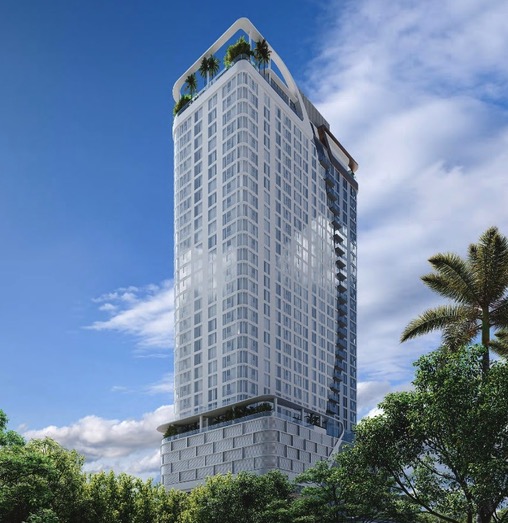
Construction has officially begun on 1600 Edgewater, a 282-unit residential development taking shape in Miami’s Omni District. Photos recently taken by Floridian Development show crews beginning foundation work, marking a major milestone for the project after months of approvals and permitting by developer Sabet Group. Proposed in March 2025, the 33-story tower will join a growing collection of high-rises planned or already rising throughout the Omni District, as developers increasingly look beyond Miami’s most expensive neighborhoods, including Brickell, for opportunities to build at scale. Located at 1600 NE 2nd Avenue, the project occupies a property that only recently cleared its previous structures. Demolition was completed several months ago after Sabet Group acquired the site for $14.3 million in late 2022, setting the stage for the redevelopment of the property. The start of foundation work follows a series of recently approved permits. Site preparation and foundation work have already received approval, for example, while GT McDonald Construction has been identified as the project’s general contractor. A vertical construction permit has also been approved, although the master construction permit remains under review while the developer addresses requested corrections. According to the master permit, the project carries an estimated construction cost exceeding $93 million and will encompass nearly 500,000 square feet of new construction. Activity on the site is now beginning to reflect those approvals. Photos show rebar cages, heavy machinery, and other equipment being used as crews drill into the ground and install reinforced foundation elements that will eventually support the tower as it rises vertically. Considering the project was only proposed around this time last year, reaching the foundation stage this quickly represents a notably short timeline from initial proposal to construction. Part of that speed can be attributed to the project’s residential model. Rather than pursuing for-sale condominiums, 1600 Edgewater will operate as a luxury rental development while incorporating a portion of affordable housing. The 282 residences will be divided into approximately 93% market-rate and 7% affordable units, with 20 apartments reserved for households earning at or below 60% of the Area Median Income. The rental model also avoids the presale requirements and extended sales process often associated with condominium developments. Residences will range from studios to one- and two-bedroom apartments. Residents will have access to a broad range of amenities, including a rooftop pool, rooftop restaurant, outdoor dining areas, and a spacious lobby. A multi-level parking podium will also provide 352 parking spaces, while the development will contain approximately 9,519 square feet of commercial space, including the rooftop restaurant. Although a detailed construction schedule has not yet been announced, completion is currently expected in 2028. The tower will rise 33 floors and approximately 384 feet, placing it among the taller structures in the Omni District once completed. Designed by Kobi Karp, the building will feature floor-to-ceiling windows and a contemporary exterior centered around a black, gray, and white color palette. Extensive exterior lighting will further accentuate the structure, giving the tower a prominent presence within the growing district. 1600 Edgewater is also advancing alongside several other major developments in the surrounding area. Nearby, Sense22, Biscayne 18, and 1775 Biscayne Boulevard have recently entered site preparation phases that include foundation work, adding to a growing wave of construction activity throughout the Omni District. As these projects progress simultaneously, the area is quickly emerging as one of Miami’s next major high-rise construction hubs.
The Aurelian Begins Rising as 161-Unit Rental Project Takes Shape in Coral Gables
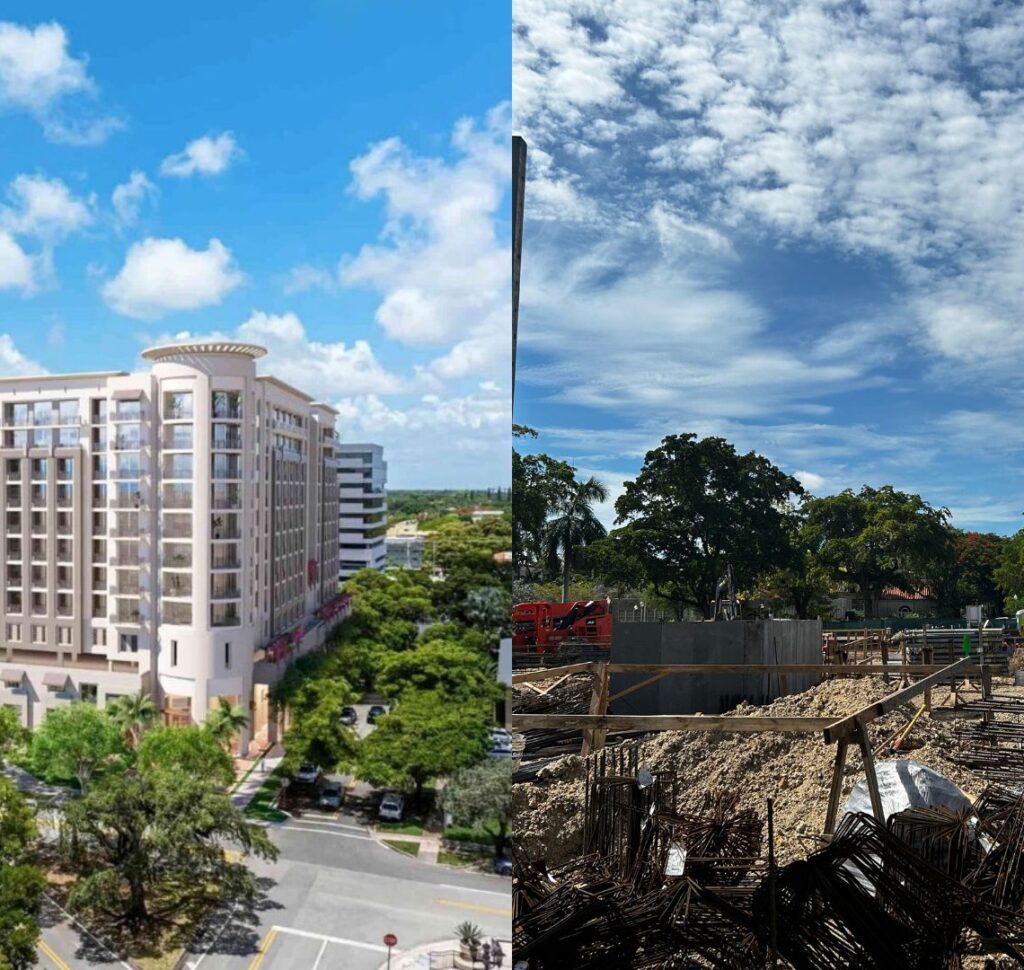
Coral Gables’ multifamily boom continues to gain momentum, as crews have begun vertical construction on The Aurelian, a 12-story rental development planned along East Ponce De Leon Boulevard. The project is being led by European developer Empira Group, which has become increasingly active in the Miami metropolitan area. Once completed, The Aurelian will mark the firm’s third multifamily project under construction in the region and will deliver 161 luxury rental residences. Located at 912 E Ponce De Leon Boulevard, the project occupies a site acquired by Empira Group for $18 million in August 2025. The property came with existing development entitlements, as a nearly identical proposal had previously been submitted and approved for the site in 2018. Known as Regency on the Park, that project ultimately never materialized, allowing Empira Group to move forward with a new vision while potentially avoiding another lengthy entitlement process. Just months after breaking ground, The Aurelian has now entered its vertical construction phase. Photos taken by Floridian Development show the first columns forming the building’s initial floor, with construction already beginning to rise above the foundation. The ground-floor columns are notably taller than those on the residential levels, as they will accommodate the building’s lobby, amenity spaces, and the ramp leading into the multi-level parking podium. A tower crane has also been erected on the property and is expected to be raised as construction progresses toward the building’s eventual topping out. Construction documents submitted to the city indicate that the development will encompass approximately 324,000 square feet of new construction. With completion currently projected for 2028, the project is expected to take roughly two years to build from its recent groundbreaking. The Aurelian will offer one-, two-, and three-bedroom residences, with spacious floor plans planned throughout the building. Residents will have access to 248 parking spaces within the multi-level podium, along with a range of indoor and outdoor amenities. These will include a swimming pool, fitness center, yoga studio, outdoor lounges, and additional resident-focused spaces. Although the ground floor will not include retail, the project will make several improvements to the pedestrian environment surrounding the property. Plans call for a new park along the western side of the site, along with a colonnade, expanded sidewalks, additional landscaping, and other improvements intended to enhance the public realm. The 12-story building is expected to rise approximately 143 feet, based on the entitlements approved for the original 2018 proposal. A crown-like architectural feature will form the highest point of the structure. The design incorporates elements of Coral Gables’ Mediterranean-inspired architectural requirements, with a predominantly beige color palette, balconies, and other details intended to complement the city’s established architectural character. Behar Font designed both iterations of the project, having originally created the design for Regency on the Park in 2018 before returning in 2026 to design the revised Aurelian development for Empira Group.