Plans Filed for a Mixed-Use Mid-Rise at 811 E Las Olas, Featuring Office and Retail Space
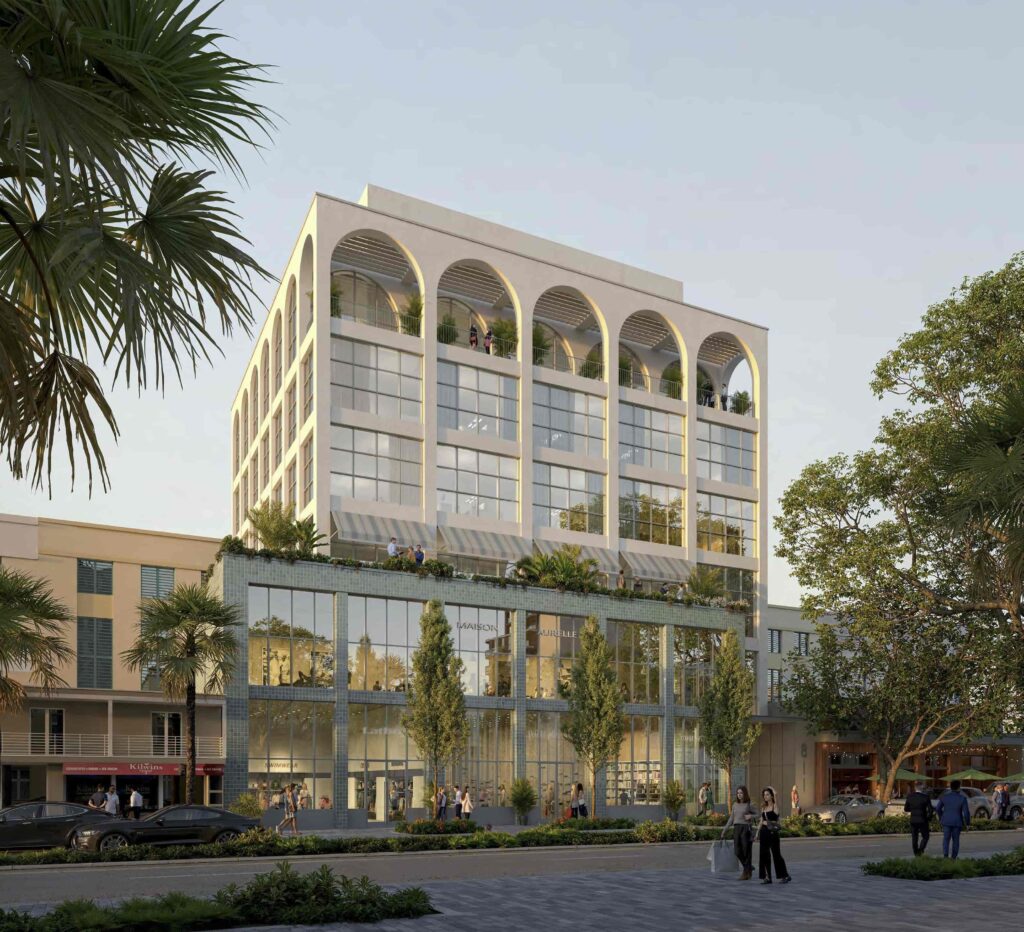
Fort Lauderdale’s iconic Las Olas Boulevard is poised for a major transformation, with new plans submitted to the city for a six-story mixed-use building. The project, led by Coombes Property Group, would replace two existing low-rise retail buildings with a contemporary structure planned with retail and office space. Designed by the acclaimed Morris Adjmi Architects in collaboration with Cube 3, the development is planned for 811 E Las Olas Boulevard on a 0.25-acre site at the heart of the corridor. Called 811 Las Olas and totaling almost 50,000 SF in size, the proposal represents one of the largest new developments currently planned along this strip of Las Olas. Just up the street, The Whitfield is poised to introduce luxury condominiums and multiple hotel rooms to the boulevard. Construction of the development began a while ago, but progress on its vertical ascent is unknown. Coombes Property Group acquired the site assemblage for $2,282,100 in late 2022. The firm maintains deep ties to Australia, where it has developed and owns multiple properties across major cities including Sydney and Brisbane. Plans submitted to the city’s Urban Development Review Board were taken up today. According to public documents, the building will feature a two-story podium with 16,167 SF of retail, divided into two equal storefronts at the ground level and a larger, continuous space on the second floor. Plans for the second floor originally included a terrace for a proposed restaurant, but that feature has since been removed in favor of a continuous glass facade. From floors 3 to 6, the new building will offer 27,256 SF of office space, enhanced by terraces on both the third and sixth floors. The office space will come online just as demand for high-quality workspace in Fort Lauderdale is rising, driven by recent construction in office such as FAT Village. As much of the region’s older office stock becomes less competitive, projects that provide accessible, high-quality space have become higher in demand. According to elevations, the building will measure 103 FT at its highest point. Its exterior finishes will include green glazed tile, a wood-look trellis, storefront glazing, warm white stucco, and aluminum grid-style windows. Uniquely, 811 E Las Olas will include no on-site parking, instead relying on 122 off-site spaces. Although zoning would normally require about 137 spaces, a recently prepared traffic study shows that only 122 are needed during peak operating hours. A construction timeline has not yet been announced. Before work can begin, the developer must demolish the low-rise buildings at 811, 813, and 815 East Las Olas Boulevard, all of which date back to the 1960s.
Canal Park West Tower Begins Construction in North Miami Beach, Set to Deliver New Office Space
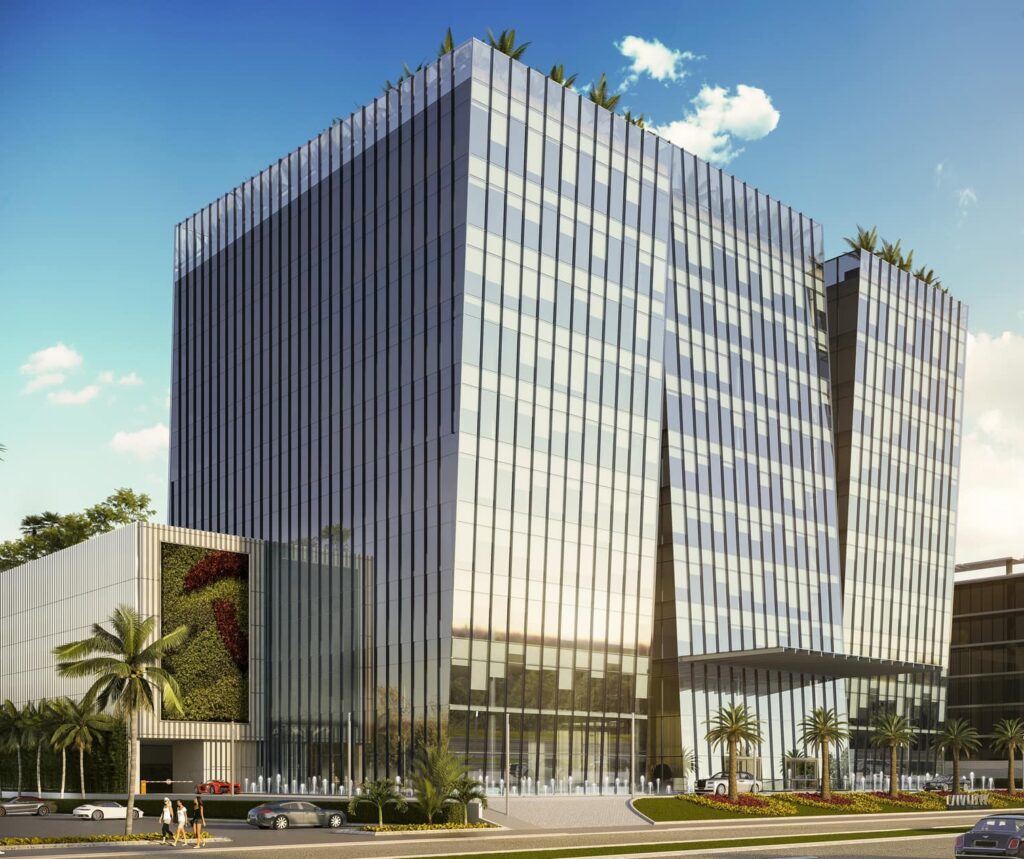
North Miami Beach is preparing to welcome its newest office development with the groundbreaking of Canal Park West, the second phase of a two-building complex along NE 163rd Street. Developed by Namnum Developers, LLC and designed by Idea Architect, the project follows the earlier completion of Canal Park East. With construction now in full swing, foundation work and site preparations are underway as the project begins rising vertically. Situated at 3227 NE 163rd St, Canal Park West will deliver modern office space to a growing commercial corridor. The building sits just steps from Uptown Harbor, Dezer Development’s upcoming mixed-use project featuring residential, office, retail, and hotel space, signaling continued investment in the area. First submitted in early 2021, Canal Park West has remained mainly consistent with the plans previously approved by the North Miami Beach Planning Board. The 10-story office tower will deliver 237,483 SF of modern office space, of which 158,509 SF is leasable area supported by a 714-space parking garage for tenants and visitors. Rising 167 FT, the building will be both taller and wider than its predecessor, Canal Park East, signaling the growing demand for premium office space in South Florida. Designed by Idea Architects with a sleek, modern facade, Canal Park West is set to offer tenants an abundance of amenities. The tower will provide 360-degree views of the surrounding skyline and waterfront from multiple viewpoints. On-site amenities include a fully equipped fitness center with personal training, a pool and tennis courts, a fully stocked juice bar, collaborative workspaces, and a restaurant offering ‘diverse cuisine’. The building is also centrally located, with easy access to nearby restaurants, commercial hubs, airports, and other key destinations. According to Miami-Dade permits, the Canal Park West site (formerly a surface parking lot) was cleared in late 2024 at a reported cost of $115,000. Beauchamp Construction, serving as the general contractor, has since secured multiple permits, including one for the tower’s shell. Beyond routine utility permits, the only remaining major approval is for the building’s site plan. Another viewpoint of the construction site can be found here.
University of Tampa’s New Science Building Moves Forward, With Permits Filed and Approvals Granted
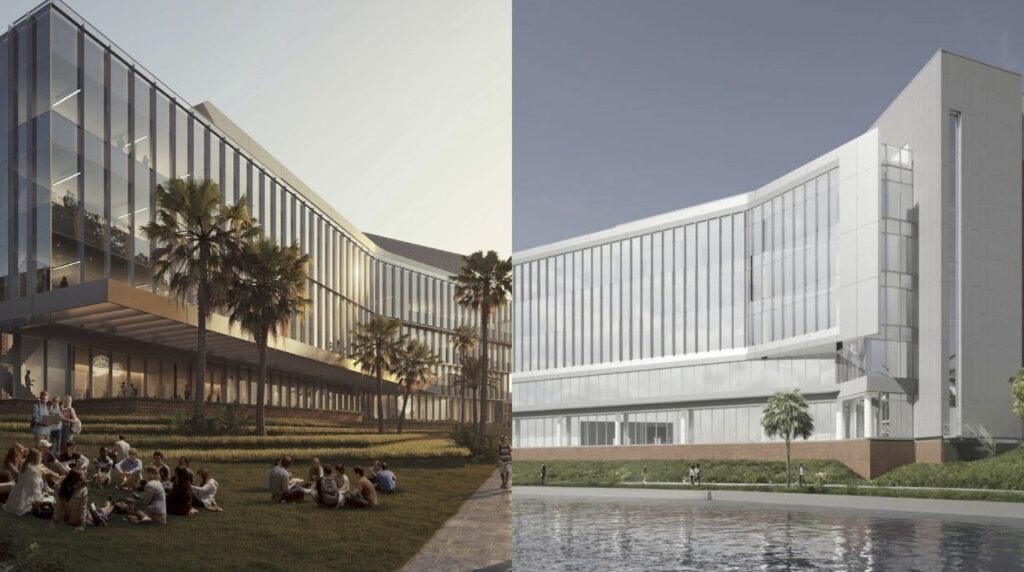
The University of Tampa’s campus is preparing for another major transformation as its next academic building moves steadily toward a groundbreaking. With key building plans approved and new construction permit filings underway, the university is laying the foundation for Project Beta, a six-story facility planned along the Hillsborough River. The project will replace a cluster of aging low-rise structures at 505 UT McNeel Ct with a modern, six-story building designed to support a range of science uses. The new academic building comes at a time when student enrollment at the University of Tampa is at an all-time high, prompting the need for revitalized and expanded academic space. Just last year, the university celebrated the opening of the Grand Center Residence Hall (Project Alpha), a mixed-use complex that introduced new academic areas, student housing, structured parking, and additional campus amenities. Plans for the new science building, known as Project Beta, call for roughly 200,000 gross SF of space, including research labs, collaborative areas, teaching facilities, faculty offices, and other academic functions. The building is being designed to achieve LEED Silver certification, incorporating strategies to promote waste reduction, improved indoor air quality, and enhanced energy efficiency. Because the campus already has sufficient parking, no additional parking is proposed as part of the project. According to elevations provided by Omaha-based HDR Architects, the building will feature a blend of the past and present, with red bricks on the west portion of the side in-line with campus material themes, and glass on the east side. The building will rise 120 FT. According to recently filed permits, Barr & Barr will serve as the project’s general contractor. Multiple permits have been submitted, including a general construction permit covering on-site demolition and new construction, as well as a separate permit for tree removal and pruning. As part of site preparation, several existing structures, including the Morsani Loading Dock, Cass Science Annex Building, McNeal Boathouse, and Communications Annex, will be demolished. Barr & Barr has extensive experience in STEM-related construction, having led numerous facilities nationwide. The new building’s research labs and specialized facilities fall well within the company’s proven expertise, making them qualified to manage the project. Construction of the new building is scheduled to take 18 months, according to Barr & Barr. There is no known groundbreaking date as of now. More images of the building can be found here.
Joint Venture Proposes Atrium Residential, Set to Feature 222 Units in Boca Raton
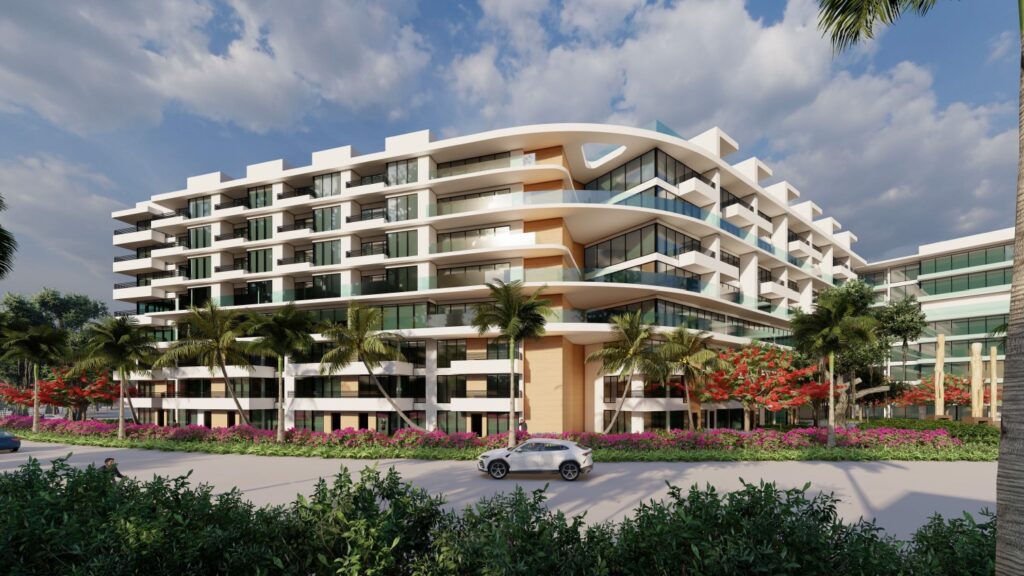
The Meyers Group and Accesso Partners, a South Florida-based joint venture with an extensive development track record in the region, are moving forward with plans to redevelop a site near the Broken Sound Golf Course. Officially titled ‘Atrium Residential,’ though also referred to as ‘The Residences at Broken Sound,’ the project is scheduled for review by the Boca Raton Planning Board tomorrow on November 20th. The proposal includes several requests related to zoning, land-use changes, site plan amendments, and more, which are all subject to different votes. Planned for a surface parking lot next to an existing office building, the project would introduce an eight-story apartment building at 6111 NW Broken Sound Parkway. It will be the first large-scale apartment development in Boca Raton for both Accesso Partners and The Meyers Group, following their $25 million acquisition of the property in 2024 under the entity BRI 1885 Atrium at Boca, LP. Designed by Garcia Stromberg Architecture, this modern residential building will include 222 units, with 12 designated as workforce housing and 23 as affordable units. This inclusion complies with Boca Raton code, which requires developers to provide a minimum number of affordable or workforce units to qualify for higher density in certain zoning districts. These units are subject to a 30-year affordability covenant, securing affordability long-term. The building’s 222 units will consist of 1 efficiency unit, 73 one-bedroom units, 109 two-bedroom units, and 39 three-bedroom units. Unit sizes will range from 528 SF for the smallest unit to 2,622 SF for the largest, with an average of 1,097 SF. All residents, regardless of income designation, will have access to amenities such as a clubhouse, resident lounge, gym/fitness center, lobby and mailroom, swimming pool, and other common areas. On the ground floor, the development will feature walk-up units, open space, 2,015 SF of retail space, amenity space, lobby space, and the beginning level of a four-story podium. This podium will include 325 parking spaces and 18 bicycle parking spaces. Parking will also be available in a surface parking lot and garage for the next-door office building, bringing the masterplan’s total to 622 parking spaces, well beyond the required 537 spaces. Elevations provided by the project’s architect, Garcia Stromberg, showcases Atrium Residences rising 80 FT, or 8 floors. The facade will be composed of glass balconies, white stucco finishes, impact resistant windows, and other modern finishes. The board is set to review five resolutions, including the rezoning of 0.90 acres from Recreation to Light Industrial Research Park, an amendment to the Future Land Use Map from Recreation/Open Space to Planned Mobility, a site plan amendment for the construction of an eight-story structure, and other items such as plat reconfigurations. Developments like Atrium Residences are becoming increasingly common in Boca Raton, where developers are eyeing office parks or industrial land for multifamily development, either through rezonings or the Live Local Act. Just a few months ago, Floridian Development reported on the proposed redevelopment of portions of the Amtec Center office park. Developers Beztak and Wexford are planning an eight-story multifamily building.
Miami-Dade to Review Citadel’s Supertall Global Headquarters, First Permit Filed

Ken Griffin’s proposed supertall headquarters for Citadel Securities is officially advancing in Brickell. After three rounds of design revisions, the most recent submitted just two months ago, the project is now moving into the approval phase in Miami-Dade County. It marks the latest step in a headquarters relocation effort that began when Citadel announced its move from Chicago to Miami. Although the firm once targeted a mid-2025 groundbreaking, rising costs and other logistical challenges have pushed that timeline back. Still, Citadel remains fully committed to the project. On November 20th, Miami’s BCC Comprehensive Development Master Plan & Zoning Committee will review plans for Citadel’s new ‘Class A, state-of-the-art, mixed-use office and hotel tower.’ The committee will also consider proposed maintenance and improvements to the existing office building at 1221 Brickell Avenue, along with the redevelopment of a parking garage designed to serve both the new and existing towers. The new headquarters will feature 1,485,174 SF of office space and 212 hotel rooms, complemented by amenities including a pool deck, dining and beverage venues, a fitness club, retail, and more. At the base of the tower, 50 executive parking spaces will be provided, with an additional 1,420 spaces available in the redeveloped parking garage nearby. As part of the latest submission, the tower’s crown has entered its newest design iteration under the supervision of the project’s architect, Foster + Partners. Earlier versions featured a relatively flat crown, which later evolved into a more open, fanned form. In the most recent redesign, the floorplates extend to cover much of the previously exposed crown base, signaling a shift back toward the earlier profile. The tower is planned to rise 58 floors, though recent elevations suggest it could exceed 60 floors, reaching approximately 1,043 FT. This height, mix of uses, and other features of the development is only possible through Citadel going through the County’s Rapid Transit Zone, designed to encourage higher intensity, mixed-use, transit-orientated development. 1201 Brickell Bay Drive, 1221 Brickell Avenue, and 1250-1260 Brickell Bay Drive were all added to the RTZ in 2022 and 2023. Beyond design updates, Citadel has also submitted its first permit since 2022, which includes the planned removal of existing trees on-site in preparation for groundbreaking. In addition, Floridian Development recently reported that multiple tower cranes have been approved for installation on-site. In total, three cranes will rise to heights of 1,298 FT, 1,298 FT, and 1,297 FT, respectively. Miami-Dade staff has recommended approval of Citadel’s master plan, albeit with several conditions, including coordination with the county’s Aviation Department, Office of Historic Preservation, and other relevant agencies. Citadel is requesting approval of the development under the County’s RTZ, as well as building closer to Biscayne Bay than code allows. If approved, Citadel has committed to several upgrades to Brickell’s surrounding infrastructure, including a $3 million contribution for maintenance, repairs, and improvements at the Financial District Metromover Station. Additionally, the project includes over $10 million in planned stormwater and pedestrian improvements throughout the area.
University of Miami Unveils Gables Village: Set to Replace the Dated Mahoney-Pearson Dorm Complex
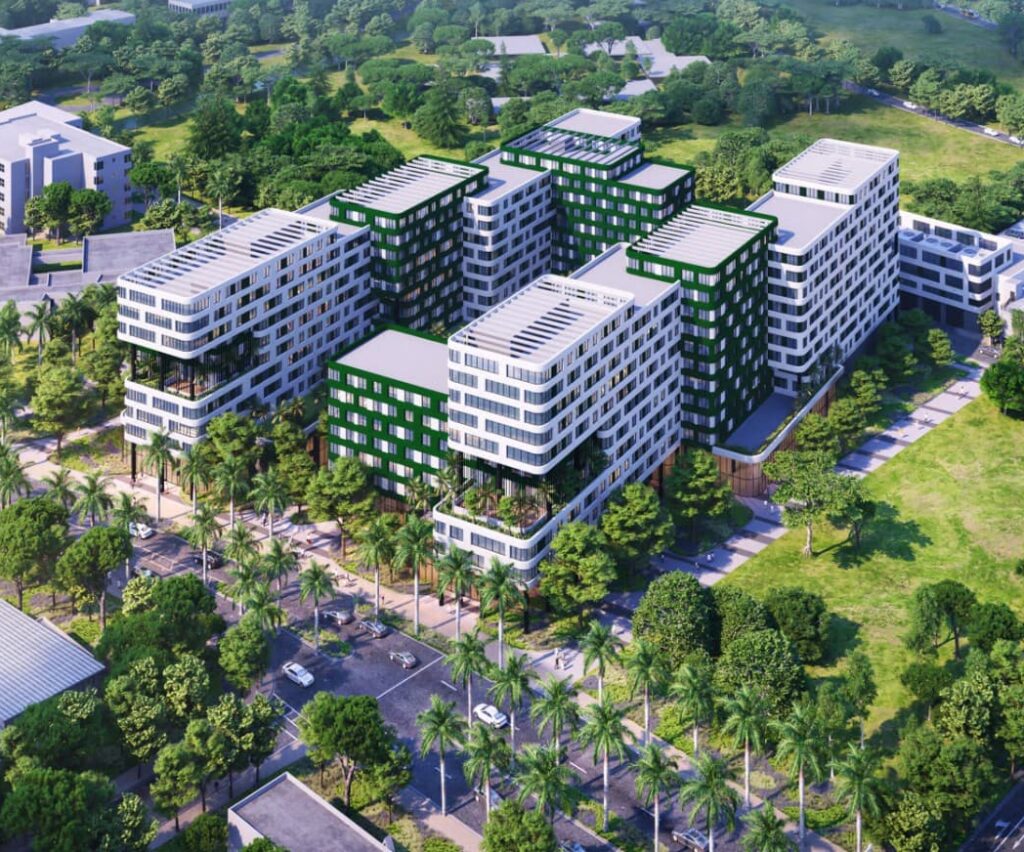
The University of Miami is preparing to completely redevelop the aging Mahoney-Pearson dorm complex, replacing it with Gables Village, a new residential district now under review by the City of Coral Gables. The project serves as the third and final phase of UM’s long-term Housing Facilities Strategic Plan, ending a multi-year effort to modernize student housing on-campus. Just a few months ago, campus officials celebrated the opening of the first phase of Centennial Village and are now nearing completion of the second. The new dormitory complex will comprise of two multi-story buildings designed by Arquitectonica, located at 1201 Stanford Drive and 1101 Stanford Drive. In total, the development will span 573,804 gross SF and introduce more than 1,000 beds, a new dining hall, and a range of amenities for incoming students. According to the University, the project is intended to provide “modern, sustainable housing that enhances the student experience for years to come.” The first residential building will rise nine stories and include 222 units, providing space for 735 beds. Units will not be limited to shared rooms; instead, the building will offer a mix of double suites, single suites, and single rooms. The second building, slightly taller at ten stories, will contain 207 units with a total of 723 beds, featuring the same unit types. Across the entire complex, single suites represent the most common room type. While the two towers are physically separate structures, they are unified through a pedestrian-oriented design featuring landscaped walkways and interconnected green spaces that link both buildings. Residents will have access to a variety of amenities, including great rooms and event space, package rooms, a 24,046 SF dining and kitchen facility with seating for 700, and multiple classrooms located on the ground floor. In addition, each floor will have access to ample natural light, along with access to amenities like viewing rooms, shared kitchens, lounge areas, study rooms, and both collective and private shower rooms, among other features. As part of the Gables Village redevelopment, the existing Mahoney-Pearson Dining Hall is slated for demolition to make way for the aforementioned new 700-seat dining facility. This replacement is both modern and updated to be closer to residents. According to elevations provided by Arquitectonica, the official architect of the project, Gables Village will feature a smooth facade complimented by large glass windows, accented in a palette of dark and light green tones alongside white. Unlike many modern apartments in Miami, the design does not include balconies. The first tower is planned to rise 118 FT, while the slightly taller second tower will reach 128 FT. In addition to the new residential towers, the University will construct a Central Energy Plant adjacent to the existing Mahoney-Pearson Garage. The 8,450 SF plant will house essential infrastructure while also featuring infrastructure space at around 10,720 SF. The Mahoney-Pearson Garage will continue to serve both residents and commuters, with its entrance relocated to the south side for access at Ponce de Leon Boulevard. Together, the energy plant and existing garage will strengthen campus infrastructure and accessibility, while supporting the functionality and sustainability of the new Gables Village complex. The Gables Village project is scheduled for review by Coral Gables’ Development Review Committee on November 21st. If the proposal is approved, campus officials are planning to begin construction in summer 2026, with the residential towers and new Central Energy Plant expected to be completed by mid-2029.
Plans Submitted to Miami’s UDRB for 805 Flagler, Featuring 354 Units in Little Havana
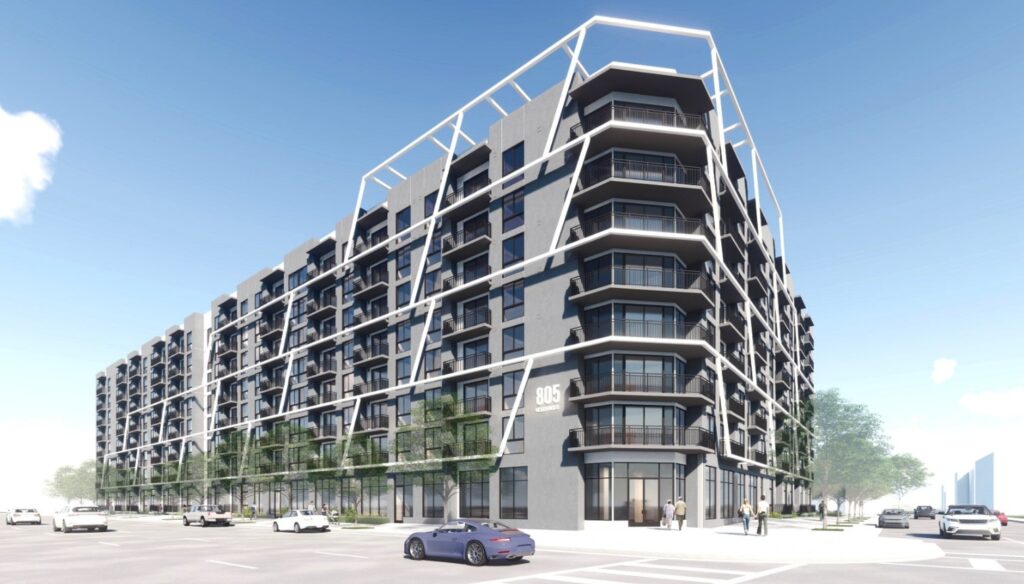
A joint venture between Brookstone Partners and the Cornerstone Group is moving forward with plans for an eight-story mixed-use development at 805 West Flagler Street, bringing a long-anticipated grocery store/pharmacy to one of Miami’s most underserved corridors. Filed under Brookstone 805 Flagler LLC, the proposal spans 14 parcels totaling roughly 103,000 SF. The developers acquired the largely vacant property for $15.8 million months ago and are now seeking approval from Miami’s Urban Development Review Board to move forward. According to recently released plans, the proposed development will span nearly an entire city block. A representative for the project described it as providing ‘infill density, reversing urban sprawl, and introducing a neighborhood-serving grocer and pharmacy with property access on three frontages.’ Designed by Corwil Architects, the building will feature a total of 354 residential units. Unit sizes will range from studios averaging 514 SF, one-bedrooms averaging 737 SF, and two-bedrooms averaging 1,081 SF. The project will also include 526 parking spaces in total, with 25 on-street spaces and 500 within a parking garage, ensuring at least one space per resident along with dedicated visitor parking. Among other amenities, there will be multiple courtyards fit with water features and seating, as well as a pool, BBQ area, and various other amenities including 8,035 SF solely for shared space on the 8th floor. On the ground floor, plans call for widened sidewalks and enhanced landscaping to improve the pedestrian experience. While early plans by the developer highlighted a potential 22,000 SF lease for an Aldi grocery store, that deal appears to have fallen through. The current plans instead show a 5,460 SF corner retail space, roughly the same in size to a typical Walgreens or CVS. From the base to the roof, the building will reach 97 FT. Corwil Architects notes that the exterior will combine aluminum balcony railings, gray-toned stucco, cement plaster finishes, and other carefully selected materials. The parking garage, often visible in modern Miami apartment buildings, is fully concealed by lined residential units. According to the architect: “The building’s structured parking podium is carefully designed to integrate seamlessly into the urban fabric. Rather than exposing parking to the street, the podium is fully lined with active residential units on all street-facing elevations. This design strategy transforms what is traditionally a service element into a vibrant, livable edge, ensuring the building maintains consistent activation at the pedestrian level”. Prior to seeking Urban Development Review Board approval, the joint venture secured key city approvals to move forward. In 2024, the City Commission amended the Future Land Use Map (FLUM) of the assemblage from “Medium Density Restricted Commercial” to “Restricted Commercial,”. The City Commission also updated the zoning for a portion of the property, changing it from T5-O to T6-8-O. As a result, current zoning supports a more mixed-use, dense development. If the developer was unable to secure standard zoning approval, Miami-Dade and the state offer alternatives. One option includes submitting the project under the county’s more flexible rules, while another route involves pursuing provisions under Florida’s Live Local Act, which encourages the inclusion of workforce housing within new developments. An Urban Development Review Board (UDRB) meeting scheduled for November 19th will evaluate the project’s design. While the board’s recommendation is advisory and not required for the project to move forward, developers often incorporate feedback or design adjustments suggested during the review process. Importantly, 805 Flagler will be the sole item on the UDRB’s November agenda.
Joint Venture Unveils 30-Story Tower at 1725 JFK Causeway, North Bay Village
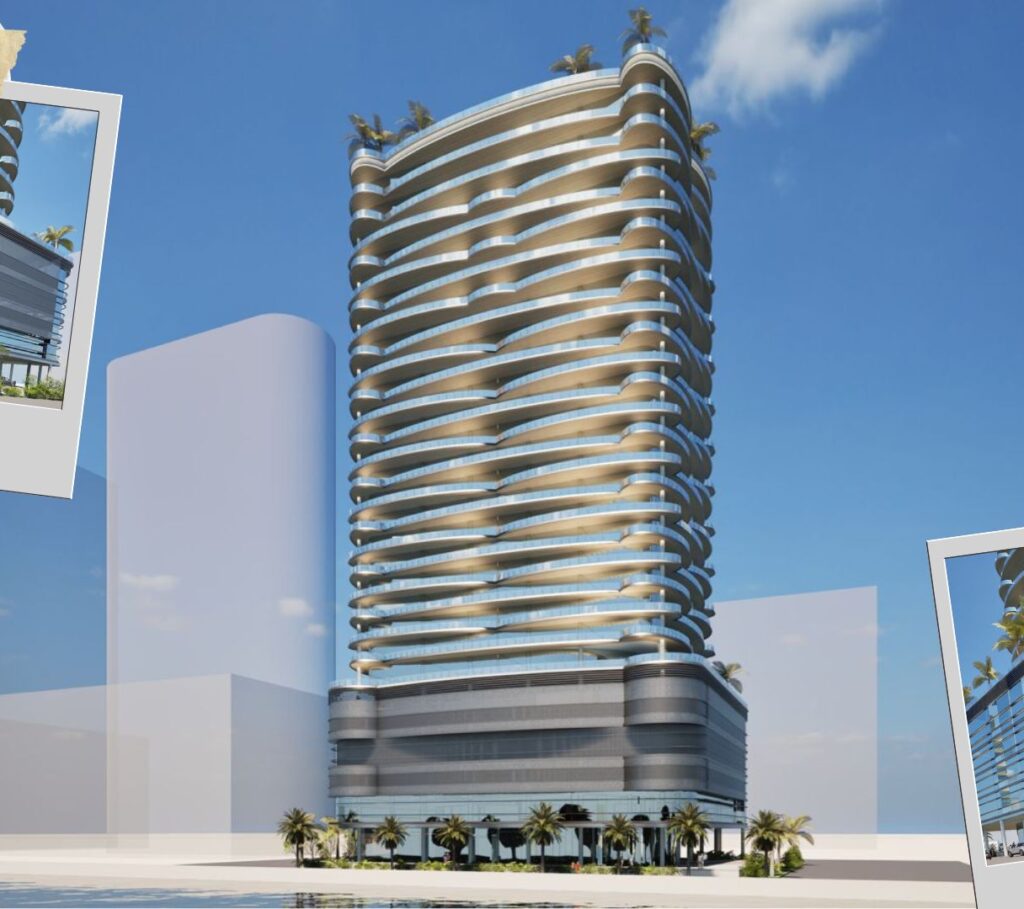
A South Florida-based joint venture, composed of MG Developer and The Prosper Group, has submitted plans to Miami-Dade County for a luxury high-rise in North Bay Village. Located at 1681 and 1725 JFK Causeway, the project is proposed on a prime 1-acre waterfront site overlooking Biscayne Bay. The joint venture acquired the two parcels for $30.9 million last year, revealing plans for a groundbreaking 2027 and a completion in 2029. The project joins a growing lineup of high-rise developments along JFK Causeway in North Bay Village, where Continuum is planning a two-tower district to the east and Sunbeam Properties is advancing a large-scale mixed-use district to the west. Designed by Revuelta Architecture International, the 30-story modern tower is set to include 147 residential units and 12 guest rooms. According to a Graham Penn, an attorney representing the project, ‘all units within the building are large, family-orientated spaces, with the smallest unit size being approximately 1,027 square feet in size.’ Split between 21 one-bedroom units, 31 two-bedroom units, 74 three-bedroom units, and 2 four-bedroom units, almost every unit will have direct access to views of Biscayne Bay. Beyond its residential offerings, 1725 JFK Causeway will include amenity spaces planned across the ground floor, level six, and the rooftop, totaling several thousand square feet. In total, six pools are planned throughout the building, four reserved for private residences and two for shared common areas. Final programming and layouts for these spaces have yet to be confirmed. Each residence will also be allocated at least one parking space, for a total of 272 spaces within the parking podium. To enhance the building’s streetscape and conceal the structure from public view, the podium will be lined with residential units along its perimeter. Plans also include 3,308 SF of ground-floor commercial space and 6,433 SF of office space. Set to rise 390 FT, the 30-story tower will feature materials such as perforated metal panels along the podium, impact-resistant glass, and glass balconies. Unlike most developments in South Florida, the project stands out for its exceptionally high glass-to-stucco ratio. In fact, if plans remain unchanged, the building will include almost no stucco at all, offering residents expansive, unobstructed views. Because the joint venture submitted the project under Miami-Dade County, it is subject to a Shoreline Development Review, which applies to properties along Biscayne Bay. The review aims to preserve public views and access to the Bay by prioritizing pedestrian connectivity, water-related activities, and open view corridors. To meet these requirements, MG Developer and the Prosper Group plan to include a public waterfront walkway, known as the Island Walk, running along the edge of the property, which will eventually link with adjacent segments to create one of the longest continuous public walkways in North Bay Village. The project also maintains a 20% view corridor along the west side of the site. However, due to the property’s strict setback requirements, fully complying with shoreline requirements would make the site undevelopable, according to the project’s representative. As a result, the developer is requesting an exception to certain setback regulations. While The Prosper Group and MG Developer continue planning for this project, both firms have been expanding their work beyond North Bay Village. Earlier this year, The Prosper Group submitted plans for one of the tallest proposed developments in Brickell, located at 1040 S. Miami Avenue, which is currently under review. The firm is also involved in a joint venture for Ora Hotel and Residences in Tampa, where sales have reportedly been strong.
The Fletcher District Gains Approval from the Florida Board of Governors, Set to Break Ground in Early 2026
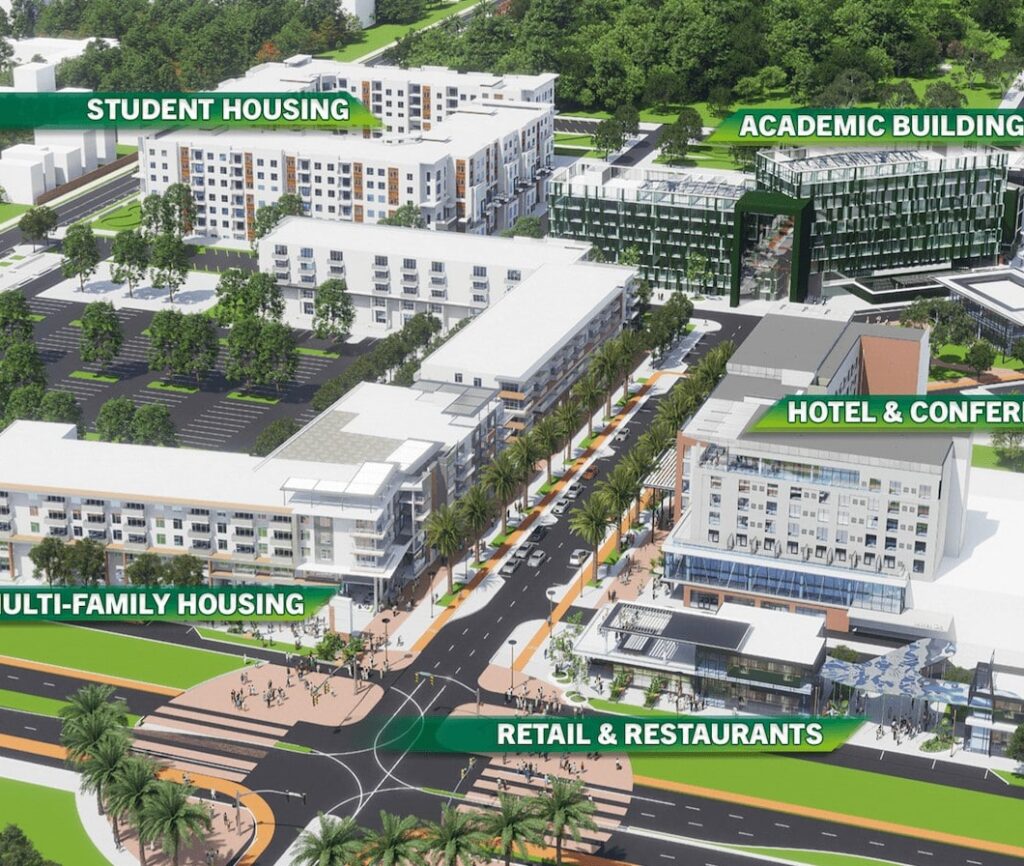
The University of South Florida has reached a major milestone in advancing its long-anticipated “Fletcher District”, a mixed-use neighborhood set to replace the former golf course known as The Claw. On November 6th, the Florida Board of Governors, which oversees the state’s public universities, voted to approve the project’s first phase. The development will transform the defunct golf course, which closed in 2023 at the corner of Fletcher Avenue and North 46th Street, into a vibrant district featuring student housing, multifamily residences, a hotel, retail space, and public amenities. Plans have been steadily progressing, with the USF Board of Trustees granting its approval on September 9th and construction expected to begin in spring 2026. Phase one will span 27 acres of the former Claw golf course’s 138-acre site. The plan includes 150 cottages, 350,000 SF of research space, 5,000 SF of conference space, a 150-room hotel, 60,000 SF of retail, 700 student beds, and 150 market-rate housing units. The development will also include over 1,000 parking spaces to support both academic and leisure uses within the district. For students seeking housing close to campus, 400 of the 700 planned beds will consist of one-, two-, and four-bedroom units, each featuring a one-to-one bedroom-to-bathroom ratio, addressing strong demand for more private student housing at USF. The 150 multifamily units will also serve university employees, faculty, graduate students, alumni, and community members, with a portion also available to the general public. According to the USF Oracle, the university is expected to generate over $509 million in profit from rent over the 40-year lease term, both from multi-family and student housing. You can find financing documents, the project’s summary, and more from yesterday’s meeting archive here. The Fletcher District will be developed through a public-private partnership between the University of South Florida and ACE Fletcher, LLC, whose members include Capstone Development Partners, Capstone Communities, Aureate Development, and Ellison Development. Under this agreement, USF will create separate ground subleases for each parcel, lasting between 40 and 99 years. The development team will design, build, finance, operate, and maintain their respective parts of the project, retain ownership during the lease, and fund their share of infrastructure and maintenance expenses. After the lease term ends, ownership of all facilities will revert to USF as required by Florida law. This means the first phase of the project, estimated at $268 million, will be funded mostly by the development team through private financing. USF’s direct financial role will be limited to constructing its own academic building and contributing to parts of the shared district infrastructure. When plans were first discussed to redevelop the golf course known as The Claw at USF, initial proposals had included parcels within the adjacent USF Forest Preserve. This sparked controversy among students and faculty, ranging from Indigenous heritage sites to critical habitat for native wildlife. After protests and study, the university clarified its intention. In a recently published FAQ the University of South Florida stated: “No. The Fletcher District is being developed entirely within the footprint of the former golf course, which was previously developed.” Instead, the adjacent USF Forest Preserve will continue to serve as a site for research, fieldwork, and educational use. The university has confirmed that there are no plans in the foreseeable future to alter or develop the preserve.
36-Story Atlantic Square Reaches Completion, Adding Mixed-Income Housing to Overtown
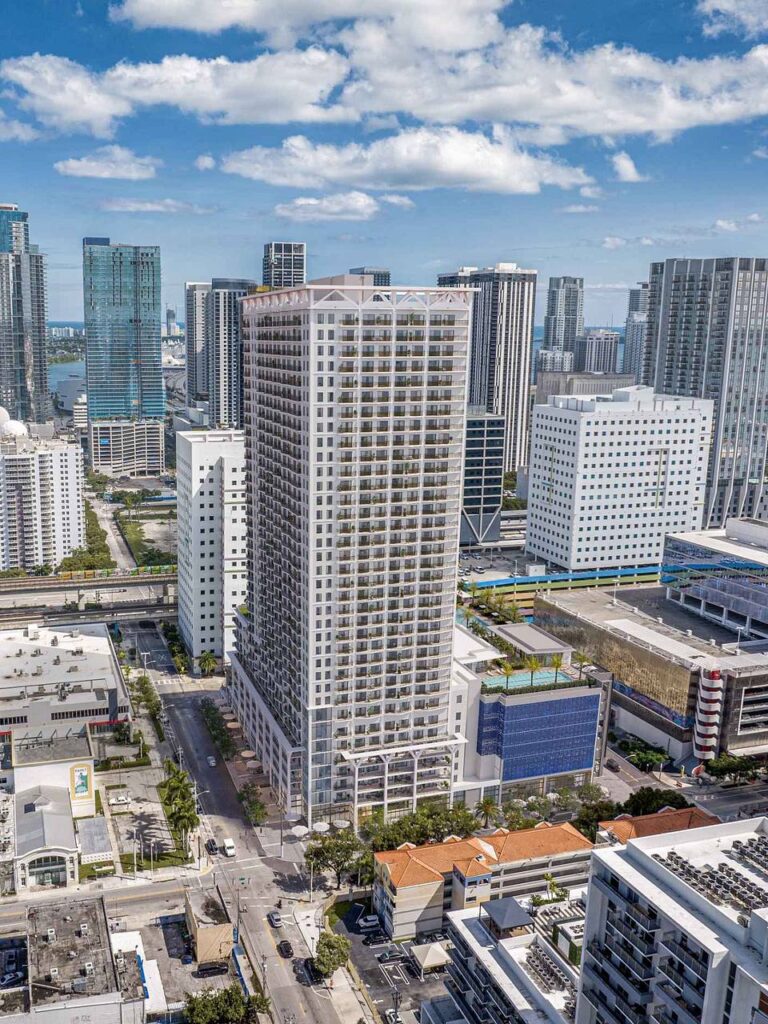
A major addition to Miami’s Overtown neighborhood has officially reached completion, marking a milestone in the community’s ongoing transformation. Rising 36 stories, Atlantic Square introduces new housing and amenities as part of the county and city’s larger effort to spur mixed-income growth and renewed economic investment in the neighborhood: bridging Overtown and Downtown Miami. Developed by Atlantic Pacific Communities and designed by Corwil Architects, the 391 FT tall tower has 616 residential units, with roughly 60% reserved as affordable and workforce housing and the remainder offered at market rate. The building replaces what was once a county-owned parking lot, transforming it into a dense, transit-oriented community in one of Miami-Dade’s most connected areas. According to the most recently submitted plans to the county, subject to minor revisions, the development includes 24,865 SF of ground-floor commercial space designed to activate the streetscape and promote walkability throughout the neighborhood. It will also provide 625 parking spaces, including 21 on-street spots, accommodating both residents and retail patrons. Atlantic Square offers a range of floor plans, from studios to one-, two-, and three-bedroom layouts. Alongside units are amenities such as pools, coworking and lounge areas, and outdoor recreation spaces including a dog park and landscaped terraces. The project also sits adjacent to key transit lines, with easy access to Metrorail, Metrobus, and Brightline. According to a quote provided by NBC6 South Florida, the county’s Director of Transportation notes, ‘We want residents here to be connected—to jobs, to schools, to opportunity—without having to rely on a car’, ‘This is the kind of project that sets a new standard for smart, equitable urban development.’ Following several years of planning, design, and construction, Atlantic Square has officially reached completion in late 2025. The project underwent multiple design changes throughout its lifetime, including updates to the parking podium. The final design features a striking blue metal facade designed by artist Marielle Plaisir, who described the work as ‘cut from aluminum with waterjet precision and bathed in my signature blue’, marking ‘a powerful new chapter in my public art journey.’ While Atlantic Square has completed construction, momentum in Overtown continues to build. Several developers are now setting their sights on the neighborhood’s next wave of projects. Most recently, Floridian Development reported on plans for Overtown’s tallest tower yet: a 55-story residential high-rise at 1210 NW 2nd Avenue, with at least 40 percent of its units designated as workforce housing under Florida’s Live Local Act.