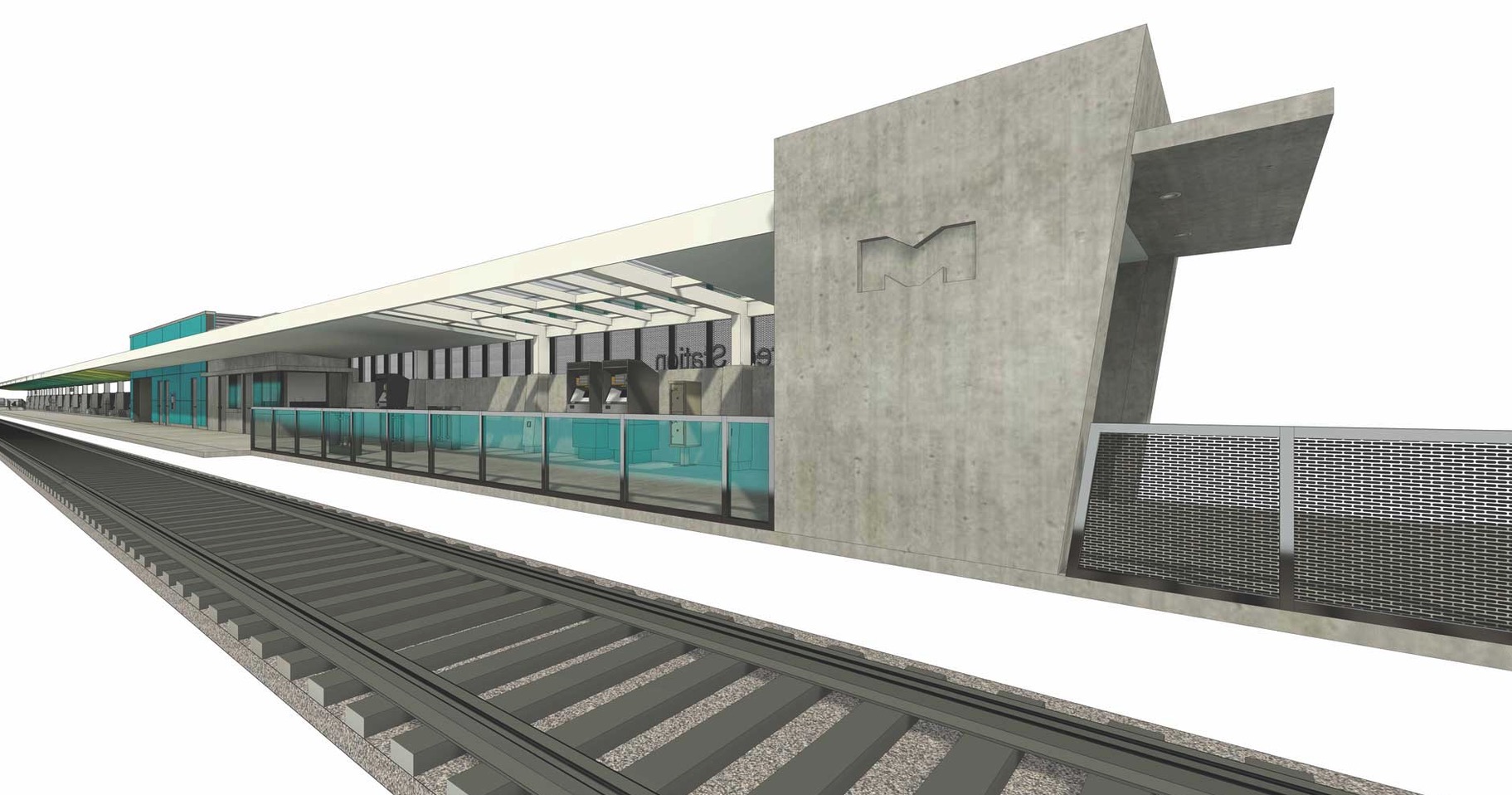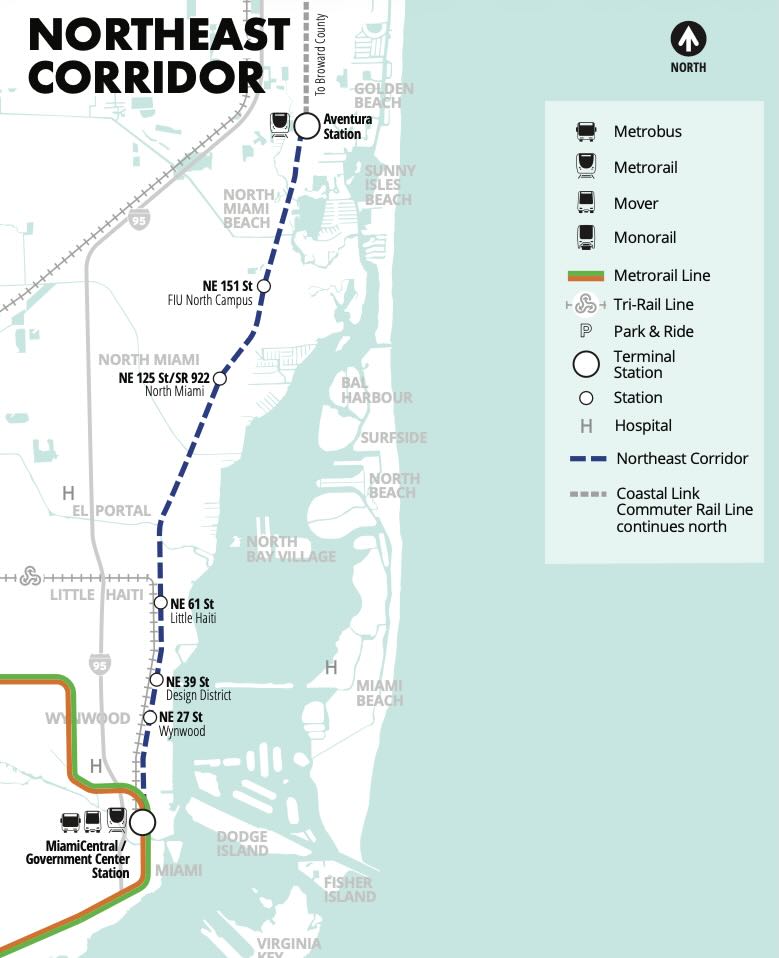
For more than two decades, Miami has been promised commuter rail service along its northeastern corridor. The project, known as the Northeast Corridor or Coastal Link, would bring new stations to neighborhoods such as Wynwood and North Miami. Trains would run on the existing Florida East Coast Railway corridor, which Brightline already uses and shares with a freight railroad. Years of delays and disputes have delayed the project, however, and its latest setback fits the pattern: in 2025, $200 million in state money was stripped from the budget.
That loss was a serious blow to the project’s progress because of how its financing is structured. The extension carries a price tag of $927.3 million. Federal dollars would cover roughly $389 million, a little over 40 percent of the total, while Miami-Dade County would contribute $337.9 million. The state was expected to supply the remainder, which is almost exactly the sum that was cut.
The state has since put that money back, according to Transit Alliance Miami, which says the reinstatement happened with little public notice. The timing is notable. Carnegie Mellon University recently announced a new campus in Wynwood, backed by billions from hedge fund founder and philanthropist Ken Griffin, and the scale of that investment, combined with sustained lobbying from Miami politicians and business owners, may have helped revive the rail funding.
The restored money has not settled the larger question of whether the deal itself is sound, though. Miami-Dade Mayor Daniella Levine Cava has been a persistent skeptic, describing the risks of partnering with Brightline as ‘risky’ and pressing for changes to the terms.
Those concerns have gained substance from a September analysis commissioned by her administration, according to recent reporting by the Miami Herald. Under Deputy Mayor Roy Coley, the county hired Newmark, a real estate and advisory firm, to review the most recent draft agreement. The firm’s findings raised several concerns.
Most prominent among them was the instability surrounding Brightline itself. The company is working through a bankruptcy and restructuring, a process that could slow the project and has already required short-term extensions on debt payments. Newmark also pointed to an ongoing feud between Brightline and a freight operator that shares the same tracks, a conflict it said would have to be resolved before Coastal Link could move forward. Beyond those external hazards, the firm faulted the draft’s structure, arguing that it leaves the county exposed to cost overruns and other burdens that a private partner would ordinarily absorb on a project of this kind.
Brightline has not welcomed the detour. With its own finances under pressure, the company is eager to lock in an agreement, and it has framed the county’s hesitation as the last obstacle. In a statement, Brightline called the project “at the finish line” and argued that it offers more value per county dollar than anything else in the SMART Plan, adding that it needs county leadership to close the deal.
If these final hurdles are cleared, the Northeast Corridor would be one of the few transit proposals in Miami-Dade to move from planning into reality. Over the years, the county has floated numerous improvements, including multiple Metrorail extensions, but few have ever broken ground. Coastal Link would not be a Metrorail extension, since it would share existing tracks rather than run on its own dedicated line. Even so, it would offer the northeast neighborhoods of the county a rail connection it has never had, and for commuters in that corridor the practical benefits would be substantial.